|
시장보고서
상품코드
2121285
SECaaS : 시장 점유율 분석, 업계 동향과 통계, 성장 예측(2026-2031년)SECaaS - Market Share Analysis, Industry Trends & Statistics, Growth Forecasts (2026 - 2031) |
||||||
 Mordor Intelligence
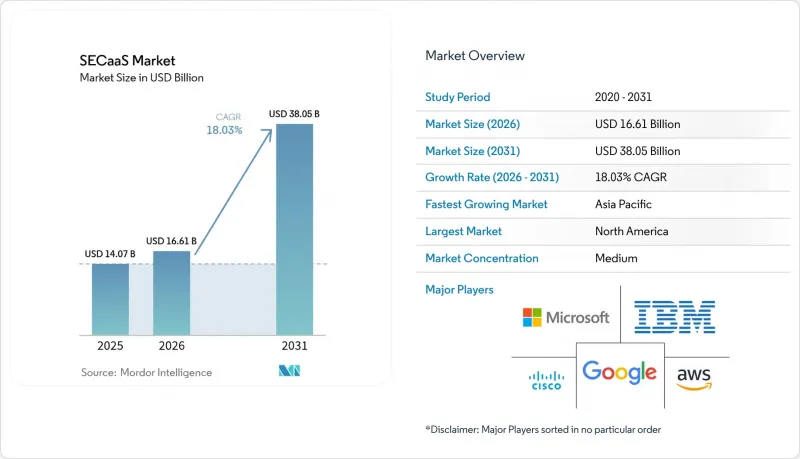
Mordor Intelligence에 따르면 SECaaS(Security-as-a-Service) 시장 규모는 2025년에 140억 7,000만 달러로 평가되며, 2026년 166억 1,000만 달러에서 2031년까지 380억 5,000만 달러에 달할 것으로 예측되며, 예측 기간(2026-2031년) 동안 CAGR은 18.03%가 될 전망입니다.
본 보고서는 솔루션별(ID·액세스 관리(IAM), 보안 이메일 게이트웨이, 기타), 전개 모델별(퍼블릭 클라우드, 프라이빗 클라우드, 하이브리드 클라우드), 조직 규모별(대기업, 중소기업(SME)), 최종사용자 산업별(BFSI, IT·통신, 헬스케어·생명과학, 기타), 지역별로 분류되어 있습니다. 시장 예측은 금액(달러) 기준으로 제시되어 있습니다.
세계 SECaaS 시장의 동향 및 인사이트
중소기업 및 대기업의 클라우드 도입 급증
기업들이 경계 중심 기술에서 ‘ID 확인 우선’ 방어 체제로 전환함에 따라, 확대되는 클라우드 예산이 SECaaS 시장에 직접 유입되고 있습니다. 인도의 퍼블릭 클라우드 서비스 규모는 2028년까지 242억 달러를 넘어설 것으로 예상되며, 그중에서도 보안 서비스는 연평균 성장률(CAGR) 19%로 가장 빠르게 성장하고 있습니다. 중소기업은 전용 SOC(보안 운영 센터)에 투자하지 않고도 엔터프라이즈 수준의 보호를 얻을 수 있기 때문에 멀티테넌트 플랫폼을 위한 벤더 파이프라인이 가속화되고 있습니다. 금융 기관들은 이러한 변화를 여실히 보여주고 있습니다. 98%가 이미 적어도 한 가지 유형의 클라우드 서비스를 이용하고 있으며, 그 대다수는 엄격하게 관리되는 액세스 정책 하에서 규제 대상 워크로드를 타사 클라우드로 확장하고 있습니다. 클라우드로 이전되는 새로운 워크로드가 하나 추가될 때마다 SECaaS 구독률이 자동으로 확대되어, 벤더 업계 전반에 시너지 효과를 가져오고 있습니다.
사이버 위협의 고도화
공격자들은 현재 AI가 생성한 피싱, 자율형 악성코드, 시그니처 기반 도구를 무력화시키는 대규모 자격 증명 스태핑 공격을 활용하고 있습니다. 이에 대응하여 각 은행은 핵심 SOC 워크플로우에 머신 러닝 분석을 통합하고, 수년까지 사이버 보안 예산의 점점 더 큰 비중을 클라우드 네이티브 위협 탐지 엔진에 할당함으로써 대응하고 있습니다. 해킹 관련 정보 유출이 256% 급증하고 있는 의료 서비스 제공업체들은 현재 모든 타사 서비스 도입 요건으로 SOC 2 및 HIPAA 준수를 의무화하고 있습니다. SECaaS 시장은 대규모 자율성을 특징으로 합니다. 위협 인텔리전스 피드는 중앙 집중화되고, 탐지 모델은 지속적으로 재학습되며, 자동화된 대응 조치는 전 세계 거점 간에 몇 초 만에 조정됩니다.
데이터 저장 위치 및 주권에 대한 우려
국경을 넘는 데이터 흐름에 대한 규제는 클라우드의 통합 도입에 있어 과제가 되고 있습니다. 유럽의 GDPR 및 곧 시행될 디지털 운영 복원력 법에 따라, 많은 금융 기관은 고객 데이터를 해당 지역 내로 보관해야 할 의무가 있어 전 세계 클라우드 위치 선택의 폭이 제한되고 있습니다. 멀티 클라우드 전략은 매력적으로 보이지만, 주권 관리의 차이로 인해 보안 아키텍처가 분할되고 비용이 중복 발생하고 있습니다. 새롭게 등장하는 주권형 클라우드 서비스는 현지 처리를 약속하고 있지만, 기업들은 벤더 종속의 가능성에 대해 여전히 신중한 태도를 보이고 있습니다.
부문 분석
ID 및 액세스 관리(IAM)는 SECaaS 시장의 핵심으로 남아 있으며, 클라우드 우선 아키텍처에 따라 ID 관리가 기본 제어 플레인으로 자리매김함에 따라 2025년 매출의 24.32%를 차지할 것으로 전망됩니다. 이 부문의 지속적인 중요성은 최소 권한 원칙에 대한 요구 사항이 엄격해지고 있으며, 타사 개발자 계정이 폭발적으로 증가하고 있음을 반영합니다. 고급 IAM 제품군은 현재 직원의 SSO(단일 로그인) 범위를 넘어 컨테이너 오케스트레이터에 의해 생성되는 비인간 ID 인증을 관리하게 되어, 라이선스 수와 사용자당 평균 수익을 끌어올리고 있습니다. 눈에 띄지는 않지만 더 빠르게 성장하고 있는 ‘클라우드 액세스 보안 브로커(CASB)’ 부문은 연평균 성장률(CAGR) 18.67%로 성장하고 있으며, 이를 견인하는 요인은 승인되지 않은 SaaS를 탐지하고SaaS 간 트래픽에 직접 데이터 유출 방지 규칙을 적용해야 할 필요성입니다. 이러한 솔루션의 핵심 요소들이 결합되어 통합형 보안 서비스 엣지(Security Service Edge) 솔루션으로의 전환을 뒷받침하고 있습니다. 이 솔루션에서는 인라인 검사, 액세스 제어, 데이터 분류가 전 세계 엣지 패브릭 상에서 공존합니다. 보안 이메일 게이트웨이(Secure Email Gateway)와 보안 웹 게이트웨이(Secure Web Gateway)의 기능은 이러한 통합된 스택으로 이전되고 있는 반면,차세대 SIEM은 하이퍼스케일러의 오브젝트 스토리지를 활용하기 위해 데이터 수집 파이프라인을 재구축함으로써 테라바이트당 비용을 대폭 절감하고, 도입 시의 장벽을 제거하고 있습니다.
CI/CD 파이프라인에 직접 통합된 2세대 취약점 관리 도구는 코드, 빌드, 실행 환경 간의 피드백 루프를 완성합니다. 이러한 전환을 통해 보안 태세는 개발자의 워크플로우와 밀접하게 연계되며, SECaaS 시장은 보다 광범위한 플랫폼 엔지니어링 흐름과 연계될 것입니다. 벤더들은 현재 사전 승인된 IaC 템플릿, 정책-as-코드 라이브러리, 파이프라인 플러그인을 패키지화하고 있으며, 위험 가시화는 사후 조치가 아닌 시스템에 내재된 요소가 되었습니다. 가장 효과적인 영업 스토리는 측정 가능한 MTTD(탐지부터 대응까지의 시간) 단축, 대시보드 주도형 규정 준수, 5가지 포인트 솔루션을 하나의 계약으로 통합함으로써 입증 가능한 ROI에 초점을 맞추고 있습니다.
조직이 턴키 방식의 세계 PoP(접속 지점)과 탄력적인 확장성을 활용함에 따라, 2025년 SECaaS 시장에서 퍼블릭 클라우드 도입이 59.12%를 차지했습니다. 그럼에도 불구하고, 규제 대상 기업들이 데이터 주권 요건과 지연 시간 및 성능 기준을 저울질하는 가운데, 하이브리드 클라우드 도입은 연평균 성장률(CAGR) 19.52%를 기록하고 있습니다. 현재 기업들은 일반적으로 ID 확인 브로커나 정책 엔진을 퍼블릭 클라우드에 배치하는 한편, 기밀성이 높은 워크로드에 대해서는 고객이 관리하는 인프라에서 인라인 복호화 노드를 운영하고 있습니다. 이러한 아키텍처의 다양성에는 정책을 한 번만 설정하면 모든 곳에 적용할 수 있는 오케스트레이션 계층이 필요하며, 바로 이 기능이 벤더 선정 시 차별화 요소로 작용하고 있습니다.
트래픽 메타데이터를 공유 환경에 공개할 수 없는 국방 기관이나 중요 인프라 운영 사업자의 경우, 프라이빗 클라우드상의 SECaaS 인스턴스가 계속해서 이용되고 있습니다. 새롭게 등장하고 있는 산업 청사진에서는 데이터 보관 장소에 대한 규칙을 위반하지 않으면서도, 신뢰 도메인 간에 침해 징후(IoC)를 통제된 형태로 동기화할 수 있게 되었습니다. 이는 각국의 CERT와 연계하는 산업용 제어 벤더에 의해 선구적으로 도입된 접근 방식입니다. 예측 기간 동안 멀티 클라우드 환경에서의 조치 자동화는 필수 요건이 될 것이며, ID 인증 연동, 키 관리, 텔레메트리 정규화를 효율화하는 것을 목적으로 하는 클라우드 플랫폼과 보안 벤더 간의 제휴가 촉진될 것으로 보입니다.
지역별 분석
북미는 2025년 전 세계 매출의 36.72%를 차지했으며, 이는 하이퍼스케일러, 사이버 보안 혁신 기업, 조기 도입 기업이 집중되어 있음을 반영합니다. CISA의 연방 정부 지침은 레거시 VPN 터널의 단계적 폐지를 요구하고, 제로 트러스트 및 클라우드 네이티브 액세스를 권장하고 있으며, 이는 수요를 더욱 공고히 하고 있습니다. 금융 기관은 현재 제3자 실사 과정에서 보안 서비스 엣지(SSE)를 통한 통제를 의무화하고 있어, 공급망 전반에 걸쳐 네트워크 효과가 강화되고 있습니다. 캐나다와 멕시코는 이러한 추세를 타고, 지역 데이터 보호 법규와 국경 간 데이터 흐름을 통합함으로써 플랫폼 확장을 촉진하고 있습니다.
아시아태평양은 각국의 디지털 경제 목표를 뒷받침하는 클라우드 전환 로드맵을 배경으로 2031년까지 연평균 성장률(CAGR) 19.12%로 성장을 이어가고 있습니다. 인도의 퍼블릭 클라우드 매출은 이미 전 세계에서 가장 빠르게 성장하는 국가 중 하나로 꼽히며, 호주의 IRAP 프레임워크는 인증된 공급업체에게 정부 조달의 길을 열어주었습니다. 일본의 통신 사업자들은 5G 엣지 구축을 주도하고 있으며, 이로 인해 산업계 고객들은 원격지에 위치한 공장을 위해 인라인 검사 기능을 사전에 구축하도록 장려받고 있습니다. 지역에 따른 데이터 규제는 다양하지만, 일관성이 있으며 지역 사정을 고려한 암호화 키 관리를 입증할 수 있는 공급자는 입찰에서 결정적인 우위를 점할 수 있습니다.
유럽에서는 GDPR과 금융 기관에 실시간 제어 검증을 의무화하는 새로운 ‘디지털 운영 복원력법’에 힘입어 견조한 수요가 유지되고 있습니다. 독일과 영국은 클라우드 액세스, 이메일 보안, 데이터 손실 방지를 통합하는 컨버지드 플랫폼에 대한 투자를 주도하고 있습니다. 프랑스와 이탈리아는 중소기업 도입을 위한 공동 자금 조성을 포함하는 국가 사이버 복원력 계획을 통해 조달을 가속화하고 있습니다. 그 밖의 지역에서는 남미와 중동 및 아프리카가 클라우드 도입 초기 단계에 있지만, 인터넷 백본과 규제 체계가 빠르게 정비되고 있으며, 경제 상황이 안정됨에 따라 SECaaS 보급률이 상승할 토대가 마련되고 있습니다.
기타 혜택
- 엑셀 형식의 시장 예측(ME) 시트
- 3개월간의 애널리스트 지원
자주 묻는 질문
목차
제1장 소개
제2장 조사 방법
제3장 주요 요약
제4장 시장 구도
제5장 시장 규모와 성장 예측
제6장 경쟁 구도
제7장 시장 기회와 향후 전망
KSM 26.09.03According to Mordor Intelligence, the SECaaS market size was valued at USD 14.07 billion in 2025 and estimated to grow from USD 16.61 billion in 2026 to reach USD 38.05 billion by 2031, at a CAGR of 18.03% during the forecast period (2026-2031).
This report is Segmented by Solution (Identity and Access Management (IAM), Secure Email Gateway, and More), Deployment Model (Public Cloud, Private Cloud, and Hybrid Cloud), Organization Size (Large Enterprises and Small and Medium Enterprises (SMEs)), End-User Industry (BFSI, IT and Telecom, Healthcare and Life Sciences, and More), and Geography. The Market Forecasts are Provided in Terms of Value (USD).
Global SECaaS Market Trends and Insights
Surging Cloud Adoption among SMEs and Enterprises
Growing cloud budgets channel directly into the SECaaS market as firms retire perimeter-centric technologies in favor of identity-first defenses. Public-cloud services in India are forecast to exceed USD 24.2 billion by 2028, with security services advancing the quickest at a 19% CAGR. Small and mid-size businesses gain enterprise-grade protection without dedicated SOC investments, accelerating vendor pipelines for multi-tenant platforms. Financial institutions illustrate the shift: 98% already consume at least one class of cloud service, and most now extend regulated workloads to third-party clouds under tightly governed access policies. Each new workload moved to the cloud automatically expands the attach rate for SECaaS subscriptions, creating a compounding revenue effect across the vendor landscape.
Rising Sophistication of Cyber Threats
Adversaries now wield AI-generated phishing, autonomous malware, and large-scale credential-stuffing campaigns that overwhelm signature-based tools. Banks have responded by embedding machine-learning analytics inside core SOC workflows, dedicating a growing share of multi-year cyber budgets to cloud-native threat detection engines. Healthcare providers, facing a 256% spike in hacking-related breaches, now stipulate SOC 2 and HIPAA alignment as entry requirements for any third-party service. The SECaaS market offers autonomy at scale: threat-intelligence feeds are centralized, detection models are continuously retrained, and automated response actions are orchestrated across global points of presence in seconds.
Data-Residency and Sovereignty Concerns
Cross-border data-flow restrictions challenge uniform cloud adoption. Europe's GDPR and impending Digital Operational Resilience Act compel many financial institutions to maintain customer data within regional boundaries, limiting the choice of global cloud locations. Multi-cloud strategies appear attractive, yet variations in sovereignty controls create fragmented security architectures that duplicate cost. While emerging sovereign-cloud offerings promise localized processing, enterprises remain cautious about potential vendor lock-in.
Other drivers and restraints analyzed in the detailed report include:
- Shift to Remote-Work and BYOD Environments
- Stringent Global Data-Protection Regulations
- Multi-Vendor Subscription-Management Complexity
For complete list of drivers and restraints, kindly check the Table Of Contents.
Segment Analysis
Identity-and-Access Management remains the anchor of the SECaaS market, contributing 24.32% of 2025 revenue as cloud-first architectures elevate identity to the default control plane. The segment's enduring relevance reflects tighter least-privilege mandates and the explosion of third-party developer accounts. Advanced IAM suites now extend beyond workforce SSO to govern non-human identities generated by container orchestrators, elevating license counts and average revenue per user. Less visible yet faster moving, the Cloud Access Security Broker segment is growing at a 18.67% CAGR, fueled by the need to discover unsanctioned SaaS and enforce data-loss-prevention rules directly in SaaS-to-SaaS traffic. Combined, these solution pillars underpin the transition toward unified Security Service Edge offerings, where in-line inspection, access control, and data classification co-reside on a global edge fabric. Secure Email Gateway and Secure Web Gateway functions are migrating into these converged stacks, while next-generation SIEM refactors ingestion pipelines to exploit hyperscaler object-storage, thus slashing per-terabyte economics and removing deployment friction.
Second-generation vulnerability-management tools, embedded directly into CI/CD pipelines, close feedback loops between code, build, and runtime. This segue ties security posture tightly to developer workflows and allies the SECaaS market with the broader Platform Engineering movement. Vendors now package pre-approved IaC templates, policy-as-code libraries, and pipeline plugins so that risk visibility becomes intrinsic rather than bolted-on. The most effective sales narratives pivot on measurable MTTD reductions, dashboard-driven compliance, and the demonstrable ROI of consolidating five point solutions into one contract.
Public-cloud deployments represented 59.12% of the 2025 SECaaS market as organizations capitalized on turnkey global points of presence and elastic scale. Nevertheless, hybrid-cloud adoption is posting a 19.52% CAGR as regulated entities weigh data-sovereignty mandates against latency and performance criteria. Enterprises now commonly place identity brokers and policy engines in public cloud while running inline decryption nodes on customer-managed infrastructure for sensitive workloads. Such architectural pluralism requires orchestration layers that can propagate policy once and enforce everywhere-capabilities that have become a differentiator in vendor bake-offs.
Private-cloud SECaaS instances persist for defense and critical-infrastructure operators who cannot expose traffic metadata to shared environments. Emerging industry blueprints allow controlled synchronization of indicators of compromise across trust domains without violating data-residency rules, an approach pioneered by industrial-control vendors working with national CERTs. Over the forecast horizon, multi-cloud policy automation will become table stakes, catalyzing alliances between cloud platforms and security vendors aimed at streamlining identity federation, key management, and telemetry normalization.
Complete Report Scope:
- By Solution
- Identity and Access Management (IAM)
- Secure Email Gateway
- Secure Web Gateway
- Cloud Access Security Broker (CASB)
- Security Information and Event Management (SIEM)
- Vulnerability Management
- Other Solutions
- By Deployment Model
- Public Cloud
- Private Cloud
- Hybrid Cloud
- By Organization Size
- Large Enterprises
- Small and Medium Enterprises (SMEs)
- By End-User Industry
- BFSI
- IT and Telecom
- Healthcare and Life Sciences
- Government and Defense
- Retail and E-commerce
- Manufacturing
- Others
- By Geography
- North America
- United States
- Canada
- Mexico
- Europe
- Germany
- United Kingdom
- France
- Italy
- Spain
- Rest of Europe
- Asia-Pacific
- China
- Japan
- India
- South Korea
- Australia
- Rest of Asia-Pacific
- South America
- Brazil
- Argentina
- Rest of South America
- Middle East and Africa
- Middle East
- Saudi Arabia
- United Arab Emirates
- Turkey
- Rest of Middle East
- Africa
- South Africa
- Egypt
- Nigeria
- Rest of Africa
- Middle East
- North America
Geography Analysis
North America retained 36.72% of global revenue in 2025, reflecting its concentration of hyperscalers, cybersecurity innovators, and early-adopter enterprises. Federal guidance from CISA urging the sunset of legacy VPN tunnels in favor of zero-trust, cloud-native access further cements demand. Financial institutions now mandate Security Service Edge controls during third-party due-diligence reviews, reinforcing network effects across supply chains. Canada and Mexico ride this momentum, integrating regional data-protection statutes with cross-border data flows to spur platform expansion.
Asia-Pacific is advancing at a 19.12% CAGR to 2031 as cloud-migration roadmaps underpin national digital-economy targets. India's public-cloud revenues already rank among the world's fastest-growing, and Australia's IRAP framework has opened government procurement channels for certified providers. Japan's telecom operators spearhead 5G edge rollouts, prompting industrial clients to pre-provision inline inspection to remote factories. Localized data regulations are diverse, but providers that can demonstrate consistent, region-aware encryption-key management gain a decisive bidding advantage.
Europe maintains robust demand, driven by GDPR and the emerging Digital Operational Resilience Act that obliges real-time control validation for financial entities. Germany and the United Kingdom lead investments in converged platforms that unify cloud access, email security, and data-loss prevention. France and Italy accelerate procurement through national cyber-resilience plans that allocate co-funding for SME adoption. Elsewhere, South America and the Middle East and Africa are earlier in their cloud journeys yet rapidly expanding internet backbones and regulatory frameworks, setting the stage for elevated SECaaS penetration rates as economic conditions stabilize.
- Cisco Systems
- Zscaler
- Palo Alto Networks
- Microsoft
- Trend Micro
- Barracuda Networks
- IBM
- Proofpoint
- Sophos
- Forcepoint
- McAfee
- Symantec (Broadcom)
- Qualys
- Check Point Software
- Fortinet
- Cloudflare
- Okta
- Akamai
- Amazon Web Services
- Google Cloud
- CrowdStrike
- Rapid7
Additional Benefits:
- The market estimate (ME) sheet in Excel format
- 3 months of analyst support
TABLE OF CONTENTS
1 INTRODUCTION
- 1.1 Study Assumptions and Market Definition
- 1.2 Scope of the Study
2 RESEARCH METHODOLOGY
3 EXECUTIVE SUMMARY
4 MARKET LANDSCAPE
- 4.1 Market Overview
- 4.2 Market Drivers
- 4.2.1 Surging cloud adoption among SMEs and enterprises
- 4.2.2 Rising sophistication of cyber threats
- 4.2.3 Shift to remote-work and BYOD environments
- 4.2.4 Stringent global data-protection regulations
- 4.2.5 API-driven "security-as-code" demand in DevSecOps
- 4.2.6 Rapid rollout of zero-trust Security Service Edge
- 4.3 Market Restraints
- 4.3.1 Data-residency and sovereignty concerns
- 4.3.2 Multi-vendor subscription-management complexity
- 4.3.3 Latency-sensitive workloads bypassing inline cloud security
- 4.3.4 Lack of usage-based billing standards
- 4.4 Value Chain Analysis
- 4.5 Regulatory Landscape
- 4.6 Technological Outlook
- 4.7 Porter's Five Forces Analysis
- 4.7.1 Bargaining Power of Suppliers
- 4.7.2 Bargaining Power of Buyers
- 4.7.3 Threat of New Entrants
- 4.7.4 Threat of Substitutes
- 4.7.5 Intensity of Competitive Rivalry
- 4.8 Investment Analysis
- 4.9 Assessment of the Impact of Macroeconomic Trends on the Market
5 MARKET SIZE AND GROWTH FORECASTS (VALUE)
- 5.1 By Solution
- 5.1.1 Identity and Access Management (IAM)
- 5.1.2 Secure Email Gateway
- 5.1.3 Secure Web Gateway
- 5.1.4 Cloud Access Security Broker (CASB)
- 5.1.5 Security Information and Event Management (SIEM)
- 5.1.6 Vulnerability Management
- 5.1.7 Other Solutions
- 5.2 By Deployment Model
- 5.2.1 Public Cloud
- 5.2.2 Private Cloud
- 5.2.3 Hybrid Cloud
- 5.3 By Organization Size
- 5.3.1 Large Enterprises
- 5.3.2 Small and Medium Enterprises (SMEs)
- 5.4 By End-User Industry
- 5.4.1 BFSI
- 5.4.2 IT and Telecom
- 5.4.3 Healthcare and Life Sciences
- 5.4.4 Government and Defense
- 5.4.5 Retail and E-commerce
- 5.4.6 Manufacturing
- 5.4.7 Others
- 5.5 By Geography
- 5.5.1 North America
- 5.5.1.1 United States
- 5.5.1.2 Canada
- 5.5.1.3 Mexico
- 5.5.2 Europe
- 5.5.2.1 Germany
- 5.5.2.2 United Kingdom
- 5.5.2.3 France
- 5.5.2.4 Italy
- 5.5.2.5 Spain
- 5.5.2.6 Rest of Europe
- 5.5.3 Asia-Pacific
- 5.5.3.1 China
- 5.5.3.2 Japan
- 5.5.3.3 India
- 5.5.3.4 South Korea
- 5.5.3.5 Australia
- 5.5.3.6 Rest of Asia-Pacific
- 5.5.4 South America
- 5.5.4.1 Brazil
- 5.5.4.2 Argentina
- 5.5.4.3 Rest of South America
- 5.5.5 Middle East and Africa
- 5.5.5.1 Middle East
- 5.5.5.1.1 Saudi Arabia
- 5.5.5.1.2 United Arab Emirates
- 5.5.5.1.3 Turkey
- 5.5.5.1.4 Rest of Middle East
- 5.5.5.2 Africa
- 5.5.5.2.1 South Africa
- 5.5.5.2.2 Egypt
- 5.5.5.2.3 Nigeria
- 5.5.5.2.4 Rest of Africa
- 5.5.5.1 Middle East
- 5.5.1 North America
6 COMPETITIVE LANDSCAPE
- 6.1 Market Concentration
- 6.2 Strategic Moves
- 6.3 Market Share Analysis
- 6.4 Company Profiles (includes Global-level Overview, Market-level Overview, Core Segments, Financials as available, Strategic Information, Market Rank/Share, Products and Services, Recent Developments)
- 6.4.1 Cisco Systems
- 6.4.2 Zscaler
- 6.4.3 Palo Alto Networks
- 6.4.4 Microsoft
- 6.4.5 Trend Micro
- 6.4.6 Barracuda Networks
- 6.4.7 IBM
- 6.4.8 Proofpoint
- 6.4.9 Sophos
- 6.4.10 Forcepoint
- 6.4.11 McAfee
- 6.4.12 Symantec (Broadcom)
- 6.4.13 Qualys
- 6.4.14 Check Point Software
- 6.4.15 Fortinet
- 6.4.16 Cloudflare
- 6.4.17 Okta
- 6.4.18 Akamai
- 6.4.19 Amazon Web Services
- 6.4.20 Google Cloud
- 6.4.21 CrowdStrike
- 6.4.22 Rapid7
7 MARKET OPPORTUNITIES AND FUTURE OUTLOOK
- 7.1 White-space and Unmet-Need Assessment