

|
시장보고서
상품코드
2121300
소포제 : 시장 점유율 분석, 업계 동향과 통계, 성장 예측(2026-2031년)Defoamers - Market Share Analysis, Industry Trends & Statistics, Growth Forecasts (2026 - 2031) |
||||||
 Mordor Intelligence
Mordor Intelligence에 의하면, 소포제 시장 규모는 2025년 71억 9,000만 달러에서 2026년에는 74억 9,000만 달러로 확대되어 2031년까지 92억 3,000만 달러에 이를 것으로 예상되고 있어 2026-2031년 CAGR 4.26%를 기록할 전망입니다.
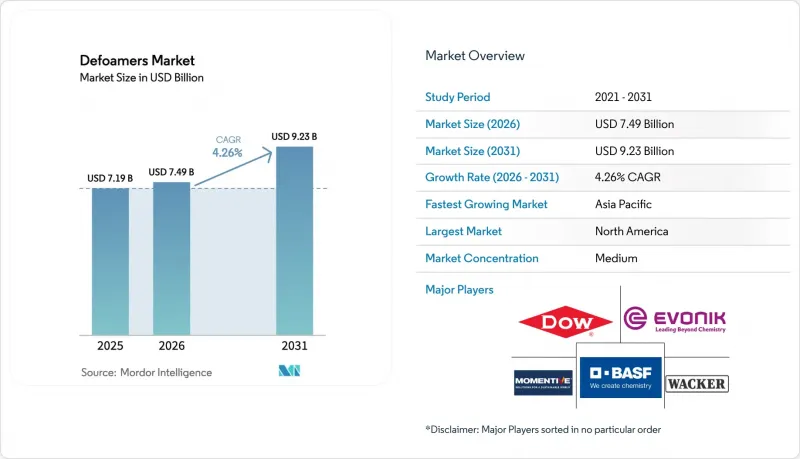
본 보고서는 유형별(실리콘계, 수계, 유계, 분말, 기타), 최종 사용자 산업별(페인트 및 코팅, 펄프·제지, 상수도·폐수 처리, 석유 및 가스,식품 및 음료, 세제, 섬유, 기타), 지역별(아시아태평양, 북미, 유럽, 남미, 중동 및 아프리카)로 분류되어 있습니다. 시장 예측은 금액(달러)으로 표시되어 있습니다.
세계 소포제 시장 동향 및 인사이트
아시아 지역의 페인트 및 코팅 생산 급증이 고성능 소포제 수요를 견인
2024년, 아시아태평양의 도료 생산액은 894억 달러를 넘어섰으며, 인도 마이소르에 신설된 장식용 도료 생산 라인에서는 현재 대량의 특수 소포제가 사용되고 있습니다. 중국과 베트남의 생산 능력 확충도 이러한 추세를 반영하고 있으며, 한편, 잔장에 위치한 BASF의 네오펜틸글리콜 복합 시설에서는 180°C 이상에서 열적 안정성이 확보된 소포제가 필요한 분체 도장용 바인더를 공급하고 있습니다. 바이오 유래의 재생 가능 폴리에테르 변성 폴리실록산은 배합 제조업체가 GB 18582-2020의 VOC 제한치를 준수하는 데 도움이 되며, 범용 에멀션에 비해 15%의 가격 프리미엄을 확보하고 있습니다. 공급업체들은 시장이 양극화되고 있다고 지적합니다. 저비용 실리콘 에멀전은 이익률 축소에 직면한 반면, 폴리머 농축액은 더욱 엄격해진 품질 기준의 혜택을 보고 있습니다. 자동차 도장 분야에서 ‘결함 없는 마감’에 대한 OEM 수요 증가는 프리미엄 부문을 더욱 강화하여, 전체 소포제 시장의 평균 판매 가격을 끌어올리고 있습니다.
인도 및 인도네시아의 펄프·제지 생산 능력 증대가 공정용 화학약품 지출을 확대
인도의 850개 펄프 공장은 거의 풀가동 상태이며, 이는 새로운 투자를 촉진하고 소포제 화학약품 예산을 확대시키고 있습니다. APRIL 그룹이 리아우 주에 건설 중인 21억 달러 규모의 접이식 골판지 공장만 해도 연간 최대 4,000톤의 소포제를 소비할 것으로 예측됩니다. 폐쇄형 백수 순환 시스템에서는 폴리에테르 폴리올 에멀전이 선호되는 반면, 막 생물 반응기에서는 7년간의 설계 수명 동안 플럭스를 보호하기 위해 실리콘이 함유되지 않은 대체품이 필요합니다. 이러한 기술적 전환이 수성 제품이 전체 소포제 시장보다 더 높은 성장률을 보이고 있는 이유를 설명해 줍니다. 인도네시아의 임업 정책과 인도의 화학물질 인센티브 제도는 그린필드 투자의 위험을 더욱 낮추고 있으며, 2031년까지 긍정적인 전망을 유지하고 있습니다.
실리콘 모노머의 비용 급등과 공급 충격
신에츠 화학 공업은 전 세계 D4 및 D5 생산 능력의 절반을 차지하고 있으며, 2024년 하반기 산둥성의 에너지 비용이 상승했을 때 이러한 병목 현상이 가격 급등을 더욱 가속화했습니다. 현물 가격은 전 분기 대비 18% 상승하여, 가격 전가를 꺼리는 펄프, 제지, 섬유 업계의 고객과 거래하는 배합 제조업체들을 압박하고 있습니다. 와커 케미(Wacker Chemie)사의 4만 톤 규모 열분해 실리카 생산 라인은 특수 등급 제품공급 부족을 완화하고 있지만, 벌크 모노머공급 균형을 바로잡기에는 미치지 못하고 있습니다. 이러한 가격 변동으로 인해 각 컨버터 기업들은 원료 산지가 지리적으로 분산되어 있는 글리세린,지방산, 그리고 에틸렌옥사이드를 기반으로 한 대체품의 조달을 서두르고 있습니다. BASF사와 에보닉사는 바이오 재생 가능 제품의 가격을 실리콘 에멀전보다 10-15% 높게 책정하고 있으나, 원료 비용이 더 안정적이기 때문에 소포제 시장에서의 이익률을 유지하고 있습니다.
부문 분석
실리콘 제품이 여전히 주도적인 위치를 차지하고 있지만, 수성 제품 시장은 연평균 성장률(CAGR) 4.98%로 급속히 확대되고 있습니다. 2025년에는 실리콘이 소포제 시장 규모의 37.68%를 차지하며, 고온용 도료 분야에서 여전히 필수적인 존재로 남아 있을 것입니다. 폴리머 및 식물성 오일 에멀젼의 성장은 저VOC 및 센서 호환 특성에 대한 최종 사용자의 선호도를 반영하고 있습니다. 인도의 건설 붐에 힘입어 드라이믹스 모르타르용 분말 유형은 꾸준히 성장하고 있습니다. D4 및 D5공급 부족 또한 가격 안정성이 높은 글리세린 및 지방산을 원료로 하는 제품으로의 전환을 촉진하고 있습니다. 따라서 소포제 시장에서는 이익률 압박에 직면한 범용 실리콘 에멀전과 가치 프리미엄을 확보하고 있는 특수 바이오 재생 가능 등급 사이에서 명확한 세분화가 나타나고 있습니다.
수성 시스템은 실리콘 잔류물을 제거하는 폐쇄형 펄프 공장 및 막형 바이오리액터의 보급으로 혜택을 보고 있습니다. BASF사의 EFKA PB 2770과 에보닉사의 TEGO Foamex 8850은 이러한 변화를 상징하는 제품으로, 둘 다 두 자릿수의 가격 프리미엄을 확보하고 있으며, UV 경화형 및 식품 접촉 용도에서 조기에 채택이 진행되고 있습니다. 유성 광물계 에멀젼은 브라운 스톡 세정 분야에서 점유율을 유지하고 있지만, VOC 규제 강화로 인해 연평균 성장률(CAGR)은 3.2%로 둔화되고 있습니다. 식물성 오일과 폴리에테르를 혼합한 하이브리드 제품을 둘러싼 지속적인 혁신으로 인해, 공급업체들이 고수익률의 농축액으로 포트폴리오를 재편하는 가운데, 경쟁 환경의 재편이 진행될 것으로 예측됩니다.
지역별 분석
2025년에는 북미가 매출의 34.05%를 차지하며 1위를 차지했습니다. 이는 성숙한 물 재이용 시설과 엄격한 제로 방류 규제로 인해 소포제 투여량이 증가했기 때문입니다. 캘리포니아주의 PFAS 관련 법규로 인해 섬유 및 세제 배합 업체들은 바이오 유래의 재생 가능한 솔루션으로의 전환을 강요받고 있으며, 이로 인해 특수 용도 수요가 더욱 증가하고 있습니다. 폐쇄형 루프 시스템으로의 개조를 추진 중인 캐나다의 펄프 공장에서는 막을 보호하기 위해 실리콘이 함유되지 않은 유화제가 지정되고 있는 반면, 멕시코의 자동차 도장 공장에서는 국내 VOC 배출 상한선을 충족하기 위해 고성능 수성 소포제가 채택되고 있습니다. 다우(Dow)가 서큘러스 홀딩스(Circulus Holdings)를 인수한 것은 미래의 제품 설계를 형성할 순환형 및 특수 소재로의 지역적 전환을 여실히 보여주고 있습니다.
아시아태평양은 성장의 원동력이며, 2031년까지 연평균 성장률(CAGR)은 5.04%로 예측됩니다. 중국은 새로운 분체 도장용 수지로 수요를 뒷받침하고 있으며, 인도는 화학 산업 장려 계획에 따라 생산 능력을 확대하고 있고, 동남아시아의 제지 공장은 접이식 골판지 및 코팅 생산량을 늘리고 있습니다. 일본과 한국에서 인라인 센서가 도입됨에 따라, 부착 방지형 소포제의 시범 도입이 가속화되고 있습니다. 이 지역 전체적으로 GB 18582-2020 및 아세안(ASEAN) 기준의 강화에 따라 구매자들은 폴리머 및 수성 기술로 전환하고 있습니다. 이러한 요인들로 인해 소포제 시장은 분산제 및 습윤제와 어깨를 나란히 하는 필수적인 공정 첨가제로서의 입지를 공고히 하고 있습니다.
유럽 시장에서는 수요가 성숙기에 접어들어 성장이 완만하지만, EU의 산업 배출 지침 및 해상 풍력 발전 공급망의 확장에 힘입어 지지를 받고 있습니다. 바커 케미(Wacker Chemie)의 후방 통합으로 인해 특수 실리콘 중간체의 현지 공급 안정성이 향상되고 있습니다. 블레이드 제조업체들이 재활용 가능한 복합재료 시스템을 목표로 하는 가운데, 인몰드 젤 코팅 분야에서는 초저 VOC 소포제에 대한 규격이 더욱 엄격해지고 있습니다. 남미 및 중동 및 아프리카에서는 석유 및 가스·농업 가공 분야의 확대를 배경으로 한 자릿수 중반의 성장을 유지하고 있으며, GCC(걸프협력회의) 국가들의 해수 담수화 플랜트에서는 센서 연동형 투여 시스템이 채택되고 있습니다. 이로 인해 총 사용량은 감소하는 반면, 1kg당 부가가치는 향상되고 있습니다.
기타 혜택:
- 엑셀 형식 시장 예측(ME) 시트
- 3개월간의 애널리스트 지원
자주 묻는 질문
목차
제1장 서론
제2장 조사 방법
제3장 주요 요약
제4장 시장 구도
제5장 시장 규모와 성장 예측
제6장 경쟁 구도
제7장 시장 기회와 향후 전망
LSH 26.09.08According to Mordor Intelligence, the defoamers market size is expected to increase from USD 7.19 billion in 2025 to USD 7.49 billion in 2026 and reach USD 9.23 billion by 2031, growing at a CAGR of 4.26% over 2026-2031.
This report is Segmented by Type (Silicone-Based, Water-Based, Oil-Based, Powder, and Other Types), End-User Industry (Paints & Coatings, Pulp & Paper, Water & Wastewater Treatment, Oil & Gas, Food & Beverages, Detergents, Textiles, and Others), and Geography (Asia-Pacific, North America, Europe, South America, and Middle East & Africa). The Market Forecasts are Provided in Terms of Value (USD).
Global Defoamers Market Trends and Insights
Booming Paints And Coatings Output In Asia Drives High-Performance Defoamer Demand
Asia-Pacific paint production exceeded USD 89.4 billion in 2024, and new decorative-paint lines in Indore and Mysore now draw significant volumes of specialty defoamers. Capacity additions in China and Vietnam echo this trend, while BASF's neopentyl-glycol complex in Zhanjiang supplies powder-coating binders that need thermally stable antifoam above 180°C. Bio-renewable polyether-modified polysiloxanes help formulators hit GB 18582-2020 VOC limits and secure 15% price premiums over commodity emulsions. Suppliers note a two-tier market: low-cost silicone emulsions face shrinking margins, whereas polymer concentrates benefit from stricter quality benchmarks. Growing OEM demand for blemish-free automotive finishes further reinforces the premium tier, lifting average selling prices across the defoamers market.
Pulp And Paper Capacity Additions In India And Indonesia Expand Process-Chemical Spend
India's 850 pulp mills are running near full capacity, pushing new investments that enlarge chemical budgets for antifoam. APRIL Group's USD 2.1 billion folding-boxboard mill in Riau alone is expected to consume up to 4,000 tonnes of defoamer yearly. Closed white-water loops favor polyether-polyol emulsions, while membrane bioreactors require silicone-free alternatives to protect flux over seven-year design lives. These technical pivots explain why water-based products are outgrowing the wider defoamers market. Indonesian forestry policy and India's chemical incentive scheme further derisk greenfield spending, sustaining a positive outlook through 2031.
Silicone-Monomer Cost Spikes And Supply Shocks
Shin-Etsu holds half of global D4 and D5 capacity, creating a bottleneck that sharpened price jumps when Shandong's energy costs rose in late 2024. Spot prices climbed 18% quarter over quarter, squeezing formulators tied to pulp, paper, and textile clients that resist pass-through increases. Wacker Chemie's 40,000 tonne pyrogenic-silica line eases specialty grades but fails to balance bulk monomer supply. The volatility motivates converters to lock in glycerin, fatty-acid, and ethylene-oxide-based alternatives whose feedstocks are geographically diverse. BASF and Evonik price their bio-renewable products 10-15% above silicone emulsions yet offer steadier input costs, insulating margins in the defoamers market.
Other drivers and restraints analyzed in the detailed report include:
- Wastewater Reuse Mandates Spur Antifoam Use In MBR And RO Plants
- Inline Optical / Ultrasonic Sensors Require Non-Fouling, Low-Silicone Formulations
- Tightening PFAS-Style Scrutiny Of Persistent Silicone Chemistries
For complete list of drivers and restraints, kindly check the Table Of Contents.
Segment Analysis
Silicone products still lead, yet water-based offerings are accelerating at 4.98% CAGR. In 2025, silicone held a 37.68% share of the defoamers market size and remains essential in high-temperature coatings. Polymer and vegetable-oil emulsions' growth reflects end-users' preference for low-VOC and sensor-friendly profiles. Powder formats for dry-mix mortars grow steadily with India's construction boom. Tight supplies of D4 and D5 also encourage migration to glycerin and fatty-acid feedstocks that carry more stable pricing. The defoamers market, therefore, shows clear segmentation between commodity silicone emulsions under margin pressure and specialty bio-renewable grades capturing value premiums.
Water-based systems benefit from closed-loop pulp mills and membrane bioreactors that prohibit silicone residue. BASF's EFKA PB 2770 and Evonik's TEGO Foamex 8850 illustrate the shift, each commanding double-digit price premiums and winning early adoption in UV-curable and food-contact applications. Oil-based mineral emulsions retain share in brown-stock washing but face a slower 3.2% CAGR because of tightening VOC caps. Continued innovation around hybrid vegetable-oil and polyether blends is expected to reshape the competitive map as suppliers reposition portfolios toward high-margin concentrates.
Complete Report Scope:
- By Type
- Silicone-based
- Water-based
- Oil-based
- Powder Defoamers
- By Other Types (Polymer / Vegetable-based)
- By End-user Industry
- Paints and Coatings
- Pulp and Paper
- Water and Waste-water Treatment
- Oil and Gas
- Food and Beverages
- Detergents
- Homecare
- Industrial
- Textiles
- Others (Pharmaceuticals, Metalworking Fluids)
- By Geography (Value)
- Asia-Pacifc
- China
- India
- Japan
- South Korea
- Vietnam
- Malaysia
- Indonesia
- Thailand
- Rest of Asia-Pacific
- North America
- United States
- Canada
- Mexico
- Europe
- Germany
- United Kingdom
- France
- Italy
- Russia
- Turkey
- Spain
- NORDIC Countries
- Rest of Europe
- South America
- Brazil
- Argentina
- Colombia
- Rest of South America
- Middle East and Africa
- Saudi Arabia
- South Africa
- Qatar
- Nigeria
- United Arab Emirates
- Rest of Middle East and Africa
- Asia-Pacifc
Geography Analysis
North America led revenues with a 34.05% share in 2025 as mature water-reuse assets and strict zero-discharge rules elevated antifoam dosing. California's PFAS legislation pushes textile and detergent formulators toward bio-renewable solutions, reinforcing specialty demand. Canadian pulp mills retrofitting closed loops now specify silicone-free emulsions to protect membranes, while Mexican automotive paint shops adopt high-performance water-based defoamers to meet national VOC caps. Dow's purchase of Circulus Holdings underlines a regional pivot toward circular and specialty materials that shape future product design.
Asia-Pacific is the growth engine, forecast at 5.04% CAGR through 2031. China anchors demand with new powder-coating resins, India scales capacity under its chemical incentive plan, and Southeast Asian mills add folding-boxboard and coatings output. Inline sensor adoption in Japan and South Korea accelerates trials of non-fouling defoamers. Across the region, stricter GB 18582-2020 and ASEAN standards steer buyers toward polymer and water-based technology. These factors consolidate the defoamers market as the essential process additive alongside dispersion and wetting aids.
Europe's market growth is moderated by mature demand yet supported by the EU Industrial Emissions Directive and offshore-wind supply chain growth. Wacker Chemie's backward integration improves local security of supply for specialty silicone intermediates. In-mold gelcoating further tightens specifications for ultra-low-VOC antifoam as blade manufacturers target recyclable composite systems. South America and the Middle East & Africa track mid-single-digit growth on the back of oil, gas, and agro-processing expansions, with GCC desalination plants adopting sensor-linked dosing that reduces overall volumes yet raises value per kilogram.
- Ashland
- BASF
- BRB International B.V.
- Buckman
- ATLANTA Group
- Dow
- Eastman Chemical Company
- Elementis plc
- Elkem ASA
- Evonik Industries AG
- Kemira
- Momentive
- Munzing Chemie GmbH
- Nouryon
- San Nopco Limited
- Sasol
- Shin-Etsu Chemical Co., Ltd.
- Syensqo
- Wacker Chemie AG
Additional Benefits:
- The market estimate (ME) sheet in Excel format
- 3 months of analyst support
TABLE OF CONTENTS
1 Introduction
- 1.1 Study Assumptions and Market Definition
- 1.2 Scope of the Study
2 Research Methodology
3 Executive Summary
4 Market Landscape
- 4.1 Market Overview
- 4.2 Market Drivers
- 4.2.1 Booming paints and coatings output in Asia drives high-performance defoamer demand
- 4.2.2 Pulp and paper capacity additions in India and Indonesia expand process-chemical spend
- 4.2.3 Waste-water reuse mandates spur antifoam use in MBR and RO plants
- 4.2.4 Inline optical/ultrasonic sensors require non-fouling, low-silicone formulations
- 4.2.5 Composite resins for offshore wind and green-hydrogen equipment specify ultra-low VOC antifoam
- 4.3 Market Restraints
- 4.3.1 Silicone-monomer cost spikes and supply shocks
- 4.3.2 Tightening PFAS-style scrutiny of persistent silicone chemistries
- 4.3.3 Shift to closed-loop, mechanical foam control in zero-discharge plants
- 4.4 Value Chain Analysis
- 4.5 Porter's Five Forces
- 4.5.1 Bargaining Power of Suppliers
- 4.5.2 Bargaining Power of Buyers
- 4.5.3 Threat of New Entrants
- 4.5.4 Threat of Substitutes
- 4.5.5 Degree of Competition
5 Market Size and Growth Forecasts (Value)
- 5.1 By Type
- 5.1.1 Silicone-based
- 5.1.2 Water-based
- 5.1.3 Oil-based
- 5.1.4 Powder Defoamers
- 5.1.5 By Other Types (Polymer / Vegetable-based)
- 5.2 By End-user Industry
- 5.2.1 Paints and Coatings
- 5.2.2 Pulp and Paper
- 5.2.3 Water and Waste-water Treatment
- 5.2.4 Oil and Gas
- 5.2.5 Food and Beverages
- 5.2.6 Detergents
- 5.2.6.1 Homecare
- 5.2.6.2 Industrial
- 5.2.7 Textiles
- 5.2.8 Others (Pharmaceuticals, Metalworking Fluids)
- 5.3 By Geography (Value)
- 5.3.1 Asia-Pacifc
- 5.3.1.1 China
- 5.3.1.2 India
- 5.3.1.3 Japan
- 5.3.1.4 South Korea
- 5.3.1.5 Vietnam
- 5.3.1.6 Malaysia
- 5.3.1.7 Indonesia
- 5.3.1.8 Thailand
- 5.3.1.9 Rest of Asia-Pacific
- 5.3.2 North America
- 5.3.2.1 United States
- 5.3.2.2 Canada
- 5.3.2.3 Mexico
- 5.3.3 Europe
- 5.3.3.1 Germany
- 5.3.3.2 United Kingdom
- 5.3.3.3 France
- 5.3.3.4 Italy
- 5.3.3.5 Russia
- 5.3.3.6 Turkey
- 5.3.3.7 Spain
- 5.3.3.8 NORDIC Countries
- 5.3.3.9 Rest of Europe
- 5.3.4 South America
- 5.3.4.1 Brazil
- 5.3.4.2 Argentina
- 5.3.4.3 Colombia
- 5.3.4.4 Rest of South America
- 5.3.5 Middle East and Africa
- 5.3.5.1 Saudi Arabia
- 5.3.5.2 South Africa
- 5.3.5.3 Qatar
- 5.3.5.4 Nigeria
- 5.3.5.5 United Arab Emirates
- 5.3.5.6 Rest of Middle East and Africa
- 5.3.1 Asia-Pacifc
6 Competitive Landscape
- 6.1 Market Concentration
- 6.2 Strategic Moves
- 6.3 Market Share(%)/Ranking Analysis
- 6.4 Company Profiles (includes Global level Overview, Market level overview, Core Segments, Financials as available, Strategic Information, Market Rank/Share for key companies, Products and Services, Recent Developments)
- 6.4.1 Ashland
- 6.4.2 BASF
- 6.4.3 BRB International B.V.
- 6.4.4 Buckman
- 6.4.5 ATLANTA Group
- 6.4.6 Dow
- 6.4.7 Eastman Chemical Company
- 6.4.8 Elementis plc
- 6.4.9 Elkem ASA
- 6.4.10 Evonik Industries AG
- 6.4.11 Kemira
- 6.4.12 Momentive
- 6.4.13 Munzing Chemie GmbH
- 6.4.14 Nouryon
- 6.4.15 San Nopco Limited
- 6.4.16 Sasol
- 6.4.17 Shin-Etsu Chemical Co., Ltd.
- 6.4.18 Syensqo
- 6.4.19 Wacker Chemie AG
7 Market Opportunities and Future Outlook
- 7.1 White-space and Unmet-Need Assessment
- 7.2 Biomanufacturing scale-up (cell-culture, precision-fermentation) needs sterile, low-foam media


