

|
시장보고서
상품코드
2121305
항공우주용 복합재료 : 시장 점유율 분석, 업계 동향과 통계, 성장 예측(2026-2031년)Aerospace Composites - Market Share Analysis, Industry Trends & Statistics, Growth Forecasts (2026 - 2031) |
||||||
 Mordor Intelligence
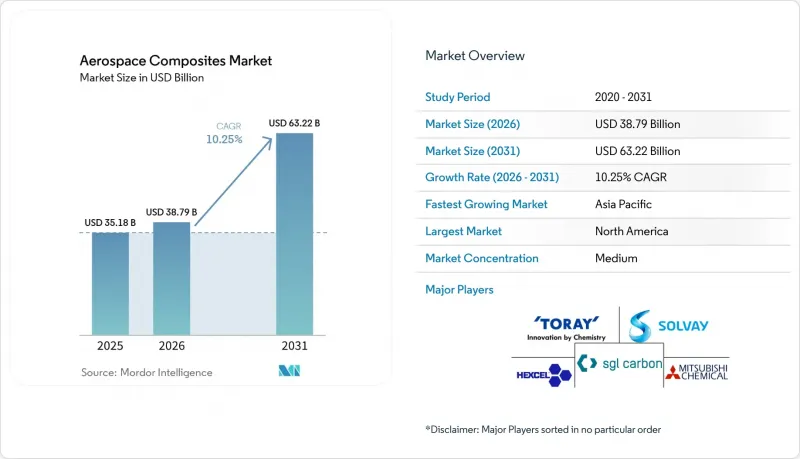
Mordor Intelligence에 따르면 항공우주용 복합재료 시장 규모는 2025년 351억 8,000만 달러에서 2026년에는 387억 9,000만 달러로 확대되고, 2026년부터 2031년까지 CAGR 10.25%를 기록하며 2031년에는 632억 2,000만 달러에 달할 것으로 예측됩니다.
본 보고서는 섬유 유형(유리섬유, 탄소섬유, 기타), 수지 유형(열경화성 복합재료, 기타), 제조 공정(필라멘트 와인딩, 기타), 항공기 유형(상용기, 기타), 구조 부품(내장 부품, 기타), 최종사용자(OEM, 기타), 지역(북미, 기타)별로 분류되어 있습니다. 시장 예측은 금액(달러) 기준으로 제시되어 있습니다.
세계 항공우주용 복합재료 시장의 동향 및 인사이트
열가소성 복합재료의 급속한 보급
Collins Aerospace는 열가소성 항공기 구조재가 생산 주기를 80% 단축하고, 오토클레이브를 이용한 경화 공정을 불필요하게 하며, 거의 100% 재활용이 가능함을 입증했습니다. 유럽의 단일 통로 항공기 프로그램에서는 납품 지연을 해소하기 위해 이 소재가 채택되고 있습니다. 동시에, Arkema사와 Heksell사의 제휴를 통해 최초의 완전 열가소성 상용 항공기 구조체가 제조되었으며, 오토클레이브를 사용하지 않는 대규모 제조 방식의 유효성이 입증되었습니다. 높은 재활용성은 새롭게 대두되고 있는 지속가능성 요건과 부합하며, 열가소성 수지를 향후 시장 확장의 초석으로 자리매김하고 있습니다.
차세대 협폭기 주익에서의 탄소섬유 적용 확대
에어버스(Airbus)의 ‘eXtra Performance Wing’ 테스트베드에서는 항력을 낮추고 CO2 배출량을 줄이기 위해 광범위하게 CFRP 스킨을 채택하고 있으며, 전장 32m의 탄소섬유제 주익 스킨 제조의 실현 가능성을 입증하고 있습니다. 북미 프로젝트에서도 병행하여 연구가 진행되고 있으며, 유럽의 CFRP 사용량에 필적하거나 이를 능가하는 것을 목표로 하고 있습니다. 알루미늄에 비해 최대 50%의 경량화와 AFP의 생산성 향상은 수주 잔고 문제를 직접적으로 해결하는 것입니다.
프리폼 및 오토클레이브의 높은 설비 투자 비용
항공우주 등급 오토클레이브는 500만-1,000만 달러의 비용이 들고, 대규모 인프라가 필요하기 때문에 Tier 2 업체의 시장 진입을 가로막고 있습니다. 오토클레이브 외부에서의 열가소성 수지 용접 및 수지 주입이 투자 부담이 적은 대체 기술로 부상하고 있어, 항공우주용 복합재료 시장 전체에서 공급업체의 진입을 확대할 가능성이 있습니다.
부문 분석
탄소섬유는 성숙한 공급망과 뛰어난 강성 대 중량 비율 덕분에 2025년 항공우주용 복합재료 시장에서 52.08%의 점유율을 유지했습니다. 한편, 세라믹 섬유는 1,500℃의 내열성이 필요한 초음속 항공기 및 우주선에 대한 수요에 힘입어 연평균 성장률(CAGR) 10.74%로 이 부문을 주도하고 있습니다. 탄소섬유와 세라믹 섬유 층을 결합한 하이브리드 적층재는 냉각용 흡기량을 25% 줄이는 것을 목표로 하는 엔진 OEM 업체들로부터 지지를 얻고 있습니다. 현재 평가가 진행 중인 그래핀 강화 로빙은 변형 감지 채널을 통합하면서 탄성률을 20-30% 향상시켰으며, 이는 자가 모니터링형 주익 외판 구현을 위한 한 걸음이 되고 있습니다.
유리섬유는 가성비가 뛰어나 레이더 돔이나 페어링의 외피에서 여전히 중요한 위치를 차지하고 있는 반면, 아라미드 섬유는 방탄 성능을 갖춘 헬리콥터 바닥재에서 점유율을 유지하고 있습니다. 지속적인 소재 혁신이 시장의 다각화를 뒷받침하고 있지만, 예측 기간 동안 탄소섬유와 세라믹 섬유가 시장 규모의 기반을 계속 유지할 것으로 전망됩니다.
열경화성 에폭시 및 BMI 시스템은 풍부한 인증 실적을 바탕으로 2025년 매출의 45.73%를 차지했습니다. 열가소성 PEKK 및 PEI 제품군은 Collins Aerospace가 지적한 80%의 사이클 타임 단축에 힘입어 13.22%의 연평균 성장률(CAGR)로 급성장하고 있습니다. AFP(자동 섬유 배열) 생산 라인이 인시투(in-situ) 고결 방식으로 전환됨에 따라, 항공우주용 열가소성 복합재료 시장 규모는 2031년까지 193억 8,000만 달러를 넘어설 것으로 예측됩니다. SHD Composites가 선구적으로 개발한 바이오 기반 수지는 재생 가능 원료 함유율이 거의 100%이며, 200℃의 사용 환경을 견딜 수 있어 환경 목표와 기계적 무결성을 모두 충족시키고 있습니다.
인증의 기세는 가속화되고 있습니다. FAA(미국 연방항공청)는 이미 비즈니스 제트기용 용접식 열가소성 수지 제어면을 승인했으며, 이는 산업 전반에 걸친 사용 사례 확대가 임박했음을 시사합니다.
지역별 분석
북미는 보잉(Boeing), GE 에어로스페이스, 록히드 마틴(Lockheed Martin)을 핵심으로 29.71%의 시장 점유율을 유지하며, 여전히 가장 큰 지역 기여 요인으로 자리 잡고 있습니다. 이 지역은 북미 전체 매출의 약 75%를 차지하고 있으며, 캐나다 몬트리올 클러스터가 하이엔드 나셀을 공급하고 있습니다. NASA의 HiCAM 프로그램은 열가소성 수지 용접 인증을 뒷받침하며, 국내 공급망을 강화하고 있습니다.
그 뒤를 이어 유럽은 에어버스와 독일, 프랑스, 영국의 견고한 티어 네트워크에 힘입어 성장하고 있습니다. EU의 ‘Fit for 55’ 포장 규제와 같은 적극적인 지속가능성 관련 규제가 바이오 기반 복합재료의 채택을 촉진하고 있습니다. 웨일스에서 생산 중인 열가소성 수지 재질의 주익 외판은 유럽이 고속 및 저탄소 제조에 주력하고 있음을 보여주는 좋은 사례입니다.
아시아태평양은 중국의 COMAC에 의한 기체 수 확대와 일본 및 한국의 전기 추진 기술 연구개발 거점에 힘입어 연평균 성장률(CAGR) 10.30%로 가장 빠르게 성장하고 있는 지역입니다. HRC의 중국 신공장은 항공우주 및 고속철도용 AFP 스트링거를 공급하며 제조 규모 면에서의 우위를 두드러지게 하고 있습니다. 인도는 방갈로르 주변에 복합재료 산업 회랑을 육성하고 있으며, ISRO의 발사 로켓과 HAL의 전투기에 부품을 공급함으로써 지역 항공우주용 복합재료 시장의 호황을 더욱 확대하고 있습니다.
라틴아메리카에서는 브라질의 엠브라에르를 필두로 E2 제트기 시리즈에 복합재료가 채택되고 있는 반면, 멕시코의 케레타로 클러스터에서는 북미 주요 제조사를 위한 나셀 도어가 제조되고 있습니다. 중동 및 아프리카에서는 아랍에미리트의 스트라타 복합재료사와 남아프리카공화국의 데넬 에어로스트럭처스가 오프셋 협정 및 기술 이전 지원을 받아 새로운 기여 기업으로 부상하고 있습니다.
기타 혜택
- 엑셀 형식의 시장 예측(ME) 시트
- 3개월간의 애널리스트 지원
자주 묻는 질문
목차
제1장 소개
제2장 조사 방법
제3장 주요 요약
제4장 시장 구도
제5장 시장 규모와 성장 예측
제6장 경쟁 구도
제7장 시장 기회와 향후 전망
KSM 26.09.03According to Mordor Intelligence, the aerospace composites market size is expected to grow from USD 35.18 billion in 2025 to USD 38.79 billion in 2026 and is forecast to reach USD 63.22 billion by 2031 at 10.25% CAGR over 2026-2031.
This report is Segmented by Fiber Type (Glass Fiber, Carbon Fiber, and More), Resin Type (Thermoset Composites, and More), Manufacturing Process (Filament Winding, and More), Aircraft Type (Commercial Aircraft, and More), Structural Component (Interior Components, and More), End-User (OEM, and More) and Geography (North America, and More). The Market Forecasts are Provided in Terms of Value (USD).
Global Aerospace Composites Market Trends and Insights
Rapid Adoption of Thermoplastic Composites
Collins Aerospace demonstrates that thermoplastic aerostructures cut production cycles by 80%, eliminate autoclave curing, and are nearly 100% recyclable.European single-aisle programs have embraced the material to reduce delivery backlogs. At the same time, an Arkema-Hexcel partnership produced the first fully thermoplastic commercial aircraft structure, validating large-scale out-of-autoclave fabrication. High recyclability aligns with emerging sustainability mandates, positioning thermoplastics as a cornerstone of future market expansion.
Increasing Penetration of Carbon Fiber in Next-Gen Narrow-Body Wings
Airbus's eXtra Performance Wing testbed incorporates extensive CFRP skins to lower drag and cut CO2, showcasing the build feasibility of 32 m-long carbon-fiber wingskins. North American programs perform parallel studies, aiming to match or exceed European CFRP usage. Weight savings of up to 50% versus aluminum and AFP throughput gains directly address the backlog challenge.
High Preform and Autoclave Capital Costs
Aerospace-grade autoclaves cost USD 5-10 million and require extensive infrastructure, deterring Tier-2 entrants. Out-of-autoclave thermoplastic welding and resin infusion are emerging as lower-investment alternatives that can broaden supplier participation across the aerospace composites market.
Other drivers and restraints analyzed in the detailed report include:
- Fleet Electrification and More-Electric Aircraft
- Space Launch Commercialization
- Supply-Chain Volatility of Aerospace-Grade Precursors
For complete list of drivers and restraints, kindly check the Table Of Contents.
Segment Analysis
Carbon fiber retained 52.08% of the aerospace composites market share in 2025, thanks to mature supply chains and superior stiffness-to-weight ratios. Ceramic fibers, however, are pacing the segment with a 10.74% CAGR, propelled by hypersonic and space vehicle demand for 1,500 °C capability. Hybrid laminates combining carbon and ceramic plies are gaining favor among engine OEMs aiming to cut cooling air draw by 25%. Graphene-enhanced rovings under evaluation show 20-30% modulus boosts while embedding strain-sensing pathways, a step toward self-monitoring wingskins.
The cost-effective positioning of glass fiber maintains relevance in radome and fairing skins, while aramid fibers sustain a share in ballistic-resistant helicopter floors. Continued material innovation supports diversification, yet carbon and ceramic remain the backbone of the market size throughout the forecast horizon.
Thermoset epoxy and BMI systems commanded 45.73% of 2025 revenue because of an extensive qualification pedigree. Thermoplastic PEKK and PEI families are surging at a 13.22% CAGR, driven by 80% cycle-time reductions cited by Collins Aerospace. The aerospace composites market size for thermoplastics is projected to exceed USD 19.38 billion by 2031 as AFP lines pivot to in-situ consolidation. Bio-based resins pioneered by SHD Composites offer near-100% renewable content and withstand 200 °C service, aligning environmental targets with mechanical integrity.
Qualification momentum is accelerating: the FAA has already cleared welded thermoplastic control surfaces for business jets, signaling an imminent broadening of use cases across the industry.
Complete Report Scope:
- By Fiber Type
- Glass Fiber
- Carbon Fiber
- Ceramic Fiber
- Aramid Fiber
- Other Fiber Types
- By Resin Type
- Thermoset Composites
- Thermoplastic Composites
- By Manufacturing Process
- Lay-Up (Hand and Automated)
- Resin Transfer Molding (RTM)
- Filament Winding
- Injection/Compression Molding
- Automated Fiber Placement and Tape Laying
- Additive Manufacturing of Composites
- By Aircraft Type
- Commercial Aircraft
- Narrow-Body
- Wide-Body
- Regional Jets
- Freighters
- Business Jets
- Military Aircraft
- Fighter Jets
- Transport and Tanker
- Rotorcraft
- Helicopters
- Spacecraft and Launch Vehicles
- Commercial Aircraft
- By Structural Component
- Interior Components
- Exterior and Airframe
- Engine Components
- Auxiliary Structures
- By End-User
- OEM
- Aftermarket/MRO
- By Geography
- North America
- United States
- Canada
- Mexico
- Europe
- United Kingdom
- Germany
- France
- Rest of Europe
- Asia-Pacific
- China
- Japan
- India
- South Korea
- Rest of Asia-Pacific
- South America
- Brazil
- Rest of South America
- Middle East and Africa
- Middle East
- Saudi Arabia
- United Arab Emirates
- Rest of Middle East
- Africa
- South Africa
- Rest of Africa
- Middle East
- North America
Geography Analysis
North America remains the largest regional contributor with a market share of 29.71%, anchored by The Boeing Company, GE Aerospace, and Lockheed Martin Corporation. The region accounts for roughly 75% of North American sales, with Canada's Montreal cluster supplying high-end nacelles. NASA's HiCAM program underpins thermoplastic welding certification, reinforcing domestic supply chains.
Europe follows, propelled by Airbus and a robust tier network in Germany, France, and the United Kingdom. Aggressive sustainability mandates, such as the EU's Fit for 55 package, are catalyzing the adoption of bio-based composites. Thermoplastic wineskins under production in Wales exemplify Europe's commitment to high-rate, low-carbon manufacturing.
Asia-Pacific is the fastest-growing territory with a CAGR of 10.30%, driven by China's COMAC fleet ramp-up and electric-propulsion R&D hubs in Japan and South Korea. HRC's new Chinese plant supplies AFP stringers for aerospace and high-speed rail, underscoring manufacturing scale advantages. India is nurturing a composites corridor around Bengaluru, supplying ISRO launch vehicles and HAL fighters, further enlarging regional aerospace composites market activity.
Latin America, led by Brazil's Embraer, integrates composites in E2 jet families, while Mexico's Queretaro cluster fabricates nacelle doors for North American primes. In the Middle East and Africa, the United Arab Emirates' Strata composites facility and South Africa's Denel Aerostructures are emerging contributors, aided by offset agreements and skills transfer.
- Toray Industries, Inc.
- Hexcel Corporation
- Solvay
- SGL Carbon
- Mitsubishi Chemical Carbon Fiber and Composites, Inc. (Mitsubishi Chemical Group Corporation)
- Teijin Aramid
- DuPont de Nemours, Inc.
- Spirit AeroSystems Inc.
- General Electric Company
- Rolls-Royce plc
- Safran SA
- Bally Ribbon Mills
- Materion Corporation
- Park Aerospace Corp.
- Lee Aerospace, Inc.
Additional Benefits:
- The market estimate (ME) sheet in Excel format
- 3 months of analyst support
TABLE OF CONTENTS
1 INTRODUCTION
- 1.1 Study Assumptions and Market Definition
- 1.2 Scope of the Study
2 RESEARCH METHODOLOGY
3 EXECUTIVE SUMMARY
4 MARKET LANDSCAPE
- 4.1 Market Overview
- 4.2 Market Drivers
- 4.2.1 Rapid adoption of thermoplastic composites to accelerte production rates of single-aisle programs (Europe-led)
- 4.2.2 Increasing penetration of carbon fiber in next-gen narrow-body wings in North America
- 4.2.3 Fleet eletrification and more-electric aircraft (MEA) driving high-temperature composite demand in Asia
- 4.2.4 Space-launch commercialization boosing demand for lightweight composite structures
- 4.2.5 Military stealth programs propelling ceramic-matrix composite uptake in hypersonic applications
- 4.2.6 OEM sustainability targets pushing recyclable composite solutions
- 4.3 Market Restraints
- 4.3.1 High preform and autoclave capital costs limiting adoption in tier-2 suppliers
- 4.3.2 Supply-chain volatility for aerospace-grade precursors for PAN-based carbon fiber
- 4.3.3 Qualification and certification delays for novel resin systems with FAA/EASA
- 4.3.4 Limited repairability expertise for advanced thermoplastics in MRO sector
- 4.4 Value Chain Analysis
- 4.5 Regulatory or Technological Outlook
- 4.6 Porter's Five Forces Analysis
- 4.6.1 Bargaining Power of Suppliers
- 4.6.2 Bargaining Power of Buyers/Consumers
- 4.6.3 Threat of New Entrants
- 4.6.4 Threat of Substitute Products
- 4.6.5 Intensity of Competitive Rivalry
5 MARKET SIZE AND GROWTH FORECASTS (VALUE)
- 5.1 By Fiber Type
- 5.1.1 Glass Fiber
- 5.1.2 Carbon Fiber
- 5.1.3 Ceramic Fiber
- 5.1.4 Aramid Fiber
- 5.1.5 Other Fiber Types
- 5.2 By Resin Type
- 5.2.1 Thermoset Composites
- 5.2.2 Thermoplastic Composites
- 5.3 By Manufacturing Process
- 5.3.1 Lay-Up (Hand and Automated)
- 5.3.2 Resin Transfer Molding (RTM)
- 5.3.3 Filament Winding
- 5.3.4 Injection/Compression Molding
- 5.3.5 Automated Fiber Placement and Tape Laying
- 5.3.6 Additive Manufacturing of Composites
- 5.4 By Aircraft Type
- 5.4.1 Commercial Aircraft
- 5.4.1.1 Narrow-Body
- 5.4.1.2 Wide-Body
- 5.4.1.3 Regional Jets
- 5.4.1.4 Freighters
- 5.4.2 Business Jets
- 5.4.3 Military Aircraft
- 5.4.3.1 Fighter Jets
- 5.4.3.2 Transport and Tanker
- 5.4.3.3 Rotorcraft
- 5.4.4 Helicopters
- 5.4.5 Spacecraft and Launch Vehicles
- 5.4.1 Commercial Aircraft
- 5.5 By Structural Component
- 5.5.1 Interior Components
- 5.5.2 Exterior and Airframe
- 5.5.3 Engine Components
- 5.5.4 Auxiliary Structures
- 5.6 By End-User
- 5.6.1 OEM
- 5.6.2 Aftermarket/MRO
- 5.7 By Geography
- 5.7.1 North America
- 5.7.1.1 United States
- 5.7.1.2 Canada
- 5.7.1.3 Mexico
- 5.7.2 Europe
- 5.7.2.1 United Kingdom
- 5.7.2.2 Germany
- 5.7.2.3 France
- 5.7.2.4 Rest of Europe
- 5.7.3 Asia-Pacific
- 5.7.3.1 China
- 5.7.3.2 Japan
- 5.7.3.3 India
- 5.7.3.4 South Korea
- 5.7.3.5 Rest of Asia-Pacific
- 5.7.4 South America
- 5.7.4.1 Brazil
- 5.7.4.2 Rest of South America
- 5.7.5 Middle East and Africa
- 5.7.5.1 Middle East
- 5.7.5.1.1 Saudi Arabia
- 5.7.5.1.2 United Arab Emirates
- 5.7.5.1.3 Rest of Middle East
- 5.7.5.2 Africa
- 5.7.5.2.1 South Africa
- 5.7.5.2.2 Rest of Africa
- 5.7.5.1 Middle East
- 5.7.1 North America
6 COMPETITIVE LANDSCAPE
- 6.1 Market Concentration
- 6.2 Strategic Moves
- 6.3 Market Share Analysis
- 6.4 Company Profiles (includes Global level Overview, Market level overview, Core Segments, Financials as available, Strategic Information, Market Rank/Share for key companies, Products and Services, and Recent Developments)
- 6.4.1 Toray Industries, Inc.
- 6.4.2 Hexcel Corporation
- 6.4.3 Solvay
- 6.4.4 SGL Carbon
- 6.4.5 Mitsubishi Chemical Carbon Fiber and Composites, Inc. (Mitsubishi Chemical Group Corporation)
- 6.4.6 Teijin Aramid
- 6.4.7 DuPont de Nemours, Inc.
- 6.4.8 Spirit AeroSystems Inc.
- 6.4.9 General Electric Company
- 6.4.10 Rolls-Royce plc
- 6.4.11 Safran SA
- 6.4.12 Bally Ribbon Mills
- 6.4.13 Materion Corporation
- 6.4.14 Park Aerospace Corp.
- 6.4.15 Lee Aerospace, Inc.
7 MARKET OPPORTUNITIES AND FUTURE OUTLOOK
- 7.1 White-Space and Unmet-Need Assessment


