

|
시장보고서
상품코드
2121324
방사선 치료 : 시장 점유율 분석, 업계 동향과 통계, 성장 예측(2026-2031년)Radiotherapy - Market Share Analysis, Industry Trends & Statistics, Growth Forecasts (2026 - 2031) |
||||||
 Mordor Intelligence
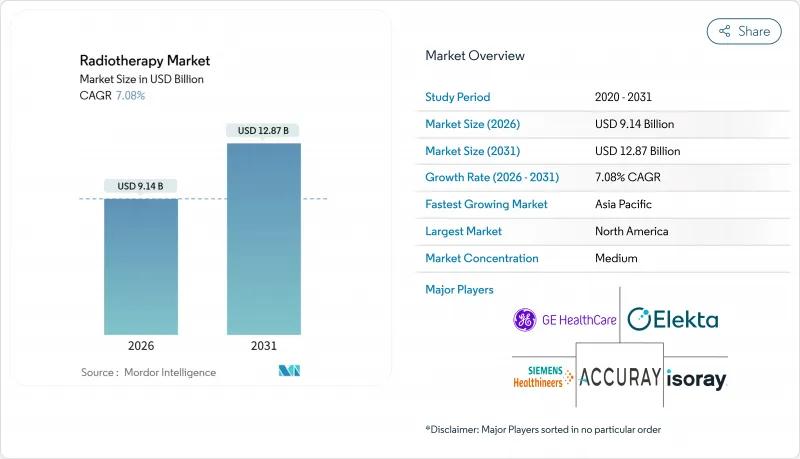
Mordor Intelligence에 따르면 방사선 치료 시장 규모는 2026년에 91억 4,000만 달러로 추정되며, 예측 기간(2026-2031년) 동안 CAGR 7.08%를 기록하며 2031년에는 128억 7,000만 달러에 달할 것으로 전망됩니다.
본 보고서에서는 산업을 제품별(방사선 치료 기기, 기타), 기술별(광자선 치료, 기타), 치료 유형별(체외 조사 요법, 기타), 용도별(유방암, 기타), 최종사용자별(병원·클리닉, 기타), 지역별(북미, 유럽, 아시아태평양, 중동 및 아프리카, 남미)로 분류하고 있습니다. 시장 예측은 금액(달러) 기준으로 제시되어 있습니다.
세계 방사선 치료 시장의 동향 및 인사이트
서브 mm 단위의 선량 투여를 위한 정밀 의료 추진
콘빔 CT와 실시간 종양 추적 기능을 통합한 영상 유도 플랫폼은 현재 매일의 적응형 재계획을 지원하며, 정상 조직의 안전 마진을 절반으로 줄여 안전한 선량 증량을 실현하고 있습니다. MR-리니어랙 도입에 관한 초기 임상 데이터에 따르면, 소수 전이성 간 병변에서 92%의 국소 제어율이 보고되었으며, 이는 기존 CT 유도 프로토콜에 비해 두 자릿수 개선을 나타냅니다. 국제 규격도 더욱 엄격해지고 있습니다. IEC 60601-2-64에서는 정위 방사선 치료 시스템에 대해 아이소센터의 정확도를 2mm 이하로 규정하고 있으며, 이에 따라 2027년까지 도입된 장치의 40%에서 업그레이드가 이루어질 전망입니다. 현재 양성자 치료 시스템에는 스팟 크기가 2mm인 펜슬 빔 스캐닝 기능이 표준으로 탑재되어 있어, 소아 의료 센터에서 두개내 치료 시 인지 기능과 관련된 구조를 보호하는 데 도움이 되고 있습니다. 그러나 의학물리사 인력 부족이 지속되고 있어, 이러한 고정밀 장치의 시운전에 시간이 걸리고, 가동 개시까지의 일정이 장기화되고 있습니다.
외래 방사선 치료에 대한 보험 급여 범위 확대
2025년 1월, 메디케어·메디케이드 서비스 센터(CMS)는 외래 정위 체부 방사선 치료(SBRT)에 대한 지급액을 병원 내 시행과 동등한 수준으로 인상하고, 독립형 시설에 대해 연간 약 4억 2,000만 달러의 시설비를 지급했습니다. 민간 보험사들도 이에 신속히 뒤따랐으며, 앤섬(Anthem)사는 2개월 후 외래 수술 센터에서의 폐 SBRT에 대한 보험 적용을 추가하여 1,400만 명의 피보험자에게 영향을 미쳤습니다. 이에 이어 독일에서는 두경부암에 대한 강도조절방사선치료(IMRT)가 외래 치료 적용 대상에 포함되었으며, 반년 이내에 사례의 5분의 1 가까이가 데이 클리닉에서의 치료로 전환되었습니다. 이러한 움직임은 일률적이지 않아, 영국에서는 양성자선 치료의 환급률이 비용의 불과 60%에 그치는 기존의 요금 체계가 유지되고 있어, 투자에 걸림돌이 되고 있습니다. 일본의 탄소 이온선 치료 지급액이 12% 인상된 것도 마찬가지로, 기술 도입에 있어 환급 제도가 결정적인 요인임을 여실히 보여주고 있습니다.
WACC 상승에 따라 리니어 액셀러레이터와 양성자 치료실의 설비 투자가 압박을 받게 됩니다
가중평균자본비용(WACC)이 2023년 5.2%에서 2025년 7.8%로 상승하고, 양성자 치료실의 투자 회수 기간이 12년으로 길어짐에 따라 유럽과 라틴아메리카 전역에서 도입이 잇달아 연기되고 있습니다. 스페인의 한 대형 병원 체인은 자금 조달 비용으로 인해 부채 상환액이 예상 수익의 40%를 초과하게 되자, 마드리드에서의 도입 계획을 중단했습니다. 미국 조사에 따르면, 지역 의료기관의 38%가 리니어 가속기(Linac) 교체를 연기하고 있으며, 이로 인해 장비의 평균 사용 연한은 11년에 달하고 가동 중단 시간도 증가하고 있습니다. 각 공급업체들은 현재 자본 비용을 운영비로 전환하는 10년 단위 리스 계약을 제공하고 있지만, 그 도입은 여전히 제한적입니다.
부문별 분석
체외 조사 요법은 방사선 치료 시장을 주도하며, 2025년에는 매출 점유율의 82.11%를 차지했습니다. 광범위한 종양에 적용 가능하고 확립된 인프라 덕분에 이용률은 높은 수준을 유지하고 있지만, 저분할 조사에 따른 치료 기간 단축이 매출 성장을 억제하고 있습니다. 전신 방사선 치료는 2031년까지 연평균 성장률(CAGR) 7.86%를 기록할 것으로 예측됩니다. 이는 1회 치료당 4만 2,500달러로 메디케어 적용 범위 확대를 확보한 ‘Pluvicto’와 같은 루테튬-177 제제의 상업적 성공에 힘입은 것입니다. 체외 조사 플랫폼은 AI를 활용한 적응형 워크플로우를 통해 대응하고 있으며, 계획 시간을 52분으로 단축함으로써 의료 기관은 치료실을 증설하지 않고도 더 많은 환자를 수용할 수 있게 되었습니다.
전신 요법용 약제는 특히 전이성 질환의 경우, 치료 장비 가동률이 포화 상태에 이른 지역에서 치료 기회를 확대하고 있습니다. 일본과 호주에서 적응증이 확대됨에 따라 2025년에는 루타세라의 매출이 28% 증가했습니다. 내부·근접 조사 요법은 동위원소 물류 문제와 SBRT와의 경쟁으로 인해 추가적인 성장이 억제되고 있기는 하지만, 치료 수익의 약 8%를 차지하며 안정적인 시장을 유지하고 있습니다. 예측 기간 동안 체외 조사 치료 건수는 높은 수준을 유지할 것으로 보이지만, 방사성의약품이 전이성 질환의 틈새 시장에서 더 큰 점유율을 확보함에 따라 그 점유율은 점차 감소할 전망입니다.
강도 변조 방사선 치료(IMRT)는 전립선암 및 두경부암의 표준 치료법으로서의 위상을 반영하여, 2025년에는 기술 매출의 31.73%를 차지했습니다. 양성자선 치료는 규모는 작지만, 2025년 중국 각 성이 8개의 신규 센터에 자금을 지원함에 따라 연평균 성장률(CAGR) 8.38%로 확대되고 있습니다. 현재 약 2,500만 달러 수준인 단일실 설계를 통한 비용 절감으로 인해 지역 병원들도 이 치료법을 도입하고 있습니다.
체적 변조 아크 요법(VMAT)을 통해 1회 조사 시간이 2분으로 단축되어, 처리 능력이 높은 시설에서는 증가하는 환자 수를 보다 효율적으로 관리할 수 있게 되었습니다. 영상 유도 플랫폼은 정위 치료 시 매일 영상 촬영을 의무화하는 미국 방사선 의학 협회(ACR)의 규정에 힘입어 매출의 28%를 차지하고 있습니다. 탄소 이온선 치료는 약 8,000만 달러에 달하는 높은 설비 투자 비용으로 인해 일본과 독일의 소수 시설로만 제한되어 있습니다. 전반적으로 각 시설이 기존 하드웨어에서 더 높은 생산성을 이끌어내면서, 소프트웨어를 중심으로 한 업그레이드가 예산의 대부분을 차지하고 있습니다.
지역별 분석
2025년, 북미는 방사선 치료 시장 매출의 41.52%를 차지했습니다. CMS(미국 의료보험서비스센터)에 의한 외래 환자에 대한 보험 적용 확대에 따라 상반기 장비 수주는 22% 증가했습니다. 이는 주로 도시 지역의 독립형 시설에서의 증가에 기인한 것입니다. 캐나다에서는 지방 접근성 보조금을 통해 리니어 가속기 8대가 추가로 도입되었으며, 멕시코에서는 보험 가입자 수 증가에 따라 민간 부문의 처리량이 증가했습니다. 현재 미국의 대상 환자 중 68%가 치료를 받고 있어, 성숙한 시스템에서 흔히 볼 수 있는 성장 정체 상태에 가까워지고 있습니다.
아시아태평양은 연평균 성장률(CAGR) 9.01%를 기록하며 가장 빠르게 성장하고 있습니다. 인도에서는 150대의 리니어 가속기를 도입하기 위한 12억 달러 규모의 계획을 통해 9주나 걸리던 대기 목록을 절반으로 줄이는 것을 목표로 하고 있습니다. 일본, 한국, 호주에서는 탄소 이온 및 양성자선 치료 서비스를 지원하기 위해 보험 환급 제도의 확충과 인재 양성 체계 강화가 추진되고 있습니다.
유럽은 매출의 28%를 차지하고 있지만, 예산 제약에 직면해 있습니다. 독일은 외래 진료 요금 체계를 개정하여 두경부암 환자의 18%를 데이 클리닉 치료로 전환시켰습니다. 영국에서는 정액제 요금이 유지되고 있으며, 양성자 치료의 보험 보상률이 비용의 60%에 그치고 있어 민간 투자가 억제되고 있습니다. 프랑스는 1억 8,000만 유로를 투자하여 코발트 치료 장비를 리니어 가속기로 교체하고, 평균 선량 적합성을 향상시켰습니다.
중동 및 아프리카의 총 점유율은 6%이며, 걸프협력회의(GCC)의 조달이 주를 이루고 있습니다. 사우디아라비아는 2025년에 리니어 가속기 8대를 도입할 계획이며, 2030년까지 주민 100만 명당 4대 도입을 목표로 하고 있습니다. 남미의 점유율은 4.5%이며, 브라질은 거시경제의 변동에도 불구하고 12대의 리니어 가속기를 도입했습니다.
기타 혜택
- 엑셀 형식의 시장 예측(ME) 시트
- 3개월간의 애널리스트 지원
자주 묻는 질문
목차
제1장 소개
제2장 조사 방법
제3장 주요 요약
제4장 시장 구도
제5장 시장 규모와 성장 예측
제6장 경쟁 구도
제7장 시장 기회와 향후 전망
KSM 26.09.03According to Mordor Intelligence, the radiotherapy market size is estimated at USD 9.14 billion in 2026, and is expected to reach USD 12.87 billion by 2031, at a CAGR of 7.08% during the forecast period (2026-2031).
This report Segments the Industry Into by Product (Radiotherapy Equipment, and More), Technology (Photon Beam Therapy, and More), Therapy Type (External Beam Radiation Therapy, and More), Application (Breast Cancer, and More), End User (Hospitals, and More), and Geography (North America, Europe, Asia-Pacific, Middle East and Africa, South America). The Market Forecasts are Provided in Terms of Value (USD).
Global Radiotherapy Market Trends and Insights
Precision-Medicine Push for Sub-Millimeter Dose Delivery
Image-guided platforms that integrate cone-beam CT and real-time tumor tracking now support daily adaptive replanning, reducing healthy-tissue margins by half and allowing safe dose escalation.Early clinical data from MR-linac installations have reported 92% local control rates in oligometastatic liver lesions, representing a double-digit improvement over historical CT-guided protocols. International standards are also stricter: IEC 60601-2-64 requires an isocenter accuracy of less than 2 mm for stereotactic systems, prompting upgrades across 40% of the installed base by 2027. Proton systems now ship with pencil-beam scanning at 2 mm spot sizes, helping pediatric centers spare cognitive structures during cranial treatments. Commissioning these high-precision units, however, is lengthened when physicist vacancies persist, thereby prolonging go-live timelines.
Reimbursement Expansion for Outpatient RT Procedures
In January 2025, the Centers for Medicare & Medicaid Services equalized payment for outpatient stereotactic body radiotherapy with hospital-based delivery, releasing an estimated USD 420 million in annual facility fees to freestanding centers. Private insurers quickly matched policy; Anthem added lung SBRT coverage for ambulatory surgery centers two months later, influencing 14 million covered lives. Germany followed by adding intensity-modulated radiotherapy for head-and-neck cancer to its outpatient catalog, shifting almost one-fifth of cases to day-clinic settings within half a year. These moves are not uniform, as the United Kingdom retained older tariffs that reimburse proton therapy at just 60% of cost, damping investment. Japan's 12% boost in carbon-ion therapy payments likewise highlights reimbursement as a decisive lever for technology adoption.
Linac & Proton-Room CAPEX Squeeze Amid Higher WACC
Weighted-average cost of capital rose from 5.2% in 2023 to 7.8% in 2025, stretching proton-suite payback periods to 12 years and prompting deferrals across Europe and Latin America. One leading Spanish hospital chain canceled a Madrid installation as financing costs made debt service exceed 40% of projected revenue. A U.S. survey found that 38% of community sites are delaying linac replacements, pushing the average equipment age to 11 years and increasing downtime. Vendors now offer decade-long leases that convert capital costs to operating expenses, but uptake remains modest.
Other drivers and restraints analyzed in the detailed report include:
- AI-Driven Adaptive Planning Slashing Workflow Time
- FLASH & Ultra-High-Dose-Rate Proof-Of-Concept Successes
- Skilled Dosimetrist/Medical-Physicist Shortages
For complete list of drivers and restraints, kindly check the Table Of Contents.
Segment Analysis
External beam radiotherapy led the radiotherapy market, accounting for 82.11% of the revenue share in 2025. Its broad tumor applicability and established infrastructure keep utilization high, yet treatment compression through hypofractionation moderates revenue growth. Systemic radiotherapy is projected to post a 7.86% CAGR to 2031, buoyed by the commercial success of Lutetium-177 agents such as Pluvicto, which secured expanded Medicare coverage at USD 42,500 per treatment. External-beam platforms are answering through AI-enabled adaptive workflows that reduce planning time to 52 minutes, allowing sites to accommodate higher patient volumes without adding rooms.
Systemic agents broaden access where machine capacity is saturated, especially for metastatic disease. Lutathera sales climbed 28% in 2025 as label extensions in Japan and Australia came online. Internal brachytherapy stabilizes nearly 8% of therapy revenue, as isotope logistics and SBRT competition cap further growth. Over the forecast window, external-beam volumes stay high but see share erosion as radiopharmaceuticals secure a larger metastatic niche.
Intensity-modulated radiotherapy captured 31.73% of the technology revenue in 2025, reflecting its status as a standard of care for prostate and head-and-neck cancers. Proton beam therapy, while smaller, is expanding at an 8.38% CAGR, assisted by Chinese provincial funding for eight new centers in 2025. Cost declines from single-room designs, now priced near USD 25 million, are drawing community hospitals into the modality.
Volumetric-modulated arc therapy reduces session times to two minutes, enabling high-throughput centers to manage rising caseloads more efficiently. Image-guided platforms hold 28% of revenue, bolstered by American College of Radiology rules that require daily imaging for stereotactic treatments. Carbon-ion therapy remains confined to a handful of Japanese and German sites due to the high capital costs of approximately USD 80 million. Overall, software-centric upgrades dominate budgets as facilities extract more productivity from legacy hardware.
Complete Report Scope:
- By Therapy Type
- External Beam Radiotherapy (EBRT)
- Internal / Brachytherapy
- Systemic Radiotherapy
- By Technology
- Image-Guided Radiotherapy
- Intensity-Modulated Radiotherapy
- Stereotactic Radiosurgery
- Proton Beam Therapy
- 3D-Conformal Radiotherapy
- Volumetric Modulated Arc Therapy
- Other Technology
- By Application
- Breast Cancer
- Prostate Cancer
- Lung Cancer
- Head & Neck Cancer
- Central Nervous System / Brain
- Gastro-intestinal
- Other Applications
- By End User
- Hospitals & Clinics
- Speciality Clinics
- Ambulatory Surgery Centers
- Other End Users
- By Geography
- North America
- United States
- Canada
- Mexico
- Europe
- Germany
- United Kingdom
- France
- Italy
- Spain
- Rest of Europe
- Asia-Pacific
- China
- Japan
- India
- Australia
- South Korea
- Rest of Asia-Pacific
- Middle East & Africa
- GCC
- South Africa
- Rest of Middle East & Africa
- South America
- Brazil
- Argentina
- Rest of South America
- North America
Geography Analysis
North America held 41.52% of the radiotherapy market revenue in 2025. CMS outpatient parity led to a 22% increase in equipment orders during the first half of the year, primarily at urban freestanding sites. Canada added eight linacs under rural-access grants, while Mexico's private sector expanded volume as insurance enrollment climbed. Utilization now reaches 68% of eligible U.S. patients, approaching the plateau of mature systems.
The Asia-Pacific region is the fastest-growing, with a 9.01% CAGR. India's USD 1.2 billion scheme to install 150 linacs aims to halve the nine-week waiting lists. Japan, South Korea, and Australia are bolstering reimbursement and workforce pipelines to support carbon-ion and proton services.
Europe accounts for 28% of revenue but faces budget constraints. Germany upgraded outpatient tariffs, shifting 18% of head-and-neck cases to day-clinic settings. The United Kingdom's static tariff keeps proton reimbursements at 60% of cost, restraining private investment. France invested EUR 180 million to swap cobalt units for linacs, raising average dose conformality.
The Middle East and Africa together hold 6% share, dominated by Gulf Cooperation Council procurement. Saudi Arabia plans to finance eight linacs in 2025, aiming to reach four machines per million inhabitants by 2030. South America sits at a 4.5% share, with Brazil installing 12 linacs despite macroeconomic volatility.
- Accuray
- Becton Dickinson (BD)
- CDR Systems
- CIVCO Radiotherapy
- Eckert & Ziegler
- Elekta
- GE Healthcare
- Hitachi
- Ion Beam Applications SA
- IsoRay
- Klarity
- Mevion Medical Systems
- Mitsubishi Electric Corp.
- Nordion
- Orfit Industries
- ProTom International
- QIAGEN
- RaySearch Laboratories
- Sumitomo Heavy Industries
- Siemens Healthineers
- ViewRay Technologies
Additional Benefits:
- The market estimate (ME) sheet in Excel format
- 3 months of analyst support
TABLE OF CONTENTS
1 Introduction
- 1.1 Study Assumptions & Market Definition
- 1.2 Scope of the Study
2 Research Methodology
3 Executive Summary
4 Market Landscape
- 4.1 Market Overview
- 4.2 Market Drivers
- 4.2.1 Precision-Medicine Push for Sub-Millimeter Dose Delivery
- 4.2.2 Reimbursement Expansion for Outpatient RT Procedures
- 4.2.3 AI-Driven Adaptive Planning Slashing Workflow Time
- 4.2.4 FLASH & Ultra-High-Dose-Rate Proof-Of-Concept Successes
- 4.2.5 Middle-Income National Cancer Plans Funding RT Build-Outs
- 4.2.6 Radiopharmaceutical Approvals for Metastatic Disease Control
- 4.3 Market Restraints
- 4.3.1 Linac & Proton-Room CAPEX Squeeze Amid Higher WACC
- 4.3.2 Skilled Dosimetrist/Medical-Physicist Shortages
- 4.3.3 Insurer Scrutiny of Comparative-Effectiveness Evidence
- 4.3.4 Radio-Supply Chain Fragility for Isotopes & Consumables
- 4.4 Regulatory Landscape
- 4.5 Technological Outlook
- 4.6 Porter's Five Forces Analysis
- 4.6.1 Threat of New Entrants
- 4.6.2 Bargaining Power of Buyers
- 4.6.3 Bargaining Power of Suppliers
- 4.6.4 Threat of Substitutes
- 4.6.5 Competitive Rivalry
5 Market Size & Growth Forecasts
- 5.1 By Therapy Type
- 5.1.1 External Beam Radiotherapy (EBRT)
- 5.1.2 Internal / Brachytherapy
- 5.1.3 Systemic Radiotherapy
- 5.2 By Technology
- 5.2.1 Image-Guided Radiotherapy
- 5.2.2 Intensity-Modulated Radiotherapy
- 5.2.3 Stereotactic Radiosurgery
- 5.2.4 Proton Beam Therapy
- 5.2.5 3D-Conformal Radiotherapy
- 5.2.6 Volumetric Modulated Arc Therapy
- 5.2.7 Other Technology
- 5.3 By Application
- 5.3.1 Breast Cancer
- 5.3.2 Prostate Cancer
- 5.3.3 Lung Cancer
- 5.3.4 Head & Neck Cancer
- 5.3.5 Central Nervous System / Brain
- 5.3.6 Gastro-intestinal
- 5.3.7 Other Applications
- 5.4 By End User
- 5.4.1 Hospitals & Clinics
- 5.4.2 Speciality Clinics
- 5.4.3 Ambulatory Surgery Centers
- 5.4.4 Other End Users
- 5.5 By Geography
- 5.5.1 North America
- 5.5.1.1 United States
- 5.5.1.2 Canada
- 5.5.1.3 Mexico
- 5.5.2 Europe
- 5.5.2.1 Germany
- 5.5.2.2 United Kingdom
- 5.5.2.3 France
- 5.5.2.4 Italy
- 5.5.2.5 Spain
- 5.5.2.6 Rest of Europe
- 5.5.3 Asia-Pacific
- 5.5.3.1 China
- 5.5.3.2 Japan
- 5.5.3.3 India
- 5.5.3.4 Australia
- 5.5.3.5 South Korea
- 5.5.3.6 Rest of Asia-Pacific
- 5.5.4 Middle East & Africa
- 5.5.4.1 GCC
- 5.5.4.2 South Africa
- 5.5.4.3 Rest of Middle East & Africa
- 5.5.5 South America
- 5.5.5.1 Brazil
- 5.5.5.2 Argentina
- 5.5.5.3 Rest of South America
- 5.5.1 North America
6 Competitive Landscape
- 6.1 Market Concentration
- 6.2 Market Share Analysis
- 6.3 Company Profiles (includes Global level Overview, Market-level Overview, Core Segments, Financials, Strategic Information, Market Rank/Share, Products & Services, Recent Developments)
- 6.3.1 Accuray Incorporated
- 6.3.2 Becton Dickinson (BD)
- 6.3.3 CDR Systems
- 6.3.4 CIVCO Radiotherapy
- 6.3.5 Eckert & Ziegler
- 6.3.6 Elekta AB
- 6.3.7 GE Healthcare
- 6.3.8 Hitachi Ltd.
- 6.3.9 Ion Beam Applications SA
- 6.3.10 Isoray Inc.
- 6.3.11 Klarity
- 6.3.12 Mevion Medical Systems
- 6.3.13 Mitsubishi Electric Corp.
- 6.3.14 Nordion Inc.
- 6.3.15 Orfit Industries
- 6.3.16 ProTom International
- 6.3.17 Qfix
- 6.3.18 RaySearch Laboratories
- 6.3.19 Sumitomo Heavy Industries
- 6.3.20 Siemens Healthineers AG
- 6.3.21 ViewRay Technologies
7 Market Opportunities & Future Outlook
- 7.1 White-space & Unmet-need Assessment


