|
시장보고서
상품코드
2121326
3D 센서 : 시장 점유율 분석, 업계 동향과 통계, 성장 예측(2026-2031년)3D Sensor - Market Share Analysis, Industry Trends & Statistics, Growth Forecasts (2026 - 2031) |
||||||
 Mordor Intelligence
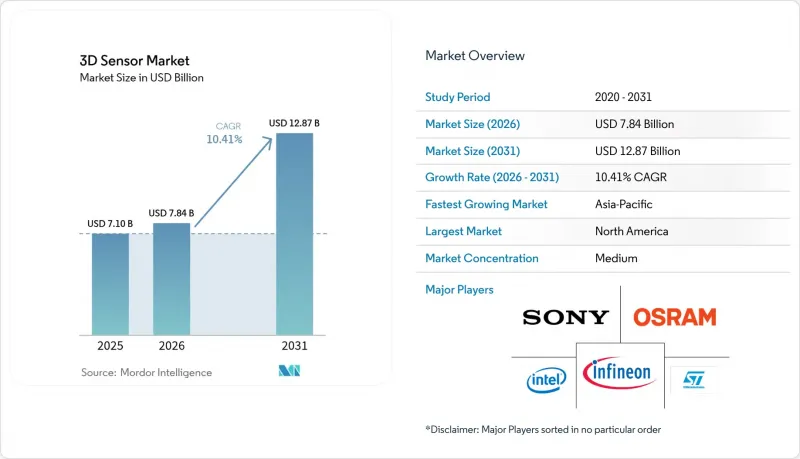
Mordor Intelligence에 의하면, 3D 센서 시장 규모는 2025년 71억 달러에서 2026년에는 78억 4,000만 달러에 이르고, 2026-2031년 CAGR 10.41%로 성장을 지속하여 2031년에는 128억 7,000만 달러에 달할 것으로 예측됩니다.
본 보고서는 제품별(위치 센서, 이미지 센서 등), 기술별(구조화된 빛, 비행 시간법 등), 최종 사용자 산업별(소비자용 전자기기, 자동차 등), 구성 요소별(IR VCSEL 이미터 등), 지역별(북미, 유럽, 아시아 등)로 분류되어 있습니다. 시장 예측은 금액(달러)으로 표시되어 있습니다.
세계 3D 센서 시장 동향 및 인사이트
스마트폰에서의 얼굴 인식 보급이 각 지역의 주도적 지위를 뒷받침하고 있습니다.
아시아의 프리미엄 스마트폰에서는 2026년까지 3D 얼굴 인식 탑재율이 65%를 넘어설 것으로 예상되며, 3D 센서 시장에서 가장 큰 단일 용도 기반으로서의 입지를 공고히 할 전망입니다. 구조화된 광 및 비행 시간(ToF) 모듈은 현재 다양한 조명 조건에서도 신뢰할 수 있는 서브mm급 깊이 맵을 생성하여 안전한 결제, 아바타 생성 및 개인화된 UI를 실현하고 있습니다. 아시아의 각 OEM 업체들은 견고성을 해치지 않으면서 전면 공간을 절약하기 위해 센서를 디스플레이 아래에 배치하기 시작했습니다. 스마트폰 생산의 양산 확대에 따라 웨어러블 및 스마트 홈 기기 등 관련 분야의 부품 비용이 하락하고 있어, 선순환적인 수요 사이클이 강화되고 있습니다.
자동차용 LiDAR가 차량 안전 기준을 새롭게 정의
유럽의 자동차 제조업체들은 2026년에 시행될 보행자용 자동 긴급 제동에 관한 NCAP 규제에 앞서 LiDAR 기반 ADAS를 도입하고 있습니다. 솔리드 스테이트 설계는 최대 200m 거리에서 센티미터 수준의 정밀도를 실현하며, 엄격한 자동차용 신뢰성 테스트를 충족하는 동시에 부품 비용을 절감하고 있습니다. 유럽의 규제 동향은 북미의 자발적인 노력에도 반영되어, 전 세계 Tier 1 센서 공급업체에 혜택을 가져다주는 통일된 요구 사항 프로파일이 형성되고 있습니다. 비용 곡선이 하락함에 따라 LiDAR의 채택은 프리미엄 모델에서 중형 부문 차량으로 확산되어, 3D 센서 시장의 잠재적 규모가 확대될 것으로 예측됩니다.
열 문제가 VCSEL 어레이 소형화의 과제
VCSEL 이미터는 점점 더 소형화되는 실적에서 더 높은 광 출력을 얻기 위해 고밀도로 배치되기 때문에 어레이 중앙부에서는 주변 온도보다 50°C나 더 높아질 수 있습니다. 접합부의 온도 상승은 효율을 저하시키고 치명적인 고장의 위험을 초래합니다. 각 디바이스 제조업체들은 열이 열에 민감한 광학 부품에 도달하기 전에 구리층으로 횡방향으로 유도하는 부문화된 구동 회로 및 첨단 패키징 기술에 대한 실험을 진행하고 있습니다. 이러한 혁신 기술을 도입함으로써 소형 소비자용 디바이스 내부의 성능을 유지하고, 현재 3D 센서 시장에서 발생하고 있는 성장의 걸림돌을 완화할 수 있을 것입니다.
부문 분석
이미지 센서는 2025년 매출의 61.35%를 차지하며, 3D 센서 시장에서 그 기초적인 역할을 입증하고 있습니다. 스마트폰, 산업용 검사, 로봇 공학 등에서는 5m 범위를 서브mm 정밀도로 커버하는 고해상도 깊이 맵이 요구되고 있으며, 이로 인해 견조한 수요가 발생하고 있습니다. 멀티스택형 후면 조사형 아키텍처와 온칩 HDR 파이프라인 덕분에 신호 대 잡음비(SNR)는 지속적으로 향상되고 있습니다. 주요 공급업체들은 300mm 웨이퍼 생산 라인으로의 전환을 추진하고 있으며, 수율 향상으로 인해 메가픽셀당 비용이 감소하고 있습니다. 제스처 인식 센서는 가장 빠른 성장세를 기록하고 있으며, 터치리스 인터페이스가 인포테인먼트 콘솔, 인터랙티브 키오스크, 의료기기에 보급됨에 따라 2031년까지 연평균 성장률(CAGR) 14.21%로 성장할 전망입니다. 새로운 모듈은 ToF 깊이, mm파 레이더, AI 추론을 단일 기판에 융합하여 조명 조건이 변화하는 상황에서도 복잡한 손의 자세를 인식할 수 있게 합니다. 아시아태평양의 OEM 설계 팀의 기술력 향상으로 개발 주기가 더욱 단축되어, 이 부문이 3D 센서 시장에서 더 높은 점유율을 확보하는 데 기여하고 있습니다.
위치 센서, 관성 측정 장치(IMU), 서모파일 소자가 제품 라인업을 보완하고 있으며, 각각은 광학 방식으로는 한계가 있는 특정 정밀도 요구 사항이나 환경 요구 사항을 충족합니다. 공급업체 간의 교차 라이선싱을 통해 지적 재산(IP)이 통합되어, 시스템 설계자가 여러 공급업체의 제품을 활용할 수 있게 되었습니다. 이미지 센서의 하위 카테고리는 2025년에 43억 6,000만 달러로 최대 규모를 차지할 것이며, 2031년까지 연평균 성장률(CAGR)이 한 자릿수 중반대를 유지할 것으로 전망됩니다. 이 카테고리 내에서는 후면 조사형 적층 CMOS 아키텍처가 출하 대수의 약 50%를 차지하고 있으며, 저전력 소비와 더 높은 다이나믹 레인지를 실현하는 방향으로의 전환이 두드러지고 있습니다. 제스처 인식 모듈은 기본 규모는 작지만, 공공 및 사적 공간에서 공용 표면과의 접촉을 최소화하려는 움직임에 힘입어 2031년까지 17억 2,000만 달러의 매출 증가를 가져올 전망입니다. 이러한 급증은 다양한 폼 팩터와 맞물려 3D 센서 시장 전체의 성장 모멘텀을 뒷받침하고 있음을 보여줍니다.
2025년에는 비행 시간(ToF) 센서가 총 매출의 45.55%를 차지할 것으로 예상되며, 이는 비용과 정밀도의 균형이 뛰어나다는 점을 반영한 결과입니다. 간접형 ToF는 VCSEL 이미터 기술이 성숙해지고 단일 광자 애벌랜치 다이오드(SPAD) 수신기가 단순화됨에 따라 소비자용 기기에서 주류를 이루고 있습니다. 한편, 피코초 단위의 타이밍 분해능을 가진 직접형 ToF는 더 긴 작동 거리가 필요한 로봇 공학 및 산업용 자동화 분야에서 주도적인 위치를 차지하고 있습니다. 광 다이오드와 동일한 칩에 정전용량식 깊이 연산 엔진을 통합함으로써 지연 시간이 대폭 단축되어, 호스트 프로세서와의 왕복 통신 없이도 엣지 AI 모델에 데이터를 공급할 수 있게 됩니다.
LiDAR 솔루션은 현재 출하량이 아직 적지만, 자동차 자율 주행 프로그램과 인프라 디지털 트윈 프로젝트에 힘입어 2031년까지 연평균 성장률(CAGR) 13.22%로 성장하고 있습니다. 솔리드 스테이트 스캔, 마이크로 전기 기계식 빔 스티어링, 주파수 변조 연속파(FMCW) 아키텍처는 가동 부품의 수를 줄이면서 측정 범위를 확대되고 있습니다. 이러한 발전으로 포인트 클라우드당 비용이 절감되어, 결과적으로 3D 센서 시장이 프리미엄 차종을 넘어 다른 분야로도 확대되고 있습니다.
구조화된 광 방식은 얼굴 인식을 통한 잠금 해제나 산업용 계측 등, 근거리에서 고해상도 데이터를 수집하는 데 여전히 선호되는 선택지입니다. 스테레오 비전과 초음파는 특정 틈새 시장에서 확고한 입지를 유지하고 있습니다. 스테레오 비전은 능동적인 조명이 필요 없는 렌즈 기반의 대안을 제공하는 반면, 초음파는 먼지나 액체로 인해 광로가 차단되는 상황에서도 작동합니다.
지역별 분석
2025년, 아시아태평양은 전 세계 매출의 37.40%를 차지했습니다. 이는 해당 지역의 반도체 팹 밀집도, 숙련된 광학 기술자의 존재, 그리고 수직 통합된 공급망을 반영한 것입니다. 중국은 자체 개발한 심도 모듈을 적극적으로 채택하고 있는 국내 스마트폰 OEM 제조업체들의 지원에 힘입어 지역 매출의 약 40%를 차지하고 있습니다. 일본은 정밀 유리 성형 및 웨이퍼 레벨 광학 기술에 뛰어나며, 산업용 로봇용 고정밀 센서를 공급하고 있습니다. 한국은 첨단 패키징 노하우를 활용하여 로직 및 센싱 기능을 단일 기판에 통합함으로써, 소형 모듈의 열 성능을 향상시키고 있습니다.
중동은 기저가 낮지만, 2031년까지 연평균 성장률(CAGR) 12.48%를 기록할 전망입니다. 각국의 스마트시티 구상에 따라, 깊이 감지 기능을 갖춘 도로 시설, 자동판매 키오스크, AI 기반 의료용 영상 진단 시스템 도입에 자금이 투입되고 있습니다. 걸프협력회의(GCC) 회원국의 국내 시스템 통합사업자들은 기후 및 언어 요건을 충족하는 솔루션을 현지화하기 위해 유럽 및 아시아의 부품 공급업체와 제휴를 추진하고 있습니다. 소매 부문의 신속한 조달 주기로 인해 시범 단계에서 양산까지의 기간이 단축되고 있으며, 이는 3D 센서 시장에 단기적인 성장 기회를 제공합니다.
북미는 활기찬 벤처 생태계와 국방 주도의 연구 보조금에 힘입어 계속해서 LiDAR 연구 개발(R&D)의 중심지로 자리 잡고 있습니다. 이 지역의 1차 자동차 부품 공급업체들은 칩 스케일 빔 스티어링 구현을 위한 노력을 주도하고 있습니다. 유럽에서는 엄격한 데이터 보호법이 있음에도 불구하고, 자동차 및 산업용 자동화 분야 수요가 지속되고 있어, 에지 측에서 개인 데이터를 처리하는 센서 설계가 촉진되고 있습니다. 남미에서는 보안 및 애그리테크 분야에서 조기 도입이 나타나는 반면, 아프리카에서의 도입은 주로 견고한 센싱 솔루션이 필요한 물류 허브 및 광업 사업에 국한되어 있습니다.
기타 혜택:
- 엑셀 형식 시장 예측(ME) 시트
- 3개월간의 애널리스트 지원
자주 묻는 질문
목차
제1장 서론
제2장 조사 방법
제3장 주요 요약
제4장 시장 구도
제5장 시장 규모와 성장 예측
제6장 경쟁 구도
제7장 시장 기회와 향후 전망
LSH 26.09.08According to Mordor Intelligence, the 3D sensor market size is expected to grow from USD 7.10 billion in 2025 to USD 7.84 billion in 2026 and is forecast to reach USD 12.87 billion by 2031 at 10.41% CAGR over 2026-2031.
This report is Segmented by Product (Position Sensors, Image Sensors and More), Technology (Structured Light, Time-Of-Flight and More), End-User Vertical (Consumer Electronics, Automotive and More), Component (IR VCSEL Emitters, and More), and Geography (North America, Europe, Asia and More). The Market Forecasts are Provided in Terms of Value (USD).
Global 3D Sensor Market Trends and Insights
Smartphone facial recognition adoption fuels regional leadership
Premium handsets in Asia are expected to pass a 65% attachment rate for 3D facial recognition by 2026, consolidating the 3D sensor market's largest single application base. Structured-light and Time-of-Flight modules now generate sub-millimeter depth maps reliable under varied lighting, enabling secure payments, avatar creation, and personalized UI. Asian OEMs have moved sensors beneath the display to save frontage without sacrificing robustness. Volume scaling in handset production is lowering component costs for adjacent sectors such as wearables and smart-home devices, reinforcing a virtuous demand cycle.
Automotive LiDAR transforms vehicle-safety benchmarks
European automakers are installing LiDAR-based ADAS ahead of the 2026 NCAP mandate for pedestrian automatic emergency braking. Solid-state designs deliver centimeter-level accuracy at up to 200 m, meeting stringent automotive reliability tests while shrinking bill-of-materials. The regulatory push in Europe is echoed by voluntary commitments in North America, creating a homogeneous requirements profile that benefits global tier-one sensor suppliers. As cost curves decline, LiDAR uptake is expected to cascade from premium models into mid-segment vehicles, enlarging the 3D sensor market addressable volume.
Thermal challenges hinder VCSEL array miniaturization
As VCSEL emitters are packed closer to achieve higher optical power in ever-smaller footprints, central elements in an array can run 50 °C hotter than ambient. Elevated junction temperatures degrade efficiency and risk catastrophic failure. Device makers are experimenting with segmented drive circuits and advanced packaging that routes heat laterally to copper layers before it reaches sensitive optics. Adoption of these innovations will moderate the current drag on the 3D sensor market by preserving performance inside compact consumer devices.
Other drivers and restraints analyzed in the detailed report include:
- Proliferation of depth-sensing cameras in mixed-reality headsets
- Collaborative robots advance precision electronics assembly
- EU AI Act creates compliance burdens for biometric sensing
For complete list of drivers and restraints, kindly check the Table Of Contents.
Segment Analysis
Image Sensors accounted for 61.35% of 2025 revenue, confirming their foundational role in the 3D sensor market. Robust demand arises from smartphones, industrial inspection, and robotics that depend on high-resolution depth maps spanning 5 m ranges with sub-millimeter precision. Multi-stack backside-illuminated architectures and on-chip HDR pipelines continue to improve signal-to-noise ratios. Leading suppliers have shifted to 300 mm wafer lines, driving yield improvements that lower cost per megapixel. Gesture-Recognition Sensors record the fastest expansion, advancing at a 14.21% CAGR to 2031 as touchless interfaces penetrate infotainment consoles, interactive kiosks, and healthcare devices. New modules fuse ToF depth, millimeter-wave radar, and AI inference on a single substrate, enabling recognition of complex hand poses under variable lighting. Upskilled OEM design teams in Asia-Pacific further shorten development cycles, helping this segment accumulate a higher share of the 3D sensor market.
Position Sensors, Inertial Measurement Units, and Thermopile elements round out the portfolio, each addressing specific accuracy or environmental requirements where optical methods face limits. Cross-licensing among suppliers is consolidating IP, ensuring multi-vendor availability for system designers.The image-sensor subcategory represents the largest at USD 4.36 billion in 2025 and is on course for a mid-single-digit CAGR through 2031. Within this category, back-illuminated stacked CMOS architectures commanded roughly 50% of shipments, underscoring the move toward higher dynamic range at lower power. Gesture-recognition modules, despite a smaller base, are set to contribute USD 1.72 billion incremental revenue by 2031 as public and private spaces look to minimize shared-surface contact. This surge illustrates how diversified form factors collectively reinforce growth momentum across the 3D sensor market.
Time-of-Flight sensors generated 45.55% of total revenue in 2025, reflecting their favorable cost-to-accuracy balance. Indirect ToF dominates consumer devices thanks to mature VCSEL emitters and simple single-photon avalanche diode (SPAD) receivers. Direct ToF variants, with picosecond timing resolution, lead in robotics and industrial automation requiring longer working distances. Integration of capacitive depth-computation engines on the same die as photodiodes slashes latency, feeding edge-AI models without round-trips to host processors.
LiDAR solutions, though smaller in today's shipment volumes, are growing at a 13.22% CAGR through 2031, propelled by automotive autonomy programs and infrastructure digital-twin projects. Solid-state scanning, micro-electro-mechanical beam steering, and frequency-modulated continuous-wave architectures are improving range while lowering moving-part counts. These advances reduce cost per point cloud and, by extension, broaden the 3D sensor market beyond premium vehicles.
Structured-light remains a preferred choice for close-range, high-detail capture such as facial unlocking and industrial metrology. Stereo vision and ultrasound maintain footholds in specific niches-stereo offers a lens-based alternative without active illumination, while ultrasound succeeds where optical paths are obstructed by dust or fluid.
Complete Report Scope:
- By Product
- Position Sensors
- Image Sensors (3D Cameras)
- Temperature Sensors
- Accelerometer and IMU Sensors
- Ambient-Light and Proximity Sensors
- Gesture-Recognition Sensors
- By Technology
- Structured Light
- Time-of-Flight (dToF and iToF)
- Stereo Vision
- LiDAR (Flash and FMCW)
- Ultrasound
- By End-User Vertical
- Consumer Electronics
- Automotive and Transportation
- Healthcare and Medical Devices
- Industrial Automation and Robotics
- Security and Surveillance
- Aerospace and Defence
- By Component
- IR VCSEL Emitters
- Depth Image Sensors
- System-on-Chip Processors
- Optics and Filters
- Illumination Modules
- Software and Algorithms
- By Geography
- North America
- United States
- Canada
- South America
- Brazil
- Argentina
- Europe
- United Kingdom
- Germany
- France
- Nordics (Sweden, Norway, Denmark, Finland)
- Middle East
- GCC
- Turkey
- Africa
- South Africa
- Nigeria
- Asia-Pacific
- China
- Japan
- South Korea
- India
- North America
Geography Analysis
Asia-Pacific commanded 37.40% of global revenue in 2025, reflecting the region's dense semiconductor fabs, skilled optics workforce, and vertically integrated supply chains. China accounts for about 40% of regional sales, bolstered by domestic smartphone OEMs that are aggressively adopting in-house depth modules. Japan excels in precision glass molding and wafer-level optics, feeding high-accuracy sensors for industrial robotics. South Korea leverages advanced packaging know-how to integrate logic and sensing into single substrates, improving thermal performance in compact modules.
The Middle East, though starting from a low base, is on course for a 12.48% CAGR through 2031. National smart-city roadmaps fund installations of depth-sensing street furniture, automated retail kiosks, and AI-enabled healthcare imaging suites. Domestic system integrators in the Gulf Cooperation Council are forging partnerships with European and Asian component vendors to localize solutions that meet climatic and linguistic requirements. Rapid procurement cycles in the retail sector are accelerating pilot-to-production timelines, providing near-term upside for the 3D sensor market.
North America remains the epicenter of LiDAR RandD, supported by a vibrant venture ecosystem and defense-driven research grants. Tier-one automotive suppliers here lead the push toward chip-scale beam steering. Europe sustains demand in automotive and industrial automation despite rigorous data-protection laws, spurring sensor designs that process personal data at the edge. South America shows early adoption in security and agritech, while Africa's deployments are mainly confined to logistics hubs and mining operations that require rugged sensing solutions.
- Intel Corp.
- Sony Group Corp.
- ams OSRAM AG
- STMicroelectronics N.V.
- Infineon Technologies AG
- Lumentum Holdings Inc.
- Apple Inc. (PrimeSense)
- Samsung Electronics Co. Ltd.
- OmniVision Technologies Inc.
- Panasonic Holdings Corp.
- Cognex Corp.
- Sick AG
- LMI Technologies Inc.
- Teledyne e2v
- Qualcomm Inc.
- SoftKinetic (Sony DepthSense)
- Melexis N.V.
- Himax Technologies Inc.
- Velodyne Lidar Inc.
- XYZ Interactive Technologies
Additional Benefits:
- The market estimate (ME) sheet in Excel format
- 3 months of analyst support
TABLE OF CONTENTS
1 INTRODUCTION
- 1.1 Study Assumptions and Market Definition
- 1.2 Scope of the Study
2 RESEARCH METHODOLOGY
3 EXECUTIVE SUMMARY
4 MARKET LANDSCAPE
- 4.1 Market Overview
- 4.2 Market Drivers
- 4.2.1 Smartphone Facial Recognition Adoption (Asia)
- 4.2.2 Automotive LiDAR-Assisted ADAS Roll-outs (Europe)
- 4.2.3 Proliferation of Depth-Sensing Cameras in AR/VR Headsets (US)
- 4.2.4 Deployment of Collaborative Robots in Electronics Assembly (South Korea, Taiwan)
- 4.2.5 Integration of 3D Sensors in Security and Surveillance Systems
- 4.2.6 Edge-AI Powered 3D Vision for Smart Retail (GCC)
- 4.3 Market Restraints
- 4.3.1 Thermal Management Challenges in Miniaturised VCSEL Arrays
- 4.3.2 Privacy-Led Regulatory Scrutiny on Depth Cameras (EU AI Act)
- 4.3.3 High Power Consumption in Continuous Time-of-Flight Modules
- 4.3.4 Semiconductor Supply-Chain Tightness for Gallium-Nitride Lasers
- 4.4 Value / Supply-Chain Analysis
- 4.5 Regulatory and Technological Outlook
- 4.6 Porter's Five Forces Analysis
- 4.6.1 Bargaining Power of Suppliers
- 4.6.2 Bargaining Power of Consumers
- 4.6.3 Threat of New Entrants
- 4.6.4 Threat of Substitutes
- 4.6.5 Intensity of Competitive Rivalry
- 4.7 Patent Landscape
5 MARKET SIZE AND GROWTH FORECASTS (VALUE)
- 5.1 By Product
- 5.1.1 Position Sensors
- 5.1.2 Image Sensors (3D Cameras)
- 5.1.3 Temperature Sensors
- 5.1.4 Accelerometer and IMU Sensors
- 5.1.5 Ambient-Light and Proximity Sensors
- 5.1.6 Gesture-Recognition Sensors
- 5.2 By Technology
- 5.2.1 Structured Light
- 5.2.2 Time-of-Flight (dToF and iToF)
- 5.2.3 Stereo Vision
- 5.2.4 LiDAR (Flash and FMCW)
- 5.2.5 Ultrasound
- 5.3 By End-User Vertical
- 5.3.1 Consumer Electronics
- 5.3.2 Automotive and Transportation
- 5.3.3 Healthcare and Medical Devices
- 5.3.4 Industrial Automation and Robotics
- 5.3.5 Security and Surveillance
- 5.3.6 Aerospace and Defence
- 5.4 By Component
- 5.4.1 IR VCSEL Emitters
- 5.4.2 Depth Image Sensors
- 5.4.3 System-on-Chip Processors
- 5.4.4 Optics and Filters
- 5.4.5 Illumination Modules
- 5.4.6 Software and Algorithms
- 5.5 By Geography
- 5.5.1 North America
- 5.5.1.1 United States
- 5.5.1.2 Canada
- 5.5.2 South America
- 5.5.2.1 Brazil
- 5.5.2.2 Argentina
- 5.5.3 Europe
- 5.5.3.1 United Kingdom
- 5.5.3.2 Germany
- 5.5.3.3 France
- 5.5.3.4 Nordics (Sweden, Norway, Denmark, Finland)
- 5.5.4 Middle East
- 5.5.4.1 GCC
- 5.5.4.2 Turkey
- 5.5.5 Africa
- 5.5.5.1 South Africa
- 5.5.5.2 Nigeria
- 5.5.6 Asia-Pacific
- 5.5.6.1 China
- 5.5.6.2 Japan
- 5.5.6.3 South Korea
- 5.5.6.4 India
- 5.5.1 North America
6 COMPETITIVE LANDSCAPE
- 6.1 Market Concentration
- 6.2 Strategic Moves
- 6.3 Market Share Analysis
- 6.4 Company Profiles (includes Global level Overview, Market level overview, Core Segments, Financials as available, Strategic Information, Market Rank/Share for key companies, Products and Services, and Recent Developments)
- 6.4.1 Intel Corp.
- 6.4.2 Sony Group Corp.
- 6.4.3 ams OSRAM AG
- 6.4.4 STMicroelectronics N.V.
- 6.4.5 Infineon Technologies AG
- 6.4.6 Lumentum Holdings Inc.
- 6.4.7 Apple Inc. (PrimeSense)
- 6.4.8 Samsung Electronics Co. Ltd.
- 6.4.9 OmniVision Technologies Inc.
- 6.4.10 Panasonic Holdings Corp.
- 6.4.11 Cognex Corp.
- 6.4.12 Sick AG
- 6.4.13 LMI Technologies Inc.
- 6.4.14 Teledyne e2v
- 6.4.15 Qualcomm Inc.
- 6.4.16 SoftKinetic (Sony DepthSense)
- 6.4.17 Melexis N.V.
- 6.4.18 Himax Technologies Inc.
- 6.4.19 Velodyne Lidar Inc.
- 6.4.20 XYZ Interactive Technologies
7 MARKET OPPORTUNITIES AND FUTURE OUTLOOK
- 7.1 White-Space and Unmet-Need Assessment