|
시장보고서
상품코드
2121344
분체 도료 : 시장 점유율 분석, 업계 동향과 통계, 성장 예측(2026-2031년)Powder Coatings - Market Share Analysis, Industry Trends & Statistics, Growth Forecasts (2026 - 2031) |
||||||
 Mordor Intelligence
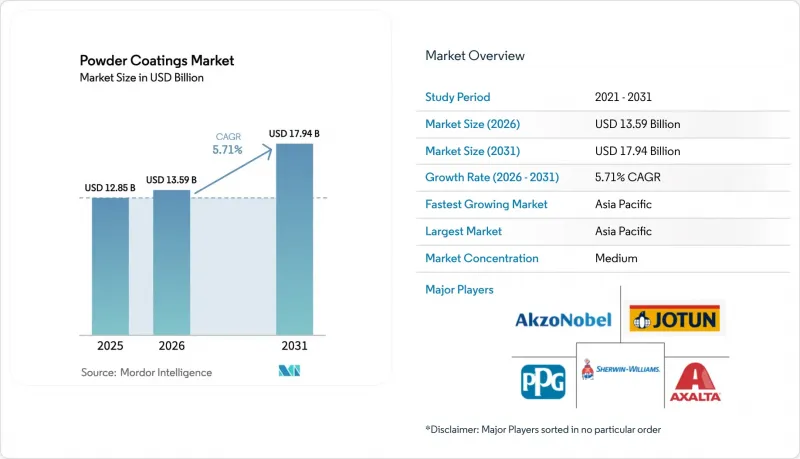
Mordor Intelligence에 의하면, 분체 도료 시장 규모는 2025년 128억 5,000만 달러, 2026년 135억 9,000만 달러에서 2031년까지 179억 4,000만 달러에 이르고, 2026-2031년 CAGR 5.71%를 나타낼 것으로 예측됩니다.
본 보고서는 수지 유형(에폭시, 폴리에스터, 에폭시·폴리에스터, 폴리우레탄, 아크릴, 기타 수지), 코팅 유형(열경화성 및 열가소성), 최종 이용 산업(건축·장식, 자동차, 산업용, 기타),기판(금속, MDF·목재, 기타), 지역(아시아태평양, 북미, 기타)별로 분류되어 있습니다. 시장 예측은 금액(미 달러) 기준으로 제시되어 있습니다.
세계 분체 도료 시장 동향 및 인사이트
엄격한 VOC 규제 및 탄소 가격 제도가 무용제 마감의 보급을 가속화하고 있습니다.
규제로 인해 액체 도장 부스보다 분체 도장 라인이 점점 더 우대받게 되었으며, 그 결과 총 소유 비용 절감으로 이어지고 있습니다. 2024년 12월, 미국 환경보호청(EPA)은 VOC 함량 상한선을 350 g/L로 설정했습니다. 이 조치로 인해 가공업체들은 배출 저감 설비 비용과 분체 도장 부스 설치라는 선택지를 비교 검토할 수밖에 없게 되었습니다. 한편, 유럽에서는 2026년 1월 발효 예정인 ‘탄소 국경 조정 메커니즘’에 따라 수입 금속 제품에 EU 배출권 거래 제도(EU-ETS)의 탄소 가격이 적용될 예정입니다. 이에 따라 튀르키예와 인도의 수출업체들은 관세를 회피하기 위해 분체 도장 솔루션으로의 전환을 추진하고 있습니다. 중국에서는 장쑤성과 광둥성에서 분체 도장 설비 비용의 일부가 성 정부 보조금으로 충당되고 있습니다. 이러한 조치는 중국의 ‘제14차 5개년 계획’에 명시된 VOC(휘발성 유기 화합물) 배출량을 10% 감축하겠다는 목표에 부합하는 것입니다. 이러한 협력적인 노력 덕분에 중규모 분체 도장 설비의 투자 회수 기간이 대폭 단축되었습니다. 또한, 각 OEM 업체들이 무용제 마감 처리를 채택함으로써 기업의 넷 제로(Net Zero) 목표 달성을 위한 노력을 강화하고, 가구, 가전, 운송 장비 업계에서 분체 도장의 보급을 촉진하고 있습니다.
저온 경화 기술로 MDF 및 열에 민감한 기판에 적용 가능
획기적인 배합을 통해 110°C에서 130°C의 온도 범위에서 경화가 가능해졌으며, 기판의 변형을 유발하지 않고集成材 및 특정 플라스틱에 도포할 수 있게 되었습니다. BASF의 ‘Ultradur High Speed’ 폴리에스터는 130°C에서 완전한 가교를 달성하며, 프라이머 없이도 MDF 위에서 ISO 2409 규격에 부합하는 접착력을 보여줍니다. 마찬가지로, Axalta의 ‘AquaEC’ 시스템은 110°C에서 폴리프로필렌 범퍼에 도포할 수 있으며, ASTM D3359 테이프 시험을 통과했습니다. 가구 제조업체들은 빠르게 이 기술을 도입하고 있습니다. IKEA는 캐비닛 프레임에 이 저소성 온도 분체 도료를 채택하여 에너지 절약 효과를 강조함과 동시에, 수성 도료에서 흔히 발생하는 나뭇결이 도장 표면에 드러나는 문제를 해결했습니다. 수지 비용은 표준 폴리에스테르보다 높지만, 에너지 및 인건비의 대폭적인 절감을 통해 장식용 패널, 사무용 가구, 자동차 내장재 분야에서 이 기술의 장기적인 성장이 크게 기대되고 있습니다.
25마이크론 미만의 박막 도포 한계
입자 크기의 제약으로 인해 균일한 필름 형성이 방해받고 있어, 고급 자동차의 외장 패널이나 가전제품의 케이스에 분체 도료를 채택하는 데 차질이 생기고 있습니다. 분체 도료는 유동화 및 정전기 문제에 직면해 있으며, 그 결과 액체 도료에 비해 자동차 업계의 검사에서 불량률이 높게 나타나고 있습니다. 2025년 슈어윈-윌리엄스(Sherwin-Williams)사가 실시한 수지 개량으로 인해 실용 가능한 도막 두께는 낮아졌지만, 여전히 자동차 제조업체가 설정한 목표에는 미치지 못하고 있습니다. 박막 형성 기술이 발전할 때까지는 액체 탑코트가 클래스 A 표면을 계속 지배할 것이며, 외관이 최우선으로 고려되는 분야에서의 분체 도료 적용은 제한될 것입니다.
부문 분석
2025년 시점에서 폴리에스테르계 분체 도료는 수지 시장 규모의 39.18%를 차지하고 있으며, 2031년까지 연평균 성장률(CAGR) 6.29%를 유지하여 에폭시계 및 아크릴계를 크게 상회하고 있습니다. 특히, 폴리에스테르-TGIC 계열 시스템은 AAMA 2605의 내후성 기준을 일관되게 충족하며, 플로리다의 태양 아래에서 10년 동안 견뎌도 눈에 띄는 백화 현상이 발생하지 않습니다.
건축용 알루미늄 압출재, 농업 기계, 야외용 가구는 모두 경쟁력 있는 가격에 높은 자외선 안정성이 요구되어 가장 강력한 수요를 견인하고 있습니다. 에폭시 수지는 부식 방지 성능으로 높은 평가를 받고 있지만, 햇빛에 노출되면 변색되기 쉬운 경향이 있어 그 용도는 주로 가전제품 내부나 자동차 언더바디 부품으로 제한되어 있습니다. 하이브리드형 에폭시·폴리에스테르 수지는 균형 잡힌 성능으로 실내용 금속 가구 및 HVAC 캐비닛에 있어 중간적인 선택지로 기능하고 있습니다. 석유 및 가스 파이프라인용 틈새 시장인 폴리우레탄은 내마모성을 갖추고 있어, 그로 인해 가격 프리미엄이 책정되어 있습니다. 아크릴 분말은 장식용 휠의 광택을 유지하는 한편, 비용 측면의 제약에 직면해 있습니다. 해상 풍력 발전소 및 태양광 발전소 증가에 따라, ISO 12944 C5-M을 준수하는 에폭시 프라이머와 폴리에스테르계 도료를 조합한 2층 도장 시스템이 가혹한 해양 환경에서 점점 더 선호되고 있습니다.
2025년에는 열경화성 등급이 매출의 91.05%를 차지할 것으로 보이며, 그 성장률은 열가소성 수지에 미치지 못하겠지만, 절대적인 수량 면에서의 우위는 앞으로도 지속될 전망입니다. 비가역적인 공유 결합에 의한 뛰어난 내용제성 및 내마모성은 세제나 염분에 노출되어야 하는 섀시, 배터리 트레이, 백색 가전제품의 외장에 적합합니다. 열가소성 등급의 분체 도장 시장 규모는 작지만, 전자기기 및 자동차 내장이 EU 순환 경제 행동 계획에서 정한 재활용 목표 달성을 목표로 하는 가운데, 연평균 성장률(CAGR) 6.17%로 확대되고 있습니다.
BASF사의 ‘Relest’를 이용한 시험 결과, 폴리올레핀계 열가소성 플라스틱이 재분쇄 및 재사용이 가능함이 입증되었습니다. 그러나 이러한 열가소성 플라스틱은 경도나 내화학성이 떨어지기 때문에 그 용도는 저응력 환경으로 제한되어 있습니다. BASF와 코베스트로가 바이오 폴리에스터로 제품 포트폴리오를 확장하는 움직임은 성능과 지속가능성을 모두 갖춘 미래를 예고합니다. 이러한 전환은 특히 비용 평등성이 실현된다면 시장 점유율에 큰 변화를 가져올 가능성이 있습니다.
지역별 분석
아시아태평양은 2025년에 분체 도료 시장 매출의 55.65%를 차지할 것으로 예상되며, 2031년까지 연평균 성장률(CAGR) 5.91%를 나타낼 것으로 전망됩니다. 베트남의 가전제품 수출에 따라 백색 가전 본체용 분체 도료의 연간 수요가 대폭 증가했습니다. 태국의 자동차 생산에서는 차체 하부 도장에 분체 도료가 채택되어, 각 OEM 업체들이 4단계 배기가스 규제를 준수할 수 있게 되었습니다. 2025년까지 가구 및 가전 분야에서 시장 침투율을 높이기 위해, 중국은 장쑤성과 광둥성의 분체 도장 설비에 대한 보조금을 통해 그 목표를 뒷받침하고 있습니다. 한편, 자동차 생산 확대를 목표로 하는 인도에서는 특히 푸네와 첸나이 근교를 중심으로 국내 분체 도장 생산 능력 확대가 진행되고 있습니다.
북미에서는 전기차(EV) 생산 라인의 국내 복귀와 USMCA(미국·멕시코·캐나다 협정)의 원산지 규정 조항이 결실을 맺고 있습니다. GM, 포드, 스텔란티스는 미국 및 캐나다 시설에 막대한 투자를 단행하며, 특히 배터리 케이스와 프레임에 분체 도장을 활용하는 데 주력했습니다. 멕시코에서는 분체 도장 채택이 대폭 증가한 반면, 캐나다의 압출 성형 제조업체들은 커튼월(curtain wall)에 분체 도장을 채택하여 AAMA 2605 규격 준수를 확보했습니다.
‘산업 배출 지침’은 유럽의 분체 도장 시장에 막대한 영향을 미치고 있으며, 순환 경제의 추진을 의무화하고 있습니다. CAFE 목표를 준수하기 위해 독일의 자동차 제조업체는 배터리 트레이에 분체 도장을 도입했습니다. 프랑스의 건설업체는 RE2020 저탄소 규정을 준수하여 알루미늄 프레임의 대부분에 분체 도장을 사용했습니다. 영국의 ‘2021년 환경법’은 가전 제조업체들에게 VOC 제로 도장으로의 전환을 촉구하고 있습니다. 이탈리아에서는 롬바르디아주의 한 가구 제조업체가 분체 도장으로의 전환을 통해 용제 사용량을 줄이는 중요한 이정표를 달성했습니다.
규모는 작지만 남미 및 중동 및 아프리카에서도 분체 도장 시장은 급속한 성장을 이루고 있습니다. 브라질에서는 저배출 제조를 촉진하는 세제 혜택에 힘입어 상용차 분야의 분체 도장 사용이 확대되었습니다. 사우디아라비아의 야심 찬 기가 프로젝트 덕분에 수입량이 대폭 증가했습니다. 아랍에미리트(UAE)에서는 친환경 건축 기준에 따라 커튼월의 상당 부분에 분체 도장 사용이 의무화되었습니다. 주로 수출을 목적으로 하는 남아프리카공화국의 자동차 공장은 유로 6에 상응하는 기준을 충족하기 위해 분체 도장으로의 전환을 추진하고 있습니다.
기타 혜택:
- 엑셀 형식 시장 예측(ME) 시트
- 3개월간의 애널리스트 지원
자주 묻는 질문
목차
제1장 서론
제2장 조사 방법
제3장 주요 요약
제4장 시장 구도
제5장 시장 규모와 성장 예측
제6장 경쟁 구도
제7장 시장 기회와 향후 전망
LSH 26.09.08According to Mordor Intelligence, the powder coatings market size is projected to expand from USD 12.85 billion in 2025 and USD 13.59 billion in 2026 to USD 17.94 billion by 2031, registering a CAGR of 5.71% between 2026 to 2031.

This report is Segmented by Resin Type (Epoxy, Polyester, Epoxy-Polyester, Polyurethane, Acrylic, and Other Resin Types), Coating Type (Thermoset and Thermoplastic), End-Use Industry (Architecture and Decorative, Automotive, Industrial, and Others), Substrate (Metal, MDF and Wood, and More), and Geography (Asia-Pacific, North America, and More). The Market Forecasts are Provided in Terms of Value (USD).
Global Powder Coatings Market Trends and Insights
Stringent VOC And Carbon-Pricing Rules Accelerating Solvent-Free Finishes
Regulations are increasingly favoring powder lines over liquid booths, leading to a reduced total cost of ownership. In December 2024, the U.S. EPA set a VOC content cap at 350 g/L. This move has forced converters to evaluate the cost of abatement hardware against the option of installing powder booths. Meanwhile, in Europe, the Carbon Border Adjustment Mechanism, set to take effect in January 2026, will apply the EU-ETS carbon price to imported metal goods. This has led exporters in Turkey and India to pivot towards powder solutions to sidestep tariffs. In China, provincial subsidies in Jiangsu and Guangdong are covering a portion of powder equipment costs. This initiative aligns with China's 10% VOC-reduction goal under its 14th Five-Year Plan. Thanks to these concerted efforts, the payback period for mid-scale powder installations has been significantly reduced. Additionally, OEMs are adopting solvent-free finishes, bolstering their corporate net-zero commitments and driving the uptake of powder coatings in the furniture, appliance, and transportation industries.
Low-Temperature Chemistries Unlocking MDF And Heat-Sensitive Substrates
Breakthrough formulations now cure at temperatures between 110 °C and 130 °C, enabling their application on engineered wood and select plastics without causing substrate distortion. BASF's Ultradur High Speed polyester achieves full cross-linking at 130 °C, adhering to ISO 2409 standards on MDF without the need for primers. Similarly, Axalta's AquaEC system performs on polypropylene bumpers at 110 °C, successfully passing ASTM D3359 tape tests. Furniture manufacturers are quick to adapt: IKEA utilized the low-bake powder on its cabinet frames, highlighting energy savings and resolving grain-raising challenges typical of water-borne liquids. While resin costs are higher than standard polyesters, the significant energy and labor savings make a strong case for the technology's long-term growth in decorative panels, office furniture, and automotive interiors.
Thin-Film Application Limits Below 25 Microns
Particle size constraints hinder the production of uniform films, preventing the use of powder in premium exterior auto panels and shells of consumer electronics. Powders face challenges with fluidization and electrostatic charge, leading to higher reject rates in automotive audits compared to their liquid counterparts. Sherwin-Williams' resin upgrade in 2025 pushed the viable build down but still falls short of the targets set by automakers. Until advancements are made in thin-film deposition, liquid topcoats will continue to dominate Class-A surfaces, limiting powder's application in categories where appearance is paramount.
Other drivers and restraints analyzed in the detailed report include:
- ASEAN Appliance Build-Out Fueled By FDI
- Re-Shoring Of Auto OEM Lines
- UV-Cure Powders Still Geometry-Restricted
For complete list of drivers and restraints, kindly check the Table Of Contents.
Segment Analysis
Polyester powders generated 39.18% of the powder coatings market size for resins in 2025 and are enjoying a 6.29% CAGR through 2031, well ahead of epoxies and acrylics. Notably, polyester-TGIC systems consistently achieve AAMA 2605 weatherability standards, enduring a decade of Florida's sun without significant chalking.
Architectural aluminum extrusions, agricultural equipment, and outdoor furniture, all demanding high UV stability at competitive prices, drive the strongest demand. While epoxies are valued for their corrosion protection, their use is largely limited to appliance interiors and underbody auto parts due to their tendency to discolor in sunlight. Hybrid epoxy-polyesters serve as a middle ground for indoor metal furniture and HVAC cabinets, where a balanced performance is adequate. Niche polyurethanes, catering to oil-and-gas pipelines, offer abrasion resistance that commands a price premium. Acrylic powders, while maintaining gloss for decorative wheels, face cost constraints. With the rise of offshore wind and solar farms, dual-layer epoxy primers topped with polyester systems, compliant with ISO 12944 C5-M, are increasingly favored in challenging marine environments.
Thermoset grades dominated revenue at 91.05% in 2025, and although their growth trails thermoplastics, the absolute volume advantage will persist. Superior solvent and abrasion resistance from irreversible covalent bonding suits chassis, battery trays, and white-goods casings that must survive detergent and salt exposure. The powder coatings market size for thermoplastic grades is smaller but rising at a 6.17% CAGR as electronics and automotive interiors pursue recyclability targets outlined in the EU Circular Economy Action Plan.
BASF's Relest trials demonstrate that polyolefin thermoplastics can be reground and reapplied. However, these thermoplastics lag in hardness and chemical durability, limiting their applications to low-stress scenarios. The move by BASF and Covestro to expand their portfolios into bio-based polyesters hints at a future where performance meets sustainability. This shift could lead to a significant market share change, especially once cost parity is realized.
Complete Report Scope:
- By Resin Type
- Epoxy
- Polyester
- Epoxy-Polyester
- Polyurethane
- Acrylic
- Other Resin Types (Polyvinyl Chloride, Polyolefins)
- By Coating Type
- Thermoset Powder Coatings
- Thermoplastic Powder Coatings
- By End-use Industry
- Architecture and Decorative
- Automotive
- Industrial
- Others (Furniture, Appliances, etc.)
- By Substrate
- Metal
- MDF and Wood
- Plastics and Composites
- Glass and Other Non-conductive Substrates
- By Geography
- Asia-Pacific
- China
- India
- Japan
- South Korea
- Rest of Asia-Pacific
- North America
- United States
- Canada
- Mexico
- Europe
- Germany
- France
- United Kingdom
- Italy
- Rest of Europe
- South America
- Brazil
- Argentina
- Rest of South America
- Middle-East and Africa
- Saudi Arabia
- South Africa
- Rest of Middle-East and Africa
- Asia-Pacific
Geography Analysis
Asia-Pacific commanded 55.65% of the powder coatings market revenue in 2025 and is tracking a 5.91% CAGR to 2031. Vietnamese appliance exports necessitated a significant annual draw of powder for white-goods casings. Thailand's automotive production relied on powder for underbodies, enabling OEMs to comply with Phase 4 emissions standards. In a bid to achieve higher market penetration in furniture and appliances by 2025, China is backing its target with subsidies for powder equipment in Jiangsu and Guangdong. Meanwhile, India's ambition to increase vehicle production is driving an expansion of domestic powder capacity, particularly near Pune and Chennai.
North America is reaping the rewards of re-shored EV lines and the stipulations of USMCA origin rules. GM, Ford, and Stellantis invested heavily in their U.S. and Canadian facilities, with a focus on using powder for battery enclosures and frames. Mexico's adoption of powder coatings increased significantly, while Canadian extruders utilized powder for curtain walls, ensuring compliance with AAMA 2605 standards.
The Industrial Emissions Directive heavily influences Europe's powder coatings market and mandates promoting a circular economy. To align with CAFE targets, German automakers turned to powder coatings for battery trays. French builders, adhering to the RE2020 low-carbon regulations, used powder on a majority of their aluminum frames. The UK's Environmental Act 2021 is pushing appliance manufacturers towards zero-VOC coatings. In Italy, furniture producers in Lombardy achieved a significant milestone, reducing solvent use through a shift towards powder coatings.
Though smaller in scale, South America and the Middle East-Africa regions are witnessing rapid growth in the powder coatings market. Brazil boosted powder usage in commercial vehicles, spurred by tax incentives promoting low-emission manufacturing. Thanks to Saudi Arabia's ambitious giga-projects, imports surged significantly. In the UAE, green-building codes mandated the use of powder coatings on a majority of curtain walls. South Africa's auto plants, primarily focused on exports, are transitioning to powder coatings to meet Euro 6-equivalent standards.
- Advanced Powder Coatings
- Akzo Nobel N.V.
- Asian Paints PPG Pvt. Ltd.
- Axalta Coating Systems, LLC
- BASF
- Berger Paints India
- Cardinal
- Hempel A/S
- IFS Coatings
- IGP Pulvertechnik AG
- Jotun
- Kansai Paint Co.,Ltd.
- NATIONAL PAINTS FACTORIES CO. LTD.
- Nippon Paint Holdings Co., Ltd.
- PPG Industries, Inc.
- RPM International Inc. (TCI Powder Coatings)
- SAK Coat
- ST POWDER COATINGS S.P.A.
- Teknos Group
- The Sherwin-Williams Company
- TIGER Coatings GmbH & Co. KG
Additional Benefits:
- The market estimate (ME) sheet in Excel format
- 3 months of analyst support
TABLE OF CONTENTS
1 Introduction
- 1.1 Study Assumptions and Market Definition
- 1.2 Scope of the Study
2 Research Methodology
3 Executive Summary
4 Market Landscape
- 4.1 Market Overview
- 4.2 Market Drivers
- 4.2.1 Stringent VOC and carbon-pricing rules accelerating solvent-free finishes
- 4.2.2 Low-temperature chemistries unlocking MDF and heat-sensitive substrates
- 4.2.3 ASEAN appliance build-out fuelled by FDI
- 4.2.4 Re-shoring of auto OEM lines
- 4.2.5 GCC giga-projects spurring architectural aluminium demand
- 4.3 Market Restraints
- 4.3.1 Thin-film (less than 25 µm) application limits
- 4.3.2 UV-cure powders still geometry-restricted
- 4.3.3 Polyester/epoxy feedstock price volatility
- 4.4 Value Chain Analysis
- 4.5 Porter's Five Forces
- 4.5.1 Bargaining Power of Suppliers
- 4.5.2 Bargaining Power of Buyers
- 4.5.3 Threat of New Entrants
- 4.5.4 Threat of Substitutes
- 4.5.5 Intensity of Competitive Rivalry
5 Market Size and Growth Forecasts (Value)
- 5.1 By Resin Type
- 5.1.1 Epoxy
- 5.1.2 Polyester
- 5.1.3 Epoxy-Polyester
- 5.1.4 Polyurethane
- 5.1.5 Acrylic
- 5.1.6 Other Resin Types (Polyvinyl Chloride, Polyolefins)
- 5.2 By Coating Type
- 5.2.1 Thermoset Powder Coatings
- 5.2.2 Thermoplastic Powder Coatings
- 5.3 By End-use Industry
- 5.3.1 Architecture and Decorative
- 5.3.2 Automotive
- 5.3.3 Industrial
- 5.3.4 Others (Furniture, Appliances, etc.)
- 5.4 By Substrate
- 5.4.1 Metal
- 5.4.2 MDF and Wood
- 5.4.3 Plastics and Composites
- 5.4.4 Glass and Other Non-conductive Substrates
- 5.5 By Geography
- 5.5.1 Asia-Pacific
- 5.5.1.1 China
- 5.5.1.2 India
- 5.5.1.3 Japan
- 5.5.1.4 South Korea
- 5.5.1.5 Rest of Asia-Pacific
- 5.5.2 North America
- 5.5.2.1 United States
- 5.5.2.2 Canada
- 5.5.2.3 Mexico
- 5.5.3 Europe
- 5.5.3.1 Germany
- 5.5.3.2 France
- 5.5.3.3 United Kingdom
- 5.5.3.4 Italy
- 5.5.3.5 Rest of Europe
- 5.5.4 South America
- 5.5.4.1 Brazil
- 5.5.4.2 Argentina
- 5.5.4.3 Rest of South America
- 5.5.5 Middle-East and Africa
- 5.5.5.1 Saudi Arabia
- 5.5.5.2 South Africa
- 5.5.5.3 Rest of Middle-East and Africa
- 5.5.1 Asia-Pacific
6 Competitive Landscape
- 6.1 Market Concentration
- 6.2 Strategic Moves
- 6.3 Market Share(%)/Ranking Analysis
- 6.4 Company Profiles (includes Global level Overview, Market level overview, Core Segments, Financials as available, Strategic Information, Market Rank/Share for key companies, Products and Services, and Recent Developments)
- 6.4.1 Advanced Powder Coatings
- 6.4.2 Akzo Nobel N.V.
- 6.4.3 Asian Paints PPG Pvt. Ltd.
- 6.4.4 Axalta Coating Systems, LLC
- 6.4.5 BASF
- 6.4.6 Berger Paints India
- 6.4.7 Cardinal
- 6.4.8 Hempel A/S
- 6.4.9 IFS Coatings
- 6.4.10 IGP Pulvertechnik AG
- 6.4.11 Jotun
- 6.4.12 Kansai Paint Co.,Ltd.
- 6.4.13 NATIONAL PAINTS FACTORIES CO. LTD.
- 6.4.14 Nippon Paint Holdings Co., Ltd.
- 6.4.15 PPG Industries, Inc.
- 6.4.16 RPM International Inc. (TCI Powder Coatings)
- 6.4.17 SAK Coat
- 6.4.18 ST POWDER COATINGS S.P.A.
- 6.4.19 Teknos Group
- 6.4.20 The Sherwin-Williams Company
- 6.4.21 TIGER Coatings GmbH & Co. KG
7 Market Opportunities and Future Outlook
- 7.1 White-space and Unmet-need Assessment