|
시장보고서
상품코드
2121351
와인 포장 : 시장 점유율 분석, 업계 동향과 통계, 성장 예측(2026-2031년)Wine Packaging - Market Share Analysis, Industry Trends & Statistics, Growth Forecasts (2026 - 2031) |
||||||
 Mordor Intelligence
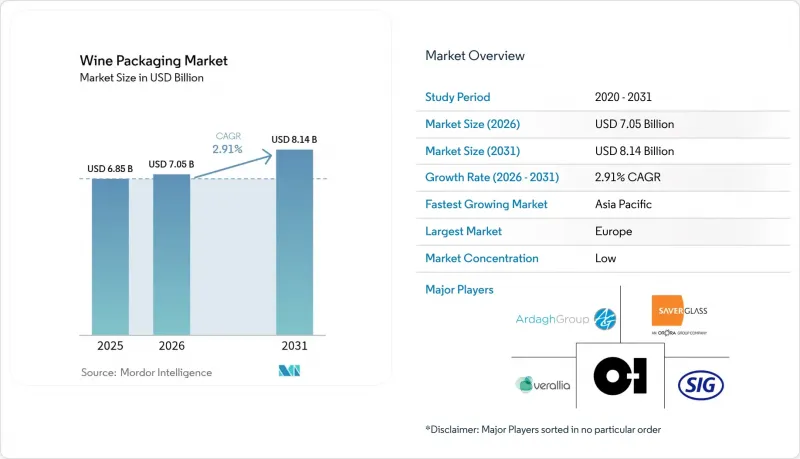
Mordor Intelligence에 의하면, 와인 포장 시장 규모는 2025년에 68억 5,000만 달러로 평가되었고, 2026년 70억 5,000만 달러에서 2031년까지 81억 4,000만 달러에 이를 것으로 예측되며, 예측 기간(2026년-2031년) CAGR은 2.91%를 기록할 전망입니다.
본 보고서는 소재별(유리, 플라스틱 등), 제품 유형별(유리병, 플라스틱병 등), 마개 유형별(천연 코르크 등), 와인 유형별(스틸 와인, 스파클링 와인 등), 용량(375mL 이하, 375-750mL, 기타), 유통 채널(직접 판매, 간접 판매), 지역별로 분류되어 있습니다. 시장 전망은 금액(달러)으로 제시되어 있습니다.
세계 와인 포장 시장 동향 및 인사이트
중국에서 와인의 프리미엄화가 디자이너 병에 대한 수요를 끌어올리고 있습니다.
중국의 도시 지역 젊은 소비자들은 편의성과 합리적인 가격을 중시하면서도, 세련된 디자인을 품질의 증거로 여깁니다. 화동 와이너리(Huadong Winery)의 오크통 와인이나 프란지아(Franzia)의 박스 와인과 같은 혁신적인 제품은 브랜드 가치를 훼손하지 않으면서도 캐주얼한 모임을 지원하며, 와인 포장 시장에서 프리미엄 스타일의 대안을 부각시키고 있습니다.
CO₂ 감축을 위한 유럽 와이너리의 경량 유리병 도입
부르고뉴의 탄소 중립 로드맵에 따르면, 병의 무게가 배출량의 중요한 요인임이 밝혀졌습니다. 베랄리아(Veralia)사의 ‘보르도 에어(300g)’는 경량 병으로도 전통을 지키면서 CO2를 최대 40%까지 감축할 수 있음을 입증하여, 와인 포장 시장 전반에 걸친 채택 확대를 뒷받침하고 있습니다.
EU의 플라스틱 포장세로 인해 PET 솔루션의 비용이 상승하고 있습니다.
재활용 소재 함유율 의무화 및 PFAS 금지로 인해 규정 준수 비용이 증가함에 따라, 와인 포장 시장의 프리미엄 라인에서 PET의 경쟁력이 떨어지고 있습니다.
부문 분석
유리는 비활성 특성과 고급스러운 느낌 덕분에 2025년 와인 포장 시장에서 68.05%의 점유율을 차지했습니다. 경량화를 목표로 한 용해로 업그레이드와 칼렛 사용률 향상을 통해 배출량을 줄이면서도 시장에서 주도적인 위치를 유지하고 있습니다. 금속의 연평균 성장률(CAGR) 5.25%는 알루미늄의 재활용성과 급속 냉각의 이점을 반영하며, 아웃도어 지향적인 소비자를 끌어들이고 와인 포장 시장 전체의 미래 선호도를 형성하고 있습니다. 규제 당국이 100% 재활용 가능 목표를 추진하는 가운데, Frugalpac사의 종이 병 및 PET 하이브리드 제품이 소재 선택의 폭을 넓히고 있습니다.
플라스틱 및 종이 기술의 발전이 오랫동안 이어져 온 소재의 위계질서에 도전하고 있습니다. Frugalpac사의 섬유 쉘은 플라스틱 사용량을 77% 줄이고, 유리에 비해 탄소 발자국을 84% 감소시켜 와인 포장 업계에서 매력적인 대안으로 떠오르고 있습니다. 이에 맞서 각 유리 제조업체들은 전기로와 초경량 디자인의 시범 도입으로 대응하고 있습니다. 알루미늄 병은 재밀봉 가능한 캡을 활용해 신선도를 오래 유지하며, 바이오 PET는 최대 30%의 rPET를 배합하고 있지만, 재활용 소재 공급량 증가를 기다리는 상황입니다.
기존의 유리병과 플라스틱 병은 2025년 매출의 71.45%를 차지하며, 와인의 숙성 및 의례적인 즐거움을 뒷받침하는 기반이 되고 있습니다. 그럼에도 불구하고, 백 인 박스(BIB) 부문은 연평균 성장률(CAGR) 5.95%로 성장하고 있으며, 와인 포장 시장에서 편의성과 규제 요건을 충족시키고 있습니다. 백 인 박스(BIB) 생산 라인은 규모의 경제를 실현하여 스웨덴 판매량의 56%를 차지하고 있으며, 프리미엄 등급으로의 진화를 보여주고 있습니다.
PET 병은 ALPLA사의 배리어 층을 통해 6개월의 유통기한을 확보하며 틈새 시장을 공략하고 있습니다. 한편, 파우치는 축제 시장에서 점유율을 확대되고 있습니다. EU의 디지털 규제 요건을 충족하는 스마트 라벨이 병과 캔에 도입되어 추적성을 향상시키는 동시에, 와인 포장 시장의 옴니채널 전략을 강화하고 있습니다.
지역별 분석
유럽과 북미는 여전히 매출에 가장 크게 기여하는 지역입니다. 캘리포니아주의 견고한 DtC(소비자 직접 판매) 법과 재활용 확대에 따라 5센트 및 10센트 보증금 제도가 도입되면서, 와인 포장 시장은 길가 수거에 대응한 디자인으로 나아가고 있습니다. 유럽의 정책에서는 2030년까지 100% 재활용 가능성을 요구하고 있으며, 이에 따라 전기로에 대한 투자와 운송 시 배출량을 줄이는 백인박스(Bag-in-Box) 기술 혁신이 촉진되고 있습니다.
2031년까지는 아시아태평양이 성장을 주도할 것입니다. 중국에서는 프리미엄화 추세에 따라 디자이너 유리병과 비용 효율이 뛰어난 상자가 결합되고 있는 반면, 호주에서는 경량 PET 병과 종이 병의 회수가 촉진되어 와인 포장 시장의 지역적 성장세를 가속화하고 있습니다. 온라인 식료품 구매의 편의성과 친환경 마케팅이 어우러져 젊은 소비자층을 효과적으로 유치하고 있습니다.
중동 및 아프리카 및 남미는 새로운 성장 경로를 제공합니다. 온난한 기후 지역에서는 가볍고 산화 방지 기능을 갖춘 형태가 선호되며, 수출업체들은 EU 규정을 충족하면서 운송 비용을 최소화하는 포장을 채택하고 있습니다. 국내 생산자들은 새로운 소비자층을 확보하기 위해 rPET 및 캔 포장 라인 도입을 검토하고 있으며, 이는 와인 포장 업계의 혁신이 전 세계적으로 확산되고 있음을 보여줍니다.
기타 혜택:
- 엑셀 형식 시장 예측(ME) 시트
- 3개월간의 애널리스트 지원
자주 묻는 질문
목차
제1장 서론
제2장 조사 방법
제3장 주요 요약
제4장 시장 구도
제5장 시장 규모와 성장 예측
제6장 경쟁 구도
제7장 시장 기회와 향후 전망
LSH 26.09.08According to Mordor Intelligence, the wine packaging market size was valued at USD 6.85 billion in 2025 and estimated to grow from USD 7.05 billion in 2026 to reach USD 8.14 billion by 2031, at a CAGR of 2.91% during the forecast period (2026-2031).
This report is Segmented by Material Type (Glass, Plastic, and More), Product Type (Glass Bottles, Plastic Bottles, and More), Closure Type (Natural Cork, and More), Wine Type (Still Wine, Sparkling Wine, and More), Capacity ( Less Than Equal To 375 ML, 375-750 ML, and More), Distribution Channel (Direct Sales, Indirect Sales), and Geography. The Market Forecasts are Provided in Terms of Value (USD).
Global Wine Packaging Market Trends and Insights
Premiumisation of Wine in China Elevating Demand for Designer Bottles
Young urban consumers in China value convenience and affordability yet still associate sophisticated design with quality. Innovations such as Huadong Winery's keg wine and Franzia's boxed offerings support casual gatherings without diluting brand equity, lifting premium-styled alternatives within the wine packaging market.
Lightweight Glass Bottle Adoption by European Wineries to Cut CO2
Bourgogne's carbon-neutral roadmap exposed bottle weight as a critical emissions driver; Verallia's 300 g Bordeaux Air proves that a lighter bottle can retain tradition while trimming up to 40% of CO2, propelling broader adoption across the wine packaging market.
EU Plastic Packaging Taxes Increasing Cost of PET Solutions
Mandatory recycled-content quotas and PFAS bans inflate compliance costs, making PET less competitive for premium lines within the wine packaging market.
Other drivers and restraints analyzed in the detailed report include:
- Rapid Uptake of Bag-in-Box Formats in the Nordics' E-grocery Channel
- Rise of DtC Channels in the US Accelerating On-premise Ready-to-Ship Packaging
- Global Recyclate Supply Shortages Limiting rPET Wine Bottle Roll-outs
For complete list of drivers and restraints, kindly check the Table Of Contents.
Segment Analysis
Glass accounted for 68.05% of the wine packaging market in 2025 due to its inert nature and premium perception. Lightweight furnace upgrades and higher cullet ratios help maintain leadership while cutting emissions. Metal's 5.25% CAGR reflects aluminum's recyclability and chill-speed advantages, luring outdoor-oriented consumers and shaping future preference across the wine packaging market. Paper bottles from Frugalpac and PET hybrids broaden the material field as regulators push 100% recyclable targets.
Plastic and paper advances test longstanding hierarchies. Frugalpac's fibre shell uses 77% less plastic and holds an 84% lower carbon footprint than glass, making it an attractive alternative in the wine packaging industry. Glass manufacturers counter by piloting electric furnaces and ultra-light designs. Aluminum bottles leverage resealable tops to extend freshness, while bio-based PET integrates up to 30% rPET yet awaits a greater recyclate supply.
Traditional glass and plastic bottles delivered 71.45% of 2025 revenue, an anchor for cellaring and ritual. Still, the bag-in-box segment is growing at a 5.95% CAGR, meeting convenience and regulations within the wine packaging market. Bag-in-box lines achieve scale benefits and hold 56% of Swedish volume, illustrating premium-grade evolution.
PET bottles secure niche roles with a six-month shelf life thanks to ALPLA's barrier layers, while pouches win festival share. Smart labels that satisfy EU digital mandates surface on bottles and cans alike, enriching traceability and reinforcing the wine packaging market's omnichannel strategy.
Complete Report Scope:
- By Material Type
- Glass
- Plastic
- Metal
- Paper
- By Product Type
- Glass Bottles
- Plastic Bottles
- Bag-in-Box
- Cans
- Pouches
- Boxes and Other Products
- By Closure Type
- Natural Cork
- Technical/Synthetic Cork
- Screw Caps
- Crown Caps
- Others (T-stoppers, Vino-Lok)
- By Wine Type
- Still Wine
- Sparkling Wine
- Fortified and Dessert Wine
- Low and No-Alcohol Wine
- By Capacity
- Less than 375 mL
- 375-750 mL
- 751-1,500 mL
- More than 1,500 mL
- By Distribution Channel
- Direct Sales
- Indirect Sales
- By Geography
- North America
- United States
- Canada
- Mexico
- Europe
- Germany
- United Kingdom
- France
- Italy
- Spain
- Russia
- Rest of Europe
- Asia-Pacific
- China
- India
- Japan
- South Korea
- Australia and New Zealand
- Rest of Asia-Pacific
- Middle East and Africa
- Middle East
- United Arab Emirates
- Saudi Arabia
- Turkey
- Rest of Middle East
- Africa
- South Africa
- Nigeria
- Egypt
- Rest of Africa
- Middle East
- South America
- Brazil
- Argentina
- Rest of South America
- North America
Geography Analysis
Europe and North America remain the largest revenue contributors. Robust DtC laws and recycling expansion in California integrate 5- and 10-cent deposits that steer the wine packaging market toward curbside-compatible designs. European policies dictate 100% recyclability by 2030, sparking investment in electric furnaces and bag-in-box innovation that lowers freight emissions.
Asia-Pacific leads growth through 2031. China's premiumisation mixes designer glass with cost-effective boxes, while Australia grants back lightweight PET and paper bottles, accelerating regional momentum for the wine packaging market. E-grocery convenience intertwines with environmental marketing to convert younger consumers.
The Middle East and Africa, and South America, provide emerging pathways. Warmer climates lean toward lighter, oxidation-barrier formats, and exporters deploy packaging that meets EU rules while minimizing freight. Domestic producers explore rPET and canning lines to reach new drinkers, illustrating the global spread of the wine packaging industry's innovations.
- Owens-Illinois Inc. (O-I)
- Verallia SA
- Ardagh Group SA
- Saverglass SAS
- Vetropack Holding AG
- BA Glass Group
- Consol Glass Pty Ltd
- Guala Closures Group
- Amorim Cork, S.A.
- Vinventions LLC (Nomacorc)
- Amcor plc
- Ball Corporation
- TricorBraun Inc.
- Tetra Laval International SA
- SIG Combibloc Group AG
- Scholle IPN (Sealed Air)
- Liqui-Box (Sealed Air)
- International Paper Company
- G3 Enterprises Inc.
- Maverick Enterprises Inc.
- Encore Glass Inc.
- Smurfit WestRock
- Crown Holdings, Inc.
Additional Benefits:
- The market estimate (ME) sheet in Excel format
- 3 months of analyst support
TABLE OF CONTENTS
1 INTRODUCTION
- 1.1 Study Assumptions and Market Definition
- 1.2 Scope of the Study
2 RESEARCH METHODOLOGY
3 EXECUTIVE SUMMARY
4 MARKET LANDSCAPE
- 4.1 Market Overview
- 4.2 Market Drivers
- 4.2.1 Premiumisation of Wine in China Elevating Demand for Designer Bottles
- 4.2.2 Light-weight Glass Bottle Adoption by European Wineries to Cut CO2
- 4.2.3 Rapid Uptake of Bag-in-Box Formats in the Nordics' E-grocery Channel
- 4.2.4 Rise of Direct-to-Consumer (DtC) Channels in the US Accelerating On-premise Ready-to-Ship Packaging
- 4.2.5 Surge in Canned and PET-Single-Serve Wines for Outdoor Consumption in Oceania
- 4.2.6 Vineyard Sustainability Certifications Driving Bio-based Closures Adoption
- 4.3 Market Restraints
- 4.3.1 EU Plastic Packaging Taxes Increasing Cost of PET Solutions
- 4.3.2 Global Recyclate Supply Shortages Limiting rPET Wine Bottle Roll-outs
- 4.3.3 Higher Oxygen Transmission Risk in Alternative Closures Capping Premium-Wine Penetration
- 4.3.4 Volatility in Soda-ash Pricing Inflating Glass Bottle Costs
- 4.4 Supply-Chain Analysis
- 4.5 Technological Outlook
- 4.6 Regulatory Outlook
- 4.7 Porter's Five Forces Analysis
- 4.7.1 Bargaining Power of Suppliers
- 4.7.2 Bargaining Power of Buyers
- 4.7.3 Threat of New Entrants
- 4.7.4 Threat of Substitutes
- 4.7.5 Intensity of Competitive Rivalry
5 MARKET SIZE AND GROWTH FORECASTS (VALUE)
- 5.1 By Material Type
- 5.1.1 Glass
- 5.1.2 Plastic
- 5.1.3 Metal
- 5.1.4 Paper
- 5.2 By Product Type
- 5.2.1 Glass Bottles
- 5.2.2 Plastic Bottles
- 5.2.3 Bag-in-Box
- 5.2.4 Cans
- 5.2.5 Pouches
- 5.2.6 Boxes and Other Products
- 5.3 By Closure Type
- 5.3.1 Natural Cork
- 5.3.2 Technical/Synthetic Cork
- 5.3.3 Screw Caps
- 5.3.4 Crown Caps
- 5.3.5 Others (T-stoppers, Vino-Lok)
- 5.4 By Wine Type
- 5.4.1 Still Wine
- 5.4.2 Sparkling Wine
- 5.4.3 Fortified and Dessert Wine
- 5.4.4 Low and No-Alcohol Wine
- 5.5 By Capacity
- 5.5.1 Less than 375 mL
- 5.5.2 375-750 mL
- 5.5.3 751-1,500 mL
- 5.5.4 More than 1,500 mL
- 5.6 By Distribution Channel
- 5.6.1 Direct Sales
- 5.6.2 Indirect Sales
- 5.7 By Geography
- 5.7.1 North America
- 5.7.1.1 United States
- 5.7.1.2 Canada
- 5.7.1.3 Mexico
- 5.7.2 Europe
- 5.7.2.1 Germany
- 5.7.2.2 United Kingdom
- 5.7.2.3 France
- 5.7.2.4 Italy
- 5.7.2.5 Spain
- 5.7.2.6 Russia
- 5.7.2.7 Rest of Europe
- 5.7.3 Asia-Pacific
- 5.7.3.1 China
- 5.7.3.2 India
- 5.7.3.3 Japan
- 5.7.3.4 South Korea
- 5.7.3.5 Australia and New Zealand
- 5.7.3.6 Rest of Asia-Pacific
- 5.7.4 Middle East and Africa
- 5.7.4.1 Middle East
- 5.7.4.1.1 United Arab Emirates
- 5.7.4.1.2 Saudi Arabia
- 5.7.4.1.3 Turkey
- 5.7.4.1.4 Rest of Middle East
- 5.7.4.2 Africa
- 5.7.4.2.1 South Africa
- 5.7.4.2.2 Nigeria
- 5.7.4.2.3 Egypt
- 5.7.4.2.4 Rest of Africa
- 5.7.4.1 Middle East
- 5.7.5 South America
- 5.7.5.1 Brazil
- 5.7.5.2 Argentina
- 5.7.5.3 Rest of South America
- 5.7.1 North America
6 Competitive Landscape
- 6.1 Market Concentration
- 6.2 Strategic Moves
- 6.3 Market Share Analysis
- 6.4 Company Profiles (includes Global level Overview, Market level overview, Core Segments, Financials as available, Strategic Information, Market Rank/Share for key companies, Products and Services, and Recent Developments)
- 6.4.1 Owens-Illinois Inc. (O-I)
- 6.4.2 Verallia SA
- 6.4.3 Ardagh Group SA
- 6.4.4 Saverglass SAS
- 6.4.5 Vetropack Holding AG
- 6.4.6 BA Glass Group
- 6.4.7 Consol Glass Pty Ltd
- 6.4.8 Guala Closures Group
- 6.4.9 Amorim Cork, S.A.
- 6.4.10 Vinventions LLC (Nomacorc)
- 6.4.11 Amcor plc
- 6.4.12 Ball Corporation
- 6.4.13 TricorBraun Inc.
- 6.4.14 Tetra Laval International SA
- 6.4.15 SIG Combibloc Group AG
- 6.4.16 Scholle IPN (Sealed Air)
- 6.4.17 Liqui-Box (Sealed Air)
- 6.4.18 International Paper Company
- 6.4.19 G3 Enterprises Inc.
- 6.4.20 Maverick Enterprises Inc.
- 6.4.21 Encore Glass Inc.
- 6.4.22 Smurfit WestRock
- 6.4.23 Crown Holdings, Inc.
7 Market Opportunities & Future Outlook
- 7.1 White-space and Unmet-need Assessment