

|
시장보고서
상품코드
2121362
프로피온산 : 시장 점유율 분석, 업계 동향과 통계, 성장 예측(2026-2031년)Propionic Acid - Market Share Analysis, Industry Trends & Statistics, Growth Forecasts (2026 - 2031) |
||||||
 Mordor Intelligence
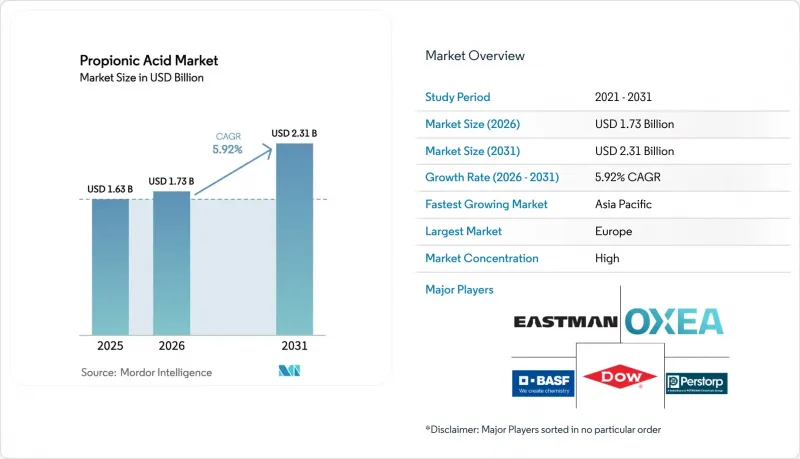
Mordor Intelligence에 의하면, 프로피온산 시장 규모는 2025년에 16억 3,000만 달러로 평가되었고, 2026년 17억 3,000만 달러에서 2031년까지 23억 1,000만 달러에 이를 것으로 예측되며, 예측 기간(2026-2031년) CAGR 5.92%를 기록할 전망입니다.
본 보고서는 용도별(동물사료 및 방부제, 칼슘·암모늄·나트륨 염 등), 최종 사용자 산업별(농업, 식품 및 음료, 퍼스널케어 등),제조 경로별(석유화학 및 바이오 발효), 등급별(사료용, 식품용 등), 지역별(아시아태평양, 북미 등)로 분류되어 있습니다. 시장 예측은 금액(미 달러) 기준으로 제시되어 있습니다.
세계 프로피온산 시장 동향 및 인사이트
곡물 및 사일리지용 방부제 수요 증가
곡물의 수분 함량이 일정 임계치를 초과하면 아스페르길루스속 및 페니실리움속의 증식이 촉진되어 아플라톡신 함량이 코덱스 기준치를 초과하게 됩니다. 그러나 많은 협동조합의 경우, 기계 건조는 비용이 너무 많이 들어 현실적이지 않습니다. 프로피온산은 곰팡이의 증식을 효과적으로 억제하여 독소 함량이 국제 기준 범위 내에 머물도록 보장합니다. 미국 식품의약국(FDA)이 사료에 대한 직접 첨가에 대해 GRAS(일반적으로 안전하다고 인정됨) 인증을 부여하고 있어, 축산 농가에게는 규제상의 안심감을 제공합니다. 사일리지의 경우, 프로피온산 칼슘과 프로피온산 암모늄 모두 사일로를 개봉했을 때 발생하는 호기성 부패를 방지하여 건조물량의 잠재적 손실을 막아줍니다. 채용률은 미코톡신 위협이 두드러지는 습한 열대 지역에서 가장 높습니다. 그 결과, 프로피온산 시장은 사료의 안전성을 높이고 농가의 수익성을 향상시키는 데 있어 매우 중요한 역할을 하고 있습니다.
항생제를 사용하지 않는 육류 생산 체인에서의 사료용 산 도입
유럽의 치료 용량 미만의 항생제 사용 금지 및 북미의 유사한 정책에 따라, 통합형 생산자들은 유기산 프로그램으로의 전환을 점점 더 추진하고 있습니다. 장내 pH를 낮추는 것으로 알려진 프로피온산은 유익한 유산균을 보호하면서 살모넬라균이나 클로스트리디움속 등의 유해한 병원균을 효과적으로 억제합니다. 육계 생산에 대한 현장 시험에서 그 경제적 이점이 입증되었습니다. 유럽식품안전청(EFSA)의 2024년 평가에서는 유전독성에 대한 우려가 확인되지 않았으며, 프로피온산의 안전성이 재확인되었습니다. 업계의 주목할 만한 동향으로, 주요 공급업체들은 현재 프로피온산, 포름산, 부티르산을 혼합하고 있습니다. 이러한 움직임은 항균 작용의 범위를 넓힐 뿐만 아니라 단일 산 전략에서 벗어나는 것을 나타내며, 프로피온산 시장의 성장 궤도를 뒷받침하고 있습니다.
석유 유래 원료 가격 변동
2025년, 정유시설의 정기 점검 및 크래커 가동률 변동으로 인해 프로파일렌 현물 가격이 급등락했습니다. 이러한 가격 변동은 올레핀 생산 능력을 통합하지 않은 제조업체의 이익률을 압박했으며, 고정 가격 계약을 체결한 제빵업체의 경우 가격 협상을 어렵게 만들었습니다. 발효법은 원료인 조글리세롤의 가격이 원유 가격과 독립적으로 거래되기 때문에 부분적인 헤지 효과를 가져오지만, 바이오 유래 제조 경로는 여전히 비용이 높아 석유화학 합성 방식보다 2배에 달하는 가격에 이르기도 합니다. 이러한 비용 격차로 인해 프로피온산 시장에서 완전한 재생 가능 원료로의 즉각적인 전환은 억제되고 있습니다.
부문별 분석
2025년, 프로피온산 시장 점유율의 51.92%를 사료 및 식품 방부제가 차지했습니다. 프로피온산 아세트산 셀룰로오스는 고고형분 자동차 재도장용 도료와 바이오 성분을 함유한 네일 래커 덕분에 연평균 성장률(CAGR) 6.49%를 기록할 전망입니다. 이 부문은 프로피오닐 함량을 증가시키고 바이오 성분 함유 주장을 뒷받침하는 특허의 혜택을 받고 있어 특수 용도 수요를 견인하고 있습니다. 프로피온산 칼슘, 프로피온산 암모늄, 프로피온산 나트륨은 pH 조절이 극히 중요한 빵, 유제품, 사료 분야에서 여전히 필수적인 존재입니다. Perstorp사의 2024년 생산 능력 증대는 염류 및 가소제의 자체 생산을 뒷받침하며, 공급 안정성을 강화하고 있습니다. 제초제 및 가소제 시장 점유율은 작지만, 안정적인 판매량은 수익 다각화와 위험 완화에 기여하고 있습니다.
세계 곡물 공급망에서 곰팡이 억제에 대한 안정적인 수요가 용도별 우선순위를 뒷받침하고 있습니다. 사료 첨가용 프로피온산 시장 규모는 아시아태평양 및 남미의 가축 사육 두수 확대와 연동되어 연평균 성장률(CAGR)이 한 자릿수 중반대를 유지할 것으로 예측됩니다. 특수 코팅 분야에서는 규제 강화에 따라 휘발성 유기 화합물(VOC) 수준을 낮추기 위해 프로피온산 셀룰로오스 아세테이트가 활용되고 있으며, 이는 높은 수익률의 성장을 가져오고 있습니다. 생산자들은 범용 사료용 등급의 제조와 소규모 의약품 및 특수 용도 생산을 균형 있게 조합함으로써 설비 가동률을 최적화하고, 프로피온산 시장 수요를 폭넓게 충족시키고 있습니다.
2025년에는 통합형 농업 기업이 항생제 미사용 시스템에서 유기산 프로그램 도입을 의무화함에 따라 농업 분야가 소비량의 56.98%를 차지했습니다. 이 부문은 프로피온산 시장의 기반이 되는 생산량을 뒷받침하고 있습니다. 의약품 분야는 서방형 부형제 및 외용 항균제의 채택 확대에 따라 2031년까지 연평균 성장률(CAGR) 6.02%를 나타낼 것으로 예측됩니다. 약전에서는 프로피온산의 순도 기준이 엄격하게 정해져 있어, 이것이 사료용 등급에 대한 가격 프리미엄을 공고히 하고 있습니다.
식품 및 음료 부문의 제조업체들은 빵의 유통 기한을 연장하고 광범위한 유통망을 통해 품질을 유지하기 위해 프로피온산 칼슘을 활용하고 있습니다. 한편, 퍼스널케어, 섬유, 전자 제품 등의 분야는 틈새 시장 역할을 하며, 농업 및 제빵 업계 수요에 따른 계절적 변동을 상쇄하고 있습니다. cGMP 규제를 준수해야 하는 의약품 등급은 공급업체 수가 제한적이기 때문에 높은 이익률을 보장받고 있습니다. 이러한 추세는 의약품 부문을 강화할 뿐만 아니라 프로피온산 시장의 시야를 넓혀, 단순한 사료용 방부제라는 용도를 넘어 그 범위를 확장시키고 있습니다.
지역별 분석
2025년, 유럽은 전 세계 시장 규모의 49.83%를 차지했습니다. 항생제계 성장 촉진제의 조기 폐지 및 유럽식품안전청(EFSA)의 엄격한 평가로 인해 프로피온산 칼슘 및 사료용 산에 대한 수요는 안정세를 보였습니다. 독일의 산업용 제빵업체와 양계장에서는 대량의 프로피온산이 소비되고 있으며, BASF의 루트비히스하펜 복합 시설에 CO₂ 배출이 없는 증기를 도입하기 위한 자금 지원은 저탄소 화학 물질에 대한 정책 지원의 한 예가 되고 있습니다. 페르스토프(Perstorp)사의 스테눙스순드(Stenungsund) 공장의 생산 능력 증강은 새로운 탄소 국경 조정 조치에 대응할 수 있는 생산 거점으로서 유럽 내 입지를 더욱 공고히 하고 있습니다. 성숙해 가면서도 안정적인 제빵 및 축산 부문 덕분에 이 지역 전체에서 프로피온산 시장은 견조한 추세를 유지하고 있습니다.
아시아태평양은 2031년까지 연평균 성장률(CAGR) 6.34%를 나타낼 것으로 예측되며, 이는 각 지역 중 가장 높은 성장률입니다. 중국은 국내 사료 공장 및 제빵 업체에 공급하는 BASF와 YPC의 합작 사업에 힘입어 소비를 주도하고 있습니다. 인도에서는 가금류 분야의 유기산 프로그램이 확대되고 있으며, 도시화에 따라 포장 빵에 대한 수요도 증가하고 있습니다. 일본이나 한국과 같은 고부가가치 시장에서는 의약품 등급의 원료가 요구되는 반면, 동남아시아에서는 수출 지향형 가금류 복합 시설이 시장을 주도하고 있습니다. 코비온(Corbion)사가 2024년 태국에서 진행한 투자는 해당 지역의 발효 유래 방부제에 대한 자신감을 보여주며, 프로피온산 시장에 유리한 미래 생산 능력의 변화를 예고합니다.
북미는 대규모 축산 사업과 유력한 베이커리 체인의 뒷받침을 받아 전 세계 프로피온산 수요의 약 4분의 1을 차지하고 있습니다. 미국 환경보호청(EPA) 보고서에 따르면, 프로피온산의 국내 생산을 통해 안정적인 현지 공급이 확보되고 있습니다. 국경을 넘는 무역을 촉진하기 위해 멕시코와 캐나다는 사료 안전성 기준을 미국과 조화시켰습니다. 브라질과 아르헨티나가 주축을 이루는 남미는 특히 곡물 보존 분야에서 규모는 크지만 가격 변동에 민감한 시장입니다. 한편, 중동 및 아프리카는 규모는 작지만 상승 추세를 보이고 있습니다. 사우디아라비아에서는 가금류 산업의 확대가, 남아프리카공화국에서는 제빵 부문의 성장이 수입 증가의 원동력이 되고 있습니다. 이러한 다양한 지역 동향이 결합되어 세계 프로피온산 시장을 지탱하는 데 있어 매우 중요한 역할을 하고 있습니다.
기타 혜택:
- 엑셀 형식 시장 예측(ME) 시트
- 3개월간의 애널리스트 지원
자주 묻는 질문
목차
제1장 서론
제2장 조사 방법
제3장 주요 요약
제4장 시장 구도
제5장 시장 규모와 성장 예측
제6장 경쟁 구도
제7장 시장 기회와 향후 전망
LSH 26.09.08According to Mordor Intelligence, the propionic acid market size was valued at USD 1.63 billion in 2025 and is estimated to grow from USD 1.73 billion in 2026 to reach USD 2.31 billion by 2031, at a CAGR of 5.92% during the forecast period (2026-2031).
This report is Segmented by Application (Animal Feed and Preservatives, Calcium Ammonium and Sodium Salts, and More), End-User Industry (Agriculture, Food and Beverage, Personal Care, and More), Production Route (Petrochemical and Bio-Based Fermentation), Grade (Feed Grade, Food Grade, and More), and Geography (Asia-Pacific, North America, and More). Market Forecasts are Provided in Terms of Value (USD).
Global Propionic Acid Market Trends and Insights
Expanding Demand for Grain and Silage Preservatives
Grain moisture levels exceeding a certain threshold foster the growth of Aspergillus and Penicillium, leading to aflatoxin levels surpassing Codex limits. However, many cooperatives find mechanical drying to be prohibitively expensive. Propionic acid effectively halts fungal growth, ensuring toxin levels remain within global standards. The U.S. Food and Drug Administration's GRAS status for direct feed inclusion provides livestock producers with regulatory assurance. In silage, both calcium and ammonium propionate prevent aerobic spoilage upon opening bunkers, safeguarding dry matter from potential loss. Adoption rates are highest in humid tropical regions, where mycotoxin pressures are pronounced. Consequently, the propionic acid market plays a pivotal role in enhancing feed safety and bolstering farmer profitability.
Uptake of Feed-Grade Acids in Antibiotic-Free Meat Chains
In response to European bans on sub-therapeutic antibiotics and similar policies in North America, integrators are increasingly turning to organic-acid programs. Propionic acid, known for lowering intestinal pH, effectively suppresses harmful pathogens like Salmonella and Clostridium, all while safeguarding beneficial lactobacilli. Field trials in broiler production have demonstrated its economic advantages. A 2024 assessment by the European Food Safety Authority, which found no genotoxic concerns, reaffirmed the safety of propionic acid. In a notable industry trend, leading suppliers are now blending propionic, formic, and butyric acids. This move not only broadens their antimicrobial coverage but also indicates a shift away from single-acid strategies, bolstering the growth trajectory of the propionic acid market.
Volatile Petro-Based Feedstock Prices
In 2025, refinery turnarounds and fluctuating cracker operating rates caused propylene spot prices to oscillate. These price swings tightened margins for producers without integrated olefin capacity and made pricing negotiations challenging for bakeries locked into fixed-price contracts. While fermentation offers a partial hedge-thanks to crude glycerol feedstock's independent trading from oil-bio routes remain costly, often reaching twice the price of petrochemical synthesis. This financial disparity moderates the immediate transition to a wholly renewable supply in the propionic acid market.
Other drivers and restraints analyzed in the detailed report include:
- Packaged-Bakery Boom in Emerging Asia
- Growing Requirement for Shelf-Life Extension in Processed Foods
- Health Concerns over Chronic Intake in Ultra-Processed Foods
For complete list of drivers and restraints, kindly check the Table Of Contents.
Segment Analysis
Animal feed and food preservatives held 51.92% of the propionic acid market share in 2025. Cellulose acetate propionate posted a 6.49% CAGR outlook thanks to high-solids automotive refinish coatings and bio-content nail lacquers. The segment benefits from patents that increase propionyl content and support bio-content claims, boosting specialty demand. Calcium, ammonium, and sodium propionates remain indispensable in bread, dairy, and feed, where pH control is critical. Perstorp's 2024 capacity addition supports captive production of salts and plasticizers, reinforcing supply stability. Herbicides and plasticizers occupy smaller shares, but their steady volumes diversify revenue and lessen risk.
Steady requirement for mold inhibition in global grain chains underpins the application hierarchy. The propionic acid market size for feed additives is projected to track livestock expansion in Asia-Pacific and South America at a mid-single-digit CAGR. Specialty coatings draw on cellulose acetate propionate to cut volatile organic compound levels in line with tightening regulations, adding high-margin growth. Producers balance commodity feed-grade manufacturing with smaller pharmaceutical and specialty runs to optimize capacity utilization, ensuring broad coverage of propionic acid market demand.
Agriculture absorbed 56.98% of consumption in 2025 as integrators mandate organic-acid programs in antibiotic-free systems. The segment anchors baseline tonnage for the propionic acid market. Pharmaceuticals are forecast to grow at a 6.02% CAGR through 2031 on the rising adoption of controlled-release excipients and topical antimicrobials. Pharmacopeial monographs set the purity of propionic acid at high levels, solidifying its price premium over feed grade.
Manufacturers in the food and beverage sector rely on calcium propionate to prolong bread's shelf life, ensuring its viability through extensive distribution networks. Meanwhile, sectors like personal care, textiles, and electronics serve as niche markets, balancing out the seasonal fluctuations in demand from agriculture and bakeries. The pharmaceutical grade, bound by cGMP regulations, faces a limited supplier base, safeguarding its margins. This dynamic not only fortifies the pharmaceutical sector but also broadens the horizons of the propionic acid market, extending its reach beyond mere bulk feed preservation.
Complete Report Scope:
- By Application
- Animal Feed and Preservatives
- Calcium, Ammonium and Sodium Salts
- Cellulose Acetate Propionate (CAP)
- Herbicides
- Plasticizers and Solvents
- Others
- By End-user Industry
- Agriculture
- Food and Beverage
- Personal Care
- Pharmaceutical
- Other End user Industries
- By Production Route
- Petrochemical
- Bio-based Fermentation
- By Grade
- Feed Grade
- Food Grade
- Pharmaceutical Grade
- Industrial Grade
- By Geography
- Asia-Pacific
- China
- India
- Japan
- South Korea
- Rest of Asia-Pacific
- North America
- United States
- Canada
- Mexico
- Europe
- Germany
- United Kingdom
- France
- Italy
- Rest of Europe
- South America
- Brazil
- Argentina
- Rest of South America
- Middle-East and Africa
- Saudi Arabia
- South Africa
- Rest of Middle-East and Africa
- Asia-Pacific
Geography Analysis
Europe controlled 49.83% of the global value in 2025. Early elimination of antibiotic growth promoters and stringent European Food Safety Authority evaluations stabilized demand for calcium propionate and feed-grade acids. Germany's industrial bakeries and poultry farms consume large volumes, while funding for CO2-free steam at BASF's Ludwigshafen complex exemplifies policy support for lower-carbon chemicals. Capacity additions at Perstorp's Stenungsund site further anchor Europe as a production base that can comply with emerging carbon-border adjustments. Mature yet stable bakery and livestock sectors keep the propionic acid market resilient across the region.
Asia-Pacific is projected to grow at a 6.34% CAGR through 2031, the fastest among regions. China leads consumption, supported by the BASF-YPC joint venture that supplies domestic feed mills and bakeries. India is ramping up organic-acid programs in poultry, and packaged-bread demand is climbing alongside urbanization. High-value markets such as Japan and South Korea require pharmaceutical-grade material, while Southeast Asia benefits from export-oriented poultry complexes. Corbion's 2024 investment in Thailand signals confidence in fermentation-based preservatives within the region, pointing to future capacity shifts favorable to the propionic acid market.
North America, bolstered by its vast livestock operations and prominent bakery chains, accounts for about a quarter of the world's propionic acid demand. The U.S. Environmental Protection Agency reports that domestic production of propionic acid ensures a steady local supply. In a bid to enhance cross-border trade, Mexico and Canada have aligned their feed-safety protocols with those of the U.S. South America, predominantly driven by Brazil and Argentina, showcases a significant yet price-sensitive market, particularly in grain preservation. Meanwhile, the Middle East and Africa, though smaller, are on an upward trajectory. In Saudi Arabia, poultry expansion and a growing bakery sector in South Africa are fueling increased imports. Together, these varied regional dynamics play a pivotal role in sustaining the global propionic acid market.
- BASF SE
- Celanese Corporation
- Dow
- Eastman Chemical Company
- KANTO KAGAKU
- Kishida Chemical Co., Ltd
- Luxi Group
- Merck KGaA
- OXEA Gmbh
- Perstorp
- Shanghai Jianbei Organic Chemical Co., Ltd.
- Yancheng Hongtai Bioengineering Co., Ltd.
- Yancheng Huade (Dancheng) Biological Engineering Co.,Ltd.
Additional Benefits:
- The market estimate (ME) sheet in Excel format
- 3 months of analyst support
TABLE OF CONTENTS
1 Introduction
- 1.1 Study Assumptions and Market Definition
- 1.2 Scope of the Study
2 Research Methodology
3 Executive Summary
4 Market Landscape
- 4.1 Market Overview
- 4.2 Market Drivers
- 4.2.1 Expanding demand for grain and silage preservatives
- 4.2.2 Uptake of feed-grade acids in antibiotic-free meat chains
- 4.2.3 Packaged-bakery boom in emerging Asia
- 4.2.4 Growing requirement for shelf-life extension in processed foods
- 4.2.5 Food-brand Scope-3 decarbonisation targets favouring low-carbon polyvinyl amide
- 4.3 Market Restraints
- 4.3.1 Volatile petro-based feedstock prices
- 4.3.2 Health concerns over chronic intake in ultra-processed foods
- 4.3.3 Capacity concentration-driven supply-chain risk
- 4.4 Value Chain Analysis
- 4.5 Porter's Five Forces
- 4.5.1 Bargaining Power of Suppliers
- 4.5.2 Bargaining Power of Buyers
- 4.5.3 Threat of New Entrants
- 4.5.4 Threat of Substitutes
- 4.5.5 Degree of Competition
5 Market Size and Growth Forecasts (Value)
- 5.1 By Application
- 5.1.1 Animal Feed and Preservatives
- 5.1.2 Calcium, Ammonium and Sodium Salts
- 5.1.3 Cellulose Acetate Propionate (CAP)
- 5.1.4 Herbicides
- 5.1.5 Plasticizers and Solvents
- 5.1.6 Others
- 5.2 By End-user Industry
- 5.2.1 Agriculture
- 5.2.2 Food and Beverage
- 5.2.3 Personal Care
- 5.2.4 Pharmaceutical
- 5.2.5 Other End user Industries
- 5.3 By Production Route
- 5.3.1 Petrochemical
- 5.3.2 Bio-based Fermentation
- 5.4 By Grade
- 5.4.1 Feed Grade
- 5.4.2 Food Grade
- 5.4.3 Pharmaceutical Grade
- 5.4.4 Industrial Grade
- 5.5 By Geography
- 5.5.1 Asia-Pacific
- 5.5.1.1 China
- 5.5.1.2 India
- 5.5.1.3 Japan
- 5.5.1.4 South Korea
- 5.5.1.5 Rest of Asia-Pacific
- 5.5.2 North America
- 5.5.2.1 United States
- 5.5.2.2 Canada
- 5.5.2.3 Mexico
- 5.5.3 Europe
- 5.5.3.1 Germany
- 5.5.3.2 United Kingdom
- 5.5.3.3 France
- 5.5.3.4 Italy
- 5.5.3.5 Rest of Europe
- 5.5.4 South America
- 5.5.4.1 Brazil
- 5.5.4.2 Argentina
- 5.5.4.3 Rest of South America
- 5.5.5 Middle-East and Africa
- 5.5.5.1 Saudi Arabia
- 5.5.5.2 South Africa
- 5.5.5.3 Rest of Middle-East and Africa
- 5.5.1 Asia-Pacific
6 Competitive Landscape
- 6.1 Market Concentration
- 6.2 Strategic Moves
- 6.3 Market Share(%)/Ranking Analysis
- 6.4 Company Profiles (includes Global level Overview, Market level overview, Core Segments, Financials as available, Strategic Information, Products and Services, and Recent Developments)
- 6.4.1 BASF SE
- 6.4.2 Celanese Corporation
- 6.4.3 Dow
- 6.4.4 Eastman Chemical Company
- 6.4.5 KANTO KAGAKU
- 6.4.6 Kishida Chemical Co., Ltd
- 6.4.7 Luxi Group
- 6.4.8 Merck KGaA
- 6.4.9 OXEA Gmbh
- 6.4.10 Perstorp
- 6.4.11 Shanghai Jianbei Organic Chemical Co., Ltd.
- 6.4.12 Yancheng Hongtai Bioengineering Co., Ltd.
- 6.4.13 Yancheng Huade (Dancheng) Biological Engineering Co.,Ltd.
7 Market Opportunities and Future Outlook
- 7.1 White-space and Unmet-need Assessment


