

|
시장보고서
상품코드
2121386
골종양 치료 : 시장 점유율 분석, 업계 동향과 통계, 성장 예측(2026-2031년)Bone Cancer Treatment - Market Share Analysis, Industry Trends & Statistics, Growth Forecasts (2026 - 2031) |
||||||
 Mordor Intelligence
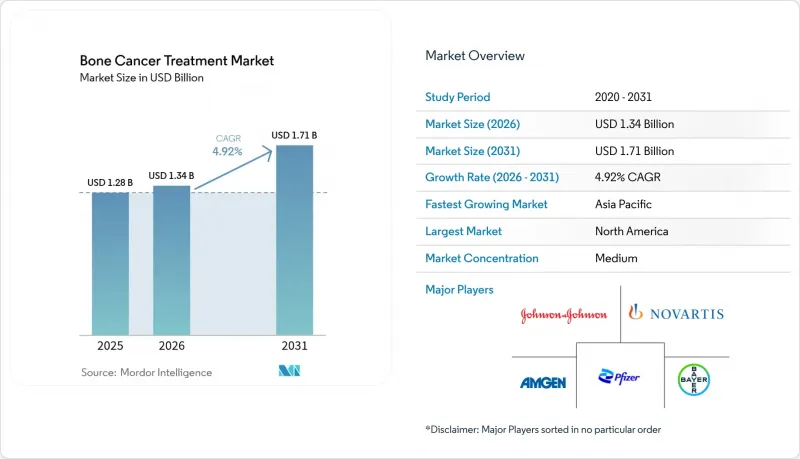
Mordor Intelligence에 따르면 2026년 골종양 치료 시장의 규모는 13억 4,000만 달러로 추정되고 있으며, 2025년 12억 8,000만 달러에서 확대하며, 2031년에는 17억 1,000만 달러에 달할 것으로 예측됩니다.
2026-2031년까지 연평균 성장률(CAGR) 4.92%로 성장할 것으로 전망됩니다.
이 보고서에서는 시장을 골종양 유형(원발성 골종양, 이차성(전이성) 골종양), 치료법 유형(화학요법, 표적 치료 등), 연령대(소아, 청소년·젊은 성인, 성인, 고령자),최종사용자(병원 등), 지역(북미, 유럽, 아시아태평양 등)별로 분류하고 있습니다. 시장 전망은 금액(달러) 기준으로 제시되어 있습니다.
전 세계 골종양 치료 시장의 동향 및 인사이트
전 세계 원발성 골육종 발병률 증가
골육종은 소아 및 청소년에게서 가장 흔한 원발성 골악성 종양으로 남아 있으며, 역학 데이터는 주요 경제권에서 유잉육종 사례 수가 지속적으로 증가하고 있음을 지원하고 있습니다. 중국에서 실시된 전국적인 질병 부담 조사에서는 발병률, 유병률, 장애 조정 생명 연수(DALY)의 증가가 보고되었으며, 2036년까지 이러한 증가세가 지속될 것으로 예측됩니다. 환자 수의 증가에 따라 각국 정부는 정형외과 종양학의 수용 능력을 확대하고 있으며, 소아 치료법에 대한 벤처 자금도 모이고 있습니다. 전국 규모의 MRI 선별 검사 등 진단 기술의 향상으로 초기 단계의 사례가 더 쉽게 발견되고 있으며, 사지 보존 수술에 대한 수요가 증가하고 있습니다.
표적 생물제제의 승인 현황 및 파이프라인 동향
규제 당국은 2024-2025년에 승인 속도를 가속화했습니다. 미국 식품의약국(FDA)은 다제내성 환자에서 43.2%의 전체 반응률을 보인 점을 바탕으로, 활막육종에 대한 최초의 유전자 치료제인 아파미트레젠 오트로이셀을 승인했습니다. 2025년 2월에는 FDA가 건활막성 거대세포종 치료제인 비므셀티닙도 승인했습니다. 이 약물은 주요 MOTION 임상시험에서 위약 대비 40%의 객관적 반응률을 보였습니다. 재발성 골육종을 대상으로 한 GSK5764227을 포함한 기타 프로그램에 대한 ‘획기적 치료제(Breakthrough Therapy)’ 지정은 표적 치료제의 효능을 입증하고 개발 주기를 단축시키고 있습니다. 이러한 이정표들이 결합되면서 임상 프로토콜이 확대되고, 성숙한 시장에서 보험사의 도입이 가속화되고 있습니다.
전이성 또는 난치성 종양에 대한 치료 선택지의 제한
전이성 골육종의 5년 생존율은 30% 미만으로, 현재 치료법이 불충분함을 여실히 드러내고 있습니다. 면역 억제적인 뼈의 미세 환경은 체크포인트 억제제의 효능을 저해하는 한편, 용량 제한 독성이 강화된 화학요법의 효과 상한선을 정하고 있습니다. HER2를 표적으로 하는 T세포 등 임상 시험 단계에 있는 세포 이식 요법은 초기 단계에서 유망한 결과를 보이고 있지만, 여전히 소규모 환자 집단에 국한되어 있습니다. 인도 및 브라질의 3차 의료기관에서 수집된 실제 임상 데이터에 따르면 난치성 사례 중 15% 미만만이 임상시험에 참여할 수 있었으며, 이로 인해 예후가 계속해서 불량한 것으로 나타났습니다.
부문 분석
2025년 시점에 원발성 악성 종양은 골종양 치료 시장의 76.45%를 차지하고 있으며, 이는 확립된 임상 경로와 소아 및 청소년층에서의 높은 발병률을 반영합니다. 골육종은 여전히 대표적인 진단이며, 1차 선택 치료법인 MAP(메토트렉세이트, 독소루비신, 시스플라틴) 프로토콜의 기반을 이루고 있습니다. 이 부문의 규모는 RUNX2 억제 저분자 화합물부터 전임상 모델에서 폐 전이를 억제하는 GD2 표적 항체-약물 접합체에 이르기까지 연구개발 분야에서 각별한 주목을 받고 있습니다. 유잉육종은 입양 유전자 치료가 상용화 단계에 접어들면서 2031년까지 연평균 성장률(CAGR) 8.74%를 기록할 것으로 예측되며, 가장 빠르게 성장하는 틈새 시장으로 자리매김하고 있습니다. 한편, 연골육종의 시장 성장은 초기 단계 임상 시험에서 부분 반응을 보인 PD-1/PD-L1 체크포인트 억제 요법에 의해 지원되고 있습니다.
치료법의 혁신으로 인해 기존의 생존율 격차는 점차 줄어들고 있습니다. 영국에 본사를 둔 한 프로그램에서는 RUNX2의 전사를 억제함으로써 생쥐의 골육종에서 생존율을 50% 개선하는 데 성공했으며, 현재 인간을 대상으로 한 독성 시험 단계에 접어들었습니다. 동시에, 전이 병변을 표적으로 하는 방사성 의약품 접합체가 중국 및 유럽 규제 당국의 심사 절차를 진행 중이며, 적응증이 원발성 종양을 넘어 확대되고 있습니다. 이러한 파이프라인들이 종합적으로 각 조직형 아형에 걸친 골종양 치료 시장의 규모를 확대할 것으로 예상됩니다.
기존의 세포독성 요법은 2025년 골종양 치료 시장의 32.35%를 차지하고 있으며, 여전히 대부분의 고악성 육종에서 1차 치료법으로 사용되고 있습니다. 그러나 부작용 프로파일과 생존 기간의 정체 현상이 정밀 의학으로의 전환을 촉진하고 있습니다. 규제상의 선례로 인해 추가 승인의 장벽이 낮아짐에 따라 세포 치료 및 유전자 치료는 연평균 성장률(CAGR) 6.52%로 확대될 것으로 예측됩니다. B7-H3·GD2를 표적으로 하는 CAR-T 요법은 다기관 공동 제2상 임상시험이 진행 중이며, 한편 동종 NK 세포 플랫폼은 면역억제적인 종양 미세환경에 대항하는 것을 목표로 하고 있습니다.
다중 키나아제 억제제를 포함한 표적 지향적 저분자 억제제는 자비적 사용 등록 임상시험에서 무재발 기간 연장 효과가 입증됨에 따라 적응증 외 사용으로서 주목을 받고 있습니다. 데노스마브가 골 관련 사건 예방에 있으며, 졸레드로네이트에 비해 직접 비교에서 우월성을 보임에 따라 RANKL 억제 요법은 표준 보조 요법으로서의 위상을 확립했습니다. 동시에, 3D 프린팅을 활용한 임플란트 기술과 갈륨을 도핑한 생체활성 유리 삽입물이 국소 제어 전략의 방향을 재정의하고 있으며, 사지 보존 치료의 보급에 대한 기대가 높아지고 있습니다.
지역별 분석
북미는 2025년에도 골종양 치료 시장에서 45.20%의 점유율을 유지했습니다. 이는 미국의 희귀질환 의약품 조기 접근 제도와 3D 프린팅 임플란트에 대한 성숙한 보험 환급 제도의 지원 덕분입니다. 소아 육종 컨소시엄에 대한 연방 정부의 자금 지원으로 임상시험 실시 빈도는 높은 수준을 유지하고 있으며, AI를 활용한 영상 진단의 광범위한 도입으로 진단 지연이 해소되고 있습니다. 캐나다의 국민건강보험 제도는 생물제제의 보급을 더욱 확대하여 환자 1인당 비용 상승을 상쇄하고 있습니다.
유럽은 이에 뒤이어 2주 이내에 지정 기관으로의 의뢰를 의무화하는 일관된 육종 치료 경로가 마련되어 있습니다. 이 지역에 뿌리내린 사지 보존 치료 문화와 유럽의약품청(EMA)이 부여한 10년간의 독점권이 혁신을 지원하고 있습니다. 그러나 회원국마다 다른 보험 급여 정책이 고비용 세포 치료법의 일률적인 도입을 억제하고 있습니다. 독일은 적층 제조 기술 도입에서 주도적인 위치를 유지하고 있는 반면, 이탈리아에서는 골육종에 대한 전국적인 유전체 스크리닝 시범 운영이 진행되고 있습니다.
아시아태평양은 가장 빠르게 성장하는 지역이며, 중국, 일본, 인도가 정형외과 종양학 수용 능력을 확대함에 따라 연평균 성장률(CAGR)은 6.79%로 예측됩니다. 중국 국가의약품감독관리국은 2025년에 골전이 치료용 방사성동위원소 결합 약물을 승인하여 국내 기업을 지역 리더로 부상시켰습니다. 일본에서는 고용량 화학요법과 자가 골수 이식에 중점을 둔 노력이 생존율을 점진적으로 향상시키고 있습니다. 인도에서는 진료 지연과 전문의 부족이 여전히 과제로 남아 있지만, 현지에서 제조된 모듈식 인공관절과 2급 도시의 치료 프로그램 덕분에 특정 의료기관에서는 무병 생존율이 61%까지 향상되었습니다.
라틴아메리카와 아프리카는 보험 환급 제도의 파편화와 임상의 부족으로 인해 다른 지역에 비해 뒤처져 있습니다. 그럼에도 불구하고 다국적 NGO들이 연수 펠로우십을 늘리고 사지 보존 구상에 대한 자금 지원을 확대함에 따라 향후 10년 이내에 이 지역의 핵심이 될 탁월한 의료 센터가 탄생할 것으로 기대됩니다.
기타 혜택:
- 엑셀 형식의 시장 예측(ME) 시트
- 3개월간의 애널리스트 지원
자주 묻는 질문
목차
제1장 서론
제2장 조사 방법
제3장 개요
제4장 시장 구도
제5장 시장 규모와 성장 예측
제6장 경쟁 구도
제7장 시장 기회와 향후 전망
KSA 26.09.04According to Mordor Intelligence, bone cancer treatment market size in 2026 is estimated at USD 1.34 billion, growing from 2025 value of USD 1.28 billion with 2031 projections showing USD 1.71 billion, growing at 4.92% CAGR over 2026-2031.
This report Segments the Industry Into Bone Cancer Type (Primary Bone Cancer, Secondary (Metastatic) Bone Cancer), Therapy Type (Chemotherapy, Targeted Therapy, and More), Age Group (Pediatric, Adolescent & Young Adult, Adult, Geriatric), End User (Hospitals, and More), and Geography (North America, Europe, Asia-Pacific, and More). The Market Forecasts are Provided in Terms of Value (USD).
Global Bone Cancer Treatment Market Trends and Insights
Increasing Global Incidence of Primary Bone Sarcomas
Osteosarcoma continues to be the most common primary bone malignancy among children and adolescents, and epidemiological data confirm a sustained rise in Ewing sarcoma cases in major economies. A national burden study in China reported higher incidence, prevalence and disability-adjusted life-years, with projections indicating continued growth to 2036. Larger patient pools are prompting governments to expand orthopaedic oncology capacity and are attracting venture funding for paediatric-focused therapies. Diagnostic improvements, such as nationwide MRI screening pilots, are capturing earlier-stage presentations and fuelling demand for limb-preserving procedures.
Approvals & Pipeline Momentum of Targeted Biologics
Regulatory agencies accelerated the pace of approvals in 2024-2025. The United States Food and Drug Administration cleared afamitresgene autoleucel, the first gene therapy for synovial sarcoma, after the product delivered a 43.2% overall response in heavily pre-treated patients. In February 2025 the agency also approved vimseltinib for tenosynovial giant cell tumour, with a 40% objective response versus placebo in the pivotal MOTION trial. Breakthrough therapy designations for additional programmes, including GSK5764227 in relapsed osteosarcoma, validate targeted approaches and shorten development cycles. Collectively, these milestones are expanding clinical protocols and hastening payor adoption across mature markets.
Limited Therapeutic Options for Metastatic or Refractory Tumours
Five-year survival drops below 30% for metastatic osteosarcoma, underscoring the inadequacy of current regimens. The immunosuppressive bone micro-environment blunts checkpoint inhibitor efficacy, while dose-limiting toxicities cap the gains from intensified chemotherapy. Investigational adoptive cell transfers, such as HER2-targeted T-cells, are showing early promise but remain confined to small cohorts. Real-world data from tertiary centres in India and Brazil illustrate that less than 15% of refractory cases gain access to clinical trials, perpetuating poor outcomes.
Other drivers and restraints analyzed in the detailed report include:
- Government & NGO-Led Sarcoma Awareness Programmes
- Advances in Functional Imaging & AI Diagnostics
- High Cost of Novel Biologics & Cell Therapies Limiting Access
For complete list of drivers and restraints, kindly check the Table Of Contents.
Segment Analysis
Primary malignancies accounted for 76.45% of bone cancer treatment market share in 2025, reflecting entrenched clinical pathways and high incidence among paediatric and adolescent populations. Osteosarcoma remains the prototypical diagnosis and anchors first-line MAP (methotrexate, doxorubicin, cisplatin) protocols. The segment's scale is drawing disproportionate R&D attention, from RUNX2-inhibiting small molecules to GD2-directed antibody-drug conjugates that cut pulmonary metastasis in preclinical models. Ewing sarcoma is positioned as the fastest-growing niche, registering a projected 8.74% CAGR to 2031 as adoptive gene therapies enter commercialisation. Meanwhile, chondrosarcoma growth is supported by PD-1/PD-L1 checkpoint regimens demonstrating partial responses in early-phase trials.
Therapeutic innovation is narrowing historical survival gaps. A UK-based programme achieved a 50% survival improvement in murine osteosarcoma by blocking RUNX2 transcription now entering human toxicology studies. At the same time, radiopharmaceutical conjugates for metastatic lesions are moving through Chinese and European regulatory channels, broadening indications beyond primary tumours. Collectively, these pipelines are expected to expand the bone cancer treatment market size across each histology subtype.
Conventional cytotoxic regimens accounted for 32.35% of the bone cancer treatment market in 2025 and remain first-line therapy for most high-grade sarcomas. However, adverse-event profiles and plateauing survival are catalysing a pivot toward precision approaches. Cell and gene therapies are forecast to expand at a 6.52% CAGR as regulatory precedents lower the bar for additional approvals. CAR-T constructs targeting B7-H3 and GD2 are in multi-centre phase II trials, while allogeneic NK-cell platforms seek to combat the immunosuppressive tumour milieu.
Targeted small-molecule inhibitors, including multi-kinase agents, are gaining off-label traction after demonstrating progression-free benefits in compassionate-use registries. Denosumab's head-to-head superiority over zoledronic acid in preventing skeletal-related events has cemented RANKL blockade as standard adjunct therapy. Concurrently, 3D-printed implant technology and gallium-doped bioactive glass inserts are redefining local control strategies, raising expectations for limb-salvage uptake.
Complete Report Scope:
- By Bone Cancer Type
- Primary Bone Cancer
- Osteosarcoma
- Chondrosarcoma
- Ewing Sarcoma
- Other Primary Types
- Secondary (Metastatic) Bone Cancer
- Primary Bone Cancer
- By Therapy Type
- Chemotherapy
- Anthracyclines
- Alkylating Agents
- Antimetabolites & Others
- Targeted Therapy
- RANKL Inhibitors
- Tyrosine Kinase Inhibitors
- mTOR/MEK & Emerging Targets
- Immunotherapy
- Immune Check-point Inhibitors
- Cell & Gene Therapies
- Radiation Therapy
- Surgery & Limb-Salvage Procedures
- Others
- Chemotherapy
- By Age Group
- Pediatric
- Adolescent & Young Adult
- Adult
- Geriatric
- By End User
- Hospitals
- Specialty Cancer Centres & Orthopaedic Institutes
- Academic & Research Institutes
- Ambulatory Surgical Centres
- By Geography
- North America
- United States
- Canada
- Mexico
- Europe
- Germany
- United Kingdom
- France
- Italy
- Spain
- Rest of Europe
- Asia-Pacific
- China
- Japan
- India
- Australia
- South Korea
- Rest of Asia-Pacific
- Middle East & Africa
- GCC
- South Africa
- Rest of Middle East & Africa
- South America
- Brazil
- Argentina
- Rest of South America
- North America
Geography Analysis
North America retained a 45.20% hold on the bone cancer treatment market in 2025, propelled by the United States' early-access framework for orphan drugs and mature reimbursement for 3D-printed implants. Federal funding for paediatric sarcoma consortia keeps trial density high, and widespread adoption of AI-augmented imaging is eliminating diagnostic delays. Canada's universal coverage further broadens biologic uptake, offsetting higher per-patient costs.
Europe follows with cohesive sarcoma-care pathways that require referral to designated centres within two weeks. The region's established limb-salvage culture and the European Medicines Agency's ten-year exclusivity bolster innovation. Nevertheless, divergent reimbursement policies across member states temper uniform adoption of high-cost cell therapies. Germany retains leadership in additive-manufacturing deployments, while Italy is piloting national genomic screening for bone sarcomas.
Asia-Pacific is the fastest-growing bloc, forecast at a 6.79% CAGR as China, Japan and India expand orthopaedic oncology capacity. China's National Medical Products Administration cleared a radionuclide-drug conjugate for bone metastases in 2025, positioning domestic companies as regional leaders. Japan's focus on high-dose chemotherapy and autologous marrow rescue continues to yield incremental survival gains. India's challenge remains late presentation and limited specialist coverage, but locally fabricated modular prostheses and tier-two city treatment programmes are improving disease-free survival to 61% in selected centres.
Latin America and Africa lag behind due to fragmented reimbursement and clinician shortages. Nonetheless, multinational NGOs are increasing training fellowships and funding limb-salvage initiatives that are expected to seed regional centres of excellence within the next decade.
- Amgen
- Bayer
- Novartis
- Johnson & Johnson
- Pfizer
- Takeda Pharmaceuticals
- Eli Lilly and Company
- Hikma Pharmaceuticals
- Recordati S.p.A
- Spectrum Pharmaceuticals
- Debiopharm Group
- Atlanthera
- Adaptimmune Therapeutics plc
- Daiichi Sankyo
- Roche
- Ipsen
- OncoTherapy Science Inc.
- Legend Biotech
- Merck
- Gilead Sciences
Additional Benefits:
- The market estimate (ME) sheet in Excel format
- 3 months of analyst support
TABLE OF CONTENTS
1 Introduction
- 1.1 Study Assumptions & Market Definition
- 1.2 Scope of the Study
2 Research Methodology
3 Executive Summary
4 Market Landscape
- 4.1 Market Overview
- 4.2 Market Drivers
- 4.2.1 Increasing Global Incidence of Primary Bone Sarcomas
- 4.2.2 Approvals & Pipeline Momentum of Targeted Biologics
- 4.2.3 Expanded Government & NGO-Led Sarcoma Awareness Programmes
- 4.2.4 Advances In Functional Imaging & AI Diagnostics Enabling Earlier Detection
- 4.2.5 3D-Printed, Patient-Specific Orthopedic Implants Boosting Limb-Salvage Adoption
- 4.2.6 Orphan-Drug Exclusivity and Tax Incentives Accelerating Niche Therapy R&D
- 4.3 Market Restraints
- 4.3.1 Limited Therapeutic Options for Metastatic or Refractory Bone Tumours
- 4.3.2 High Cost of Novel Biologics & Cell Therapies Limiting Access
- 4.3.3 Post-Operative Morbidity and Lengthy Rehabilitation Deterring Surgery Uptake
- 4.3.4 Shortage of Specialised Orthopaedic Oncologists in Emerging Markets
- 4.4 Porter's Five Forces Analysis
- 4.4.1 Threat of New Entrants
- 4.4.2 Bargaining Power of Buyers
- 4.4.3 Bargaining Power of Suppliers
- 4.4.4 Threat of Substitute Products
- 4.4.5 Intensity of Competitive Rivalry
5 Market Size & Growth Forecasts (Value in USD)
- 5.1 By Bone Cancer Type
- 5.1.1 Primary Bone Cancer
- 5.1.1.1 Osteosarcoma
- 5.1.1.2 Chondrosarcoma
- 5.1.1.3 Ewing Sarcoma
- 5.1.1.4 Other Primary Types
- 5.1.2 Secondary (Metastatic) Bone Cancer
- 5.1.1 Primary Bone Cancer
- 5.2 By Therapy Type
- 5.2.1 Chemotherapy
- 5.2.1.1 Anthracyclines
- 5.2.1.2 Alkylating Agents
- 5.2.1.3 Antimetabolites & Others
- 5.2.2 Targeted Therapy
- 5.2.2.1 RANKL Inhibitors
- 5.2.2.2 Tyrosine Kinase Inhibitors
- 5.2.2.3 mTOR/MEK & Emerging Targets
- 5.2.3 Immunotherapy
- 5.2.4 Immune Check-point Inhibitors
- 5.2.5 Cell & Gene Therapies
- 5.2.6 Radiation Therapy
- 5.2.7 Surgery & Limb-Salvage Procedures
- 5.2.8 Others
- 5.2.1 Chemotherapy
- 5.3 By Age Group
- 5.3.1 Pediatric
- 5.3.2 Adolescent & Young Adult
- 5.3.3 Adult
- 5.3.4 Geriatric
- 5.4 By End User
- 5.4.1 Hospitals
- 5.4.2 Specialty Cancer Centres & Orthopaedic Institutes
- 5.4.3 Academic & Research Institutes
- 5.4.4 Ambulatory Surgical Centres
- 5.5 By Geography
- 5.5.1 North America
- 5.5.1.1 United States
- 5.5.1.2 Canada
- 5.5.1.3 Mexico
- 5.5.2 Europe
- 5.5.2.1 Germany
- 5.5.2.2 United Kingdom
- 5.5.2.3 France
- 5.5.2.4 Italy
- 5.5.2.5 Spain
- 5.5.2.6 Rest of Europe
- 5.5.3 Asia-Pacific
- 5.5.3.1 China
- 5.5.3.2 Japan
- 5.5.3.3 India
- 5.5.3.4 Australia
- 5.5.3.5 South Korea
- 5.5.3.6 Rest of Asia-Pacific
- 5.5.4 Middle East & Africa
- 5.5.4.1 GCC
- 5.5.4.2 South Africa
- 5.5.4.3 Rest of Middle East & Africa
- 5.5.5 South America
- 5.5.5.1 Brazil
- 5.5.5.2 Argentina
- 5.5.5.3 Rest of South America
- 5.5.1 North America
6 Competitive Landscape
- 6.1 Market Concentration
- 6.2 Market Share Analysis
- 6.3 Company Profiles (includes Global level Overview, Market level overview, Core Segments, Financials as available, Strategic Information, Market Rank/Share for key companies, Products & Services, and Recent Developments)
- 6.3.1 Amgen Inc.
- 6.3.2 Bayer AG
- 6.3.3 Novartis AG
- 6.3.4 Johnson & Johnson (Janssen)
- 6.3.5 Pfizer Inc.
- 6.3.6 Takeda Pharmaceutical Company Ltd.
- 6.3.7 Eli Lilly and Company
- 6.3.8 Hikma Pharmaceuticals PLC
- 6.3.9 Recordati S.p.A
- 6.3.10 Spectrum Pharmaceuticals Inc.
- 6.3.11 Debiopharm Group
- 6.3.12 Atlanthera
- 6.3.13 Adaptimmune Therapeutics plc
- 6.3.14 Daiichi Sankyo Company Ltd.
- 6.3.15 F. Hoffmann-La Roche Ltd.
- 6.3.16 Ipsen S.A.
- 6.3.17 OncoTherapy Science Inc.
- 6.3.18 Legend Biotech
- 6.3.19 Merck & Co., Inc.
- 6.3.20 Gilead Sciences (Kite Pharma)
7 Market Opportunities & Future Outlook
- 7.1 White-space & Unmet-need Assessment


