

|
시장보고서
상품코드
2121394
암 백신 : 시장 점유율 분석, 업계 동향과 통계, 성장 예측(2026-2031년)Cancer Vaccines - Market Share Analysis, Industry Trends & Statistics, Growth Forecasts (2026 - 2031) |
||||||
 Mordor Intelligence
Mordor Intelligence에 의하면, 암 백신 시장 규모는 2025년에 106억 7,000만 달러로 평가되었고, 2026년 117억 5,000만 달러에서 2031년까지 190억 6,000만 달러에 이를 것으로 예측되며, 예측 기간(2026-2031년) CAGR은 10.14%를 기록할 전망입니다.
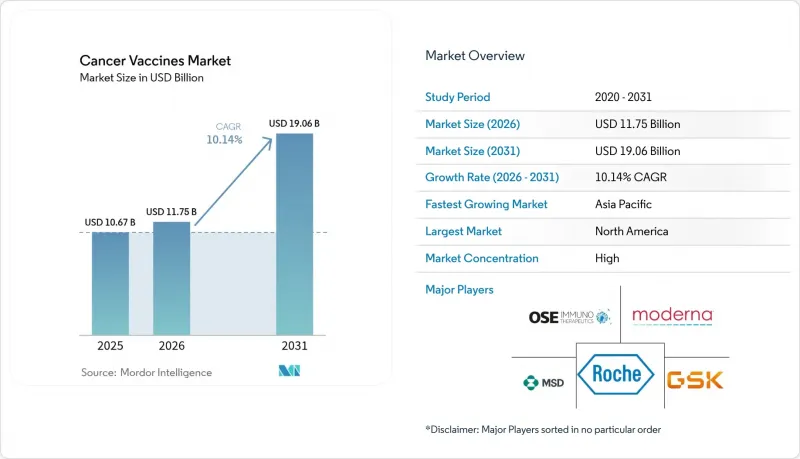
본 보고서는 기술별(재조합 백신 등), 치료법별(예방 백신 및 치료용 백신), 암 유형별(자궁경부암(HPV), 악성 흑색종 등), 투여 경로별(근육 내 주사, 정맥 내 주사 등), 지역별(북미, 유럽, 아시아태평양 등)로 분류되어 있습니다. 시장 규모 및 전망은 금액(달러) 기준으로 제시되어 있습니다.
세계 암 백신 시장 동향 및 인사이트
전 세계 암 발병률 증가
암 진단 건수는 2020년부터 2040년 사이에 47% 증가할 것으로 예측되며, 종합적인 종양 의료 인프라가 갖춰지지 않은 지역에서 가장 급격한 증가가 예상됩니다. 이러한 인구 통계학적 변화로 인해 예방용 및 치료용 백신 모두의 대상 인구가 확대되고 있습니다. 고령화 사회에서는 돌연변이 부하가 높아지는 한편, 조기 진단이 보편화됨에 따라 맞춤형 면역요법의 대상이 되는 환자층이 확대되고 있습니다. 외래 진료에 적합한 백신 투여 방식은 입원을 수반하는 암 치료에서 벗어나는 추세와 부합하며, 고소득 시장에서 환자 1인당 15만 달러를 초과하기도 하는 시스템 비용을 절감합니다. 따라서 지불 기관은 장기적인 전신 요법과 비교하여 백신을 비용 절감 수단으로 인식하고 있습니다.
연구개발 투자 및 정부 자금 증가
민관 협력(PPP) 체계가 기존의 보조금을 대체하는 경향이 강해지고 있으며, 이를 통해 위험을 분담하고 개발 기간을 단축하고 있습니다. CEPI의 CMC 프레임워크는 현재 암 백신 제조의 품질 기준을 정하고 있으며, 여러 관할 구역에 걸친 신청 절차를 원활하게 하고 있습니다. 암 관련 기술에 대한 유럽의 특허 출원 건수는 70% 이상 증가했으며, 대학의 출원 비율도 상승하고 있어 공동 혁신의 기세를 보여주고 있습니다. 영국의 BioNTech 프로그램은 2030년까지 1만 명의 환자에게 맞춤형 백신을 제공하겠다고 약속하고 있는데, 이는 각국의 의료 시스템이 상용화 과정에 직접 투자하고 있는 실제 사례입니다. 벤처 캐피털 자금 유입은 여전히 종양학 분야에 편중되어 있으며, 그 격차를 정부 자금이 점점 더 메우고 있습니다.
엄격한 규제 일정과 복잡성
맞춤형 배치 출시 프로토콜 및 AI 알고리즘 검증으로 인해 승인 주기는 표준 생물학적 제제에 비해 18-24개월 더 길어지고 있습니다. 전 세계적인 규제 대응 팀을 갖추지 못한 중소기업은 임상 데이터가 성숙해지면 EMA의 PRIME 제도를 통해 신속 심사 대상이 될 수 있음에도 불구하고, 불균형적인 부담을 떠안고 있습니다. AI 모델의 투명성에 관한 공통 기준의 부재는 심사 과정을 더욱 불투명하게 만들고, 이익률을 압박하는 규정 준수 비용을 증가시키고 있습니다.
부문 분석
2025년, 암 백신 시장에서 재조합 플랫폼은 42.78%의 점유율을 유지했습니다. 확립된 제조거점과 정평이 난 안전성 기록 덕분에 그 존재감은 여전히 높으며, 개발자들이 다중 항원 인코딩과 신속한 맞춤화를 우선시함에 따라 mRNA/네오항원 백신은 2031년까지 연평균 성장률(CAGR) 10.96%로 급성장하고 있습니다. 자가 증폭형 구축체는 투여량을 10분의 1로 줄이고 콜드체인의 부담을 경감함으로써, 자원이 제한된 환경에서 경제성을 향상시킵니다. 바이러스 벡터 및 DNA 치료법은 특히 신흥 시장에서 열 안정성이 최우선으로 요구되는 틈새 환자층에 대한 대응을 계속해서 담당하고 있습니다. 전세포 백신과 수지상 세포 백신은 시장 규모는 작지만, 고도로 개인화된 치료법에서 전문적인 역할을 수행하고 있습니다. 디아코노스 종양(Diakonos Oncology)가 교모세포종 치료제 개발을 위해 2,000만 달러를 조달한 것은 투자자들의 관심을 뒷받침하는 사례입니다.
기술의 스펙트럼은 몇 주 이내에 항원을 교체할 수 있는 플랫폼 생태계로 수렴되고 있으며, 이는 선구자들에게 중요한 차별화 요소가 되고 있습니다. 공유 네오항원 라이브러리를 통해 대상 환자층이 맞춤형 제품을 넘어 확대되고, 환자 1인당 비용이 절감되며, 규제 당국의 심사 기간이 단축됩니다. 그 결과, mRNA 제제를 활용한 암 백신 시장 규모는 특히 상온 제제가 후기 임상시험 단계에 진입할 경우 그 우위를 더욱 확대할 것으로 예측됩니다.
2025년, 자궁경부암은 암 백신 시장 규모의 71.12%를 차지했는데, 이는 HPV 예방접종 캠페인이 광범위하게 실시되어 온 데 기인합니다. 한편, 흑색종 백신은 확실한 바이오마커를 통해 환자를 정밀하게 매칭할 수 있고, 규제 당국이 획기적 치료제 지정을 승인함에 따라 연평균 성장률(CAGR) 10.79%로 성장하고 있습니다. 전립선암 및 교모세포종 프로그램은 수지상 세포 플랫폼을 기반으로 하는 반면, 공유 네오항원 전략은 대장직장암 및 위암으로의 길을 열어주고 있습니다. 흑색종에서 나타난 긍정적인 결과는 관련 고형암에 대한 위험 인식을 낮추고, 다중 암 플랫폼 임상시험으로의 자본 유입을 촉진하고 있습니다.
단일 암종에서의 성공 사례를 바탕으로 플랫폼 기반의 다암종 솔루션으로의 전환에 따라, 자궁경부암의 우위는 향후 점차 약화될 것이며, 2031년까지는 암 백신 시장 점유율이 적응증 간에 보다 고르게 분산될 것으로 예측됩니다.
지역별 분석
2025년에 북미가 45.62%의 점유율을 차지하게 된 배경에는 성숙한 규제 절차, 광범위한 임상시험 네트워크, 그리고 미국 국립암연구소(NCI)의 250만 달러 규모의 중개 연구 보조금과 같은 안정적인 공공 자금이 있습니다. USMCA(미국·멕시코·캐나다 협정)는 국경을 초월한 연구를 원활하게 하고, 캐나다와 멕시코의 이해관계자들을 공동 제조 사업에 참여시키고 있습니다. 벤처 투자 문화가 고위험 연구개발을 뒷받침하고 있어, 비용 압박이 가중되고 있음에도 불구하고 이 지역의 암 백신 시장 성장률은 세계 평균을 크게 상회하고 있습니다.
유럽에서는 민관 협력 이니셔티브가 활용되고 있습니다. 2030년까지 1만 명의 환자를 대상으로 하는 영국과 BioNTech의 파트너십은 각국의 의료 제도가 구매력을 활용하여 혁신을 촉진하는 좋은 사례입니다. EMA PRIME은 후기 단계 심사를 신속화하고 있으며, 독일, 프랑스, 이탈리아는 학술적 전문 지식과 GMP 대응 능력을 제공합니다. 환자 중심의 성과를 중시하는 보험 급여 체계는 맞춤형 솔루션의 채택을 뒷받침하며, 유럽의 경쟁력을 유지하고 있습니다.
아시아태평양은 정부 주도의 생명공학 프로그램과 서유럽의 가격 우위를 약화시키는 저비용 생산을 통해 11.05%라는 가장 높은 연평균 성장률(CAGR)을 기록하고 있습니다. 중국은 모듈식 소규모 공장 및 무료 HPV 백신 접종 캠페인에 자금을 지원하는 한편, 일본과 한국은 첨단 공정 기술을 수출하고 있습니다. 인도는 수탁 제조의 발전 수준과 방대한 환자 기반을 바탕으로 중요한 임상시험 거점으로 자리매김하고 있습니다. 호주는 ICH 기준을 준수하는 규제 체계를 통해 태평양을 가로지르는 상업화의 가교 시장으로서의 지위를 확립하고 있습니다.
기타 혜택:
- 엑셀 형식 시장 예측(ME) 시트
- 3개월간의 애널리스트 지원
자주 묻는 질문
목차
제1장 서론
제2장 조사 방법
제3장 주요 요약
제4장 시장 구도
제5장 시장 규모와 성장 예측
제6장 경쟁 구도
제7장 시장 기회와 향후 전망
LSH 26.09.09According to Mordor Intelligence, the cancer vaccines market size was valued at USD 10.67 billion in 2025 and estimated to grow from USD 11.75 billion in 2026 to reach USD 19.06 billion by 2031, at a CAGR of 10.14% during the forecast period (2026-2031).
This report is Segmented by Technology (Recombinant Vaccines, and More), Treatment Method (Preventive Vaccines and Therapeutic Vaccines), Cancer Type (Cervical Cancer (HPV), Melanoma and More), Delivery Route (Intramuscular, Intravenous, and More), and Geography (North America, Europe, Asia-Pacific, and More). The Market and Forecasts are Provided in Terms of Value (USD).
Global Cancer Vaccines Market Trends and Insights
Growing Global Cancer Incidence
Cancer diagnoses are projected to rise 47% between 2020 and 2040, with the sharpest increases in regions lacking comprehensive oncology infrastructure; this demographic shift expands the addressable population for both preventive and therapeutic vaccines. Aging societies bring higher mutation loads, while earlier diagnostic practices enlarge the pool of patients eligible for tailored immunotherapies. Outpatient-friendly vaccine regimens align with the transition away from inpatient oncology care, trimming system costs that can exceed USD 150,000 per patient in high-income markets. Payers therefore see vaccines as cost-containment tools when compared with prolonged systemic therapies.
Increasing R&D Investments & Government Funding
Public-private partnership structures increasingly supplant traditional grants, sharing risk and compressing timelines. CEPI's CMC framework now guides quality standards for cancer vaccine manufacturing, smoothing multi-jurisdictional filings . European patent applications for cancer technologies climbed more than 70%, with universities filing a rising share, signaling collaborative innovation momentum. The UK's BioNTech program pledges personalized vaccines to 10,000 patients by 2030, illustrating how national health systems invest directly in commercialization pathways. Venture capital flows remain skewed toward oncology, leaving a gap that government funds increasingly fill.
Stringent Regulatory Timelines & Complexity
Personalized batch release protocols and AI-algorithm validation stretch approval cycles by 18-24 months beyond standard biologics. Smaller firms lacking global regulatory teams face disproportionate burdens, even though EMA's PRIME gives accelerated status once clinical data mature. Absence of common standards on AI model transparency further clouds review processes, adding compliance costs that erode margins.
Other drivers and restraints analyzed in the detailed report include:
- Advances in mRNA & Neoantigen Platforms
- AI-Driven Antigen Prediction Lowering Cost
- Availability of Alternative Immunotherapies
For complete list of drivers and restraints, kindly check the Table Of Contents.
Segment Analysis
Recombinant platforms retained a 42.78% share of the cancer vaccines market in 2025. Their installed manufacturing base and well-known safety records keep them relevant, yet mRNA/neoantigen vaccines are accelerating at an 10.96% CAGR through 2031 as developers prioritize multiplex antigen encoding and rapid customization. Self-amplifying constructs reduce dose volume tenfold and ease cold-chain stress, improving economics for resource-constrained settings. Viral-vector and DNA modalities continue to address niche populations where thermostability is paramount, especially in emerging markets. Whole-cell and dendritic vaccines, though smaller in volume, play specialized roles in highly personalized regimens; Diakonos Oncology's USD 20 million raise for glioblastoma underscores investor interest.
The technology spectrum is converging toward platform ecosystems that allow antigen swapping within weeks, a key differentiation for first movers. Shared-neoantigen libraries expand addressable populations beyond bespoke products, cutting per-patient costs and shortening regulatory reviews. As a result, the cancer vaccines market size attributed to mRNA constructs is forecast to widen its lead, especially once room-temperature formulations enter late-stage trials.
Cervical cancer accounted for 71.12% of the cancer vaccines market size in 2025, a legacy of widespread HPV immunization campaigns. Melanoma vaccines, however, are advancing at an 10.79% CAGR as robust biomarkers facilitate precise patient matching and regulators grant breakthrough designations. Prostate and glioblastoma programs build on dendritic-cell platforms, while shared-neoantigen strategies open doors for colorectal and gastric cancers. Positive melanoma results reduce risk perceptions for adjacent solid tumors, drawing capital toward multi-cancer platform trials.
The transition from single-tumor success stories to platform-based multi-cancer solutions is expected to dilute cervical dominance over time, distributing the cancer vaccines market share more evenly across indications by 2031.
Complete Report Scope:
- By Technology
- Recombinant Vaccines
- Viral Vector & DNA Vaccines
- mRNA/Neoantigen Personalised Vaccines
- Whole-cell & Dendritic Cell Vaccines
- Other Technologies
- By Treatment Method
- Preventive Vaccines
- Therapeutic Vaccines
- By Cancer Type
- Cervical Cancer (HPV)
- Prostate Cancer
- Melanoma
- Other Cancers
- By Delivery Route
- Intramuscular
- Intradermal / Sub-cutaneous
- Intravenous
- By Geography
- North America
- United States
- Canada
- Mexico
- Europe
- Germany
- United Kingdom
- France
- Italy
- Spain
- Russia
- Rest of Europe
- Asia-Pacific
- China
- Japan
- India
- Australia
- South Korea
- Rest of Asia-Pacific
- Middle East and Africa
- GCC
- South Africa
- Rest of Middle East and Africa
- South America
- Brazil
- Argentina
- Rest of South America
- North America
Geography Analysis
North America's 45.62% share in 2025 stems from mature regulatory pathways, extensive trial networks, and steady public funding such as the National Cancer Institute's USD 2.5 million translational grants. USMCA streamlines cross-border studies, drawing Canadian and Mexican stakeholders into joint manufacturing ventures. Venture investment culture sustains high-risk R&D, keeping the cancer vaccines market growth in the region well above global averages despite mounting cost pressures.
Europe leverages coordinated public-private initiatives; the UK-BioNTech partnership targeting 10,000 patients by 2030 exemplifies how national health systems deploy purchasing power to spur innovation. EMA PRIME accelerates late-stage reviews, while Germany, France, and Italy supply academic expertise and GMP capacity. Reimbursement frameworks that value patient-centric outcomes favor adoption of personalized solutions, maintaining Europe's competitive weight.
Asia-Pacific posts the fastest 11.05% CAGR owing to state-sponsored biotech programs and low-cost manufacturing that erodes Western price advantages. China funds modular micro-factories and free HPV drives, while Japan and South Korea export advanced process technologies. India's contract-manufacturing depth and expansive patient base make it a pivotal trial hub. Australia's regulatory alignment with ICH standards positions it as a bridge market for trans-Pacific commercialization.
- Merck
- GlaxoSmithKline
- Moderna
- Bristol-Myers Squibb
- AstraZeneca
- F. Hoffmann-La Roche AG (Genentech)
- BioNTech
- Gritstone bio, Inc.
- Vaccitech plc
- OSE Immunotherapeutics SA
- Anixa Biosciences
- Dendreon Pharmaceuticals
- Providence Therapeutics Holdings
- eTheRNA Immunotherapies NV
- Imugene Ltd.
- Transgene
- OncoSec Medical Incorporated
- NantKwest Inc.
- Ultimovacs ASA
- ISA Pharmaceuticals BV
Additional Benefits:
- The market estimate (ME) sheet in Excel format
- 3 months of analyst support
TABLE OF CONTENTS
1 Introduction
- 1.1 Study Assumptions & Market Definition
- 1.2 Scope of the Study
2 Research Methodology
3 Executive Summary
4 Market Landscape
- 4.1 Market Overview
- 4.2 Market Drivers
- 4.2.1 Growing global cancer incidence
- 4.2.2 Increasing R&D investments & government funding
- 4.2.3 Advances in mRNA & neoantigen platforms
- 4.2.4 AI-driven antigen prediction lowering cost
- 4.2.5 Modular micro-factory manufacturing hubs
- 4.2.6 Combination regimens with CPIs de-risking trials (under-reported)
- 4.3 Market Restraints
- 4.3.1 Stringent regulatory timelines & complexity
- 4.3.2 Availability of alternative immunotherapies
- 4.3.3 Cold-chain gaps for personalised logistics
- 4.3.4 Neoantigen IP clustering limiting entrants
- 4.4 Regulatory Landscape
- 4.5 Technological Outlook
- 4.6 Porters Five Forces Analysis
- 4.6.1 Bargaining Power of Buyers
- 4.6.2 Bargaining Power of Suppliers
- 4.6.3 Threat of New Entrants
- 4.6.4 Threat of Substitutes
- 4.6.5 Competitive Rivalry
5 Market Size & Growth Forecasts (Value, USD)
- 5.1 By Technology
- 5.1.1 Recombinant Vaccines
- 5.1.2 Viral Vector & DNA Vaccines
- 5.1.3 mRNA/Neoantigen Personalised Vaccines
- 5.1.4 Whole-cell & Dendritic Cell Vaccines
- 5.1.5 Other Technologies
- 5.2 By Treatment Method
- 5.2.1 Preventive Vaccines
- 5.2.2 Therapeutic Vaccines
- 5.3 By Cancer Type
- 5.3.1 Cervical Cancer (HPV)
- 5.3.2 Prostate Cancer
- 5.3.3 Melanoma
- 5.3.4 Other Cancers
- 5.4 By Delivery Route
- 5.4.1 Intramuscular
- 5.4.2 Intradermal / Sub-cutaneous
- 5.4.3 Intravenous
- 5.5 By Geography
- 5.5.1 North America
- 5.5.1.1 United States
- 5.5.1.2 Canada
- 5.5.1.3 Mexico
- 5.5.2 Europe
- 5.5.2.1 Germany
- 5.5.2.2 United Kingdom
- 5.5.2.3 France
- 5.5.2.4 Italy
- 5.5.2.5 Spain
- 5.5.2.6 Russia
- 5.5.2.7 Rest of Europe
- 5.5.3 Asia-Pacific
- 5.5.3.1 China
- 5.5.3.2 Japan
- 5.5.3.3 India
- 5.5.3.4 Australia
- 5.5.3.5 South Korea
- 5.5.3.6 Rest of Asia-Pacific
- 5.5.4 Middle East and Africa
- 5.5.4.1 GCC
- 5.5.4.2 South Africa
- 5.5.4.3 Rest of Middle East and Africa
- 5.5.5 South America
- 5.5.5.1 Brazil
- 5.5.5.2 Argentina
- 5.5.5.3 Rest of South America
- 5.5.1 North America
6 Competitive Landscape
- 6.1 Market Concentration
- 6.2 Market Share Analysis
- 6.3 Company Profiles (includes Global level Overview, Market level overview, Core Segments, Financials as available, Strategic Information, Market Rank/Share for key companies, Products & Services, and Recent Developments)
- 6.3.1 Merck & Co., Inc.
- 6.3.2 GlaxoSmithKline plc
- 6.3.3 Moderna Inc.
- 6.3.4 Bristol Myers Squibb Co.
- 6.3.5 AstraZeneca plc
- 6.3.6 F. Hoffmann-La Roche AG (Genentech)
- 6.3.7 BioNTech SE
- 6.3.8 Gritstone bio, Inc.
- 6.3.9 Vaccitech plc
- 6.3.10 OSE Immunotherapeutics SA
- 6.3.11 Anixa Biosciences Inc.
- 6.3.12 Dendreon Pharmaceuticals LLC
- 6.3.13 Providence Therapeutics Holdings
- 6.3.14 eTheRNA Immunotherapies NV
- 6.3.15 Imugene Ltd.
- 6.3.16 Transgene SA
- 6.3.17 OncoSec Medical Incorporated
- 6.3.18 NantKwest Inc.
- 6.3.19 Ultimovacs ASA
- 6.3.20 ISA Pharmaceuticals BV
7 Market Opportunities & Future Outlook
- 7.1 White-space & Unmet-need Assessment


