

|
시장보고서
상품코드
2121948
아시아태평양의 암 백신 : 시장 점유율 분석, 업계 동향과 통계, 성장 예측(2026-2031년)Asia-Pacific Cancer Vaccines - Market Share Analysis, Industry Trends & Statistics, Growth Forecasts (2026 - 2031) |
||||||
 Mordor Intelligence
Mordor Intelligence에 의하면, 아시아태평양의 암 백신 시장 규모는 2025년 21억 8,000만 달러에서 2026년에는 24억 2,000만 달러에 이르고, 2026-2031년 CAGR 11.02%로 성장을 지속하여 2031년에는 40억 8,000만 달러에 달할 것으로 예측됩니다.
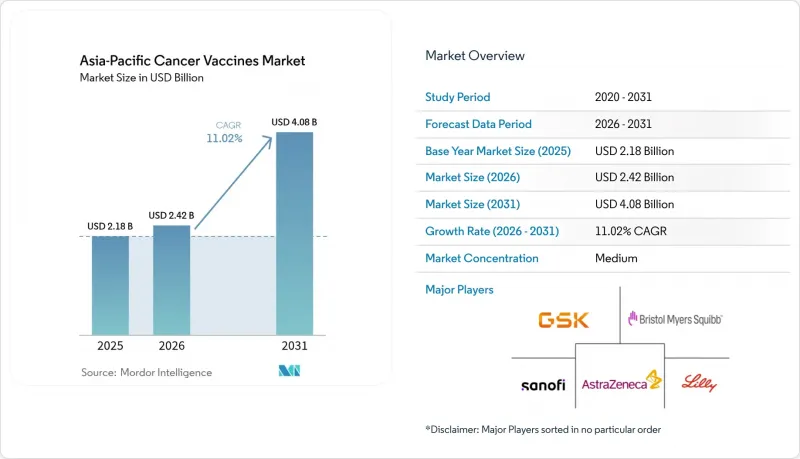
본 보고서는 기술별(재조합 백신 등), 치료법별(예방 백신 및 치료용 백신), 암 유형별(자궁경부암(HPV), 악성 흑색종 등), 투여 경로별(근육 내 주사, 정맥 내 주사 등), 지역별(중국, 일본, 인도 등)로 세분화되어 있습니다. 시장 규모 및 전망은 금액(미화) 단위로 제시되어 있습니다.
아시아태평양 암 백신 시장 동향 및 인사이트
아시아태평양 전체에서 증가하는 암 부담이 시장 확대를 견인
아시아태평양은 현재 전 세계 암 사례의 60%를 차지하고 있으며, 이 수치는 도시화, 식생활의 변화, 그리고 급속한 인구 고령화에 기인합니다. 중국에서는 연간 457만 건의 신규 진단 사례가 보고되고 있으며, 인도의 일부 주에서는 여성 10만 명당 자궁경부암 발생률이 23을 초과하고 있습니다. 비인두암, 간세포암, 위암과 같은 이 지역 특유의 암은 독자적인 예방 수요를 창출하고 있습니다. 경제 모델에 따르면 베트남, 태국, 인도네시아에서 백신 접종을 통해 자궁경부암 발생률을 20-76%까지 줄일 수 있는 것으로 나타났으며, 예방이 치료보다 비용 대비 효과가 더 높다고 할 수 있습니다. 이러한 추세로 인해 예방 및 치료용 암 백신에 대한 장기적인 수요가 뒷받침되고 있습니다.
HPV 백신의 전국적 도입이 시장 침투를 가속화
중국의 ‘건강 중국 2030’ 계획에서는 9-14세 소녀의 접종률이 고작 2.24%에 그치고 있음에도 불구하고, HPV 백신 접종이 여성 건강 정책의 핵심으로 자리 잡고 있습니다. 일본은 10년 동안 중단했던 HPV 백신 접종의 적극적인 권고를 재개했으며, 호주에서는 이미 접종률이 90%를 넘어섰고, 인도네시아의 캠페인에서는 HPV 관련 질환이 54-82% 감소한 것으로 나타났습니다. 몽골, 인도네시아, 태국의 증분 비용 대비 효과 비율은 QALY당 166-450달러 범위이며, 이에 따라 각국의 재무부는 대규모 조달에 자금을 투입할 자신감을 가지고 있습니다. 수요량을 예측할 수 있기 때문에 공급업체는 장기 계약을 체결하고 지역 내 생산량을 확대할 수 있습니다.
면역관문억제제 및 CAR-T 요법과의 경쟁
PD-1/PD-L1 억제제는 2025년까지 중국에서 40억 달러 규모 시장을 창출할 가능성이 있으며, 국내 기업들은 폐암 및 간암에 그치지 않고 더 광범위한 고형암 파이프라인으로 진출하고 있습니다. 클라우딘 18.2를 표적으로 하는 CAR-T 치료 프로토콜의 경우, 초기 단계의 소화기 계통 임상시험에서 객관적 반응률 38.8%, 질병 통제율 91.8%가 보고되었습니다. 용납 가능한 안전성 프로파일(부작용의 96.1%가 경증 또는 중등도)은 임상의들의 신뢰를 높이고, 환자들이 백신 기반 치료법에서 멀어지게 할 가능성이 있습니다. FT와 펨브롤리주맙의 병용 요법은 단일 요법의 26.7%에 비해 32.8%의 반응률을 보여주고 있어, 면역종양학 분야의 경쟁을 더욱 치열하게 만들고 있습니다.
부문 분석
재조합 제품은 2025년 매출의 47.85%를 차지하며, 입증된 안전성 기록과 확립된 GMP 생산 라인을 바탕으로 아시아태평양의 암 백신 시장을 지탱하고 있습니다. mRNA/네오항원 부문은 연평균 성장률(CAGR) 11.92%로 확대될 전망이며, 비용 효율성이 뛰어난 중국 기업들이 맞춤형 치료 후보 물질을 빠르게 상용화함에 따라 경쟁 환경이 재편될 것입니다. 바이러스 벡터 및 DNA 치료법은 안정적인 한 자릿수 중반대의 성장 궤도를 유지하고 있으며, 기존 제제와 차세대 치료법 사이의 가교 역할을 수행하고 있습니다. 전세포 백신 및 수지상 세포 백신은 여전히 틈새 분야에 머물러 있지만, 다항원 반응이 필요한 진행성 고형암에 대해서는 임상적 의의를 계속 유지하고 있습니다.
mRNA의 부상은 AI를 활용한 표적 발견과, 염기서열 분석부터 임상시험까지의 기간을 단축하는 유연한 생산 주기에 의해 주도되고 있습니다. Likang Life Sciences사의 LK-101과 StemiRNA사의 지질 폴리플렉스 시스템은 비용 면에서 우위를 보이고 있으며, 유럽과 미국의 현행 가격의 100분의 1로 6회 투여 요법을 실현하고 있습니다. 지역별 CDMO 거점 확충으로 대륙 간 운송 및 통관으로 인한 지연이 해소되면서 가격 차이는 더욱 확대되고 있습니다. 그 결과, mRNA 제제는 특히 흑색종이나 폐선암 등 돌연변이 부하가 높은 암에서 향후 승인 건수의 상당 부분을 차지할 것으로 예측됩니다.
2025년 매출의 90.75%는 예방용 제제가 차지하고 있으며, 이는 정부 자금을 통한 HPV 예방 프로그램과 광범위한 공중보건 계몽 활동을 반영한 것입니다. 한편, 치료용 후보 제품은 체크포인트 억제제를 보완하는 환자 맞춤형 치료에 대한 수요 증가에 힘입어 연평균 성장률(CAGR) 12.05%로 성장을 지속하고, 있습니다. 아시아태평양의 치료용 주사제 암 백신 시장 규모는 2026년 2억 2,160만 달러에서 2031년까지 약 3억 9,140만 달러로 확대될 것으로 예측되며, 이는 통합적인 치료 경로로의 전환을 여실히 보여주고 있습니다.
경제 모델에서는 여전히 예방이 중시되고 있으며, 많은 저·중소득 국가에서 HPV 프로그램의 QALY당 비용은 450달러 미만입니다. 그러나 난치성 자궁경부암에서 19.2%의 객관적 반응률과 53.8%의 질병 제어율을 달성한 BVAC-C와 같은 약물에 대한 2차 치료 데이터는 치료상의 유효성을 뒷받침하고 있습니다. 네오항원 선별 도구가 성숙해짐에 따라, 치료 주기는 표준 화학방사선요법과 원활하게 통합되어 향후 수익원을 재정의할 것으로 기대됩니다.
기타 혜택:
- 엑셀 형식 시장 예측(ME) 시트
- 3개월간의 애널리스트 지원
자주 묻는 질문
목차
제1장 서론
제2장 조사 방법
제3장 주요 요약
제4장 시장 구도
제5장 시장 규모 및 성장 예측(시장 규모, 달러)
제6장 경쟁 구도
제7장 시장 기회와 향후 전망
LSH 26.09.10According to Mordor Intelligence, the Asia-Pacific cancer vaccines market size is expected to grow from USD 2.18 billion in 2025 to USD 2.42 billion in 2026 and is forecast to reach USD 4.08 billion by 2031 at 11.02% CAGR over 2026-2031.
This report is Segmented by Technology (Recombinant Vaccines, and More), Treatment Method (Preventive Vaccines and Therapeutic Vaccines), Cancer Type (Cervical Cancer (HPV), Melanoma and More), Delivery Route (Intramuscular, Intravenous, and More), and Geography (China, Japan, India, and More). The Market and Forecasts are Provided in Terms of Value (USD).
Asia-Pacific Cancer Vaccines Market Trends and Insights
Growing Burden of Cancer Across APAC Drives Market Expansion
Asia-Pacific now shoulders 60% of global cancer cases, a figure driven by urbanisation, dietary shifts, and rapid population ageing. China reports 4.57 million new diagnoses annually, while cervical cancer incidence in India exceeds 23 per 100,000 women in several states. Region-specific malignancies-nasopharyngeal, hepatocellular, and gastric cancers-raise unique prevention needs. Economic modelling shows that vaccination can cut cervical cancer incidence by 20-76% across Vietnam, Thailand, and Indonesia, making prophylaxis more cost-effective than treatment. These dynamics sustain long-term demand for both preventive and therapeutic cancer vaccines.
HPV-Vaccination National Roll-Outs Accelerate Market Penetration
China's Healthy China 2030 agenda places HPV immunisation at the centre of women's-health policy, even though coverage among girls aged 9-14 stands at just 2.24% . Japan reversed its decade-long suspension of proactive HPV recommendations, Australia already tops 90% coverage, and Indonesia's campaigns show 54-82% declines in HPV-related disease. Incremental cost-effectiveness ratios range from USD 166 to USD 450 per QALY in Mongolia, Indonesia, and Thailand, giving finance ministries confidence to fund large-scale procurement. Predictable demand volumes allow suppliers to negotiate long-term contracts and ramp regional output.
Competition from Immune-Checkpoint Inhibitors & CAR-T Therapies
PD-1/PD-L1 inhibitors could generate USD 4 billion in China by 2025, with domestic firms moving beyond lung and liver cancer into broader solid-tumour pipelines. Claudin18.2 CAR-T protocols report 38.8% objective response and 91.8% disease-control rates in early-phase gastrointestinal trials. Acceptable safety profiles-96.1% of adverse events graded mild or moderate-bolster clinician confidence and may divert patients from vaccine based therapeutics. Combination regimens such as efti plus pembrolizumab post 32.8% response versus 26.7% for monotherapy, further crowding the immuno-oncology landscape.
Other drivers and restraints analyzed in the detailed report include:
- Shift Toward Personalised Neo-Antigen Vaccine Platforms
- Rapid Scale-Up of Regional CDMO Capacity for mRNA/Viral-Vector Vaccines
- Low Adult-Immunisation Acceptance in Several Southeast-Asian Nations
For complete list of drivers and restraints, kindly check the Table Of Contents.
Segment Analysis
Recombinant products held 47.85% of 2025 revenue, anchoring the Asia-Pacific cancer vaccines market with proven safety records and well-established GMP lines. The mRNA/neoantigen class is set to rise at 11.92% CAGR, reshaping the competitive grid as cost-efficient Chinese playersrapidly commercialise personalised candidates. Viral-vector and DNA modalities post stable mid-single-digit trajectories, serving as bridges between legacy constructs and next-generation therapies. Whole-cell and dendritic-cell vaccines remain niche, yet they retain clinical relevance for advanced solid tumours that require multi-antigen responses.
The mRNA upswing is powered by AI-driven target discovery and flexible production cycles that compress sequence-to-clinic timelines. Likang Life Sciences' LK-101 and StemiRNA's lipid-polyplex system illustrate cost-engineering advantages, enabling six-dose regimens at one-hundredth of prevailing Western prices. Regional CDMO build-outs further widen the gap by eliminating transcontinental freight and customs delays. As a result, mRNA lines are forecast to absorb a sizeable share of future approvals, particularly in cancers with high mutational loads such as melanoma and lung adenocarcinoma.
Preventive formulations controlled 90.75% of 2025 revenue, reflecting government-funded HPV programmes and broad public-health messaging. Therapeutic candidates, however, are tracking a 12.05% CAGR on rising demand for patient-specific regimens that augment checkpoint inhibitors. The Asia-Pacific cancer vaccines market size for therapeutic injections is projected to expand from USD 221.6 million in 2026 to roughly USD 391.4 million by 2031, underscoring the shift toward integrated care pathways.
Economic models continue to favour prophylaxis, with HPV programmes costing below USD 450 per QALY in multiple low- and middle-income settings. Yet second-line data for agents like BVAC-C, which delivered 19.2% objective response and 53.8% disease control in refractory cervical cancer, validate therapeutic relevance. As neoantigen selection tools mature, therapeutic cycles are expected to integrate seamlessly with standard chemoradiation, redefining downstream revenue pools.
Complete Report Scope:
- By Technology
- Recombinant Vaccines
- Viral Vector & DNA Vaccines
- mRNA/Neoantigen Personalised Vaccines
- Whole-cell & Dendritic Cell Vaccines
- Other Technologies
- By Treatment Method
- Preventive Vaccines
- Therapeutic Vaccines
- By Cancer Type
- Cervical Cancer (HPV)
- Prostate Cancer
- Melanoma
- Other Cancers
- By Delivery Route
- Intramuscular
- Intradermal / Sub-cutaneous
- Intravenous
- By Geography
- China
- Japan
- India
- South Korea
- Australia
- Rest of Asia-Pacific
List of Companies Covered in this Report:
- Astellas Pharma
- AstraZeneca
- BioNTech
- Bristol-Myers Squibb
- CanSino BIO
- Daiichi Sankyo Co. Ltd.
- Eli Lilly and Company
- Genexine Inc.
- GlaxoSmithKline
- Imugene Ltd.
- Kanghong Pharmaceutical
- Merck
- Moderna
- Ono Pharmaceutical Co. Ltd.
- Pfizer
- Sanofi
- Serum Institute of India Pvt Ltd.
- Shenzhen Baiyi Bio-Pharma
- Takara Bio
- Vaccitech Plc
- Likang Life Sciences
Additional Benefits:
- The market estimate (ME) sheet in Excel format
- 3 months of analyst support
TABLE OF CONTENTS
1 Introduction
- 1.1 Study Assumptions & Market Definition
- 1.2 Scope of the Study
2 Research Methodology
3 Executive Summary
4 Market Landscape
- 4.1 Market Overview
- 4.2 Market Drivers
- 4.2.1 Growing burden of cancer across APAC
- 4.2.2 HPV-vaccination national roll-outs
- 4.2.3 Shift toward personalised neo-antigen vaccine platforms
- 4.2.4 Rapid scale-up of regional CDMO capacity for mRNA/viral-vector vaccines
- 4.2.5 Government price-support for locally-made HPV vaccines
- 4.2.6 Oncology-focused VC funding surge into APAC biotech clusters
- 4.3 Market Restraints
- 4.3.1 Competition from immune-checkpoint inhibitors & CAR-T therapies
- 4.3.2 Low adult-immunisation acceptance in several Southeast-Asian nations
- 4.3.3 Supply-chain fragility for ultra-cold-chain mRNA vaccines
- 4.3.4 Heightened regulatory scrutiny after safety-signal incidents
- 4.4 Regulatory Landscape
- 4.5 Porters Five Forces Analysis
- 4.5.1 Bargaining Power of Suppliers
- 4.5.2 Bargaining Power of Buyers/Consumers
- 4.5.3 Threat of New Entrants
- 4.5.4 Threat of Substitute Products
- 4.5.5 Intensity of Competitive Rivalry
5 Market Size & Growth Forecasts (Market Value, USD)
- 5.1 By Technology
- 5.1.1 Recombinant Vaccines
- 5.1.2 Viral Vector & DNA Vaccines
- 5.1.3 mRNA/Neoantigen Personalised Vaccines
- 5.1.4 Whole-cell & Dendritic Cell Vaccines
- 5.1.5 Other Technologies
- 5.2 By Treatment Method
- 5.2.1 Preventive Vaccines
- 5.2.2 Therapeutic Vaccines
- 5.3 By Cancer Type
- 5.3.1 Cervical Cancer (HPV)
- 5.3.2 Prostate Cancer
- 5.3.3 Melanoma
- 5.3.4 Other Cancers
- 5.4 By Delivery Route
- 5.4.1 Intramuscular
- 5.4.2 Intradermal / Sub-cutaneous
- 5.4.3 Intravenous
- 5.5 By Geography
- 5.5.1 China
- 5.5.2 Japan
- 5.5.3 India
- 5.5.4 South Korea
- 5.5.5 Australia
- 5.5.6 Rest of Asia-Pacific
6 Competitive Landscape
- 6.1 Market Concentration
- 6.2 Market Share Analysis
- 6.3 Company Profiles (includes Global-level Overview, Market-level Overview, Core Segments, Financials as available, Strategic Information, Market Rank/Share, Products & Services, Recent Developments)
- 6.3.1 Astellas Pharma Inc.
- 6.3.2 AstraZeneca Plc
- 6.3.3 BioNTech SE
- 6.3.4 Bristol-Myers Squibb Co.
- 6.3.5 CanSino BIO
- 6.3.6 Daiichi Sankyo Co. Ltd.
- 6.3.7 Eli Lilly and Co.
- 6.3.8 Genexine Inc.
- 6.3.9 GlaxoSmithKline Plc
- 6.3.10 Imugene Ltd.
- 6.3.11 Kanghong Pharmaceutical
- 6.3.12 Merck & Co., Inc.
- 6.3.13 Moderna Inc.
- 6.3.14 Ono Pharmaceutical Co. Ltd.
- 6.3.15 Pfizer Inc.
- 6.3.16 Sanofi
- 6.3.17 Serum Institute of India Pvt Ltd.
- 6.3.18 Shenzhen Baiyi Bio-Pharma
- 6.3.19 Takara Bio Inc.
- 6.3.20 Vaccitech Plc
- 6.3.21 Likang Life Sciences
7 Market Opportunities & Future Outlook
- 7.1 White-space & Unmet-need Assessment


