|
시장보고서
상품코드
2121407
자동차용 카메라 : 시장 점유율 분석, 업계 동향과 통계, 성장 예측(2026-2031년)Automotive Camera - Market Share Analysis, Industry Trends & Statistics, Growth Forecasts (2026 - 2031) |
||||||
 Mordor Intelligence
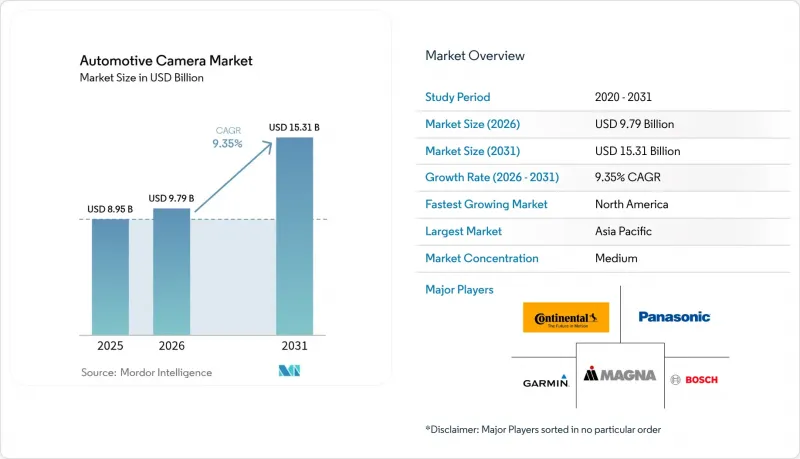
Mordor Intelligence에 따르면 자동차용 카메라 시장 규모는 2025년에 89억 5,000만 달러로 평가되며, 2026년 97억 9,000만 달러에서 2031년까지 153억 1,000만 달러에 달할 것으로 예측되고 있으며, 예측 기간(2026-2031년)에 CAGR은 9.35%에 달할 전망입니다.
이 보고서는 차종(승용차, 소형 상용차 등), 유형(시야(서라운드/후방/전방/차량 내부) 등), 기술(디지털(CMOS) 등), 용도(주차 보조 등), 판매 채널(OEM 탑재 등), 지역별로 분류되어 있습니다. 시장 규모 및 전망은 금액(달러) 기준으로, 상기 모든 부문에 대해 제시되어 있습니다.
전 세계 자동차용 카메라 시장의 동향 및 인사이트
미국, EU, 중국에서의 안전 카메라 장착 의무화
안전 규제의 통합이 진행됨에 따라 각 OEM 업체들은 모든 신형 차량 플랫폼에 멀티 카메라 시스템을 탑재해야만 합니다. 2024년 7월에 시행될 유럽연합(EU)의 ‘일반 안전 규정 II’에서는 차선 유지, 지능형 속도 지원, 긴급 제동을 위한 전방 카메라의 탑재가 의무화되어 있습니다. 중국의 2024년판 NCAP에서는 운전자 모니터링의 정확도가 평가 대상이 되며, 사실상 적외선 실내 카메라의 탑재가 의무화되었습니다. 미국에서는 2024년에 확정된 NHTSA 규정에 따라 시속 90마일까지 보행자 감지 기능을 갖춘 자동긴급제동 장치가 의무화되면서, 어둠 속에서도 식별 가능한 열 센서에 대한 명확한 수요가 발생하고 있습니다. 이에 따라 자동차 제조사들은 이 세 가지 규제 요건을 동시에 충족하는 카메라 아키텍처를 모색하고 있으며, 전 세계 설계 주기가 가속화되고 있습니다. 확장성이 뛰어난 레퍼런스 설계를 보유한 공급업체들은 양산 플랫폼으로부터 새로운 견적 의뢰를 확보하고 있습니다. 이처럼 규제의 통합에 따라 안전 카메라는 차별화 요소가 아닌 표준 상품으로 변화하고 있으며, 이는 자동차용 카메라 시장 전체의 출하량을 끌어올리고 있습니다.
ADAS 및 자율주행의 보급
레벨 2+ 주행 기능은 프리미엄 브랜드에서 대중 시장의 C부문 차량으로 점차 확대되고 있습니다. Mobileye사의 SuperVision 플랫폼은 현재 폭스바겐의 MQB 모델에 탑재되어 있으며, 최대 11대의 카메라를 사용하여 주변 상황을 감지하고 고해상도의 도로 위치 정보를 획득하고 있습니다. 소니는 카메라 1대당 탑재 대수가 현재의 8대에서 2027년까지 12대로 증가할 것으로 예측하고 있습니다. 센서 상의 AI 처리 기능을 통해 실시간 비전 알고리즘을 엣지 프로세서에서 실행할 수 있게 되어, 시스템 지연 및 배선 복잡성이 완화됩니다. 그 결과, 자동화 수준 향상으로 인해 카메라 수 증가가 투자 회수로 이어져 비용 대비 효과의 선순환이 창출됩니다. 이러한 시너지 효과로 인해 카메라의 평균 판매 가격(ASP)은 상승하고 출하 대수도 급증할 것으로 예상되어, 2030년까지 자동차용 카메라 시장의 연평균 성장률(CAGR)이 2.1%포인트 상승할 전망입니다.
멀티 카메라의 BOM 비용
포괄적인 ADAS 스택에는 현재 8-12대의 카메라가 필요하지만, 단가는 해상도에 따라 20달러에서 500달러까지 폭이 넓습니다. 비용을 중시하는 자동차 제조사에게 있으며, 카메라는 차량 재료비의 최대 3%를 차지할 가능성이 있으며, 이익률을 압박하고 있습니다. 포드가 2025년 후방 카메라의 소프트웨어 결함을 이유로 107만 5,000대의 차량을 리콜한 사례는 복잡성 증가에 따른 보증 리스크의 크기를 여실히 드러내고 있습니다. Tier 1 공급업체들은 통합형 비전 ECU 및 단일 케이블 아키텍처 도입에 대응하고 있지만, 단기적인 비용 상승 압력은 여전히 자동차용 카메라 시장의 연평균 성장률(CAGR)을 1.8%포인트 끌어내리고 있습니다.
부문 분석
2025년 승용차용 자동차 카메라 시장 규모는 59억 5,000만 달러로, 이는 전 세계 매출의 66.48%에 해당합니다. 소형 상용차는 현재 규모는 작지만, 2031년까지 연평균 성장률(CAGR) 11.02%로 확대되며 시장 전체의 성장률을 상회하고 있습니다. 차량 소유주들은 보험료 절감, 충돌 사고 억제, 텔레매틱스 기반 운전자 평가 지원을 목적으로 카메라 도입을 추진하고 있습니다. 볼보 트럭에 따르면 기존의 미러를 카메라·모니터 시스템으로 대체함으로써 2%의 연료 절감 효과를 얻을 수 있다고 합니다. 따라서 ROI를 정량화할 수 있는 물류 기업의 자동차용 카메라 시장 조달 수요가 증가하고 있습니다.
승용차는 대량 생산과 소비자의 안전 패키지 구매 의지가 높아 계속해서 주도적인 위치를 유지하고 있습니다. 2025년에는 신형 소형 승용차의 ADAS 보급률이 90%를 넘어, 안정적인 도입 대수가 확보되고 있습니다. 대형 트럭의 경우, 카메라 채택이 EU의 GSR II(사각지대 감지 규정) 등 규제상의 이정표와 연동되어 있습니다. 프레이트라이너 카스카디아 대형 트럭에 탑재된 스토너리지(Stoner Ridge)사의 ‘MirrorEye’ 시스템은 8대의 카메라를 통한 중복성을 입증하고 있으며, 향후 일반용 SUV로도 확산될 가능성이 있습니다. 비용 절감 모듈과 검증된 차량 운영 비용 절감 효과의 조합 덕분에, 상용차 부문 전체에서 자동차용 카메라 시장의 매출은 두 자릿수 성장세를 유지하고 있습니다.
2025년에도 뷰잉 카메라는 매출 점유율 56.80%를 유지하며, 후방 카메라, 서라운드 카메라, 미러 대체 기능을 중심으로 자동차용 카메라 시장의 점유율을 주도하고 있습니다. 그러나 각 OEM 업체들이 표시 기능보다 지각 기능을 우선시하는 경향이 있으며, 센싱·스테레오 유닛은 연평균 성장률(CAGR) 12.95%로 확대되고 있습니다. 스바루의 차세대 ‘아이사이트(EyeSight)’는 온세미(On Semiconductor)의 Hyperlux AR0823AT 센서를 활용하여, 기존에는 LiDAR 시스템으로만 가능했던 차선 중앙 유지 정확도를 실현하고 있습니다. 심도 인식 스테레오 시스템은 현재 일본에서 자율주행 시스템(ADS) 레벨 3 인증을 획득하여 그 보급을 지원하고 있습니다. 센싱 카메라가 합리적인 가격대의 트림에도 탑재됨에 따라 지각 하위 부문의 자동차용 카메라 시장 규모는 기존의 시인성 카테고리와의 격차를 좁혀 나갈 것입니다.
기존의 시각 인식 시스템도 진화하고 있으며, HDR 성능 향상과 도로의 오염 속에서도 선명도를 유지하는 방비말 코팅이 채택되고 있습니다. 자동차 제조사들은 4대의 카메라 간 프레임 단위의 정확한 동기화가 필요한 ‘버드아이’ 계산 모자이크 기술을 통합하고 있으며, 공급업체에 스큐가 적은 이미저를 제공할 것을 요구하고 있습니다. Foresight사의 스테레오 알고리즘 번들은 0.05럭스 미만의 환경에서도 물체 감지를 실현하여, 센싱 카메라를 LiDAR를 대체할 수 있는 비용 효율적인 대안으로 자리매김하고 있습니다. 전반적으로 이미지 기반 인식 기술의 우위와 부품 원가(BOM) 감소로 인해 자동차용 카메라 시장의 성장은 ‘지능’ 분야로 중심을 옮겨가고 있습니다.
지역별 분석
아시아태평양은 중국의 생산 규모와 일본의 반도체 분야 리더십에 힘입어 2025년에는 40.10%의 점유율로 자동차용 카메라 시장을 장악했습니다. 소니는 2026 회계연도까지 자동차용 이미저 시장에서 전 세계에서 큰 점유율을 확보하는 것을 목표로 하고 있으며, 이로 인해 지역 공급망의 경쟁력이 강화되고 있습니다. 베이징시의 스마트카 로드맵에서는 레벨 2+ 시스템에 대한 보조금이 지급되고 있으며, 저가형 전기자동차(EV)에서도 멀티 카메라 패키지가 기본 사양으로 장착되고 있습니다. 한국의 각 OEM 업체들은 국내 센서 및 렌즈 생산을 기반으로 모든 신형 SUV에 첨단 서라운드 뷰 기능을 탑재하고 있습니다. 이러한 정책과 산업의 깊이가 자동차용 카메라 시장에서 아시아태평양의 확고한 입지를 공고히 하고 있습니다.
북미는 2025년에 26.05%의 점유율을 차지했으며, 고급 안전 기능에 대한 소비자 수요가 NHTSA(미국 도로교통안전국)의 규제와 맞물려 확대되었습니다. 2029년까지 자동긴급제동을 의무화하는 미국의 규제는 검증 비용을 더 긴 주기로 분산시키기 위해 카메라의 조기 도입을 촉진하고 있습니다. 캐나다 각 주에서는 대시캠 도입에 대해 차량 보험 할인을 제공하여 사후 장착 시장의 규모를 확대하고 있습니다. 실리콘밸리의 반도체 기업은 국내 OEM(Original Equipment Manufacturer)의 시장 출시 기간을 단축하는 엣지 AI 레퍼런스 설계를 제공하고 있습니다. 이러한 요인들로 인해 해당 지역의 자동차용 카메라 시장은 견고한 성장 궤도를 유지하고 있습니다.
유럽은 GSR II에 따라 카메라 기반의 포괄적인 안전 대책을 조기에 법제화한 것을 원동력으로 23.15%의 점유율을 확보했습니다. 독일의 고급차 브랜드는 Euro NCAP 5성급 평가를 확보하기 위해 차량에 최대 10대의 카메라를 탑재하고 있습니다. EU내 전자식 미러 승인은 전기자동차 제조사들이 공기 저항을 줄이기 위해 가상 미러를 채택함에 따라 새로운 호재로 작용하고 있습니다. 그러나 GDPR에 따른 엄격한 데이터 처리 규정이 광범위한 분석을 제한하고 있으며, 아시아태평양(APAC)에 비해 성장은 다소 둔화되고 있습니다.
중동 및 아프리카는 걸프협력회의(GCC) 회원국들의 안전 장비 의무화와 도시화 진전에 힘입어 2025년 매출의 6.70%를 차지했습니다. 사우디아라비아에서 부상하고 있는 자동차용 스플릿 뷰 카메라 생태계는 국내 조립 생산 확대를 위한 노력을 지원하고 있습니다. 남미의 점유율은 4.00%에 그쳤지만, 브라질이 2026년에 유엔 유럽경제위원회(UN ECE)의 후방 확인 카메라 기준을 준수할 계획인 만큼, 향후 몇년에 업그레이드 주기가 형성될 전망입니다. 전반적으로 규제 도입 시기의 차이로 인해 자동차용 카메라 시장에서 지역별 분산이 발생하고 있습니다.
기타 혜택:
- 엑셀 형식의 시장 예측(ME) 시트
- 3개월간의 애널리스트 지원
자주 묻는 질문
목차
제1장 서론
제2장 조사 방법
제3장 개요
제4장 시장 구도
제5장 시장 규모와 성장 예측
제6장 경쟁 구도
제7장 시장 기회와 향후 전망
KSA 26.09.04According to Mordor Intelligence, the automotive camera market size was valued at USD 8.95 billion in 2025 and estimated to grow from USD 9.79 billion in 2026 to reach USD 15.31 billion by 2031, at a CAGR of 9.35% during the forecast period (2026-2031).
This report is Segmented by Vehicle Type (Passenger Vehicles, Light Commercial Vehicles, and More), Type (Viewing (Surround/Rear/Front/Interior) and More), Technology (Digital (CMOS), and More), Application (Park Assist and More), Sales Channel (OEM-Installed and More), and Geography. The Market Sizes and Forecasts are Provided in Terms of Value (USD) and for all the Above Segments.
Global Automotive Camera Market Trends and Insights
Safety-camera mandates in US, EU & China
A convergence of safety regulations is forcing OEMs to integrate multi-camera suites in every new vehicle platform. The European Union's General Safety Regulation II, effective July 2024, compels forward-facing cameras for lane keeping, intelligent speed assistance, and emergency braking. China's 2024 NCAP now scores driver-monitoring accuracy, effectively requiring infrared cabin cameras. In the United States, the NHTSA rule finalized in 2024 obliges automatic emergency braking with pedestrian detection up to 90 mph, creating a clear pull for thermal sensors that can see in darkness. Automakers, therefore, seek camera architectures that meet all three regimes simultaneously, accelerating global design cycles. Suppliers equipped with scalable reference designs are winning new RFQs from volume platforms. Regulatory alignment is thus turning safety cameras into a baseline commodity rather than a differentiator, lifting overall shipment volumes across the automotive camera market.
ADAS & autonomy penetration
Level 2+ driving functions are shifting from premium nameplates to mass-market C-segment vehicles. Mobileye's SuperVision platform now powers Volkswagen's MQB models, using up to 11 cameras for surround sensing and high-definition road referencing. Sony forecasts each vehicle will embed 12 cameras by fiscal 2027, up from 8 today. AI-on-sensor capabilities let real-time vision algorithms run on edge silicon, trimming system latency and wiring complexity. In turn, higher automation creates a payback for more cameras, closing the cost-benefit loop. The net effect is an upward shift in camera ASPs alongside ballooning unit counts, underpinning an incremental 2.1-percentage-point lift in the automotive camera market CAGR through 2030.
Multi-camera BOM cost
Comprehensive ADAS stacks now need 8-12 cameras, yet unit prices range from USD 20 to USD 500, depending on resolution. For value-oriented nameplates, cameras can consume up to 3% of vehicle material cost, squeezing margins. Ford's 2025 recall of 1.075 million vehicles over rear camera software faults underscores the warranty exposure linked with added complexity. Tier 1 suppliers are responding with consolidated vision ECUs and single-cable architectures, but near-term cost headwinds still trim 1.8 percentage points from the automotive camera market CAGR.
Other drivers and restraints analyzed in the detailed report include:
- Parking/360-view consumer pull
- Driver-monitoring regulation momentum
- Cyber-security & privacy risks
For complete list of drivers and restraints, kindly check the Table Of Contents.
Segment Analysis
The automotive camera market size for passenger vehicles stood at USD 5.95 billion in 2025, equal to 66.48% of global revenue. Light commercial vehicles, while smaller today, are expanding at an 11.02% CAGR through 2031, outpacing overall growth. Fleet owners embrace cameras to trim insurance costs, curb collisions, and support telematics-based driver scoring. Volvo Trucks reports fuel savings of 2% when camera monitor systems replace traditional mirrors. The automotive camera market, therefore, sees rising procurement from logistics firms that can quantify ROI.
Passenger cars keep leadership because of scale production and consumer willingness to pay for safety packs. ADAS penetration exceeded 90% in new light-duty vehicles in 2025, ensuring a stable installed base. In heavy trucks, camera adoption aligns with regulatory milestones such as the EU's GSR II blind-spot detection rule. Stoneridge's MirrorEye system on Freightliner Cascadia heavy trucks has demonstrated 8-camera redundancy that may later cascade to consumer SUVs. The blend of cost-down modules and proven fleet savings sustains a double-digit rise in the automotive camera market across commercial segments.
Viewing cameras retained a 56.80% revenue share in 2025, anchoring the automotive camera market share around reversing, surround, and mirror replacement functions. Yet, sensing and stereo units are scaling at 12.95% CAGR as OEMs prioritize perception over display. Subaru's next-gen EyeSight leverages onsemi Hyperlux AR0823AT sensors to offer lane-centering precision previously limited to lidar setups. Depth-perception stereo rigs are now validated to Automated Driving Systems (ADS) Level 3 in Japan, driving broader uptake. As sensing cameras migrate into affordable trims, the automotive camera market size within perception sub-segments will narrow the gap against legacy viewing categories.
Traditional viewing systems evolve too, with higher HDR and de-spray coatings that maintain clarity in road grime. Automakers are integrating bird-eye computational mosaics that require frame-accurate synchronization across four cameras, pushing suppliers to deliver low-skew imagers. Foresight's stereo algorithm bundles deliver object detection at sub-0.05 lux, positioning sensing cameras as a cost-effective alternative to lidar. Overall, image-based perception advantages and falling BOMs are pivoting growth toward the intelligence end of the automotive camera market.
Complete Report Scope:
- By Vehicle Type
- Passenger Vehicles
- Light Commercial Vehicles
- Medium and Heavy Commercial Vehicles
- By Camera Type
- Viewing (Surround/Rear/Front/Interior)
- Sensing / Stereo Cameras
- By Technology
- Digital (CMOS)
- Infra-red (NIR)
- Thermal (LWIR)
- By Application
- Park Assist
- Advanced Driver Assistance Systems (ADAS)
- Driver Monitoring & Cabin Safety
- By Sales Channel
- OEM-Installed
- Aftermarket
- By Geography
- North America
- United States
- Canada
- Rest of North America
- Europe
- Germany
- France
- United Kingdom
- Rest of Europe
- Asia-Pacific
- China
- Japan
- India
- South Korea
- Rest of Asia-Pacific
- Middle East and Africa
- Saudi Arabia
- United Arab Emirates
- South Africa
- Rest of Middle East and Africa
- South America
- Brazil
- Argentina
- Rest of South America
- North America
Geography Analysis
Asia-Pacific dominated the automotive camera market with a 40.10% share in 2025, buoyed by China's production scale and Japan's semiconductor leadership. Sony targets a significant global share in automotive imagers by fiscal 2026, reinforcing regional supply-chain competitiveness. Beijing's smart-vehicle roadmap subsidizes Level 2+ systems, making multi-camera packages standard even in economy EVs. South Korea's OEMs embed advanced surround-view on every new SUV, underpinned by local sensor and lens fabrication. Such a policy and industrial depth secure APAC's anchor position in the automotive camera market.
North America held a 26.05% share in 2025 as consumer demand for high-end safety features dovetailed with NHTSA mandates. The U.S. rule obliging automatic emergency braking by 2029 incentivizes early camera adoption to spread validation costs over longer cycles. Canadian provinces offer fleet insurance rebates for dash-cams, expanding the retrofit pool. Silicon Valley chip firms provide edge-AI reference designs that reduce time-to-market for domestic OEMs. These factors keep the region's automotive camera market on a firm expansion track.
Europe captured 23.15% share, driven by being first to legislate comprehensive camera-based safety under GSR II. German luxury brands equip vehicles with up to 10 cameras to secure 5-Star Euro NCAP scores. The bloc's e-mirror approval delivers a fresh windfall as EV makers adopt drag-cutting virtual mirrors. However, GDPR imposes strict data processing rules that limit broader analytics, slightly moderating growth relative to APAC.
The Middle East and Africa region accounted for 6.70% of 2025 revenue, thanks to safety-equipment mandates in Gulf Cooperation Council states and expanding urbanization. Saudi Arabia's emerging automotive split-view camera ecosystem underpins domestic assembly ambitions. South America remained at 4.00% share, yet Brazil's 2026 plan to align with UN ECE rearview camera standards sets a multi-year upgrade cycle. Overall, differential regulation timing drives geographic dispersion within the automotive camera market.
- Robert Bosch GmbH
- Continental AG
- Magna International Inc.
- Valeo SA
- ZF Friedrichshafen AG
- Gentex Corporation
- Autoliv Inc.
- Hella GmbH & Co KGaA
- Panasonic Corp.
- Garmin Ltd
- Denso Corp.
- Mobileye N.V.
- Aptiv PLC
- onsemi (Semiconductor Components Industries LLC)
- Ambarella Inc.
- Mitsubishi Electric Corp.
- Hyundai Mobis
Additional Benefits:
- The market estimate (ME) sheet in Excel format
- 3 months of analyst support
TABLE OF CONTENTS
1 Introduction
- 1.1 Study Assumptions & Market Definition
- 1.2 Scope of the Study
2 Research Methodology
3 Executive Summary
4 Market Landscape
- 4.1 Market Overview
- 4.2 Market Drivers
- 4.2.1 Safety-camera mandates in US, EU & China
- 4.2.2 ADAS & autonomy penetration
- 4.2.3 Parking/360-view consumer pull
- 4.2.4 CMOS-AI cost deflation
- 4.2.5 EV drag-reduction via e-mirrors
- 4.2.6 Driver-monitoring regulation momentum
- 4.3 Market Restraints
- 4.3.1 Multi-camera BOM cost
- 4.3.2 Cyber-security & privacy risks
- 4.3.3 IR-glass supply crunch
- 4.3.4 CMS rule-making uncertainty
- 4.4 Value / Supply-Chain Analysis
- 4.5 Regulatory Landscape
- 4.6 Technological Outlook
- 4.7 Porters Five Forces
- 4.7.1 Bargaining Power of Suppliers
- 4.7.2 Bargaining Power of Buyers
- 4.7.3 Threat of New Entrants
- 4.7.4 Threat of Substitutes
- 4.7.5 Competitive Rivalry
5 Market Size & Growth Forecasts (Value in USD)
- 5.1 By Vehicle Type
- 5.1.1 Passenger Vehicles
- 5.1.2 Light Commercial Vehicles
- 5.1.3 Medium and Heavy Commercial Vehicles
- 5.2 By Camera Type
- 5.2.1 Viewing (Surround/Rear/Front/Interior)
- 5.2.2 Sensing / Stereo Cameras
- 5.3 By Technology
- 5.3.1 Digital (CMOS)
- 5.3.2 Infra-red (NIR)
- 5.3.3 Thermal (LWIR)
- 5.4 By Application
- 5.4.1 Park Assist
- 5.4.2 Advanced Driver Assistance Systems (ADAS)
- 5.4.3 Driver Monitoring & Cabin Safety
- 5.5 By Sales Channel
- 5.5.1 OEM-Installed
- 5.5.2 Aftermarket
- 5.6 By Geography
- 5.6.1 North America
- 5.6.1.1 United States
- 5.6.1.2 Canada
- 5.6.1.3 Rest of North America
- 5.6.2 Europe
- 5.6.2.1 Germany
- 5.6.2.2 France
- 5.6.2.3 United Kingdom
- 5.6.2.4 Rest of Europe
- 5.6.3 Asia-Pacific
- 5.6.3.1 China
- 5.6.3.2 Japan
- 5.6.3.3 India
- 5.6.3.4 South Korea
- 5.6.3.5 Rest of Asia-Pacific
- 5.6.4 Middle East and Africa
- 5.6.4.1 Saudi Arabia
- 5.6.4.2 United Arab Emirates
- 5.6.4.3 South Africa
- 5.6.4.4 Rest of Middle East and Africa
- 5.6.5 South America
- 5.6.5.1 Brazil
- 5.6.5.2 Argentina
- 5.6.5.3 Rest of South America
- 5.6.1 North America
6 Competitive Landscape
- 6.1 Market Concentration
- 6.2 Strategic Moves
- 6.3 Market Share Analysis
- 6.4 Company Profiles (Includes Global level Overview, Market level overview, Core Segments, Financials as available, Strategic Information, Market Rank/Share for key companies, Products & Services, and Recent Developments)
- 6.4.1 Robert Bosch GmbH
- 6.4.2 Continental AG
- 6.4.3 Magna International Inc.
- 6.4.4 Valeo SA
- 6.4.5 ZF Friedrichshafen AG
- 6.4.6 Gentex Corporation
- 6.4.7 Autoliv Inc.
- 6.4.8 Hella GmbH & Co KGaA
- 6.4.9 Panasonic Corp.
- 6.4.10 Garmin Ltd
- 6.4.11 Denso Corp.
- 6.4.12 Mobileye N.V.
- 6.4.13 Aptiv PLC
- 6.4.14 onsemi (Semiconductor Components Industries LLC)
- 6.4.15 Ambarella Inc.
- 6.4.16 Mitsubishi Electric Corp.
- 6.4.17 Hyundai Mobis
7 Market Opportunities & Future Outlook
- 7.1 White-space & Unmet-Need Assessment