|
시장보고서
상품코드
2121411
자동차 배터리 시장 : 시장 점유율 분석, 업계 동향 및 통계, 성장 예측(2026-2031년)Automotive Battery - Market Share Analysis, Industry Trends & Statistics, Growth Forecasts (2026 - 2031) |
||||||
 Mordor Intelligence
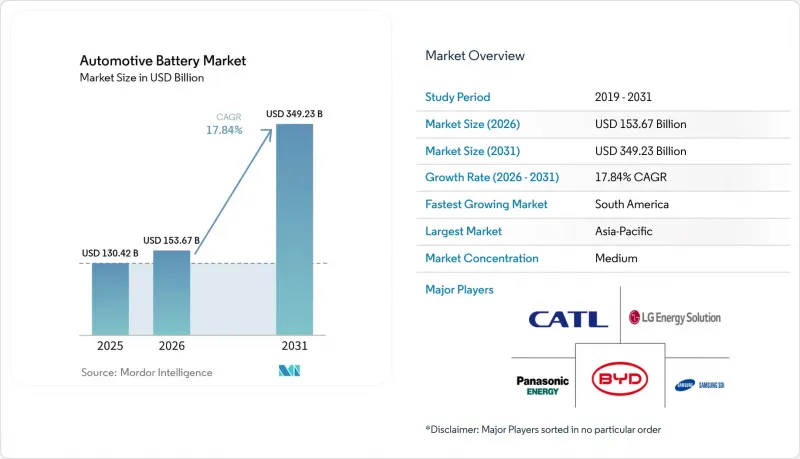
Mordor Intelligence에 의하면, 자동차 배터리 시장 규모는 2025년에 1,304억 2,000만 달러로 평가되었고, 2026년에는 1,536억 7,000만 달러로 추정되고 있습니다.
또한, 2026-2031년 연평균 성장률(CAGR) 17.84%로 확대될 전망이며, 2031년에는 3,492억 3,000만 달러에 달할 것으로 예측됩니다.
본 보고서는 배터리 유형별(납축, 리튬이온 등), 차량 유형별(승용차, 상용차 등), 구동 방식별(ICE(SLI·아이들링 스톱), 하이브리드(HEV·PHEV) 등), 용도별(SLI, 추진 등), 판매 채널별, 지역별로 분류되어 있습니다. 시장 예측은 금액(달러) 기준으로 제시되어 있습니다.
세계의 자동차 배터리 시장 동향 및 인사이트
EV 생산 및 판매의 급증
2025년, 전 세계 전기차 판매 대수는 2,000만 대를 넘어섰으며, 전기차는 전 세계 자동차 판매 대수의 25%를 차지했습니다. 이에 따라 승용차 및 상용차 양쪽 플랫폼에서 자동차 배터리 시장 수요 기반이 크게 확대되었습니다. 중국은 계속해서 이러한 확장의 주요 원동력이었으며, 국내 신에너지차 보급률은 2025년에 50%를 넘어섰고, 2025년 12월에는 60%를 초과했습니다. 이에 따라 일반 차량 및 고급 차량 양쪽 카테고리에서 현지 배터리 수요는 높은 수준을 유지했습니다. 수요에 미치는 영향은 더 이상 차량 대수만으로 설명할 수 없습니다. 전기 상용 트럭에는 훨씬 더 대형의 배터리 팩이 필요하기 때문입니다. CATL은 2025년 말, 전기 대형 트럭 1대가 승용차 3-4대 분량에 해당하는 배터리 용량을 탑재할 수 있다고 발표했습니다. 이에 따라 조달 행태에 변화가 생기고 있습니다. 왜냐하면 소수의 차량 대여 계약이라도 동 규모의 승용차 계약에 비해 셀 생산, 팩 조립, 물류 계획, 향후 교체 서비스에 대한 수요가 훨씬 더 커지기 때문입니다. 또한 성장의 기반은 지리적으로도 더욱 분산되고 있습니다. 브라질의 전기차 시장은 2024년에 12만 5,000대로 두 배로 증가할 전망이며, 2026년부터는 현지 생산이 시작될 것으로 예측됩니다. 이에 따라 중국 중심의 성장 패턴에 국한되지 않는 자동차 배터리 시장에서 더 광범위한 제조 거점 확장이 촉진되고 있습니다. 그 결과, 승용차와 대용량 차량용 플랫폼 모두에 공급할 수 있는 공급업체는 비록 판매 대수 측면에서 시장을 선도파관 않더라도, 증가하는 GWh 단위 수요에서 더 큰 점유율을 확보할 수 있는 입장에 있습니다.
정부의 인센티브와 배기가스 규제
정책은 자동차 배터리 시장에서 가장 명확한 수요 지지 요인 중 하나로 계속 자리 잡고 있습니다. 인센티브 설계가 셀의 제조 장소, 공급망 문서화 방식, 그리고 어떤 제조업체가 현지 조달 우대 조치의 대상이 될지를 좌우하게 되었기 때문입니다. 미국에서는 제45X조에 근거한 ‘첨단 제조 생산 세액 공제’가 국내 셀 및 모듈 생산을 지속적으로 지원하고 있으며, 차종 부문별로 소비자 수요 동향이 불균일하더라도 공장 투자가 활발하게 유지되고 있습니다. 유럽에서는 규정(EU) 2023/1542에 따라 탄소 발자국 공개, 재활용 소재 함유율, 실사, 표시, 디지털 배터리 패스포트 요건에 관한 구속력 있는 프레임워크가 확립되었습니다. 이로 인해 배터리 경쟁의 초점은 가격뿐만 아니라 규정 준수 대응 준비 태세로 이동하고 있습니다. 이러한 규정이 중요한 이유는 추적성이 불충분할 경우 비용을 증가시킬 뿐만 아니라, 차량 프로그램 주기의 초기 단계에서 조달, 재활용, 성능 데이터를 인증할 수 있는 공급업체를 우대하기 때문입니다. 실질적인 영향으로, 배터리 공급업체는 현재 화학적 조성이나 용량뿐만 아니라, 각 차량 플랫폼의 수명 주기 전반에 걸쳐 OEM이 규제 대상인 최종 시장에 접근할 수 있는지 여부도 평가 대상이 되고 있습니다. 이로 인해 소매 시장에서의 전기차 보급이 일시적으로 국가나 보조금 제도에 따라 변동하는 시기라 하더라도, 규제는 자동차 배터리 시장에 대한 지속적인 수요 지지 요인으로 작용하고 있습니다.
중요 광물공급 변동
리튬, 니켈, 코발트공급망은 자동차 수요 자체보다 여전히 집중되어 있기 때문에 중요 광물은 자동차 배터리 시장에 있어 구조적인 제약 요인으로 남아 있습니다. 국제에너지기구(IEA) 보고서에 따르면, 상위 3개국의 정제 능력이 전 세계 코발트 정제 능력의 대부분을 차지하고 있으며, 이는 하류 배터리 제조업체들이 제한된 수의 국가에 있는 업스트림 공급원에 기인한 공급 중단 위험에 지속적으로 노출되어 있음을 의미합니다. 이러한 집중화는 배터리 제조업체가 화학 성분을 다각화한 경우에도 중요한 문제가 됩니다. 왜냐하면 광물에 대한 의존도가 사라지는 것이 아니라 단순히 재료의 조합이 변화할 뿐이며, 그럼에도 불구하고 양극재, 가격 또는 인증 공급량에 영향을 미칠 가능성이 있기 때문입니다. 그 결과, 조달 팀은 리튬 이온 배터리의 성장이 아직 소규모였던 시절에 비해 장기적인 공급 안정성, 재활용 체계, 화학 조성의 선택지를 더욱 중시하게 되었습니다. 또한 이것이 LFP(리튬인산철)의 전략적 중요성이 높아진 이유이기도 합니다. LFP는 코발트에 대한 의존도를 낮추고, 그동안 니켈을 많이 포함하는 시스템에 특히 큰 부담이 되어 온 가격 변동의 일부를 제조업체가 관리하기 쉽게 만들기 때문입니다. 하지만 채굴, 제련, 가공의 생산 능력은 전동 모빌리티 수요에 비해 여전히 확대 속도가 느리기 때문에 자동차 배터리 시장은 업스트림 부문의 충격에 대해 계속해서 민감한 상태를 유지할 것입니다.
부문 분석
2025년, 납축전지는 매출의 48.72%를 차지했으며, 이는 자동차 배터리 시장이 여전히 전 세계 내연기관(ICE) 차량의 보유 대수와 시동·조명·점화 시스템을 위한 정기적인 교체 주기에 크게 의존하고 있음을 보여줍니다. 매우 많은 차량이 저비용이며 널리 구할 수 있는 12V 배터리를 계속해서 필요로 하고 있으며, 또한 교체 수요는 신차 생산에 비해 경기 변동의 영향을 덜 받기 때문에 이러한 위상은 앞으로도 견조하게 유지될 전망입니다. 또한, 이 부문은 확립된 서비스 네트워크, 재활용을 통한 높은 경제성, 많은 기존 차량 플랫폼에서의 표준화된 호환성 등의 이점도 누리고 있어, 전기차(EV)의 보급이 진전되는 상황에서도 상업적 중요성을 유지하고 있습니다. 반면, 공회전 정지 시스템이나 저전압 지원 용도에서 사이클 수명 향상과 급속 충전 성능이 점점 더 중요시됨에 따라, 일부 새로운 차량 아키텍처에서는 납축전지의 역할이 축소되고 있습니다. 즉, 납축전지는 여전히 판매량의 기반을 형성하고 있지만, 자동차 배터리 시장에서는 전동화 플랫폼과 높은 에너지 출력을 뒷받침하는 화학계 배터리에 미래 가치가 꾸준히 부여되고 있습니다.
PHEV(플러그인 하이브리드 차량) 수요에서의 점유율 확대, 증가하는 12V 보조 전원 및 아이들링 스톱 시스템의 업그레이드에 대응하고 있기 때문에 자동차 배터리 시장에서 주요 성장 동력으로 계속 자리 잡고 있습니다. 니켈-수소 배터리는 여전히 기존 하이브리드 자동차에서 틈새 역할을 담당하고 있으며, 특히 각 OEM 업체들이 완전한 전기차로의 전환보다는 검증된 HEV(하이브리드 전기차) 아키텍처와 적당한 배터리 크기를 선호하여 계속 채택하고 있는 분야에서 그 역할이 두드러집니다. ‘기타’ 부문은 2031년까지 연평균 성장률(CAGR) 18.06%를 나타낼 것으로 예측되며, 이는 제한된 광물 자원에 대한 의존도를 낮추고, 한랭 지역에서의 성능, 안전성 또는 비용 유연성을 향상시키려는 업계 전반의 노력을 반영합니다. CATL은 2026년 5월, 자사의 ‘Naxtra’ 나트륨 이온 배터리가 2026년 말까지 양산에 들어갈 것이라고 발표했습니다. 이에 따라 이 부문은 단순한 실험실 단계에 그치지 않고 구체적인 단기적 발판을 마련하게 될 것입니다. 이는 자동차 배터리 업계에 중요한 의미를 지닙니다. 왜냐하면 화학 조성의 다양화가 전략적 논의 단계에서 제품 계획 단계로 전환되고 있으며, 이에 따라 예측 기간 동안 제조업체들이 비용, 원자재 의존도, 차량 적합성을 어떻게 균형 있게 조정해 나갈지가 점차 재구성되어 가고 있기 때문입니다.
2025년에는 승용차가 매출의 70.05%를 차지했으며, 자동차 배터리 시장에서 가장 큰 기여원을 계속 유지했습니다. 이는 중국, 유럽, 북미에서 전기차(EV)의 보급이 여전히 주류 및 프리미엄 승용차의 판매 대수에 의해 주도되고 있기 때문입니다. 이러한 우위는 내연기관(ICE), 하이브리드, 배터리식 전기 구동 시스템에 걸친 광범위한 도입 실적을 반영하며, 승용차가 교체용 배터리와 OEM(순정 장비) 프로그램 모두에서 수요를 모으고 있음을 의미합니다. 또한, 이 부문은 정책 지원, 충전 인프라 접근성, 소비자 모델 선택의 폭이 현재 가장 잘 갖춰진 분야이기도 하여, 국가별로 보급률이 다르더라도 일정한 규모를 유지하는 데 도움이 되고 있습니다. 하지만 차량당 배터리 사용량이 부문마다 크게 다르며, 공급업체가 GWh 단위의 추가 성장을 기대할 수 있는 분야도 변화하고 있기 때문에 승용차 수요만으로는 더 이상 전체적인 상황을 파악할 수 없습니다. 자동차 배터리 시장이 성숙해짐에 따라, 승용차 판매 대수에만 초점을 맞추고 있는 공급업체는 대형 차량 플랫폼에서 현재 발생하고 있는 더 강력한 에너지 수요를 놓칠 위험이 있습니다.
상용차 부문은 2031년까지 연평균 성장률(CAGR) 18.61%로 확대될 것으로 예측되며, 그 성장세가 전체 시장에서 매우 큰 비중을 차지하고 있습니다. 이는 플릿 차량 1대당 배터리 용량이 일반 승용차보다 훨씬 더 클 가능성이 있기 때문입니다. CATL은 2025년 말, 배터리 구동 대형 트럭 1대가 승용차 3-4대 분량의 배터리 용량을 탑재할 수 있을 것이라고 지적했습니다. 이는 플릿의 전기화가 판매 대수를 앞지르기 전에 용량 계획 자체를 재구성할 수 있음을 의미합니다. 따라서 차량 수는 적지만, 지자체 차량, 물류 사업자, 버스, 도시 지역 배송 프로그램이 배터리 공급업체에게 전략적으로 중요한 고객이 되고 있습니다. 아시아에서는 이륜차도 중요한 역할을 하고 있습니다. 배터리 용량은 적을지라도, 전기화의 기반을 넓히고 저비용 모빌리티 분야에서 큰 판매 대수를 더하기 때문입니다. 오프로드 장비는 여전히 소규모 카테고리이지만, 배기가스 규제 강화와 조기 조달 활동으로 인해 전문 작업용 차량이 향후 자동차 배터리 시장에서 더욱 두드러진 수요원이 될 것으로 예측됩니다.
지역별 분석
2025년, 아시아태평양은 매출의 42.68%를 차지했으며 자동차 배터리 시장에서 가장 큰 기여를 한 지역이 되었고, 제조 규모와 전기차 보급 양면에서 이 지역의 주도적 지위를 확고히 했습니다. 중국이 이러한 지위를 뒷받침하고 있는 이유는 2025년 12월 국내 신에너지차(NEV) 보급률이 60%를 넘어섬에 따라, 차량 수요, 배터리 생산, 공급업체의 활동이 하나의 거대한 시장 내에서 밀접하게 연결되었기 때문입니다. 이 점이 중요한 이유는 현지 배터리 제조업체들이 자동차 제조업체와의 근접성, 긴밀한 공급망 생태계, 그리고 급속한 제품 주기와 규모의 경제를 흡수할 수 있을 만큼 충분한 규모의 국내 시장이라는 혜택을 누리고 있기 때문입니다. 일본과 한국은 자동차 배터리 시장에서 여전히 중요한 위치를 차지하고 있지만, 그 발전 경로는 비용 주도라기보다는 기술 주도적이며, 대중 시장에서의 가격 주도권보다는 차별화된 화학 조성, 프리미엄 용도, 전략적인 연구 개발에 중점을 두고 있습니다. 중국도 폐배터리 관리 체계를 강화하고 있으며, 공업정보화부는 2026년 폐동력배터리의 전체 공급망에 걸친 추적 가능성을 강화하기 위한 조치를 취했습니다. 이는 장기적으로 보다 체계적인 재활용 및 재사용 시스템 구축을 뒷받침하는 것입니다.
유럽과 북미는 합쳐서 자동차 배터리 시장의 다음 주요 수요 거점이 되고 있지만, 두 지역은 현재 주기에서 서로 다른 양상을 보이고 있습니다. 유럽은 여전히 정책의 영향을 크게 받고 있으며, 배터리 규제, 탄소 공시, 실사, 배터리 여권 요건으로 인해 공급업체들은 더 투명하고 지역 규정을 준수하는 밸류체인을 구축해야 하는 압박을 받고 있습니다. 이러한 규제 구조는 장기적인 현지화를 촉진하는 한편, 유럽의 OEM 프로그램 및 애프터마켓 채널에 대한 지속적인 접근을 원하는 제조업체들에게는 사업 운영 측면에서 더 높은 기대치를 요구하고 있습니다. 북미는 현지 생산 지원과 소매 수요 상황 간의 균형에 크게 의존하는 경향이 있으며, 섹션 45X는 파워트레인 유형에 따른 차량 판매 구성이 변화하더라도 국내 셀 생산을 지속적으로 지원하고 있습니다. 또한, 노스볼트(Northvolt)사의 파산도 이 지역의 사고방식에 영향을 미쳤습니다. 이는 특히 중국 제조업체들이 자동차 배터리 시장 전체에서 더 강력한 규모와 확립된 학습 곡선을 유지하고 있는 상황에서 자본만으로는 비용 경쟁력을 확보할 수 없음을 보여주었기 때문입니다.
남미는 2031년까지 연평균 성장률(CAGR) 18.01%를 나타낼 것으로 예측되며, 관세 주도형 현지화와 도시 지역의 전기차 보급이 서로 시너지를 내기 시작하면서 가장 빠르게 성장하는 지역이 되었습니다. 브라질은 전기차 시장이 급속히 성장하고 있을 뿐만 아니라, 관세 구조가 BYD나 GWM과 같은 중국 자동차 제조업체들을 현지 생산 계획으로 이끌고 있어 지역 공급망의 심화가 예상에 따라 이러한 변화의 중심에 서 있습니다. 중동 및 아프리카는 여전히 초기 단계에 있는 지역이지만, 정책 주도형 차량 일괄 조달 및 무역 접근성 덕분에 향후 배터리 조립, 전기차 유통, 서비스 네트워크 측면에서 이 지역들의 중요성이 높아지고 있습니다. 이에 따라 자동차 배터리 시장에서는 뚜렷한 지역적 경향이 나타납니다. 아시아태평양이 시장 규모를 주도하고, 유럽과 북미가 규제 대응 및 현지화를 주도하며, 남미가 예측 기간 동안 가장 급격한 성장 잠재력을 보이고 있습니다.
기타 혜택 :
- 엑셀 형식 시장 예측(ME) 시트
- 3개월간의 애널리스트 지원
자주 묻는 질문
목차
제1장 서론
제2장 조사 방법
제3장 주요 요약
제4장 시장 구도
제5장 시장 규모 및 성장 예측
제6장 경쟁 구도
제7장 시장 기회 및 향후 전망
AJY 26.09.09According to Mordor Intelligence, the automotive battery market size was valued at USD 130.42 billion in 2025 and is estimated at USD 153.67 billion in 2026, and is forecast to reach USD 349.23 billion by 2031 at a 17.84% CAGR over 2026-2031.
This report is Segmented by Battery Type (Lead-Acid, Lithium-Ion, and More), Vehicle Type (Passenger Cars, Commercial Vehicles, and More), Drive Type (Internal Combustion Engine (SLI and Start-Stop), Hybrid (HEV and PHEV), and More), Application (Starting-Lighting-Ignition (SLI), Propulsion, and More), Sales Channel, and Geography. The Market Forecasts are Provided in Terms of Value (USD).
Global Automotive Battery Market Trends and Insights
Surging EV Production and Sales
Global EV sales exceeded 20 million units in 2025, and electric cars accounted for 25% of all cars sold worldwide, which materially lifted the volume base for the automotive battery market across both passenger and commercial platforms. China remained the dominant engine of this expansion, with domestic new energy vehicle penetration moving above 50% in 2025 and then above 60% in December 2025, which kept local battery demand high across mainstream and premium vehicle categories . The demand effect is no longer explained by vehicle counts alone because electric commercial trucks require much larger battery packs, and CATL stated in late 2025 that one battery-electric heavy truck can carry battery capacity equal to 3 to 4 passenger cars. That changes procurement behavior because a smaller number of fleet wins can generate a much larger call on cell output, pack assembly, logistics planning, and future replacement services than passenger vehicle contracts of similar unit size. The growth base is also becoming more geographically distributed, as Brazil's EV market doubled to 125,000 units in 2024 and local production activity started moving into 2026, which supports a broader manufacturing footprint for the automotive battery market beyond China-centric growth patterns. As a result, suppliers that can serve both passenger vehicles and high-capacity fleet platforms are positioned to capture a larger share of incremental GWh demand even if their unit volumes do not lead the market.
Government Incentives and Emission Norms
Policy remains one of the clearest demand anchors for the automotive battery market because incentive design now affects where cells are made, how supply chains are documented, and which producers can qualify for local sourcing benefits. In the United States, the advanced manufacturing production credit under Section 45X continues to support domestic cell and module output, which keeps plant investment active even when consumer demand signals move unevenly across vehicle segments. In Europe, Regulation (EU) 2023/1542 established a binding framework for carbon footprint disclosure, recycled content, due diligence, labeling, and digital battery passport requirements, which shifts battery competition away from price alone and toward compliance readiness. These rules matter because they raise the cost of weak traceability and reward suppliers that can certify sourcing, recycling, and performance data early in the vehicle program cycle. The practical effect is that battery suppliers are now being assessed not only on chemistry and capacity but also on whether they can protect OEM access to regulated end markets over the life of each vehicle platform. That makes regulation a continuing demand support for the automotive battery market, even in periods when retail EV adoption temporarily varies by country or subsidy structure.
Critical Mineral Supply Volatility
Critical minerals remain a structural restraint on the automotive battery market because lithium, nickel, and cobalt supply chains are still more concentrated than vehicle demand itself. The International Energy Agency reported that the top 3 refining countries accounted for the majority of global cobalt refining capacity, which means downstream battery producers remain exposed to disruptions that originate far upstream in a limited number of countries. This concentration matters even when battery makers diversify chemistry because mineral exposure does not disappear; it simply shifts from one material mix to another and can still affect cathodes, pricing, or qualifying supply volumes. The practical result is that procurement teams now place more value on long-term offtake security, recycling pathways, and chemistry optionality than they did when lithium-ion growth was starting from a smaller base. It also explains why LFP has gained strategic weight, since it reduces cobalt exposure and helps producers manage part of the volatility that has historically weighed more heavily on nickel-rich systems. Even so, the automotive battery market will remain sensitive to upstream shocks because mining, refining, and processing capacity still scale more slowly than demand for electrified mobility.
Other drivers and restraints analyzed in the detailed report include:
- Rapid Decline in Li-Ion Price/kWh
- Vehicle-To-Grid Pilots Boosting Second-Life Demand
- Thermal-Runaway Recalls and Safety Perceptions
For complete list of drivers and restraints, kindly check the Table Of Contents.
Segment Analysis
Lead-Acid held 48.72% of revenue in 2025, which shows that the automotive battery market still depends heavily on the installed global ICE fleet and its recurring replacement cycle for starting, lighting, and ignition systems. This position remains durable because a very large vehicle parc continues to require low-cost and widely available 12V batteries, and replacement demand is less cyclical than new vehicle production. The segment also benefits from familiar service networks, strong recycling economics, and standardized fitment across many established vehicle platforms, which keep it commercially relevant even as EV penetration rises. At the same time, the operating role of lead-acid is narrowing in some newer vehicle architectures because start-stop systems and low-voltage support applications increasingly reward better cycle life and faster recharge performance. That means Lead-Acid still anchors volume, but the automotive battery market is steadily assigning more future value to chemistries that support electrified platforms and higher energy throughput.
Lithium-ion remains the main growth engine inside the automotive battery market because it serves BEV propulsion, a rising share of PHEV requirements, and a growing number of 12V auxiliary and start-stop upgrades. Nickel-Metal Hydride still holds a niche role in conventional hybrids, especially where OEMs continue to favor proven HEV architectures and modest battery sizing over full battery-electric transitions. The Others segment is projected to grow at 18.06% CAGR through 2031, which reflects a broader industry push to reduce dependence on a narrow set of mineral pathways and to improve cold-weather performance, safety, or cost flexibility. CATL stated in May 2026 that its Naxtra sodium-ion battery will enter mass production by the end of 2026, which gives the segment a concrete near-term anchor rather than only a laboratory narrative CATL. That matters for the automotive battery industry because chemistry diversification is moving from strategic discussion into product planning, and that will gradually reshape how manufacturers balance cost, raw material exposure, and vehicle fit across the forecast period.
Passenger Cars held 70.05% of revenue in 2025, which kept them as the largest contributor to the automotive battery market because EV adoption is still led by mainstream and premium passenger vehicle volumes in China, Europe, and North America. This dominance reflects a broad installed base across ICE, hybrid, and battery-electric drivetrains, which means passenger cars draw demand from both replacement batteries and original equipment programs. The segment is also where policy support, charging access, and consumer model choice are currently the most developed, which helps it retain scale even as adoption rates vary across countries. Even so, passenger car demand no longer tells the whole story because battery intensity per vehicle differs sharply across segments, and that is changing where suppliers find incremental GWh growth. As the automotive battery market matures, suppliers that focus only on car volumes may miss the stronger energy demand now emerging from larger vehicle platforms.
Commercial Vehicles is projected to expand at 18.61% CAGR through 2031, and that growth carries unusual weight because each fleet vehicle can require far more battery capacity than a typical passenger car. CATL noted in late 2025 that one battery-electric heavy truck can carry battery capacity equal to 3 to 4 passenger cars, which means fleet electrification can reshape capacity planning even before it dominates unit sales. This is why municipal fleets, logistics operators, buses, and urban delivery programs have become strategically important accounts for battery suppliers despite their smaller vehicle counts. Two-wheelers also matter in Asia because they widen the electrification base and add large unit volumes in lower-cost mobility segments, even when pack sizes are modest. Off-highway equipment remains a smaller category, but tightening emissions rules and early procurement activity suggest that specialized work vehicles will become a more visible demand pocket for the automotive battery market over time.
Complete Report Scope:
- By Battery Type
- Lead-Acid
- Lithium-ion
- Nickel-Metal Hydride
- Others (Li-S, Na-ion, Zinc-air)
- By Vehicle Type
- Passenger Cars
- Hatchback
- Sedan
- Multi-Purpose Vehicle and Sport-Utility Vehicle
- Commercial Vehicles
- Light Commercial Vehicles
- Medium and Heavy Trucks
- Bus and Coach
- Two-Wheelers
- Off-Highway
- Construction Equipment
- Agricultural Machinery
- Passenger Cars
- By Drive Type
- Internal Combustion Engine (SLI and Start-Stop)
- Hybrid (HEV and PHEV)
- Battery Electric Vehicle (BEV)
- Fuel-Cell Electric Vehicle (FCEV)
- By Application
- Starting-Lighting-Ignition (SLI)
- Propulsion
- Start-Stop
- Auxiliary/12 V Systems
- Battery-as-a-Service / Swap
- By Sales Channel
- OEM
- Aftermarket
- By Geography
- North America
- United States
- Canada
- Rest of North America
- South America
- Brazil
- Argentina
- Rest of South America
- Europe
- Germany
- France
- United Kingdom
- Italy
- Spain
- Rest of Europe
- Asia-Pacific
- China
- Japan
- India
- South Korea
- Rest of Asia-Pacific
- Middle-East and Africa
- United Arab Emirates
- Saudi Arabia
- Egypt
- South Africa
- Rest of Middle-East and Africa
- North America
Geography Analysis
Asia-Pacific held 42.68% of revenue in 2025, which made it the largest regional contributor to the automotive battery market and confirmed the region's lead in both manufacturing scale and EV adoption. China anchors that position because domestic new energy vehicle penetration moved above 60% in December 2025, which kept vehicle demand, battery production, and supplier activity tightly linked in one large market. This matters because local battery makers benefit from proximity to automakers, dense supplier ecosystems, and a domestic market large enough to absorb rapid product cycles and scale advantages. Japan and South Korea remain important in the automotive battery market, but their path is more technology-led than cost-led, with stronger emphasis on differentiated chemistries, premium applications, and strategic R&D rather than mass-market price leadership. China is also tightening end-of-life governance, and the Ministry of Industry and Information Technology moved in 2026 toward stronger full-chain traceability for retired power batteries, which supports more formal recycling and reuse systems over time.
Europe and North America together form the next major demand center for the automotive battery market, but the two regions are moving through the current cycle in different ways. Europe remains strongly policy-shaped, with battery regulation, carbon disclosure, due diligence, and battery passport requirements pushing suppliers to build more transparent and regionally compliant value chains. That regulatory structure supports long-term localization, but it also raises operating expectations for manufacturers that want durable access to European OEM programs and aftermarket channels. North America is more dependent on the balance between local manufacturing support and retail demand conditions, and Section 45X continues to support domestic cell production even when vehicle sales mix changes across powertrain types. The Northvolt failure also shaped regional thinking because it showed that capital alone does not ensure cost competitiveness, especially when Chinese producers retain stronger scale and established learning curves across the automotive battery market.
South America is projected to grow at 18.01% CAGR through 2031, which makes it the fastest-growing region as tariff-led localization and urban EV adoption begin to reinforce each other. Brazil is the center of that shift because its EV market has grown quickly and the tariff structure has pushed Chinese automakers such as BYD and GWM toward local production plans that should deepen regional supply chains. The Middle East and Africa remain earlier-stage regions, but policy-led fleet procurement and trade access are making them more relevant to future battery assembly, EV distribution, and service networks. That leaves the automotive battery market with a clear geographic pattern, Asia-Pacific sets the scale, Europe and North America shape compliance and localization, and South America provides the sharpest growth runway during the forecast period.
- Contemporary Amperex Technology Co., Limited (CATL)
- LG Energy Solution
- Panasonic Energy Co., Ltd.
- BYD Co. Ltd.
- Samsung SDI Co., Ltd.
- Clarios
- GS Yuasa Corporation
- VARTA AG
- Exide Technologies
- EnerSys
- A123 Systems Corp.
- Prime Planet Energy & Solutions, Inc.
- Robert Bosch GmbH
- SK On
- EVE Energy Co., Ltd.
- Farasis Energy
- SVOLT Energy Technology Co., Ltd
- Saft Groupe SA
Additional Benefits:
- The market estimate (ME) sheet in Excel format
- 3 months of analyst support
TABLE OF CONTENTS
1 Introduction
- 1.1 Study Assumptions and Market Definition
- 1.2 Scope of the Study
2 Research Methodology
3 Executive Summary
4 Market Landscape
- 4.1 Market Overview
- 4.2 Market Drivers
- 4.2.1 Surging Electric Vehicle Production and Sales
- 4.2.2 Government Incentives and Emission Norms
- 4.2.3 Rapid Decline in Li-Ion Price/kWh
- 4.2.4 Vehicle-To-Grid Pilots Boosting Second-Life Demand
- 4.2.5 Localization Via IRA/EU Battery Reg. Gigafactory Subsidies
- 4.2.6 Growing Demand for 12 V Li-Ion Start-Stop Replacements
- 4.3 Market Restraints
- 4.3.1 Critical Mineral Supply Volatility
- 4.3.2 Thermal-Runaway Recalls and Safety Perceptions
- 4.3.3 Solid-State and Na-Ion Tech Risk Stranding Current Assets
- 4.3.4 Recycling Over-Capacity Pressuring Margins
- 4.4 Value / Supply-Chain Analysis
- 4.5 Regulatory Landscape
- 4.6 Technological Outlook
- 4.7 Porter's Five Forces
- 4.7.1 Bargaining Power of Suppliers
- 4.7.2 Bargaining Power of Buyers
- 4.7.3 Threat of New Entrants
- 4.7.4 Threat of Substitutes
- 4.7.5 Intensity of Competitive Rivalry
5 Market Size and Growth Forecasts (Value in USD)
- 5.1 By Battery Type
- 5.1.1 Lead-Acid
- 5.1.2 Lithium-ion
- 5.1.3 Nickel-Metal Hydride
- 5.1.4 Others (Li-S, Na-ion, Zinc-air)
- 5.2 By Vehicle Type
- 5.2.1 Passenger Cars
- 5.2.1.1 Hatchback
- 5.2.1.2 Sedan
- 5.2.1.3 Multi-Purpose Vehicle and Sport-Utility Vehicle
- 5.2.2 Commercial Vehicles
- 5.2.2.1 Light Commercial Vehicles
- 5.2.2.2 Medium and Heavy Trucks
- 5.2.2.3 Bus and Coach
- 5.2.3 Two-Wheelers
- 5.2.4 Off-Highway
- 5.2.4.1 Construction Equipment
- 5.2.4.2 Agricultural Machinery
- 5.2.1 Passenger Cars
- 5.3 By Drive Type
- 5.3.1 Internal Combustion Engine (SLI and Start-Stop)
- 5.3.2 Hybrid (HEV and PHEV)
- 5.3.3 Battery Electric Vehicle (BEV)
- 5.3.4 Fuel-Cell Electric Vehicle (FCEV)
- 5.4 By Application
- 5.4.1 Starting-Lighting-Ignition (SLI)
- 5.4.2 Propulsion
- 5.4.3 Start-Stop
- 5.4.4 Auxiliary/12 V Systems
- 5.4.5 Battery-as-a-Service / Swap
- 5.5 By Sales Channel
- 5.5.1 OEM
- 5.5.2 Aftermarket
- 5.6 By Geography
- 5.6.1 North America
- 5.6.1.1 United States
- 5.6.1.2 Canada
- 5.6.1.3 Rest of North America
- 5.6.2 South America
- 5.6.2.1 Brazil
- 5.6.2.2 Argentina
- 5.6.2.3 Rest of South America
- 5.6.3 Europe
- 5.6.3.1 Germany
- 5.6.3.2 France
- 5.6.3.3 United Kingdom
- 5.6.3.4 Italy
- 5.6.3.5 Spain
- 5.6.3.6 Rest of Europe
- 5.6.4 Asia-Pacific
- 5.6.4.1 China
- 5.6.4.2 Japan
- 5.6.4.3 India
- 5.6.4.4 South Korea
- 5.6.4.5 Rest of Asia-Pacific
- 5.6.5 Middle-East and Africa
- 5.6.5.1 United Arab Emirates
- 5.6.5.2 Saudi Arabia
- 5.6.5.3 Egypt
- 5.6.5.4 South Africa
- 5.6.5.5 Rest of Middle-East and Africa
- 5.6.1 North America
6 Competitive Landscape
- 6.1 Market Concentration
- 6.2 Strategic Moves
- 6.3 Market Share Analysis
- 6.4 Company Profiles (Includes Global Level Overview, Market Level Overview, Core Segments, Financials as Available, Strategic Information, Market Rank/Share for Key Companies, Products and Services, SWOT Analysis, and Recent Developments)
- 6.4.1 Contemporary Amperex Technology Co., Limited (CATL)
- 6.4.2 LG Energy Solution
- 6.4.3 Panasonic Energy Co., Ltd.
- 6.4.4 BYD Co. Ltd.
- 6.4.5 Samsung SDI Co., Ltd.
- 6.4.6 Clarios
- 6.4.7 GS Yuasa Corporation
- 6.4.8 VARTA AG
- 6.4.9 Exide Technologies
- 6.4.10 EnerSys
- 6.4.11 A123 Systems Corp.
- 6.4.12 Prime Planet Energy & Solutions, Inc.
- 6.4.13 Robert Bosch GmbH
- 6.4.14 SK On
- 6.4.15 EVE Energy Co., Ltd.
- 6.4.16 Farasis Energy
- 6.4.17 SVOLT Energy Technology Co., Ltd
- 6.4.18 Saft Groupe SA