

|
시장보고서
상품코드
2121421
포장 자동화 : 시장 점유율 분석, 업계 동향과 통계, 성장 예측(2026-2031년)Packaging Automation - Market Share Analysis, Industry Trends & Statistics, Growth Forecasts (2026 - 2031) |
||||||
 Mordor Intelligence
Mordor Intelligence에 의하면, 포장 자동화 시장 규모는 2025년에 808억 4,000만 달러로 평가되었고, 2026년 866억 4,000만 달러에서 2031년까지 1,225억 1,000만 달러에 이를 것으로 예측되며, 예측 기간(2026-2031년) CAGR은 7.17%를 기록할 전망입니다.
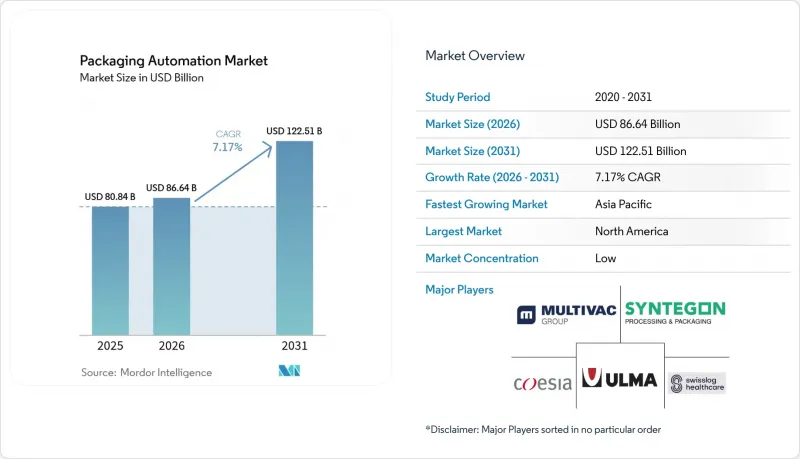
본 보고서는 제품 유형(충진, 라벨링, 케이스 포장 등), 최종 사용자(식품, 음료, 의약품 등), 자동화 수준(완전 자동화 라인, 반자동화 라인,협동/하이브리드 시스템), 솔루션(하드웨어 등), 포장 단계(1차 포장, 2차 포장, 3차 포장/엔드 오브 라인), 지역별로 분류되어 있습니다. 시장 예측은 금액(달러) 기준으로 제시되어 있습니다.
세계 포장 자동화 시장 동향 및 인사이트
식품 및 음료, 제약, 전자상거래 각 부문에서의 자동화 도입 확대
2024년에는 대량 생산을 하는 식품 사업에 더해, 유연하고 소량 생산이 요구되는 제약 라인의 견인에 힘입어 포장 기계 출하 대수가 증가했습니다. 제약 제조업체들은 맞춤형 의료를 위한 포장을 실현하기 위해 2025년에 1,600억 달러를 시설 업그레이드에 투자할 예정입니다. 전자상거래 풀필먼트 센터에서는 수천 가지 유형의 상자 변형을 생성하는 ‘라이트사이징(light-sizing)’ 시스템이 도입되어, 골판지 사용량을 절반으로 줄이는 동시에 노동 생산성을 향상시키고 있습니다. 한 업계에서 검증된 솔루션이 다른 업계로 확산됨에 따라, 업계 간 기술 이전이 가속화되고 포장 자동화 시장의 보급이 촉진되고 있습니다. 이러한 시너지 효과로 인해 가동 중지 시간을 최소화하면서 SKU 등급 간 전환이 가능한 적응형 로봇 및 통합 비전 시스템에 대한 수요가 증가하고 있습니다.
이커머스가 가져온 고속 2차 포장 수요
적정 크기로 설계된 상자 시스템과 이동식 로봇을 결합함으로써, 한 물류 거점의 생산성이 몇 달 만에 97% 향상되어 2차 포장이 얼마나 중요한 효율화의 열쇠인지가 부각되었습니다. 가변 치수 대응 자동화는 현재 포장 자동화 시장의 41.42%를 차지하고 있으며, 혼합 주문을 신속하게 처리해야 할 필요성을 반영하고 있습니다. 아시아태평양의 온라인 소매 매출 급증으로 인해 2024년에는 해당 지역의 설비 투자액이 180억 달러에 달할 것으로 예측됩니다. 유럽과 북미의 옴니채널 모델과 맞물려, 이러한 변화는 라인 속도, 소프트웨어 기반 오케스트레이션, 인체공학적 팔레타이징에 지속적인 압박을 가하며, 포장 자동화 시장 전반에 걸친 지속적인 업그레이드를 촉진하고 있습니다.
높은 설비 투자 비용과 사이버 보안 위험
본격적인 포장 셀을 구축하려면 막대한 초기 투자가 필요하며, 이는 많은 중소기업에게 장벽이 되고 있습니다. 동시에, 네트워크 연결이 확대됨에 따라 운영 기술이 사이버 위협에 노출될 위험이 높아지고 있으며, 산업 분야의 사고 중 4분의 1 이상이 제조업에서 발생하고 있습니다. 기업은 자동화 하드웨어와 다층적인 보안 모두에 투자해야 하므로 예산에 부담이 되고, 도입 속도가 둔화되고 있습니다. ‘Robots-as-a-Service(RaaS)’ 모델은 지출을 OPEX(운영비)로 전환하고, 구독 계약 내에서 관리형 사이버 보안을 제공함으로써 이러한 이중 과제를 해결하고 있습니다. 이 접근 방식은 대차대조표에 미치는 영향을 완화하지만, 포장 자동화 시장 전체에 확산시키기 위해서는 여전히 시장 인식을 제고할 필요가 있습니다.
부문 분석
2025년, 케이스 포장은 포장 자동화 시장의 31.74%를 차지하며, 유통 과정에서 상품 보호에 필수적인 역할을 하고 있음이 부각되었습니다. 지속가능성 노력에 따라 더 얇은 골판지와 정밀한 접착제 도포가 추진됨에 따라, 케이스 부문의 성장은 견조한 추세를 보이고 있습니다. 팔레타이징은 매출 규모는 작지만 연평균 성장률(CAGR) 11.94%로 확대되고 있습니다. 파낙(FANUC)의 신형 코봇 ‘CRX-25iA’는 30kg의 하중을 처리할 수 있으며, 셀 설치 면적을 줄이면서도 조작하기 쉬운 티치 펜던트를 갖추고 있습니다. 협동 로봇은 시운전 기간을 단축하고 작업자의 작업 환경을 개선하기 때문에 이 부문은 보다 광범위한 자동화 도입의 선행 지표가 되고 있습니다.
업스트림 공정에서는 유연한 무균 충전 방식이 맞춤형 치료에 대응할 수 있기 때문에 제약 분야의 충전기에 대한 투자가 증가하고 있습니다. 라벨링 라인에는 의약품 및 음료 분야의 규제상 추적성 요건을 충족하는 일련번호 부여 모듈이 추가되었습니다. 포장 및 캡핑 분야에서는 경량 필름 기술의 발전을 배경으로 수요가 확대되고 있으며, 밴딩 기술을 통해 시범 도입 단계에서 플라스틱 사용량을 80% 절감하고 있습니다. 포장 라인에서는 내마모성이 뛰어난 Hardox 강재가 수명을 연장시켜 주는 연마성 재료 분야에서 점차 자리 잡고 있습니다. 이러한 제품 간의 상호작용은 여러 작업을 융합한 엔드투엔드 셀로 전환되고 있으며, 적응성이 높은 포장 자동화 시장 솔루션이 형성되고 있음을 보여줍니다.
2025년, 식품 제조업체는 포장 자동화 시장의 28.07%를 차지하며, 대량 생산되는 SKU와 엄격한 위생 기준의 혜택을 누리고 있습니다. 소량 제품 및 주사제 수요 증가에 힘입어 의약품 포장 시장은 연평균 성장률(CAGR) 11.55%를 나타낼 것으로 전망됩니다. Syntegon사의 ‘Pharmatag 2025’ 라인은 엄격한 무균 조건 하에서 액체를 충전하는 동시에 소량 생산에 대응하기 위해 포맷을 신속하게 전환할 수 있습니다. 아시아태평양의 음료 생산 라인에서는 확대되는 중산층 수요를 충족하기 위해 고속 캔 포장 및 슬리브 포장 설비가 도입되고 있습니다.
퍼스널케어 브랜드는 자동화된 멀티 라인 주문 피킹을 통해 구현되는 고급스러운 맞춤형 포장에 주력하고 있습니다. 화학 제조업체는 Fest사의 EX 인증 액추에이터를 활용하여 부식성 매체에 대한 노출을 제한하기 위해 밀폐형 충전 및 밀봉 방식을 채택하고 있습니다. 위조품 방지 대책으로서 의약품의 일련번호 부여가 소비재 분야로 확대됨에 따라 기술의 상호 침투가 가속화되고 있으며, 이로 인해 포장 자동화 시장의 적용 범위가 확대되고 있습니다.
지역별 분석
2025년, 북미는 첨단 제조 인프라와 FDA의 일련번호 부여 의무화를 활용하여 포장 자동화 시장의 33.78%를 차지했습니다. 제약사들은 2025년에 시설 업그레이드에 1,600억 달러를 투자하여 클린룸 대응 로봇 수요를 뒷받침할 전망입니다. ABB가 미시간주에서 2,000만 달러 규모의 확장 계획을 발표한 것은 해당 공급업체가 지역 고객에 대한 강한 의지를 가지고 있음을 보여줍니다. 전자상거래 주문 처리 허브가 급증함에 따라 적응성이 높은 2차 포장 수요도 증가하고 있습니다.
아시아태평양은 2031년까지 연평균 성장률(CAGR)이 10.32%에 달하고, 가장 빠른 성장이 예상되는 지역입니다. 중국은 2024년에 산업용 로봇에 66억 달러를 투자하여 로봇 밀도를 두 배로 늘리겠다는 정책 목표를 반영하고 있습니다. 상하이에서 개최되는 ‘ProPak 2025’에는 스마트 포장 솔루션 분야의 2,500개 이상의 전시업체가 참가하여, 해당 지역이 수작업 생산 라인에서 디지털 공장으로 전환되고 있음을 여실히 보여주고 있습니다. Estun Automation과 같은 국내 공급업체들은 경쟁력 있는 가격의 로봇 팔로 시장 점유율을 확대하며 현지 포장 자동화 시장을 성장시키고 있습니다.
유럽에서는 지속가능성 규제와 ‘인더스트리 4.0’ 보조금을 통해 도입이 촉진되고 있습니다. 스웨덴의 한 시설에서는 자동 밴딩을 통해 플라스틱 포장재를 80% 줄여 순환 경제 목표를 달성했습니다. 독일의 선도적인 기계 제조업체들은 수출 경쟁력을 유지하기 위해 AI 모듈을 도입하고 있습니다. 그 밖의 지역에서는 중동 및 아프리카에서 식량 안보를 강화하기 위한 유제품 자동 생산 라인의 시범 운영이 진행되고 있으며, 한편 브라질의 남미 공장에서는 지역 내 증가하는 음료 수요에 대응하기 위해 팔레타이저가 도입되고 있습니다. 이러한 다양한 노력이 어우러져 전 세계 포장 자동화 시장 규모를 확대시키고 있습니다.
기타 혜택:
- 엑셀 형식 시장 예측(ME) 시트
- 3개월간의 애널리스트 지원
자주 묻는 질문
목차
제1장 서론
제2장 조사 방법
제3장 주요 요약
제4장 시장 구도
제5장 시장 규모와 성장 예측
제6장 경쟁 구도
제7장 시장 기회와 향후 전망
LSH 26.09.09According to Mordor Intelligence, the packaging automation market size was valued at USD 80.84 billion in 2025 and estimated to grow from USD 86.64 billion in 2026 to reach USD 122.51 billion by 2031, at a CAGR of 7.17% during the forecast period (2026-2031).
This report is Segmented by Product Type (Filling, Labeling, Case Packaging, and More), End-User (Food, Beverage, Pharmaceuticals, and More), Automation Level (Fully-Automated Lines, Semi-Automated Lines, Collaborative/Hybrid Systems), Solution (Hardware, and More), Packaging Stage (Primary, Secondary, Tertiary/End-of-Line), and Geography. The Market Forecasts are Provided in Terms of Value (USD).
Global Packaging Automation Market Trends and Insights
Rising Adoption of Automation Across F&B, Pharma and E-commerce Sectors
Packaging machinery shipments climbed in 2024, propelled by pharmaceutical lines that demand flexible, small-batch formats beside high-volume food operations. Pharmaceutical manufacturers are committing USD 160 billion to site upgrades in 2025 to enable personalized medicine packaging. E-commerce fulfillment centers adopt right-sizing systems generating thousands of box variations, halving corrugate use while boosting labor productivity. Cross-industry technology transfer quickens as solutions proven in one sector migrate to another, accelerating packaging automation market penetration. The combined momentum amplifies demand for adaptive robotics and integrated vision that can shift between SKU classes with limited downtime.
E-commerce-Induced Demand for High-Speed Secondary Packaging
Right-sized box systems coupled with mobile robots lifted a distribution site's productivity by 97% within months, underscoring how secondary packaging has become the pivotal efficiency lever. Variable-dimension automation now comprises 41.42% of the packaging automation market, reflecting the need to process mixed orders at speed. Asia-Pacific's surging online retail sales are projected to escalate regional equipment outlays to USD 18 billion in 2024. Coupled with omnichannel models in Europe and North America, the shift places sustained pressure on line speeds, software orchestration, and ergonomic palletizing, stimulating continuous upgrades across the packaging automation market.
High Capital Cost and Cybersecurity Risks
Full-scale packaging cells require significant upfront cash that many SMEs find prohibitive. Simultaneously, rising connectivity exposes operational technology to cyber threats, with manufacturing representing over one quarter of industrial incidents. Firms must invest in both automation hardware and layered security, stretching budgets and slowing adoption. Robots-as-a-Service models address this dual hurdle by shifting spending to OPEX and providing managed cybersecurity within the subscription. The approach lessens balance-sheet impact, yet market education is still needed before it scales across the packaging automation market.
Other drivers and restraints analyzed in the detailed report include:
- Labor Shortages Accelerating Robotics Deployment
- AI-Driven Predictive Maintenance Lowering Downtime
- Skilled-Operator Scarcity
For complete list of drivers and restraints, kindly check the Table Of Contents.
Segment Analysis
Case packaging accounted for 31.74% of packaging automation market share in 2025, underscoring its essential role in safeguarding goods during distribution. Growth within the case segment remains steady as sustainability pushes thinner corrugate and precision glue application. Palletizing, though smaller in revenue, is expanding at 11.94% CAGR. FANUC's new CRX-25iA cobot, able to handle 30 kg loads, compresses cell footprints while offering easy teach pendants. Collaborative robots shorten commissioning and improve worker ergonomics, making the segment a leading indicator of wider automation uptake.
Upstream, filling machines win pharmaceutical investment as flexible aseptic formats accommodate personalized therapies. Labeling lines add serialization modules that satisfy regulatory traceability in medicine and beverages. Wrapping and capping rise on the back of lightweight film advances, with banding technology reducing plastic by 80% in pilot deployments. Bagging lines gain footing in abrasive material sectors where ruggedized Hardox steel prolongs service life. The interplay among these products signals a move toward end-to-end cells that fuse multiple tasks into an adaptive packaging automation market solution.
Food manufacturers held 28.07% of the packaging automation market in 2025, benefiting from high-volume SKUs and rigid hygiene standards. Despite its smaller baseline, pharmaceutical packaging is poised for 11.55% CAGR as injectable therapies rise. Syntegon's Pharmatag 2025 line fills liquids under strict sterility while switching formats quickly to handle short runs. Beverage lines in Asia-Pacific install high-speed canning and sleeving to satisfy rising middle-class demand.
Personal-care brands focus on luxurious, custom packs enabled by automated multi-line order picking. Chemical producers adopt enclosed filling and sealing to limit exposure to aggressive media, leveraging Festo's EX-certified actuators. Technology crossover accelerates as pharma serialization migrates into consumer goods to combat counterfeits, broadening application scope for the packaging automation market.
Complete Report Scope:
- By Product Type
- Filling
- Labeling
- Case Packaging
- Bagging
- Palletizing
- Capping
- Wrapping
- Other Product Types
- By End-user
- Food
- Beverage
- Pharmaceuticals
- Personal Care and Toiletries
- Industrial and Chemicals
- Other End-users
- By Automation Level
- Fully-Automated Lines
- Semi-Automated Lines
- Collaborative/Hybrid Systems
- By Solution
- Hardware (Robots, Conveyors, Sensors)
- Software (SCADA, MES, Analytics)
- Services (Installation, Maintenance, Retrofits)
- By Packaging Stage
- Primary Packaging Automation
- Secondary Packaging Automation
- Tertiary / End-of-Line Automation
- By Geography
- North America
- United States
- Canada
- Mexico
- Europe
- Germany
- United Kingdom
- France
- Italy
- Spain
- Russia
- Rest of Europe
- Asia-Pacific
- China
- India
- Japan
- South Korea
- Australia and New Zealand
- Rest of Asia-Pacific
- Middle East and Africa
- Middle East
- United Arab Emirates
- Saudi Arabia
- Turkey
- Rest of Middle East
- Africa
- South Africa
- Nigeria
- Egypt
- Rest of Africa
- Middle East
- South America
- Brazil
- Argentina
- Rest of South America
- North America
Geography Analysis
North America contributed 33.78% to the packaging automation market in 2025, leveraging sophisticated manufacturing infrastructure and FDA serialization mandates. Drug makers will spend USD 160 billion on facility upgrades during 2025, sustaining demand for clean-room ready robots. ABB's USD 20 million expansion in Michigan underscores vendor commitment to regional customers. E-commerce fulfillment hubs proliferate, amplifying calls for adaptive secondary packaging.
Asia-Pacific is the fastest region at 10.32% CAGR through 2031. China spent USD 6.6 billion on industrial robots in 2024, reflecting policy ambitions to double robot density. Shanghai's ProPak 2025 will gather more than 2,500 exhibitors in smart packaging solutions, highlighting the region's shift from manual lines to digital factories. Domestic suppliers such as Estun Automation are winning share with competitively priced robotic arms, expanding the packaging automation market locally.
Europe drives adoption through sustainability regulation and Industry 4.0 grants. A Swedish facility cut plastic wrap by 80% via automated banding, satisfying circular-economy goals. Germany's advanced machine builders add AI modules to retain export competitiveness. Elsewhere, Middle East and Africa pilot automated dairy lines to bolster food security, while South American plants in Brazil install palletizers to serve growing regional beverage demand. These diverse initiatives collectively extend the global packaging automation market footprint.
- Multivac Group
- Coesia S.p.A.
- ULMA Packaging
- Syntegon Technology
- Swisslog Healthcare
- Rockwell Automation Inc.
- Sealed Air Corporation
- Mitsubishi Electric Corporation
- Automated Packaging Systems LLC
- ABB Ltd.
- Fanuc Corp.
- KUKA AG
- Schneider Electric SE
- Siemens AG
- Tetra Pak International SA
- ProMach Inc.
- Barry-Wehmiller Companies Inc.
- Sidel Group
- Ishida Co. Ltd.
- Yaskawa Motoman Robotics
Additional Benefits:
- The market estimate (ME) sheet in Excel format
- 3 months of analyst support
TABLE OF CONTENTS
1 INTRODUCTION
- 1.1 Study Assumptions and Market Definition
- 1.2 Scope of the Study
2 RESEARCH METHODOLOGY
3 EXECUTIVE SUMMARY
4 MARKET LANDSCAPE
- 4.1 Market Overview
- 4.2 Market Drivers
- 4.2.1 Rising adoption of automation across FandB, pharma and e-commerce sectors
- 4.2.2 E-commerce-induced demand for high-speed secondary packaging
- 4.2.3 Labor shortages accelerating robotics deployment
- 4.2.4 AI-driven predictive maintenance lowering downtime (under-radar)
- 4.2.5 Modular cobot cells for SMEs (under-radar)
- 4.2.6 Sustainability-led material-reduction automation (under-radar)
- 4.3 Market Restraints
- 4.3.1 High capital cost and cybersecurity risks
- 4.3.2 Skilled-operator scarcity
- 4.3.3 Vendor lock-in to proprietary control software (under-radar)
- 4.3.4 Lack of certified open-source machine-vision libraries for hygienic zones (under-radar)
- 4.4 Supply-Chain Analysis
- 4.5 Regulatory Landscape
- 4.6 Technological Outlook
- 4.7 Porter's Five Forces Analysis
- 4.7.1 Bargaining Power of Suppliers
- 4.7.2 Bargaining Power of Buyers
- 4.7.3 Threat of New Entrants
- 4.7.4 Threat of Substitutes
- 4.7.5 Intensity of Competitive Rivalry
5 MARKET SIZE AND GROWTH FORECASTS (VALUE)
- 5.1 By Product Type
- 5.1.1 Filling
- 5.1.2 Labeling
- 5.1.3 Case Packaging
- 5.1.4 Bagging
- 5.1.5 Palletizing
- 5.1.6 Capping
- 5.1.7 Wrapping
- 5.1.8 Other Product Types
- 5.2 By End-user
- 5.2.1 Food
- 5.2.2 Beverage
- 5.2.3 Pharmaceuticals
- 5.2.4 Personal Care and Toiletries
- 5.2.5 Industrial and Chemicals
- 5.2.6 Other End-users
- 5.3 By Automation Level
- 5.3.1 Fully-Automated Lines
- 5.3.2 Semi-Automated Lines
- 5.3.3 Collaborative/Hybrid Systems
- 5.4 By Solution
- 5.4.1 Hardware (Robots, Conveyors, Sensors)
- 5.4.2 Software (SCADA, MES, Analytics)
- 5.4.3 Services (Installation, Maintenance, Retrofits)
- 5.5 By Packaging Stage
- 5.5.1 Primary Packaging Automation
- 5.5.2 Secondary Packaging Automation
- 5.5.3 Tertiary / End-of-Line Automation
- 5.6 By Geography
- 5.6.1 North America
- 5.6.1.1 United States
- 5.6.1.2 Canada
- 5.6.1.3 Mexico
- 5.6.2 Europe
- 5.6.2.1 Germany
- 5.6.2.2 United Kingdom
- 5.6.2.3 France
- 5.6.2.4 Italy
- 5.6.2.5 Spain
- 5.6.2.6 Russia
- 5.6.2.7 Rest of Europe
- 5.6.3 Asia-Pacific
- 5.6.3.1 China
- 5.6.3.2 India
- 5.6.3.3 Japan
- 5.6.3.4 South Korea
- 5.6.3.5 Australia and New Zealand
- 5.6.3.6 Rest of Asia-Pacific
- 5.6.4 Middle East and Africa
- 5.6.4.1 Middle East
- 5.6.4.1.1 United Arab Emirates
- 5.6.4.1.2 Saudi Arabia
- 5.6.4.1.3 Turkey
- 5.6.4.1.4 Rest of Middle East
- 5.6.4.2 Africa
- 5.6.4.2.1 South Africa
- 5.6.4.2.2 Nigeria
- 5.6.4.2.3 Egypt
- 5.6.4.2.4 Rest of Africa
- 5.6.4.1 Middle East
- 5.6.5 South America
- 5.6.5.1 Brazil
- 5.6.5.2 Argentina
- 5.6.5.3 Rest of South America
- 5.6.1 North America
6 COMPETITIVE LANDSCAPE
- 6.1 Market Concentration
- 6.2 Strategic Moves
- 6.3 Market Share Analysis
- 6.4 Company Profiles {(includes Global level Overview, Market level overview, Core Segments, Financials as available, Strategic Information, Market Rank/Share for key companies, Products and Services, and Recent Developments)}
- 6.4.1 Multivac Group
- 6.4.2 Coesia S.p.A.
- 6.4.3 ULMA Packaging
- 6.4.4 Syntegon Technology
- 6.4.5 Swisslog Healthcare
- 6.4.6 Rockwell Automation Inc.
- 6.4.7 Sealed Air Corporation
- 6.4.8 Mitsubishi Electric Corporation
- 6.4.9 Automated Packaging Systems LLC
- 6.4.10 ABB Ltd.
- 6.4.11 Fanuc Corp.
- 6.4.12 KUKA AG
- 6.4.13 Schneider Electric SE
- 6.4.14 Siemens AG
- 6.4.15 Tetra Pak International SA
- 6.4.16 ProMach Inc.
- 6.4.17 Barry-Wehmiller Companies Inc.
- 6.4.18 Sidel Group
- 6.4.19 Ishida Co. Ltd.
- 6.4.20 Yaskawa Motoman Robotics
7 MARKET OPPORTUNITIES AND FUTURE OUTLOOK
- 7.1 White-space and Unmet-Need Assessment


