|
시장보고서
상품코드
2121432
자동차용 커튼 에어백 : 시장 점유율 분석, 업계 동향과 통계, 성장 예측(2026-2031년)Automotive Curtain Airbags - Market Share Analysis, Industry Trends & Statistics, Growth Forecasts (2026 - 2031) |
||||||
 Mordor Intelligence
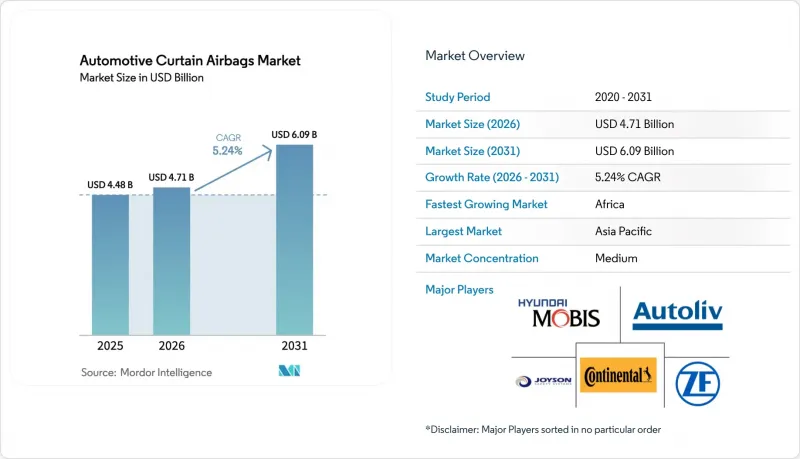
Mordor Intelligence에 의하면, 2026년 자동차용 커튼 에어백 시장 규모는 47억 1,000만 달러로 추정되며, 2025년 44억 8,000만 달러에서 2031년에는 60억 9,000만 달러에 달할 것으로 예측됩니다.
또한 2026-2031년 연평균 성장률(CAGR)은 5.24%를 기록할 전망입니다.
본 보고서는 커튼 에어백의 유형(몸통용 커튼 에어백, 머리용 커튼 에어백 등), 차종(해치백, 세단,스포츠 유틸리티 차량 등), 최종 사용자(OEM 및 애프터마켓), 인플레이터 기술(화약식, 저장 가스식 등), 판매 채널(기존 딜러 등) 및 지역별로 분류되어 있습니다. 시장 예측은 금액(달러) 기준으로 제시되어 있습니다.
전 세계 자동차용 커튼 에어백 시장 동향 및 인사이트
엄격한 측면 충돌 및 전복 관련 규제가 전 세계적 보급을 촉진
국제 기술 규정 제14호(Global Technical Regulation 14)는 각 시장의 머리 부상 기준을 통일하고, 각 OEM 업체에 수출 사양 차량뿐만 아니라 모든 플랫폼에 커튼 에어백을 장착할 것을 의무화하고 있습니다. 호주의 새로운 측면 충돌 규제로 인해 커튼 에어백 전개가 의무화된 결과, 탑승자 사망자 수가 30% 감소했습니다. 이에 앞서 미국 도로교통안전국(NHTSA)은 측면 에어백 의무화로 연간 311명의 생명을 구할 수 있을 것으로 예측했는데, 이 목표는 충돌 사고 데이터베이스를 통한 실증적 검증을 통해 입증되었습니다. 인도가 6개의 에어백을 의무화하는 법규 제정을 추진 중이고, 브라질 NCAP이 별점 평가를 루프 레일식 커튼 에어백 장착 여부와 연계하고 있는 만큼, 공급업체들은 사이드 커튼 에어백이 더 이상 옵션 사양이 아니게 되고 있는 규제 연쇄의 혜택을 누리고 있습니다. 그 결과, 원단, 인플레이터, 이니시에이터에 대한 대량 발주 계약이 향후 수년 동안 확정되어, 경기 순환에 따른 침체기에도 생산 능력 가동률이 보장되고 있습니다.
전 세계 SUV 및 CUV 보급률 상승이 루프 레일 장착을 촉진
SUV 판매 대수는 승용차 부문에서 가장 빠르게 성장하고 있으며, 이러한 추세는 차량 1대당 커튼 에어백 장착 수를 직접적으로 끌어올리고 있습니다. 포드의 전장 15피트, 5열 시트에 대응하는 에어백은 롱 바디 밴이나 3열 시트 크로스오버 차량에서 탑승자를 보호하기 위해 필요한 기술적 도약을 보여줍니다. 미국 도로안전보험협회(IIHS)의 데이터에 따르면, 머리를 보호하는 커튼 에어백이 전개될 경우 운전자의 사망률이 37% 감소하는 것으로 입증되었습니다. 중국의 SUV 붐과 인도의 해치백에서 소형 SUV로의 전환은 향후 몇 년간 커튼 에어백 수요를 끌어올릴 것이며, 이러한 요인이 전 세계 수요 곡선에 더욱 확고하게 자리 잡게 될 것입니다.
인플레이터 결함으로 인한 리콜 및 소송이 리스크 프리미엄을 상승시킴
NHTSA(미국 도로교통안전국)가 2024년, 사이드 에어백의 인플레이터블 커튼 파열 위험을 이유로 크라이슬러 및 닷지의 세단 29만 8,700대를 리콜함에 따라, 파편으로 인한 부상에 대한 대중의 우려가 다시 불거졌습니다. 법적 합의로 인해 공급업체의 보험료가 상승하는 한편, OEM 각사는 검증 절차를 장기화하고 있어 비용 증가와 모델 출시 지연을 초래하고 있습니다. BMW, 기아, 토요타 역시 2024년부터 2025년에 걸쳐 유사한 커튼 에어백 관련 리콜에 직면해 있어, 자동차용 커튼 에어백 업계에 대한 투자자들의 경계심을 높이고 있습니다.
부문 분석
2025년에는 측면 충돌 시 사망률을 31% 감소시킨다는 입증된 실적을 바탕으로, 머리 전용 커튼 에어백이 자동차용 커튼 에어백 시장 점유율의 50.62%를 차지했습니다. 규제 당국은 계속해서 머리 부상에 관한 기준을 중시하고 있어, 이로 인해 지속적인 수요가 확보되고 있습니다. 머리와 상체를 단일 모듈로 보호하는 콤보 커튼 에어백은 2031년까지 연평균 성장률(CAGR) 7.95%를 기록할 전망이며, 부품 수를 단순화하려는 고급 3열 시트 SUV에서 보급이 확대되고 있습니다.
각 제조업체들은 6초간의 팽창을 유지하기 위해 직조 밀도와 통기구의 형태를 개선하여, 다중 충돌 사고 시 발생하는 2차 충격으로부터 탑승자를 보호하고 있습니다. 오토리브(Autoliv)의 최신 3열 시트용 설계는 전장 2.5m에 달하며, 35ms 만에 전개되는데, 이는 공급업체들이 차량 실내 길이 증가에 어떻게 대응하고 있는지를 보여줍니다. 중국의 MPV 플랫폼이 차량 공유 서비스를 수용하기 위해 연장되는 가운데, 초장형 커튼 에어백은 자동차용 커튼 에어백 시장의 다음 보급 물결을 가져올 것으로 기대됩니다.
2025년 시점에서 SUV는 자동차용 커튼 에어백 시장 규모의 43.89%를 차지하고 있으며, 연평균 성장률(CAGR) 8.74%로 성장할 전망입니다. SUV는 무게 중심이 높아 전복 위험이 커지므로, 루프 레일을 더 광범위하게 커버하는 에어백이 필요합니다. B부문 및 C부문 크로스오버 차량은 중국, 인도, 미국에서 호조를 보이고 있으며, 공급업체들은 파노라마 선루프 프레임을 방해하지 않는 얇은 모듈을 개발해야 하는 압박을 받고 있습니다.
세단 판매는 점차 감소하는 추세이지만, 일본과 한국에서는 지역적 선호도에 따라 소형 4도어 차량용 커튼 에어백 수요가 견조하게 유지되고 있습니다. 픽업 트럭과 MPV는 수익성이 높은 틈새 시장을 형성하고 있으며, 포드의 상용 밴용 커튼 에어백은 전개 타이밍을 해치지 않으면서 5열 좌석을 커버해야 하는 복잡성을 보여줍니다. EV SUV는 새로운 기술적 과제를 안겨줍니다. 바닥 아래에 배치된 배터리가 사이드 실을 보강하여 침입력을 상향으로 전달하기 때문에 파편이 흩날리는 유리에 머리가 닿는 것을 방지하려면 커튼 에어백을 더 오랫동안 전개된 상태로 유지해야 합니다.
지역별 분석
아시아태평양은 중국의 거대한 생산 거점과 인도의 6개 에어백 장착 의무화 규제의 추진에 힘입어, 2025년에는 매출 점유율 45.74%로 자동차용 커튼 에어백 시장을 주도할 것입니다. 지리(Geely)와 마루티(Maruti)와 같은 국내 OEM 업체들은 수출 목표를 달성하기 위해 1만 달러 미만의 해치백 차량에도 풀 길이 커튼 에어백을 장착하고 있습니다. 일본의 화공 기술 전문 지식이 전 세계에 하이브리드식 인플레이터를 공급하는 다이셀(Daicel)의 추진제 화학 분야에서 획기적인 진전을 뒷받침하고 있습니다. 한국에서는 ADAS 알고리즘과 패시브 시스템을 결합하여 프리미엄 전기차(EV) 라인업 전반에 걸쳐 전개 시점을 최적화하고 있습니다.
북미는 FMVSS 214 준수 및 SUV 판매 호조에 힘입어 여전히 중요한 시장으로 자리 잡고 있습니다. 미국 내 레벨 4 자율주행 시범 운영은 저온 대응 하이브리드 인플레이터의 채택을 촉진하고 있으며, 공급업체에게는 극한의 기후 조건에 대응하는 솔루션을 입증할 수 있는 무대가 되고 있습니다. 멕시코의 조립 공장에서는 국경을 넘어 판매되는 모델에 동일한 커튼 에어백 사양을 채택하여 Tier 1 공급업체의 금형을 합리화하고 있습니다. 캐나다는 지역별 부품 현지화율 규제에 따라 모듈의 하위 조립을 지원함으로써 자동차 부문에 대한 부가가치를 높이고 있습니다.
유럽에서는 지속가능성과 기술 통합이 중시되고 있습니다. 독일에서 프리미엄 전기차(EV)가 확대됨에 따라 첨단 통풍구 제어 기술이 추진되는 한편, 프랑스와 이탈리아에서는 사고 후 신속한 공기 배출을 가능하게 하고 응급 구조대의 접근을 용이하게 하는 기계식 스티칭이 권장되고 있습니다. 아프리카는 기저 수준은 낮지만, 2031년까지 연평균 성장률(CAGR)이 5.86%로 가장 빠르게 성장하고 있는 지역입니다. 남아프리카공화국의 CKD 공장에서는 EU 수출 형식 인증을 준수한 2단계 커튼 에어백이 장착되고 있습니다. 케냐와 나이지리아는 중고차 수입 규제를 도입하고, 완벽한 안전 장비를 표준으로 장착한 신차 판매를 촉진하고 있습니다. GCC 국가들은 유엔 규정 R135를 채택하고 있으며, 일본 및 미국의 SUV를 수입할 때 세관 검사 시 머리 보호용 커튼 에어백 장착이 의무화되어 있습니다.
기타 혜택:
- 엑셀 형식 시장 예측(ME) 시트
- 3개월간의 애널리스트 지원
자주 묻는 질문
목차
제1장 서론
제2장 조사 방법
제3장 주요 요약
제4장 시장 구도
제5장 시장 규모와 성장 예측
제6장 경쟁 구도
제7장 시장 기회와 향후 전망
LSH 26.09.09According to Mordor Intelligence, automotive curtain airbags market size in 2026 is estimated at USD 4.71 billion, growing from 2025 value of USD 4.48 billion with 2031 projections showing USD 6.09 billion, growing at 5.24% CAGR over 2026-2031.
This report is Segmented by Curtain Airbag Type (Torso Curtain Airbags, Head Curtain Airbags and More), Vehicle Type (Hatchback, Sedan, Sports Utility Vehicles, and More), End User (OEM and Aftermarket), Inflator Technology (Pyrotechnic, Stored Gas, and More), Sales Channel (Traditional Dealerships and More) and Geography. The Market Forecasts are Provided in Terms of Value (USD).
Global Automotive Curtain Airbags Market Trends and Insights
Stringent Side-Impact & Rollover Regulations Drive Global Adoption
Global Technical Regulation 14 aligns head-injury criteria across markets and forces OEMs to specify curtain airbags on every platform, not just export trims. Australia's new side-impact rule lowered occupant fatalities by 30% once curtain deployment became compulsory. Earlier, NHTSA projected its side-airbag mandate would save 311 lives per year-a target now verified through empirical crash-database reviews. With India moving toward mandatory six-airbag legislation and Brazil's NCAP tying star ratings to roof-rail curtains, suppliers benefit from a regulatory cascade that eliminates optional-equipment status for side curtains. Consequently, volume commitments for fabric, inflators, and initiators stay locked years in advance, safeguarding capacity utilization even in cyclical downturns.
Rising Global SUV & CUV Penetration Increases Roof-Rail Fitment
SUV deliveries represent the fastest-growing light-vehicle category, a trend that directly lifts per-vehicle curtain count. Ford's 15-ft-long, five-row airbag points to the engineering leap required to safeguard occupants in stretched vans and three-row crossovers. Insurance Institute for Highway Safety data corroborate a 37% drop in driver deaths when head-protecting curtains deploy. China's domestic SUV boom and India's migration from hatchbacks to compact SUVs assure a multi-year uplift in curtain volumes, further embedding this driver in global demand curves.
Recalls & Litigations from Inflator Defects Raise Risk Premium
NHTSA's 2024 recall of 298,700 Chrysler and Dodge sedans for Side Airbag Inflatable Curtain rupture risk revived public anxiety around shrapnel injuries. Legal settlements inflate supplier insurance premiums, while OEMs lengthen validation protocols, adding cost and delaying model launches. BMW, Kia, and Toyota faced similar curtain-related recalls in 2024-2025, reinforcing investor caution in the Automotive curtain airbags industry.
Other drivers and restraints analyzed in the detailed report include:
- Integration of ADAS with Passive Safety Suites
- Consumer Demand for 5-Star NCAP Ratings in Emerging Economies
- Price Pressure on Entry-Level Models Limits Standardization
For complete list of drivers and restraints, kindly check the Table Of Contents.
Segment Analysis
Head-only curtains secured 50.62% of the Automotive curtain airbags market share in 2025, supported by a proven 31% fatality reduction in side-impact crashes. Regulatory agencies continue to weigh head-injury criteria heavily, ensuring perennial demand. Combo curtains, which merge head and torso coverage in a single module, log an 7.95% CAGR through 2031 and gain traction in premium three-row SUVs seeking simpler bill-of-material counts.
Manufacturers refine weaving density and vent-hole geometry to sustain six-second inflation, protecting occupants against secondary hits in multi-roll incidents. Autoliv's latest three-row design spans 2.5 m and deploys in 35 ms, illustrating how suppliers address cabin length growth. As Chinese MPV platforms stretch to court ride-hailing services, ultra-long curtains promise the next adoption wave for the Automotive curtain airbags market.
SUVs accounted for 43.89% of the Automotive curtain airbags market size in 2025 and are on pace for a 8.74% CAGR. Their high center of gravity increases rollover exposure, necessitating extended roof-rail coverage. Crossovers in the B- and C-segments sell briskly in China, India, and the United States, pushing suppliers to develop low-profile modules that clear panoramic-sunroof frames.
Sedans decline gradually, yet regional tastes in Japan and South Korea maintain steady curtain demand for compact four-doors. Pickup trucks and MPVs create lucrative niches; Ford's commercial van curtain illustrates the complexity of spanning five seating rows without compromising deployment timing. EV SUVs bring new engineering variables: floor batteries stiffen side sills, transferring intrusion force upward, so curtains must remain inflated longer to prevent head contact with shattered glass.
Complete Report Scope:
- By Curtain Airbag Type
- Torso Curtain Airbags
- Head Curtain Airbags
- Combo Curtain Airbags
- By Vehicle Type
- Hatchback
- Sedan
- Sports Utility Vehicle
- Pick-up Trucks & MPVs
- By End User
- OEM
- Aftermarket
- By Inflator Technology
- Pyrotechnic
- Stored Gas
- Hybrid / Low-temperature Hybrid
- By Sales Channel
- Traditional Dealerships
- Online & Direct-to-Consumer
- By Geography
- North America
- United States
- Canada
- Rest of North America
- Europe
- Germany
- United Kingdom
- France
- Russia
- Rest of Europe
- Asia-Pacific
- China
- India
- Japan
- South Korea
- Rest of Asia-Pacific
- South America
- Brazil
- Argentina
- Rest of South America
- Middle East
- Saudi Arabia
- United Arab Emirates
- Rest of Middle East
- Africa
- South Africa
- Morocco
- Rest of Africa
- North America
Geography Analysis
Asia-Pacific leads the Automotive curtain airbags market with 45.74% revenue share in 2025, driven by China's large production base and India's regulatory push for six airbags. Domestic OEMs such as Geely and Maruti embed full-length curtains even in sub-USD 10,000 hatches to meet export targets. Japan's pyrotechnic expertise propels propellant chemistry breakthroughs at Daicel, which supplies hybrid inflators worldwide. South Korea pairs ADAS algorithms with passive systems to refine deployment timing across premium electric vehicle (EV) lineups.
North America remains pivotal through FMVSS 214 compliance and strong SUV sales. United States Level-4 autonomy pilots promote low-temperature hybrid inflators, giving suppliers a proving ground for extreme-climate solutions. Mexico's assembly plants adopt identical curtain specifications for cross-border models, streamlining tier-one tooling. Canada supports module sub-assembly under regional parts-content rules, adding value to its auto sector.
Europe emphasizes sustainability and technology integration. Germany's premium EV expansion drives advanced vent-hole metering, while France and Italy encourage mechanical stitching that enables rapid post-crash deflation to aid emergency access. Africa, while starting from a lower base, is the fastest-growing region with a 5.86% CAGR through 2031. South African CKD plants integrate dual-stage curtains aligned with EU export homologation. Kenya and Nigeria launch used-vehicle import restrictions, compelling new-car sales that bundle full safety suites. GCC states adopt UN R135, obliging Japanese and US SUV imports to include head-protecting curtains at customs inspection.
- Autoliv Inc.
- Joyson Safety Systems
- ZF Friedrichshafen AG
- Continental AG
- Hyundai Mobis Co. Ltd
- Toyoda Gosei Co. Ltd
- Daicel Corporation
- ARC Automotive Inc.
- iSi Automotive GmbH
- Ashimori Industry Co. Ltd
- Nihon Plast Co. Ltd
- Porcher Industries SA
- Toray Industries Inc.
- East Joy Long Motor
- Neaton Auto Products
- Sumitomo Corporation
- TRW Automotive Holdings Corp.
- Visteon Corporation
- Bosch Passive Safety Systems
Additional Benefits:
- The market estimate (ME) sheet in Excel format
- 3 months of analyst support
TABLE OF CONTENTS
1 Introduction
- 1.1 Study Assumptions & Market Definition
- 1.2 Scope of the Study
2 Research Methodology
3 Executive Summary
4 Market Landscape
- 4.1 Market Overview
- 4.2 Market Drivers
- 4.2.1 Stringent Side-Impact & Rollover Regulations (FMVSS 214, Euro NCAP, GTR 14)
- 4.2.2 Rising Global SUV & CUV Penetration Increasing Roof-Rail Airbag Fitment
- 4.2.3 Integration of ADAS/Active Safety Suites Boosting Passive Safety Content
- 4.2.4 Consumer Demand for 5-Star NCAP Ratings in Emerging Economies
- 4.2.5 EV Skateboard Platforms Freeing Packaging Space for Larger Curtain Airbags
- 4.2.6 Low-Temperature Hybrid Inflators Enabling Safe OOP Deployment in Robo-Taxis
- 4.3 Market Restraints
- 4.3.1 Recalls & Litigations From Inflator Defects (Takata, ARC) Raise Risk Premium
- 4.3.2 Price Pressure on Entry-Level Models Limits Standardisation in Low-Cost Cars
- 4.3.3 Nylon-6,6 Fabric & Initiator Supply Shortages Causing OEM Production Delays
- 4.3.4 Structural Battery Packs in EVs Offering Alternative Side-Impact Protection
- 4.4 Value / Supply-Chain Analysis
- 4.5 Technological Outlook
- 4.6 Regulatory Landscape
- 4.7 Porter's Five Forces
- 4.7.1 Threat of New Entrants
- 4.7.2 Bargaining Power of Buyers
- 4.7.3 Bargaining Power of Suppliers
- 4.7.4 Threat of Substitutes
- 4.7.5 Intensity of Competitive Rivalry
5 Market Size & Growth Forecasts (Value, USD)
- 5.1 By Curtain Airbag Type
- 5.1.1 Torso Curtain Airbags
- 5.1.2 Head Curtain Airbags
- 5.1.3 Combo Curtain Airbags
- 5.2 By Vehicle Type
- 5.2.1 Hatchback
- 5.2.2 Sedan
- 5.2.3 Sports Utility Vehicle
- 5.2.4 Pick-up Trucks & MPVs
- 5.3 By End User
- 5.3.1 OEM
- 5.3.2 Aftermarket
- 5.4 By Inflator Technology
- 5.4.1 Pyrotechnic
- 5.4.2 Stored Gas
- 5.4.3 Hybrid / Low-temperature Hybrid
- 5.5 By Sales Channel
- 5.5.1 Traditional Dealerships
- 5.5.2 Online & Direct-to-Consumer
- 5.6 By Geography
- 5.6.1 North America
- 5.6.1.1 United States
- 5.6.1.2 Canada
- 5.6.1.3 Rest of North America
- 5.6.2 Europe
- 5.6.2.1 Germany
- 5.6.2.2 United Kingdom
- 5.6.2.3 France
- 5.6.2.4 Russia
- 5.6.2.5 Rest of Europe
- 5.6.3 Asia-Pacific
- 5.6.3.1 China
- 5.6.3.2 India
- 5.6.3.3 Japan
- 5.6.3.4 South Korea
- 5.6.3.5 Rest of Asia-Pacific
- 5.6.4 South America
- 5.6.4.1 Brazil
- 5.6.4.2 Argentina
- 5.6.4.3 Rest of South America
- 5.6.5 Middle East
- 5.6.5.1 Saudi Arabia
- 5.6.5.2 United Arab Emirates
- 5.6.5.3 Rest of Middle East
- 5.6.6 Africa
- 5.6.6.1 South Africa
- 5.6.6.2 Morocco
- 5.6.6.3 Rest of Africa
- 5.6.1 North America
6 Competitive Landscape
- 6.1 Market Concentration
- 6.2 Strategic Moves
- 6.3 Market Share Analysis
- 6.4 Company Profiles (Includes Global Level Overview, Market Level Overview, Core Segments, Financials as Available, Strategic Information, Market Rank/Share, Products & Services, and Recent Developments)
- 6.4.1 Autoliv Inc.
- 6.4.2 Joyson Safety Systems
- 6.4.3 ZF Friedrichshafen AG
- 6.4.4 Continental AG
- 6.4.5 Hyundai Mobis Co. Ltd
- 6.4.6 Toyoda Gosei Co. Ltd
- 6.4.7 Daicel Corporation
- 6.4.8 ARC Automotive Inc.
- 6.4.9 iSi Automotive GmbH
- 6.4.10 Ashimori Industry Co. Ltd
- 6.4.11 Nihon Plast Co. Ltd
- 6.4.12 Porcher Industries SA
- 6.4.13 Toray Industries Inc.
- 6.4.14 East Joy Long Motor
- 6.4.15 Neaton Auto Products
- 6.4.16 Sumitomo Corporation
- 6.4.17 TRW Automotive Holdings Corp.
- 6.4.18 Visteon Corporation
- 6.4.19 Bosch Passive Safety Systems
7 Market Opportunities & Future Outlook
- 7.1 White-space & Unmet-need Assessment