
|
시장보고서
상품코드
2121492
활성 및 지능형 포장 : 시장 점유율 분석, 업계 동향과 통계, 성장 예측(2026-2031년)Active And Intelligent Packaging - Market Share Analysis, Industry Trends & Statistics, Growth Forecasts (2026 - 2031) |
||||||
 Mordor Intelligence
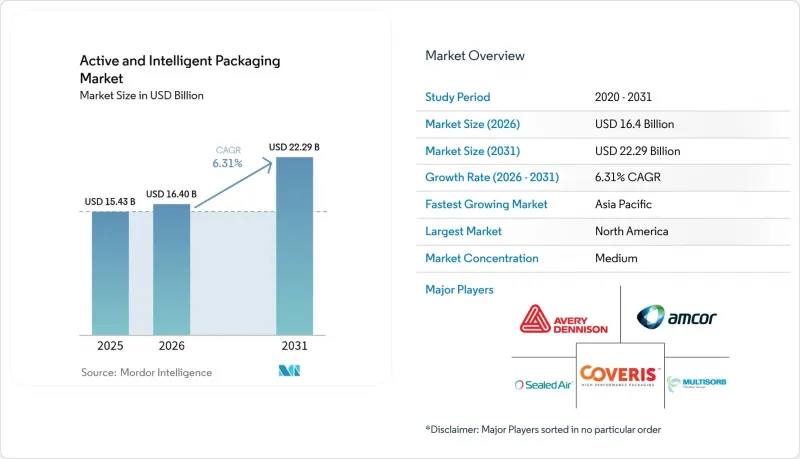
활성 및 지능형 포장 시장 규모는 2026년에 164억 달러로 추정되며, 2025년 154억 3,000만 달러에서 확대되어 2031년에는 222억 9,000만 달러에 달할 것으로 예측됩니다.
2026년부터 2031년까지 연평균 성장률(CAGR) 6.31%로 성장할 것으로 전망됩니다.
본 보고서는 포장 기능(공급망 관리 등), 포장 기술(활성 포장, 지능형 포장), 활성 포장의 종류(가스 흡수제/방출제 등), 지능형 포장의 종류(코딩 및 마킹 등), 최종사용자 산업(식품, 음료 등) 및 지역별로 분류되어 있습니다. 시장 전망은 금액(달러) 기준으로 제시되어 있습니다.
세계 활성 및 지능형 포장 시장의 동향 및 인사이트
신선도 유지 기간이 긴 신선 식품에 대한 슈퍼마켓의 수요
주요 식료품 체인점들은 산소 및 수분 스캐빈저를 도입한 결과, 부패를 15-25% 줄일 수 있었다고 보고하고 있으며, 이는 이익률 향상과 품절 감소로 이어지고 있습니다. 효소계 스캐빈저는 산소가 존재할 때만 활성화되므로 유통 과정 전반에 걸쳐 포장 내 헤드스페이스의 균형이 유지됩니다. 현재 여러 소매업체들이 스캐빈저 용량이 소진되면 색이 변하는 스마트 인디케이터를 도입하여 매장 직원들에게 재고 회전 상황을 시각적으로 알리고 있습니다. FDA 및 EFSA의 새로운 철-폴리머 복합재료 승인으로 상용화 일정이 가속화된 한편, 인라인 소포장 삽입 장치의 도입으로 고속 생산 라인의 전환 시간이 단축되었습니다. 이러한 이점은 북미와 같이 유통 거리가 긴 지역에서 가장 두드러지지만, 소매업체들이 폐기물 감축 의무 목표를 달성하기 위해 노력함에 따라 유럽 및 아시아의 도시 지역에서도 도입이 확대되고 있습니다.
브랜드 소유자의 실시간 콜드체인 가시화 노력
±0.5°C의 정확도를 가진 RFID 지원 온도 로거는 5분마다 데이터를 기록하여 백신 및 생물학적 제제의 상세한 온도 이력을 제공합니다. 제약 회사는 이러한 기록을 클라우드 플랫폼과 연동하여 누적 온도 노출이 경고 임계값에 도달했을 때 자동 알림을 전송하도록 하고 있습니다. 식품 브랜드들도 냉동 디저트나 수산물 분야에서 이를 따르고 있으며, 예측 분석을 활용하여 품질이 저하되기 전에 위험이 있는 팔레트의 배송 경로를 변경하고 있습니다. 태그 비용이 0.05달러 미만으로 떨어지면서 설비 투자는 감소하고 있으며, 고부가가치 SKU에서도 품목 단위로 도입이 가능해졌습니다. 비즈니스 사례는 단순한 물류 최적화가 아닌 리콜 방지에 중점을 두고 있으므로, 보수적인 품질 저하 가정 하에서도 ROI는 여전히 매력적입니다.
초기 설비 및 개조 비용의 높음
중규모 컨버터 기업들은 멀티 레인 방식의 산소 흡수제 삽입 시스템, 비전 검사, 그리고 RFID 인코딩 스테이션을 추가하기 위해 200만-800만 달러를 지출하고 있습니다. 생산량이 적은 상태에서는 투자 회수에 4년 이상이 소요되므로, 소규모 기업들은 종종 투자를 미루고 있습니다. 신흥 시장에서는 상업 금융 기관이 스마트팩 관련 자산을 틈새 담보로 간주하기 때문에 자금 조달 옵션은 여전히 제한적입니다. 또한 기술자는 포장 메커니즘과 전자 장비 문제 해결을 모두 익혀야 하므로, 교육 비용이 자본 지출을 더욱 부풀리고 있습니다. 이에 반해, OEM 업체들은 기존 폼-필-씰(FFS) 기계에 장착 가능한 모듈형 개조 솔루션을 제공하고 있어 진입 장벽은 낮아졌지만, 여전히 막대한 자금 부담이라는 장벽은 남아 있습니다.
부문 분석
2025년, 제품 신선도 유지 용도는 활성 및 지능형 포장 시장에서 45.90%의 점유율을 차지하여, 소매업체들이 신선 식품의 유통 기한 연장에 중점을 두고 있음을 여실히 보여주었습니다. 이러한 우위는 전원이 필요하지 않고 기존 생산 라인에 쉽게 통합될 수 있는 산소 제거제, 흡습제, 에틸렌 억제제의 폭넓은 유용성을 반영합니다. 신선도 유지 솔루션 분야의 능동형 및 스마트 포장 시장 규모는 북미와 유럽의 폐기물 감축 목표 강화에 힘입어 2031년까지 102억 3,000만 달러에 달할 것으로 예측됩니다. 소매업체들이 수축률을 벤치마킹하는 가운데, 비용 절감 효과가 능동형 포장에 직접 귀속됨에 따라, 우선 공급업체 지위를 추구하는 청과물 포장업체들의 추가 투자가 유도되고 있습니다. 조사 결과에 따르면, 냉장 상품 카테고리 전체에서 신선도가 재구매의 가장 큰 요인으로 나타났으며, 소비자의 행동도 이러한 우선순위와 일치하고 있습니다.
가장 빠르게 성장하는 기능 부문은 브랜드 보호로, 의약품 및 고급 화장품의 위조 위험을 배경으로 연평균 성장률(CAGR) 8.42%를 기록하고 있습니다. 위조 방지 씰 아래에 내장된 NFC 태그를 통해 원터치 인증이 가능해지며, UV 반응 잉크는 눈에 보이지 않는 보안 계층을 추가합니다. 전 세계 각국 당국에 의한 위조 의약품 압수가 잇따르면서, 정식 제조업체들은 공급망 보호에 대한 압박을 받고 있습니다. 일련번호가 부여된 식별자를 클라우드 대시보드와 통합함으로써, 기업은 불법 유통에 대한 실시간 알림과 그레이 마켓 동향에 관한 시장 정보를 얻을 수 있습니다. 이러한 복합적인 동향으로 인해 신선도와 보안은 기능성 수요의 두 축으로 자리매김하며, 솔루션 제공업체에게는 다양한 수익원이 확보되고 있습니다.
능동형 기술은 수동적인 작동 모드가 대량 생산되는 상품에 적합하기 때문에 2025년에는 62.70%의 점유율을 차지했습니다. 이러한 기술은 배터리가 필요하지 않고 밸류체인에 대한 변경도 최소화되므로 도입 장벽이 낮습니다. 철계 스캐빈저는 1봉지당 0.02달러 미만의 비용 면에서 여전히 우위를 유지하고 있으며, 베이커리 제품이나 스낵 식품 등 비용을 중시하는 부문에서 계속해서 채택되고 있습니다. 능동형 및 지능형 포장 시장에서는 하이브리드화가 진행되고 있으며, 능동형 필름에는 누적 노출량이 임계값을 초과하면 색이 짙어지는 인쇄된 온도 스트립이 내장되고 있습니다. 지능형 기술은 시장 규모는 작지만, 단위당 경제성이 향상되고 5G 연결로 인해 데이터 전송 비용이 감소함에 따라 연평균 성장률(CAGR) 7.56%로 확대되고 있습니다.
신흥 프린트 전자 플랫폼은 이 두 분야의 경계를 모호하게 만들고 있습니다. 롤 투 롤(roll-to-roll) 그라비어 인쇄기는 단일 공정에서 전도성 트레이스와 가스 흡수성 화학제품을 동시에 형성할 수 있어, 발효가 시작되면 CO₂를 배출하는 자가 조절형 패키지를 실현하고 있습니다. ISO 15378과 같은 표준화 기구는 이러한 다기능 구조를 포괄하도록 지침을 업데이트하여 선구적인 기업들에게 규제상의 명확성을 제공하고 있습니다. 이러한 융합을 통해 화학 및 전자 분야 모두에 대한 전문 지식을 갖춘 컨버터의 경쟁 우위가 더욱 높아지고 있으며, 능동형 지능형 포장 시장에서 통합형 기업의 경쟁 우위가 강화되고 있습니다.
지역별 분석
2025년, 북미는 활성 및 지능형 포장 시장에서 34.00%의 점유율을 차지하며 시장을 주도했습니다. 이는 FDA의 일련번호 부여 규정과 성숙한 콜드체인이 초기 추진력이 되었기 때문입니다. 소매업체들은 공급업체의 성과를 검증하기 위해 내장형 신선도 표시기를 채택하고 있으며, 벤처 캐피털은 IoT와 유연 포장을 융합하는 스타트업 기업에 대한 자금 지원을 계속하고 있습니다. 2025년 말까지 미국 내 냉장육 포장재에 대한 스마트 라벨 보급률은 18%를 넘어섰으며, 사용자 정착이 진행되었습니다.
유럽은 여전히 이 기술의 요람이며, 지속가능성에 관한 법규가 급속한 기술 혁신을 주도하고 있습니다. ‘일회용 플라스틱 지침’은 퇴비화 가능한 NFC 태그 및 무용제 라미네이트에 대한 연구 개발을 촉진했습니다. 독일에서는 포장재의 자동 분류를 위한 디지털 워터마크 기술을 시범 도입하여, 지자체 주도의 시범 운영에서 95%의 탐지 정확도를 달성했습니다. 프랑스에서는 재활용 가능성과 재생 소재 함유율에 따라 단계적으로 설정된 확대 생산자 책임(EPR) 요금을 통해, 가공업체들이 단일 소재의 스마트 필름으로 전환하도록 간접적으로 유도하고 있습니다.
아시아태평양은 연평균 성장률(CAGR) 9.45%로 가장 빠르게 성장하고 있으며, 그 원동력은 중국의 식품 표시법 개정과 현재 이 지역의 RFID 칩 생산 거점인 인도의 ‘메이크 인 인디아(Make in India)’ 추진 정책입니다. 현재의 설비 투자 계획이 실현된다면, 아시아태평양의 액티브·인텔리전트 패키징 시장 규모는 2028년까지 유럽을 추월할 가능성이 있습니다. 일본의 편의점 업계에서는 고급 도시락 용기에 시간·온도 기록 장치의 시범 도입이 진행되고 있는 반면, 한국에서는 특정 생물학적 제제에 대해 일련번호 부여가 의무화되어 있어 의료 분야에서의 스마트 기술 도입이 더욱 진전되고 있습니다.
기타 혜택:
- 엑셀 형식의 시장 예측(ME) 시트
- 3개월간의 애널리스트 지원
자주 묻는 질문
목차
제1장 소개
제2장 조사 방법
제3장 주요 요약
제4장 시장 구도
제5장 시장 규모와 성장 예측
제6장 경쟁 구도
제7장 시장 기회와 향후 전망
KSM 26.09.07According to Mordor Intelligence, the active and intelligent packaging market size in 2026 is estimated at USD 16.4 billion, growing from 2025 value of USD 15.43 billion with 2031 projections showing USD 22.29 billion, growing at 6.31% CAGR over 2026-2031.
This report is Segmented by Packaging Function (Supply Chain Management, and More), Packaging Technology (Active Packaging, and Intelligent Packaging), Active Packaging Type (Gas Scavengers/Emitters, and More), Intelligent Packaging Type (Coding and Markings, and More), End-User Industry (Food, Beverages, and More), and Geography. The Market Forecasts are Provided in Terms of Value (USD).
Global Active And Intelligent Packaging Market Trends and Insights
Supermarket Demand for Longer Shelf-Life Fresh Produce
Large grocery chains reported 15-25% spoilage reduction after adopting oxygen and moisture scavengers, translating into better margins and fewer out-of-stocks. Enzymatic scavengers activate only in the presence of oxygen, so the package headspace remains balanced throughout distribution. Multiple retailers are now integrating smart indicators that change color once scavenger capacity is exhausted, giving store associates a visual cue for stock rotation. FDA and EFSA approvals of newer iron-polymer composites accelerated commercial launch schedules, while in-line sachet placement equipment lowered changeover time on high-speed lines. The benefit is most pronounced in regions with long distribution distances, such as North America, yet adoption is expanding in Europe and urban Asia as retailers target waste reduction mandates.
Brand-Owner Push for Real-Time Cold-Chain Visibility
RFID-enabled temperature loggers capable of +-0.5 °C accuracy record data every five minutes, providing granular thermal histories for vaccines and biologics. Pharmaceutical companies integrate these logs with cloud platforms that send automatic alerts when cumulative thermal exposure reaches warning thresholds. Food brands are following suit in frozen desserts and seafood, leveraging predictive analytics to reroute at-risk pallets before quality deteriorates. Capital outlays are declining as tag costs fall below USD 0.05, making item-level deployment feasible for high-value SKUs. The business case hinges on recall avoidance rather than pure logistics optimization, so ROI remains compelling even under conservative spoilage assumptions.
High Initial Equipment and Retrofit Costs
A mid-sized converter spends USD 2-8 million to add multilane oxygen-scavenger insertion systems, vision inspection, and RFID encoding stations. Payback stretches past four years if output volumes stay modest, so small firms often postpone investment. Financing options remain limited in emerging markets, where commercial lenders perceive smart-pack assets as niche collateral. Training expenses further inflate capital outlays because technicians must master both packaging mechanics and electronics troubleshooting. OEMs are responding with modular retrofits that clip onto existing form-fill-seal machines, lowering entry thresholds but still leaving a sizable cash hurdle.
Other drivers and restraints analyzed in the detailed report include:
- Regulatory Shift Toward Single-Use Plastic Reduction
- E-Commerce Boom Creating Last-Mile Freshness Challenges
- Human Toxicology Concerns around Scavenger Chemistries
For complete list of drivers and restraints, kindly check the Table Of Contents.
Segment Analysis
Product freshness applications captured 45.90% share of the active and intelligent packaging market in 2025, underscoring the premium retailers' place on extending perishable shelf life. This dominance reflects the broad utility of oxygen scavengers, moisture absorbers, and ethylene inhibitors that operate without power and integrate easily into existing lines. The active and intelligent packaging market size for freshness solutions is forecast to grow toward USD 10.23 billion by 2031, propelled by stricter waste-reduction targets in North America and Europe. Retailers' benchmarking shrink rates are assigning cost savings directly to active formats, drawing follow-on investment from produce packers seeking preferred-supplier status. Consumer behavior aligns with this priority as surveys indicate freshness is the top driver of repeat purchase across refrigerated categories.
The fastest-growing functional segment is brand protection at an 8.42% CAGR, buoyed by counterfeit risks in pharmaceuticals and luxury cosmetics. NFC tags embedded under tamper-evident seals enable one-tap authentication, while UV-responsive inks add covert security layers. Global authorities confiscated fake drugs, intensifying pressure on legitimate manufacturers to safeguard supply chains. By integrating serialized identifiers with cloud dashboards, companies gain real-time diversion alerts and market intelligence on gray-market flows. These combined dynamics position freshness and security as dual pillars of functional demand, ensuring diversified revenue streams for solution providers.
Active technologies held a 62.70% share in 2025 as its passive mode of action suits high-volume commodities. They require no batteries and minimal supply-chain modification, reducing implementation friction. Iron-based scavengers remain cost leaders at less than USD 0.02 per sachet, sustaining uptake in value-driven segments such as bakery and snack foods. The active and intelligent packaging market is witnessing hybridization, with active films now incorporating printed temperature strips that darken after cumulative exposure thresholds. Intelligent technologies, although on a smaller base, are advancing at a 7.56% CAGR as unit economics improve and 5G connectivity lowers data-transmission costs.
Emerging printed-electronics platforms blur the lines between the two camps. Roll-to-roll gravure presses can deposit conductive traces alongside gas-absorbing chemistries in a single pass, creating self-regulating packs that vent CO2 when fermentation begins. Standards bodies like ISO 15378 are updating guidance to cover such multifunctional constructs, giving early movers regulatory clarity. This convergence widens the moat for converters with both chemistry and electronics expertise, reinforcing the competitive advantage of integrated players in the active and intelligent packaging market.
Complete Report Scope:
- By Packaging Function
- Supply Chain Management
- Product Freshness
- Consumer Convenience
- Brand Protection
- Product Information
- By Packaging Technology
- Active Packaging
- Intelligent Packaging
- By Active Packaging Type
- Gas Scavengers/Emitters
- Moisture Scavengers
- Microwave Susceptors
- Other Active Packaging Technologies
- By Intelligent Packaging Type
- Coding and Markings
- Antenna (RFID and NFC)
- Sensors and Output Devices
- Other Intelligent Packaging Technologies
- By End-user Industry
- Food
- Beverages
- Pharmaceuticals
- Industrial
- Logistics
- Other End-user Industries
- By Geography
- North America
- United States
- Canada
- Mexico
- South America
- Brazil
- Argentina
- Rest of South America
- Europe
- United Kingdom
- Germany
- France
- Italy
- Spain
- Rest of Europe
- Asia-Pacific
- China
- India
- Japan
- South Korea
- Australia
- Rest of Asia-Pacific
- Middle East and Africa
- Middle East
- Saudi Arabia
- United Arab Emirates
- Turkey
- Rest of Middle East
- Africa
- South Africa
- Nigeria
- Rest of Africa
- Middle East
- North America
Geography Analysis
North America led the active and intelligent packaging market with 34.00% share in 2025 as FDA serialization and mature cold chains gave early impetus. Retailers employ embedded freshness indicators to verify supplier performance, and venture capital continues funding start-ups that merge IoT with flexible packaging. Smart-label penetration surpassed 18% of chilled meat packs in the United States by late 2025, cementing user familiarity.
Europe remains a technology crucible where sustainability legislation drives rapid iteration. The Single-Use Plastics Directive stimulated R&D into compostable NFC tags and solvent-free laminations. Germany piloted digital watermarks for automatic pack sorting, achieving 95% detection accuracy during municipal trials. France's extended producer responsibility fees, tiered by recyclability and recycled content, indirectly nudge converters toward mono-material smart films.
Asia-Pacific is the fastest grower at a 9.45% CAGR, powered by China's upgraded food labeling law and India's "Make in India" push that now hosts regional RFID chip production. The active and intelligent packaging market size in Asia-Pacific could overtake Europe by 2028 if current capital expenditure plans materialize. Japan's convenience-store channel is piloting time-temperature integrators on premium bento boxes, while South Korea mandates serialization for select biologics, pushing intelligent adoption deeper into healthcare.
- Amcor plc
- Sealed Air Corporation
- Avery Dennison Corporation
- Crown Holdings Inc.
- Ball Corporation
- Coveris Holding SA
- Smurfit WestRock plc
- Honeywell International Inc.
- Graphic Packaging International LLC
- Desiccare Inc.
- Timestrip UK Ltd.
- Multisorb Technologies Inc.
- Tetra Pak International SA
- Thinfilm Electronics ASA
- PakSense Inc.
- Insignia Technologies Ltd.
- Printpack Inc.
Additional Benefits:
- The market estimate (ME) sheet in Excel format
- 3 months of analyst support
TABLE OF CONTENTS
1 INTRODUCTION
- 1.1 Study Assumptions and Market Definition
- 1.2 Scope of the Study
2 RESEARCH METHODOLOGY
3 EXECUTIVE SUMMARY
4 MARKET LANDSCAPE
- 4.1 Market Overview
- 4.2 Industry Value Chain Analysis
- 4.3 Industry Attractiveness - Porter's Five Forces Analysis
- 4.3.1 Threat of New Entrants
- 4.3.2 Bargaining Power of Buyers
- 4.3.3 Bargaining Power of Suppliers
- 4.3.4 Threat of Substitutes
- 4.3.5 Intensity of Competitive Rivalry
- 4.4 Market Drivers
- 4.4.1 Supermarket Demand for Longer Shelf-Life Fresh Produce
- 4.4.2 Brand-Owner Push for Real-Time Cold-Chain Visibility
- 4.4.3 Regulatory Shift Toward Single-Use Plastic Reduction
- 4.4.4 E-Commerce Boom Creating Last-Mile Freshness Challenges
- 4.4.5 Integration of Printed Electronics in Flexible Films (UNDER-RADAR)
- 4.4.6 Pharmaceutical Serialization 2.0 Mandates (UNDER-RADAR)
- 4.5 Market Restraints
- 4.5.1 High Initial Equipment and Retrofit Costs
- 4.5.2 Human Toxicology Concerns around Scavenger Chemistries
- 4.5.3 Fragmented Recycling Infrastructure for Smart Labels
- 4.5.4 Semiconductor Supply Bottlenecks for RFID Inlays (UNDER-RADAR)
- 4.6 Impact of Macroeconomic Factors on the Market
- 4.7 Regulatory Landscape
- 4.8 Technological Outlook
5 MARKET SIZE AND GROWTH FORECASTS (VALUE)
- 5.1 By Packaging Function
- 5.1.1 Supply Chain Management
- 5.1.2 Product Freshness
- 5.1.3 Consumer Convenience
- 5.1.4 Brand Protection
- 5.1.5 Product Information
- 5.2 By Packaging Technology
- 5.2.1 Active Packaging
- 5.2.2 Intelligent Packaging
- 5.3 By Active Packaging Type
- 5.3.1 Gas Scavengers/Emitters
- 5.3.2 Moisture Scavengers
- 5.3.3 Microwave Susceptors
- 5.3.4 Other Active Packaging Technologies
- 5.4 By Intelligent Packaging Type
- 5.4.1 Coding and Markings
- 5.4.2 Antenna (RFID and NFC)
- 5.4.3 Sensors and Output Devices
- 5.4.4 Other Intelligent Packaging Technologies
- 5.5 By End-user Industry
- 5.5.1 Food
- 5.5.2 Beverages
- 5.5.3 Pharmaceuticals
- 5.5.4 Industrial
- 5.5.5 Logistics
- 5.5.6 Other End-user Industries
- 5.6 By Geography
- 5.6.1 North America
- 5.6.1.1 United States
- 5.6.1.2 Canada
- 5.6.1.3 Mexico
- 5.6.2 South America
- 5.6.2.1 Brazil
- 5.6.2.2 Argentina
- 5.6.2.3 Rest of South America
- 5.6.3 Europe
- 5.6.3.1 United Kingdom
- 5.6.3.2 Germany
- 5.6.3.3 France
- 5.6.3.4 Italy
- 5.6.3.5 Spain
- 5.6.3.6 Rest of Europe
- 5.6.4 Asia-Pacific
- 5.6.4.1 China
- 5.6.4.2 India
- 5.6.4.3 Japan
- 5.6.4.4 South Korea
- 5.6.4.5 Australia
- 5.6.4.6 Rest of Asia-Pacific
- 5.6.5 Middle East and Africa
- 5.6.5.1 Middle East
- 5.6.5.1.1 Saudi Arabia
- 5.6.5.1.2 United Arab Emirates
- 5.6.5.1.3 Turkey
- 5.6.5.1.4 Rest of Middle East
- 5.6.5.2 Africa
- 5.6.5.2.1 South Africa
- 5.6.5.2.2 Nigeria
- 5.6.5.2.3 Rest of Africa
- 5.6.5.1 Middle East
- 5.6.1 North America
6 COMPETITIVE LANDSCAPE
- 6.1 Market Concentration
- 6.2 Strategic Moves
- 6.3 Market Share Analysis
- 6.4 Company Profiles {(includes Global level Overview, Market level overview, Core Segments, Financials as available, Strategic Information, Market Rank/Share for key companies, Products and Services, and Recent Developments)}
- 6.4.1 Amcor plc
- 6.4.2 Sealed Air Corporation
- 6.4.3 Avery Dennison Corporation
- 6.4.4 Crown Holdings Inc.
- 6.4.5 Ball Corporation
- 6.4.6 Coveris Holding SA
- 6.4.7 Smurfit WestRock plc
- 6.4.8 Honeywell International Inc.
- 6.4.9 Graphic Packaging International LLC
- 6.4.10 Desiccare Inc.
- 6.4.11 Timestrip UK Ltd.
- 6.4.12 Multisorb Technologies Inc.
- 6.4.13 Tetra Pak International SA
- 6.4.14 Thinfilm Electronics ASA
- 6.4.15 PakSense Inc.
- 6.4.16 Insignia Technologies Ltd.
- 6.4.17 Printpack Inc.
7 MARKET OPPORTUNITIES AND FUTURE OUTLOOK
- 7.1 White-space and Unmet-need Assessment