

|
시장보고서
상품코드
2121494
초고속 레이저 : 시장 점유율 분석, 업계 동향과 통계, 성장 예측(2026-2031년)Ultrafast Lasers - Market Share Analysis, Industry Trends & Statistics, Growth Forecasts (2026 - 2031) |
||||||
 Mordor Intelligence
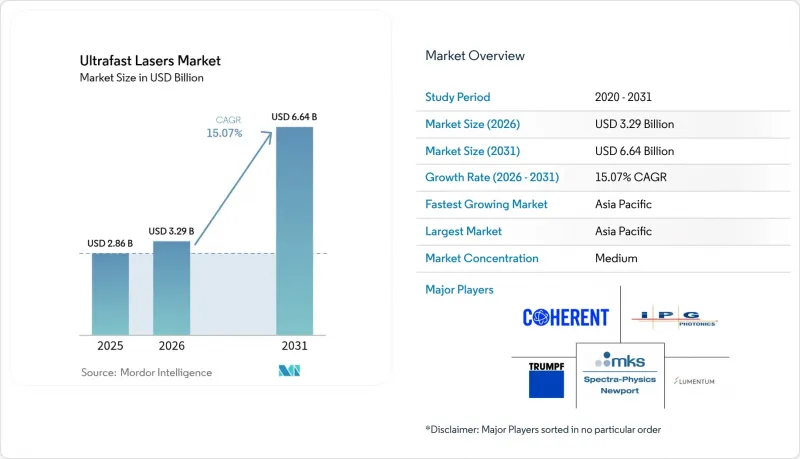
Mordor Intelligence에 의하면, 2026년 초고속 레이저 시장 규모는 32억 9,000만 달러로 추정되며, 2025년 28억 6,000만 달러에서 2031년에는 66억 4,000만 달러에 달할 것으로 예측됩니다.
또한 2026-2031년 연평균 성장률(CAGR)은 15.07%를 기록할 전망입니다.
본 보고서는 레이저의 유형(파이버 레이저, 고체 레이저 등), 펄스 폭(펨토초, 피코초), 파장(적외선 등), 용도(재료 가공·미세 가공 등), 최종 사용자(민간용 전자기기, 의료기기 등) 및 지역별로 분류되어 있습니다. 시장 예측은 금액(달러) 기준으로 제시되어 있습니다.
세계 초고속 레이저 시장 동향 및 인사이트
반도체의 초미세화 흐름이 20µm 미만의 미세 가공 수요를 견인
3D 패키징 아키텍처로의 전환을 추진하는 칩 제조업체들은 열 영향 영역을 제거하면서 종횡비 10:1을 초과하는 TSV(Through-Silicon Via)를 천공하는 펨토초 펄스에 의존하고 있습니다. Samsung Electronics와 SK하이닉스는 이미 고대역폭 메모리 적층을 위해 이러한 시스템을 도입했습니다. 공급업체 보고서에 따르면, 2024년 신규 웨이퍼 가공 수주 중 초고속 레이저 플랫폼이 차지하는 비중은 35%에 달하고,, 2022년의 18%에서 증가했습니다. 20nm 미만의 노드 미세화가 지속됨에 따라 기계식 및 CW 레이저 옵션이 배제되면서 초고속 레이저의 잠재 시장이 확대되고 있습니다. 아시아태평양의 양산 확대에 따라 관련 포토마스크 및 기판 제조업체 전반에 걸쳐 장비 수요가 증가하고 있습니다.
EV용 배터리 포일 절단이 초고속 ‘버스트 모드’ 레이저로 전환
기가팩토리의 데이터에 따르면, 펨토초 버스트 모드 절단을 통해 6µm 포일의 처리량이 40% 향상되었을 뿐만 아니라, 단락의 원인이 되는 가장자리의 버가 제거되었습니다. CATL과 BYD는 2024년에 레이저 절단 라인에 1억 5,000만 달러를 투자했으며, 이는 상용화의 탄력을 보여줍니다. 배터리의 에너지 밀도가 높아짐에 따라 정밀도에 대한 요구가 증가하면서, 제조업체들은 기계적 전단보다 어블레이션에 더 적합한 더 얇은 포일을 채택하고 있습니다. 다중화된 빔 분할 기술을 통해 적층된 시트의 동시 가공이 가능해져 설비 가동률이 향상되었으며, 이는 더 높은 설비 투자 타당성을 뒷받침하고 있습니다. 이러한 요인들로 인해 자동차 생산 라인용 초고속 레이저 시장 점유율이 확대되고 있습니다.
이테르븀 첨가 파이버 공급망의 병목 현상
2024년에는 펨토초 수준의 안정성에 필요한 희토류의 균일성을 확보한 기업이 극소수에 불과하기 때문에 고출력 이테르븀 파이버의 리드타임이 6개월로 연장되었습니다. 중국의 신생 제조업체들은 모드 불안정성을 유발하는 불순물 문제로 어려움을 겪고 있으며, 시장 침투는 100W 미만의 시스템으로 제한되어 있습니다. 공급 제약은 초고속 레이저 시장에서 가장 빠르게 성장하고 있는 분야인 전광섬유형 펨토초 레이저의 생산 확대를 위협하고 있습니다. 각 공급업체는 듀얼 소스 인증을 추진하며 대응하고 있지만, 공정의 복잡성으로 인해 적어도 2026년까지는 생산 능력 확대가 지연될 전망입니다. 공급 부족이 장기화될 경우, 하류 수요가 급증하고 있음에도 불구하고 수익 성장이 정체될 위험이 있습니다.
부문 분석
2025년, 파이버 아키텍처는 공장 가동률 목표를 충족하는 50,000시간을 초과하는 평균 고장 간격(MTBF)에 힘입어 초고속 레이저 시장의 45.68%를 차지했습니다. 고체 및 다이오드 여기 벌크 플랫폼은 1 mJ를 초과하는 피크 에너지에서 여전히 유용성을 유지하고 있지만, 생산 라인에 대한 판매는 주춤하고 있습니다. 전체 파이버형 펨토초 레이저 시장 규모는 정렬이 필요 없는 레이아웃으로 인해 유지보수 방문 횟수가 감소함에 따라 연평균 성장률(CAGR) 16.28%로 확대될 것으로 예측됩니다. Coherent와 같은 벤더들은 광원, 전원 공급 장치, 냉각 장치를 공간 절약형 랙에 통합하여 웨이퍼 및 배터리 제조 장비에 직접 내장할 수 있게 하고 있습니다.
시스템이 간소화됨에 따라 OEM 각사는 레이저를 모션 스테이지에 통합할 수 있게 되어, 기존에는 오염의 원인이 되었던 외부 빔 경로가 제거됩니다. 또한, 통합화를 통해 서비스 유지율도 높아집니다. 이는 브랜드를 변경할 경우 장비 전체에 대한 재인증이 필요하기 때문입니다. 따라서 파이버 레이저 주요 제조업체들은 펌웨어, 스캐너, AI 광학 시스템 제품군을 확충하고, 전환 비용을 높임으로써 초고속 레이저 시장에 대한 지배력을 더욱 강화하고 있습니다. 한편, 벌크 레이저 전문 제조업체들은 펄스 에너지나 파장 조정 능력 면에서 파이버 레이저가 뒤처지는 연구 용도나 특수 파장의 틈새 시장으로 무게중심을 옮기고 있습니다.
2025년에는 펨토초 레이저 장비가 매출의 62.35%를 차지했습니다. 이는 비열적 어블레이션을 통해 실리콘, 유리, 폴리머 필름 기판의 손상을 방지할 수 있기 때문입니다. 버스트 모드 아키텍처의 발전으로 열 침투 깊이를 100nm 미만으로 억제하면서 재료 제거율을 5배까지 높일 수 있게 되었습니다. 초고속 레이저 시장 부문은 장비 비용이 피코초 옵션과 수렴함에 따라 2031년까지 연평균 성장률(CAGR) 16.42%를 나타낼 것으로 예측됩니다. 피코초 광원은 미세한 열 영향 영역이 허용되고, 대면적 텍스처링에 높은 평균 출력이 요구되는 분야에서 계속해서 사용되고 있습니다.
펨토초 레이저의 가격 하락과 속도 향상에 따라, 두 기술의 경계는 점차 모호해지고 있습니다. 장비 구매자들은 예산 제약보다는 용도의 물리적 요구 사항에 따라 펄스 폭을 지정하는 경향이 강해지고 있어 경쟁이 치열해지고 있습니다. 각 공급업체들은 단일 펄스와 버스트 시퀀싱를 전환하는 컨트롤러를 강화하고 있으며, 이를 통해 하나의 헤드로 동일 라인 내에서 다이싱, 마킹, 트리밍을 처리할 수 있게 되어 초고속 레이저 시장의 잠재적 적용 범위가 확대되고 있습니다.
지역별 분석
아시아태평양은 2025년에 초고속 레이저 시장의 38.14%를 차지할 것으로 예상되며, 2031년까지 연평균 성장률(CAGR) 18.21%를 나타낼 것으로 전망됩니다. 이는 웨이퍼 공장, 배터리 기가팩토리, 디스플레이 생산 라인이 중국, 일본, 한국에 집중되어 있기 때문입니다. 중국의 정책에 따른 우대 조치는 국내 레이저 공급업체를 육성하고 있지만, 300펨토초 미만의 안정성이 요구되는 고정밀 분야에서는 여전히 유럽 및 미국 브랜드가 우위를 점하고 있습니다. 일본은 혁신 분야의 리더십을 유지하고 있습니다. 하마마츠 포토닉스가 NKT 포토닉스를 8억 달러에 인수함에 따라 양자 및 생의학 분야의 포트폴리오가 확대되고, 국내 시스템 통합 밀도가 높아지고 있습니다. 한국 반도체 및 디스플레이 업계의 선도 기업들이 안정적인 장비 수요를 뒷받침하고 있어, 이 지역이 초고속 레이저 시장 수익의 주요 원동력으로 계속 남아 있을 것으로 확실시되고 있습니다.
북미는 연구 자금 및 리쇼어링 보조금의 혜택을 받고 있습니다. 매사추세츠주의 ‘Manufacturing Accelerate’와 같은 프로그램에서는 IEC 60825 인증 비용을 상쇄하는 20만 달러의 보조금이 지급되고 있으며, 이는 중소기업의 펨토초 레이저 장비 도입을 촉진하고 있습니다. 미국의 연구소에서는 양자 포토닉스 프로토타입의 시범 운영이 진행되고 있는 반면, 미시간주와 텍사스주의 자동차 부품 공급업체들은 전기차(EV) 모듈용으로 버스트 모드 레이저를 채택하고 있습니다. 캐나다의 대학들은 파이버 레이저 연구를 강화하고 있으며, 지역 서비스 생태계를 뒷받침할 포토닉스 분야 졸업생을 지속적으로 배출하고 있습니다.
유럽은 자동차 및 의료기기 분야에서 확고한 입지를 유지하고 있습니다. 독일의 Tier 1 공급업체는 배터리 케이스 용접 및 스텐트 가공에 초고속 시스템을 지정하여 높은 이익률을 유지하고 있습니다. 프랑스와 리투아니아공급업체들은 특수 파장 모듈을 제공하여 EU 내 공급 안정성을 높이고 있습니다. 한편, 중동 및 아프리카에서는 아랍에미리트 정부가 연구 거점에 자금을 지원함에 따라 점차 입지를 확대되고 있습니다. 생산량은 여전히 적지만, 항공우주용 복합재료 및 포토닉 센서의 시범 생산 라인은 기술 인력이 양성된다면 향후 초고속 레이저 시장에 기여할 조짐을 보이고 있습니다.
기타 혜택:
- 엑셀 형식 시장 예측(ME) 시트
- 3개월간의 애널리스트 지원
자주 묻는 질문
목차
제1장 서론
제2장 조사 방법
제3장 주요 요약
제4장 시장 구도
제5장 시장 규모와 성장 예측
제6장 경쟁 구도
제7장 시장 기회와 향후 전망
LSH 26.09.09According to Mordor Intelligence, ultrafast lasers market size in 2026 is estimated at USD 3.29 billion, growing from 2025 value of USD 2.86 billion with 2031 projections showing USD 6.64 billion, growing at 15.07% CAGR over 2026-2031.
This report is Segmented by Laser Type (Fiber Laser, Solid-State Laser, and More), Pulse Duration (Femtosecond, and Picosecond), Wavelength (Infra-Red, and More), Application (Material Processing and Micromachining, and More), End User (Consumer Electronics, Medical Devices, and More), and Geography. The Market Forecasts are Provided in Terms of Value (USD).
Global Ultrafast Lasers Market Trends and Insights
Semiconductor Mini-Miniaturization Wave Fuels <20 µm Feature Machining Demand
Chipmakers migrating to 3D packaging architectures depend on femtosecond pulses that drill through-silicon vias with aspect ratios beyond 10:1 while eliminating heat-affected zones. Samsung and SK Hynix already deploy such systems for high-bandwidth memory stacking. Tool vendors report that ultrafast platforms represented 35% of new wafer-processing orders in 2024, up from 18% in 2022. Continuous node shrinkage below 20 nm widens the addressable ultrafast lasers market by forcing abandonment of mechanical or CW-laser options. Volume ramps in Asia-Pacific amplify equipment demand across allied photomask and substrate houses.
EV Battery Foil Cutting Shift to Ultrafast "Burst-Mode" Lasers
Gigafactory data show femtosecond burst-mode cutting improves 6 µm foil throughput by 40% while eliminating edge burrs that trigger short circuits. CATL and BYD invested USD 150 million in laser cutting lines during 2024, illustrating commercialization momentum. Precision demand rises as battery energy density climbs, pushing manufacturers to thinner foils that favor ablation over mechanical shearing. Multiplexed beam splitting allows simultaneous processing of stacked sheets, lifting utilization, and justifying higher capital expenditure. These factors enlarge the ultrafast lasers market share devoted to automotive manufacturing lines.
Supply-Chain Choke Points in Ytterbium-Doped Fiber
Lead times for high-power ytterbium fibers lengthened to six months in 2024 as only a handful of firms master the rare-earth uniformity needed for femtosecond stability. Chinese newcomers struggle with impurities that trigger mode instabilities, limiting penetration to sub-100 W systems. Restricted supply threatens production ramps for all-fiber femtosecond lasers, the fastest expanding slice of the ultrafast lasers market. Vendors respond by qualifying dual sources, yet process complexity slows capacity additions until at least 2026. Any prolonged shortage risks capping revenue even as downstream demand spikes.
Other drivers and restraints analyzed in the detailed report include:
- High-Aspect-Ratio Glass Drilling for Foldable Displays
- On-Wafer Quantum Photonics Prototyping Needs Sub-200 fs Pulses
- Productivity Gap vs. CW Fiber Lasers in Thick-Metal Cutting
For complete list of drivers and restraints, kindly check the Table Of Contents.
Segment Analysis
Fiber architectures captured 45.68% of the ultrafast lasers market in 2025, underpinned by a mean time between failures above 50,000 hours that satisfy factory uptime targets. Solid-state and diode-pumped bulk platforms retain utility for peak energies above 1 mJ, yet they see slower sales into production lines. The ultrafast lasers market size for all-fiber femtosecond units is projected to climb at a 16.28% CAGR as alignment-free layouts cut maintenance visits. Vendors like Coherent compress sources, power supplies, and chiller units into footprint-saving racks, allowing direct integration inside wafer or battery tools.
System simplification lets OEMs embed lasers within motion stages, removing external beam paths that previously invited contamination. Integration also strengthens service stickiness, because swapping brands would mean requalifying the entire machine. Fiber leaders thus extend firmware, scanner, and AI optics suites that raise switching costs, deepening control of the ultrafast lasers market. Bulk-laser specialists pivot toward research or exotic-wavelength niches where fibers lag in pulse energy or tunability.
Femtosecond devices owned 62.35% revenue in 2025 because non-thermal ablation prevents substrate damage in silicon, glass, and polymer films. Advancing burst-mode architectures now achieve fivefold material-removal rate jumps while restraining heat below 100 nm penetration. The ultrafast lasers market segment is forecast at 16.42% CAGR to 2031 as tooling costs converge with picosecond options. Picosecond sources persist where slight heat zones are acceptable, and higher average power is required for large-area texturing.
Convergence blurs the boundary as femtosecond prices fall and speed rises. Equipment buyers increasingly specify pulse duration by application physics rather than budget constraints, tightening competition. Suppliers augment controllers that switch between single-pulse and burst sequences, enabling one head to serve dicing, marking, and trimming within the same line, broadening the ultrafast lasers market addressable reach.
Complete Report Scope:
- By Laser Type
- Fiber Laser
- Solid-State Laser
- Diode-Pumped Bulk Laser
- All-Fiber Femtosecond Laser
- By Pulse Duration
- Femtosecond
- Picosecond
- By Wavelength
- Infra-red (Approx. 1030 nm)
- Green (Approx. 515 nm)
- UV (Approx. 355 nm)
- Deep-UV (Less than or Equal to 266 nm)
- By Application
- Material Processing and Micromachining
- Biomedical and Bio-imaging
- Spectroscopy and Metrology
- Scientific Research
- By End User
- Consumer Electronics
- Medical Devices
- Automotive
- Aerospace and Defense
- Research Institutes
- Other End Users
- By Geography
- North America
- United States
- Canada
- Mexico
- South America
- Brazil
- Argentina
- Colombia
- Rest of South America
- Europe
- United Kingdom
- Germany
- France
- Italy
- Spain
- Rest of Europe
- Asia-Pacific
- China
- Japan
- South Korea
- India
- Rest of Asia-Pacific
- Middle East and Africa
- Middle East
- Saudi Arabia
- United Arab Emirates
- Rest of Middle East
- Africa
- South Africa
- Egypt
- Rest of Africa
- Middle East
- North America
Geography Analysis
Asia-Pacific commanded 38.14% of the ultrafast lasers market in 2025 and is forecast at 18.21% CAGR to 2031 because wafer fabs, battery gigafactories, and display lines cluster across China, Japan, and South Korea. China's policy incentives nurture domestic laser suppliers, but Western brands still dominate high-precision tiers that demand sub-300 fs stability. Japan retains innovation leadership; Hamamatsu's USD 800 million NKT Photonics buy enlarges its quantum and biomedical portfolio, increasing local system integration density. South Korean chip and display leaders anchor steady tool demand, ensuring the region remains the primary engine for ultrafast lasers market revenue.
North America benefits from research funding and reshoring grants. Programs like Massachusetts' Manufacturing Accelerate deliver USD 200,000 subsidies that offset IEC 60825 certification costs, prompting SMEs to adopt femtosecond tools. U.S. labs pilot quantum-photonics prototypes, while automotive suppliers in Michigan and Texas turn to burst-mode lasers for EV modules. Canadian universities bolster fiber-laser research, providing a pipeline of photonics graduates who sustain regional service ecosystems.
Europe maintains strongholds in automotive and medical devices. German tier-ones specify ultrafast systems for battery enclosure welding and stent machining, preserving premium margins. French and Lithuanian vendors contribute specialty wavelength modules, enhancing intra-EU supply security. Meanwhile, Middle East and Africa emerge slowly as governments fund research hubs in the United Arab Emirates. Though volume remains small, pilot lines in aerospace composites and photonic sensors foreshadow future contributions to the ultrafast lasers market once technical workforces mature.
- TRUMPF SE + Co. KG
- Coherent Corp.
- IPG Photonics Corporation
- MKS Instruments Inc. (Spectra-Physics and Newport)
- Lumentum Holdings Inc.
- Amplitude Laser Group SA
- Novanta Inc. (Laser Quantum Ltd.)
- NKT Photonics A/S
- Light Conversion UAB
- Ekspla UAB (EKSMA Group)
- Clark-MXR Inc.
- IMRA America Inc. (Aisin Corp.)
- Jenoptik AG
- Hamamatsu Photonics K.K.
- Menlo Systems GmbH
- Fluence Sp. z o.o.
- Wuhan Huaray Precision Laser Co., Ltd.
- YSL Photonics Co., Ltd.
- Raycus Fiber Laser Technologies Co., Ltd.
- nLIGHT, Inc.
Additional Benefits:
- The market estimate (ME) sheet in Excel format
- 3 months of analyst support
TABLE OF CONTENTS
1 INTRODUCTION
- 1.1 Study Assumptions and Market Definition
- 1.2 Scope of the Study
2 RESEARCH METHODOLOGY
3 EXECUTIVE SUMMARY
4 MARKET LANDSCAPE
- 4.1 Market Overview
- 4.2 Market Drivers
- 4.2.1 Semiconductor mini-maturization wave fuels Less than 20 µm feature machining demand
- 4.2.2 EV battery foil cutting shift to ultrafast "burst-mode" lasers
- 4.2.3 High-aspect-ratio glass drilling for foldable displays
- 4.2.4 On-wafer quantum photonics prototyping needs sub-200 fs pulses
- 4.2.5 Government incentives for reshoring advanced manufacturing
- 4.2.6 AI-assisted adaptive optics boosting multi-beam throughput
- 4.3 Market Restraints
- 4.3.1 Supply-chain choke points in ytterbium-doped fiber
- 4.3.2 Productivity gap vs. CW fiber lasers in thick-metal cutting
- 4.3.3 IEC 60825 laser-safety compliance costs for SMEs
- 4.3.4 Thermal-lens instability above 500 W average power
- 4.4 Industry Supply Chain Analysis
- 4.5 Regulatory Landscape
- 4.6 Technological Outlook
- 4.7 Porter's Five Forces Analysis
- 4.7.1 Bargaining Power of Suppliers
- 4.7.2 Bargaining Power of Buyers
- 4.7.3 Threat of New Entrants
- 4.7.4 Threat of Substitutes
- 4.7.5 Intensity of Competitive Rivalry
5 MARKET SIZE AND GROWTH FORECASTS (VALUE)
- 5.1 By Laser Type
- 5.1.1 Fiber Laser
- 5.1.2 Solid-State Laser
- 5.1.3 Diode-Pumped Bulk Laser
- 5.1.4 All-Fiber Femtosecond Laser
- 5.2 By Pulse Duration
- 5.2.1 Femtosecond
- 5.2.2 Picosecond
- 5.3 By Wavelength
- 5.3.1 Infra-red (Approx. 1030 nm)
- 5.3.2 Green (Approx. 515 nm)
- 5.3.3 UV (Approx. 355 nm)
- 5.3.4 Deep-UV (Less than or Equal to 266 nm)
- 5.4 By Application
- 5.4.1 Material Processing and Micromachining
- 5.4.2 Biomedical and Bio-imaging
- 5.4.3 Spectroscopy and Metrology
- 5.4.4 Scientific Research
- 5.5 By End User
- 5.5.1 Consumer Electronics
- 5.5.2 Medical Devices
- 5.5.3 Automotive
- 5.5.4 Aerospace and Defense
- 5.5.5 Research Institutes
- 5.5.6 Other End Users
- 5.6 By Geography
- 5.6.1 North America
- 5.6.1.1 United States
- 5.6.1.2 Canada
- 5.6.1.3 Mexico
- 5.6.2 South America
- 5.6.2.1 Brazil
- 5.6.2.2 Argentina
- 5.6.2.3 Colombia
- 5.6.2.4 Rest of South America
- 5.6.3 Europe
- 5.6.3.1 United Kingdom
- 5.6.3.2 Germany
- 5.6.3.3 France
- 5.6.3.4 Italy
- 5.6.3.5 Spain
- 5.6.3.6 Rest of Europe
- 5.6.4 Asia-Pacific
- 5.6.4.1 China
- 5.6.4.2 Japan
- 5.6.4.3 South Korea
- 5.6.4.4 India
- 5.6.4.5 Rest of Asia-Pacific
- 5.6.5 Middle East and Africa
- 5.6.5.1 Middle East
- 5.6.5.1.1 Saudi Arabia
- 5.6.5.1.2 United Arab Emirates
- 5.6.5.1.3 Rest of Middle East
- 5.6.5.2 Africa
- 5.6.5.2.1 South Africa
- 5.6.5.2.2 Egypt
- 5.6.5.2.3 Rest of Africa
- 5.6.5.1 Middle East
- 5.6.1 North America
6 COMPETITIVE LANDSCAPE
- 6.1 Market Concentration
- 6.2 Strategic Moves
- 6.3 Market Share Analysis
- 6.4 Company Profiles (includes Global-level Overview, Market-level Overview, Core Segments, Financials as available, Strategic Information, Market Rank/Share, Products and Services, Recent Developments)
- 6.4.1 TRUMPF SE + Co. KG
- 6.4.2 Coherent Corp.
- 6.4.3 IPG Photonics Corporation
- 6.4.4 MKS Instruments Inc. (Spectra-Physics and Newport)
- 6.4.5 Lumentum Holdings Inc.
- 6.4.6 Amplitude Laser Group SA
- 6.4.7 Novanta Inc. (Laser Quantum Ltd.)
- 6.4.8 NKT Photonics A/S
- 6.4.9 Light Conversion UAB
- 6.4.10 Ekspla UAB (EKSMA Group)
- 6.4.11 Clark-MXR Inc.
- 6.4.12 IMRA America Inc. (Aisin Corp.)
- 6.4.13 Jenoptik AG
- 6.4.14 Hamamatsu Photonics K.K.
- 6.4.15 Menlo Systems GmbH
- 6.4.16 Fluence Sp. z o.o.
- 6.4.17 Wuhan Huaray Precision Laser Co., Ltd.
- 6.4.18 YSL Photonics Co., Ltd.
- 6.4.19 Raycus Fiber Laser Technologies Co., Ltd.
- 6.4.20 nLIGHT, Inc.
7 MARKET OPPORTUNITIES AND FUTURE OUTLOOK
- 7.1 White-space and Unmet-need Assessment


