

|
시장보고서
상품코드
2121517
해상 위성통신 : 시장 점유율 분석, 산업 동향 및 통계 데이터, 성장 예측(2026-2031년)Maritime Satellite Communication - Market Share Analysis, Industry Trends & Statistics, Growth Forecasts (2026 - 2031) |
||||||
 Mordor Intelligence
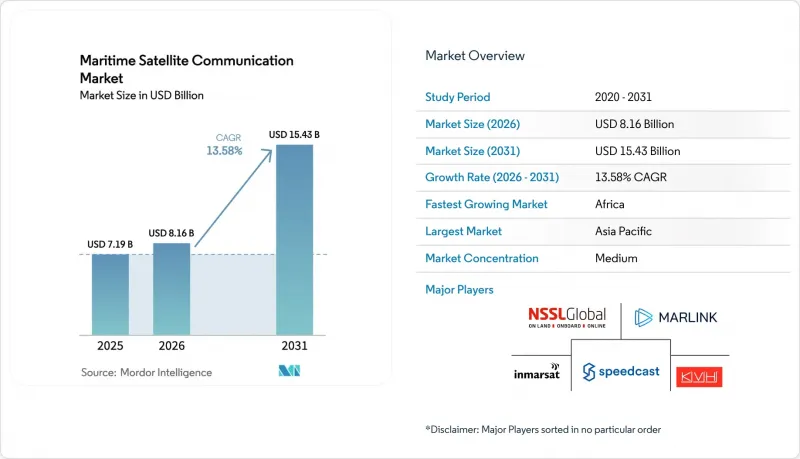
Mordor Intelligence에 의하면, 해상 위성통신 시장 규모는 2025년 71억 9,000만 달러, 2026년 81억 6,000만 달러에서 2031년까지 154억 3,000만 달러로 성장할 것으로 예측되며, 2026-2031년 연평균 복합 성장률(CAGR)은 13.58%를 기록할 전망입니다.
본 보고서는 접속 방식(이동체 위성 서비스(MSS), 정지 궤도(VSAT) 등),주파수 대역(L-밴드, S-밴드 등), 제공 내용(하드웨어·단말기, 접속 서비스 등), 최종 사용자 업종(일반 화물선·유조선 등), 지역(북미, 남미 등)별로 세분화되어 있습니다. 시장 예측은 금액(달러) 기준으로 제시되어 있습니다.
세계 해상 위성 통신 시장 동향과 인사이트
선원 복지에 관한 규제 강화와 선내 디지털화의 진전
2024년에 비준된 ‘해사노동협약’ 개정에 따라 선주는 합리적인 인터넷 접속을 제공해야 할 의무가 부과되었으며, 광대역 인터넷은 단순한 혜택이 아닌 규정 준수 요건이 되었습니다. 2025년 선원 설문조사에서 Wi-Fi는 인재 유지를 위한 요인 중 상위 3위에 올랐으며, 통신 환경이 선원의 이직 비용에 직접적인 영향을 미치고 있음이 밝혀졌습니다. 현재 선사는 복리후생 데이터와 운항 데이터를 단일 대용량 Ka-밴드 회선 상에서 통합하고 있으며, 이에 따라 조선소에서는 신조 선박에 평면 패널 안테나를 표준으로 장착하고 있습니다. 이러한 변화는 로테이션 기간이 8개월에 달하는 장거리 컨테이너선 및 유조선 선단에서 가장 두드러지게 나타나며, 정신 건강의 향상이 안전성 향상으로 이어지고 있습니다. 전반적으로 선원에 관한 규제가 안정적인 대역폭 수요를 뒷받침하고 있어, 해상 위성 통신 시장을 가격 변동의 영향으로부터 보호하고 있습니다.
대역폭의 경제성을 혁신하는 LEO 위성 군집의 부상
Starlink Maritime은 40밀리초 미만의 지연 시간과 최대 220 Mbps의 속도를 실현하여 대역폭 자체를 상품화시키고, GEO의 기존 사업자들에게 서비스 계층으로의 전환을 촉구하고 있습니다. OneWeb의 전 세계 커버리지와 정액제 패키지를 통해 메가바이트 단위의 초과 요금이 폐지되는 한편, Project Kuiper는 2026년에 시범 운영을 시작할 예정이며, 이는 가격 경쟁을 더욱 격화시킬 전망입니다. 선박 운항 사업자들은 실시간 영상, 클라우드 대시보드, 원격 조선을 위해 LEO를 채택하고 있지만, 위상 배열 안테나는 자본 측면의 장벽이 되어 GEO와 LEO를 결합한 하이브리드 단말기 시장에 틈새 시장을 창출하고 있습니다. 멀티 오빗 모뎀이 성숙해짐에 따라 해상 위성 통신 시장은 용도별로 최적의 링크를 선택하는 유연한 아키텍처로 전환되고 있습니다. 그 결과, 특히 크루즈선, 해양 에너지 관련 선박, 조사선에서 트래픽이 두 자릿수 성장을 보이고 있습니다.
플랫 패널 안테나의 높은 자본 지출(CAPEX)
전자 제어 안테나의 단가는 대당 15,000-5만 달러로, 일부 소형 선박의 연간 예산에서 최대 25%를 차지합니다. 초기 모델은 거친 바다에서 성능 저하 문제도 있어, 운항사는 2세대 기종이 등장할 때까지 구매를 미루고 있었습니다. 리스 프로그램에서는 하드웨어와 통신 시간을 세트로 묶어 초기 비용 부담을 경감하고 있지만, 고객을 다년간의 계약에 묶어두기 때문에 투자 회수 기간이 길어지게 됩니다. 이러한 격차로 인해 접속 환경은 양극화되고 있으며, 대규모 선단은 멀티 기가비트급 LEO 링크를 이용할 수 있는 반면, 소형 선박은 여전히 협대역 L-밴드에 머물러 있습니다. 하드웨어 가격이 대폭 하락하지 않는 한, 설비 투자(CAPEX)의 장벽이 해상 위성 통신 시장의 도입 속도를 둔화시킬 것입니다.
부문 분석
비 GEO 광대역 매출은 연평균 성장률(CAGR) 14.12%로 확대되고 있으며, 이는 사업자들이 저지연 솔루션으로 전환하는 속도가 빠르다는 점을 여실히 보여줍니다. 2025년 통신 수익의 49.32%가 기존 GEO 계약을 통해 창출되었기 때문에 정지 궤도(GEO) VSAT와 관련된 해상 위성 통신 시장 규모는 여전히 큰 임베디드니다. 그러나 LEO(저궤도) 신규 진출기업들이 가격 경쟁을 심화시키고 있으며, 이에 따라 GEO 제공업체들은 사이버 보안 및 분석 기능을 장기 계약 번들에 포함시키고 있습니다. 단일 섀시에서 LEO와 GEO를 통합하는 하이브리드 모뎀은 부문 간의 경계를 모호하게 만들어, 향후 선단 투자를 미래에 대비한 것으로 만듭니다. 2026년에 시범 운영이 시작될 스페이스X(SpaceX)의 ‘직접 투 셀(Direct-to-Cell)’ 기능은 전용 단말기 없이도 스마트폰을 위성에 연결할 수 있게 함으로써, 협대역 통신에 대한 지출을 잠식할 가능성이 있습니다.
SES의 MEO에 대한 지속적인 투자는 극지방 커버리지나 가동 시간 보장이 필수적인 상황에서 중간 수준의 지연 시간을 특징으로 하는 대안을 제공합니다. ITU의 주파수 대역 관련 결정으로 인해 간섭에 대한 우려가 완화되어 저궤도 전개 계획이 탄력을 받고 있습니다. 전반적으로 해상 위성 통신 시장에서는 연결성 선택 기준이 ‘궤도 중심’에서 ‘성능 중심’ 조달로 전환되고 있으며, 계약 기준에서 서비스 품질, SLA에 기반한 가동 시간, 사이버 보안이 단순한 대역폭을 능가하는 중요성을 띠고 있습니다.
Ka 대역의 매출은 경량 평면 패널 안테나가 신규 도입의 주류를 이루게 됨에 따라 연평균 성장률(CAGR) 14.23%를 나타낼 것으로 예측되며, 이는 각 대역 중 가장 높은 수치입니다. Ku 대역은 방대한 설치된 리플렉터 기반과 풍부한 GEO 용량 덕분에 해상 위성 통신 시장 점유율의 38.63%를 유지하고 있습니다. 그러나 Ku 대역의 신청 건수는 감소 추세를 보이는 반면, Ka 대역과 신흥 Q/V 대역이 새로운 위성 투자를 유치하고 있습니다. 르네사스의 빔 포밍 칩 덕분에 Ka 대역 단말기의 전력 소비가 40% 감소하고 단가가 2만 달러 아래로 떨어지면서, 중형 상선에서의 채택이 촉진되고 있습니다.
플랫 패널 안테나의 이득 제한으로 인해 더 높은 주파수가 유리해졌으며, 이것이 Ka 대역의 성장을 뒷받침하고 있습니다. L 대역은 GMDSS 및 IoT에 필수적인 안전 분야로서의 위상을 유지하고 있지만, 처리량 제한으로 인해 상업적 성장 여지는 제한적입니다. 27.5-28.35GHz 대역에서 해상용 5G-위성 하이브리드에 대한 인가를 위한 규제상의 움직임은 Ka 대대의 전망을 더욱 밝게 하고 있습니다. 그 결과, 주파수 전략은 현재 안테나의 경제성과 용도의 대역폭을 조화시키는 데 중점을 두고 있으며, Ka 대역은 해상 위성 통신 시장에서 선두 자리를 확고히 하고 있습니다.
지역별 분석
아시아태평양은 2025년 매출의 32.71%를 차지하고 있으며, 이는 해당 지역의 조선, 컨테이너 운송, 어업이 집중되어 있음을 반영합니다. 중국, 일본, 한국의 조선소에서는 용선자의 연결 요건을 충족하기 위해 신조 선박에 Ka 대역 지원 평면 패널을 표준 사양으로 장착하고 있습니다. 동남아시아의 ‘일대일로’ 항만 디지털화를 통해 위성을 이용한 화물 목록 및 AIS 요건이 도입되면서 지역 수요가 확대되고 있습니다. 일본의 연안 자율 항로 시험에서는 HD 영상 및 LiDAR 데이터 전송에 저궤도 백홀이 활용되고 있습니다. 인도의 ‘사가르마라’ 계획 확대에 따라 연안 화물선에 대한 AIS 및 SATCOM 도입 의무화가 진행되고 있어 수요를 끌어올리고 있습니다.
아프리카는 연평균 성장률(CAGR) 14.83%로 가장 빠르게 성장하는 지역이며, 나이지리아, 케냐, 남아프리카공화국에서는 다자간 금융기관의 자금 지원을 받아 위성을 이용한 컨테이너 추적 시스템을 도입하고, 항만 디지털화를 추진하고 있습니다. 남대서양 어업에서는 어획 할당량 준수를 철저히 하기 위해 L-밴드 IoT가 도입되고 있으나, 설비 투자(CAPEX)의 장벽으로 인해 평면 패널 기술의 채택은 제한되고 있습니다. 북아프리카에서는 이집트와 리비아의 해상 석유 개발 재개로 인해 고처리량 VSAT에 대한 투자가 촉진되고 있습니다.
북미와 유럽에서는 엄격한 사이버 보안 규제와 하이브리드형 VSAT-5G의 조기 도입을 배경으로 꾸준한 성장이 이어지고 있습니다. 미국 멕시코만에서의 5G 시범 운영과 EU의 ‘커넥팅 유럽 시설(CEF)’을 통한 보조금이 단말기 업그레이드를 촉진하고 있습니다. 중동의 주요 에너지 기업들은 요충지를 통과할 때 화물의 무결성을 모니터링하기 위해 유조선에 멀티오빗 링크를 장착하고 있습니다. 남미에서는 브라질과 가이아나의 심해 유전지에서 GEO-HTS가 도입되고 있는 반면, 아르헨티나의 어업 분야에서는 전자 문서화를 위해 Ku 대역으로의 전환이 진행되고 있습니다. 이러한 동향들이 맞물려 해상 위성 통신 시장의 지역별 수요는 폭넓게 견조한 상태를 유지하고 있습니다.
기타 혜택:
- Excel 형식 시장 예측(ME) 시트
- 3개월간의 애널리스트 지원
자주 묻는 질문
목차
제1장 서론
제2장 분석 방법
제3장 주요 요약
제4장 시장 구도
제5장 시장 규모·성장률 예측
제6장 경쟁 구도
제7장 시장 기회와 향후 전망
LSH 26.09.02According to Mordor Intelligence, the maritime satellite communication market size is projected to expand from USD 7.19 billion in 2025 and USD 8.16 billion in 2026 to USD 15.43 billion by 2031, registering a CAGR of 13.58% between 2026 to 2031.
This report is Segmented by Connectivity Type (Mobile Satellite Services, Geostationary VSAT, and More), Frequency Band (L-Band, S-Band, and More), Offering (Hardware and Terminals, Connectivity Services, and More), End-User Vertical (Merchant Cargo and Tanker, and More), and Geography (North America, South America, and More). The Market Forecasts are Provided in Terms of Value (USD).
Global Maritime Satellite Communication Market Trends and Insights
Growing Crew Welfare Mandates And Onboard Digitalization
Amendments to the Maritime Labour Convention, ratified in 2024, oblige shipowners to provide reasonable internet access, making broadband a compliance item rather than a perk. Seafarer surveys in 2025 ranked Wi-Fi among the top three retention factors, linking connectivity directly to crew turnover costs. Operators now merge welfare and operational data over a single high-capacity Ka-Band link, prompting shipyards to pre-install flat-panel antennas on newbuilds. The shift is most visible in long-haul container and tanker tonnage, where rotations last eight months, and mental-health benefits translate into safety gains. Overall, crew mandates underpin steady demand for bandwidth, insulating the maritime satellite communication market from price volatility.
Emergence Of LEO Constellations Disrupting Bandwidth Economics
Starlink Maritime delivers sub-40 ms latency and speeds up to 220 Mbps, commoditizing raw bandwidth and forcing GEO incumbents to pivot toward service layers. OneWeb's global footprint and flat-rate packages remove per-megabyte overage fees, while Project Kuiper is slated to enter trials in 2026, intensifying price pressure. Vessel operators embrace LEO for real-time video, cloud dashboards, and remote piloting, yet phased-array antennas raise capital hurdles and create a niche for hybrid GEO-LEO terminals. As multi-orbit modems mature, the maritime satellite communication market is migrating to flexible architectures that select the optimal link per application. The immediate result is double-digit traffic growth, especially on cruise, offshore energy, and research vessels.
High CAPEX For Flat-Panel Antennas
Electronically steered antennas cost USD 15,000-50,000 per unit, representing up to 25% of some small-vessel annual budgets. Early models also suffered performance degradation in rough seas, leading operators to defer purchases until second-generation units emerged. Leasing programs bundle hardware and airtime to soften upfront spending but lock customers into multi-year terms that lengthen payback periods. The gap creates a two-tier connectivity landscape, where large fleets enjoy multi-gigabit LEO links and small craft remain on narrowband L-Band. Unless hardware prices fall sharply, CAPEX friction will temper adoption velocity in the maritime satellite communication market.
Other drivers and restraints analyzed in the detailed report include:
- IMO Decarbonization Data-Reporting Requirements
- Hybrid VSAT-5G Coastal Hand-Off Architectures
- Cybersecurity Compliance Burden For Small Fleets
For complete list of drivers and restraints, kindly check the Table Of Contents.
Segment Analysis
Revenue from non-GEO broadband is expanding at 14.12% CAGR, underscoring the speed with which operators are migrating to low-latency solutions. The maritime satellite communication market size attached to geostationary VSAT remains sizable because 49.32% of 2025 connectivity revenue flowed through established GEO contracts. Yet LEO newcomers are eroding price points, prompting GEO providers to fold cybersecurity and analytics into long-term bundles. Hybrid modems that mesh LEO and GEO on a single enclosure blur segmentation boundaries and future-proof fleet investments. SpaceX's direct-to-cell capability, entering trials in 2026, could siphon narrowband spending by allowing smartphones to connect to satellites without specialized terminals.
Continued MEO investment by SES offers mid-latency alternatives where polar coverage or guaranteed uptime is critical. ITU spectrum rulings have lessened interference worries and bolstered low-orbit deployment plans. Overall, the maritime satellite communication market sees connectivity choice shifting from orbit-centric to performance-centric procurement, with service quality, SLA uptime, and cybersecurity overtaking raw bandwidth in contract criteria.
Ka-Band revenue is projected to grow 14.23% CAGR, the highest among bands, as lightweight flat-panel antennas dominate new installations. Ku-Band retains a 38.63% slice of maritime satellite communication market share due to a vast installed reflector base and plentiful GEO capacity. Yet Ku filings are waning while Ka and emerging Q/V bands attract fresh satellite investment. Renesas beamforming chips have cut Ka-terminal power use 40% and pushed unit pricing below USD 20,000, driving mid-size merchant adoption.
Flat-panel gain constraints favor higher frequencies, anchoring Ka-Band's growth narrative. L-Band maintains a vital safety niche for GMDSS and IoT, but limited throughput caps its commercial upside. Regulatory moves to authorize maritime 5G-satellite hybrids in the 27.5-28.35 GHz slice further brighten Ka prospects. Consequently, frequency strategy now hinges on matching antenna economics with application bandwidth, locking Ka-Band into pole position within the maritime satellite communication market.
Complete Report Scope:
- By Connectivity Type
- Mobile Satellite Services (MSS)
- Geostationary VSAT
- Non-GEO Broadband (LEO/MEO)
- By Frequency Band
- L-Band
- S-Band
- C-Band
- Ku-Band
- Ka-Band
- By Offering
- Hardware and Terminals
- Connectivity Services (Airtime)
- Managed and Value-Added Services
- By End-User Vertical
- Merchant Cargo and Tanker
- Offshore Energy and Support Vessels
- Passenger (Cruise and Ferry)
- Fishing and Aquaculture
- Leisure and Yachts
- Government and Defence
- By Geography
- North America
- United States
- Canada
- Mexico
- South America
- Brazil
- Argentina
- Rest of South America
- Europe
- Germany
- United Kingdom
- France
- Italy
- Spain
- Russia
- Rest of Europe
- Asia Pacific
- China
- Japan
- South Korea
- India
- Australia
- New Zealand
- Rest of Asia Pacific
- Middle East
- United Arab Emirates
- Saudi Arabia
- Turkey
- Rest of Middle East
- Africa
- South Africa
- Nigeria
- Kenya
- Rest of Africa
- North America
Geography Analysis
The Asia Pacific contributes 32.71% of the 2025 revenue, reflecting its concentration in shipbuilding, container traffic, and fishing operations. Chinese, Japanese, and South Korean yards pre-wire new hulls with Ka-Band flat panels to meet charterer connectivity clauses. Belt-and-Road port digitalization in Southeast Asia embeds satellite-based manifest and AIS requirements, expanding regional demand. Japan's autonomous coastal corridor tests lean on low-orbit backhaul for HD video and LiDAR streams. India's Sagarmala expansion is adding AIS and SATCOM mandates for coastal cargo vessels, reinforcing volume.
Africa is the fastest-growing region, with a 14.83% CAGR, as Nigeria, Kenya, and South Africa digitalize their ports with satellite container tracking, financed by multilateral lenders. South-Atlantic fisheries deploy L-Band IoT to enforce quotas, yet CAPEX hurdles constrain the adoption of flat-panel technology. North Africa's offshore oil reactivation in Egypt and Libya injects high-throughput VSAT spending.
North America and Europe sustain steady growth on the back of stringent cyber mandates and early hybrid VSAT-5G rollouts. The U.S. Gulf of Mexico 5G trials and EU Connecting Europe Facility grants incentivize terminal upgrades. Middle-East energy majors equip tankers with multi-orbit links to oversee cargo integrity through chokepoints. South America's deep-water oil in Brazil and Guyana deploys GEO-HTS, while Argentina's fisheries migrate to Ku for electronic documentation. Together, these dynamics keep geographic demand broad and resilient for the maritime satellite communication market.
- Inmarsat Group Limited
- Marlink SAS
- KVH Industries Inc.
- Speedcast International
- NSSL Global Ltd.
- Cobham Satcom
- Iridium Communications Inc.
- Thuraya Telecommunications Co.
- Hughes Network Systems LLC
- Viasat Inc.
- Eutelsat Group (incl. OneWeb)
- SES S.A.
- Intelsat S.A.
- SpaceX Starlink
- Telesat Corp.
- ORBCOMM Inc.
- Satcom Global Ltd.
- Intellian Technologies Inc.
- Cobham SATCOM
- Kymeta Corporation
Additional Benefits:
- The market estimate (ME) sheet in Excel format
- 3 months of analyst support
TABLE OF CONTENTS
1 INTRODUCTION
- 1.1 Study Assumptions and Market Definition
- 1.2 Scope of the Study
2 RESEARCH METHODOLOGY
3 EXECUTIVE SUMMARY
4 MARKET LANDSCAPE
- 4.1 Market Overview
- 4.2 Market Drivers
- 4.2.1 Growing Crew Welfare Mandates and Onboard Digitalization
- 4.2.2 Emergence of LEO Constellations Disrupting Bandwidth Economics
- 4.2.3 IMO Decarbonization Data-Reporting Requirements
- 4.2.4 Hybrid VSAT-5G Coastal Hand-Off Architectures
- 4.2.5 AI-Driven Route Optimisation Platforms Embedding SATCOM
- 4.2.6 Rising Defence Demand for Resilient Maritime SATCOM
- 4.3 Market Restraints
- 4.3.1 High CAPEX for Flat-Panel Antennas
- 4.3.2 Cybersecurity Compliance Burden for Small Fleets
- 4.3.3 Spectrum Coordination Congestion in Ku/Ka
- 4.3.4 Export-Control Limits on Advanced Modems
- 4.4 Industry Value Chain Analysis
- 4.5 Regulatory Landscape
- 4.6 Technological Outlook
- 4.7 Impact of Macroeconomic Factors on the Market
- 4.8 Porter's Five Forces Analysis
- 4.8.1 Threat of New Entrants
- 4.8.2 Bargaining Power of Buyers
- 4.8.3 Bargaining Power of Suppliers
- 4.8.4 Threat of Substitute Products and Services
- 4.8.5 Intensity of Competitive Rivalry
5 MARKET SIZE AND GROWTH FORECASTS (VALUE)
- 5.1 By Connectivity Type
- 5.1.1 Mobile Satellite Services (MSS)
- 5.1.2 Geostationary VSAT
- 5.1.3 Non-GEO Broadband (LEO/MEO)
- 5.2 By Frequency Band
- 5.2.1 L-Band
- 5.2.2 S-Band
- 5.2.3 C-Band
- 5.2.4 Ku-Band
- 5.2.5 Ka-Band
- 5.3 By Offering
- 5.3.1 Hardware and Terminals
- 5.3.2 Connectivity Services (Airtime)
- 5.3.3 Managed and Value-Added Services
- 5.4 By End-User Vertical
- 5.4.1 Merchant Cargo and Tanker
- 5.4.2 Offshore Energy and Support Vessels
- 5.4.3 Passenger (Cruise and Ferry)
- 5.4.4 Fishing and Aquaculture
- 5.4.5 Leisure and Yachts
- 5.4.6 Government and Defence
- 5.5 By Geography
- 5.5.1 North America
- 5.5.1.1 United States
- 5.5.1.2 Canada
- 5.5.1.3 Mexico
- 5.5.2 South America
- 5.5.2.1 Brazil
- 5.5.2.2 Argentina
- 5.5.2.3 Rest of South America
- 5.5.3 Europe
- 5.5.3.1 Germany
- 5.5.3.2 United Kingdom
- 5.5.3.3 France
- 5.5.3.4 Italy
- 5.5.3.5 Spain
- 5.5.3.6 Russia
- 5.5.3.7 Rest of Europe
- 5.5.4 Asia Pacific
- 5.5.4.1 China
- 5.5.4.2 Japan
- 5.5.4.3 South Korea
- 5.5.4.4 India
- 5.5.4.5 Australia
- 5.5.4.6 New Zealand
- 5.5.4.7 Rest of Asia Pacific
- 5.5.5 Middle East
- 5.5.5.1 United Arab Emirates
- 5.5.5.2 Saudi Arabia
- 5.5.5.3 Turkey
- 5.5.5.4 Rest of Middle East
- 5.5.6 Africa
- 5.5.6.1 South Africa
- 5.5.6.2 Nigeria
- 5.5.6.3 Kenya
- 5.5.6.4 Rest of Africa
- 5.5.1 North America
6 COMPETITIVE LANDSCAPE
- 6.1 Market Concentration
- 6.2 Strategic Moves
- 6.3 Market Share Analysis
- 6.4 Company Profiles (includes Global Level Overview, Market Level Overview, Core Segments, Financials as available, Strategic Information, Market Rank/Share for Key Companies, Products and Services, and Recent Developments)
- 6.4.1 Inmarsat Group Limited
- 6.4.2 Marlink SAS
- 6.4.3 KVH Industries Inc.
- 6.4.4 Speedcast International
- 6.4.5 NSSL Global Ltd.
- 6.4.6 Cobham Satcom
- 6.4.7 Iridium Communications Inc.
- 6.4.8 Thuraya Telecommunications Co.
- 6.4.9 Hughes Network Systems LLC
- 6.4.10 Viasat Inc.
- 6.4.11 Eutelsat Group (incl. OneWeb)
- 6.4.12 SES S.A.
- 6.4.13 Intelsat S.A.
- 6.4.14 SpaceX Starlink
- 6.4.15 Telesat Corp.
- 6.4.16 ORBCOMM Inc.
- 6.4.17 Satcom Global Ltd.
- 6.4.18 Intellian Technologies Inc.
- 6.4.19 Cobham SATCOM
- 6.4.20 Kymeta Corporation
7 MARKET OPPORTUNITIES AND FUTURE OUTLOOK
- 7.1 White-Space and Unmet-Need Assessment


