
|
시장보고서
상품코드
2121526
유럽의 BIM(Building Information Modeling) : 시장 점유율 분석, 산업 동향 및 통계 데이터, 성장 예측(2026-2031년)Europe Building Information Modeling - Market Share Analysis, Industry Trends & Statistics, Growth Forecasts (2026 - 2031) |
||||||
 Mordor Intelligence
Mordor Intelligence에 의하면, 유럽의 BIM(Building Information Modeling) 시장 규모는 2025년에 31억 7,000만 달러로 평가되었고, 2026년 35억 7,000만 달러에서 2031년까지 65억 1,000만 달러에 이를 것으로 예측되며, 예측 기간(2026-2031년) CAGR은 12.74%를 기록할 전망입니다.
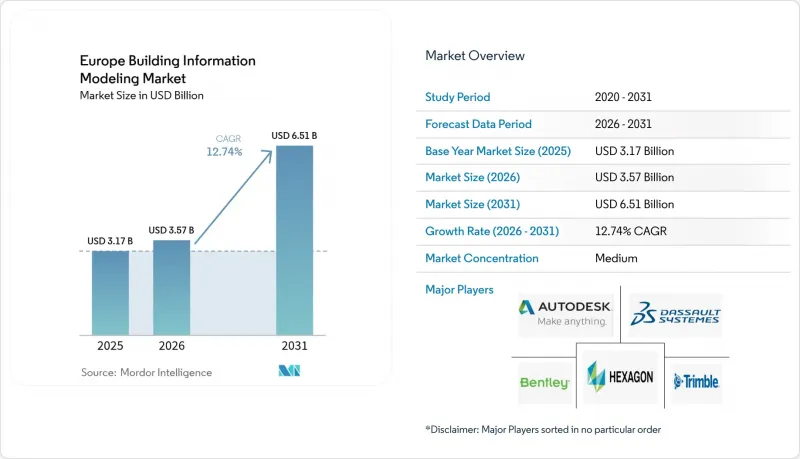
본 보고서는 솔루션 유형(소프트웨어, 서비스), 배포 방식(On-Premise, 클라우드), 용도(상업, 주거, 산업, 인프라), 최종 사용자(건축가·디자이너, 종합 건설업체, 전문 시공업체, 시설 소유자·운영자), 지역(영국, 독일, 프랑스 등)별로 분류되어 있습니다. 시장 예측은 금액(달러) 기준으로 제시되어 있습니다.
유럽의 BIM(Building Information Modeling) 시장 동향 및 인사이트
정부의 BIM 도입 의무화가 조달 프로세스의 변혁을 주도
EU의 공공 조달 지침에 따라 공공 부문 소유주는 BIM 준수 결과물을 요구할 의무가 있으며, 이로 인해 27개 회원국 전체에서 입찰 요건이 변화하고 조정된 디지털 워크플로가 촉진되고 있습니다. 영국에서는 2016년부터 레벨 2 의무화를 시행하고 있으며, 독일에서는 2020년부터 연방 교통 계획에 BIM이 의무화되었습니다. 이탈리아의 단계적 정책은 2025년까지 100만 유로를 초과하는 프로젝트를 전면적으로 대상으로 하며, 명확한 기한을 설정함으로써 소프트웨어 구매, 직원 인증 및 프로세스 재구성을 가속화하고 있습니다. 이러한 규정은 소프트웨어 및 서비스 제공업체의 진입 장벽을 제거하는 동시에, 기술 향상을 미루는 계약자에게는 벌금을 부과함으로써 중기적으로는 전체 밸류체인을 디지털 성숙 단계로 효과적으로 이끌고 있습니다.
디지털화 가속화를 위한 자금 지원이 투자 우선순위를 재편
‘회복·탄력성 기금(RRF)’에 따라 각 회원국은 배정액의 최소 20%를 디지털 전환에 사용해야 하며, 건설 분야의 디지털화는 적격 지출 대상이 됩니다. 남유럽 및 동유럽에는 불균형적으로 큰 비율이 배정되어 있어, 그동안 2D 워크플로우에서 전환하는 데 필요한 자원이 부족했던 기업들에게 자금 조달의 길이 열리고 있습니다. 경기 부양책에 따른 지출은 2026년까지로 기한이 정해져 있기 때문에 많은 유틸리티 발주처는 초기 투자를 앞당긴 다년 계약의 BIM 입찰을 실시하고 있으며, 그로 인해 전개 일정이 단축되고 있습니다. 클라우드 호스팅, 사용자 교육, 규정 준수 감사를 턴키 패키지에 통합할 수 있는 공급업체는 경기 부양 자금이 단계적으로 축소되고 프로젝트 파이프라인이 정상화되더라도 이 급증하는 수요를 계속해서 포착하고 있습니다.
높은 도입 비용으로 인해 중소기업의 도입이 저해되고 있다.
종합적인 BIM 제품군은 사용자 1인당 연간 1만 유로 이상의 비용이 들 수 있으며, 계약업체는 충분한 역량을 갖추기 위해 워크스테이션 업그레이드 및 수 주간에 걸친 교육 프로그램 비용을 추가로 부담해야 합니다. 이러한 지출은 여전히 유럽 공급망의 대부분을 차지하는 소규모 전문 업체들을 주저하게 만들고 있습니다. 보조금은 존재하지만, 복잡한 신청 절차와 공동 출자 요건으로 인해 가장 소규모의 사업자들은 종종 배제되고 맙니다. 대형 도급업체들이 BIM 산출물 요구 사항을 하도급 단계로 하향 조정함에 따라, 디지털 대응 능력을 갖추지 못한 중소기업들은 수익성이 높은 프로젝트에서 배제될 위험에 직면하고 있으며, 단기적으로는 시장으로의 균일한 확산이 둔화될 우려가 있습니다.
부문 분석
2025년, 소프트웨어 솔루션은 유럽 BIM 시장 점유율의 76.25%를 차지하며, 설계 사무소 및 건설업체의 본사에서 그 기반적인 입지를 공고히 했습니다. 그러나 서비스 부문은 연평균 성장률(CAGR) 13.05%로 확대되고 있으며, 발주처와 건설사가 규제 요건을 BIM 실행 계획에 반영할 수 있는 전문적인 파트너를 찾는 가운데, 라이선스 기반 용도의 성장률을 상회하고 있습니다. 규정 준수 감사, 변경 관리 및 CDE 관리가 지속적으로 필요해짐에 따라, 유럽 BIM 시장의 구현 및 컨설팅 서비스 규모는 확대될 것으로 예측됩니다. 연간 구독에 포함된 내장형 서비스 패키지는 기존의 경계를 모호하게 만들고, 벤더가 단순한 소프트웨어 제공업체를 넘어 전략적 자문가로서의 역할도 수행하도록 유도하고 있습니다.
프로젝트의 복잡성과 국경을 초월한 협업이 증가함에 따라, 연합 모델 조정, 간섭 해결 및 데이터 거버넌스 관련 문서화에 대한 수요가 높아지고 있습니다. 서비스 기업들은 ISO 19650 인증, 사이버 보안, 라이프사이클 데이터 이관에 관한 필수적인 지침을 제공합니다. 공공 부문 발주처가 입찰에 탄소 추적 기능을 포함함에 따라, 환경 데이터 통합에 정통한 컨설턴트들이 타사와의 차별화를 꾀하고 있습니다. 그 결과, 벤더들이 하류 부문의 수익을 추구함에 따라 네메체크(Nemetschek)사의 32억 7,700만 달러 규모의 서비스 지향적 인수 붐과 같은 합병 및 인수는 앞으로도 계속될 전망입니다.
2025년, 유럽 BIM 시장 규모의 57.45%는 On-Premise 구축이 차지하고 있으며, 특히 독일에서 데이터 주권에 관한 규제를 우려하는 기업들로부터 지지를 받고 있습니다. 그러나 팬데믹 기간 동안 원격 협업을 통해 형성된 새로운 업무 관행을 발판으로, 클라우드 환경은 연평균 성장률(CAGR) 13.30%로 확대될 것으로 예측됩니다. 유연한 구독 플랜은 자본 지출(CAPEX)을 최소화하고 자동 갱신 기능을 갖추고 있어, 이전에는 엔트리 레벨 도면 작성 도구에 의존하던 소규모 하도급 업체들을 끌어들이고 있습니다.
IFC 4.3이나 BCF 3.0과 같은 상호 운용성 프레임워크 덕분에 데이터 교환이 용이해지면서, 오프프레미스 데이터 저장에 대한 거부감이 줄어들고 있습니다. 북유럽과 네덜란드의 유틸리티 발주처는 이미 클라우드 기반 CDE(공통 데이터 환경)를 의무화하고 있으며, 이는 확산을 가속화하고 있습니다. 하이브리드 구성도 주목받고 있는데, 기밀 데이터는 로컬 서버에서 엄격하게 보호되고, 중요도가 낮은 작업은 클라우드 분석에 맡겨집니다. 이 모델은 규정 준수(컴플라이언스)와 생산성 간의 균형을 맞추며, 분산된 공급망 전체에 걸친 보편적인 연결성을 위한 길을 열어줍니다.
기타 혜택:
- Excel 형식 시장 예측(ME) 시트
- 3개월간의 애널리스트 지원
자주 묻는 질문
목차
제1장 서론
제2장 분석 방법
제3장 주요 요약
제4장 시장 구도
제5장 시장 규모와 성장 예측
제6장 경쟁 구도
제7장 시장 기회와 향후 전망
LSH 26.09.02According to Mordor Intelligence, the Europe building information modeling market size was valued at USD 3.17 billion in 2025 and estimated to grow from USD 3.57 billion in 2026 to reach USD 6.51 billion by 2031, at a CAGR of 12.74% during the forecast period (2026-2031).
This report is Segmented by Solution Type (Software, and Services), Deployment Type (On-Premise, and Cloud), Application (Commercial, Residential, Industrial, and Infrastructure), End-User (Architects and Designers, General Contractors, Specialty Sub-Contractors, and Facility Owners and Operators), and Geography (United Kingdom, Germany, France, and More). The Market Forecasts are Provided in Terms of Value (USD).
Europe Building Information Modeling Market Trends and Insights
Government-mandated BIM adoption drives procurement transformation
EU Public Procurement Directives oblige public sector owners to demand BIM-compliant deliverables, transforming tender requirements across 27 member states and promoting coordinated digital workflows. The United Kingdom has enforced a Level 2 mandate since 2016, while Germany requires BIM for federal transport schemes from 2020. Italy's phased policy reaches full coverage for projects above EUR 1 million by 2025, creating firm deadlines that accelerate software purchases, staff certification, and process reengineering. These rules lift entry barriers for software and service suppliers, but they also penalize contractors that defer upskilling, effectively pushing the entire value chain toward digital maturity over the medium term.
Accelerated digitization funding reshapes investment priorities
Under the Recovery and Resilience Facility, each member state must channel at least 20% of its allocation toward digital transition, and construction digitalization qualifies as an eligible spend. Southern and Eastern Europe receive a disproportionate share, unlocking capital for firms that historically lacked resources to migrate from 2D workflows. Because stimulus spending is time-bound to 2026, many public owners are issuing front-loaded, multi-year BIM tenders, thereby compressing deployment timelines. Vendors that can bundle cloud hosting, user training, and compliance audits within turnkey packages are capturing this surge, even as the pipeline may normalize once stimulus funds taper.
High implementation costs constrain SME adoption
Comprehensive BIM suites can cost more than EUR 10,000 per seat each year, and contractors must add workstation upgrades and multi-week training programs to achieve competence. These outlays deter smaller trade firms, which still form the bulk of Europe's supply chain. Although subsidies exist, complex application procedures and co-financing requirements often sideline the smallest entities. As larger contractors push BIM deliverables down the subcontracting pyramid, SMEs without digital capacity risk being disqualified from lucrative projects, slowing homogeneous market penetration in the short term.
Other drivers and restraints analyzed in the detailed report include:
- Shift to cloud-based collaborative design platforms
- EU Green Deal integrates carbon reporting with BIM workflows
- Persistent skills gap limits implementation effectiveness
For complete list of drivers and restraints, kindly check the Table Of Contents.
Segment Analysis
Software solutions captured 76.25% of Europe BIM market share in 2025, confirming their foundational status within design offices and contractor headquarters. However, the services segment is advancing at a 13.05% CAGR, outpacing licensed applications as owners and contractors seek expert partners who can translate regulatory mandates into BIM execution plans. The Europe BIM market size for implementation and consulting services is projected to widen as compliance auditing, change management, and CDE administration become recurring necessities. Embedded service packages attached to annual subscriptions blur boundaries, encouraging vendors to act as strategic advisors as well as software providers.
Rising project complexity and cross-border collaboration elevate demand for federated model coordination, clash resolution, and data governance documentation. Services firms offer essential guidance on ISO 19650 certification, cybersecurity, and lifecycle data handover. As public owners embed carbon tracking into tenders, consultants skilled in environmental data integration are differentiating themselves. Consequently, mergers and acquisitions such as Nemetschek's USD 3.277 billion service-oriented spree are likely to continue as vendors chase downstream revenue.
On-premise deployments controlled 57.45% of the Europe BIM market size in 2025, favored by companies wary of data sovereignty rules, particularly in Germany. Yet cloud environments are forecast to expand 13.30% CAGR, riding new work routines shaped by pandemic-era remote collaboration. Flexible subscription plans minimize capex and embed automatic updates, drawing small subcontractors who previously relied on entry-level drafting tools.
Interoperability frameworks such as IFC 4.3 and BCF 3.0 ease data exchange, increasing comfort with off-premise storage. Nordic and Dutch public owners already require cloud-based CDEs, accelerating adoption curves. Hybrid topologies are gaining traction: sensitive data are ring-fenced on local servers while non-critical tasks flow to cloud analytics. This model balances compliance with productivity, clearing a pathway for universal connectivity across scattered supply chains.
Complete Report Scope:
- By Solution Type
- Software
- Services
- By Deployment Type
- On-premise
- Cloud
- By Application
- Commercial
- Residential
- Industrial
- Infrastructure
- By End-user
- Architects and Designers
- General Contractors
- Specialty Sub-contractors
- Facility Owners and Operators
- By Country
- United Kingdom
- Germany
- France
- Italy
- Spain
- Netherlands
- Nordics (Denmark, Sweden, Norway, Finland)
- Rest of Europe
List of Companies Covered in this Report:
- Autodesk, Inc.
- Bentley Systems, Incorporated
- Dassault Systemes SE
- Hexagon AB
- Trimble Inc.
- AVEVA Group plc
- Nemetschek SE
- Graphisoft SE
- Allplan GmbH
- RIB Software GmbH
- Topcon Corporation
- Asite Solutions Limited
- Dalux A/S
- PlanRadar GmbH
- Vectorworks, Inc.
- ACCA software S.p.A.
- Catenda AS
- Procore Technologies, Inc.
- Buildots Ltd.
- Bimeye AB
Additional Benefits:
- The market estimate (ME) sheet in Excel format
- 3 months of analyst support
TABLE OF CONTENTS
1 INTRODUCTION
- 1.1 Study Assumptions and Market Definition
- 1.2 Scope of the Study
2 RESEARCH METHODOLOGY
3 EXECUTIVE SUMMARY
4 MARKET LANDSCAPE
- 4.1 Market Overview
- 4.2 Market Drivers
- 4.2.1 Government-mandated BIM adoption (EU Public Procurement Directives)
- 4.2.2 Accelerated digitalisation funding via EU Recovery and Resilience Facility
- 4.2.3 Shift to cloud-based collaborative design platforms
- 4.2.4 EU Green Deal linking BIM to lifecycle-carbon reporting
- 4.2.5 Growing offsite-modular construction requiring BIM-enabled DfMA
- 4.2.6 AI-driven generative design improving project efficiency
- 4.3 Market Restraints
- 4.3.1 High upfront software and training costs
- 4.3.2 Persistent skills gap among SME contractors
- 4.3.3 Inconsistent national BIM maturity frameworks across Europe
- 4.3.4 Fragmented interoperability standards and data ownership concerns
- 4.4 Industry Ecosystem Analysis
- 4.5 Impact of Macroeconomic Factors
- 4.6 Technological Outlook
- 4.7 Porter's Five Forces Analysis
- 4.7.1 Threat of New Entrants
- 4.7.2 Bargaining Power of Buyers
- 4.7.3 Bargaining Power of Suppliers
- 4.7.4 Threat of Substitute Products
- 4.7.5 Intensity of Competitive Rivalry
5 MARKET SIZE AND GROWTH FORECASTS (VALUE)
- 5.1 By Solution Type
- 5.1.1 Software
- 5.1.2 Services
- 5.2 By Deployment Type
- 5.2.1 On-premise
- 5.2.2 Cloud
- 5.3 By Application
- 5.3.1 Commercial
- 5.3.2 Residential
- 5.3.3 Industrial
- 5.3.4 Infrastructure
- 5.4 By End-user
- 5.4.1 Architects and Designers
- 5.4.2 General Contractors
- 5.4.3 Specialty Sub-contractors
- 5.4.4 Facility Owners and Operators
- 5.5 By Country
- 5.5.1 United Kingdom
- 5.5.2 Germany
- 5.5.3 France
- 5.5.4 Italy
- 5.5.5 Spain
- 5.5.6 Netherlands
- 5.5.7 Nordics (Denmark, Sweden, Norway, Finland)
- 5.5.8 Rest of Europe
6 COMPETITIVE LANDSCAPE
- 6.1 Market Concentration
- 6.2 Strategic Moves
- 6.3 Market Share Analysis
- 6.4 Company Profiles (includes Global level Overview, Market level overview, Core Segments, Financials as available, Strategic Information, Market Rank/Share for key companies, Products and Services, and Recent Developments)
- 6.4.1 Autodesk, Inc.
- 6.4.2 Bentley Systems, Incorporated
- 6.4.3 Dassault Systemes SE
- 6.4.4 Hexagon AB
- 6.4.5 Trimble Inc.
- 6.4.6 AVEVA Group plc
- 6.4.7 Nemetschek SE
- 6.4.8 Graphisoft SE
- 6.4.9 Allplan GmbH
- 6.4.10 RIB Software GmbH
- 6.4.11 Topcon Corporation
- 6.4.12 Asite Solutions Limited
- 6.4.13 Dalux A/S
- 6.4.14 PlanRadar GmbH
- 6.4.15 Vectorworks, Inc.
- 6.4.16 ACCA software S.p.A.
- 6.4.17 Catenda AS
- 6.4.18 Procore Technologies, Inc.
- 6.4.19 Buildots Ltd.
- 6.4.20 Bimeye AB
7 MARKET OPPORTUNITIES AND FUTURE OUTLOOK
- 7.1 White-space and Unmet-need Assessment