

|
시장보고서
상품코드
2121528
자동차 서스펜션 시스템 : 시장 점유율 분석, 산업 동향 및 통계 데이터, 성장 예측(2026-2031년)Automotive Suspension System - Market Share Analysis, Industry Trends & Statistics, Growth Forecasts (2026 - 2031) |
||||||
 Mordor Intelligence
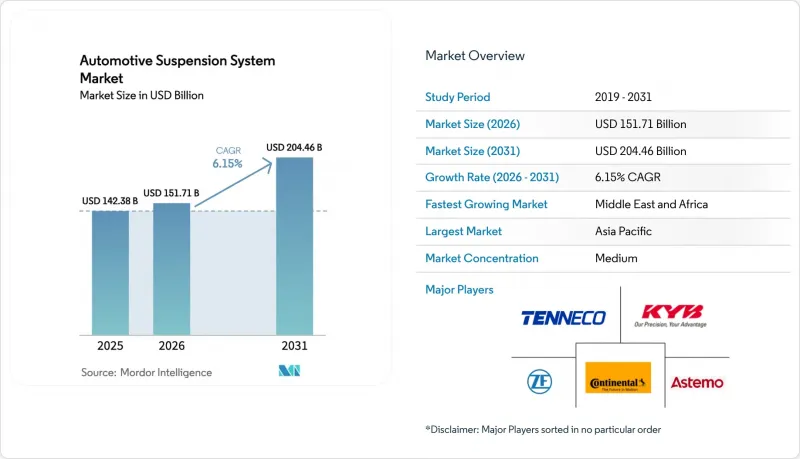
Mordor Intelligence에 의하면, 자동차 서스펜션 시스템 시장 규모는 2025년 1,423억 8,000만 달러에서 2026년에는 1,517억 1,000만 달러로 확대되어 2031년까지 2,044억 6,000만 달러에 이를 것으로 예측되며, 예측 기간(2026-2031년) CAGR은 6.15%입니다.
이는 전동화와 소프트웨어 정의 차량 아키텍처가 섀시 설계의 우선순위를 재구성하고 있기 때문입니다.
본 보고서는 부품 유형(코일 스프링, 리프 스프링 등), 서스펜션 시스템 유형(패시브 서스펜션 등), 지오메트리(맥퍼슨 스트럿, 더블 위시본 등), 차종(승용차, LCV 등),판매 채널(OEM, 애프터마켓), 추진 방식(ICE 등), 지역별로 분류되어 있습니다. 시장 전망은 금액(달러) 및 수량(대수)으로 제시되어 있습니다.
세계 자동차 서스펜션 시스템 시장 동향 및 인사이트
전동화가 이끄는 경량 적응형 서스펜션
다이캐스팅 알루미늄 로어 암을 탑재한 마힌드라의 SUV ‘BE 6e’는 인도의 험로에서 진동 차단 성능을 향상시켰습니다. ZF의 ‘sMOTION’은 에어 스프링과 액티브 안티롤 바를 통합하여, 기존의 스틸 코일 방식에 비해 질량을 줄임으로써 전기차가 잃어버린 주행 거리를 회복할 수 있게 합니다. 유럽연합 집행위원회의 LEVA 프로그램은 3D 프린팅된 열가소성 복합재 암을 승인했습니다. 이 암은 단조 강철제보다 가볍고, ECE 충돌 안전 기준을 충족합니다. 도요타의 ‘bZ4X’는 유한 요소 분석을 활용하여 중공형 스태빌라이저 바를 채택함으로써 경량화를 실현했습니다. 이러한 추세에 따라 헨드릭슨의 ‘PRIMAAX EX’는 전기 배송 밴의 차축 중량을 줄이는 데 성공했으며, 이러한 노력은 상용차 차량군으로도 확산되고 있습니다.
ADAS 연동형 섀시 안전성을 뒷받침하는 규제 동향
유럽에서는 유엔 규정 R171이 차선 유지를 의무화하고 있으며, 수동형 시스템으로는 중요한 시간 범위 내에서 횡방향 하중을 안정화하기 어렵기 때문에 반능동형 댐핑을 암묵적으로 권장하고 있습니다. 콘티넨탈은 전자 제어 댐퍼를 탑재함으로써 차선 이탈 사고가 대폭 감소했음을 확인했습니다. EU 규정 2019/2144는 긴급 제동 시 타이어와 노면 간의 안정적인 접촉의 중요성을 강조하고 있습니다. 이에 대응하여 ZF의 sMOTION 기술은 자동 긴급 제동 장치가 작동하기 전에 댐퍼를 미리 압축합니다. 한편, NHTSA의 2025년 이니셔티브는 더 높은 속도 영역에서의 자동 긴급 제동 시스템 인증을 목표로 하고 있으며, 이로 인해 미국 시장에서 능동 안전 기능에 대한 수요가 증가하고 있습니다. 또한, ISO 26262에서는 서스펜션용 ECU가 안전상 중요한 부품으로 지정되어 있으며, 이러한 움직임은 개발 주기를 장기화시키는 한편, 인증을 받은 공급업체의 중요성을 부각시키고 있습니다.
스마트 서스펜션 아키텍처의 높은 초기 비용과 수명 주기 비용
폭스바겐은 세미액티브 하드웨어 도입으로 인해 차량 제조 비용이 증가하고 있어, 어댑티브 댐핑 기능을 고가형 티구안 트림으로 한정하고 있습니다. 이 전략적 조치는 회사의 이익률을 지키기 위한 것입니다. 에어 스프링의 컴프레서는 일정 주행 거리 후 교체가 필요하며, 코일 스프링의 수명 주기 비용을 상회하지만, 인도에서는 특정 주행 거리 내에서 세미액티브 댐퍼의 고장률이 높게 나타나고 있습니다. 이 문제는 솔레노이드 밸브가 철분으로 인해 막히기 때문에 발생합니다. 대조적으로, 패시브 유닛의 고장률은 현저히 낮은 것으로 보고되고 있습니다. 구독형 가격 책정을 통해 도입 비용은 절감되지만, 가격에 민감한 구매자 중에서도 무료 체험 기간이 끝난 후에도 결제를 계속하는 사람은 극히 일부에 불과합니다.
부문 분석
자동차 서스펜션 시스템 시장 중에서도 전자 제어 장치 및 센서는 차량 1대당 8-12개의 가속도 센서와 여러 개의 차고 센서가 필요하기 때문에 2031년까지 연평균 성장률(CAGR) 9.22%로 확대되고 있습니다. 2025년 매출액에서 쇼크 업소버가 차지하는 비중은 여전히 40.21%였으나, 가격이 55-75달러인 모노튜브 방식으로의 업그레이드는 판매량이 어댑티브형으로 전환되는 상황 속에서도 그 가치를 유지하고 있습니다. 제품 구성의 변화로 인해 현재는 모노튜브 방식 제품의 방열 효율이 우선시되고 있습니다. 이는 전기차(EV)의 회생 제동 듀티 사이클에서 중요한 요건입니다. 코일 스프링과 리프 스프링의 출하 대수는 안정적인 반면, 클래스 8 트럭용 에어 스프링 모듈은 북미 차축 시장에서 점유율을 확대되고 있습니다.
앞으로 기대되는 혁신 기술로는 광범위한 온도 범위에서 일관된 강성을 유지하고 NVH 관련 불만을 대폭 줄여주는 열가소성 엘라스토머 재질의 부시가 포함됩니다. 댐퍼와 동일한 MR 유체를 사용하는 자기 유변학식 엔진 마운트는 하이브리드 차량에서 파워트레인의 충격을 차단합니다. 이 개발로 인해 파커(Parker)와 같은 공급업체의 차량당 채택량이 증가할 전망입니다. 중국의 모노튜브 공급업체들은 GB/T 21510 품질 기준을 준수하면서도 일본 경쟁사보다 낮은 가격을 책정함으로써, 아시아태평양의 쇼크 업소버 매출에서 상당한 점유율을 확보하고 있습니다.
2025년에는 자동차 서스펜션 시스템 시장에서 패시브 설계가 64.32%의 점유율을 차지했으나, 생산량 확대를 통한 비용 절감을 배경으로 세미액티브 방식의 채택이 진행됨에 따라 그 점유율은 축소되는 추세입니다. 포드사가 모든 F-150 라이트닝 모델에 연속 가변 감쇠 제어를 기본 사양으로 장착하기로 결정한 것은 이러한 중요한 동향을 여실히 보여주고 있습니다. 연평균 성장률(CAGR) 8.74%로 확대되는 세미액티브 시스템의 채택 증가로 인해, 자동차 서스펜션 시장에서 전자 부품의 역할이 커지고 있으며, 독자적인 제어 알고리즘이 공급업체의 우위를 더욱 공고히 하고 있습니다. 액티브 유압 구동 시스템은 시장 점유율이 작지만, 고급 전기차(EV) 분야에서 틈새 시장을 개척하고 있습니다. 예를 들어, 메르세데스-벤츠 EQS에서는 캐빈 틸트 제어를 통해 체감되는 횡방향 힘이 효과적으로 감소됩니다.
가격에 대한 민감성으로 인해 패시브 시스템은 2만 5,000달러 미만 시장 부문에 국한되어 있습니다. 특히, 전자 기기의 ISO 26262 인증에 드는 비용이 높다는 점이 그 요인입니다. 전 세계 소형차 생산 대수의 대부분을 차지하는 토션 빔은 변화의 물결에 직면해 있습니다. 이는 주로 EU의 차선 유지 규제로 인해 이러한 구조가 독립 서스펜션 시스템으로 대체되어야 하기 때문입니다. 지역 간에 현저한 격차가 나타납니다. 유럽은 아시아태평양에 비해 세미액티브 시스템의 채택률이 높아, 자동차의 정교함에 대한 소비자의 가치관 차이가 두드러지게 나타나고 있습니다.
지역별 분석
2025년, 아시아태평양은 자동차 서스펜션 시스템 시장에서 48.96%의 점유율을 차지했습니다. 이는 중국의 경차 생산에서 BYD 등 현지 OEM이 ‘Seal’ 세단에 적응형 댐퍼를 탑재한 것이 요인입니다. 인도에서는 SUV 시장의 급속한 성장에 힘입어 타타가 멀티링크식 리어 액슬을 채택했습니다. 이를 통해 차체 롤이 감소하여 현대 투손이 설정한 기준을 충족했습니다. 단위 노동 비용을 절감하기 위해 일본 공급업체들은 댐퍼 생산을 태국이나 베트남으로 이전한 결과, 일본의 지역 점유율은 하락했습니다. 현지화 노력을 강조하듯, 현대모비스는 인도네시아에 공장을 설립하고 서스펜션 모듈의 연간 생산을 목표로 하고 있습니다.
매출의 대부분을 북미와 유럽이 차지하고 있으며, 세미액티브식 부품으로의 전환이 두드러졌습니다. 포드의 ‘F-150 라이트닝’은 어댑티브 댐퍼를 기본 사양으로 장착함으로써 선례를 세웠으며, 전체 판매 대수에서 완전한 보급을 달성했습니다. ZF의 독일 내 생산 라인은 BMW 및 메르세데스-벤츠용 sMOTION 유닛을 순조롭게 공급했습니다. 유럽의 차선 유지 규제가 세미액티브 방식 시스템의 채택을 뒷받침하고 있습니다. 한편, 북미 애프터마켓에서는 조절 가능한 코일오버에 대한 전자상거래 수요의 급증에 힘입어 매출이 증가했습니다. 캐나다에서는 혹독한 겨울을 배경으로 픽업트럭 구매자들이 최적의 최저 지상고를 확보하기 위해 에어 스프링을 선택하는 경향이 강해지고 있습니다.
중동 및 아프리카는 2025년 판매 대수에서 차지하는 점유율은 작지만, 2031년까지 연평균 성장률(CAGR) 7.65%로 전 세계 성장률을 주도하고 있습니다. 사우디아라비아의 합작 기업 ‘Lucid’는 에어 서스펜션이 탑재된 차량의 연간 생산을 계획하고 있으며, 이는 콘티넨탈 및 ZF에게 이 지역 내 새로운 공급망 구축으로 이어질 것입니다. 아랍에미리트(UAE)에서는 뜨거운 사막의 더위를 극복하기 위해 고급차 시장에서 적응형 댐핑 시스템에 대한 수요가 현저히 증가하고 있습니다. 한편, 남아프리카공화국에서는 전력 공급 문제로 자동차 생산이 감소했으나, 랜드화 약세가 유럽으로의 수출을 뒷받침하여 수출은 증가 추세를 보이고 있습니다. 이집트의 높은 수입 관세에 대응하기 위해 테네코(Teneco)는 수에즈 특별경제구역에 댐퍼 공장을 건설하고 있습니다. 남미는 시장 점유율이 작지만, 아르헨티나에서는 부품 수입 상한선이 철폐됨에 따라 수요가 급증했습니다.
기타 혜택:
- Excel 형식 시장 예측(ME) 시트
- 3개월간의 애널리스트 지원
자주 묻는 질문
목차
제1장 서론
제2장 분석 방법
제3장 주요 요약
제4장 시장 구도
제5장 시장 규모·성장률 예측
제6장 경쟁 구도
제7장 시장 기회와 향후 전망
LSH 26.09.02According to Mordor Intelligence, the automotive suspension system market size is expected to grow from USD 142.38 billion in 2025 to USD 151.71 billion in 2026 and is forecast to reach USD 204.46 billion by 2031, advancing at a 6.15% CAGR during the forecast period (2026-2031), as electrification and software-defined vehicle architectures reshape chassis design priorities.
This report is Segmented by Component Type (Coil Spring, Leaf Spring, and More), Suspension System Type (Passive Suspension and More), Geometry (MacPherson Strut, Double Wishbone, and More), Vehicle Type (Passenger Cars, LCV, and More), Sales Channel (OEM and Aftermarket), Propulsion (ICE and More), and Geography. The Market Forecasts are Provided in Terms of Value (USD) and Volume (Units).
Global Automotive Suspension System Market Trends and Insights
Electrification-Driven Lightweight Adaptive Suspensions
Mahindra's BE 6e SUV, equipped with die-cast aluminum lower arms, enhances isolation indices on India's rugged roads. ZF's sMOTION, integrating air springs with active anti-roll bars, reduces mass compared to traditional steel coil counterparts, allowing electric vehicles to regain lost driving range. The European Commission's LEVA program has endorsed a 3D-printed thermoplastic composite arm, which is lighter than its forged steel counterpart and meets ECE crash standards. Toyota's bZ4X, using finite element analysis, has achieved weight reduction through a hollow stabilizer bar. Following this trend, Hendrickson's PRIMAAX EX has successfully reduced axle weight in electric delivery vans, a move that commercial fleets have echoed.
Regulatory Push for ADAS-Linked Chassis Safety
In Europe, UN R171 mandates lane-keeping and subtly advocates semi-active damping, as passive systems struggle to stabilize lateral loads within a crucial time window . Continental observed a significant reduction in lane-departure incidents with the installation of electronically controlled dampers. The EU regulation 2019/2144 emphasizes the importance of stable tire contact during emergency braking. In response, ZF's sMOTION technology pre-compresses the dampers before autonomous braking is activated. Meanwhile, NHTSA's 2025 initiative aims to certify automatic emergency braking systems for higher speeds, thereby amplifying the U.S. market's appetite for active safety features. Additionally, ISO 26262 has designated suspension ECUs as safety-critical, a move that extends development cycles but also underscores the importance of certified suppliers.
High Upfront and Lifecycle Cost of Smart Suspension Architectures
Volkswagen, facing higher vehicle build costs due to semi-active hardware, has limited adaptive damping to higher-priced Tiguan trims. This strategic move safeguards the company's margins. While air-spring compressors require replacement after a certain distance, overshadowing the lifetime costs of coil springs, India sees a higher failure rate in semi-active dampers within a specific distance. The issue arises from solenoid valves clogging with ferrous dust. In contrast, passive units report a significantly lower failure rate. Although subscription pricing eases entry costs, only a small percentage of price-sensitive buyers continue paying after the free trial period.
Other drivers and restraints analyzed in the detailed report include:
- Increasing Demand for Enhanced Ride Comfort and Handling
- Rapid SUV and Premium-Vehicle Sales in Emerging Economies
- Reliability and Maintenance Challenges in Harsh Conditions
For complete list of drivers and restraints, kindly check the Table Of Contents.
Segment Analysis
The automotive suspension system market for electronic control units and sensors is expanding at a 9.22% CAGR through 2031, driven by the 8-12 accelerometers and multiple ride-height sensors required per vehicle. Shock absorbers still accounted for 40.21% of 2025 revenue, but monotube upgrades, priced at USD 55-75, are holding their value even as volumes shift toward adaptive variants. Changes in the mix now prioritize monotube heat-dissipation efficiency, a key requirement for regenerative-braking duty cycles in electric vehicles (EVs). While shipments of coil and leaf springs remained stable, air-spring modules for Class 8 trucks have increased their share of North American axles.
Innovations on the horizon include thermoplastic-elastomer bushings, which maintain consistent stiffness across a wide temperature range, leading to a significant reduction in NVH complaints. Magnetorheological engine mounts, which utilize the same MR fluid as dampers, are isolating powertrain shocks in hybrids. This development is set to increase the content per vehicle for suppliers like Parker. Chinese monotube suppliers have captured a notable share of Asia-Pacific absorber revenue by pricing themselves lower than their Japanese counterparts, while adhering to GB/T 21510 quality standards.
Passive designs accounted for 64.32% of the automotive suspension system market share in 2025, but are ceding share as semi-active content rises due to volume-driven cost reductions; Ford's decision to standardize continuously controlled damping across all F-150 Lightning models underscores a significant trend. The growing adoption of semi-active systems, with a CAGR of 8.74%, is elevating the role of electronic components in the automotive suspension market, while proprietary control algorithms further solidify supplier dominance. While active hydraulically driven systems hold a smaller share of the market, they're finding a niche in luxury EVs. For instance, in the Mercedes-Benz EQS, cabin tilt control effectively reduces perceived lateral forces.
Price sensitivity keeps passive systems in the sub-USD 25,000 market segment, especially given the steep ISO 26262 validation costs for electronics. Torsion beams, which constitute a significant portion of the global compact-car output, are facing a shift. This is mainly due to EU lane-keeping mandates that are pushing for the replacement of these setups with independent systems. There's a notable regional disparity: Europe shows higher adoption rates for semi-active systems than Asia-Pacific, highlighting differing consumer valuations of automotive refinement.
Complete Report Scope:
- By Component Type
- Coil Springs
- Leaf Springs
- Air Springs
- Shock Absorbers
- Stabilizer / Anti-roll Bars
- Suspension Arms & Links
- Electronic Control Units and Sensors
- Other Components
- By Suspension System Type
- Passive Suspension
- Semi-Active Suspension
- Active Suspension
- By Geometry /Architecture
- MacPherson Strut
- Double Wishbone
- Multi-Link
- Torsion Beam / Twist Beam
- Other Geometries
- By Vehicle Type
- Passenger Cars
- Light Commercial Vehicles
- Heavy Commercial Vehicles
- By Sales Channel
- Original Equipment Manufacturer (OEM)
- Aftermarket
- By Propulsion
- Internal-Combustion-Engine Vehicles
- Electric & Hybrid Vehicles
- By Geography
- North America
- United States
- Canada
- Rest of North America
- South America
- Brazil
- Argentina
- Rest of South America
- Europe
- Germany
- United Kingdom
- France
- Italy
- Spain
- Russia
- Rest of Europe
- Asia-Pacific
- China
- India
- Japan
- South Korea
- Rest of Asia-Pacific
- Middle East and Africa
- Saudi Arabia
- United Arab Emirates
- South Africa
- Egypt
- Turkey
- Rest of Middle East and Africa
- North America
Geography Analysis
The Asia-Pacific region accounted for 48.96% of the automotive suspension system market share in 2025, as China's light-vehicle production saw local OEMs, such as BYD, equipping their Seal sedans with adaptive dampers. In India, a booming SUV market led Tata to implement multi-link rear axles, which reduced body roll and aligned with benchmarks set by the Hyundai Tucson. To reduce unit labor costs, Japanese suppliers relocated absorber production to Thailand and Vietnam, resulting in a drop in Japan's regional share. Highlighting the push for localization, Hyundai Mobis inaugurated a plant in Indonesia, aiming to produce suspension modules annually.
North America and Europe accounted for a significant portion of the turnover, with a noticeable tilt towards semi-active content. Ford's F-150 Lightning set a precedent by making adaptive damping standard, achieving full penetration across its sales. ZF's production line in Germany successfully delivered sMOTION units for BMW and Mercedes-Benz. Europe's lane-keeping regulations have driven the adoption of semi-active installations. Meanwhile, North America's aftermarket experienced a revenue boost, driven by the surge in e-commerce demand for adjustable coilovers. In Canada, frigid winters are prompting pickup buyers to opt for air-springs, ensuring optimal ground clearance.
The Middle East and Africa, although they held a smaller share of the 2025 volume, are pacing the global growth chart at a 7.65% CAGR through 2031. Saudi Arabia's Lucid joint venture plans to produce air-suspended cars annually, establishing new regional supply chains for Continental and ZF. In the UAE, luxury car demand skews heavily towards adaptive damping systems, a move aimed at combating the sweltering desert heat. While South Africa's power supply challenges led to a dip in car production, a weaker rand bolstered exports to Europe, seeing an uptick. In response to Egypt's high import tariffs, Tenneco is setting up a damper plant in the Suez zone. South America accounted for a small market share, with Argentina witnessing a surge after lifting caps on component imports.
- Continental AG
- ZF Friedrichshafen AG
- Tenneco Inc.
- KYB Corporation
- Hitachi Astemo Ltd.
- Thyssenkrupp AG
- Mando Corporation
- Marelli Corporation
- Hyundai Mobis Co. Ltd.
- BWI Group
- Sogefi SpA
- Parker LORD Corporation
- Benteler International AG
- Fox Factory Holding Corp.
- Hendrickson International
- Showa Corporation
Additional Benefits:
- The market estimate (ME) sheet in Excel format
- 3 months of analyst support
TABLE OF CONTENTS
1 Introduction
- 1.1 Study Assumptions and Market Definition
- 1.2 Scope of the Study
2 Research Methodology
3 Executive Summary
4 Market Landscape
- 4.1 Market Overview
- 4.2 Market Drivers
- 4.2.1 Increasing Demand for Enhanced Ride Comfort and Handling
- 4.2.2 Electrification-Driven Chassis Redesign (Lightweight Adaptive Suspensions)
- 4.2.3 Regulatory Push for ADAS-Linked Chassis Safety
- 4.2.4 Rapid SUV and Premium-Vehicle Sales in Emerging Economies
- 4.2.5 Subscription-Based OTA Upgrades Unlocking Active-Suspension Features
- 4.2.6 3-D Printed Composite Suspension Parts Reducing Tooling Cost
- 4.3 Market Restraints
- 4.3.1 High Upfront and Lifecycle Cost of Smart Suspension Architectures
- 4.3.2 Reliability and Maintenance Challenges in Harsh Conditions
- 4.3.3 Cyber-Security and Functional-Safety Compliance Burden
- 4.3.4 Rare-Earth MR-Fluid and Semiconductor Sensor Supply Bottlenecks
- 4.4 Value / Supply-Chain Analysis
- 4.5 Regulatory Landscape
- 4.6 Technological Outlook
- 4.7 Porter's Five Forces
- 4.7.1 Bargaining Power of Suppliers
- 4.7.2 Bargaining Power of Buyers/Consumers
- 4.7.3 Threat of New Entrants
- 4.7.4 Threat of Substitute Products
- 4.7.5 Intensity of Competitive Rivalry
5 Market Size and Growth Forecasts (Value (USD) and Volume (Units))
- 5.1 By Component Type
- 5.1.1 Coil Springs
- 5.1.2 Leaf Springs
- 5.1.3 Air Springs
- 5.1.4 Shock Absorbers
- 5.1.5 Stabilizer / Anti-roll Bars
- 5.1.6 Suspension Arms & Links
- 5.1.7 Electronic Control Units and Sensors
- 5.1.8 Other Components
- 5.2 By Suspension System Type
- 5.2.1 Passive Suspension
- 5.2.2 Semi-Active Suspension
- 5.2.3 Active Suspension
- 5.3 By Geometry /Architecture
- 5.3.1 MacPherson Strut
- 5.3.2 Double Wishbone
- 5.3.3 Multi-Link
- 5.3.4 Torsion Beam / Twist Beam
- 5.3.5 Other Geometries
- 5.4 By Vehicle Type
- 5.4.1 Passenger Cars
- 5.4.2 Light Commercial Vehicles
- 5.4.3 Heavy Commercial Vehicles
- 5.5 By Sales Channel
- 5.5.1 Original Equipment Manufacturer (OEM)
- 5.5.2 Aftermarket
- 5.6 By Propulsion
- 5.6.1 Internal-Combustion-Engine Vehicles
- 5.6.2 Electric & Hybrid Vehicles
- 5.7 By Geography
- 5.7.1 North America
- 5.7.1.1 United States
- 5.7.1.2 Canada
- 5.7.1.3 Rest of North America
- 5.7.2 South America
- 5.7.2.1 Brazil
- 5.7.2.2 Argentina
- 5.7.2.3 Rest of South America
- 5.7.3 Europe
- 5.7.3.1 Germany
- 5.7.3.2 United Kingdom
- 5.7.3.3 France
- 5.7.3.4 Italy
- 5.7.3.5 Spain
- 5.7.3.6 Russia
- 5.7.3.7 Rest of Europe
- 5.7.4 Asia-Pacific
- 5.7.4.1 China
- 5.7.4.2 India
- 5.7.4.3 Japan
- 5.7.4.4 South Korea
- 5.7.4.5 Rest of Asia-Pacific
- 5.7.5 Middle East and Africa
- 5.7.5.1 Saudi Arabia
- 5.7.5.2 United Arab Emirates
- 5.7.5.3 South Africa
- 5.7.5.4 Egypt
- 5.7.5.5 Turkey
- 5.7.5.6 Rest of Middle East and Africa
- 5.7.1 North America
6 Competitive Landscape
- 6.1 Market Concentration
- 6.2 Strategic Moves
- 6.3 Market Share Analysis
- 6.4 Company Profiles (Includes Global Level Overview, Market Level Overview, Core Segments, Financials as Available, Strategic Information, Market Rank/Share for Key Companies, Products & Services, and Recent Developments)
- 6.4.1 Continental AG
- 6.4.2 ZF Friedrichshafen AG
- 6.4.3 Tenneco Inc.
- 6.4.4 KYB Corporation
- 6.4.5 Hitachi Astemo Ltd.
- 6.4.6 Thyssenkrupp AG
- 6.4.7 Mando Corporation
- 6.4.8 Marelli Corporation
- 6.4.9 Hyundai Mobis Co. Ltd.
- 6.4.10 BWI Group
- 6.4.11 Sogefi SpA
- 6.4.12 Parker LORD Corporation
- 6.4.13 Benteler International AG
- 6.4.14 Fox Factory Holding Corp.
- 6.4.15 Hendrickson International
- 6.4.16 Showa Corporation
7 Market Opportunities and Future Outlook
- 7.1 White-space & Unmet-Need Assessment


