

|
시장보고서
상품코드
2121539
내비게이션 시스템 : 시장 점유율 분석, 산업 동향 및 통계 데이터, 성장 예측(2026-2031년)Navigation System - Market Share Analysis, Industry Trends & Statistics, Growth Forecasts (2026 - 2031) |
||||||
 Mordor Intelligence
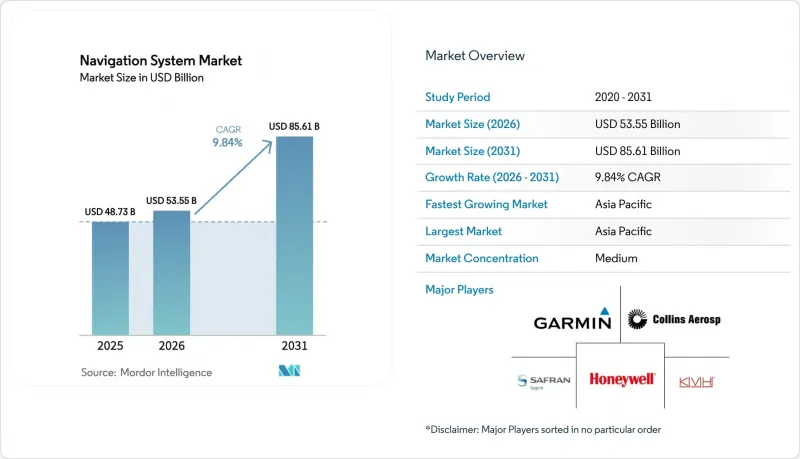
Mordor Intelligence에 의하면, 내비게이션 시스템 시장 규모는 2026년에 535억 5,000만 달러로 추정되며, 예측 기간(2026-2031년)에 CAGR 9.84%로 확대되어 2031년에는 856억 1,000만 달러에 이를 전망입니다.
본 보고서는 용도별(자동차, 항공, 선박, 국방, 산업), 내비게이션 기술별(위성 항법 시스템, 관성 항법 시스템, 수술용 내비게이션 시스템, 하이브리드 센서 융합 시스템),구성 요소별(하드웨어, 소프트웨어, 서비스), 플랫폼별(육상, 항공, 해상, 우주선), 지역별로 분류되어 있습니다. 시장 예측은 금액(미화) 기준으로 제시되어 있습니다.
전 세계 내비게이션 시스템 시장 동향 및 인사이트
승용차 및 상용차에 탑재된 순정 내비게이션 시스템의 급증
자동차 제조업체들은 현재 조립 단계에서 위치 측정용 하드웨어를 탑재하고 있으며, 이를 통해 부품 원가를 절감하는 동시에 구매자를 자사의 독자적인 지도 생태계에 연결하고 있습니다. 폭스바겐의 CARIAD 부문은 2024년 10월 톰톰(TomTom)과 제휴하여 2028년까지 1,500만 대의 차량에 ‘IndiGO.NDS’ 스택을 탑재하는 것을 목표로 하고 있습니다. 이를 통해 딜러를 방문할 필요 없이 무선으로 지도를 업데이트할 수 있게 됩니다. 2025년에 출시될 BMW의 ‘Operating System 9’는 HERE HD Live Map과 실시간 오버레이를 통합하여 200밀리초 만에 경로를 재계산합니다. 이는 애프터마켓 기기에서는 도저히 따라잡을 수 없는 지연 시간입니다. 상업 분야에서는 2025년 2월부터 전면 시행되는 유럽연합(EU)의 ‘모빌리티 패키지 I’에 따라, 중량 3.5톤을 초과하는 국경을 넘는 트럭에는 GNSS 지원 타코그래프의 탑재가 의무화됩니다. 이로 인해 정기적인 교체 주기가 확립되고, 프리미엄 운전 지원 기능 도입을 위한 사전 단계로서 차선 수준의 위치 파악이 촉진될 것입니다.
GNSS 지원 가전제품의 급속한 확대
2025년에 출하된 스마트폰의 68%에 L1 및 L5 신호를 모두 처리하는 듀얼 주파수 수신기가 탑재되었습니다. 이는 GPS, 갈릴레오, 북두, NavIC의 입력을 융합하여 도시 지역의 ‘캐니언 효과’ 하에서도 1미터 미만의 정확도를 실현하는 퀄컴의 스냅드래곤 X80 모뎀 덕분에 2023년의 41%에서 증가한 수치입니다. 애플의 U2 초광대역(UWB) 칩은 GNSS와 UWB를 결합하여 실내 소매점이나 의료시설에서의 내비게이션을 위해 센티미터 수준의 피어투피어 위치 파악을 실현하고 있으며, 이 기능은 현재 안드로이드 생태계 전반으로 확산되고 있습니다. 웨어러블 기기는 소비자용 GNSS 모듈의 22%를 차지하는 반면, DHL과 같은 물류 사업자들은 2024년에 유럽 전역에 120만 대의 추적기를 도입한 결과, 고객으로부터의 위치 정보 문의가 40% 감소했습니다. 출하 대수가 증가함에 따라 모듈 가격은 2달러 미만으로 떨어졌으며, 이로 인해 저가형 전동 킥보드나 대여용 자전거에 도난 방지 및 이용량에 따른 과금을 위한 위치 정보 기능이 탑재되기 시작했습니다.
고정밀 시스템의 높은 초기 투자 비용
센티미터급 수신기는 5,000-1만 5,000달러에 판매되고 있어, 비용에 민감한 사용자에게는 장벽이 되고 있습니다. Trimble사의 R12i는 1만 2,800달러에 판매되고 있으며, 여기에 보정 서비스 비용으로 연간 1,200-2,400달러가 추가로 필요하기 때문에 그 도입은 측량사나 자금력이 있는 농장으로 제한되고 있습니다. John Deere사의 StarFire 7000은 9,500달러이며, 연간 이용료가 1,800달러가 들기 때문에 50헥타르 미만의 농지를 경작하는 소규모 농가에게는 부담스러운 가격입니다. Septentrio사의 Mosaic-X5 모듈은 대량 구매 시 800달러로 가격 책정되어 있어 도입 비용은 절감할 수 있지만, 1데시미터 미만의 정확도를 달성하기 위해서는 여전히 유료 보정 데이터가 필요합니다.
부문 분석
RTK 및 고정밀 위치 측정이 머신 비전 및 로봇 공학과 융합됨에 따라, 산업용 및 측량용 솔루션은 연평균 성장률(CAGR) 12.60%로 확대될 것으로 예측되며, 이는 모든 용도 중 가장 높은 성장률입니다. Trimble사가 2024년에 Bilberry사를 인수함에 따라, 이 회사의 GNSS 툴셋에 AI 기반의 잡초 감지 기능이 추가되어, 부분 살포 시험에서 제초제 사용량을 70% 절감했습니다. 또한, 2025년 3월 Agri-Trak사와의 제휴를 통해 가변 비율 파종 기술이 일반 농가에도 보급되었습니다. 건설 업계에서도 유사한 추세가 나타나고 있습니다. 캐터필러(Caterpillar)에 따르면, 2024년에 북미에서 출하된 불도저의 38%에 공장 출하 시 3D 그레이드 컨트롤이 탑재되어, 프로젝트당 1만 8,000달러의 재작업 비용을 절감할 수 있었습니다고 합니다.
자동차 용도가 매출의 대부분을 차지하고 있으며, 2025년에는 내비게이션 시스템 시장에서 38%의 점유율을 차지할 전망이지만, 자동차 제조업체들이 분리형 소프트웨어 플랫폼으로 전환하고 있어 성장세는 둔화되고 있습니다. EU의 타코그래프 규제 등 차량 관련 규제로 인해 교체 주기는 꾸준히 진행되고 있으나, 그 속도는 완만해지고 있습니다. 항공, 해운, 국방과 같은 틈새 시장에서는 엄격한 무결성, 중복성 및 스푸핑 방지 요건으로 인해 프리미엄 가격이 책정되고 있습니다.
하이브리드 및 센서 퓨전 아키텍처는 2031년까지 연평균 성장률(CAGR) 14.40%로 성장할 전망입니다. 2024년 11월 영국에서 실시된 비행 시험에서는 냉원자 간섭법을 이용하여 위성의 도움 없이 90분 동안 10미터의 정확도를 달성함으로써, 상업 항공 분야에서 양자 관성 기술의 가능성을 입증했습니다. DARPA의 Micro-PNT 프로토타입은 칩 규모의 원자 시계와 MEMS 자이로스코프를 10cm3 크기의 패키지에 통합하여 보병의 항법에서 1미터 미만의 드리프트를 실현하고 있습니다.
2025년에도 위성 수신기는 여전히 내비게이션 시스템 시장의 49% 점유율을 차지하고 있으며, 그 주된 요인은 민수용 전자 기기와의 통합에 있습니다. 관성 항법 장치(INS)만 탑재된 장치는 GNSS를 이용할 수 없는 잠수함, 기뢰, 실내 로봇 등에서 사용되고 있지만, 고성능 INS의 높은 비용이 더 광범위한 활용을 제한하고 있습니다. 광학식 및 전자기식 수술용 플랫폼은 GNSS의 범위를 완전히 벗어나 작동하지만, 하이브리드 센서 기술의 광범위한 발전의 혜택을 받고 있습니다.
지역별 분석
아시아태평양은 2025년 매출의 38%를 차지할 것으로 예상되며, 2031년까지 연평균 성장률(CAGR) 10.50%로 성장할 것으로 전망됩니다. 2025년 1월, 중국이 모든 신형 스마트폰에 북두(BeiDou) 지원 기능을 의무화함에 따라 연간 3억 대의 단말기가 즉시 국내 사용자 기반에 추가되었습니다. 인도의 NavIC 위성군은 2025년 중반에 인도양 지역 전체로 커버리지를 확대하여 해상에서 GPS에 대한 의존도를 낮추는 동시에 듀얼 콘스텔레이션 지원 수신기에 대한 수요를 견인했습니다. 일본의 준천정 위성 시스템은 2024년에 7기로 늘어남에 따라, 상세한 HD 지도 없이도 자율주행차의 시험 주행이 가능해졌습니다. 한국에서는 2025년에 출하된 신규 농기계의 42%에 RTK 수신기가 탑재된 것으로 보고되었습니다. 태국은 2024년에 12곳의 SBAS 기준국을 배치하여 18개 공항에서 RNP 접근을 가능하게 했으며, 몬순 시즌의 지연 시간을 14% 단축했습니다.
북미와 유럽을 합친 연간 매출 비중은 47%를 차지했습니다. FAA(미국 연방항공청)의 규제에 따라 2025년부터 2027년에 걸쳐 6,800건의 항공전자 장비 개조가 추진되는 한편, EU의 타코그래프 규제로 인해 420만 대의 트럭을 대상으로 한 고정 주기가 형성되었습니다. 미국 중서부 지역의 정밀 농업에서는 2024년 가뭄 이후 RTK 기반의 가변 비료 시비 시스템을 도입한 결과, 관개 용수를 22% 절약했습니다. 국방 분야의 현대화는 계속해서 견조한 추세를 보였으며, NATO는 2025년 4월에 멀티 소스 PNT 요건을 채택했습니다.
중동 및 아프리카은 규모 면에서는 뒤처져 있지만, 특히 국가 주도의 스마트 시티 및 물류 프로젝트가 전개되고 있는 지역에서 두 자릿수의 성장률을 기록하고 있습니다. 아랍에미리트(UAE)의 ‘팔콘 아이(Falcon Eye)’ 네트워크는 2025년 중반까지 도시 지역의 87%를 커버하여, 응급 서비스 및 교통의 실시간 조정을 가능하게 했습니다. 이러한 노력은 기존의 항공·선박 분야를 넘어선 하이브리드 내비게이션의 도입을 촉진하고 있습니다.
기타 혜택:
- Excel 형식 시장 예측(ME) 시트
- 3개월간의 애널리스트 지원
자주 묻는 질문
목차
제1장 서론
제2장 분석 방법
제3장 주요 요약
제4장 시장 구도
제5장 시장 규모·성장률 예측
제6장 경쟁 구도
제7장 시장 기회와 향후 전망
LSH 26.09.02According to Mordor Intelligence, the navigation system market size is estimated at USD 53.55 billion in 2026, and is expected to reach USD 85.61 billion by 2031, at a CAGR of 9.84% during the forecast period (2026-2031).
This report is Segmented by Application (Automotive, Aviation, Maritime, Defense, Industrial), Navigation Technology (Satellite Navigation Systems, Inertial Navigation Systems, Surgical Navigation Systems, Hybrid and Sensor-Fusion Systems), Component (Hardware, Software, Services), Platform (Land, Airborne, Maritime, Spacecraft), and Geography. The Market Forecasts are Provided in Terms of Value (USD).
Global Navigation System Market Trends and Insights
Surge in Factory-Fitted Navigation in Passenger and Commercial Vehicles
Automakers now embed positioning hardware at the assembly stage, reducing bill-of-materials cost and tying buyers into proprietary map ecosystems. Volkswagen's CARIAD unit partnered with TomTom in October 2024 to deliver the IndiGO.NDS stack across 15 million vehicles by 2028, enabling over-the-air map updates that eliminate the need for dealership visits. BMW's Operating System 9, released in 2025, merges HERE HD Live Map with real-time overlays to deliver 200-millisecond route recalculations, a latency that aftermarket devices cannot match. On the commercial side, the European Union's Mobility Package I, fully effective as of February 2025, requires cross-border trucks weighing more than 3.5 tonnes to carry GNSS-enabled tachographs, creating a captive replacement cycle and promoting lane-level positioning as a precursor to premium driver-assistance features.
Rapid Expansion of GNSS-Enabled Consumer Electronics
Dual-frequency receivers processed both L1 and L5 signals in 68% of smartphones shipped during 2025, up from 41% in 2023, thanks to Qualcomm's Snapdragon X80 modem that fuses GPS, Galileo, BeiDou, and NavIC inputs for sub-meter accuracy in urban canyons. Apple's U2 ultra-wideband chip combines GNSS with UWB to deliver centimeter-level peer-to-peer localization for indoor retail and healthcare navigation, a capability now replicating across Android ecosystems. Wearables account for 22% of consumer GNSS modules, while logistics operators such as DHL deployed 1.2 million trackers across Europe in 2024, resulting in a 40% reduction in customer location queries. Higher shipment volumes drove module prices below USD 2, allowing low-cost e-scooters and rental bikes to integrate positioning for anti-theft and usage-based billing.
High Capital Cost of High-Precision Systems
Centimeter-level receivers list between USD 5,000 and USD 15,000, a hurdle for cost-sensitive users. Trimble's R12i sells for USD 12,800 and requires an additional USD 1,200-2,400 per year for correction services, limiting its adoption to surveyors and well-capitalized farms. John Deere's StarFire 7000 costs USD 9,500, with an annual subscription of USD 1,800, pricing out smallholders cultivating under 50 hectares. Septentrio's Mosaic-X5 module, priced at USD 800 in high volume, lowers entry costs but still needs paid corrections to reach sub-decimeter precision.
Other drivers and restraints analyzed in the detailed report include:
- Aviation Demand for Performance-Based Navigation Compliance
- Defense Modernization Programs Requiring Assured-PNT Solutions
- Vulnerability to Jamming and Spoofing Attacks
For complete list of drivers and restraints, kindly check the Table Of Contents.
Segment Analysis
Industrial and surveying solutions are projected to rise at a 12.60% CAGR, the fastest among all applications, as RTK and precise point positioning converge with machine vision and robotics. Trimble's 2024 Bilberry acquisition added AI weed-detection to its GNSS toolset, reducing herbicide use by 70% in spot-spraying trials, while the March 2025 Agri-Trak deal extended variable-rate seeding to mainstream farmers. Construction adopts similar patterns; Caterpillar stated that 38% of North American dozers shipped in 2024 carried factory-installed 3D grade control, trimming rework by USD 18,000 per project.
Automotive uses dominated revenue, with a 38% market share in navigation systems in 2025; however, growth is moderating as carmakers pivot toward decoupled software platforms. Fleet regulations such as the EU tachograph rule push steady, but slower, replacement cycles. Aviation, maritime, and defense niches command premium pricing due to strict integrity, redundancy, and anti-spoofing needs.
Hybrid and sensor-fusion architectures are set to expand at a 14.40% CAGR through 2031. The United Kingdom's November 2024 flight test utilized cold-atom interferometry to achieve 10-meter accuracy for 90 minutes without the aid of satellites, thereby confirming the quantum inertial potential in commercial aviation. DARPA's Micro-PNT prototypes integrate chip-scale atomic clocks and MEMS gyros in a 10-cm3 package, achieving sub-meter drift for infantry navigation.
Satellite receivers still hold a 49% share of the navigation systems market in 2025, largely due to their integration with consumer electronics. Inertial-only units are used in submarines, mines, and indoor robots where GNSS is unavailable, but the high cost of high-performance INS limits their wider use. Optical and electromagnetic surgical platforms operate entirely outside GNSS, yet they benefit from broader hybrid sensor advances.
Complete Report Scope:
- By Application
- Automotive
- Aviation
- Maritime
- Defense and Security
- Industrial and Surveying
- By Navigation Technology
- Satellite Navigation Systems (GNSS)
- Inertial Navigation Systems
- Surgical Navigation Systems
- Hybrid and Sensor-Fusion Systems
- By Component
- Hardware (Receivers, IMUs, Antennas)
- Software and Mapping Services
- Services (Installation, Training, Maintenance)
- By Platform
- Land Vehicles
- Airborne Platforms
- Maritime and Sub-Sea Platforms
- Spacecraft and Launch Vehicles
- Geography
- North America
- United States
- Canada
- Mexico
- South America
- Brazil
- Argentina
- Rest of South America
- Europe
- United Kingdom
- Germany
- France
- Italy
- Spain
- Russia
- Benelux
- Nordics
- Rest of Europe
- Asia Pacific
- China
- India
- Japan
- South Korea
- ASEAN
- Oceania
- Rest of Asia Pacific
- Middle East
- Turkey
- Israel
- GCC
- Rest of Middle East
- Africa
- North Africa
- South Africa
- Rest of Africa
- North America
Geography Analysis
Asia Pacific seized 38% of 2025 revenue and is forecast to grow at a 10.50% CAGR through 2031. China's January 2025 mandate that all new smartphones support BeiDou instantly converted 300 million devices per year into a domestic user base. India's NavIC constellation expanded coverage across the Indian Ocean Region in mid-2025, cutting maritime reliance on GPS and driving dual-constellation receiver demand. Japan's Quasi-Zenith System reached seven satellites in 2024, enabling autonomous vehicle trials operating without detailed HD maps. South Korea reported that 42% of new farm machinery shipped in 2025 was equipped with RTK receivers. Thailand deployed 12 SBAS reference stations in 2024, enabling RNP approaches at 18 airports and reducing monsoon-season delays by 14%.
North America and Europe combined for 47% of annual revenue. FAA mandates are driving 6,800 avionics retrofits between 2025 and 2027, while EU tachograph rules created a captive cycle for 4.2 million trucks. Precision agriculture in the U.S. Midwest conserved 22% irrigation water after the 2024 droughts through RTK-guided variable-rate systems. Defense modernizations remain robust, with NATO adopting a multi-source PNT requirement in April 2025.
The Middle East and Africa trail in volume but post double-digit growth, particularly in areas with sovereign smart-city and logistics projects. The UAE's Falcon Eye network had covered 87% of urban areas by mid-2025, enabling the coordination of emergency services and traffic in real-time. These initiatives encourage the adoption of hybrid navigation beyond traditional aviation and maritime domains.
- Honeywell International Inc.
- Garmin Ltd
- Collins Aerospace (RTX)
- Safran Electronics & Defense
- Trimble Inc.
- Thales Group
- TomTom N.V.
- Northrop Grumman Corporation
- L3Harris Technologies Inc.
- KVH Industries Inc.
- SBG Systems
- Advanced Navigation Pty Ltd
- Raytheon Company
- Bosch Mobility Solutions
- Denso Corporation
- HERE Technologies
- Apple Inc. (Maps)
- Google LLC (Maps & Waze)
- Medtronic plc (Surgical)
- Stryker Corporation (Surgical)
- Brainlab AG
Additional Benefits:
- The market estimate (ME) sheet in Excel format
- 3 months of analyst support
TABLE OF CONTENTS
1 INTRODUCTION
- 1.1 Study Assumptions and Market Definition
- 1.2 Scope of the Study
2 RESEARCH METHODOLOGY
3 EXECUTIVE SUMMARY
4 MARKET LANDSCAPE
- 4.1 Market Overview
- 4.2 Market Drivers
- 4.2.1 Surge in Factory-Fitted Navigation in Passenger and Commercial Vehicles
- 4.2.2 Rapid Expansion of GNSS-Enabled Consumer Electronics
- 4.2.3 Aviation Demand for Performance-Based Navigation (PBN) Compliance
- 4.2.4 Defense Modernization Programs Requiring Assured-PNT Solutions
- 4.2.5 Emergence of Quantum and Optical Gyro Technologies for GPS-Denied Environments
- 4.2.6 AI-Driven Sensor-Fusion Software Enhancing Real-Time Accuracy
- 4.3 Market Restraints
- 4.3.1 High Capital Cost of High-Precision Systems
- 4.3.2 Vulnerability to Jamming and Spoofing Attacks
- 4.3.3 Short Product Life-Cycles Versus Automotive Design Cycles
- 4.3.4 Talent Shortage in Advanced Navigation Algorithm Development
- 4.4 Industry Value / Supply-Chain Analysis
- 4.5 Impact of Macroeconomic Factors on the Market
- 4.6 Regulatory Landscape
- 4.7 Technological Outlook
- 4.8 Porter's Five Forces Analysis
- 4.8.1 Threat of New Entrants
- 4.8.2 Bargaining Power of Suppliers
- 4.8.3 Bargaining Power of Buyers
- 4.8.4 Threat of Substitutes
- 4.8.5 Intensity of Competitive Rivalry
5 MARKET SIZE AND GROWTH FORECASTS (VALUE)
- 5.1 By Application
- 5.1.1 Automotive
- 5.1.2 Aviation
- 5.1.3 Maritime
- 5.1.4 Defense and Security
- 5.1.5 Industrial and Surveying
- 5.2 By Navigation Technology
- 5.2.1 Satellite Navigation Systems (GNSS)
- 5.2.2 Inertial Navigation Systems
- 5.2.3 Surgical Navigation Systems
- 5.2.4 Hybrid and Sensor-Fusion Systems
- 5.3 By Component
- 5.3.1 Hardware (Receivers, IMUs, Antennas)
- 5.3.2 Software and Mapping Services
- 5.3.3 Services (Installation, Training, Maintenance)
- 5.4 By Platform
- 5.4.1 Land Vehicles
- 5.4.2 Airborne Platforms
- 5.4.3 Maritime and Sub-Sea Platforms
- 5.4.4 Spacecraft and Launch Vehicles
- 5.5 Geography
- 5.5.1 North America
- 5.5.1.1 United States
- 5.5.1.2 Canada
- 5.5.1.3 Mexico
- 5.5.2 South America
- 5.5.2.1 Brazil
- 5.5.2.2 Argentina
- 5.5.2.3 Rest of South America
- 5.5.3 Europe
- 5.5.3.1 United Kingdom
- 5.5.3.2 Germany
- 5.5.3.3 France
- 5.5.3.4 Italy
- 5.5.3.5 Spain
- 5.5.3.6 Russia
- 5.5.3.7 Benelux
- 5.5.3.8 Nordics
- 5.5.3.9 Rest of Europe
- 5.5.4 Asia Pacific
- 5.5.4.1 China
- 5.5.4.2 India
- 5.5.4.3 Japan
- 5.5.4.4 South Korea
- 5.5.4.5 ASEAN
- 5.5.4.6 Oceania
- 5.5.4.7 Rest of Asia Pacific
- 5.5.5 Middle East
- 5.5.5.1 Turkey
- 5.5.5.2 Israel
- 5.5.5.3 GCC
- 5.5.5.4 Rest of Middle East
- 5.5.6 Africa
- 5.5.6.1 North Africa
- 5.5.6.2 South Africa
- 5.5.6.3 Rest of Africa
- 5.5.1 North America
6 COMPETITIVE LANDSCAPE
- 6.1 Market Concentration
- 6.2 Strategic Moves
- 6.3 Market Share Analysis
- 6.4 Company Profiles (includes Global Level Overview, Market Level Overview, Core Segments, Financials as available, Strategic Information, Market Rank/Share for key companies, Products and Services, and Recent Developments)
- 6.4.1 Honeywell International Inc.
- 6.4.2 Garmin Ltd
- 6.4.3 Collins Aerospace (RTX)
- 6.4.4 Safran Electronics & Defense
- 6.4.5 Trimble Inc.
- 6.4.6 Thales Group
- 6.4.7 TomTom N.V.
- 6.4.8 Northrop Grumman Corporation
- 6.4.9 L3Harris Technologies Inc.
- 6.4.10 KVH Industries Inc.
- 6.4.11 SBG Systems
- 6.4.12 Advanced Navigation Pty Ltd
- 6.4.13 Raytheon Company
- 6.4.14 Bosch Mobility Solutions
- 6.4.15 Denso Corporation
- 6.4.16 HERE Technologies
- 6.4.17 Apple Inc. (Maps)
- 6.4.18 Google LLC (Maps & Waze)
- 6.4.19 Medtronic plc (Surgical)
- 6.4.20 Stryker Corporation (Surgical)
- 6.4.21 Brainlab AG
7 MARKET OPPORTUNITIES and FUTURE OUTLOOK
- 7.1 White-Space and Unmet-Need Assessment


