

|
시장보고서
상품코드
2121546
젖산 : 시장 점유율 분석, 업계 동향과 통계, 성장 예측(2026-2031년)Lactic Acid - Market Share Analysis, Industry Trends & Statistics, Growth Forecasts (2026 - 2031) |
||||||
 Mordor Intelligence
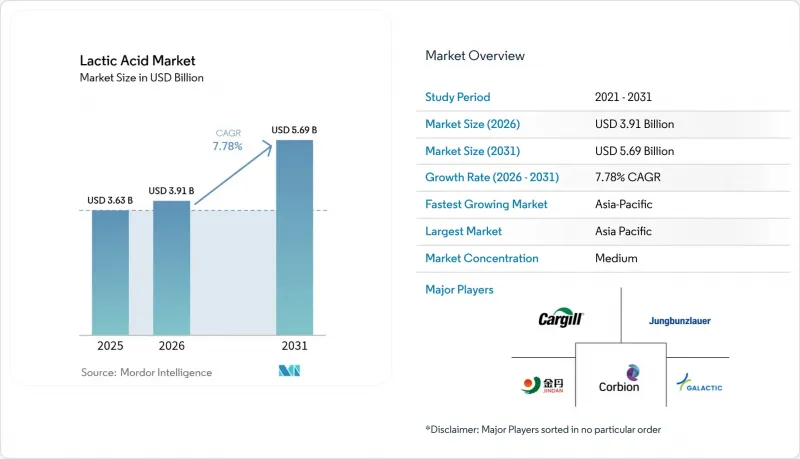
Mordor Intelligence에 의하면, 젖산 시장 규모는 2025년에 36억 3,000만 달러로 평가되었고, 2026년 39억 1,000만 달러에서 2031년까지 56억 9,000만 달러에 이를 것으로 예측되며, 예측 기간(2026-2031년) CAGR은 7.78%를 기록할 전망입니다.
본 보고서는 원료별(천연 및 합성), 형태별(액체 및 고체), 등급별(식품 등급, 산업용 등급 등), 용도별(식품 및 음료, 퍼스널케어 및 화장품 등), 지역별(북미, 유럽, 아시아태평양, 남미, 중동 및 아프리카)로 분류되어 있습니다. 시장 규모 및 예측은 금액(달러)으로 표시되어 있습니다.
세계 젖산 시장 동향 및 인사이트
PLA가 주도하는 생분해성 플라스틱에 대한 수요
젖산이 식품 첨가물에서 폴리머 전구체로 진화하고 있는 것이 시장의 현저한 성장을 견인하고 있으며, 폴리젖산(PLA)의 용도가 전체 시장의 연평균 성장률(CAGR)에 기여하고 있습니다. 2025년까지 상업 가동을 시작할 예정인 네이처웍스(NatureWorks)의 태국 내 6억 달러 규모 시설은 젖산 생산, 락티드 합성 및 PLA 중합을 단일 시설 내에서 통합함으로써 이러한 변화를 여실히 보여주고 있습니다. 이 시설의 통합적 접근 방식은 생산 효율 최적화와 운영 비용 절감을 목표로 하고 있습니다. 유럽연합(EU)의 ‘일회용 플라스틱 지침’은 특정 포장 용도에서 생분해성 대체재 사용을 의무화함으로써 시장 성장을 뒷받침하고 있으며, PLA 채택을 촉진하는 규제 체계를 구축하고 있습니다. 아랍에미리트(UAE)에 건설이 계획된 에미레이트 바이오테크(Emirates Biotech)의 시설은 세계 최대 규모의 PLA 공장이 될 전망이며, 이는 중동의 해당 시장에 대한 투자 확대를 시사함과 동시에, 해당 지역이 지속 가능한 소재 생산에 주력하고 있음을 여실히 보여주고 있습니다. PLA 기술이 3D 프린팅용 필라멘트와 의료기기로 확대됨에 따라 시장의 잠재력은 더욱 넓어졌으며, 제조 및 의료 분야에서 혁신적인 솔루션을 제공합니다. 안면 지방 감소 치료용 폴리-L-젖산이 FDA 승인을 받은 것은 고부가가치 의료 분야에서 PLA의 다용도성과 안전성을 입증하는 것입니다. 지원적인 규제 체계, 지속적인 기술 발전, 그리고 제조 능력 강화가 맞물리면서 PLA는 2030년까지 젖산 시장의 성장을 이끄는 주요 동력으로 자리매김하여 업계 지형을 새롭게 바꾸는 동시에, 지속 가능한 소재 솔루션을 위한 새로운 기회를 창출하고 있습니다.
식품 및 음료 분야의 방부제 및 향료로서의 용도
식품 및 음료 부문은 여전히 젖산의 최대 최종 시장이며, 클린 라벨 제품 및 천연 보존 방법에 대한 수요 증가가 성장을 뒷받침하고 있습니다. FDA가 젖산을 ‘일반적으로 안전하다고 인정되는 물질(GRAS)’로 지정하고 규제를 우수 제조 기준(GMP) 준수로 한정함에 따라, 식품 제조업체는 제품 배합, 안전 기준 준수, 품질 관리 조치에 관한 종합적인 규제 지침을 얻을 수 있습니다. 미국 농무부(USDA)의 조사에 따르면, 가금류 제품에서 살모넬라균을 감소시키는 젖산의 효능이 확인되었으며, 통제된 실험을 통해 병원균 감소율이 입증됨에 따라 그 용도는 기존의 유제품 발효 공정을 넘어 확대되고 있습니다. 젖산의 항균 특성은 다양한 식품 매트릭스에서 널리 입증되었으며, 특히 육류 및 가금류 가공 환경에서 높은 효능이 나타나고 있습니다. 유럽 식품안전청(EFSA)은 쇠고기 도체 살균에 2-5%의 젖산 농도를 권장하고 있으며, 이를 통해 식품 안전 프로토콜, 미생물 관리 전략 및 육류 가공 위생 기준 전반에서 젖산의 역할이 강화되고 있습니다. 식물성 유제품 대체품 분야에서는 제조업체들이 특정 유산균 균주를 활용하여 이취 감소, 영양소 흡수 촉진 및 식감 개선을 도모하고 있으며, 관능적 특성 향상, 기능적 이점 및 유통기한 연장을 통해 제품의 차별화를 꾀할 기회를 창출하고 있습니다. 식물성 유제품 대체품에 대한 젖산의 응용은 단백질 안정화 및 풍미 향상 측면에서도 유망한 결과를 보여주고 있으며, 특히 요거트 대체품이나 치즈 대체품과 같은 발효 제품에서 두드러집니다.
산업용 세정제
생산 비용은 시장 성장을 현저히 제약하고 있으며, 특히 가격에 민감한 산업용 분야에서 젖산의 경쟁력에 영향을 미치고 있습니다. 발효 기반 제조 공정은 환경적 이점이 있지만, 합성 화학 제조법과 비교할 때 전용 바이오리액터, 첨단 분리 장치 및 복잡한 정제 시스템에 대한 막대한 설비 투자가 필요합니다. 코비온(Corbion)사의 2024년 자본 시장 프레젠테이션에서는 지속적인 비용 경쟁력 문제를 해결하기 위해 종합적인 운영 효율 개선 및 전략적 사업 재편 노력을 강조하고 있습니다. 현재의 비용 구조는 젖산이 합성 방부제 및 산미료와 직접 경쟁하는 범용 용도에 막대한 영향을 미치고 있으며, 뛰어난 환경적 이점과 지속가능성이라는 특성을 가지고 있음에도 불구하고 가격에 민감한 부문에서 시장 침투를 제한하고 있습니다. 높은 생산 비용은 원자재 조달부터 최종 제품 유통에 이르는 전체 밸류체인에 영향을 미치고 있으며, 제품의 품질과 지속가능성 기준을 확보하면서도 경쟁력 있는 가격을 유지하려는 제조업체에게 추가적인 과제가 되고 있습니다.
부문 분석
2025년 기준, 젖산 시장 점유율의 87.62%를 천연 발효가 차지하고 있으며, 2031년까지 연평균 성장률(CAGR) 8.21%를 나타낼 것으로 예측됩니다. 바이오 유래 제품에 대한 소비자의 선호는 지속 가능한 생산 방식에 대한 인식 제고와 환경 문제에 대한 관심에서 비롯되고 있습니다. 특히 식품 및 음료 용도에서 천연 유래 산을 지지하는 식품 안전 규제가 이 생산 방식의 우위를 더욱 강화하고 있습니다. 주로 석유계 중간체를 통해 이루어지는 합성 생산은 화학 제조나 산업용도 등 비용이 최우선시되는 특정 산업 분야에서 활용되고 있습니다.
천연 발효 기술의 발전에는 서로 다른 원료의 동시 발효를 가능하게 하는 다기질 처리, 전환 효율을 향상시키는 유전자 편집 유산균 균주, 그리고 생산 수율을 높이는 현장 생성물 제거 기술 등이 포함됩니다. 과일 폐기물이나 리그노셀룰로오스계 잔여물을 활용한 실증 프로젝트의 성공은 식용 작물과 경쟁하지 않으면서도 대규모 생산이 가능함을 보여줍니다. 이러한 대체 원료 공급원에는 농업 잔여물, 식품 가공 폐기물, 임업 부산물 등이 포함됩니다. 이러한 원료의 다양화는 곡물 가격 변동으로부터 젖산 시장을 보호하는 동시에 순환 경제의 원칙을 추진하는 데 기여하고 있습니다.
액상 젖산은 식품, 의약품 및 CIP(정지 세척) 용도에서 직접 펌프 이송 시스템과의 호환성 덕분에 2025년에 매출 점유율의 64.10%를 차지했습니다. 이 형태가 시장에서 우위를 유지하고 있는 이유는 대부분의 산업용 바이오리액터 및 다운스트림 공정 충전 설비가 액체 처리 작업을 위해 특별히 설계 및 최적화되어 있기 때문입니다. 업계 전반에 걸친 액체 처리 시스템에 대한 대규모 인프라 투자가 이러한 우위를 더욱 공고히 하고 있습니다. 고체 형태 부문은 특히 보관 및 운송 조건이 까다로운 지역에서 동물사료 프리믹스 및 드라이브렌드 퍼스널케어 제품으로의 채택 확대에 힘입어 연평균 성장률(CAGR) 8.53%로 성장하고 있습니다. 이러한 성장은 유통 기한이 긴 제품에 대한 수요 증가와 벌크 제조 공정에서의 취급 용이성에도 힘입고 있습니다.
분무 건조 및 결정화 공정의 최근 기술 발전으로 인해 제조업체는 높은 제품 순도를 유지하면서 운송 중량을 대폭 줄일 수 있게 되었습니다. 이러한 개선 사항에는 입자 크기 분포의 최적화 및 수분 제어 시스템의 강화 등이 포함됩니다. 여러 생산 시설에서 실시된 파일럿 연구에 따르면, 막 기술과 증발 공정을 결합한 새로운 하이브리드 시스템을 통해 에너지 소비량을 10% 이상 절감할 수 있는 것으로 나타났습니다. 이러한 효율성 향상으로 인해 액상 형태와 고체 형태 사이에 기존에 존재하던 가격 차이가 점차 좁혀지고 있으며, 고체 젖산은 다양한 용도에서 점점 더 경쟁력을 높이고 있습니다. 또한, 특수 포장 솔루션의 개발과 저장 안정성 향상으로 인해 신흥 시장에서 고체 젖산의 매력은 더욱 높아지고 있습니다.
지역별 분석
아시아태평양은 2025년에 30.72%의 시장 점유율을 차지할 것으로 예상되며, 2031년까지 연평균 성장률(CAGR) 8.95%로 성장할 것으로 전망됩니다. 이 지역은 태국, 중국, 인도에 통합된 제조 시설을 통해 경쟁 우위를 유지하고 있으며, 이러한 시설은 사탕수수나 옥수수와 같은 원료를 쉽게 확보할 수 있을 뿐만 아니라, 설치 톤당 설비 투자 요건이 낮다는 이점을 누리고 있습니다. 네이처웍스의 태국 공장은 현지 원료의 확보 가능성, 규모의 경제, 그리고 수출 항구와의 전략적 근접성을 결합함으로써 이러한 지역 전략을 구현하고 있습니다. 시장 성장은 일회용 푸드서비스 용품에 대한 국내 수요 증가와 퇴비화 가능한 쇼핑백에 관한 규제 요건에 의해서도 더욱 촉진되고 있습니다.
북미는 확립된 옥수수 습식 제분 인프라, 첨단 바이오프로세스 기술, 그리고 명확한 규제 체계를 통해 시장 내 입지를 유지하고 있습니다. 이 지역은 의료, 퍼스널케어, 식품 안전 분야의 고부가가치 용도에 주력하고 있습니다. 아시아산 PLA 포장재 수입이 증가하고 있음에도 불구하고, 스코프 3 배출량을 줄이기 위해 현지 조달을 선호하는 기업의 경향으로 인해 북미 시장은 안정세를 유지하고 있습니다.
유럽 시장의 성장은 주로 ‘일회용 플라스틱 지침’에 의해 주도되고 있으며, 이 지침은 제조업체들에게 퇴비화 가능한 대체재의 채택을 장려하고 있습니다. Galactic이나 Jungbunzlauer와 같은 기업들은 규제 요건에 적응하며 의약품 및 화장품 분야에서 확고한 입지를 구축하고 있습니다. 농산물 가격 변동이 도입률에 영향을 미치는 반면, ‘그린 딜’ 이니셔티브는 지역 발효 시설에 대한 투자를 지속적으로 촉진하고 있습니다.
기타 혜택:
- 엑셀 형식 시장 예측(ME) 시트
- 3개월간의 애널리스트 지원
자주 묻는 질문
목차
제1장 서론
제2장 조사 방법
제3장 주요 요약
제4장 시장 구도
제5장 시장 규모와 성장 예측
제6장 경쟁 구도
제7장 시장 기회와 향후 전망
LSH 26.09.09According to Mordor Intelligence, the lactic acid market size was valued at USD 3.63 billion in 2025 and estimated to grow from USD 3.91 billion in 2026 to reach USD 5.69 billion by 2031, at a CAGR of 7.78% during the forecast period (2026-2031).
This report is Segmented by Source (Natural and Synthetic), Form (Liquid and Solid), Grade (Food Grade, Industrial Grade, and More), Application (Food and Beverages, Personal Care and Cosmetics, and More), and Geography (North America, Europe, Asia-Pacific, South America, and Middle East and Africa). The Market Size and Forecasts are Provided in Terms of Value (USD).
Global Lactic Acid Market Trends and Insights
PLA-driven Demand for Biodegradable Plastics
The evolution of lactic acid from a food additive to a polymer precursor is driving significant market growth, with Polylactic Acid (PLA) applications contributing to the overall market CAGR. NatureWorks' USD 600 million facility in Thailand, scheduled for commercial operation by 2025, demonstrates this transition by combining lactic acid production, lactide synthesis, and PLA polymerization in a single facility. The facility's integrated approach aims to optimize production efficiency and reduce operational costs. The European Union's Single-Use Plastics Directive supports market growth by requiring biodegradable alternatives for specific packaging applications, creating a regulatory framework that favors PLA adoption. The planned Emirates Biotech facility in the UAE, set to become the world's largest PLA plant, indicates increasing Middle Eastern investment in this market and highlights the region's commitment to sustainable materials production. The expansion of PLA technology into 3D printing filaments and medical devices has broadened its market potential, offering innovative solutions for manufacturing and healthcare applications. FDA approval of poly-L-lactic acid for facial fat loss treatment demonstrates its versatility and safety profile in high-value medical segments. The combination of supportive regulatory frameworks, continuous technological progress, and increased manufacturing capacity establishes PLA as the main driver of lactic acid market growth through 2030, reshaping the industry landscape and creating new opportunities for sustainable material solutions.
Food and Beverage Preservative and Flavor Uses
The food and beverage sector remains the largest end-market for lactic acid, with growth supported by increasing demand for clean-label products and natural preservation methods. The FDA's designation of lactic acid as Generally Recognized as Safe (GRAS), with restrictions limited to good manufacturing practices, provides food manufacturers with comprehensive regulatory guidance for product formulation, safety compliance, and quality control measures. USDA research confirms lactic acid's effectiveness in reducing Salmonella in poultry applications, demonstrating pathogen reduction rates in controlled studies and expanding its use beyond traditional dairy fermentation processes.The antimicrobial properties of lactic acid have been extensively documented across various food matrices, showing particular efficacy in meat and poultry processing environments. The European Food Safety Authority encourages lactic acid concentrations of 2-5% for beef carcass decontamination, strengthening its role in food safety protocols, microbial control strategies, and overall meat processing hygiene standards. In the plant-based dairy segment, manufacturers utilize specific lactic acid bacteria strains to reduce off-flavors, enhance nutrient absorption, and improve texture profiles, creating product differentiation opportunities through improved organoleptic properties, functional benefits, and extended shelf life. The application of lactic acid in plant-based dairy alternatives has also shown promising results in protein stabilization and flavor development, particularly in fermented products like yogurt alternatives and cheese substitutes.
Industrial Cleaning Formulations
Production costs significantly constrain market growth, particularly affecting lactic acid's competitiveness in price-sensitive industrial applications. The fermentation-based production process requires substantial capital investment in specialized bioreactors, advanced separation equipment, and complex purification systems compared to synthetic chemical routes, despite its environmental advantages. Corbion's 2024 capital market presentation emphasizes comprehensive operational efficiency improvements and strategic restructuring initiatives to address persistent cost competitiveness challenges. The current cost structure substantially impacts commodity applications where lactic acid directly competes with synthetic preservatives and acidulants, limiting market penetration in price-sensitive segments despite its superior environmental benefits and sustainable characteristics. The high production costs affect the entire value chain, from raw material procurement to final product distribution, creating additional challenges for manufacturers seeking to maintain competitive pricing while ensuring product quality and sustainability standards.
Other drivers and restraints analyzed in the detailed report include:
- Pharmaceutical Formulations and Excipients
- Personal Care and Cosmetics Expansion
- Raw-material Price Volatility
For complete list of drivers and restraints, kindly check the Table Of Contents.
Segment Analysis
Natural fermentation accounts for 87.62% of the lactic acid market share in 2025 and is expected to grow at an 8.21% CAGR through 2031. Consumer preference for bio-based products stems from increasing awareness of sustainable production methods and environmental concerns. Food safety regulations supporting naturally derived acids, particularly in food and beverage applications, further reinforce the dominance of this production method. Synthetic production, primarily from petroleum intermediates, serves specific industrial segments where cost is the primary consideration, such as in chemical manufacturing and industrial applications.
Technological advancements in natural fermentation include multi-substrate processing, which allows for simultaneous fermentation of different raw materials, gene-edited Lactobacillus strains that improve conversion efficiency, and in situ product removal techniques that increase production yields. The successful implementation of demonstration projects using fruit waste and lignocellulosic residues indicates the potential for scaled production without competing with food crops. These alternative feedstock sources include agricultural residues, food processing waste, and forestry byproducts. This feedstock diversification helps protect the lactic acid market against fluctuations in grain prices while promoting circular economy principles.
Liquid lactic acid held a 64.10% revenue share in 2025, due to its compatibility with direct pumping systems in food, pharmaceutical, and clean-in-place (CIP) applications. This form maintains its market dominance because most industrial bioreactors and downstream filling equipment are specifically designed and optimized for liquid handling operations. The extensive infrastructure investment in liquid handling systems across industries further reinforces this dominance. The solid form segment is growing at an 8.53% CAGR, driven by increased adoption in animal feed premixes and dry-blend personal care products, particularly in regions with challenging storage and transportation conditions. The growth is also supported by the rising demand for extended shelf-life products and easier handling in bulk manufacturing processes.
Recent technological advancements in spray drying and crystallization processes enable manufacturers to maintain high product purity levels while significantly reducing shipping weights. These improvements include optimized particle size distribution and enhanced moisture control systems. New hybrid systems combining membrane technology and evaporation processes reduce energy consumption by more than 10%, according to pilot studies conducted across multiple production facilities. These efficiency improvements are gradually reducing the historical price difference between liquid and solid forms, making solid lactic acid increasingly competitive in various applications. The development of specialized packaging solutions and improved storage stability has further enhanced the appeal of solid lactic acid in emerging markets.
Complete Report Scope:
- By Source
- Natural
- Synthetic
- By Form
- Liquid
- Solid
- By Grade
- Food Grade
- Industrial Grade
- Pharmaceutical Grade
- Cosmetic Grade
- By Application
- Food and Beverages
- Meat, Poultry and Seafood
- Dairy Products
- Bakery
- Confectionery
- Beverages
- Others Food and Beverage Applications
- Polylactic Acid (PLA) and Bioplastics
- Personal Care and Cosmetics
- Pharmaceutical and Healthcare
- Industrial and Chemical Processing
- Food and Beverages
- By Geography
- North America
- United States
- Canada
- Mexico
- Rest of North America
- Europe
- United Kingdom
- Germany
- France
- Italy
- Spain
- Russia
- Rest of Europe
- Asia-Pacific
- China
- India
- Japan
- Australia
- Rest of Asia-Pacific
- South America
- Brazil
- Argentina
- Rest of South America
- Middle East and Africa
- Saudi Arabia
- South Africa
- Rest of Middle East and Africa
- North America
Geography Analysis
Asia-Pacific held a 30.72% market share in 2025 and is expected to grow at a 8.95% CAGR through 2031. The region maintains a competitive advantage through integrated manufacturing facilities in Thailand, China, and India, which benefit from readily available sugarcane and corn feedstock, along with lower capital expenditure requirements per installed ton. NatureWorks' Thailand facility exemplifies this regional strategy by combining local feedstock availability, economies of scale, and strategic proximity to export ports. The market growth is further supported by increasing domestic demand for disposable food service items and regulatory requirements for compostable shopping bags.
North America maintains its market position through established corn-wet-milling infrastructure, sophisticated bioprocessing capabilities, and well-defined regulatory frameworks. The region focuses on high-value applications in medical, personal care, and food safety sectors. Despite increased PLA packaging imports from Asia, the North American market remains stable due to corporate preferences for local sourcing to reduce scope 3 emissions.
Europe's market growth is primarily driven by the Single-Use Plastics Directive, which encourages manufacturers to adopt compostable alternatives. Companies like Galactic and Jungbunzlauer have adapted to regulatory requirements, establishing strong positions in pharmaceutical and cosmetic applications. While agricultural price fluctuations affect adoption rates, Green Deal initiatives continue to support investments in regional fermentation facilities.
- Corbion N.V.
- Cargill Incorporated
- Galactic S.A.
- Henan Jindan Lactic Acid Technology Co. Ltd.
- Jungbunzlauer Suisse AG
- Musashino Chemical Laboratory, Ltd.
- Futerro S.A.
- BBCA Biochemical
- Shandong Baisheng Biotech
- Cellulac Ltd.
- NatureWorks LLC
- Zhengzhou Tianrun
- Anhui COFCO Biochemical
- Qingdao Abel Technology
- TotalEnergies Corbion
- Zhejiang Huakang Pharmaceutical Co.
- Synbra Technology
- Henan Shenzhou Biochem
- Sulzer Chemtech
- Wei Mon Industry Co. (Unitika PLA JV)
Additional Benefits:
- The market estimate (ME) sheet in Excel format
- 3 months of analyst support
TABLE OF CONTENTS
1 INTRODUCTION
- 1.1 Study Assumptions and Market Definition
- 1.2 Scope of the Study
2 RESEARCH METHODOLOGY
3 EXECUTIVE SUMMARY
4 MARKET LANDSCAPE
- 4.1 Market Overview
- 4.2 Market Drivers
- 4.2.1 Expanding applications in biodegradable plastics production, particularly PLA (Polylactic Acid)
- 4.2.2 Surging Demand from the Food and Beverage Industry for Lactic Acid as a Preservative and Flavor Enhancer
- 4.2.3 Expanding use in pharmaceutical applications for drug formulation and as an excipient
- 4.2.4 Growing adoption in personal care products and cosmetics manufacturing
- 4.2.5 Escalating demand in industrial cleaning applications
- 4.2.6 Rising usage in animal feed production
- 4.3 Market Restraints
- 4.3.1 High production costs of lactic acid compared to conventional alternatives
- 4.3.2 Fluctuating raw material prices, particularly for corn and sugarcane
- 4.3.3 Competition from synthetic alternatives
- 4.3.4 Storage and transportation challenges due to the product's chemical properties
- 4.4 Supply-Chain Analysis
- 4.5 Regulatory Outlook
- 4.6 Porter's Five Forces
- 4.6.1 Threat of New Entrants
- 4.6.2 Bargaining Power of Buyers/Consumers
- 4.6.3 Bargaining Power of Suppliers
- 4.6.4 Threat of Substitute Products
- 4.6.5 Intensity of Competitive Rivalry
5 MARKET SIZE AND GROWTH FORECASTS (VALUE)
- 5.1 By Source
- 5.1.1 Natural
- 5.1.2 Synthetic
- 5.2 By Form
- 5.2.1 Liquid
- 5.2.2 Solid
- 5.3 By Grade
- 5.3.1 Food Grade
- 5.3.2 Industrial Grade
- 5.3.3 Pharmaceutical Grade
- 5.3.4 Cosmetic Grade
- 5.4 By Application
- 5.4.1 Food and Beverages
- 5.4.1.1 Meat, Poultry and Seafood
- 5.4.1.2 Dairy Products
- 5.4.1.3 Bakery
- 5.4.1.4 Confectionery
- 5.4.1.5 Beverages
- 5.4.1.6 Others Food and Beverage Applications
- 5.4.2 Polylactic Acid (PLA) and Bioplastics
- 5.4.3 Personal Care and Cosmetics
- 5.4.4 Pharmaceutical and Healthcare
- 5.4.5 Industrial and Chemical Processing
- 5.4.1 Food and Beverages
- 5.5 By Geography
- 5.5.1 North America
- 5.5.1.1 United States
- 5.5.1.2 Canada
- 5.5.1.3 Mexico
- 5.5.1.4 Rest of North America
- 5.5.2 Europe
- 5.5.2.1 United Kingdom
- 5.5.2.2 Germany
- 5.5.2.3 France
- 5.5.2.4 Italy
- 5.5.2.5 Spain
- 5.5.2.6 Russia
- 5.5.2.7 Rest of Europe
- 5.5.3 Asia-Pacific
- 5.5.3.1 China
- 5.5.3.2 India
- 5.5.3.3 Japan
- 5.5.3.4 Australia
- 5.5.3.5 Rest of Asia-Pacific
- 5.5.4 South America
- 5.5.4.1 Brazil
- 5.5.4.2 Argentina
- 5.5.4.3 Rest of South America
- 5.5.5 Middle East and Africa
- 5.5.5.1 Saudi Arabia
- 5.5.5.2 South Africa
- 5.5.5.3 Rest of Middle East and Africa
- 5.5.1 North America
6 COMPETITIVE LANDSCAPE
- 6.1 Market Concentration
- 6.2 Strategic Moves
- 6.3 Market Ranking Analysis
- 6.4 Company Profiles (includes Global level Overview, Market level overview, Core Segments, Financials as available, Strategic Information, Market Rank/Share for key companies, Products and Services, and Recent Developments)
- 6.4.1 Corbion N.V.
- 6.4.2 Cargill Incorporated
- 6.4.3 Galactic S.A.
- 6.4.4 Henan Jindan Lactic Acid Technology Co. Ltd.
- 6.4.5 Jungbunzlauer Suisse AG
- 6.4.6 Musashino Chemical Laboratory, Ltd.
- 6.4.7 Futerro S.A.
- 6.4.8 BBCA Biochemical
- 6.4.9 Shandong Baisheng Biotech
- 6.4.10 Cellulac Ltd.
- 6.4.11 NatureWorks LLC
- 6.4.12 Zhengzhou Tianrun
- 6.4.13 Anhui COFCO Biochemical
- 6.4.14 Qingdao Abel Technology
- 6.4.15 TotalEnergies Corbion
- 6.4.16 Zhejiang Huakang Pharmaceutical Co.
- 6.4.17 Synbra Technology
- 6.4.18 Henan Shenzhou Biochem
- 6.4.19 Sulzer Chemtech
- 6.4.20 Wei Mon Industry Co. (Unitika PLA JV)


