

|
시장보고서
상품코드
2121557
콘택트렌즈 : 시장 점유율 분석, 산업 동향 및 통계 데이터, 성장 예측(2026-2031년)Contact Lenses - Market Share Analysis, Industry Trends & Statistics, Growth Forecasts (2026 - 2031) |
||||||
 Mordor Intelligence
Mordor Intelligence에 의하면, 콘택트렌즈 시장 규모는 2025년 106억 달러에서 2026년에는 109억 8,000만 달러로 성장하고, 2026-2031년 CAGR 3.62%로 성장을 지속하여 2031년에는 131억 2,000만 달러에 달할 것으로 예측됩니다.
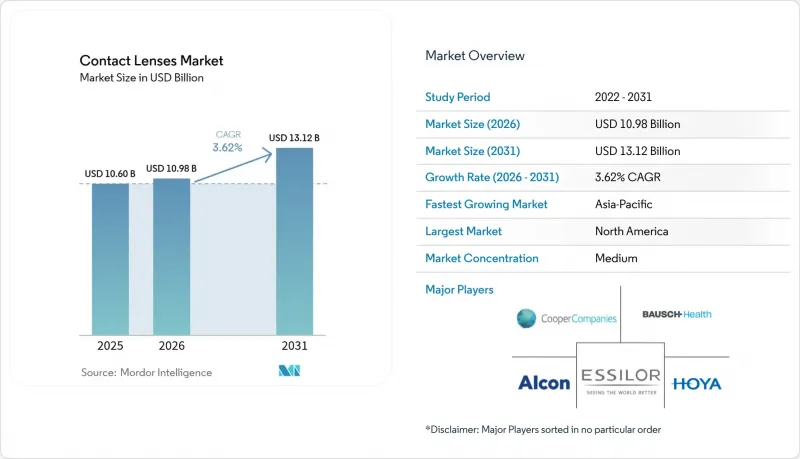
본 보고서는 소재(실리콘 하이드로겔, 하이드로겔 등), 디자인(구면, 토릭, 다초점/프로그레시브 등), 사용 방법(1일용 일회용, 주간/격주용 등),용도(시력 교정, 치료 용도 등), 유통 채널(소매 안경점 등), 지역(북미, 유럽 등)별로 분류되어 있습니다. 시장 전망은 금액(달러)으로 표시되어 있습니다.
전 세계 콘택트렌즈 시장 동향 및 인사이트
청소년층의 근시 유병률 증가
세계 소아 및 청소년의 근시 유병률은 2050년까지 39.80%를 나타낼 것으로 예측되며, 이는 7억 4,000만 명 이상의 근시 환자에 해당합니다. 동아시아 도시에서 가장 급격한 증가가 나타나고 있으며, 코로나19 제한 조치 하에서 스크린 사용 시간이 증가함에 따라 안축장의 신장이 가속화되고 있습니다. 근시는 일반적으로 소아기에 발병하여 10대까지 진행되므로, 콘택트렌즈 시장 전체에서는 교정용 렌즈에 대한 수요가 안정되는 한편, 진행을 늦추기 위한 듀얼 포커스 렌즈나 주변부 디포커스 렌즈가 등장하고 있습니다. 중국에서 실시된 한 임상시험에서는 듀얼 포커스 소프트 렌즈가 1년 동안 안경에 비해 안축장의 신장을 0.10mm 억제하는 것으로 나타났습니다. 이러한 치료상의 이점으로 인해 수요는 범용 교정용 제품에서 예방을 목적으로 한 프리미엄 제품으로 이동하고 있습니다.
1일용 소프트 렌즈의 급속한 보급
1일용 일회용 소프트 렌즈 시장 점유율은 2000년 17.1%에서 2023년 46.7%로 급증했으며, 이는 위생 의식의 고조와 편의성을 중시하는 경향을 반영하고 있습니다. 보급률은 1인당 GDP와 상관관계가 있으므로, 미국, 캐나다, 서유럽에서의 보급률이 가장 높습니다. 젊은 층은 세척의 번거로움을 덜어주는 일회용 유형을 선호하는 반면, 의료 종사자들은 감염 위험이 낮다는 점을 환영하고 있습니다. 실리콘 하이드로겔 소재의 일회용 콘택트렌즈는 높은 산소 투과성과 일회용 포장을 겸비하고 있지만, 가격에 대한 민감성이 신흥 시장에서의 보급을 저해하고 있으며, 특히 콘택트렌즈 시장에서 비용에 민감한 부문에서는 이러한 경향이 두드러집니다.
콘택트렌즈와 관련된 안구건조증 및 사용 중단
세계 1억 4,000만 명의 콘택트렌즈 사용자 중 약 30%-50%가 안구건조증 증상을 경험하고 있으며, 이로 인해 사용을 중단하는 경우가 적지 않습니다. 눈물의 불안정성이나 각막 표면의 건조는 특히 장시간 착용형이나 월간 교체형 렌즈에서 착용감을 현저히 저하시킵니다. 각 제조업체는 수분 구배 표면이나 자가 윤활 코팅 등의 기술로 이에 대응하고 있으며, 한 다기관 공동 연구에서는 데레필콘 A를 사용한 1일용 렌즈가 증상을 대폭 완화시킨 것으로 나타났습니다. 각막 전체에 눈물을 공급하는 미세 유체 채널은 아직 실험 단계이지만, 생리적 적합성을 추구하는 경쟁의 현 상황을 여실히 보여주고 있습니다.
부문 분석
소프트 콘택트렌즈 부문은 세계 콘택트렌즈 시장에서 계속해서 지배적인 위치를 차지하고 있으며, 2025년에는 콘택트렌즈 시장 점유율의 약 63.40%를 차지할 것으로 예측됩니다. 이러한 압도적인 시장 지위는 뛰어난 착용감, 신규 사용자의 적응 용이성, 각막에 대한 높은 산소 투과성 등 다른 제품 유형에 비해 이 렌즈가 가진 수많은 장점에 기인합니다. 이 부문의 성장은 통기성과 보습성을 향상시키는 실리콘 하이드로겔 소재의 기술적 진보에 의해 더욱 가속화되고 있습니다. 존슨앤드존슨 비전(Johnson & Johnson Vision)과 알콘(Alcon)과 같은 주요 시장 참여자들은 특히 1일용 및 1개월 교체형 카테고리에서 혁신적인 제품 라인업을 통해 이 부문을 강화해 왔습니다. 또한, 편안한 시력 교정 솔루션에 대한 소비자의 선호도 증가와 의료 및 미용 목적 모두에서 콘택트렌즈의 보급 확대에 힘입어 이 부문은 시장에서 가장 높은 성장률을 기록하고 있습니다.
구면 렌즈는 근시나 원시에 쉽게 적용될 수 있다는 점 때문에 2025년 콘택트렌즈 시장 매출의 41.92%를 차지했습니다. 반면, 토릭 렌즈는 진단 기술을 통해 잠재적인 난시가 식별되고, 형상 안정화를 통해 회전 일관성이 향상됨에 따라 이 부문에서 가장 높은 연평균 성장률(CAGR) 4.48%를 나타낼 것으로 전망됩니다. 다초점 렌즈는 노안을 겪는 베이비붐 세대를 타겟으로 하고 있지만, 여전히 적응에 대한 저항에 직면해 있습니다.
고도의 선반 가공 및 파면 가이드형 금형을 통해 맞춤형 광학 성능이 실현되고, 고차 수차가 감소하며, 고객 충성도가 높아지고 있습니다. 한편, 아시아의 소셜 미디어 환경에서는 미용용 오버레이가 활발해지고 있습니다. 콘택트렌즈 시장에서는 디자인 SKU가 지속적으로 다양화되고 있으며, 제조업체들은 가격 경쟁력을 유지하면서 소량 생산의 자동화를 추진해야 하는 상황에 직면해 있습니다.
지역별 분석
북미는 보험 적용 범위와 안과 의사 밀도에 힘입어 매출 기준 여전히 가장 규모가 큰 지역입니다. 미국은 프리미엄 1일용 렌즈와 근시 진행 억제 디자인의 조기 도입에 힘입어 매출의 대부분을 차지하고 있습니다. 캐나다에서는 규모는 작지만 유사한 추세가 나타나고 있으며, 멕시코에서는 젊은 층의 인구 구성으로 인해 가격 측면의 제약이 있음에도 불구하고 새로운 시장 침투 기회가 창출되고 있습니다. FDA의 규제 명확화는 혁신을 가속화하고 있지만, 심사 기준이 엄격해짐에 따라 비용 부담이 증가하고 있어 중소규모의 신규 진출기업들은 이를 극복해야 합니다.
아시아태평양은 중국, 일본, 한국, 싱가포르에서 근시 유병률이 급증하고 있어 가장 빠른 성장세를 보이고 있습니다. 중국에서는 콘택트렌즈의 전자상거래 판매가 폭발적으로 증가하고 있지만, 국경을 넘는 그레이 마켓의 존재가 규정 준수를 복잡하게 만들고 있습니다. 일본은 스마트 콘택트렌즈의 연구 개발을 선도하고 있는 반면, 한국은 패션 주도형 장식용 콘택트렌즈 수요를 뒷받침하고 있습니다. 인도의 도시 중산층에서는 실리콘 하이드로겔 소재의 1일용 콘택트렌즈에 대한 수용도가 확대되고 있지만, 여전히 광범위한 가격 장벽이 존재합니다. 지역별 다양성으로 인해 KOL과의 협업에서 위챗 미니 스토어 활용에 이르기까지, 지역에 맞춘 시장 진출 전략이 요구되고 있습니다.
유럽에서는 견조하면서도 완만한 성장세가 관찰됩니다. 독일과 프랑스에서는 노안용 프리미엄 다초점 렌즈가 선호되는 반면, 영국에서는 브렉시트 이후 온라인 소매업체들이 가격 투명성을 주도하고 있습니다. 지속 가능한 포장 및 PFAS 무함유 화학 성분은 EU의 ‘그린 딜’ 우선순위와 부합하며, 공급망 전반에 걸친 수명 주기 평가가 촉진되고 있습니다. 스페인이나 이탈리아 등 남유럽 시장에서는 가족 경영 안경점이 주류를 이루고 있어, 관계 중심의 판매가 필수적입니다. 조화로운 MDR(의료기기 규정) 요건은 환자 안전을 강화하는 한편, 복잡한 치료용 의료기기 시장 출시 기간을 연장시키고 있습니다.
기타 혜택:
- Excel 형식 시장 예측(ME) 시트
- 3개월간의 애널리스트 지원
자주 묻는 질문
목차
제1장 서론
제2장 분석 방법
제3장 주요 요약
제4장 시장 구도
제5장 시장 규모·성장률 예측
제6장 경쟁 구도
제7장 시장 기회와 향후 전망
LSH 26.09.02According to Mordor Intelligence, the contact lenses market size is expected to grow from USD 10.60 billion in 2025 to USD 10.98 billion in 2026 and is forecast to reach USD 13.12 billion by 2031 at 3.62% CAGR over 2026-2031.
This report is Segmented by Material (Silicone Hydrogel, Hydrogel, and More), Design (Spherical, Toric, Multifocal/Progressive and More ), Usability (Daily Disposable, Weekly/Bi-Weekly, and More), Application (Vision Correction, Therapeutic, and More), Distribution Channel (Retail Optical Stores, and More), and Geography (North America, Europe and More). The Market Forecasts are Provided in Terms of Value (USD).
Global Contact Lenses Market Trends and Insights
Rising Prevalence of Myopia Among Youth
Global myopia prevalence among children and adolescents is forecast to reach 39.80% by 2050, translating into more than 740 million affected individuals. East Asian cities record the sharpest increments, with screen-time escalation during COVID-19 restrictions accelerating axial length growth. As myopia commonly begins in childhood and progresses through teenage years, demand stabilizes for corrective wear across the contact lens market, while dual-focus and peripheral defocus lenses emerge to slow progression. One Chinese trial showed dual-focus soft lenses limiting axial elongation by 0.10 mm versus spectacles over one year. This therapeutic edge shifts procurement from commodity correction toward premium prophylactic devices.
Rapid Adoption of Daily Disposable Soft Lenses
Daily disposables jumped from 17.1% of soft lens fits in 2000 to 46.7% in 2023, mirroring heightened hygiene awareness and convenience priorities. Uptake correlates with GDP per-capita, so penetration is deepest in the United States, Canada, and Western Europe. Younger adults prefer single-use wear that removes cleaning chores, while practitioners welcome the lower infection profile. Silicone-hydrogel disposables blend high oxygen flux with single-use packaging, although price sensitivity restrains emerging-market adoption, especially in cost-pressured segments of the contact lenses market.
Contact-Lens Related Dry-Eye & Wearer Drop-Outs
An estimated 30%-50% of the world's 140 million lens wearers experience dry-eye symptoms that often culminate in discontinuation. Tear instability and surface desiccation degrade comfort, especially in extended-wear and monthly modalities. Manufacturers respond with water-gradient surfaces and self-lubricating coatings; Delefilcon A dailies significantly eased symptoms in one multi-center study. Microfluidic channels that pump tears across the cornea remain experimental but illustrate the race toward physiological compatibility.
Other drivers and restraints analyzed in the detailed report include:
- Technological Breakthroughs in Silicone-Hydrogel & Smart Lenses
- Expansion of E-commerce & D2C Distribution
- Stringent FDA / CE Regulatory Approvals
For complete list of drivers and restraints, kindly check the Table Of Contents.
Segment Analysis
The soft contact lenses segment continues to dominate the global contact lenses market, commanding approximately 63.40% of the contact lenses market share in 2025. This significant market position is attributed to the numerous advantages these lenses offer over other product types, including superior comfort, easier adaptation for new users, and better oxygen permeability to the cornea. The segment's growth is further bolstered by technological advancements in silicone hydrogel materials, which provide enhanced breathability and moisture retention. Major market players like Johnson & Johnson Vision and Alcon have strengthened this segment through their innovative product offerings, particularly in daily disposable and monthly replacement categories. The segment is also experiencing the fastest growth rate in the market, driven by increasing consumer preference for comfortable vision correction solutions and the rising adoption of contact lenses for both medical and cosmetic purposes.
Spherical products retained 41.92% of the contact lenses market share of 2025 sales, buoyed by straightforward fits for myopia and hyperopia. Toric lenses, however, will post the segment's strongest 4.48% CAGR as diagnostics identify latent astigmatism and stabilizing geometries improve rotational consistency. Multifocal formats aim at presbyopic boomers but still encounter adaptation resistance.
Advanced lathe-cutting and wavefront-guided molds now deliver bespoke optics, reducing higher-order aberrations and nurturing loyalty. Meanwhile, cosmetic overlays flourish in Asia's social-media ecosystems. The contact lens market continues diversifying design SKUs, pressing manufacturers to automate small-batch production while maintaining price competitiveness.
Complete Report Scope:
- By Material
- Silicone Hydrogel
- Hydrogel
- Gas-Permeable (RGP)
- Hybrid
- By Design
- Spherical
- Toric
- Multifocal / Progressive
- Cosmetic & Colored
- By Usability / Replacement Modality
- Daily Disposable
- Weekly / Bi-Weekly
- Monthly / Quarterly
- Extended-Wear (>=7 days)
- By Application
- Vision Correction
- Therapeutic (Drug Delivery, Bandage)
- Cosmetic Enhancement
- Prosthetic / Speciality (Ortho-k, Myopia Control)
- By Distribution Channel
- Retail Optical Stores
- Hospitals & Eye Clinics
- Online / E-commerce Platforms
- Geography
- North America
- United States
- Canada
- Mexico
- Europe
- Germany
- United Kingdom
- France
- Italy
- Spain
- Rest of Europe
- Asia-Pacific
- China
- India
- Japan
- South Korea
- Australia
- Rest of Asia-Pacific
- South America
- Brazil
- Argentina
- Rest of South America
- Middle East and Africa
- GCC
- South Africa
- Rest of Middle East and Africa
- North America
Geography Analysis
North America remains the largest region by value, supported by insurance coverage and practitioner density. The United States contributes the bulk of turnover, buoyed by premium daily disposables and early adoption of myopia-control designs. Canada mirrors these trends at smaller scale, whereas Mexico's youthful demographics create fresh penetration opportunities despite price constraints. Regulatory clarity under the FDA accelerates innovation, but heightened scrutiny adds cost layers that smaller entrants must navigate.
Asia-Pacific delivers the fastest growth as myopia rates soar across China, Japan, South Korea, and Singapore. China exhibits explosive e-commerce lens sales, though cross-border gray markets muddy compliance. Japan pioneers smart lens R&D, while South Korea anchors fashion-led cosmetic demand. India's urban middle class increasingly embraces silicone-hydrogel dailies, yet broad affordability hurdles persist. Regional heterogeneity obliges tailored go-to-market tactics ranging from key-opinion-leader engagement to WeChat mini-store activations.
Europe logs steady but moderate expansion. Germany and France favor premium multifocals for presbyopia, whereas the United Kingdom's online retailers shape price transparency post-Brexit. Sustainable packaging and PFAS-free chemistry resonate with EU Green Deal priorities, prompting lifecycle assessments across the supply chain. Southern markets like Spain and Italy lean on family-run opticians, making relationship selling crucial. Harmonized MDR requirements reinforce patient safety yet extend time-to-launch for complex therapeutics.
- Johnson & Johnson Vision Care (Acuvue)
- Alcon
- The Cooper Companies
- Bausch + Lomb
- Menicon
- HOYA Vision Care
- Carl Zeiss
- EssilorLuxottica
- Seed Co.
- Contamac
- SynergEyes
- STAAR Surgical (EVO ICL contact-lens alternatives)
- Ginko International (Hydron)
- BenQ Materials (Miacare)
- Clearlab
- Optical 88
- Oculus Private Limited (India)
- Interojo
- Shanghai Weicon Optics
- Brighten Optix
Additional Benefits:
- The market estimate (ME) sheet in Excel format
- 3 months of analyst support
TABLE OF CONTENTS
1 Introduction
- 1.1 Study Assumptions & Market Definition
- 1.2 Scope of the Study
2 Research Methodology
3 Executive Summary
4 Market Landscape
- 4.1 Market Overview
- 4.2 Market Drivers
- 4.2.1 Rising prevalence of myopia among youth
- 4.2.2 Rapid adoption of daily disposable soft lenses
- 4.2.3 Technological breakthroughs in silicone-hydrogel & smart lenses
- 4.2.4 Expansion of e-commerce & D2C distribution
- 4.2.5 Surge in cosmetic & colored lens demand among Gen-Z in Asia
- 4.2.6 Emergence of myopia-control & drug-eluting lenses with reimbursement prospects
- 4.3 Market Restraints
- 4.3.1 Contact-lens related dry-eye & wearer drop-outs
- 4.3.2 Stringent FDA / CE regulatory approvals
- 4.3.3 Sustainability backlash against single-use plastics
- 4.3.4 Growing uptake of low-cost refractive surgeries (SMILE) in Asia
- 4.4 Value / Supply-Chain Analysis
- 4.5 Regulatory Landscape
- 4.6 Technological Outlook
- 4.7 Porter's Five Forces Analysis
- 4.7.1 Threat of New Entrants
- 4.7.2 Bargaining Power of Suppliers
- 4.7.3 Bargaining Power of Buyers
- 4.7.4 Threat of Substitutes
- 4.7.5 Industry Rivalry
5 Market Size & Growth Forecasts (Value, USD Billion)
- 5.1 By Material
- 5.1.1 Silicone Hydrogel
- 5.1.2 Hydrogel
- 5.1.3 Gas-Permeable (RGP)
- 5.1.4 Hybrid
- 5.2 By Design
- 5.2.1 Spherical
- 5.2.2 Toric
- 5.2.3 Multifocal / Progressive
- 5.2.4 Cosmetic & Colored
- 5.3 By Usability / Replacement Modality
- 5.3.1 Daily Disposable
- 5.3.2 Weekly / Bi-Weekly
- 5.3.3 Monthly / Quarterly
- 5.3.4 Extended-Wear (>=7 days)
- 5.4 By Application
- 5.4.1 Vision Correction
- 5.4.2 Therapeutic (Drug Delivery, Bandage)
- 5.4.3 Cosmetic Enhancement
- 5.4.4 Prosthetic / Speciality (Ortho-k, Myopia Control)
- 5.5 By Distribution Channel
- 5.5.1 Retail Optical Stores
- 5.5.2 Hospitals & Eye Clinics
- 5.5.3 Online / E-commerce Platforms
- 5.6 Geography
- 5.6.1 North America
- 5.6.1.1 United States
- 5.6.1.2 Canada
- 5.6.1.3 Mexico
- 5.6.2 Europe
- 5.6.2.1 Germany
- 5.6.2.2 United Kingdom
- 5.6.2.3 France
- 5.6.2.4 Italy
- 5.6.2.5 Spain
- 5.6.2.6 Rest of Europe
- 5.6.3 Asia-Pacific
- 5.6.3.1 China
- 5.6.3.2 India
- 5.6.3.3 Japan
- 5.6.3.4 South Korea
- 5.6.3.5 Australia
- 5.6.3.6 Rest of Asia-Pacific
- 5.6.4 South America
- 5.6.4.1 Brazil
- 5.6.4.2 Argentina
- 5.6.4.3 Rest of South America
- 5.6.5 Middle East and Africa
- 5.6.5.1 GCC
- 5.6.5.2 South Africa
- 5.6.5.3 Rest of Middle East and Africa
- 5.6.1 North America
6 Competitive Landscape
- 6.1 Market Concentration
- 6.2 Market Share Analysis
- 6.3 Company Profiles (includes Global level Overview, Market level overview, Core Segments, Financials as available, Strategic Information, Market Rank/Share for key companies, Products & Services, and Recent Developments)
- 6.3.1 Johnson & Johnson Vision Care (Acuvue)
- 6.3.2 Alcon
- 6.3.3 CooperVision
- 6.3.4 Bausch + Lomb
- 6.3.5 Menicon
- 6.3.6 HOYA Vision Care
- 6.3.7 Carl Zeiss Meditec
- 6.3.8 EssilorLuxottica
- 6.3.9 Seed Co.
- 6.3.10 Contamac
- 6.3.11 SynergEyes
- 6.3.12 STAAR Surgical (EVO ICL contact-lens alternatives)
- 6.3.13 Ginko International (Hydron)
- 6.3.14 BenQ Materials (Miacare)
- 6.3.15 Clearlab
- 6.3.16 Optical 88
- 6.3.17 Oculus Private Limited (India)
- 6.3.18 Interojo
- 6.3.19 Shanghai Weicon Optics
- 6.3.20 Brighten Optix
7 Market Opportunities & Future Outlook
- 7.1 White-space & Unmet-Need Assessment


