

|
시장보고서
상품코드
2121568
클라우드 마이그레이션 서비스 : 시장 점유율 분석, 업계 동향과 통계, 성장 예측(2026-2031년)Cloud Migration Services - Market Share Analysis, Industry Trends & Statistics, Growth Forecasts (2026 - 2031) |
||||||
 Mordor Intelligence
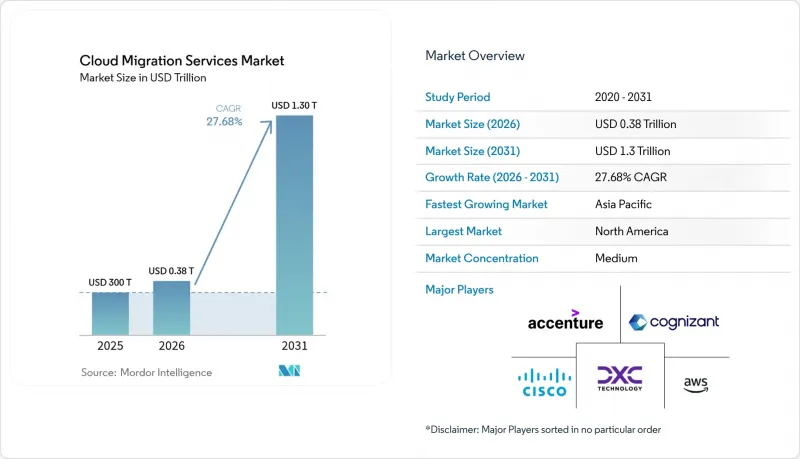
Mordor Intelligence에 따르면 클라우드 마이그레이션 서비스 시장 규모는 2025년에 3,000억 달러로 평가되며, 2026년 3,830억 4,000만 달러에서 2031년까지 1조 2,994억 8,000만 달러에 달할 것으로 예측되며, 예측 기간(2026-2031년) 동안 CAGR은 27.68%가 될 전망입니다.
본 보고서는 배포 방식(퍼블릭 클라우드 등), 기업 규모(중소기업 등), 서비스 유형(IaaS, PaaS, SaaS), 마이그레이션 접근 방식(리프트 앤 시프트, 리플랫폼, 리팩토링/재구축, 교체), 최종사용자 산업(BFSI, 의료, 소매업 등) 및 지역별로 분류되어 있습니다. 시장 예측은 금액(달러) 기준으로 제시되어 있습니다.
세계 클라우드 마이그레이션 서비스 시장의 동향 및 인사이트
클라우드 도입을 통한 비용 효율성 및 확장성의 이점
기업들은 워크로드를 클라우드로 마이그레이션한 후에도, 주로 자본 집약적인 하드웨어의 업데이트 주기를 없애고, 온디맨드 방식으로 리소스를 적정 규모로 조정함으로써 운영 비용을 20-30% 지속적으로 절감하고 있습니다. Infomart가 자사의 B2B 플랫폼을 Oracle Cloud Infrastructure로 마이그레이션한 결과, 데이터센터 비용을 38% 절감하는 동시에 성능의 유연성을 높일 수 있었습니다. 현재, 탄력적인 리소스 프로비저닝을 통해 조직은 물리적 데이터센터 환경에서 흔히 발생하는 6-12개월의 조달 지연 없이 예상치 못한 수요 급증에 대응할 수 있게 되었습니다. 인프라 유지 관리에서 해방된 예산은 경쟁적 차별화를 강화하는 혁신 활동에 점점 더 많이 배정되고 있습니다. 이러한 누적된 이점으로 인해 비용 합리화 전략은 예측 연평균 성장률(CAGR)에 가장 큰 긍정적 영향을 미치고 있습니다.
원격 근무 및 BYOD의 확산
하이브리드 근무 모델이 정착됨에 따라, 기업들은 장소나 기기에 관계없이 일관된 사용자 경험을 보장하기 위해 협업 스위트, ID 서비스, 보안 제어 기능을 클라우드로 이전하고 있습니다. 최근 조사에 따르면, IT 리더의 89%가 분산된 팀을 지원하기 위해 2025년에 클라우드 지출을 늘릴 의향을 나타냈습니다. BYOD는 경계 보안을 복잡하게 만들며, 기업을 클라우드 네이티브 형태로 도입하기 쉬운 제로 트러스트 아키텍처로 이끌고 있습니다. 그 결과, 어디서나 직원의 생산성을 유지하기 위한 SASE(Secure Access Service Edge), 엔드포인트 관리, 실시간 분석 계층이 마이그레이션 대상에 점점 더 많이 포함되고 있습니다. 이러한 추세는 특히 북미와 유럽에서 프로젝트 파이프라인에 강력하고 단기적인 견인력을 제공하고 있습니다.
데이터 보안 및 규정 준수 위험
유럽 기업들은 일반 데이터 보호 규정(GDPR)의 조항과 퍼블릭 클라우드 서비스 모델 간의 조화를 이루는 데 어려움을 겪고 있습니다. 한편, 전 세계 금융 기관들은 클라우드상의 데이터 흐름을 명시적으로 규정하는 경우가 드문, 중복되는 관할 구역의 규정과 조화를 이루는 데 어려움을 겪고 있습니다. 공동 책임 모델에서는 암호화, 로그 기록, 사고 대응에 대한 책임 소재가 불분명해지는 경우가 많습니다. 경우에 따라 주권 클라우드 요건으로 인해 조직은 현지화된 용량에 대해 추가 요금을 지불하거나 온프레미스 인프라를 유지해야만 하여, 마이그레이션 일정이 장기화되고 있습니다. 이러한 요인들로 인해 거의 모든 산업, 특히 의료, 은행, 정부 기관 분야의 성장이 억제되고 있습니다.
부문 분석
하이브리드 배포가 가장 빠르게 성장하고 있으며, 기업들이 저지연 온프레미스 요구 사항과 퍼블릭 클라우드의 확장성을 모두 충족함에 따라 연평균 성장률(CAGR) 18.35%로 확대되고 있습니다. 하이퍼스케일 제공업체의 성숙한 보안 체제 덕분에 퍼블릭 클라우드는 여전히 클라우드 마이그레이션 서비스 시장의 54.82% 점유율을 차지하고 있습니다. 엣지 클라우드의 통합을 통해 탄력적인 백엔드 분석 연결성을 유지하면서 컴퓨팅을 사용자에게 더 가까운 곳에 배치할 수 있게 되었으며, 향후 아키텍처에서는 단일 워크플로우 내에서 여러 실행 위치를 결합할 것으로 예상됩니다. 이러한 노드에 걸친 워크로드 배치를 조정할 수 있는 마이그레이션 전문가에 대한 수요는 여전히 높은 상태입니다.
기업들은 더 이상 도입 형태를 양자택일의 선택지로 보지 않습니다. 금융 기관들은 1밀리초 미만의 지연 시간을 실현하기 위해 프라이빗 클러스터에 거래 엔진을 배치하는 한편, 규제 보고 업무를 비용 효율적인 퍼블릭 버킷으로 오프로드하고 있습니다. 의료 그룹은 이미지 데이터를 온프레미스에서 처리한 후, 익명화된 데이터세트를 클라우드상의 AI 파이프라인으로 전송하고 있습니다. 이러한 미묘한 차이를 보이는 도입 모델은 하이브리드형 솔루션이 클라우드 마이그레이션 서비스 시장에서 앞으로도 그 입지를 계속 확대해 나갈 이유를 여실히 보여줍니다.
2025년 클라우드 마이그레이션 서비스 시장 규모 중 대기업이 61.20%를 차지하고 있으며, 이는 수년에 걸친 변혁 예산과 세계 확장을 반영한 것입니다. 한편, 중소기업(SME)은 설정 시간을 단축하고 전문 지식의 진입 장벽을 낮추는 패키지화된 마이그레이션 툴 체인의 지원에 힘입어 연평균 성장률(CAGR) 17.65%를 기록하고 있습니다. 클라우드 제공업체들은 현재 포춘 500대 기업을 위한 세심한 컨설팅과 중소기업을 위한 표준화된 템플릿 등 서비스를 세분화하여, 이익률을 훼손하지 않으면서도 대상 수요를 확대하고 있습니다.
중소기업은 비용이 많이 드는 사내 운영 팀을 구성하는 것을 피하기 위해 SaaS로의 전환이나 매니지드 서비스에 기울고 있습니다. 한편, 대기업은 거버넌스 및 보안 청사진을 체계화하는 ‘센터 오브 엑설런스(CoE)’ 팀을 기반으로, 수십 개의 사업 부문에 걸친 단계적인 아키텍처 재구성을 추진하고 있습니다. 이러한 양극화로 인해 벤더는 각 고객층의 예산 주기 및 규정 준수 의무에 맞춘 차별화된 시장 진출 전략을 유지해야 합니다.
지역별 분석
북미는 2025년 지출의 37.10%를 차지하고 있으며, 그 원동력은 현재 AI 최적화 및 멀티 클라우드 비용 거버넌스에 주력하고 있는 얼리 어답터들입니다. 미국은 83억 달러 규모의 현대화 예산과 같은 연방 정부의 클라우드 프로그램을 통해 주도적인 입지를 차지하고 있는 반면, 캐나다와 멕시코는 네트워크 백본 개선을 활용하여 도입을 가속화하고 있습니다. 이 지역 전체에서 각 조직은 예측형 워크로드 배치 엔진을 도입하여 소비 모델을 최적화하고 아웃바운드 요금을 억제하고 있으며, 이를 통해 클라우드 마이그레이션 서비스 시장의 중심으로서 북미의 입지가 더욱 공고해지고 있습니다.
아시아태평양은 주 차원의 디지털 전환 기금과 하이퍼스케일러의 투자에 힘입어 2031년까지 연평균 성장률(CAGR) 18.15%를 기록할 것으로 예측됩니다. 마이크로소프트는 일본 내 데이터센터 확장에 29억 달러를 배정하며, 일본 클라우드 시장의 성장 궤도에 대한 자신감을 보여주고 있습니다. 인도의 경우, BFSI(은행·금융 서비스·보험), 소매업, 정부 기관의 광범위한 현대화를 배경으로 2028년까지 클라우드 시장 규모가 255억 달러에 달할 전망입니다. 중국에서는 데이터 현지화 규제의 뒷받침을 받는 국내 공급업체들이 각국의 요구에 맞춘 독자적인 서비스를 제공함으로써 시장 점유율을 지속적으로 확대하고 있습니다. 이 지역의 다양한 규제 상황은 하이브리드 클라우드 및 멀티 클라우드 설계에 패치워크와 같은 복잡성을 야기하고 있으며, 전환을 진행 중인 기업들은 이를 잘 헤쳐나가야 합니다.
유럽에서는 꾸준한 성장과 엄격한 데이터 주권 규제가 병행되고 있습니다. 독일과 영국은 여전히 최대 도입국이지만, 프랑스와 스페인은 국내 벤더를 지원하는 소버린 클라우드 프레임워크를 추진하고 있습니다. GDPR 시행에 따라 모든 프로젝트에서 세밀한 데이터 위치 매핑과 암호화 거버넌스가 의무화되었습니다. 그 결과, 하이브리드 전략이 주류를 이루고 있으며, 기밀성이 높은 워크로드는 자국 내에 유지하면서 분석 및 AI 작업에는 확장 가능한 지역 노드를 활용할 수 있게 되었습니다. 이러한 추세로 인해 예측 기간 동안 유럽의 전환 상황은 규정 준수를 최우선으로 하는 아키텍처와 밀접하게 연계된 상태를 유지할 것입니다.
기타 혜택:
- Excel 형식의 시장 예측(ME) 시트
- 3개월간의 애널리스트 지원
자주 묻는 질문
목차
제1장 소개
제2장 분석 방법
제3장 주요 요약
제4장 시장 구도
제5장 시장 규모·성장률 예측
제6장 경쟁 구도
제7장 시장 기회와 향후 전망
KSM 26.09.07According to Mordor Intelligence, the cloud migration services market size was valued at USD 300 billion in 2025 and estimated to grow from USD 383.04 billion in 2026 to reach USD 1299.48 billion by 2031, at a CAGR of 27.68% during the forecast period (2026-2031).
This report is Segmented by Deployment Type (Public Cloud, and More), Enterprise Size (Small and Medium Enterprises, and More), Service Type (IaaS, Paas, Saas), Migration Approach (Lift-And-Shift, Re-Platform, Refactor/Re-architect, Replace), End-User Vertical (BFSI, Healthcare, Retail, and More), and Geography. The Market Forecasts are Provided in Terms of Value (USD).
Global Cloud Migration Services Market Trends and Insights
Cost-efficiency and Scalability Advantages of Cloud Adoption
Enterprises continue to realize 20-30% operational-expenditure savings after moving workloads to the cloud, primarily by eliminating capital-intensive hardware refresh cycles and right-sizing resources on demand. Infomart's business-to-business platform migration to Oracle Cloud Infrastructure cut data-center costs by 38% while boosting performance flexibility. Elastic resource provisioning now allows organizations to handle unexpected demand spikes without the six-to-twelve-month procurement delays common in physical data-center environments. Budget freed from infrastructure upkeep is increasingly redirected toward innovation initiatives that sharpen competitive differentiation. These cumulative benefits give cost-rationalization strategies the highest positive impact on the forecast CAGR.
Rising Remote-work and BYOD Penetration
Hybrid work models have solidified, prompting organizations to migrate collaboration suites, identity services and security controls to the cloud to guarantee consistent user experiences across locations and devices. A recent survey shows 89% of IT leaders intend to raise cloud spending in 2025 to support distributed teams. BYOD complicates perimeter security, steering enterprises toward zero-trust architectures that are easier to enforce in cloud-native form. Consequently, migrations increasingly encompass secure access service edge, endpoint management and real-time analytics layers that maintain workforce productivity from any location. This trend exerts a strong, near-term pull on project pipelines, particularly in North America and Europe.
Data-security and Regulatory-compliance Risks
European firms struggle to reconcile General Data Protection Regulation (GDPR) stipulations with public-cloud service models, while global financial institutions juggle overlapping jurisdictional rules that rarely address cloud data flows explicitly. The shared-responsibility model often blurs accountability for encryption, logging and incident response. In some cases, sovereign-cloud requirements force organizations to pay premiums for localized capacity or retain on-premises infrastructure, extending migration timelines. These factors temper growth across nearly every industry, especially healthcare, banking and government.
Other drivers and restraints analyzed in the detailed report include:
- Government Digital-transformation Funding
- Proliferation of Hybrid / Multi-cloud Strategies
- Legacy-application Complexity and Interoperability
For complete list of drivers and restraints, kindly check the Table Of Contents.
Segment Analysis
Hybrid deployments are the fastest riser, advancing at an 18.35% CAGR as enterprises balance low-latency on-premises demands with public-cloud scale. Public cloud still holds 54.82% cloud migration services market share due to the mature security posture of hyperscale providers. Edge-cloud integrations now push compute closer to the user while maintaining elastic backend analytics connectivity, signaling that future architectures will combine multiple execution venues within a single workflow. Migration specialists able to orchestrate workload placement across these nodes remain in high demand.
Enterprises no longer view deployment as a binary choice. Financial institutions position trading engines on private clusters for sub-millisecond latency while offloading regulatory reporting to cost-efficient public buckets. Healthcare groups process imaging data on-site, then route anonymized sets to AI pipelines in the cloud. These nuanced blueprints underline why hybrid options will keep expanding their footprint within the cloud migration services market.
Large enterprises accounted for 61.20% of cloud migration services market size in 2025, reflecting multi-year transformation budgets and global rollouts. Yet SMEs exhibit an 17.65% CAGR, propelled by packaged migration toolchains that cut setup time and lower expertise thresholds. Cloud providers now segment offerings-white-glove consulting for Fortune 500 clients versus prescriptive templates for smaller firms-thereby widening addressable demand without eroding margins.
SMEs gravitate toward SaaS replacements and managed services to avoid staffing expensive in-house operations teams. Conversely, large entities pursue phased re-architecting across dozens of business units, often underpinned by center-of-excellence teams that codify governance and security blueprints. This bifurcation requires service vendors to maintain differentiated go-to-market motions tailored to each cohort's budget cycles and compliance obligations.
Complete Report Scope:
- By Deployment Type
- Public Cloud
- Private Cloud
- Hybrid Cloud
- Multi-Cloud
- By Enterprise Size
- Small and Medium Enterprises (SMEs)
- Large Enterprises
- By Service Type
- Infrastructure-as-a-Service (IaaS)
- Platform-as-a-Service (PaaS)
- Software-as-a-Service (SaaS)
- By Migration Approach
- Lift-and-Shift (Re-hosting)
- Re-platform
- Refactor / Re-architect
- Replace (SaaS Substitution)
- By End-user Vertical
- Banking, Financial Services and Insurance (BFSI)
- Healthcare and Life Sciences
- Retail and E-commerce
- Government and Public Sector
- IT and Telecommunication
- Manufacturing
- Energy and Utilities
- Others
- By Geography
- North America
- United States
- Canada
- Mexico
- South America
- Brazil
- Argentina
- Europe
- Germany
- United Kingdom
- France
- Russia
- Rest of Europe
- Asia-Pacific
- China
- India
- Japan
- South Korea
- Rest of Asia-Pacific
- Middle East and Africa
- Middle East
- Saudi Arabia
- UAE
- Turkey
- Africa
- South Africa
- Nigeria
- Middle East
- North America
Geography Analysis
North America captured 37.10% of 2025 spend, anchored by early adopters that now focus on AI optimization and multi-cloud cost governance. The United States leads through federal cloud programs such as the USD 8.3 billion modernization budget, while Canada and Mexico leverage improved network backbones to accelerate adoption. Across the region, organizations are integrating predictive workload placement engines to refine consumption models and curb egress charges, reinforcing North America's position at the core of the cloud migration services market.
Asia-Pacific is projected to post an 18.15% CAGR to 2031, propelled by state-level digital-transformation funds and hyperscaler investments. Microsoft earmarked USD 2.9 billion for data-center expansion in Japan, demonstrating confidence in Japan's cloud trajectory. India is on course for a USD 25.5 billion cloud sector by 2028, reflecting widespread modernization across BFSI, retail and government. China's domestic providers, supported by data-localization rules, continue to grow market share via tailored sovereign offerings. The region's diverse regulatory landscape shapes a patchwork of hybrid and multi-cloud designs that migration firms must navigate.
Europe pairs steady growth with stringent data-sovereignty controls. Germany and the United Kingdom remain the largest adopters, yet France and Spain are championing sovereign-cloud frameworks that bolster domestic vendors. GDPR enforcement compels meticulous residency mapping and encryption governance across every project. Consequently, hybrid strategies dominate, allowing sensitive workloads to stay on national soil while analytics and AI tasks harness scalable regional nodes. This dynamic will keep Europe's migration profile firmly tied to compliance-first architectures throughout the forecast period.
- Accenture plc
- Amazon Web Services Inc.
- Cisco Systems Inc.
- Cognizant Technology Solutions Corporation
- DXC Technology Company
- Evolve IP LLC
- Google LLC
- International Business Machines Corporation (IBM)
- Microsoft Corporation
- Oracle Corporation
- Rackspace Technology Inc.
- Flexera Software LLC (RightScale)
- Tech Mahindra Limited
- VMware Inc.
- WSM International LLC
- Infosys Limited
- HCL Technologies Limited
- Capgemini SE
- Atos SE
- Fujitsu Limited
- Alibaba Cloud (Alibaba Group Holding Limited)
- Kyndryl Holdings Inc.
- Tata Consultancy Services Limited
- NTT Data Corporation
Additional Benefits:
- The market estimate (ME) sheet in Excel format
- 3 months of analyst support
TABLE OF CONTENTS
1 INTRODUCTION
- 1.1 Study Assumptions and Market Definition
- 1.2 Scope of the Study
2 RESEARCH METHODOLOGY
3 EXECUTIVE SUMMARY
4 MARKET LANDSCAPE
- 4.1 Market Overview
- 4.2 Market Drivers
- 4.2.1 Cost-efficiency and scalability advantages of cloud adoption
- 4.2.2 Rising remote-work and BYOD penetration
- 4.2.3 Government digital-transformation funding
- 4.2.4 Proliferation of hybrid / multi-cloud strategies
- 4.2.5 Generative-AI workload acceleration of refactoring
- 4.2.6 Scope-3 reporting pushes carbon-aware migrations
- 4.3 Market Restraints
- 4.3.1 Data-security and regulatory-compliance risks
- 4.3.2 Legacy-application complexity and interoperability
- 4.3.3 Escalating cloud-egress fees impact TCO
- 4.3.4 Vendor lock-in fears amid sovereign-cloud mandates
- 4.4 Value / Supply-Chain Analysis
- 4.5 Regulatory Landscape
- 4.6 Technological Outlook
- 4.7 Impact of Macro-Economic Factors
- 4.8 Investment Analysis
- 4.9 Porter's Five Forces
- 4.9.1 Threat of New Entrants
- 4.9.2 Bargaining Power of Buyers
- 4.9.3 Bargaining Power of Suppliers
- 4.9.4 Threat of Substitutes
- 4.9.5 Intensity of Competitive Rivalry
5 MARKET SIZE AND GROWTH FORECASTS (VALUE)
- 5.1 By Deployment Type
- 5.1.1 Public Cloud
- 5.1.2 Private Cloud
- 5.1.3 Hybrid Cloud
- 5.1.4 Multi-Cloud
- 5.2 By Enterprise Size
- 5.2.1 Small and Medium Enterprises (SMEs)
- 5.2.2 Large Enterprises
- 5.3 By Service Type
- 5.3.1 Infrastructure-as-a-Service (IaaS)
- 5.3.2 Platform-as-a-Service (PaaS)
- 5.3.3 Software-as-a-Service (SaaS)
- 5.4 By Migration Approach
- 5.4.1 Lift-and-Shift (Re-hosting)
- 5.4.2 Re-platform
- 5.4.3 Refactor / Re-architect
- 5.4.4 Replace (SaaS Substitution)
- 5.5 By End-user Vertical
- 5.5.1 Banking, Financial Services and Insurance (BFSI)
- 5.5.2 Healthcare and Life Sciences
- 5.5.3 Retail and E-commerce
- 5.5.4 Government and Public Sector
- 5.5.5 IT and Telecommunication
- 5.5.6 Manufacturing
- 5.5.7 Energy and Utilities
- 5.5.8 Others
- 5.6 By Geography
- 5.6.1 North America
- 5.6.1.1 United States
- 5.6.1.2 Canada
- 5.6.1.3 Mexico
- 5.6.2 South America
- 5.6.2.1 Brazil
- 5.6.2.2 Argentina
- 5.6.3 Europe
- 5.6.3.1 Germany
- 5.6.3.2 United Kingdom
- 5.6.3.3 France
- 5.6.3.4 Russia
- 5.6.3.5 Rest of Europe
- 5.6.4 Asia-Pacific
- 5.6.4.1 China
- 5.6.4.2 India
- 5.6.4.3 Japan
- 5.6.4.4 South Korea
- 5.6.4.5 Rest of Asia-Pacific
- 5.6.5 Middle East and Africa
- 5.6.5.1 Middle East
- 5.6.5.1.1 Saudi Arabia
- 5.6.5.1.2 UAE
- 5.6.5.1.3 Turkey
- 5.6.5.2 Africa
- 5.6.5.2.1 South Africa
- 5.6.5.2.2 Nigeria
- 5.6.5.1 Middle East
- 5.6.1 North America
6 COMPETITIVE LANDSCAPE
- 6.1 Market Concentration
- 6.2 Strategic Moves
- 6.3 Market Share Analysis
- 6.4 Company Profiles (includes Global-level Overview, Market-level Overview, Core Segments, Financials as available, Strategic Information, Market Rank/Share for key companies, Products and Services, Recent Developments)
- 6.4.1 Accenture plc
- 6.4.2 Amazon Web Services Inc.
- 6.4.3 Cisco Systems Inc.
- 6.4.4 Cognizant Technology Solutions Corporation
- 6.4.5 DXC Technology Company
- 6.4.6 Evolve IP LLC
- 6.4.7 Google LLC
- 6.4.8 International Business Machines Corporation (IBM)
- 6.4.9 Microsoft Corporation
- 6.4.10 Oracle Corporation
- 6.4.11 Rackspace Technology Inc.
- 6.4.12 Flexera Software LLC (RightScale)
- 6.4.13 Tech Mahindra Limited
- 6.4.14 VMware Inc.
- 6.4.15 WSM International LLC
- 6.4.16 Infosys Limited
- 6.4.17 HCL Technologies Limited
- 6.4.18 Capgemini SE
- 6.4.19 Atos SE
- 6.4.20 Fujitsu Limited
- 6.4.21 Alibaba Cloud (Alibaba Group Holding Limited)
- 6.4.22 Kyndryl Holdings Inc.
- 6.4.23 Tata Consultancy Services Limited
- 6.4.24 NTT Data Corporation
7 MARKET OPPORTUNITIES AND FUTURE OUTLOOK
- 7.1 White-space and Unmet-Need Assessment


