|
시장보고서
상품코드
2121571
국소 약물전달 : 시장 점유율 분석, 업계 동향과 통계, 성장 예측(2026-2031년)Topical Drug Delivery - Market Share Analysis, Industry Trends & Statistics, Growth Forecasts (2026 - 2031) |
||||||
 Mordor Intelligence
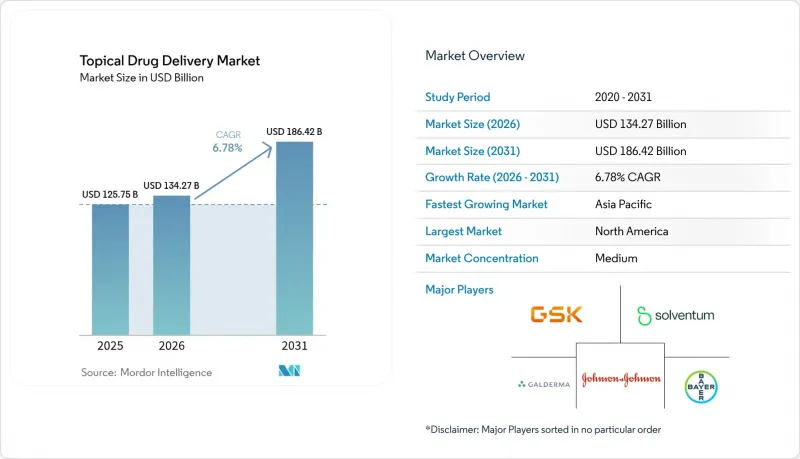
Mordor Intelligence에 따르면 국소 약물전달 시장 규모는 2026년에 1,342억 7,000만 달러로 추정되며, 2025년 1,257억 5,000만 달러에서 성장하여 2031년에는 1,864억 2,000만 달러에 달할 것으로 예측됩니다.
2026년부터 2031년까지 연평균 성장률(CAGR) 6.78%로 성장할 것으로 전망됩니다.
본 보고서는 투여 경로(경피, 안과, 경비, 기타), 제품(제제 [고형, 반고형, 기타], 기기 [경피 패치, 기타]), 적응증(피부 질환, 통증 관리, 기타), 최종사용자(병원, 재택의료 등), 지역(북미, 유럽, 아시아태평양 등)별로 분류되어 있습니다. 시장 전망은 금액(달러) 기준으로 제시되어 있습니다.
세계 국소 약물전달 시장의 동향 및 인사이트
만성 및 감염성 피부 질환의 높은 유병률
건선 및 아토피 피부염과 같은 만성 피부 질환은 여전히 전 세계적으로 가장 흔한 질환 상위 10위 안에 포함됩니다. 2024년에는 건선 환자만 4,000만 명 이상에 달하며, 이는 외용 바이오의약품 처방 건수의 꾸준한 증가를 뒷받침하고 있습니다. 2024년 12월에 승인된 갈데르마(Galderma)사의 ‘네무르비오(Nemrubio)’는 1,900명의 환자를 대상으로 한 임상시험에서 뛰어난 가려움증 완화 효과를 보여주었으며,IL-31 길항제가 중등도에서 중증의 아토피 피부염 치료를 어떻게 혁신하고 있는지를 여실히 보여주었습니다. 현재 인공지능(AI)을 활용한 피부 매핑 도구가 맞춤형 치료 계획의 지침이 되고 있으며, 200만 장의 이미지로 학습된 다중 모달 시각 모델이 진료 현장의 진단 정확도를 높이고 있습니다. 이러한 역학적 요인과 기술의 융합이 맞물리면서, 만성 질환의 치료는 국소 약물전달 시장에 있어 장기적인 성장의 원동력이 되고 있습니다.
통증 및 호르몬 치료 분야에서 경피 패치의 급속한 보급
미국 식품의약국(FDA)은 2025년 1월, 중등도에서 중증의 급성 통증을 적응증으로 하는 최초의 비오피오이드계 패치 제제 ‘Journavx(수제트리긴)’를 승인했습니다. 이 결정은 신규이며 의존성이 없는 진통제를 장려하는 규제 당국의 입장을 보여줍니다. 호르몬 요법 분야에서는 바이엘의 엘리나제탄에 대한 신약 승인 신청이 2030년까지 전 세계적으로 12억 명에 달할 것으로 예상되는 갱년기 환자의 혈관운동 증상을 대상으로 하고 있습니다. 메델란트사의 TEPI 플랫폼과 같은 새로운 접착 기술은 장기간 부착 기간 동안 균일한 용량을 공급하며, 경구 투여법보다 패치를 선호하는 환자의 경향을 뒷받침하고 있습니다. 그 결과, 경피 투여법은 더 광범위한 국소 약물전달 시장에서 점유율을 지속적으로 확대하고 있습니다.
외용 코르티코스테로이드에 대한 전 세계적인 엄격한 가격 규제
많은 정부가 기준 가격 제도를 강화하고 있어, 주류 코르티코스테로이드 제품의 이익률을 압박하고 있으며, 새로운 전달 기술 연구에 투입될 자금을 제한하고 있습니다. 2025년에 여러 브랜드 제제의 특허가 만료됨에 따라, 특히 판매량이 많은 신흥 시장에서 저가 경쟁이 더욱 격화되고 있습니다. 공급업체들은 복잡한 생물학적 제제 파이프라인이 더 높은 연구개발 투자를 필요로 하는 상황에서 비용 구조를 재검토할 수밖에 없으며, 이러한 양자택일의 딜레마가 국소 약물전달 시장의 특정 부문에서 성장을 둔화시킬 가능성이 있습니다.
부문 분석
2025년, 경피 투여는 국소 약물전달 시장의 44.71%를 차지하며, 임상 현장에서 널리 인정받은 사용 실적과 환자의 편의성을 반영하고 있습니다. 바이오의약품 및 스마트 패치가 피부과 분야와 전신성 질환의 적응증에 점차 보급됨에 따라, 경피 투여 경로와 관련된 국소 약물전달 시장 규모는 꾸준히 확대될 것으로 예상됩니다. 그러나 편두통, 호흡기 감염증, 신경학적 응급 치료를 위한 비강 스프레이가 보급되고 있어, 비강 투여는 2031년까지 9.12%라는 가장 높은 연평균 성장률(CAGR)을 기록하고 있습니다. 디지털 헬스의 통합은 현재 투여 기록을 전자 차트로 전송하는 센서 탑재 패치를 통해 경피 약물전달 분야로도 확대되고 있으며, 한편 커넥티드 흡입기는 호흡기 용도에서 유사한 피드백 루프를 제공하고 있습니다. 안과 치료에서는 안구 표면 손상을 줄이는 방부제 무첨가 다회 투여용 병이 활용되고 있으며, 호흡기 기기에서는 진동 메시 기술을 활용하여 폐 심부로의 침착률을 향상시키고 있습니다.
마이크로니들 및 비강·경피 투여 플랫폼의 융합을 통해 고분자 화합물 투여에 대한 접근성이 확대되고 있습니다. 스마트 인터페이스가 앱 기반 튜토리얼을 통해 사용자를 안내함으로써 투여 실수를 줄이고 있습니다. 한편, 직장 투여 경로와 구강 점막 투여 경로는 각각 완화 치료 및 볼 점막을 통한 백신 투여 분야에서 틈새 시장으로서의 중요성을 유지하고 있습니다. 모든 투여 경로에서 제제 과학자들은 안전성을 해치지 않으면서 투여 목표를 달성하기 위해 침투 촉진제, 나노에멀전 및 인시투 젤을 점점 더 많이 활용하고 있습니다. 이러한 폭넓은 도구 상자는 새로운 임상적 요구에 대응하는 각 경로의 역량을 강화하고, 국소 약물전달 시장의 장기적인 다각화를 뒷받침하고 있습니다.
2025년에는 기존의 크림, 젤, 로션, 스프레이가 국소 약물전달 시장 규모의 70.45%를 차지했습니다. 의사들의 확고한 지지와 대규모 제조 체계를 바탕으로 그 판매량은 높은 수준을 유지하고 있습니다. 폼과 같은 반고형 제제는 신속한 흡수를 선호하는 환자들에게 인기가 있는 반면, 액상 제제는 정량식 어플리케이터를 통해 투여 정확도가 향상되는 안과 및 비강 관리 분야에서 널리 사용되고 있습니다. 고체 필름이나 분말은 여전히 시장 규모가 작지만, 외출 시의 상처 관리나 소아 투여에 있어 필수적인 존재입니다.
패치, 마이크로니들 어레이, 스마트 붕대, 약물 방출 드레싱으로 구성된 ‘디바이스’ 카테고리는 연평균 성장률(CAGR) 8.07%를 기록하며, 확실히 성장세가 두드러지는 분야입니다. Solventum사의 ‘V.A.C. Peel and Place’ 시스템은 임상 도입 기간 동안 병원의 작업 시간을 61% 단축하고 치료 비용을 41% 절감했습니다. 세마글루타이드와 같은 체중 관리 약물을 위한 프로그래밍 가능한 마이크로니들 패치는, 기존의 크림으로는 불가능했던월 1회 투여 주기를 의료기기를 통해 실현할 수 있음을 보여줍니다. 전자부품 비용이 낮아지고 플렉서블 회로가 성숙해짐에 따라, 하이브리드형 ‘제제+디바이스’ 제품은 카테고리 경계를 모호하게 만들며, 모니터링 및 데이터 수집을 통해 부가가치를 창출하고 있습니다.
지역별 분석
북미는 2025년에도 탄탄한 연구개발 파이프라인, 높은 1인당 의료비, 그리고 획기적인 의료기기에 대한 신속한 규제 심사를 배경으로 매출 점유율 38.31%를 유지했습니다. 미국에서는 내원 횟수 감소를 장려하는 가치 기반 상환 제도를 통해 패치의 보급이 촉진되고 있습니다. 캐나다에서는 단일 지불자 제도 하에서 바이오시밀러 크림에 대한 수요가 견조한 반면, 멕시코의 민간 클리닉에서는 당뇨병성 궤양 치료용으로 스마트 드레싱 재고를 늘리고 있습니다.
아시아태평양은 2024년 벤처 자금 조달이 22% 감소했음에도 불구하고 9.18%라는 가장 높은 연평균 성장률(CAGR)을 기록하고 있습니다. 중국은 국내 마이크로니들 관련 스타트업에 자금을 지원하는 동시에, 국내 및 수출 수요를 충족시킬 대규모 GMP 공장을 지원하고 있습니다. 일본은 급속한 고령화에 직면해 있어, 부착하기 쉬운 진통 패치의 매출이 증가하고 있습니다. 인도에서는 Cipla사가 주도하는 호흡기 제품 포트폴리오가 전년 대비 17.9% 확대되어, 국내 전문 의료기기에 대한 수요가 증가하고 있음을 보여주고 있습니다. 한국에서는 녹내장 유병률 증가에 대응하기 위해 점안제 ‘Rhopressa’가 승인되었으며, 호주에서는 지방 환자를 위한 원격 모니터링 솔루션이 추진되고 있습니다.
유럽은 꾸준한 성장을 기록하고 있으며, 지속가능성 관련 법규에서 주도적인 역할을 수행하고 있고, 독일과 북유럽 국가에서는 바셀린 대체가 빠르게 진행되고 있습니다. 프랑스와 영국에서는 규제 당국에 실세계 데이터를 제공하는 AI 연계형 피부과 네트워크의 시범 운영이 진행되고 있습니다. 동유럽은 낮은 기점에서 성장하고 있지만, 제네릭 의약품에 대한 수요가 활발하여 국소 약물전달 업계에서 사업을 전개하는 수탁 제조업체들의 주요 목표 시장이 되고 있습니다. 남미, 중동 및 아프리카는 현재 규모는 작지만, 헬스케어 인프라가 성숙해지고 디지털 헬스 연결성이 확대됨에 따라 향후 성장 잠재력을 지니고 있습니다.
기타 혜택:
- Excel 형식의 시장 예측(ME) 시트
- 3개월간의 애널리스트 지원
자주 묻는 질문
목차
제1장 소개
제2장 분석 방법
제3장 주요 요약
제4장 시장 구도
제5장 시장 규모·성장률 예측
제6장 경쟁 구도
제7장 시장 기회와 향후 전망
KSM 26.09.07According to Mordor Intelligence, the topical drug delivery market size in 2026 is estimated at USD 134.27 billion, growing from 2025 value of USD 125.75 billion with 2031 projections showing USD 186.42 billion, growing at 6.78% CAGR over 2026-2031.
This report is Segmented by Route of Administration (Dermal, Ophthalmic, Nasal, and More), Product (Formulations [Solid, Semi-Solid and More] and Device [Transdermal Patches and More]), Indications (Dermal, Pain Management and More), End User (Hospitals, Home-Care Settings and More) and Geography (North America, Europe, Asia-Pacific and More). The Market Forecasts are Provided in Terms of Value (USD).
Global Topical Drug Delivery Market Trends and Insights
High prevalence of chronic & infectious skin diseases
Chronic skin disorders such as psoriasis and atopic dermatitis remain among the ten most common health conditions worldwide. Psoriasis alone affected more than 40 million people in 2024, spurring steady prescription growth for topical biologics. Galderma's Nemluvio, approved in December 2024, demonstrated superior itch reduction in trials with 1,900 patients, underscoring how IL-31 antagonists reshape moderate-to-severe atopic dermatitis management. Artificial-intelligence skin-mapping tools now guide personalized regimens, while multimodal vision models trained on two million images boost diagnostic accuracy in clinics. Together, epidemiologic pressure and technology convergence position chronic-disease care as a long-duration growth engine for the topical drug delivery market.
Rapid adoption of transdermal patches in pain & hormone therapy
The United States Food and Drug Administration cleared Journavx (suzetrigine) in January 2025 as the first non-opioid patch indicated for moderate to severe acute pain. The decision signals regulatory willingness to back novel, non-addictive analgesics. In hormone therapy, Bayer's elinzanetant New Drug Application targets vasomotor symptoms for the 1.2 billion global menopausal population anticipated by 2030. New adhesive chemistries such as Medherant's TEPI platform deliver uniform doses over extended wear periods, driving patient preference for patches over oral regimens. As a result, transdermal modalities continue to capture share within the broader topical drug delivery market.
Stringent global price controls on topical corticosteroids
Many governments have tightened reference pricing schemes, compressing margins on mainstream corticosteroid products and restricting cash flow available for novel delivery research. Patent expiries in 2025 for several branded formulations further intensify low-price competition, particularly in high-volume emerging markets. Suppliers are forced to re-engineer cost structures even as complex biologic pipelines demand higher R&D investment, creating a squeeze that could moderate growth in certain segments of the topical drug delivery market.
Other drivers and restraints analyzed in the detailed report include:
- Rising geriatric population
- Demand for self-administration & home-care-friendly formats
- Frequent contamination-driven product recalls & warning letters
For complete list of drivers and restraints, kindly check the Table Of Contents.
Segment Analysis
Dermal deliveries captured 44.71% of topical drug delivery market share in 2025, reflecting broad clinical familiarity and patient comfort. The topical drug delivery market size attached to dermal routes is forecast to expand steadily as biologics and smart patches penetrate dermatology and systemic indications. Nasal delivery, however, is registering the fastest 9.12% CAGR to 2031 as intranasal sprays for migraine, respiratory infections, and neurologic rescue therapy gain traction. A growing pipeline of antisense oligonucleotides formulated for the nasal cavity demonstrates commercial enthusiasm. Digital health integration now extends to dermal routes through sensor-equipped patches that relay dose records to electronic health records, while connected inhalers offer similar feedback loops for pulmonary applications. Ophthalmic therapy benefits from preservative-free multi-dose bottles that reduce ocular surface damage, and pulmonary devices leverage vibrating mesh technology to improve deep-lung deposition.
The convergence of microneedles with nasal and dermal platforms is widening access to large molecules. Smart interfaces guide users through app-based tutorials, lowering administration errors. Meanwhile, rectal and oral-mucosal routes maintain niche relevance for palliative care and buccal vaccine delivery, respectively. Across all pathways, formulation scientists increasingly employ permeation enhancers, nanoemulsions, and in situ gels to meet dosing targets without compromising safety. This broad toolbox strengthens each route's ability to address emerging clinical needs, reinforcing the long-term diversification of the topical drug delivery market.
Traditional creams, gels, lotions, and sprays represented 70.45% of topical drug delivery market size in 2025. Their entrenched physician acceptance and manufacturing scale keep volumes high. Semi-solids such as foams are popular with patients who prefer quick absorption, whereas liquids thrive in ophthalmology and nasal care where metered-dose applicators enhance accuracy. Solid films and powders remain small but essential for on-the-go wound care and pediatric dosing.
The devices category-comprising patches, microneedle arrays, smart bandages, and drug-eluting dressings-shows an 8.07% CAGR and is the clear momentum play. Solventum's V.A.C. Peel and Place system lowered hospital-labor time by 61% and treatment costs by 41% during clinical rollout. Programmable microneedle patches for weight-management agents such as Semaglutide demonstrate that devices can unlock monthly dosing cycles impossible with traditional creams. As electronics costs fall and flexible circuits mature, hybrid "formulation-plus-device" products blur category boundaries, adding value through monitoring and data capture.
Complete Report Scope:
- By Route of Administration
- Dermal
- Ophthalmic
- Nasal
- Oral Mucosal
- Otic
- Rectal
- Vaginal
- Pulmonary (Inhalational)
- Others
- By Product
- Formulations
- Solid (powders, films)
- Semi-Solid
- Creams
- Ointments
- Gels & Pastes
- Liquid (solutions, sprays)
- Foams
- Devices
- Transdermal Patches
- Microneedle Patches
- Inhalers & Nebulisers
- Metered-Dose Sprayers
- Formulations
- By Indication
- Dermatology (Eczema, Psoriasis, Acne)
- Pain Management (Musculoskeletal, Neuropathic)
- Ophthalmology (Dry-eye, Glaucoma)
- Respiratory (Asthma, COPD)
- ENT & Nasal Infections
- Hormone Replacement Therapy
- CNS Disorders (Migraine, Parkinson's)
- Others
- By End-User
- Hospitals
- Specialty Clinics & Dermatology Centers
- Home-Care Settings
- By Geography
- North America
- United States
- Canada
- Mexico
- Europe
- Germany
- United Kingdom
- France
- Italy
- Spain
- Rest of Europe
- Asia-Pacific
- China
- Japan
- India
- Australia
- South Korea
- Rest of Asia-Pacific
- Middle East and Africa
- GCC
- South Africa
- Rest of Middle East and Africa
- South America
- Brazil
- Argentina
- Rest of South America
- North America
Geography Analysis
North America maintained a 38.31% revenue share in 2025, backed by deep R&D pipelines, high healthcare expenditure per capita, and fast regulatory turnarounds for break-through devices. The United States drives patch adoption through value-based reimbursement that rewards fewer hospital visits. Canada shows strong demand for biosimilar creams within its single-payer scheme, while Mexico's private-sector clinics increasingly stock smart dressings for diabetic ulcer care.
Asia-Pacific shows the fastest 9.18% CAGR, even as venture funding fell 22% in 2024. China funds domestic microneedle startups and supports large-scale GMP plants that supply domestic and export demand. Japan faces accelerated aging, boosting sales of easy-to-apply analgesic patches. India's respiratory portfolio, led by Cipla, expanded 17.9% year over year and demonstrates rising domestic appetite for specialty devices. South Korea approved Rhopressa ophthalmic solution to address rising glaucoma prevalence, while Australia promotes remote monitoring solutions for rural patients.
Europe registers steady growth and leads in sustainability legislation, prompting rapid petrolatum replacement in Germany and the Nordic region. France and the United Kingdom pilot AI-linked dermatology networks that feed real-world evidence to regulators. Eastern Europe grows off a lower base but exhibits strong demand for generics, making it a target for contract manufacturers operating within the topical drug delivery industry. South America and the Middle East & Africa remain smaller today but represent future upside as healthcare infrastructure matures and digital-health connectivity widens.
- Bayer
- Johnson & Johnson
- GlaxoSmithKline
- Novartis
- Galderma
- Solventum
- Bausch Health
- Hisamitsu Pharmaceutical Co.
- Cipla
- Viatris
- MedPharm Ltd.
- Pfizer
- Leo Pharma
- Sun Pharma Industries Ltd.
- Abbvie
- Teva Pharmaceutical Industries
- Lupin
- Perrigo Company
- Taro Pharmaceutical Industries
- Glenmark Pharmaceuticals
Additional Benefits:
- The market estimate (ME) sheet in Excel format
- 3 months of analyst support
TABLE OF CONTENTS
1 Introduction
- 1.1 Study Assumptions and Market Definition
- 1.2 Scope of the Study
2 Research Methodology
3 Executive Summary
4 Market Landscape
- 4.1 Market Overview
- 4.2 Market Drivers
- 4.2.1 High Prevalence Of Chronic & Infectious Skin Diseases
- 4.2.2 Rapid Adoption Of Transdermal Patches In Pain & Hormone Therapy
- 4.2.3 Rising Geriatric Population
- 4.2.4 Demand For Self-Administration & Home-Care-Friendly Formats
- 4.2.5 Polymeric Microneedle Breakthroughs Enabling Large-Molecule Delivery
- 4.2.6 Smart/Connected Patches Driving Longitudinal Dosing Compliance
- 4.3 Market Restraints
- 4.3.1 Stringent Global Price Controls On Topical Corticosteroids
- 4.3.2 Frequent Contamination-Driven Product Recalls & Warning Letters
- 4.3.3 Limited Skin Permeation Of Biologics Without Enhancers
- 4.3.4 ESG-Driven Phase-Out Of Petrolatum Bases In Europe
- 4.4 Value / Supply-Chain Analysis
- 4.5 Regulatory Landscape
- 4.6 Technology Outlook
- 4.7 Porter's Five Forces Analysis
- 4.7.1 Bargaining Power of Suppliers
- 4.7.2 Bargaining Power of Buyers
- 4.7.3 Threat of New Entrants
- 4.7.4 Threat of Substitutes
- 4.7.5 Intensity of Competitive Rivalry
5 Market Size and Growth Forecasts (Value-USD)
- 5.1 By Route of Administration
- 5.1.1 Dermal
- 5.1.2 Ophthalmic
- 5.1.3 Nasal
- 5.1.4 Oral Mucosal
- 5.1.5 Otic
- 5.1.6 Rectal
- 5.1.7 Vaginal
- 5.1.8 Pulmonary (Inhalational)
- 5.1.9 Others
- 5.2 By Product
- 5.2.1 Formulations
- 5.2.1.1 Solid (powders, films)
- 5.2.1.2 Semi-Solid
- 5.2.1.2.1 Creams
- 5.2.1.2.2 Ointments
- 5.2.1.2.3 Gels & Pastes
- 5.2.1.3 Liquid (solutions, sprays)
- 5.2.1.4 Foams
- 5.2.2 Devices
- 5.2.2.1 Transdermal Patches
- 5.2.2.2 Microneedle Patches
- 5.2.2.3 Inhalers & Nebulisers
- 5.2.2.4 Metered-Dose Sprayers
- 5.2.1 Formulations
- 5.3 By Indication
- 5.3.1 Dermatology (Eczema, Psoriasis, Acne)
- 5.3.2 Pain Management (Musculoskeletal, Neuropathic)
- 5.3.3 Ophthalmology (Dry-eye, Glaucoma)
- 5.3.4 Respiratory (Asthma, COPD)
- 5.3.5 ENT & Nasal Infections
- 5.3.6 Hormone Replacement Therapy
- 5.3.7 CNS Disorders (Migraine, Parkinson's)
- 5.3.8 Others
- 5.4 By End-User
- 5.4.1 Hospitals
- 5.4.2 Specialty Clinics & Dermatology Centers
- 5.4.3 Home-Care Settings
- 5.5 By Geography
- 5.5.1 North America
- 5.5.1.1 United States
- 5.5.1.2 Canada
- 5.5.1.3 Mexico
- 5.5.2 Europe
- 5.5.2.1 Germany
- 5.5.2.2 United Kingdom
- 5.5.2.3 France
- 5.5.2.4 Italy
- 5.5.2.5 Spain
- 5.5.2.6 Rest of Europe
- 5.5.3 Asia-Pacific
- 5.5.3.1 China
- 5.5.3.2 Japan
- 5.5.3.3 India
- 5.5.3.4 Australia
- 5.5.3.5 South Korea
- 5.5.3.6 Rest of Asia-Pacific
- 5.5.4 Middle East and Africa
- 5.5.4.1 GCC
- 5.5.4.2 South Africa
- 5.5.4.3 Rest of Middle East and Africa
- 5.5.5 South America
- 5.5.5.1 Brazil
- 5.5.5.2 Argentina
- 5.5.5.3 Rest of South America
- 5.5.1 North America
6 Competitive Landscape
- 6.1 Market Concentration
- 6.2 Market Share Analysis
- 6.3 Company profiles (includes Global level Overview, Market level overview, Core Segments, Financials as available, Strategic Information, Market Rank/Share for key companies, Products and Services, and Recent Developments)
- 6.3.1 Bayer AG
- 6.3.2 Johnson & Johnson
- 6.3.3 GlaxoSmithKline plc
- 6.3.4 Novartis AG
- 6.3.5 Galderma SA
- 6.3.6 Solventum
- 6.3.7 Bausch Health Companies Inc.
- 6.3.8 Hisamitsu Pharmaceutical Co.
- 6.3.9 Cipla Ltd.
- 6.3.10 Viatris Inc.
- 6.3.11 MedPharm Ltd.
- 6.3.12 Pfizer Inc.
- 6.3.13 Leo Pharma A/S
- 6.3.14 Sun Pharma Industries Ltd.
- 6.3.15 AbbVie Inc. (Allergan)
- 6.3.16 Teva Pharmaceutical Industries
- 6.3.17 Lupin Ltd.
- 6.3.18 Perrigo Company plc
- 6.3.19 Taro Pharmaceutical Industries
- 6.3.20 Glenmark Pharmaceuticals
7 Market Opportunities and Future Outlook
- 7.1 White-Space and Unmet-Need Assessment