

|
시장보고서
상품코드
2121597
원격 조작 무인 잠수기(ROV) : 시장 점유율 분석, 업계 동향과 통계, 성장 예측(2026-2031년)Remotely Operated Vehicles (ROV) - Market Share Analysis, Industry Trends & Statistics, Growth Forecasts (2026 - 2031) |
||||||
 Mordor Intelligence
Mordor Intelligence에 의하면, 원격 조작 무인 잠수기(ROV) 시장 규모는 2026년에 37억 2,000만 달러로 추정되고, 예측 기간(2026년-2031년) CAGR 10.21%로 성장을 지속하여 2031년까지 60억 5,000만 달러에 이를 전망입니다.
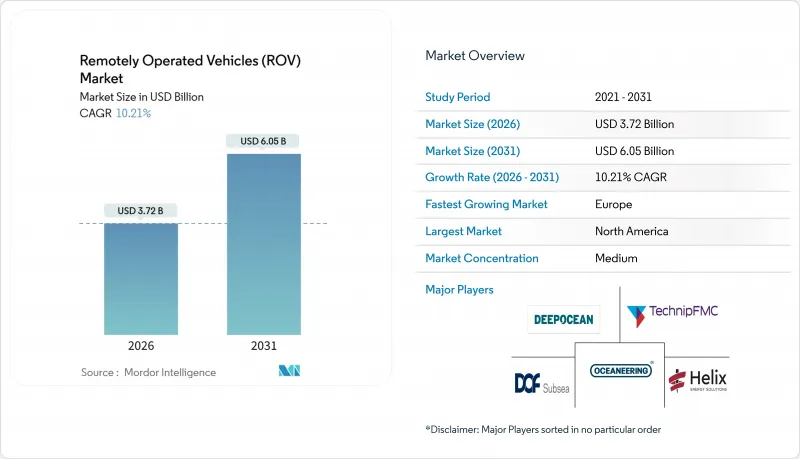
본 보고서는 차량 등급(작업용 등급 및 관측용 등급), 내수심(얕은 바다, 중간 수심, 심해), 추진 시스템(전기식, 유압식, 하이브리드식), 용도(시추·개발, 점검·수리·유지보수, 기타), 최종 사용자 용도(석유 및 가스,해상 풍력, 기타), 지역(북미, 유럽, 아시아태평양, 기타)별로 분류되어 있습니다.
전 세계 원격조종 무인 잠수정(ROV) 시장 동향 및 인사이트
증가하는 해양 석유 및 가스 탐사 설비 투자의 회복
2020년부터 2023년까지의 침체를 겪은 후, 전 세계 업스트림 부문 예산은 정상화되고 있으며, 셰브론(Chevron)은 2025년에 업스트림 부문에 145억 달러를 배정했고, 그 대부분은 멕시코만에 할당되었습니다. 쉘의 ‘웨일(Whale)’ 프로젝트는 2024년 하반기 수심 2,500미터에서 첫 원유 생산을 달성했으나, 그 과정에서 지속적인 작업용 ROV의 지원이 필요했습니다. 피치 레이팅스는 2027년까지 업스트림 부문의 연간 지출이 5,000억 달러 이상에 달할 것으로 예측하고 있으며, 그중 심해 분야가 지출의 22%를 차지할 것으로 전망하고 있습니다. 국제에너지기구(IEA)는 2025-2030년 해양 생산량이 하루 180만 배럴 증가할 것으로 예측하고 있으며, 그 거의 전부가 심해 자산에 의한 것이 될 것입니다. 수심 1,500미터를 초과하는 해역에서 유압 작업을 수행할 수 있는 것은 중장비용 ROV뿐이므로, 이러한 노력은 전 세계 ROV 시장의 확대로 이어질 것입니다.
해상 풍력 발전소의 확대와 해저 케이블
유럽에서는 2030년까지 120기가와트의 해상 풍력 발전을 실현할 전망이며, 이를 위해서는 매년 점검이 필요한 3만 킬로미터의 케이블이 필요합니다. 오르스테드(Orsted)사의 ‘혼시 3(Hornsea 3)’ 프로젝트에서는 696제곱킬로미터에 걸쳐 231기의 풍력 터빈을 설치할 예정이며, 기초 조사를 위해 얕은 바다용 ROV가 투입됩니다. 에퀴놀(Equinor)사의 부유식 프로젝트 ‘하이윈드 탄펜(Highwind Tanpen)’에서는 멀티빔을 탑재한 ROV를 이용한 계류 로프 점검이 도입되었습니다. 중국은 2025년에 40기가와트를 돌파하고, 2030년까지 100기가와트를 목표로 하고 있어, 이에 따라 배터리 구동식 유닛의 지속적인 조달이 예상됩니다. 켈틱해의 임대 라운드에서는 4.5기가와트가 추가되었으며, 계약에 따라 매년 침식 평가가 의무화되어 있어 향후 수십 년에 걸친 지속적인 수요가 보장됩니다.
해양 탐사 및 생산(E&P) : 모라토리엄과 환경 보호 운동
2025년에 발표된 미국 연방 정부의 신규 임대 일시 중단 조치로 인해, 단기 탐사 대상에서 1,200만 에이커가 제외되었습니다. 캘리포니아주는 시추 모라토리엄을 2030년까지 연장하여, 산타바바라 해협에서의 ROV 수요가 동결되었습니다. 노르웨이는 영향 평가가 2027년에 완료될 때까지 바렌츠해에서의 라이선스 발급을 연기했습니다. EU의 재생에너지 전략에 따라 북해 면적의 18%가 탄화수소 개발 활동에서 제외되었습니다. 한편, 환경 보호 단체들은 국제해저관리기구(ISA)에 상업 채굴 허가 발급을 2028년까지 연기할 것을 압박했습니다.
부문 분석
2025년 현재, 워크클래스 시스템은 ROV 시장 점유율의 71.6%를 차지하고 있으며, 2031년까지 연평균 성장률(CAGR) 11.7%로 성장할 전망입니다. 워크클래스 ROV 시장 규모는 예측 기간 동안 19억 달러 확대될 것으로 예상되며, 이는 200kg의 매니퓰레이터 힘이 필요한 작업 분야에서 이 부문이 차지하는 독점적 지위를 반영한 것입니다. 사브 시아이(Saab Seaeye)는 2024년에 ‘레오파드(Leopard)’를 출시했습니다. 이 기종은 전동 주행과 유압 리프트를 결합하여 연료 소비량을 18% 절감했습니다. 관측용 ROV는 얕은 해역의 검사에서 여전히 필수적이지만, 일일 임대료는 비교적 낮게 책정되어 있습니다. 포럼(Forum)사의 ‘서브 애틀랜틱 모호크 라이트(Sub Atlantic Mohawk Light)’는 2시간 이내에 재구성 가능한 툴 스키드를 갖추고 있어 중규모 작업을 대상으로 합니다. 이러한 양극화로 인해 ROV 시장 내에서는 병행된 성장 경로가 확보되고 있습니다. 해상 풍력 발전에서는 소형 전동 유닛이 선호되는 반면, 석유 및 가스 분야에서는 중작업급의 높은 성능이 요구되기 때문입니다.
워크 클래스의 혁신은 현재 실시간 4K 영상을 가능하게 하는 광섬유 텔레메트리에 초점이 맞추어져 있으며, 이를 통해 기존에는 임무 종료 후 데이터 다운로드를 할 수밖에 없었던 데이터 공백이 해소되고 있습니다. 오세아니아 링(Oceania Ring)사의 ‘밀레니엄 플러스(Millennium Plus)’는 멕시코만에서 실시된 시험을 통해 멀티빔을 이용한 끊김 없는 스트리밍을 입증했습니다. 소형 관측용 ROV 함대는 기동성과 배터리 지속 시간에 중점을 두고 있으며, 10시간 지속되는 리튬 이온 배터리를 탑재한 VideoRay사의 ‘Pro 5’가 그 대표적인 예입니다. 하이브리드 아키텍처가 타협안으로 부상하고 있으며, 이를 통해 운영자는 페이로드를 희생하지 않고도 환경 지침을 충족할 수 있게 되었습니다.
2025년에는 수심 1,000미터를 초과하는 심해 프로젝트가 매출의 56.3%를 차지했지만, 수심 300미터까지의 얕은 바다용 기체군은 연평균 성장률(CAGR) 13.1%로 전 세계 ROV 시장을 주도하고 있습니다. 터빈 기초 점검이 보편화됨에 따라, 얕은 바다 작업용 세계 ROV 시장 규모는 2031년까지 2배 이상으로 증가할 것으로 예측됩니다. 오스트에드(Austed)사의 ‘혼시 3(Hornsea 3)’ 프로젝트에서는 수심 40-60미터 해역에 설치된 231기의 터빈에 대해 연례 점검이 요구되고 있습니다. 비디오레이(VideoRay)사의 ‘Pro 5’와 딥 트레커(Deep Trekker)사의 ‘Revolution’은 배터리 교체를 5분 이내에 완료할 수 있다는 점을 강점으로 내세워 이 분야를 공략하고 있습니다.
수심 300-1,000미터의 중층 해역은 성숙한 북해 유전과 수심이 더 깊은 연안 풍력 발전 단지를 포함합니다. EU 지침에 따르면 수심 200미터 미만의 해역에서 케이블에 대한 연례 점검이 의무화되어 있으며, 이를 통해 연간 4억 5,000만 달러 규모의 안정적인 얕은 해역 수익원이 창출되고 있습니다. 이러한 규정 준수 의무는 전 세계 ROV 시장에서 지속적인 계약을 목표로 하는 사업자에게 장기적인 사업 전망을 보장해 줍니다.
지역별 분석
북미는 2025년 매출의 37.1%를 차지했으며, 3억 8,200만 달러 규모의 입찰액을 모은 멕시코만 임대 입찰이 주도적인 역할을 했습니다. 셰브론의 업스트림 부문 예산은 심해 개발에 대한 지속적인 의지를 보여주고 있으며, 캐나다 뉴펀들랜드에서의 승인으로 2027년까지 새로운 시추 프로젝트가 추가될 예정입니다. 페멕스는 2024년에 페르디도 탐사를 재개하여 중기적인 수요를 뒷받침하고 있습니다. 연방 정부의 임대 일시 중단 및 캘리포니아주의 모라토리엄이 연안 지역의 성장을 제약하고 있어, 정책적 역풍은 여전히 지속되고 있습니다.
유럽은 연평균 성장률(CAGR) 16.5%로 가장 빠르게 성장하는 지역이며, 해상 풍력 발전소의 건설 및 해체로 인해 전 세계 ROV 시장을 주도하고 있습니다. 크라운 에스테이트(Crown Estate)의 켈트해 임대 계약으로 4.5기가와트의 용량이 추가되었으며, 연 1회의 정기 점검이 의무화되어 있습니다. 노르웨이의 연간 건전성 규정에 따라 8억 달러 규모의 독점적인 IRM 시장이 창출되고 있습니다. 덴마크의 에너지넷(Energinet)은 2024년에 1,200킬로미터 길이의 송전 케이블에 관한 계약을 체결했습니다. 독일은 2030년까지 30기가와트의 풍력 발전 설비 설치를 목표로 하고 있습니다.
아시아태평양, 중동, 라틴아메리카는 높은 성장이 예상되는 지역입니다. 중국은 2025년에 이미 해상 풍력 발전 용량 40기가와트를 돌파했습니다. 인도의 ONGC는 KG 분지의 심해 블록에 관한 계약을 수주했습니다. 사우디 아람코, 페트로브라스, ADNOC은 2028년까지 연간 60기 이상의 해저 트리(Subsea Tree) 설치를 계획하고 있으며, 중작업 등급의 가동률을 유지하고 있습니다. 말레이시아와 인도네시아가 가스 수출을 확대함에 따라, 아세안(ASEAN) 내 파이프라인 검사 업무도 증가하고 있습니다.
기타 혜택:
- 엑셀 형식 시장 예측(ME) 시트
- 3개월간의 애널리스트 지원
자주 묻는 질문
목차
제1장 서론
제2장 조사 방법
제3장 주요 요약
제4장 시장 구도
제5장 시장 규모와 성장 예측
제6장 경쟁 구도
제7장 시장 기회와 향후 전망
LSH 26.09.02According to Mordor Intelligence, the remotely operated vehicles market size is estimated at USD 3.72 billion in 2026, and is expected to reach USD 6.05 billion by 2031, at a CAGR of 10.21% during the forecast period (2026-2031).
This report is Segmented by Vehicle Class (Work-Class and Observatory-Class), Depth Rating (Shallow, Mid-Water, and Deep-Water), Propulsion System (Electric, Hydraulic, and Hybrid), Activity (Drilling and Development, Inspection, Repair and Maintenance, and More), End-User Application (Oil and Gas, Offshore Wind, and More), and Geography (North America, Europe, Asia-Pacific, and More).
Global Remotely Operated Vehicles (ROV) Market Trends and Insights
Increasing Offshore Oil & Gas Exploration Capex Rebound
Global upstream budgets have normalized after the 2020-2023 downturn, with Chevron allocating USD 14.5 billion to upstream in 2025, much of it in the Gulf of Mexico. Shell's Whale project reached first oil in late 2024 at 2,500 meters and required continuous work-class support. Fitch Ratings expects annual upstream spending to top USD 500 billion through 2027, with deep-water claiming 22% of that outlay. The International Energy Agency projects offshore production to rise by 1.8 million barrels per day between 2025 and 2030, almost entirely from deep-water assets. These commitments enlarge the Global ROV market because only heavy work-class units can handle hydraulic manipulation at depths beyond 1,500 meters.
Expansion of Offshore Wind Farms and Subsea Cabling
Europe is on track for 120 gigawatts of offshore wind by 2030, requiring 35,000 kilometers of cables that must be inspected annually. Orsted's Hornsea 3 will install 231 turbines across 696 square kilometers and deploy shallow-water vehicles for foundation surveys. Equinor's Hywind Tampen floating project introduced mooring-line inspections that depend on multi-beam-equipped ROVs. China surpassed 40 gigawatts in 2025 and targets 100 gigawatts by 2030, generating sustained procurement of battery-electric units. The Celtic Sea leasing round added 4.5 gigawatts with contracts mandating yearly scour assessments, guaranteeing decades of recurring demand.
Offshore E&P Moratoriums & Environmental Activism
The U.S. federal pause on new leases announced in 2025 removed 12 million acres from near-term exploration. California extended its drilling moratorium to 2030, freezing ROV demand in the Santa Barbara Channel. Norway deferred Barents licensing until impact studies finish in 2027. The EU's Renewable Energy Strategy closed 18% of the North Sea to hydrocarbon activity. Meanwhile, environmental groups pressured the International Seabed Authority to postpone commercial mining licenses until 2028.
Other drivers and restraints analyzed in the detailed report include:
- Rising IRM Demand for Ageing Subsea Infrastructure
- Deep-Water Capex Surge by NOCs
- High Capex & OPEX of Work-Class ROV Fleets
For complete list of drivers and restraints, kindly check the Table Of Contents.
Segment Analysis
Work-class systems held 71.6% of the ROV market share in 2025 and will climb at an 11.7% CAGR to 2031. The ROV market size for work-class units is projected to expand by USD 1.9 billion over the forecast, reflecting monopoly on tasks that demand 200-kilogram manipulator force. Saab Seaeye launched the Leopard in 2024, pairing electric transit with hydraulic lift to cut fuel use 18%. Observatory-class vehicles remain essential for shallow inspections but command lower day rates. Forum's Sub-Atlantic Mohawk Lite targets mid-tier tasks with a tool skid that reconfigures in under two hours. This bifurcation ensures parallel growth paths inside the ROV market as offshore wind favors compact electric units while oil and gas relies on heavy work-class capacity.
Work-class innovations now center on fiber-optic telemetry that enables real-time 4K video, closing a data gap that historically forced post-mission downloads. Oceaneering's Millennium Plus demonstrated seamless multi-beam streaming in Gulf of Mexico trials. Smaller observatory fleets focus on agility and battery endurance, typified by VideoRay's Pro 5 with a 10-hour lithium-ion package. Hybrid architecture is emerging as a compromise, letting operators satisfy environmental guidelines without sacrificing payload.
Deep-water projects above 1,000 meters controlled 56.3% of revenue in 2025, yet shallow-water fleets up to 300 meters are pacing the Global ROV market at a 13.1% CAGR. The Global ROV market size for shallow-water operations is projected to more than double by 2031 as turbine-foundation inspections proliferate. Orsted's Hornsea 3 requires annual verification across 231 turbines located at 40-60 meters. VideoRay's Pro 5 and Deep Trekker's Revolution target this domain with battery swaps under five minutes.
Mid-water zones covering 300-1,000 meters serve mature North Sea fields and deeper coastal wind sites. EU directives mandate yearly cable checks in waters shallower than 200 meters, creating a captive shallow-water revenue stream of USD 450 million annually. These compliance obligations ensure long-run visibility for operators pursuing recurrent contracts inside the Global ROV market.
Complete Report Scope:
- By Vehicle Class
- Work-class
- Light Work-class
- Medium Work-class
- Heavy Work-class
- Observatory-class
- Work-class
- By Depth Rating
- Shallow (Up to 300 m)
- Mid-water (300 to 1,000 m)
- Deep-water (Above 1,000 m)
- By Propulsion System
- Electric
- Hydraulic
- Hybrid
- By Activity
- Drilling and Development
- Construction and Installation
- Inspection, Repair and Maintenance (IRM)
- Decommissioning
- Environmental Monitoring
- By End-user Application
- Oil and Gas
- Offshore Wind
- Defense and Security
- Research and Academia
- Aquaculture and Marine Infrastructure
- By Geography
- North America
- United States
- Canada
- Mexico
- Europe
- United Kingdom
- Norway
- Denmark
- Germany
- France
- Russia
- Rest of Europe
- Asia-Pacific
- China
- India
- Japan
- South Korea
- ASEAN Countries
- Rest of Asia-Pacific
- South America
- Brazil
- Argentina
- Colombia
- Rest of South America
- Middle East and Africa
- Saudi Arabia
- United Arab Emirates
- Qatar
- South Africa
- Egypt
- Nigeria
- Rest of Middle East and Africa
- North America
Geography Analysis
North America generated 37.1% of 2025 revenue, anchored by Gulf of Mexico lease rounds that drew USD 382 million in bids. Chevron's upstream budget signals a durable deep-water appetite, and Canada's approvals in Newfoundland add new drilling campaigns through 2027. Pemex revived Perdido exploration in 2024, enhancing medium-term demand. Policy headwinds persist as the federal leasing pause and California moratorium constrain near-shore growth.
Europe is the fastest-advancing region with a 16.5% CAGR, scaling the Global ROV market through offshore wind build-out and decommissioning. The Crown Estate's Celtic Sea leases add 4.5 gigawatts with compulsory yearly inspections. Norway's annual integrity rules create a USD 800 million captive IRM market. Denmark's Energinet let contracts for 1,200 kilometers of export cables in 2024. Germany targets 30 gigawatts of wind by 2030.
Asia-Pacific, the Middle East, and Latin America represent high-growth corridors. China already crossed 40 gigawatts of offshore wind in 2025. India's ONGC awarded contracts for deep-water KG-Basin blocks. Saudi Aramco, Petrobras, and ADNOC together plan more than 60 subsea trees per year through 2028, sustaining heavy work-class utilization. ASEAN pipeline inspection work is rising as Malaysia and Indonesia expand gas exports.
- Oceaneering International Inc.
- TechnipFMC plc
- Subsea 7 S.A.
- Fugro N.V.
- DOF Subsea AS
- DeepOcean AS
- Helix Energy Solutions Group Inc.
- Bourbon Corp. SA
- Saipem SpA
- Forum Energy Technologies Inc.
- Saab Seaeye Ltd.
- ROVOP Ltd.
- Delta SubSea LLC
- IKM Subsea AS
- Kongsberg Maritime
- ECA Group
- Deep Trekker Inc.
- VideoRay LLC
- Blue Robotics Inc.
- Seatronics (Ashtead Group)
Additional Benefits:
- The market estimate (ME) sheet in Excel format
- 3 months of analyst support
TABLE OF CONTENTS
1 Introduction
- 1.1 Study Assumptions & Market Definition
- 1.2 Scope of the Study
2 Research Methodology
3 Executive Summary
4 Market Landscape
- 4.1 Market Overview
- 4.2 Market Drivers
- 4.2.1 Increasing offshore oil & gas exploration capex rebound
- 4.2.2 Expansion of offshore wind farms and subsea cabling
- 4.2.3 Rising IRM demand for ageing subsea infrastructure
- 4.2.4 Deep-water capex surge by NOCs
- 4.2.5 Resident ROV systems enabled by subsea docking
- 4.2.6 Seabed mineral-mining pilot programs
- 4.3 Market Restraints
- 4.3.1 Offshore E&P moratoriums & environmental activism
- 4.3.2 High capex & OPEX of work-class ROV fleets
- 4.3.3 Regulatory grey zones for autonomous subsea ops
- 4.3.4 Fiber-optic umbilical bandwidth constraints
- 4.4 Supply-Chain Analysis
- 4.5 Regulatory Landscape
- 4.6 Technological Outlook
- 4.7 Porter's Five Forces
- 4.7.1 Bargaining Power of Suppliers
- 4.7.2 Bargaining Power of Buyers
- 4.7.3 Threat of New Entrants
- 4.7.4 Threat of Substitutes
- 4.7.5 Intensity of Rivalry
5 Market Size & Growth Forecasts
- 5.1 By Vehicle Class
- 5.1.1 Work-class
- 5.1.1.1 Light Work-class
- 5.1.1.2 Medium Work-class
- 5.1.1.3 Heavy Work-class
- 5.1.2 Observatory-class
- 5.1.1 Work-class
- 5.2 By Depth Rating
- 5.2.1 Shallow (Up to 300 m)
- 5.2.2 Mid-water (300 to 1,000 m)
- 5.2.3 Deep-water (Above 1,000 m)
- 5.3 By Propulsion System
- 5.3.1 Electric
- 5.3.2 Hydraulic
- 5.3.3 Hybrid
- 5.4 By Activity
- 5.4.1 Drilling and Development
- 5.4.2 Construction and Installation
- 5.4.3 Inspection, Repair and Maintenance (IRM)
- 5.4.4 Decommissioning
- 5.4.5 Environmental Monitoring
- 5.5 By End-user Application
- 5.5.1 Oil and Gas
- 5.5.2 Offshore Wind
- 5.5.3 Defense and Security
- 5.5.4 Research and Academia
- 5.5.5 Aquaculture and Marine Infrastructure
- 5.6 By Geography
- 5.6.1 North America
- 5.6.1.1 United States
- 5.6.1.2 Canada
- 5.6.1.3 Mexico
- 5.6.2 Europe
- 5.6.2.1 United Kingdom
- 5.6.2.2 Norway
- 5.6.2.3 Denmark
- 5.6.2.4 Germany
- 5.6.2.5 France
- 5.6.2.6 Russia
- 5.6.2.7 Rest of Europe
- 5.6.3 Asia-Pacific
- 5.6.3.1 China
- 5.6.3.2 India
- 5.6.3.3 Japan
- 5.6.3.4 South Korea
- 5.6.3.5 ASEAN Countries
- 5.6.3.6 Rest of Asia-Pacific
- 5.6.4 South America
- 5.6.4.1 Brazil
- 5.6.4.2 Argentina
- 5.6.4.3 Colombia
- 5.6.4.4 Rest of South America
- 5.6.5 Middle East and Africa
- 5.6.5.1 Saudi Arabia
- 5.6.5.2 United Arab Emirates
- 5.6.5.3 Qatar
- 5.6.5.4 South Africa
- 5.6.5.5 Egypt
- 5.6.5.6 Nigeria
- 5.6.5.7 Rest of Middle East and Africa
- 5.6.1 North America
6 Competitive Landscape
- 6.1 Market Concentration
- 6.2 Strategic Moves (M&A, Partnerships, PPAs)
- 6.3 Market Share Analysis (Market Rank/Share for key companies)
- 6.4 Company Profiles (includes Global level Overview, Market level overview, Core Segments, Financials as available, Strategic Information, Products & Services, and Recent Developments)
- 6.4.1 Oceaneering International Inc.
- 6.4.2 TechnipFMC plc
- 6.4.3 Subsea 7 S.A.
- 6.4.4 Fugro N.V.
- 6.4.5 DOF Subsea AS
- 6.4.6 DeepOcean AS
- 6.4.7 Helix Energy Solutions Group Inc.
- 6.4.8 Bourbon Corp. SA
- 6.4.9 Saipem SpA
- 6.4.10 Forum Energy Technologies Inc.
- 6.4.11 Saab Seaeye Ltd.
- 6.4.12 ROVOP Ltd.
- 6.4.13 Delta SubSea LLC
- 6.4.14 IKM Subsea AS
- 6.4.15 Kongsberg Maritime
- 6.4.16 ECA Group
- 6.4.17 Deep Trekker Inc.
- 6.4.18 VideoRay LLC
- 6.4.19 Blue Robotics Inc.
- 6.4.20 Seatronics (Ashtead Group)
7 Market Opportunities & Future Outlook
- 7.1 White-space & Unmet-Need Assessment


