
|
시장보고서
상품코드
2121638
휴대용 초음파 진단 기기 : 시장 점유율 분석, 업계 동향과 통계, 성장 예측(2026-2031년)Portable Ultrasound Devices - Market Share Analysis, Industry Trends & Statistics, Growth Forecasts (2026 - 2031) |
||||||
 Mordor Intelligence
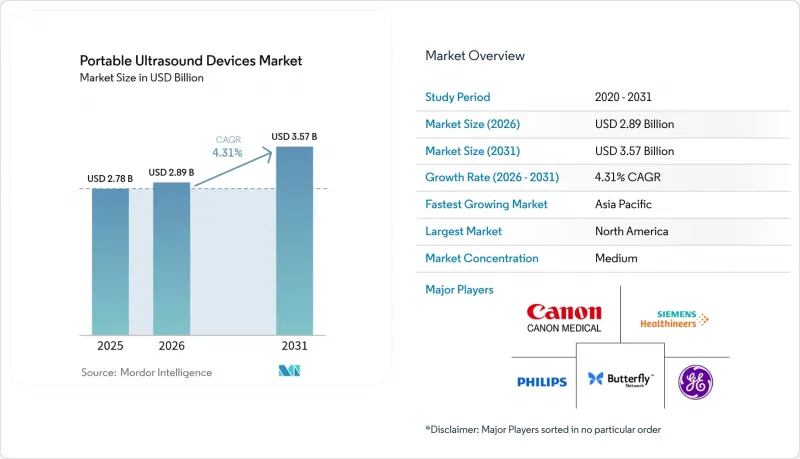
Mordor Intelligence에 따르면 휴대용 초음파 진단 기기 시장 규모는 2025년 27억 8,000만 달러에서 2026년에는 28억 9,000만 달러로 확대되고, 2026년부터 2031년까지 CAGR 4.31%를 기록하며 2031년에는 35억 7,000만 달러에 달할 것으로 예측됩니다.
본 보고서는 기기 유형(핸드헬드형, 모바일/카트형, 웨어러블형, 태블릿형), 기술(2D, 3D/4D, 도플러), 용도(산부인과, 순환기, 비뇨기·신장, 근골격계 등), 최종사용자(병원, ASC, 진단 센터, 산과 센터, 재택 간호·원격의료), 및 지역별로 분류되어 있습니다. 시장 예측은 금액(달러)으로 표시되어 있습니다.
세계 휴대용 초음파 진단 기기 시장의 동향 및 인사이트
응급 및 중환자 치료 현장에서의 현장 진단(Point-of-Care)에 대한 수요 증가
응급실에서는 현재 핸드헬드형 스캐너가 트리아지에 통합되어 있습니다. 이는 병상 옆 초음파 검사를 통해 쇼크, 기흉, 심정지 진단까지 걸리는 시간이 기존 진료 과정에 비해 30-40% 단축되기 때문입니다. ACEP의 2024년 성명에서는 11가지 주요 POCUS 검사가 필수 역량으로 분류되어 있으며, 장비 접근성이 인증 요건으로 규정되어 있습니다. 이에 대응하여 병원에서는 몇 초 이내에 영상 촬영을 시작할 수 있는 포켓 사이즈 프로브를 응급 카트에 비치하고 있습니다. 응급의료서비스(EMS) 시범 프로그램에서는 8시간의 훈련을 받은 응급구조사가 비외상성 체액 검출에서 85%의 민감도를 달성한 것으로 나타났으며, 병원 도착 전 현장에서의 활용이 더욱 확대될 조짐을 보이고 있습니다. 당분간 수익은 응급실의 설비 투자 예산에서 조달되지만, 향후 성장은 EMS의 보상 제도와의 연계성에 좌우될 것입니다.
기술의 소형화와 AI를 활용한 영상 처리를 통해 사용 편의성과 화질이 향상되었습니다.
실리콘 기반 CMUT 어레이는 현재 두께가 2mm 미만으로 얇아져, B모드의 정밀도를 저하시키지 않으면서 패치형이나 손목 착용형 프로브를 구현하고 있습니다. Butterfly사의 iQ3는 싱글 칩 CMUT와 온디바이스 AI를 통합하여, 경험이 부족한 검사자의 검사 시간을 35% 단축했습니다. 필립스는 Lumify에 ‘AI 자동 측정’ 기능을 추가하여, 전문가의 소견과 5% 이내의 오차로 일치하는 심박출량 산출을 실현했습니다. GE 헬스케어의 ‘Caption Guidance’는 해부학적 랜드마크가 올바른 위치에 올 때까지 안내 메시지를 화면에 중첩하여 표시함으로써, 수련 1년 차 의사의 영상 품질을 향상시킵니다. 병원에서는 일반적으로 휴대용 장비를 3-4년마다 교체하기 때문에 중기적으로는 AI 탑재 모델이 기존 장비를 꾸준히 대체해 나갈 것입니다.
높은 초기 비용과 불균일한 보험 급여 정책
5,000-1만 5,000달러 가격대의 핸드헬드형 초음파 장치는 1인당 의료비가 200달러 미만인 지방 진료소에게는 여전히 감당하기 어려운 수준입니다. CMS(미국 의료보험서비스센터)는 CPT 76604에 대해 환급을 실시하고 있지만, 민간 보험사는 사전 승인을 의무화하는 경우가 많아 이로 인해 지급이 30-60일 지연되는 일이 흔합니다. 독일에서는 특정 POCUS(POC(Point-of-Care) 초음파) 적응증에 대해 비용이 지급되는 반면, 프랑스에서는 외래 진료에 대한 환급이 제한되어 있어 유럽 내 대응 방식의 편차가 두드러지게 나타나고 있습니다. 사하라 이남 아프리카 지역의 많은 의료 기관에게 구독료는 여전히 예산을 초과하고 있습니다. 가격에 민감한 구매자들은 정가가 3,000달러 미만이 되거나 지불 기관이 신속한 환급을 보장할 때까지 구매를 미루게 될 것입니다.
부문 분석
2025년에는 휴대용 기기가 매출의 57.12%를 차지했으며, 이러한 성장은 영상 진단용 사전 설정 기능에 의해 주도될 것입니다. 그러나 웨어러블형 및 태블릿형 스캐너가 2031년까지 연평균 성장률(CAGR) 7.06%를 기록함에 따라, 핸드헬드형 장치의 시장 점유율은 점차 감소할 전망입니다. 병원에서는 복잡한 도플러 검사나 3D 검사에서 여전히 카트형 플랫폼이 중시되고 있지만, 현재는 핸드헬드형도 대부분의 병상 검사 품질 기준을 충족하게 되었기 때문에 휴대용 초음파 진단 기기 시장 규모는 초모바일형 폼팩터에 중점을 두는 경향이 있습니다. 현재 개발 중인 웨어러블 방광 모니터링 패치는 사용자의 조작 없이 48시간 동안 데이터 스트림을 제공할 것으로 기대되며, 만성 질환의 재택 모니터링 분야로 확대될 것으로 전망됩니다. 칩 수준의 CMUT 통합으로 부품 비용이 낮아짐에 따라, 벤더들은 하드웨어를 통한 차별화를 자제하고 AI 워크플로우, 구독형 분석, 상호 운용성 측면에서 차별화를 꾀할 것입니다.
GE Vscan Air CL과 같은 태블릿형 제품은 화면 크기의 한계를 보완하고, 무선 프로브를 일반용 태블릿과 결합함으로써 현장에서의 외상 분류(triage)를 실현하고 있습니다. 이러한 제품들은 듀얼 모드 도플러 오버레이를 표시하기에 충분한 처리 능력을 갖추고 있으면서도, 구급대원의 키트에 들어갈 수 있는 크기입니다. 휴대용 초음파 진단 기기 시장은 계속해서 사용 사례별로 가격대가 분화되고 있습니다. 병상에서의 광범위한 도입에는 핸드헬드형, 이송 팀에는 태블릿형, 높은 처리량을 요구하는 초음파 검사실에는 카트형, 그리고 질환의 장기 관리에는 웨어러블형이 각각 적합합니다. 각 부문은 성장하고 있지만, 전력 관리의 소형화와 소프트 트랜스듀서 연구가 융합됨에 따라 웨어러블 기기의 성장이 가장 빠르게 진행되고 있습니다.
2D 영상 진단은 산과, 응급 의료 및 시술 분야에서 오랫동안 수행해 온 역할 덕분에 2025년에도 49.58%의 점유율을 유지했습니다. 그러나 현재 눈앞에 다가온 GPU의 발전으로 인해, 예전에는 워크스테이션에서만 가능했던 실시간 볼륨 렌더링이 가능해졌으며, 그 결과 3D/4D는 2031년까지 연평균 성장률(CAGR) 6.39%로 성장할 전망입니다. 도플러 모드는 여전히 심장 및 혈관 의료의 기반을 이루고 있으며, 휴대용 검사의 약 30%를 차지하고 있습니다. 현재 AI가 기본적인 2D 성능을 강화하고 있습니다. 필립스의 ‘Auto Follicle’은 불임 치료 클리닉에서 검사 시간을 40% 단축시켰으며, 이는 소프트웨어를 통해 2D의 유용성이 유지되고 있음을 입증하고 있습니다. 교육 프로그램에 볼륨 렌더링 커리큘럼 도입이 지연되고 있어, 2024년 시점에서 3D를 다루는 비율은 고작 18%에 그치고 있으며, 이것이 보급 속도를 저해하고 있습니다. 각 벤더사는 임상의가 익숙한 단면 영상과 대조하여 새로운 단면을 확인할 수 있는 2D와 3D의 동기화 표시 기능으로 이에 대응하고 있습니다. 향후 휴대성은 트랜스듀서의 물리적 특성보다 엣지 디바이스에 배포되는 소프트웨어 툴체인을 통해 더욱 강력하게 정의될 것입니다.
지역별 분석
2025년, CMS가 원격 판독 스캔용 CPT 76604를 추가하고, 같은 해 FDA 승인을 받은 Butterfly iQ3, GE Vscan Air CL, Philips Lumify가 시장에 등장함에 따라 북미는 매출의 32.98%를 차지했습니다. 캐나다의 퍼스트 네이션스 프로그램에서는 간호사에게 휴대용 프로브를 배포함으로써 산과 의료 이송을 35% 줄였습니다. 멕시코 사회보장기금은 지방 진료소를 위해 2,500대의 휴대용 장비를 발주했으며, 이는 이 지역에서 신흥 시장의 수요가 증가하고 있음을 뒷받침합니다. 도시 지역 병원의 시장 포화로 인해 공급업체들은 수의과 진료소, 재택 간호 서비스 제공업체 및 응급 의료 접근 시설로 사업을 확장하고 있습니다.
아시아태평양은 2031년까지 연평균 성장률(CAGR) 5.76%로 확대될 전망입니다. 중국에서는 Mindray, Sonoscape, Edan에 대한 NMPA 승인을 배경으로, 향진 보건 센터의 조달 분량이 이미 국내 시장 점유율의 40%를 초과하고 있습니다. 인도에서는 2024년에 18개의 신형 모델이 승인되었으며, 그 중 다수가 3,000달러 미만의 가격으로 책정되어 3급 도시로의 보급이 가능해졌습니다. 일본에서는 재택 심장 초음파 검사가 요양보험 적용 대상이 되었으며, 호주의 로열 플라잉 닥터 서비스(Royal Flying Doctor Service)에서는 외딴 오지 진료소에서의 진단 지연 시간을 절반으로 줄였습니다. 한국에서는 응급용 POCUS의 보험 적용 범위가 확대되어 외상 센터의 장비 업그레이드가 진행되었습니다.
기타 혜택:
- 엑셀 형식의 시장 예측(ME) 시트
- 3개월간의 애널리스트 지원
자주 묻는 질문
목차
제1장 소개
제2장 조사 방법
제3장 주요 요약
제4장 시장 구도
제5장 시장 규모와 성장 예측
제6장 경쟁 구도
제7장 시장 기회와 향후 전망
KSM 26.09.07According to Mordor Intelligence, the portable ultrasound devices market size is expected to grow from USD 2.78 billion in 2025 to USD 2.89 billion in 2026 and is forecast to reach USD 3.57 billion by 2031 at 4.31% CAGR over 2026-2031.
This report is Segmented by Device Type (Handheld, Mobile/Cart-based, Wearable & Tablet-Based), Technology (2D, 3D/4D, Doppler), Application (Obstetrics & Gynecology, Cardiovascular, Urology & Renal, Musculoskeletal, and More), End User (Hospitals, Ascs, Diagnostic Centers, Maternity Centers, Home Care & Telehealth), and Geography. Market Forecasts are in Value (USD).
Global Portable Ultrasound Devices Market Trends and Insights
Rising Demand for Point-of-Care Diagnostics in Emergency and Critical-Care Settings
Emergency departments now integrate handheld scanners into triage because bedside ultrasound reduces time to diagnosis for shock, pneumothorax, and cardiac arrest by 30-40% compared with conventional pathways. ACEP's 2024 statement classifies 11 core POCUS exams as mandatory competencies, making device access an accreditation requirement. Hospitals respond by equipping crash carts with pocket-sized probes that start imaging within seconds. Pilot EMS programs show that paramedics who received 8 hours of training achieved 85% sensitivity for detecting trauma-free fluid, foreshadowing broader prehospital use. Immediate revenue comes from emergency department capital budgets, while future growth hinges on alignment with EMS reimbursement.
Technological Miniaturization & AI-Enabled Imaging Improve Usability and Image Quality
Silicon-based CMUT arrays are now measuring under 2 mm thick, enabling patch and wrist-worn probes without compromising B-mode fidelity. Butterfly's iQ3 unites a single-chip CMUT with on-device AI, shortening novice exam times by 35%. Philips added AI Auto Measure to Lumify, delivering cardiac ejection fraction calculations that agree within 5% of expert readings. GE Healthcare's Caption Guidance overlays coaching prompts until anatomical landmarks align, lifting image quality among first-year residents. Hospitals typically refresh portable fleets every 3 to 4 years, so AI-enabled models will steadily replace legacy units over the medium term.
High Upfront Cost & Uneven Reimbursement Policies
Handhelds priced at USD 5,000-15,000 remain beyond the reach of rural clinics, where per-capita health spending is under USD 200. CMS reimburses CPT 76604, yet private insurers often impose prior authorization that delays payment 30-60 days. Germany pays for specific POCUS indications, whereas France limits outpatient reimbursement, illustrating European fragmentation. Subscription fees still overshoot budgets for many sub-Saharan posts. Price-sensitive buyers will postpone purchases until list prices drop below USD 3,000 or payers guarantee prompt reimbursement.
Other drivers and restraints analyzed in the detailed report include:
- Growing Burden of Chronic Diseases Necessitating Accessible Imaging Solutions
- 5G-Enabled Tele-Ultrasound Platforms Extending Reach to Rural & EMS Environments
- Shortage of Trained Operators; Lack of Standardized Frameworks
For complete list of drivers and restraints, kindly check the Table Of Contents.
Segment Analysis
Handheld units generated 57.12% of revenue in 2025 and were driven by imaging presets. That share will gradually cede ground as wearables and tablet-based scanners post a 7.06% CAGR to 2031. Hospitals still value cart platforms for complex Doppler and 3D tasks, yet handhelds now meet quality thresholds for most bedside exams, keeping the portable ultrasound devices market size weighted toward ultra-mobile form factors. Wearable bladder-monitoring patches under development promise 48-hour data streams without user intervention, extending reach into chronic-disease home monitoring. As chip-level CMUT integration lowers the bill of materials, vendors will differentiate less on hardware and more on AI workflows, subscription analytics, and interoperability.
Tablet-based offerings such as GE Vscan Air CL bridge screen real estate gaps, pairing wireless probes with consumer tablets for field trauma triage. They deliver enough processing to display dual-mode Doppler overlays while still fitting paramedic kits. The portable ultrasound devices market continues to price-segment by use case: handhelds for broad bedside adoption, tablets for transport teams, carts for high-throughput echo labs, and wearables for longitudinal disease management. Each slice grows, but wearables accelerate fastest as power-management miniaturization and soft-transducer research converge.
2D imaging maintained a 49.58% share in 2025, thanks to its longstanding roles in obstetrics, emergency care, and procedures. Yet GPU advances now on the horizon enable real-time volumetric rendering that was once workstation-exclusive; consequently, 3D/4D will grow at a 6.39% CAGR through 2031. Doppler modes still underpin cardiac and vascular care, representing roughly 30% of portable exams. AI now augments baseline 2D performance: Philips Auto Follicle cuts fertility clinic exam time by 40%, proving that software keeps 2D relevant. Residency programs have lagged in volumetric curricula only 18% covered 3D in 2024 slows adoption. Vendors counter with synchronized 2D-3D views that let clinicians validate new planes against familiar slices. Over time, portability will be defined less by transducer physics and more by the software toolchain deployed on edge devices.
Complete Report Scope:
- By Device Type
- Handheld
- Mobile/Cart-based
- Wearable & Tablet-based
- By Technology
- 2D Ultrasound
- 3D/4D Ultrasound
- Doppler Imaging
- By Application
- Obstetrics & Gynecology
- Cardiovascular
- Urology & Renal
- Musculoskeletal
- Anesthesiology & Critical Care
- Emergency Medicine & Trauma
- Abdominal & General Imaging
- By End User
- Hospitals
- Ambulatory Surgical Centers
- Diagnostic Imaging Centers
- Maternity Centers & Fertility Clinics
- Home Care & Telehealth
- By Geography
- North America
- United States
- Canada
- Mexico
- Europe
- Germany
- United Kingdom
- France
- Italy
- Spain
- Rest of Europe
- Asia-Pacific
- China
- Japan
- India
- Australia
- South Korea
- Rest of Asia-Pacific
- Middle East & Africa
- GCC
- South Africa
- Rest of Middle East & Africa
- South America
- Brazil
- Argentina
- Rest of South America
- North America
Geography Analysis
North America contributed 32.98% revenue in 2025 as CMS added CPT 76604 for tele-interpreted scans and FDA-cleared Butterfly iQ3, GE Vscan Air CL, and Philips Lumify within the same year. Canada's First Nations program reduced obstetric medevacs by 35% by equipping nurses with handheld probes. Mexico's social security fund ordered 2,500 handheld units for rural clinics, underscoring emerging-market appetite within the hemisphere. Market saturation in urban hospitals pushes vendors toward veterinary practices, home care suppliers, and critical-access facilities.
Asia-Pacific will expand at a 5.76% CAGR through 2031. China's township health center procurement, backed by NMPA approvals for Mindray, Sonoscape, and Edan, already exceeds 40% of the domestic market share. India cleared 18 new models in 2024, many priced below USD 3,000, enabling penetration into tier-3 cities. Japan embedded home-based cardiac ultrasound into long-term care insurance, and Australia's Royal Flying Doctor Service halved diagnostic delays in remote outback clinics. South Korea expanded insurance coverage for emergency POCUS, prompting upgrades at trauma centers.
- GE Healthcare
- Koninklijke Philips
- FUJIFILM
- Canon
- Siemens Healthineers
- Mindray
- Samsung Group
- Butterfly Network Inc.
- Clarius Mobile Health Corp.
- Esaote
- Terason Corporation
- Konica Minolta Healthcare
- Sonoscape Medical Corp.
- Fukuda Denshi Co., Ltd.
- VaveHealth
- Edan Instruments Inc.
- EchoNous Inc.
- Beijing Konted Medical Technology Co.
- Promed Technology Co., Ltd.
- EchoNous, Inc.
Additional Benefits:
- The market estimate (ME) sheet in Excel format
- 3 months of analyst support
TABLE OF CONTENTS
1 Introduction
- 1.1 Study Assumptions & Market Definition
- 1.2 Scope of the Study
2 Research Methodology
3 Executive Summary
4 Market Landscape
- 4.1 Market Overview
- 4.2 Market Drivers
- 4.2.1 Rising Demand for Point-Of-Care Diagnostics in Emergency and Critical-Care Settings
- 4.2.2 Technological Miniaturization & AI-Enabled Imaging Improve Usability and Image Quality
- 4.2.3 Growing Burden of Chronic Diseases Necessitating Accessible Imaging Solutions
- 4.2.4 5G-Enabled Tele-Ultrasound Platforms Extending Reach to Rural & EMS Environments
- 4.2.5 Subscription & Pay-Per-Use Models Lowering Capital Barriers for Smaller Providers
- 4.2.6 Increased Adoption in Home Healthcare Segments
- 4.3 Market Restraints
- 4.3.1 High Upfront Cost & Uneven Reimbursement Policies
- 4.3.2 Shortage of Trained Operators; Lack of Standardized Training Frameworks
- 4.3.3 Cyber-Security and Data-Privacy Risks with Wireless Handheld Devices
- 4.3.4 Regulatory Variability Affecting Global Market Entry
- 4.4 Regulatory Landscape
- 4.5 Technological Outlook
- 4.6 Porter's Five Forces Analysis
- 4.6.1 Threat of New Entrants
- 4.6.2 Bargaining Power of Buyers
- 4.6.3 Bargaining Power of Suppliers
- 4.6.4 Threat of Substitute Products
- 4.6.5 Intensity of Competitive Rivalry
5 Market Size & Growth Forecasts
- 5.1 By Device Type
- 5.1.1 Handheld
- 5.1.2 Mobile/Cart-based
- 5.1.3 Wearable & Tablet-based
- 5.2 By Technology
- 5.2.1 2D Ultrasound
- 5.2.2 3D/4D Ultrasound
- 5.2.3 Doppler Imaging
- 5.3 By Application
- 5.3.1 Obstetrics & Gynecology
- 5.3.2 Cardiovascular
- 5.3.3 Urology & Renal
- 5.3.4 Musculoskeletal
- 5.3.5 Anesthesiology & Critical Care
- 5.3.6 Emergency Medicine & Trauma
- 5.3.7 Abdominal & General Imaging
- 5.4 By End User
- 5.4.1 Hospitals
- 5.4.2 Ambulatory Surgical Centers
- 5.4.3 Diagnostic Imaging Centers
- 5.4.4 Maternity Centers & Fertility Clinics
- 5.4.5 Home Care & Telehealth
- 5.5 By Geography
- 5.5.1 North America
- 5.5.1.1 United States
- 5.5.1.2 Canada
- 5.5.1.3 Mexico
- 5.5.2 Europe
- 5.5.2.1 Germany
- 5.5.2.2 United Kingdom
- 5.5.2.3 France
- 5.5.2.4 Italy
- 5.5.2.5 Spain
- 5.5.2.6 Rest of Europe
- 5.5.3 Asia-Pacific
- 5.5.3.1 China
- 5.5.3.2 Japan
- 5.5.3.3 India
- 5.5.3.4 Australia
- 5.5.3.5 South Korea
- 5.5.3.6 Rest of Asia-Pacific
- 5.5.4 Middle East & Africa
- 5.5.4.1 GCC
- 5.5.4.2 South Africa
- 5.5.4.3 Rest of Middle East & Africa
- 5.5.5 South America
- 5.5.5.1 Brazil
- 5.5.5.2 Argentina
- 5.5.5.3 Rest of South America
- 5.5.1 North America
6 Competitive Landscape
- 6.1 Market Concentration
- 6.2 Market Share Analysis
- 6.3 Company Profiles (includes Global level Overview, Market level overview, Core Segments, Financials as available, Strategic Information, Market Rank/Share for key companies, Products & Services, and Recent Developments)
- 6.3.1 GE Healthcare
- 6.3.2 Koninklijke Philips N.V.
- 6.3.3 Fujifilm SonoSite Inc.
- 6.3.4 Canon Medical Systems Corp.
- 6.3.5 Siemens Healthineers
- 6.3.6 Shenzhen Mindray Bio-Medical Electronics Co., Ltd.
- 6.3.7 Samsung Medison Co., Ltd.
- 6.3.8 Butterfly Network Inc.
- 6.3.9 Clarius Mobile Health Corp.
- 6.3.10 Esaote SpA
- 6.3.11 Terason Corporation
- 6.3.12 Konica Minolta Healthcare
- 6.3.13 Sonoscape Medical Corp.
- 6.3.14 Fukuda Denshi Co., Ltd.
- 6.3.15 VaveHealth
- 6.3.16 Edan Instruments Inc.
- 6.3.17 EchoNous Inc.
- 6.3.18 Beijing Konted Medical Technology Co.
- 6.3.19 Promed Technology Co., Ltd.
- 6.3.20 EchoNous, Inc.
7 Market Opportunities & Future Outlook
- 7.1 White-space & Unmet-Need Assessment