|
시장보고서
상품코드
2121686
바이오에탄올 : 시장 점유율 분석, 업계 동향과 통계, 성장 예측(2026-2031년)Bioethanol - Market Share Analysis, Industry Trends & Statistics, Growth Forecasts (2026 - 2031) |
||||||
 Mordor Intelligence
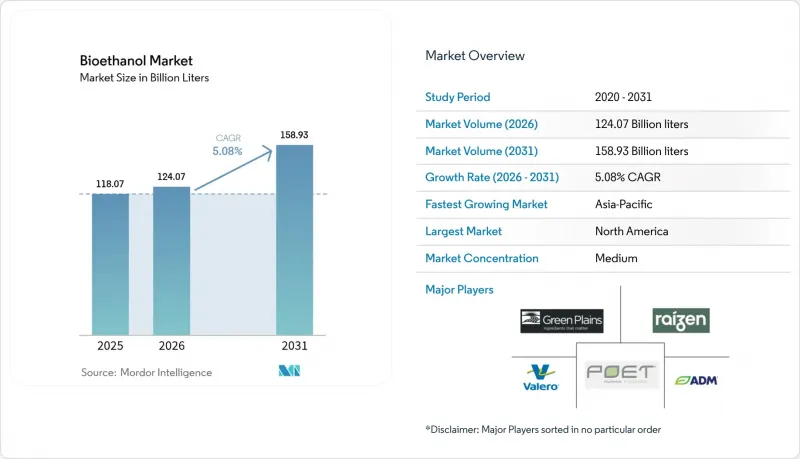
Mordor Intelligence에 따르면 바이오에탄올 시장 규모는 2025년에 1,180억 7,000만 리터로 평가되며, 2026년 1,240억 7,000만 리터에서 2031년까지 1,589억 3,000만 리터에 달할 것으로 예측되며, 예측 기간(2026-2031년) 동안 CAGR은 5.08%가 될 전망입니다.
본 보고서는 원료 종류(사탕수수, 옥수수, 밀, 기타 원료), 용도(자동차·운송, 식품·음료, 의약품, 화장품·퍼스널케어, 기타 용도), 및 지역(아시아태평양, 북미, 유럽, 남미, 중동 및 아프리카)별로 분류되어 있습니다. 시장 예측은 리터 기준으로 제시되어 있습니다.
세계 바이오에탄올 시장의 동향 및 인사이트
세계 E10-E20 혼합 의무화의 긍정적 영향
혼합 의무 강화로 인해 예측 가능한 기본 수요가 창출되고 있으며, 이로 인해 바이오에탄올 시장은 원유 가격 변동의 영향을 덜 받게 되었고, 동시에 생산능력 확대가 확고해지고 있습니다. 일본 전역의 E10 도입 및 E20 시범 도입 지역, 브라질의 27% 상한 유연성, 그리고 인도의 30% 목표 가속화가 맞물려 연간 구매량을 끌어올리고, 신규 플랜트에 대한 투자를 촉진하고 있습니다. 규제 당국은 연료 품질 기준, 국산 제품 사용 규정 및 수입 규제를 통해 규정 준수를 뒷받침하고 있으며, 혼합 목표가 단순한 서류상의 크레딧에 그치지 않고 실제 공급으로 이어지도록 보장하고 있습니다. 이러한 정책 덕분에 전기화가 진전되는 상황 속에서도 바이오에탄올 시장은 국가 에너지 안보 전략의 구조적 요소로 자리매김하고 있습니다.
정유사에 가해지는 탄소 감축 및 ESG 압박
투자자들의 엄격한 감시와 까다로운 탄소 기준에 직면한 정유사들은 현재 저탄소 바이오에탄올을 단순한 규정 준수 요소가 아닌 전략적 차별화 요소로 인식하고 있습니다. 캘리포니아주의 2024년판 ‘저탄소 연료 기준(LCFS)’ 개정에서는 탄소 기준이 강화되었으며, ISCC 등의 제도를 기반으로 인증된 공급이 우대받게 되었습니다. 개정된 EU ‘재생에너지 지침’ 역시 추적 가능하고 지속가능한 공급원에서 생산된 에탄올을 우선시하고 있습니다. 이에 대응하여 BP 등의 기업은 14억 달러를 투자해 Bunge Bioenergia를 인수함으로써 업스트림 부문을 수직 통합하고, 원료 확보와 생애주기 배출량 관리를 한 번에 실현했습니다. 재생 가능 연료 혼합 비율이 의무화된 최저 기준을 상회하는 시장에서는 프리미엄 수요가 발생하여, 저탄소 생산자에게 유리한 가격 차이가 유지되고 있습니다.
소형차의 급속한 전기화
전기자동차(EV) 보급이 급속히 확대되는 가운데, 주요 시장의 휘발유 수요 상한선은 축소되고 있습니다. 노르웨이에서는 2024년 신차 판매에서 전기자동차 보급률이 94%에 달했고, 중국에서는 35%를 넘어섰습니다. 또한, IEA는 2030년까지 전 세계 경차 시장에서 전기자동차의 점유율이 30%에 달할 것으로 예측하고 있습니다. 그 결과, 정유사들은 혼합용 연료 공급원이 축소되는 상황에 직면하고 있으며, 바이오에탄올 생산자들은 항공 연료, 대형 운송 차량 및 수출 주도 전략으로 무게중심을 옮길 수밖에 없게 되었습니다. 신흥국에서는 자동차의 전기화가 뒤처져 있어 지역별 수요의 편차가 여전히 지속되고 있으며, 바이오에탄올 시장에서 지리적 분산화의 기회가 생겨나고 있습니다.
부문 분석
2025년 바이오에탄올 시장 규모 중 옥수수를 원료로 한 생산이 58.12%를 차지했습니다. 이는 미국 중서부, 브라질 마토그로소주의 생산 확대, 그리고 확립된 철도 및 바지선을 통한 물류망에 힘입은 결과입니다. 각 생산 기업은 효소 기술의 발전과 제품별 효율적 활용(특히 가축 사료로서의 증류 잔류물, 음료 활용을 위한 회수된 CO2)을 통해 단위 비용 절감과 탄소 점수 향상을 도모하고 있습니다. 미국 중부 지역 전역에 걸친 탄소 회수 및 지하 저장 클러스터에 대한 지속적인 투자로 인해 라이프사이클 성능의 신뢰성은 더욱 높아지고 있습니다.
밀 에탄올은 2031년까지 연평균 성장률(CAGR) 5.45%를 기록할 것으로 예측되며, 주요 원료 중 가장 빠른 성장이 기대되고 있습니다. 유럽의 사업자들은 국내 곡물 다변화를 위한 정책적 인센티브를 활용하고 있는 반면, 호주의 밀 풍작 주기는 수출 기회를 가져다주고 있습니다. 단백질 프리미엄의 상승으로 인해 밀 유래 증류박은 가축 사료 업체들에게 매력적인 원료가 되어 전분 비용 상승을 상쇄하고 있습니다. 고비중 발효 및 분류를 가능하게 하는 기술적 혁신으로 플랜트의 가동률이 향상되어 바이오에탄올 시장에서 밀의 경쟁력이 강화되고 있습니다.
사탕수수, 카사바, 신흥 리그노셀룰로오스계 원료 등 기타 원료는 틈새 시장이지만 전략적인 공급량을 확보하여, 기상 조건에 따른 작물 변동성에 대한 헤지 역할을 하고 있습니다. 브라질의 사탕수수는 바가스 연소를 통한 열병합 발전을 통해 구조적인 비용 우위를 유지하고 있는 반면, 인도네시아의 니파 야자나 멕시코의 아가베를 활용한 시범 사업은 한계 토지에서 생산을 가능하게 하는 것을 목표로 하고 있습니다. 이러한 다각화는 가격 변동을 완화할 뿐만 아니라, 식용 작물의 대체를 최소화할 것을 요구하는 정책 입안자들의 압력에도 부합합니다.
지역별 분석
북미는 확립된 옥수수 인프라, 안정적인 재생 가능 연료 기준(RFS) 목표, 그리고 주 차원의 저탄소 연료 이니셔티브에 힘입어 2025년에도 세계 생산량의 55.10%를 계속 차지했습니다. 생산자들은 탄소 포집, 대기 직접 포집 및 파이프라인 네트워크를 통합하여 옥수수 에탄올의 탄소 집약도를 낮추고, 고부가가치 크레딧 시장에 진입할 자격을 얻고 있습니다. 캐나다는 밀과 옥수수 원료 클러스터를 활용하는 한편, 멕시코의 수요 증가가 미국의 수출을 흡수함으로써 지역 간 균형을 안정시키는 대륙 간 무역 흐름을 강화하고 있습니다.
아시아태평양은 인도의 30% 혼합 목표와 중국의 수입 의지가 소비를 확대함에 따라, 2031년까지의 예측 연평균 성장률(CAGR)이 5.74%로 가장 높을 것으로 전망됩니다. 각 지역 정부는 바이오에탄올 확대를 농촌 지역 소득 지원 및 외화 절약책으로 간주하며, 다원료형 바이오리파이너리에 대한 현지 투자를 장려하고 있습니다. 태국, 필리핀, 베트남은 농업 현대화 계획에 따른 혼합 의무화를 추진하는 한편, 인도네시아는 식용 작물의 제약을 피하기 위해 니파 야자에서 에탄올을 제조하는 방식을 시험적으로 도입하고 있습니다.
유럽에서는 지속가능성 인증이 중시되고 있으며, 엄격한 온실가스 감축 기준을 충족하는 잔여물 유래 에탄올이 선호되고 있습니다. 독일과 프랑스의 할당제가 수요의 기반이 되고 있으며, 영국의 ‘재생 가능 운송 연료 의무(RTO)’는 지속가능한 항공 연료(SAF)를 우선시하여 간접적으로 에탄올에서 제트 연료로의 전환을 뒷받침하고 있습니다. 브라질이 주도하는 남미에서는 특히 UAE의 135억 달러 투자 약속 등 외국 자본을 유치하여, 사탕수수, 옥수수, 열병합발전을 결합한 통합형 자산의 확장이 진행되고 있습니다. 중동 및 아프리카는 여전히 틈새 시장이지만, 에탄올을 가정용 에너지의 대체 수단으로 자리매김하는 FAO(유엔 식량농업기구)의 ‘청정 조리 솔루션’ 프로그램의 후원에 힘입어 성장을 이어가고 있습니다.
기타 혜택:
- 엑셀 형식의 시장 예측(ME) 시트
- 3개월간 애널리스트의 지원
자주 묻는 질문
목차
제1장 소개
제2장 조사 방법
제3장 주요 요약
제4장 시장 구도
제5장 시장 규모와 성장 예측
제6장 경쟁 구도
제7장 시장 기회와 향후 전망
KSM 26.09.07According to Mordor Intelligence, the bioethanol market size was valued at 118.07 billion litres in 2025 and estimated to grow from 124.07 billion litres in 2026 to reach 158.93 billion litres by 2031, at a CAGR of 5.08% during the forecast period (2026-2031).
This report is Segmented by Feedstock Type (Sugarcane, Corn, Wheat, and Other Feedstock), Application (Automotive and Transportation, Food and Beverages, Pharmaceutical, Cosmetics and Personal Care, and Other Applications), and Geography (Asia-Pacific, North America, Europe, South America, and Middle-East and Africa). The Market Forecasts are Provided in Terms of Volume (Liters).
Global Bioethanol Market Trends and Insights
Favourable Global E10-E20 Blending Mandates
Strengthened blending requirements are creating predictable baseload demand that insulates the bioethanol market from crude price swings while locking in capacity expansion. Japan's nationwide E10 roll-out and pilot E20 zones, Brazil's 27% ceiling flexibility, and India's accelerated 30% target together lift annual offtake volumes and encourage new plant investment. Regulatory agencies back compliance through fuel-quality standards, domestic content rules, and import controls, ensuring blend targets translate into physical deliveries rather than paper credits. These policies turn the bioethanol market into a structural element of national energy security strategies even as electrification gains momentum.
Carbon-Reduction and ESG Pressure on Refiners
Refiners facing investor scrutiny and stringent carbon standards now view low-intensity bioethanol as a strategic differentiator instead of a mere compliance component. California's 2024 Low Carbon Fuel Standard update tightened carbon benchmarks, rewarding supplies certified under schemes such as ISCC. The EU's revised Renewable Energy Directive likewise privileges traceable, sustainably sourced ethanol. In response, companies like BP vertically integrated upstream via the USD 1.4 billion acquisition of Bunge Bioenergia, securing feedstock and lifecycle emission control in one step. Premium demand emerges in markets where renewable-content uptake exceeds mandate floors, sustaining price spreads favorable to lower-carbon producers.
Rapid Electrification of Light-Duty Vehicles
Soaring EV adoption trims gasoline demand ceilings in core markets. Norway hit 94% EV penetration for 2024 new car sales, China surpassed 35%, and the IEA forecasts a 30% global light-vehicle share by 2030. As a result, refiners face shrinking blend pools, compelling bioethanol producers to pivot toward aviation, heavy-duty transport, and export-led strategies. Regional demand divergence persists because emerging economies lag in vehicle electrification, creating opportunities for geographic diversification within the bioethanol market.
Other drivers and restraints analyzed in the detailed report include:
- Feedstock Cost Advantage in U.S. Corn and Brazil Sugarcane
- Octane Demand Spurring Ethanol as Aromatic Substitute
- Food-vs-Fuel and Land-Use Controversy
For complete list of drivers and restraints, kindly check the Table Of Contents.
Segment Analysis
Corn-based output contributed 58.12% of the bioethanol market size in 2025, anchored by the U.S. Midwest, Brazil's Mato Grosso expansion, and well-established rail and barge logistics. Producers leverage enzyme advances and co-product valorization, notably distillers' grains for livestock feed and captured CO2 for beverages, to compress unit costs and improve carbon scores. Continuing investments in carbon capture and underground storage clusters across the Midcontinent further enhance lifecycle performance credentials.
Wheat ethanol is projected to record a 5.45% CAGR through 2031, the fastest growth among mainstream feedstocks. European players harness policy incentives for domestic grain diversification, while Australia's bumper wheat cycles offer export opportunities. Rising protein premiums make wheat distillers' grains attractive to livestock feeders, offsetting higher starch costs. Technology breakthroughs enabling high-gravity fermentation and fractional distillation improve plant utilization rates, strengthening wheat's competitiveness within the bioethanol market.
Other feedstocks, such as sugarcane, cassava, and emerging lignocellulosic sources, supply niche but strategic volumes that hedge against weather-induced crop swings. Brazilian sugarcane retains a structural cost edge via bagasse-fired cogeneration, while Indonesia's nipa palm and Mexico's agave pilots aim to unlock marginal-land production. Such diversification dampens price volatility and aligns with policymakers' pressure to minimize food-crop displacement.
Complete Report Scope:
- By Feedstock Type
- Sugarcane
- Corn
- Wheat
- Other Feedstock
- By Application
- Automotive and Transportation
- Food and Beverages
- Pharmaceutical
- Cosmetics and Personal Care
- Other Applications (Fuel Cells, Power Generation)
- By Geography
- Asia-Pacific
- China
- India
- Japan
- South Korea
- Rest of Asia-Pacific
- North America
- United States
- Canada
- Mexico
- Europe
- Germany
- United Kingdom
- France
- Italy
- Rest of Europe
- South America
- Brazil
- Argentina
- Rest of South America
- Middle-East and Africa
- Saudi Arabia
- South Africa
- Rest of Middle-East and Africa
- Asia-Pacific
Geography Analysis
North America maintained 55.10% of global volume in 2025 thanks to entrenched corn infrastructure, stable Renewable Fuel Standard targets, and supportive state-level Low Carbon Fuel initiatives. Producers integrate carbon capture, direct air capture, and pipeline networks that compress the carbon intensity of corn ethanol, qualifying it for high-value credit markets. Canada leverages wheat and corn feedstock clusters, whereas Mexico's demand uptick absorbs U.S. exports, reinforcing continental trade flows that stabilize regional balance.
Asia-Pacific records the highest forecast CAGR at 5.74% through 2031 as India's 30% blend target and China's import appetite amplify consumption. Regional governments frame bioethanol expansion as rural income support and foreign-exchange savings, encouraging local investment in multi-feedstock biorefineries. Thailand, the Philippines, and Vietnam advance blend mandates aligned with agricultural modernization plans, while Indonesia pilots nipa-to-ethanol routes to sidestep food-crop constraints.
Europe emphasizes sustainability certification and favors residue-based ethanol that fulfills stringent greenhouse-gas savings thresholds. Quota systems in Germany and France anchor demand, and the United Kingdom's Renewable Transport Fuel Obligation prioritizes SAF, indirectly boosting ethanol-to-jet pathways. South America, dominated by Brazil, attracts foreign capital, notably the UAE's USD 13.5 billion commitment, to expand integrated assets that marry sugarcane, corn, and cogeneration. Middle East and Africa remain niche but rising, catalyzed by FAO programs for clean cooking solutions that position ethanol as a household energy alternative.
- Abengoa
- ADM
- Alto Ingredients Inc.
- Blue Biofuels Inc.
- BP p.l.c.
- Cenovus Energy
- Cristalco
- CropEnergies AG
- Ethanol Technologies
- GranBio Investimentos SA
- Green Plains Inc.
- Henan Tianguan Group Co. Ltd
- Jilin Fuel Ethanol Co. Ltd
- KWST
- Lantmannen
- POET LLC
- Raizen
- SEKAB
- SUNCOR Energy Inc.
- Tereos
- Valero
- VERBIO Vereinigte Bioenergie AG
Additional Benefits:
- The market estimate (ME) sheet in Excel format
- 3 months of analyst support
TABLE OF CONTENTS
1 Introduction
- 1.1 Study Assumptions and Market Definition
- 1.2 Scope of the Study
2 Research Methodology
3 Executive Summary
4 Market Landscape
- 4.1 Market Overview
- 4.2 Market Drivers
- 4.2.1 Favourable global E10-E20 blending mandates
- 4.2.2 Carbon-reduction and ESG pressure on refiners
- 4.2.3 Feedstock cost advantage in U.S. corn and Brazil sugarcane
- 4.2.4 Octane demand spurring ethanol as aromatic substitute
- 4.2.5 Airline demand for ethanol-to-jet SAF pathways
- 4.3 Market Restraints
- 4.3.1 Rapid electrification of light-duty vehicles
- 4.3.2 Food-vs-fuel and land-use controversy
- 4.3.3 Stricter ILUC-based carbon-intensity scoring
- 4.4 Value Chain Analysis
- 4.5 Porter's Five Forces
- 4.5.1 Bargaining Power of Suppliers
- 4.5.2 Bargaining Power of Buyers
- 4.5.3 Threat of New Entrants
- 4.5.4 Threat of Substitutes
- 4.5.5 Degree of Competition
5 Market Size and Growth Forecasts (Volume)
- 5.1 By Feedstock Type
- 5.1.1 Sugarcane
- 5.1.2 Corn
- 5.1.3 Wheat
- 5.1.4 Other Feedstock
- 5.2 By Application
- 5.2.1 Automotive and Transportation
- 5.2.2 Food and Beverages
- 5.2.3 Pharmaceutical
- 5.2.4 Cosmetics and Personal Care
- 5.2.5 Other Applications (Fuel Cells, Power Generation)
- 5.3 By Geography
- 5.3.1 Asia-Pacific
- 5.3.1.1 China
- 5.3.1.2 India
- 5.3.1.3 Japan
- 5.3.1.4 South Korea
- 5.3.1.5 Rest of Asia-Pacific
- 5.3.2 North America
- 5.3.2.1 United States
- 5.3.2.2 Canada
- 5.3.2.3 Mexico
- 5.3.3 Europe
- 5.3.3.1 Germany
- 5.3.3.2 United Kingdom
- 5.3.3.3 France
- 5.3.3.4 Italy
- 5.3.3.5 Rest of Europe
- 5.3.4 South America
- 5.3.4.1 Brazil
- 5.3.4.2 Argentina
- 5.3.4.3 Rest of South America
- 5.3.5 Middle-East and Africa
- 5.3.5.1 Saudi Arabia
- 5.3.5.2 South Africa
- 5.3.5.3 Rest of Middle-East and Africa
- 5.3.1 Asia-Pacific
6 Competitive Landscape
- 6.1 Market Concentration
- 6.2 Strategic Moves
- 6.3 Market Share (%)/Ranking Analysis
- 6.4 Company Profiles {(includes Global level Overview, Market level overview, Core Segments, Financials as available, Strategic Information, Market Rank/Share for key companies, Products and Services, and Recent Developments)}
- 6.4.1 Abengoa
- 6.4.2 ADM
- 6.4.3 Alto Ingredients Inc.
- 6.4.4 Blue Biofuels Inc.
- 6.4.5 BP p.l.c.
- 6.4.6 Cenovus Energy
- 6.4.7 Cristalco
- 6.4.8 CropEnergies AG
- 6.4.9 Ethanol Technologies
- 6.4.10 GranBio Investimentos SA
- 6.4.11 Green Plains Inc.
- 6.4.12 Henan Tianguan Group Co. Ltd
- 6.4.13 Jilin Fuel Ethanol Co. Ltd
- 6.4.14 KWST
- 6.4.15 Lantmannen
- 6.4.16 POET LLC
- 6.4.17 Raizen
- 6.4.18 SEKAB
- 6.4.19 SUNCOR Energy Inc.
- 6.4.20 Tereos
- 6.4.21 Valero
- 6.4.22 VERBIO Vereinigte Bioenergie AG
7 Market Opportunities and Future Outlook
- 7.1 White-space and Unmet-Need Assessment