|
시장보고서
상품코드
2121734
3D 세포배양 : 시장 점유율 분석, 업계 동향과 통계, 성장 예측(2026-2031년)3D Cell Culture - Market Share Analysis, Industry Trends & Statistics, Growth Forecasts (2026 - 2031) |
||||||
 Mordor Intelligence
Mordor Intelligence에 의하면, 2026년 3D 세포배양 시장 규모는 26억 7,000만 달러로 추정되며, 2025년 23억 2,000만 달러에서 2031년에는 53억 7,000만 달러에 달할 것으로 예측됩니다.
또한 2026-2031년 연평균 성장률(CAGR) 15.02%를 기록할 전망입니다.
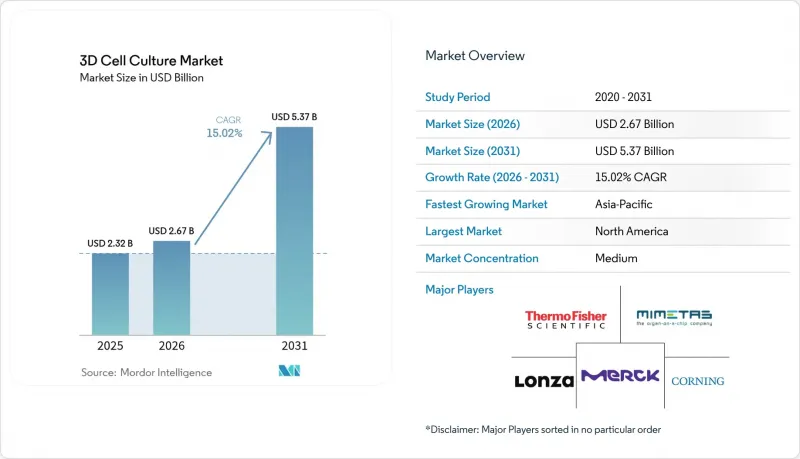
본 보고서는 기술별(스캐폴드 기반 플랫폼, 스캐폴드 프리 플랫폼, 마이크로플루이딕스 기술 기반의 ‘장기 온 칩’ 시스템 등), 용도별(암 연구 및 항암제 스크리닝 등), 최종 사용자별(생명공학 기업 및 제약 회사 등),지역별(북미, 유럽, 아시아태평양 등)로 분류되어 있습니다. 시장 예측은 금액(달러) 기준으로 제시되어 있습니다.
전 세계 3D 세포 배양 시장 동향 및 인사이트
후기 단계의 의약품 개발 실패를 줄이기 위해, 생리학적 관련성이 높은 전임상 모델에 대한 수요가 확대되고 있습니다.
2상 및 3상 단계에서 후보 약물의 90%가 도태되는 현 상황에서 예측 정확도의 향상은 연구 개발에서 필수적인 과제가 되고 있습니다. 세포외 기질의 강성, 산소 농도 구배 및 다세포 간 상호작용을 재현한 3차원 조직은 2차원 배양 플레이트에서는 간과되기 쉬운 독성 특성을 밝혀냅니다. ‘FDA 현대화법 3.0’에 따라 비동물 데이터를 기반으로 한 임상시험용 의약품 신청이 허용되면서, 기업의 검증 주기가 가속화되고 있습니다. 바이오프린팅 기술을 활용해 환자 유래 오가노이드를 생성함으로써, 치료에 반응하는 환자와 반응하지 않는 환자를 실시간으로 분류할 수 있어 비용이 많이 드는 임상시험의 재설계를 줄일 수 있습니다. ‘간 온 칩(Liver-on-a-chip)’ 어레이를 도입한 제약 팀은 2024년 신청 건에서 간독성과 관련된 후보 화합물의 철회가 30% 감소했다고 보고했습니다. 이러한 개선 사항들이 결합되어 임상 위험을 저감하며, 첨단 배양 플랫폼에 대한 초기 투자 증대를 정당화합니다.
재생의학 및 맞춤형 의료에 대한 전 세계적 투자 확대가 3D 배양 기술의 보급을 가속화
2025년, 재생의학 분야에 투입된 민간 및 공공 자금은 전 세계적으로 300억 달러를 넘어섰으며, 그중 35%가 조직 공학 툴킷에 할당되었습니다. 자가 이식에는 환자 고유의 미세 환경이 필요하기 때문에 각 기업은 3D 바이오 프린팅과 유도 만능 줄기세포(iPS 세포)를 통합하여 면역 적합성이 있는 이식편을 제조하고 있습니다. 중국 국가자연과학기금은 하이드로겔 기반 장기 패치에 대한 보조금을 두 배로 늘려 국내 바이오잉크 공급업체를 지원하고 있습니다. 이와 병행하여 진행되고 있는 CRISPR 편집 오가노이드에 대한 투자는 한때 치료가 불가능하다고 여겨졌던 단일 유전자 질환에 대한 전임상 단계의 청사진을 만들어내고 있습니다. 이러한 중개 연구 워크플로는 맞춤형 기질 재료의 화학적 구성과 관류형 바이오리액터에 의존하며, 3D 배양 하드웨어를 정밀 의학의 밸류체인 핵심에 통합하고 있습니다.
첨단 3D 배양 플랫폼과 기존 2D 시스템의 높은 설비 투자 및 운영 비용
시판되는 유량 제어식 ‘장기 온 칩(organ-on-a-chip)’ 장치의 가격은 8만-15만 달러로, 적층 가능한 2D 인큐베이터의 최저 가격인 1만 5,000달러를 훨씬 상회합니다. 마이크로플루이딕스 펌프, 인라인 센서, 다중 이미징 기능을 포함하면 운영 비용은 더욱 상승합니다. 소규모 연구 기관들은 업그레이드를 미루고 있으며, 이로 인해 남미와 아프리카에서의 보급이 제한되고 있습니다. 이에 대응하여 각 제조업체들은 데스크톱형 스테레오 리소그래피 프린터로 제조된 모듈식 칩을 제공함으로써 1회 실행당 비용을 35% 절감하고 있습니다. 광경화성 수지의 대량 공급 계약과 오픈소스 제어 소프트웨어 덕분에 소유 비용이 절감되어, 많은 연구실에서 2회 예산 주기 이내에 이러한 제약을 해소할 가능성이 있습니다.
부문 분석
2025년, 3D 세포 배양 시장에서 스캐폴드 플랫폼은 48.32%의 점유율을 차지하며, 세포외 기질의 모방이 필요한 장기 배양에서 여전히 필수적인 존재였습니다. 이 기존 범주는 수십 년에 걸친 공개 프로토콜의 혜택을 받아 왔으며, 규제된 품질 관리 시스템 내에서 검증이 용이하다는 장점이 있었습니다. 그러나 마이크로플루이딕스식 ‘장기-온-칩(organ-on-chip)’ 하위 부문은 층류 기능, 실시간 이미징 창, 그리고 중개 약동학 분석을 가능하게 하는 다기관 네트워크 기능을 바탕으로 18.25%의 연평균 성장률(CAGR)을 기록하며 다른 모든 경쟁 제품을 앞지르고 있습니다. 각 벤더는 연동 펌프가 필요 없는 중력 흐름과 자기 결합 밸브를 통합함으로써 유지보수로 인한 가동 중단 시간을 단축하고 실험의 재현성을 높이고 있습니다. 추가적인 성장 동력은 대사 플럭스를 머신러닝 모델로 스트리밍하는 클라우드 연결 센서에서 비롯되며, 이를 통해 생이미지를 며칠이 아닌 몇 분 만에 용량-반응 곡선으로 변환할 수 있게 되었습니다. 이러한 효율성은 엄격한 마일스톤 기한에 쫓기는 신약 개발 팀의 공감을 불러일으키며, 정적 하이드로겔 인서트에서 대체하는 추세를 촉진하고 있습니다. 비용이 감소함에 따라, 마이크로플루이딕스 기술을 이용한 3D 세포 배양 시장 규모는 2029년까지 2024년 기준치의 2배에 달할 것으로 예측됩니다. 이는 하이브리드 프로토콜에서 칩 내에서 하이드로겔 액적(droplet)을 혼합하여 간질 구획을 모방하기 때문에 스캐폴드 재료에 대한 수요를 완전히 대체하지는 않기 때문입니다.
스캐폴드 프리 스페로이드 생성 장치는 음향력이나 자력을 이용하여 세포 응집체를 형성하기 때문에 384웰 규모의 처리 능력이 필요한 고처리량 스크리닝 그룹에게 매력적입니다. 한때 공학 분야로 한정되었던 3D 바이오 프린팅 워크스테이션도 현재는 GMP 등급의 인클로저를 표준으로 장착하고 있어, 이 기술은 상업적인 자가 조직 제조를 향한 입지를 확립해 가고 있습니다. 관류 센서와 연동된 바이오리액터는 세포 치료제 제조를 목적으로 하는 밀리리터 규모의 조직 구조체에 필요한 균일한 영양 농도 구배를 실현합니다. 풀 스택형 모델 설계, 검증, 데이터 분석을 제공하는 서비스 제공업체들은 처리 속도와 분자 어노테이션의 심도 측면에서 경쟁하고 있으며, 이러한 차별화는 사내 자원이 제한적인 소규모 생명공학 기업들로부터 강력한 지지를 받고 있습니다. 이러한 기술적 진보가 결합되면서 대상 사용자층이 확대되고 있으며, 3D 배양은 단순한 실험적 부가 기능이 아닌 표준 기법으로서의 입지를 확고히 하고 있습니다.
지역별 분석
2025년, 북미는 전 세계 매출의 41.55%를 차지했습니다. 이는 NIH(미국 국립보건원)의 중개 연구 보조금, 풍부한 벤처 캐피탈, 그리고 비동물 데이터에 대한 FDA(미국 식품의약국)의 신속 심사 절차에 힘입은 결과입니다. 미국 연구소는 해당 지역 매출의 85%를 차지하고 있으며, 특히 매사추세츠주와 캘리포니아주의 클러스터에는 장기 칩 혁신 기업과 시퀀싱 제공업체가 집중되어 있습니다. 캐나다와 멕시코는 바이오테크 인큐베이터에 대한 자금 지원을 확대하여 사용자의 접근성을 높이는 한편, 소모품 수입을 보완했습니다.
유럽은 2위를 차지했으며, 엄격한 동물 실험 금지 조치와 대체법에 할당된 ‘호라이즌 유럽’ 보조금을 통해 성장을 강화했습니다. 독일의 프라운호퍼 연구소와 영국의 캐터펄트 센터는 중소기업과 협력하여 근골격계 질환 파이프라인을 다루는 혈관화 뼈 모델의 상용화를 추진하고 있습니다. 규제 당국은 표준화 제정 기관과 협력하여 검증 프레임워크의 조화를 도모하고, 국경을 초월한 연구 비교를 원활하게 하며, 수요에 대한 신뢰를 강화하고 있습니다.
아시아태평양은 중국, 일본, 한국이 3D 배양 기술을 각국의 정밀의료 로드맵에 포함시킨 덕분에 16.32%라는 가장 높은 연평균 성장률(CAGR)을 기록하고 있습니다. 중국 과학기술부는 국가 중점 연구소에서 진행하는 ‘오르간 온 칩(Organ-on-a-chip)’ 시범 사업에 보조금을 지원하고 있으며, 한편 일본의 컨소시엄은 신경퇴행성 질환을 대상으로 한 ‘브레인 온 칩(Brain-on-a-chip)’ 솔루션 개발에 매진하고 있습니다. 인도의 과학산업연구평의회는 수입 의존도를 낮추기 위해 국내 하이드로겔 스타트업 기업을 지원하고 있습니다. 기타 지역에서는 중동 및 아프리카, 남미에서 대학 병원을 중심으로 산학 협력 클러스터가 형성되어, 수주 규모는 초기 단계이지만 증가 추세를 보이고 있습니다. 브라질에서는 새로운 화장품 규제에 대응하기 위해 피부 독성 시험에 특화된 3D 바이오 프린팅 센터에 자금을 지원하고 있습니다. 전 세계적인 확산은 지역별 3D 세포 배양 시장 규모를 확대하고, 이 기술을 주류 채택 주기로 끌어올리고 있습니다.
기타 혜택:
- 엑셀 형식 시장 예측(ME) 시트
- 3개월간의 애널리스트 지원
자주 묻는 질문
목차
제1장 서론
제2장 조사 방법
제3장 주요 요약
제4장 시장 구도
제5장 시장 규모와 성장 예측
제6장 경쟁 구도
제7장 시장 기회와 향후 전망
LSHAccording to Mordor Intelligence, 3D cell culture market size in 2026 is estimated at USD 2.67 billion, growing from 2025 value of USD 2.32 billion with 2031 projections showing USD 5.37 billion, growing at 15.02% CAGR over 2026-2031.
This report is Segmented by Technology (Scaffold-Based Platforms, Scaffold-Free Platforms, Microfluidics-Based Organ-On-Chip Systems, and More), Application (Cancer Research & Oncology Drug Screening, and More), End User (Biotechnology & Pharmaceutical Companies, and More), and Geography (North America, Europe, Asia-Pacific, and More). The Market Forecasts are Provided in Terms of Value (USD).
Global 3D Cell Culture Market Trends and Insights
Expanding Demand for Physiologically Relevant Pre-clinical Models to Cut Late-Stage Drug Failures
The 90% attrition of drug candidates at phase II and phase III has made predictive fidelity an R&D imperative. Three-dimensional tissues that recapitulate extracellular matrix stiffness, oxygen gradients and multicellular interactions yield toxicity signatures frequently missed in 2D plates. FDA Modernization Act 3.0 now permits investigational new drug submissions anchored on non-animal data, accelerating corporate validation cycles. Bioprinted patient-derived organoids allow real-time stratification of responders and non-responders, reducing costly trial redesigns. Pharmaceutical teams that deployed liver-on-chip arrays reported a 30% drop in candidate withdrawal related to hepatotoxicity in 2024 filings. Together these improvements shrink clinical risk and justify higher up-front spending on advanced culture platforms.
Escalating Global Investment in Regenerative & Personalized Medicine Accelerating 3D Culture Uptake
Private and public capital directed to regenerative therapeutics exceeded USD 30 billion globally in 2025, with 35% earmarked for tissue-engineering toolkits. Because autologous implants demand patient-specific microenvironments, companies integrate 3D bioprinting with induced pluripotent stem cells to fabricate immune-compatible grafts. China's National Natural Science Foundation doubled grants for hydrogel-based organ patches, spurring domestic suppliers of bioinks. Parallel investments in CRISPR-edited organoids are creating pre-clinical blueprints for single-gene disorders once deemed untreatable. These translational workflows rely on customizable scaffold chemistries and perfusion bioreactors, embedding 3D culture hardware into the core of precision-medicine value chains.
High Capital & Operating Costs of Advanced 3D Culture Platforms vs. Conventional 2D Systems
Commercial flow-controlled organ-on-chip rigs list between USD 80,000 and USD 150,000, dwarfing the USD 15,000 entry point for stackable 2D incubators. Operating outlays rise further once microfluidic pumps, inline sensors and multiplex image capture are included. Smaller institutes postpone upgrades, limiting regional penetration in South America and Africa. Manufacturers are responding with modulable chips produced on desktop stereolithography printers, slicing per-run costs by 35%. Bulk supply agreements for photo-curable resins and open-source control software reduce ownership expenses and could neutralize the restraint within two budget cycles for many labs.
Other drivers and restraints analyzed in the detailed report include:
- Intensifying Regulatory & Ethical Pressure to Replace Animal Testing in Cosmetics and Pharma
- Rapid Advances in Scaffold Materials & Bioinks Enabling Commercial-Scale 3D Production
- Lack of Harmonized Global Standards for Validation & Reproducibility
For complete list of drivers and restraints, kindly check the Table Of Contents.
Segment Analysis
Scaffold platforms held a 48.32% slice of the 3D cell culture market share in 2025 and remained indispensable for long-term cultures that require extracellular-matrix mimicry. This legacy category benefited from decades of published protocols, which made validation straightforward inside regulated quality systems. Yet the microfluidic organ-on-chip sub-segment is outpacing all rivals with an 18.25% CAGR tied to its capacity for laminar flow, real-time imaging windows and multi-organ networking that unlock translational pharmacokinetics. Vendors are integrating peristaltic-pump-free gravity flow and magnetically coupled valves, trimming maintenance downtime and increasing experiment reproducibility. Further momentum stems from cloud-connected sensors that stream metabolic flux to machine-learning models, turning raw images into dose-response curves in minutes rather than days. This efficiency resonates with discovery teams pressured by aggressive milestone timelines, encouraging substitution away from static hydrogel inserts. As costs fall, the 3D cell culture market size for microfluidics is projected to double its 2024 baseline before 2029 without cannibalizing all scaffold demand, because hybrid protocols mix hydrogel droplets within chips to simulate stromal compartments.
Scaffold-free spheroid generators leverage acoustic or magnetic forces to assemble cellular aggregates, appealing to high-throughput screening groups that need 384-well throughput. 3D bioprinting workstations, once confined to engineering departments, now ship with GMP-grade enclosures, positioning the technology for commercial autologous tissue fabrication. Bioreactors married to perfusion sensors deliver homogeneous nutrient gradients required for milliliter-scale tissue constructs aimed at cell-therapy manufacturing. Service providers offering full-stack model design, validation, and data interpretation compete on turnaround speed and depth of molecular annotation, a differentiation that resonates with small biotech firms with lean internal capacities. Collectively, these technological advances expand the addressable user base and cement 3D culture as a staple rather than an exploratory add-on.
Complete Report Scope:
- By Technology
- Scaffold-based Platforms
- Micropatterned Surface Microplates
- Hydrogels (Natural, Synthetic, Hybrid)
- ECM-Derived Scaffolds
- Porous Microcarriers
- Scaffold-free Platforms
- Hanging Drop Plates
- Magnetic Levitated Spheroids
- Microfluidics-based Organ-on-Chip Systems
- 3D Bioreactors (Spinner, Perfusion, Rotating-Wall)
- 3D Bioprinting Systems & Reagents
- Services (Custom Assay Development, Outsourced Models)
- Scaffold-based Platforms
- By Application
- Cancer Research & Oncology Drug Screening
- Stem Cell Research & Tissue Engineering
- Drug Discovery & Toxicology Screening
- Regenerative Medicine / Personalized Therapeutics
- Other Applications (Virology, Cosmetics Safety)
- By End User
- Biotechnology & Pharmaceutical Companies
- Academic & Research Institutes
- Contract Research Organizations & CDMOs
- Hospitals & Diagnostic Centers
- Geography
- North America
- United States
- Canada
- Mexico
- Europe
- Germany
- United Kingdom
- France
- Italy
- Spain
- Rest of Europe
- Asia-Pacific
- China
- Japan
- India
- South Korea
- Australia
- Rest of Asia-Pacific
- Middle East and Africa
- GCC
- South Africa
- Rest of Middle East and Africa
- South America
- Brazil
- Argentina
- Rest of South America
- North America
Geography Analysis
North America accounted for 41.55% of global revenue in 2025, supported by NIH translational grants, venture-capital depth and expedited FDA pathways for non-animal data. United States laboratories accumulated 85% of regional turnover, particularly within Massachusetts and California clusters that concentrate organ-chip innovators and sequencing providers. Canada and Mexico increased funding pools for biotech incubators, broadening user access and supplementing import flows of consumables.
Europe ranked second and fortified growth through stringent animal-testing bans and Horizon Europe grants earmarked for alternative methods. Germany's Fraunhofer institutes and the United Kingdom's Catapult centers collaborate with SMEs to commercialize vascularized bone models that tackle musculoskeletal-disorder pipelines. Regulators collaborate with standard-development bodies to harmonize validation frameworks, smoothing cross-border study comparisons and reinforcing demand confidence.
Asia-Pacific logs the fastest CAGR at 16.32% as China, Japan and South Korea integrate 3D culture into national precision-medicine roadmaps. China's Ministry of Science and Technology subsidizes organ-on-chip pilots in state key laboratories, while Japanese consortia target brain-on-chip solutions for neurodegeneration. India's Council of Scientific and Industrial Research sponsors indigenous hydrogel startups to cut import dependency. Elsewhere, the Middle East, Africa and South America register nascent but rising orders as academic-industry clusters form around university hospitals. Brazil funds 3D bioprinting centers focused on dermal toxicity tests to align with new cosmetic regulations. The growing global footprint magnifies the 3D cell culture market size in regional breakouts and propels the technology into mainstream adoption cycles.
- Thermo Fisher Scientific
- Corning
- Merck
- Lonza Group
- Sartorius
- Becton Dickinson & Co.
- InSphero
- Mimetas
- CN Bio Innovations Ltd.
- BiomimX
- Hurel
- Nortis
- PromoCell
- Kirkstall Ltd.
- TissUse
- Synthecon Inc.
- QGel SA
- Prellis Biologics Inc.
- Advanced Solutions Life Sciences
- CELLINK AB
Additional Benefits:
- The market estimate (ME) sheet in Excel format
- 3 months of analyst support
TABLE OF CONTENTS
1 Introduction
- 1.1 Study Assumptions & Market Definition
- 1.2 Scope of the Study
2 Research Methodology
3 Executive Summary
4 Market Landscape
- 4.1 Market Overview
- 4.2 Market Drivers
- 4.2.1 Expanding Demand for Physiologically Relevant Pre-clinical Models to Cut Late-Stage Drug Failures
- 4.2.2 Escalating Global Investment in Regenerative & Personalized Medicine Accelerating 3D Culture Uptake
- 4.2.3 Intensifying Regulatory & Ethical Pressure to Replace Animal Testing in Cosmetics and Pharma
- 4.2.4 Rapid Advances in Scaffold Materials & Bioinks Enabling Commercial-Scale 3D Production
- 4.2.5 Pharma-CRO Partnerships for Turn-Key 3D Models Shortening Time-to-Clinic
- 4.3 Market Restraints
- 4.3.1 High Capital & Operating Costs of Advanced 3D Culture Platforms vs. Conventional 2D Systems
- 4.3.2 Lack of Harmonized Global Standards for Validation & Reproducibility
- 4.3.3 Scarcity of Specialized Technical Talent in Emerging Regions
- 4.4 Regulatory Outlook
- 4.5 Porter's Five Forces
- 4.5.1 Threat of New Entrants
- 4.5.2 Bargaining Power of Buyers
- 4.5.3 Bargaining Power of Suppliers
- 4.5.4 Threat of Substitutes
- 4.5.5 Competitive Rivalry
5 Market Size & Growth Forecasts (Value, USD)
- 5.1 By Technology
- 5.1.1 Scaffold-based Platforms
- 5.1.1.1 Micropatterned Surface Microplates
- 5.1.1.2 Hydrogels (Natural, Synthetic, Hybrid)
- 5.1.1.3 ECM-Derived Scaffolds
- 5.1.1.4 Porous Microcarriers
- 5.1.2 Scaffold-free Platforms
- 5.1.2.1 Hanging Drop Plates
- 5.1.2.2 Magnetic Levitated Spheroids
- 5.1.3 Microfluidics-based Organ-on-Chip Systems
- 5.1.4 3D Bioreactors (Spinner, Perfusion, Rotating-Wall)
- 5.1.5 3D Bioprinting Systems & Reagents
- 5.1.6 Services (Custom Assay Development, Outsourced Models)
- 5.1.1 Scaffold-based Platforms
- 5.2 By Application
- 5.2.1 Cancer Research & Oncology Drug Screening
- 5.2.2 Stem Cell Research & Tissue Engineering
- 5.2.3 Drug Discovery & Toxicology Screening
- 5.2.4 Regenerative Medicine / Personalized Therapeutics
- 5.2.5 Other Applications (Virology, Cosmetics Safety)
- 5.3 By End User
- 5.3.1 Biotechnology & Pharmaceutical Companies
- 5.3.2 Academic & Research Institutes
- 5.3.3 Contract Research Organizations & CDMOs
- 5.3.4 Hospitals & Diagnostic Centers
- 5.4 Geography
- 5.4.1 North America
- 5.4.1.1 United States
- 5.4.1.2 Canada
- 5.4.1.3 Mexico
- 5.4.2 Europe
- 5.4.2.1 Germany
- 5.4.2.2 United Kingdom
- 5.4.2.3 France
- 5.4.2.4 Italy
- 5.4.2.5 Spain
- 5.4.2.6 Rest of Europe
- 5.4.3 Asia-Pacific
- 5.4.3.1 China
- 5.4.3.2 Japan
- 5.4.3.3 India
- 5.4.3.4 South Korea
- 5.4.3.5 Australia
- 5.4.3.6 Rest of Asia-Pacific
- 5.4.4 Middle East and Africa
- 5.4.4.1 GCC
- 5.4.4.2 South Africa
- 5.4.4.3 Rest of Middle East and Africa
- 5.4.5 South America
- 5.4.5.1 Brazil
- 5.4.5.2 Argentina
- 5.4.5.3 Rest of South America
- 5.4.1 North America
6 Competitive Landscape
- 6.1 Market Concentration
- 6.2 Market Share Analysis
- 6.3 Company Profiles (includes Global level Overview, Market level overview, Core Business Segments, Financials, Headcount, Key Information, Market Rank, Market Share, Products and Services, and analysis of Recent Developments)
- 6.3.1 Thermo Fisher Scientific Inc.
- 6.3.2 Corning Incorporated
- 6.3.3 Merck KGaA
- 6.3.4 Lonza Group AG
- 6.3.5 Sartorius AG
- 6.3.6 Becton Dickinson & Co.
- 6.3.7 InSphero AG
- 6.3.8 MIMETAS BV
- 6.3.9 CN Bio Innovations Ltd.
- 6.3.10 BiomimX SRL
- 6.3.11 Hurel Corporation
- 6.3.12 Nortis Inc.
- 6.3.13 PromoCell GmbH
- 6.3.14 Kirkstall Ltd.
- 6.3.15 TissUse GmbH
- 6.3.16 Synthecon Inc.
- 6.3.17 QGel SA
- 6.3.18 Prellis Biologics Inc.
- 6.3.19 Advanced Solutions Life Sciences
- 6.3.20 CELLINK AB
7 Market Opportunities & Future Outlook
- 7.1 White-space & Unmet-Need Assessment