|
시장보고서
상품코드
2121748
유럽의 머신 비전 시스템 : 시장 점유율 분석, 업계 동향과 통계, 성장 예측(2026-2031년)Europe Machine Vision Systems - Market Share Analysis, Industry Trends & Statistics, Growth Forecasts (2026 - 2031) |
||||||
 Mordor Intelligence
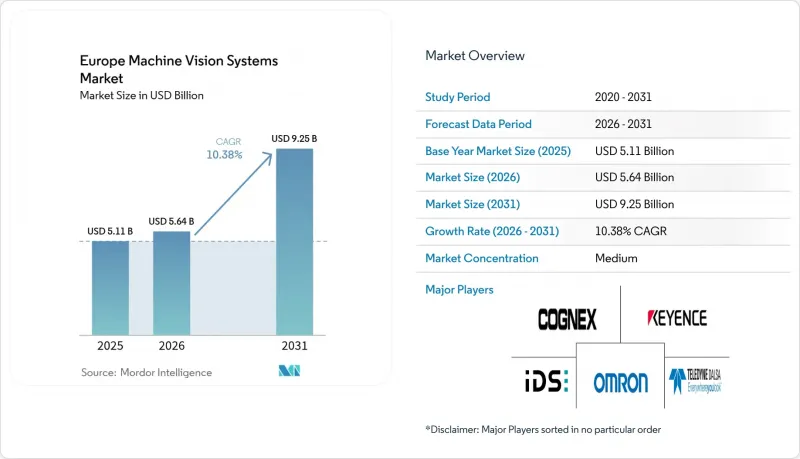
Mordor Intelligence에 따르면 2026년 유럽의 머신 비전 시스템 시장 규모는 56억 4,000만 달러로 추정되고 있으며, 2025년 51억 1,000만 달러에서 확대하며, 2031년에는 92억 5,000만 달러에 달할 것으로 예측됩니다.
2026-2031년 동안의 연평균 성장률(CAGR)은 10.38%에 달할 전망입니다.
이 보고서는 구성 요소(하드웨어(비전 시스템, 카메라, 광학·조명 시스템, 기타)·소프트웨어), 제품(PC 기반·스마트 카메라 기반), 최종사용자 산업(자동차, 식품 및 음료, 기타), 용도(품질 검사, 계측·계량, 기타), 지역별로 분류되어 있습니다. 시장 전망은 금액(달러) 기준으로 제시되어 있습니다.
유럽 머신 비전 시스템 시장의 동향 및 인사이트
품질 검사 및 자동화에 대한 수요 증가
유럽의 각 제조업체들은 인력 부족을 보완하고 더욱 엄격한 품질 기준을 충족하기 위해 비전 가이드형 검사로의 전환을 추진하고 있습니다. 유로 7 규제로 인해 상세한 배기가스 모니터링이 의무화됨에 따라 자동차 제조업체들은 비전 기술을 활용한 진단 기능을 조립 라인에 통합해야 하는 상황에 직면해 있습니다. 독일의 공급업체인 Durr는 도장 공장의 로봇에 카메라를 탑재하여, 보다 정밀한 도장을 통해 에너지 사용량을 30% 절감했습니다. Stevanato Group과 같은 제약 기업은 AI를 강화한 시스템을 도입하여 사람의 개입 없이 1분당 600개 이상의 용기를 검사하고 있습니다. 이러한 성공 사례로 인해 생산량 확보와 규제 준수를 목표로 하는 중규모 공장에서의 도입이 더욱 확대되고 있습니다.
고정밀 결함 탐지에 대한 수요 증가
전자 및 반도체 생산 분야의 허용 오차 범위는 지속적으로 축소되고 있으며, 이로 인해 서브미크론 수준의 시각적 분석에 대한 수요가 발생하고 있습니다. 벨기에 기업 Robovision은 PCB 수준의 정밀도를 유지하면서 분당 100미터의 검사 속도를 실현했습니다. 식품 및 음료 가공업체들도 이에 발맞춰 Deep Detection의 ‘PhotonAI’와 같은 X선 장비를 도입하고 있습니다. 이 장비는 1제곱밀리미터당 초당 2,000만 포톤이라는 고밀도의 광자를 분석하여 이물질을 선별합니다. 조명 기술이 UV에서 멀티 스펙트럼으로 진화함에 따라 지금까지 보이지 않았던 결함을 식별할 수 있게 되어 유럽내 머신 비전의 가치 제안 범위가 넓어지고 있습니다.
중소기업의 높은 초기 도입 비용
풀 라인 비전 시스템의 도입 비용은 종종 10만 유로(11만 3,000달러)를 초과하여, 특히 인건비 경쟁이 치열한 동유럽 지역의 소규모 공장에게는 장벽이 되고 있습니다. MVTec의 MERLIC과 같은 스마트 카메라나 노코드 소프트웨어는 현재 2만 5,000유로(2만 8,250달러) 이하로 판매되어 장벽이 낮아졌지만, 완전히 해소된 것은 아닙니다. 향후 시행될 EU의 수리 가능성에 관한 소비자 보호 지침으로 인해 수명 주기 비용이 증가하고 투자 회수 기간이 길어질 가능성이 있습니다.
부문 분석
유럽 머신 비전 시스템 시장의 하드웨어 시장 규모는 2025년에 압도적인 점유율을 기록했으며, 카메라, 광학 시스템, 프레임 그래버가 매출의 62.55%를 차지했습니다. 비전 시스템용 카메라가 대부분을 차지하고 있으며, 견고한 CMOS 제품 라인을 제공하는 Basler 및 IDS Imaging과 같은 독일 제조업체들이 이를 지원하고 있습니다. 하드웨어 부문의 유럽 머신 비전 시스템 시장 점유율은 소프트웨어 가치가 연평균 성장률(CAGR) 12.68%로 상승함에 따라 점차 감소할 것으로 예상됩니다. 소프트웨어의 부상은 임베디드 칩에 최적화된 AI 모델, MVTec HALCON과 같은 벤더 독립적인 플랫폼, 공정 엔지니어가 코딩 지식 없이도 검사 규칙을 조정할 수 있는 노코드 인터페이스에 대한 수요에 기인합니다.
2세대 엣지 라이브러리는 팬이 없는 시스템에서 첨단 신경망을 실행할 수 있게 되어 총 소유 비용(TCO)을 절감하고 있습니다. 계산 부하가 높은 작업에서는 여전히 클라우드 분석이 중요한 역할을 하고 있지만, GDPR 준수에 따라 많은 공장에서 기밀성이 높은 이미지 데이터를 온프레미스로 보관하고 있습니다. 따라서 사이버 보안 대책이 적용된 컨테이너와 ISO 27001 인증은 조달시 표준 점검 항목이 되었습니다.
2025년, PC 기반 아키텍처는 자동차 도장 검사 및 웨이퍼 계측에서의 멀티 카메라 처리를 가능하게 하는 GPU 가속화에 힘입어, 유럽 머신 비전 시스템 시장 점유율 56.42%를 유지했습니다. 한편, 스마트 카메라는 연평균 성장률(CAGR) 13.55%를 기록하며, 카메라 한 대로 대응 가능한 상황에서는 랙마운트형 솔루션의 시장 점유율을 서서히 빼앗고 있습니다. 배선 및 캐비닛 하드웨어가 줄어들어 비용 절감이 이루어지는 한편, ARM과 비전 처리 유닛을 통해 추론 시간은 10밀리초 이하로 억제되고 있습니다.
의료 분야의 사용 사례는 이러한 변화를 여실히 보여줍니다. 스테바나트 그룹에서는 스마트 카메라를 활용하여 1분당 600개 이상의 바이알의 무결성을 검증함으로써 엄격한 제약 규제를 충족하고 있습니다. 모바일 로봇도 마찬가지로 혜택을 받고 있으며, 공간 제약으로 인해 단일 하우징 내에 광학 시스템과 연산 기능을 통합하는 것이 선호되고 있습니다. 펌웨어 업데이트를 통해 시간이 지남에 따라 새로운 신경망 레이어가 추가됨에 따라 스마트 카메라는 자동화 도입을 고려 중인 중소기업에게 쉽게 확장 가능한 진입점이 되고 있습니다.
기타 혜택
- 엑셀 형식의 시장 예측(ME) 시트
- 3개월간의 애널리스트 지원
자주 묻는 질문
목차
제1장 서론
제2장 조사 방법
제3장 개요
제4장 시장 구도
제5장 시장 규모와 성장 예측
제6장 경쟁 구도
제7장 시장 기회와 향후 전망
KSA 26.09.03According to Mordor Intelligence, Europe machine vision systems market size in 2026 is estimated at USD 5.64 billion, growing from 2025 value of USD 5.11 billion with 2031 projections showing USD 9.25 billion, growing at 10.38% CAGR over 2026-2031.
This report is Segmented by Component (Hardware (Vision Systems Cameras, Optics and Illumination Systems, Frame Grabbers, and More), and Software), Product (PC-Based, and Smart Camera-Based), End-User Industry (Automotive, Food and Beverage, and More), Application (Quality Inspection, Measurement and Metrology, and More), and Geography. The Market Forecasts are Provided in Terms of Value (USD).
Europe Machine Vision Systems Market Trends and Insights
Increasing Need for Quality Inspection and Automation
European manufacturers are turning to vision-guided inspection to offset labour shortages and satisfy stricter quality rules. Euro 7 requirements now oblige detailed emissions monitoring, pushing automakers to integrate vision-enabled diagnostics into assembly lines. German supplier Durr embedded cameras into paint-shop robotics, cutting energy use by 30% through more precise spraying. Pharmaceutical players such as Stevanato Group deploy AI-enhanced systems that inspect more than 600 containers per minute without human intervention. These successes encourage broader adoption across mid-sized plants seeking to safeguard yields and compliance.
Rising Demand for Accurate Defect Detection
Tolerance bands in electronics and semiconductor production continue to shrink, creating demand for sub-micron visual analytics. Belgian firm Robovision demonstrated 100 m-per-minute inspection speeds while maintaining PCB-grade accuracy. Food and beverage processors follow suit with X-ray units such as Deep Detection's PhotonAI, which analyzes 20 million photons / mm2 / s to screen for contaminants. Illumination advances from UV to multispectral help identify previously invisible flaws, widening the value proposition of machine vision in Europe.
High Initial Deployment Costs for SMEs
Full-line vision installations often exceed EUR 100 000 (USD 113 000) and deter smaller factories, especially in wage-competitive regions of Eastern Europe. Smart cameras and no-code software such as MVTec MERLIC now sell for under EUR 25,000 (USD 28,250), shrinking barriers but not eliminating them. Upcoming EU consumer-protection directives on repairability may add life-cycle costs and stretch payback periods.
Other drivers and restraints analyzed in the detailed report include:
- Growing Adoption of Industry 4.0 and Smart Factories
- Advancements in Camera Sensor Resolutions and Processing Speeds
- Lack of Skilled Personnel for System Integration
For complete list of drivers and restraints, kindly check the Table Of Contents.
Segment Analysis
Europe machine vision systems market size for hardware reached a commanding share in 2025, when cameras, optics, and frame grabbers represented 62.55% of revenue. Vision systems cameras accounted for the bulk, aided by German makers like Basler and IDS Imaging that supply robust CMOS lines. *Europe machine vision systems market share* for hardware is expected to erode gradually as software value rises at a 12.68% CAGR. Software's ascent stems from AI models optimized for embedded chips, vendor-agnostic platforms such as MVTec HALCON, and demand for no-code interfaces that let process engineers adjust inspection rules without coding knowledge.
Second-generation edge libraries now run sophisticated neural nets on fanless systems, lowering the total cost of ownership. Cloud analytics still plays a role for compute-heavy tasks, but GDPR compliance drives many factories to keep sensitive imagery on-premises. Cyber-hardened containers and ISO 27001 certifications have therefore become standard check-box items during procurement.
PC-based architectures retained 56.42% of Europe's machine vision systems market share in 2025, bolstered by GPU acceleration that handles multi-camera automotive paint inspection and wafer metrology. Smart cameras, however, are posting a 13.55% CAGR and chip away at rack-mounted solutions whenever one camera can do the job. Cost savings accrue from reduced cabling and cabinet hardware, while ARM and vision-processing units keep inference times under 10 ms.
Healthcare use cases exemplify this shift: Stevanato Group runs smart cameras to verify vial integrity at >600 units per minute and meets stringent pharma rules. Mobile robotics also benefits, as space constraints favour integrated optics and compute within a single housing. As firmware updates add new neural layers over time, smart cameras become an easily scalable entry point for SMEs testing automation waters.
Complete Report Scope:
- By Component
- Hardware
- Vision Systems
- Cameras
- Optics and Illumination Systems
- Frame Grabbers
- Other Hardware
- Software
- Hardware
- By Product
- PC-Based
- Smart Camera-Based
- By End-User Industry
- Automotive
- Electronics and Semiconductors
- Food and Beverage
- Healthcare and Pharmaceutical
- Logistics and Retail
- Other Industries
- By Application
- Quality Inspection
- Measurement and Metrology
- Identification and Code Reading
- Positioning and Guidance
- Robotics Safety and Others
- By Country
- Germany
- United Kingdom
- Italy
- Rest of Europe
List of Companies Covered in this Report:
- Cognex Corporation
- Keyence Corporation
- Omron Corporation
- Basler AG
- Sick AG
- Teledyne DALSA Inc.
- National Instruments Corporation
- Datalogic SpA
- Perceptron Inc.
- USS Vision Inc.
- IDS Imaging Development Systems GmbH
- Stemmer Imaging AG
- Isra Vision AG
- Vitronic Dr.-Ing. Stein Bildverarbeitungssysteme GmbH
- Baumer Optronic GmbH
- Vision Components GmbH
- LMI Technologies Inc.
- MVTec Software GmbH
- Sony Europe B.V. - Industrial Cameras
- Hikrobot Technology Co., Ltd.
Additional Benefits:
- The market estimate (ME) sheet in Excel format
- 3 months of analyst support
TABLE OF CONTENTS
1 INTRODUCTION
- 1.1 Study Assumptions and Market Definition
- 1.2 Scope of the Study
2 RESEARCH METHODOLOGY
3 EXECUTIVE SUMMARY
4 MARKET LANDSCAPE
- 4.1 Market Overview
- 4.2 Market Drivers
- 4.2.1 Increasing Need for Quality Inspection and Automation
- 4.2.2 Rising Demand for Accurate Defect Detection
- 4.2.3 Growing Adoption of Industry 4.0 and Smart Factories
- 4.2.4 Advancements in Camera Sensor Resolutions and Processing Speeds
- 4.2.5 EU Sustainability Rules Driving Energy-Efficiency Audits
- 4.2.6 Edge AI Inferencing ASICs Unlocking New Use-Cases
- 4.3 Market Restraints
- 4.3.1 High Initial Deployment Costs for SMEs
- 4.3.2 Lack of Skilled Personnel for System Integration
- 4.3.3 Fragmented European Harmonised Standards
- 4.3.4 Cyber-Security Risks in Cloud-Based Vision Analytics
- 4.4 Industry Value-Chain Analysis
- 4.5 Impact of Macroeconomic Factors
- 4.6 Technological Outlook
- 4.7 Regulatory Landscape
- 4.8 Porter's Five Forces Analysis
- 4.8.1 Bargaining Power of Suppliers
- 4.8.2 Bargaining Power of Consumers
- 4.8.3 Threat of New Entrants
- 4.8.4 Threat of Substitutes
- 4.8.5 Intensity of Competitive Rivalry
5 MARKET SIZE AND GROWTH FORECASTS (VALUE)
- 5.1 By Component
- 5.1.1 Hardware
- 5.1.1.1 Vision Systems
- 5.1.1.2 Cameras
- 5.1.1.3 Optics and Illumination Systems
- 5.1.1.4 Frame Grabbers
- 5.1.1.5 Other Hardware
- 5.1.2 Software
- 5.1.1 Hardware
- 5.2 By Product
- 5.2.1 PC-Based
- 5.2.2 Smart Camera-Based
- 5.3 By End-User Industry
- 5.3.1 Automotive
- 5.3.2 Electronics and Semiconductors
- 5.3.3 Food and Beverage
- 5.3.4 Healthcare and Pharmaceutical
- 5.3.5 Logistics and Retail
- 5.3.6 Other Industries
- 5.4 By Application
- 5.4.1 Quality Inspection
- 5.4.2 Measurement and Metrology
- 5.4.3 Identification and Code Reading
- 5.4.4 Positioning and Guidance
- 5.4.5 Robotics Safety and Others
- 5.5 By Country
- 5.5.1 Germany
- 5.5.2 United Kingdom
- 5.5.3 Italy
- 5.5.4 Rest of Europe
6 COMPETITIVE LANDSCAPE
- 6.1 Market Concentration
- 6.2 Strategic Moves
- 6.3 Market Share Analysis
- 6.4 Company Profiles (includes Global level Overview, Market level overview, Core Segments, Financials as available, Strategic Information, Market Rank/Share for key companies, Products and Services, and Recent Developments)
- 6.4.1 Cognex Corporation
- 6.4.2 Keyence Corporation
- 6.4.3 Omron Corporation
- 6.4.4 Basler AG
- 6.4.5 Sick AG
- 6.4.6 Teledyne DALSA Inc.
- 6.4.7 National Instruments Corporation
- 6.4.8 Datalogic SpA
- 6.4.9 Perceptron Inc.
- 6.4.10 USS Vision Inc.
- 6.4.11 IDS Imaging Development Systems GmbH
- 6.4.12 Stemmer Imaging AG
- 6.4.13 Isra Vision AG
- 6.4.14 Vitronic Dr.-Ing. Stein Bildverarbeitungssysteme GmbH
- 6.4.15 Baumer Optronic GmbH
- 6.4.16 Vision Components GmbH
- 6.4.17 LMI Technologies Inc.
- 6.4.18 MVTec Software GmbH
- 6.4.19 Sony Europe B.V. - Industrial Cameras
- 6.4.20 Hikrobot Technology Co., Ltd.
7 MARKET OPPORTUNITIES AND FUTURE OUTLOOK
- 7.1 White-space and unmet-need assessment