

|
시장보고서
상품코드
2121756
독일의 약물전달 디바이스 : 시장 점유율 분석, 업계 동향과 통계, 성장 예측(2026-2031년)Germany Drug Delivery Devices - Market Share Analysis, Industry Trends & Statistics, Growth Forecasts (2026 - 2031) |
||||||
 Mordor Intelligence
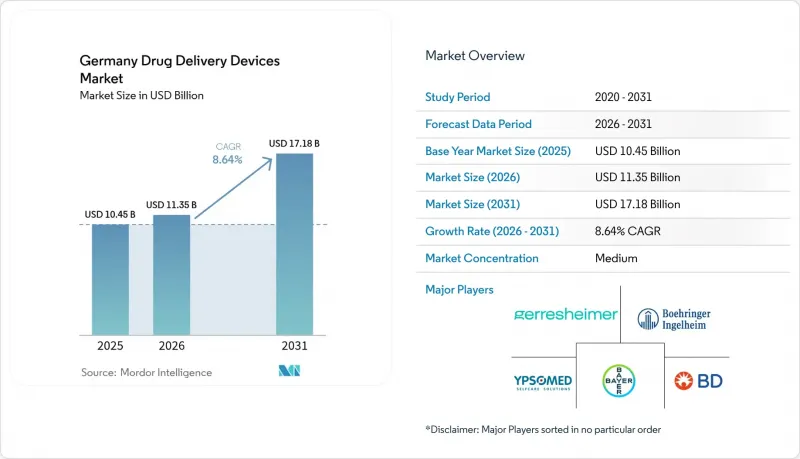
Mordor Intelligence에 따르면 독일의 약물전달 디바이스 시장 규모는 2025년에 104억 5,000만 달러로 평가되며, 2026년 113억 5,000만 달러에서 2031년까지 171억 8,000만 달러에 달할 것으로 예측되고 있으며, 예측 기간(2026-2031년)에 CAGR은 8.64%에 달할 전망입니다.
이 보고서는 기기 유형(주사용 투여 기기, 경피 흡수 패치, 수액 펌프, 기타), 투여 경로(주사제, 흡입, 경피 투여, 기타), 용도(당뇨병, 종양학, 심혈관, 기타), 최종사용자(병원, 외래 수술 센터, 재택 간호, 기타)별로 분류되어 있습니다. 시장 규모 및 전망은 금액(달러) 기준으로 제시됩니다.
독일 약물전달 기기 시장의 동향 및 인사이트
만성질환 및 감염증의 높은 유병률 및 발병률
독일에서는 당뇨병(8.4%), 심혈관 질환(6.8%), 만성 호흡기 질환(11.4%)의 유병률이 EU 평균을 상회하고 있습니다. 이러한 만성질환의 부담이 복약 순응도와 치료 성과를 향상시키는 첨단 주사기, 인슐린 펜,스마트 펌프, 서방형 임플란트에 대한 꾸준한 수요를 견인하고 있습니다. 당뇨병만 해도 2040년까지 1,090만-1,420만 명의 독일인이 앓게 될 것으로 예측되며, 이에 따라 자동 인슐린 투여 생태계의 지속적인 개선이 촉진될 전망입니다. 종양학 부문의 수요도 유사한 추세를 보이고 있으며, 독일 암 연구 센터에서 개발중인 마이크로/나노 로봇은 전신 독성을 줄이면서 종양 부위로의 흡수를 높이는 것을 목표로 하고 있습니다. 이러한 질병 동향과 연구의 비약적인 발전이 맞물리면서, 독일의 약물전달 기기 시장은 혁신 주도형 성장 궤도를 계속 유지하고 있습니다.
재택 의료 확대 동향 및 고령화
65세 이상 인구 비율은 2023년 21%에서 2050년까지 30% 가까이 상승할 전망입니다. 동시에 장기 요양이 필요한 사람의 수는 2050년까지 1,400만 명에 달할 가능성이 있습니다. 이러한 변화로 인해 일반인이 가정 환경에서 안전하게 사용할 수 있는 의료기기에 대한 수요가 높아지고 있습니다. 게레스하이머(Geresheimer)사의 ‘Gx SensAir(R)’와 같은 체내 착용형 주사기는 병원을 방문하지 않고도 주 1회 모노클로널 항체의 피하 투여를 가능하게 하여, 병원 방문에 따른 탄소 배출량을 줄이는 동시에 간병인의 부담을 경감시킵니다. 또한 원격의료 플랫폼에 대한 소비자의 친숙도가 약물 복용 준수 대시보드가 통합된 커넥티드형 흡입기, 펜형 주사기, 패치의 보급을 더욱 가속화하여 독일의 약물전달 기기 시장의 성장세를 지원하고 있습니다.
엄격한 규제 요건 및 제품 리콜
독일에서는 EU 의료기기 규정(MDR)에 더해 의료기기법 시행법이 시행되고 있습니다. 복합 제품은 의약품과 의료기기 양측에 대한 증거 요건을 충족해야 하며, 고위험 등급의 경우 제3자에 의한 적합성 평가가 요구됩니다. 그로 인해 발생하는 비용 급등과 리콜에 따른 책임은 중소기업에게 특히 큰 부담이 되고 있으며, 경우에 따라 신제품 출시가 중단되거나 독일 약물전달 기기 시장의 성장세가 둔화되기도 합니다.
부문 분석
2025년에는 주사용 기기가 총매출의 43.02%를 차지하며, 독일 약물전달 기기 시장 규모에서 그 입지를 확고히 다졌습니다. 신약 승인을 주도하는 생물제제에 대한 지속적인 수요와 임상의들 사이에서 계속해서 선호되는 비경구 투여의 정확성 덕분에 수요가 유지되고 있습니다. SCHOTT Pharma의 폴리머 및 유리 주사기 생산 능력 확대는 업계의 자신감을 지원하고 있습니다.
이식형 펌프, 마이크로칩, 생체흡수성 저장 장치는 연평균 성장률(CAGR) 9.96%로 가장 빠른 성장세를 보이고 있습니다. 만성 호흡기 질환의 국가적 부담이 큰 가운데, 환자 친화적인 흡입기는 시장 점유율을 유지하고 있는 반면, 경피 패치는 호르몬 요법 및 통증 관리 분야에서 점차적으로 채택되고 있습니다. 카테고리를 불문하고 내장된 연결 기능을 통해 투여량 기록 및 피드백 루프가 강화되어, 독일의 약물전달 기기 시장에서 복약 순응도 강화과 데이터베이스 치료 경로가 촉진되고 있습니다.
2025년에도 주사제 투여는 매출의 49.21%를 계속 차지하고 있으며, 이는 백신 및 고분자 의약품에 대한 정맥 내, 피하, 근육내 투여 경로에 대한 임상의들의 신뢰를 반영합니다. 이 비율은 독일 약물전달 기기 시장 점유율의 기반을 형성하고 있으며, 작동력을 줄이고 2-5mL의 투여량을 지원하는 차세대 자동 주사기에 의해 더욱 강화되고 있습니다.
경피 투여 형태는 마이크로니들 어레이와 약물 적재량 한계를 확대하는 무선 구동 음향 패치를 배경으로 연평균 성장률(CAGR) 9.81%로 가장 빠르게 확대되고 있습니다. 구강 점막 필름은 신속한 통증 완화 수단으로 주목받고 있는 반면, 흡입, 안과용, 비강용 투여법은 표적화된 국소 치료의 선택지를 넓혀주고 있으며, 이 모든 요소가 결합되어 독일 약물전달 장치 시장에서 의료진이 활용할 수 있는 임상 툴 키트를 더욱 풍부하게 만들고 있습니다.
기타 혜택
- 엑셀 형식의 시장 예측(ME) 시트
- 3개월간의 애널리스트 지원
자주 묻는 질문
목차
제1장 서론
제2장 조사 방법
제3장 개요
제4장 시장 구도
제5장 시장 규모와 성장 예측
제6장 경쟁 구도
제7장 시장 기회와 향후 전망
KSA 26.09.03According to Mordor Intelligence, the Germany drug delivery devices market size was valued at USD 10.45 billion in 2025 and estimated to grow from USD 11.35 billion in 2026 to reach USD 17.18 billion by 2031, at a CAGR of 8.64% during the forecast period (2026-2031).
This report is Segmented by Device Type (Injectable Delivery Devices, Transdermal Patches, Infusion Pumps, and More), Route of Administration (Injectable, Inhalational, Transdermal, and More), Application (Diabetes, Oncology, Cardiovascular, and More), and End Users (Hospitals, Ambulatory Surgical Centres, Homecare Settings, and More). The Market and Forecasts are Provided in Terms of Value (USD).
Germany Drug Delivery Devices Market Trends and Insights
High Prevalence and Incidence of Chronic and Infectious Diseases
Germany reports higher-than-EU-average prevalence for diabetes (8.4%), cardiovascular diseases (6.8%), and chronic respiratory diseases (11.4%). This chronic-disease load drives steady demand for advanced injectors, insulin pens, smart pumps, and sustained-release implants that improve adherence and outcomes. Diabetes alone is projected to affect 10.9-14.2 million Germans by 2040, pushing continuous upgrades in automated insulin delivery ecosystems. Oncology demand follows a similar path: micro-/nano-robots under development at the German Cancer Research Center aim to raise tumour-site uptake while cutting systemic toxicity. Together, disease trends and research breakthroughs keep the Germany drug delivery devices market on an innovation-driven trajectory.
Growing Trend of Home Healthcare and Aging Population
People aged >= 65 will rise from 21% of the population in 2023 to nearly 30% by 2050. Concurrently, those requiring long-term care could climb to 14 million by 2050. These shifts amplify the need for devices that non-professionals can use safely in domestic settings. On-body injectors such as Gerresheimer's Gx SensAir(R) allow weekly subcutaneous dosing of monoclonal antibodies without clinical visits, cutting travel-related emissions and easing caregiver burdens. Consumer familiarity with telehealth platforms further accelerates uptake of connected inhalers, pens, and patches that integrate adherence dashboards, reinforcing market momentum in Germany drug delivery devices market.
Stringent Regulatory Requirements and Product Recalls
Germany enforces EU Medical Device Regulation (MDR) alongside its Medical Device Law Implementation Act. Combination products must satisfy dual drug-device evidence packages, and higher-risk classes require third-party conformity assessments.Resulting cost spikes and recall liabilities weigh heaviest on SMEs, occasionally pausing launches and trimming the Germany drug delivery devices market growth curve.
Other drivers and restraints analyzed in the detailed report include:
- Increasing Investment in Biosimilar and Biologics Product Innovation and Development
- Government Initiatives Supporting Fast Track Approval and Reimbursement
For complete list of drivers and restraints, kindly check the Table Of Contents.
Segment Analysis
Injectable devices represented 43.02% of all revenues in 2025, cementing their role in the Germany drug delivery devices market size. Sustained demand arises from biologic therapies that dominate new drug approvals and from continuing preference among clinicians for parenteral accuracy. SCHOTT Pharma's capacity surge in polymer and glass syringes underscores industry confidence.
Implantable pumps, micro-chips, and bioresorbable depots post the quickest gains at an 9.96% CAGR. Patient-friendly inhalers preserve share amid a high national burden of chronic respiratory illness, while transdermal patches earn incremental adoption for hormone and pain management. Across categories, embedded connectivity features enhance dose logging and feedback loops, lifting adherence and data-driven care pathways within the Germany drug delivery devices market.
Injectable delivery retained a 49.21% revenue stake in 2025, reflecting clinician trust in intravenous, subcutaneous, and intramuscular routes for vaccines and large-molecule drugs. This proportion anchors the Germany drug delivery devices market share and is bolstered by next-gen autoinjectors that lower activation force and support 2-5 mL volumes.
Transdermal formats scale fastest at a 9.81% CAGR on the back of microneedle arrays and wirelessly powered acoustic patches that raise payload size limits. Oral mucosal films gain traction for rapid pain relief, while inhaled, ocular, and nasal modalities extend options for targeted local therapy, together enriching clinical toolkits available to practitioners in the Germany drug delivery devices market.
Complete Report Scope:
- By Device Type
- Injectable Delivery Devices
- Inhalation Delivery Devices
- Infusion Pumps
- Transdermal Patches
- Implantable Drug Delivery Systems
- Ocular Inserts & Delivery Implants
- Nasal & Buccal Delivery Devices
- By Route of Administration
- Injectable
- Inhalation
- Transdermal
- Oral Mucosal (Buccal and Sublingual)
- Ocular
- Nasal
- By Application
- Diabetes
- Oncology
- Cardiovascular
- Respiratory
- Central Nervous System Disorders
- Infectious Diseases
- Others
- By End-user
- Hospitals
- Ambulatory Surgical Centres
- Homecare Settings
- Clinics and Speciality Centres
- Others
List of Companies Covered in this Report:
- Beckton Dickinson
- Gerresheimer
- Ypsomed
- Bayer
- Boehringer Ingelheim
- Pfizer
- Solventum
- Phillips-Medisize LLC
- Novartis
- Owen Mumford
- Novo Nordisk
- Medtronic
- West Pharmaceutical Services
- SCHOTT
- Haselmeier GmbH
- Sanofi
- Terumo
- Teva Pharmaceutical Industries
- Vetter Pharma-Fertigung GmbH & Co. KG
- Nemera La Verpilliere SAS
Additional Benefits:
- The market estimate (ME) sheet in Excel format
- 3 months of analyst support
TABLE OF CONTENTS
1 Introduction
- 1.1 Study Assumptions and Market Definition
- 1.2 Scope of the Study
2 Research Methodology
3 Executive Summary
4 Market Landscape
- 4.1 Market Overview
- 4.2 Market Drivers
- 4.2.1 High Prevalence and Incidence of Chronic and Infectious Diseases
- 4.2.2 Growing Trend of Home Healthcare and Aging Population
- 4.2.3 Increasing Investment in Biosimiliar and Biologics Product Innovation and Development
- 4.2.4 Government Initiatives Supporting Fast Track Approval and Reimbursemnet
- 4.2.5 Technological Advancement and Digitalization
- 4.2.6 Expansion of Contract-Manufacturing Hubs
- 4.3 Market Restraints
- 4.3.1 Stringent Regulatory Requirements and Product Recalls
- 4.3.2 G-BA Price Regulation Capping Premiums for Innovative Systems
- 4.3.3 Market Saturation in Conventional systems Coupled with Patient Compliance and Acceptance Issues
- 4.3.4 Limited Availability of Specialized Microfluidics & Combination-Product Engineering Talent
- 4.4 Value / Supply-Chain Analysis
- 4.5 Regulatory and Technological Outlook
- 4.6 Porter's Five Forces Analysis
- 4.6.1 Bargaining Power of Suppliers
- 4.6.2 Bargaining Power of Buyers
- 4.6.3 Threat of New Entrants
- 4.6.4 Threat of Substitutes
- 4.6.5 Intensity of Competitive Rivalry
5 Market Size and Growth Forecasts (Value-USD)
- 5.1 By Device Type
- 5.1.1 Injectable Delivery Devices
- 5.1.2 Inhalation Delivery Devices
- 5.1.3 Infusion Pumps
- 5.1.4 Transdermal Patches
- 5.1.5 Implantable Drug Delivery Systems
- 5.1.6 Ocular Inserts & Delivery Implants
- 5.1.7 Nasal & Buccal Delivery Devices
- 5.2 By Route of Administration
- 5.2.1 Injectable
- 5.2.2 Inhalation
- 5.2.3 Transdermal
- 5.2.4 Oral Mucosal (Buccal and Sublingual)
- 5.2.5 Ocular
- 5.2.6 Nasal
- 5.3 By Application
- 5.3.1 Diabetes
- 5.3.2 Oncology
- 5.3.3 Cardiovascular
- 5.3.4 Respiratory
- 5.3.5 Central Nervous System Disorders
- 5.3.6 Infectious Diseases
- 5.3.7 Others
- 5.4 By End-user
- 5.4.1 Hospitals
- 5.4.2 Ambulatory Surgical Centres
- 5.4.3 Homecare Settings
- 5.4.4 Clinics and Speciality Centres
- 5.4.5 Others
6 Competitive Landscape
- 6.1 Market Concentration
- 6.2 Strategic Moves
- 6.3 Market Share Analysis
- 6.4 Company profiles (includes Global level Overview, Market level overview, Core Segments, Financials as available, Strategic Information, Market Rank/Share for key companies, Products and Services, and Recent Developments)
- 6.4.1 Becton, Dickinson and Company
- 6.4.2 Gerresheimer AG
- 6.4.3 Ypsomed Holding AG
- 6.4.4 Bayer AG
- 6.4.5 Boehringer Ingelheim International GmbH
- 6.4.6 Pfizer Inc.
- 6.4.7 Solventum
- 6.4.8 Phillips-Medisize LLC
- 6.4.9 Novartis AG
- 6.4.10 Owen Mumford Ltd
- 6.4.11 Novo Nordisk A/S
- 6.4.12 Medtronic plc
- 6.4.13 West Pharmaceutical Services Inc.
- 6.4.14 SCHOTT AG
- 6.4.15 Haselmeier GmbH
- 6.4.16 Sanofi S.A.
- 6.4.17 Terumo Corporation
- 6.4.18 Teva Pharmaceutical Industries Ltd.
- 6.4.19 Vetter Pharma-Fertigung GmbH & Co. KG
- 6.4.20 Nemera La Verpilliere SAS
7 Market Opportunities and Future Outlook
- 7.1 White-Space and Unmet-Need Assessment


