|
시장보고서
상품코드
2121788
웨어러블 접착제 : 시장 점유율 분석, 업계 동향과 통계, 성장 예측(2026-2031년)Wearable Adhesive - Market Share Analysis, Industry Trends & Statistics, Growth Forecasts (2026 - 2031) |
||||||
 Mordor Intelligence
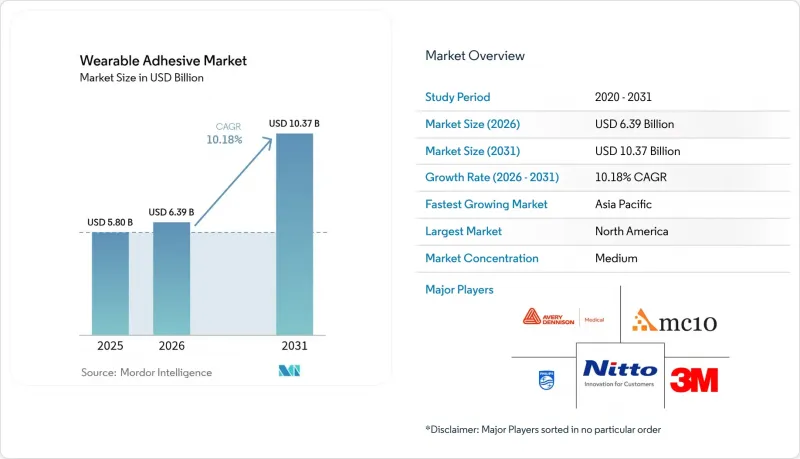
Mordor Intelligence에 의하면, 웨어러블 용접착제 시장 규모는 2025년 58억 달러에서 2026년에는 63억 9,000만 달러에 이르고, 2026-2031년 CAGR 10.18%로 성장을 지속하여 2031년에는 103억 7,000만 달러에 달할 것으로 예측됩니다.
본 보고서는 접착제의 화학 조성(실리콘, 아크릴, 하이드로겔, 하이드로콜로이드, 기타),제품 유형(진단·모니터링용 패치, 치료용 패치 등), 용도(의료, 스포츠 및 피트니스, 산업·군사 등), 최종 사용자(병원, 진료소, 재택 간호 시설 등), 그리고 지역별로 분류되어 있습니다. 시장 전망은 금액(달러) 기준으로 제시되어 있습니다.
세계 웨어러블 접착제 시장 동향 및 인사이트
웨어러블 의료·피트니스 기기의 보급 확대
2024년 3월, FDA가 최초의 시판용 연속 혈당 모니터인 Dexcom Stelo를 승인함에 따라 2형 당뇨병을 앓고 있는 미국 성인 2,500만 명이라는 새로운 최종 사용자층이 개척되었고, 그 결과 소매 채널 전반에서 접착제 판매량 증가가 촉진되었습니다. 벤처 자금 동향도 비슷한 추세를 보이고 있습니다. Biolinq사는 2024년 4월, 장기 착용형 피부용 접착제를 기반으로 한 고정밀 다성분 바이오센서 사업 확장을 위해 5,800만 달러를 조달했습니다. 센서의 수명 연장이 현실화되고 있습니다. Dexcom사의 G7 플랫폼은 15.5일 동안 확실한 접착력을 유지하며 교체 빈도를 줄임으로써 소비자들의 지지를 더욱 넓혀가고 있습니다. 이러한 각 이정표를 통해 웨어러블 접착제 시장은 임상 분야의 범위를 넘어 확장되고 있으며, 패치가 일상적인 건강 관리에 자리 잡아가고 있습니다.
피부에 자극이 적은 접착제 화학의 발전
『Contact Dermatitis』지에 게재된 동료 심사 데이터를 통해 이소보르닐 아크릴레이트(IBOA)가 특정 CGM 사용자에게 알레르기를 유발할 수 있다는 점이 지적되면서, 업계 전반에서 성분 재검토가 진행되었습니다. 이에 대응하여 다이맥스사는 IBOA 및 TPO를 포함하지 않는 2000-MW 시리즈를 개발했습니다. 이 시리즈는 피부 접촉에 관한 ISO 10993 요건을 여전히 충족하고 있습니다. 또한, MIT 연구진은 섬유화를 방지하고 면역 거부 반응을 일으키지 않으면서 수개월에 걸친 이식이 가능하도록 하이드로겔 장벽을 추가했습니다. 이러한 획기적인 발전으로 인해 피부 유해 사건과 관련된 규제 장벽이 완화되어 웨어러블용 접착제 시장의 확대로 이어지고 있습니다.
피부 자극 및 과민증에 따른 제품 리콜
FDA의 MAUDE 데이터베이스에는 접착제 기반 웨어러블 제품에 대한 피부염 관련 불만이 증가하고 있는 것으로 기록되어 있습니다. iRhythm사의 ‘Zio Monitor’와 애보트사의 ‘FreeStyle Libre 3’는 모두 화학적 화상이나 측정값의 부정확성과 관련하여 경고나 리콜 대상이 되었습니다. 소아 화상 사례를 계기로 Megadyne사는 전극을 개선할 수밖에 없었습니다. 이는 획일적인 설계로는 민감한 피부의 요구를 충족시킬 수 없음을 보여줍니다. 이러한 사건들은 웨어러블용 접착제 시장 규모를 일시적으로 억제하고, 배합 변경에 따른 비용을 초래할 뿐만 아니라, 예방적인 생체적합성 입증을 중시하는 규제 환경을 뒷받침하고 있습니다.
부문 분석
실리콘은 저알레르기성, 재배치 가능성, 그리고 ISO 10993 규격 준수 실적을 바탕으로 2025년에는 웨어러블용 접착제 시장의 35.78%를 차지했습니다. NuSil과 Elkem은 롤-투-롤 코팅 라인에 적합한 점도 범위를 최적화함으로써 의료 분야에서의 계약을 확실히 확보했습니다. 하이드로겔 계열은 현재 시장 점유율이 23.8%에 그치고 있지만, 땀을 흡수하고 장시간 근무 중에도 전기적 접촉을 유지할 수 있어 연평균 성장률(CAGR) 11.02%로 빠르게 확대되고 있습니다. 현재의 성장세가 지속된다면, 하이드로겔 패치 웨어러블 접착제 시장 규모는 2031년까지 31억 8,000만 달러를 넘어설 전망입니다. 특히 통기성과 전도성을 모두 필요로 하는 플렉서블 인쇄 회로 기판 조립 분야에서 실록산과 하이드로겔의 하이브리드 매트릭스가 중간적인 대안으로 부상하고 있습니다.
두 번째 단계의 혁신은 전도성과 자가 복원성을 목표로 하고 있습니다. 『Frontiers in Chemistry』지에는 기계적 손상 후 결합의 완전성을 회복하고 실시간 심전도(ECG) 기록을 가능하게 하는 폴리비닐 알코올 하이드로겔에 대해 보고되어 있습니다. 캘리포니아 대학교 버클리(UC Berkeley)가 개발한 재활용 가능한 리포산계 접착제는 지속가능성 노력을 더욱 촉진하며, 성능 데이터가 확립되면 의료 폐기물 감축으로 이어질 가능성이 있습니다. 이러한 친환경적 특성은 조만간 조달 평가에 영향을 미치며, 웨어러블 접착제 시장을 순환형 모델로 이끌게 될 것입니다.
연속 혈당 모니터, 심전도 패치 및 생식 능력 추적기는 40.85%의 점유율을 확보하며 웨어러블 접착제 시장 내 진단 분야의 선도적 입지를 공고히 하고 있습니다. 2025년 4월, 덱스콤(Dexcom)사의 G7 익스텐션이 15일간의 착용 기록을 달성함으로써 이 분야의 접착성 기준이 한층 더 높아졌습니다. 그러나 첫 번째 통과 대사를 회피하는 마이크로니들 약물 전달 어레이에 힘입어 치료용 패치는 연평균 성장률(CAGR) 11.46%라는 빠른 속도로 성장하고 있습니다. 이 하위 범주에서 웨어러블 접착제 시장 규모는 이미 8억 4,260만 달러를 넘어섰으며, 접착 성능이 약물 전달의 안전성 지표로도 기능하기 때문에 프리미엄 가격 책정이 적용되고 있습니다.
경피적 신경 조절 및 통증 관리 기기가 이러한 추세를 뒷받침하고 있습니다. 이러한 기기의 경우 피부 임피던스의 안정성이 요구되므로, 접착제의 선정이 중요한 임상 매개변수가 됩니다. 2024년에 발표된 FDA 지침에서는 약물 함유 접착제 시스템에 대해 부착 후 72시간 동안의 박리 시험을 구체적으로 규정하고 있어, 신규 진출기업에게는 기술적 장벽이 높아지고 있습니다. 스마트 상처 드레싱은 습도 센서와 항균제 방출 기능을 통합함으로써 이 두 제품 분야를 융합하고, 차별화를 위한 장기적인 성장 여지를 제공합니다.
지역별 분석
규제의 명확성으로 인해 북미는 37.22%의 점유율을 유지하며 1위를 차지하고 있습니다. FDA가 2024년에 발표한 의료기기 생물학적 평가에 관한 업데이트로 인해, 이미 IBOA가 포함되지 않은 화학 성분을 채택하고 있는 공급업체에게는 선점자 우위가 주어졌습니다. 또한, 이 지역에서는 10일 이상의 착용 기간을 입증하는 수많은 임상시험이 실시되어, 데이터와 보험 급여 간의 일관성이라는 선순환이 정착되어 있습니다.
아시아태평양은 중국의 ‘제14차 5개년 계획’이 국내 의료기기 혁신과 현지 접착제 코팅 생산 라인에 자금을 지원하고 있어 10.55%라는 가장 높은 연평균 성장률(CAGR)을 기록하고 있습니다. 2023년 말에 시행된 인도의 새로운 등록 의무화 제도는 품질 기준을 충족하지 않는 수입품을 배제하는 동시에, 신뢰할 수 있는 공급업체가 합작 사업에 참여하도록 장려하여 웨어러블 접착제 시장의 확대에 기여하고 있습니다.
유럽은 꾸준한 성장세를 보이고 있으나, ‘그린 딜(Green Deal)’에 따라 재활용 가능성과 용제 감축이 추진되면서 연구 개발이 수성 시스템으로 중심을 옮겨가고 있으며, 이로 인해 단가가 다소 상승할 가능성이 있습니다.
기타 혜택:
- 엑셀 형식 시장 예측(ME) 시트
- 3개월간의 애널리스트 지원
자주 묻는 질문
목차
제1장 서론
제2장 조사 방법
제3장 주요 요약
제4장 시장 구도
제5장 시장 규모와 성장 예측
제6장 경쟁 구도
제7장 시장 기회와 향후 전망
LSH 26.09.09According to Mordor Intelligence, the wearable adhesive market size is expected to grow from USD 5.80 billion in 2025 to USD 6.39 billion in 2026 and is forecast to reach USD 10.37 billion by 2031 at 10.18% CAGR over 2026-2031.
This report is Segmented by Adhesive Chemistry (Silicone, Acrylic, Hydrogel, Hydrocolloid, and Others), Product Type (Diagnostic / Monitoring Patches, Therapeutic Patches, and More), Application (Healthcare, Sports and Fitness, Industrial and Military, and More), End-User (Hospitals, Clinics, Home-Care Settings, and More), and Geography. The Market Forecasts are Provided in Terms of Value (USD).
Global Wearable Adhesive Market Trends and Insights
Growing Adoption of Wearable Medical and Fitness Devices
The FDA's March 2024 clearance of Dexcom Stelo, the first over-the-counter continuous glucose monitor, unlocked a new end-user pool of 25 million U.S. adults with Type 2 diabetes and in turn catalyzed adhesive-volume growth across retail channels. Venture funding signals similar momentum: Biolinq raised USD 58 million in April 2024 to scale precision multi-analyte biosensors that hinge on long-wear skin adhesives. Longer sensor life is now feasible; Dexcom's G7 platform reaches 15.5 days of reliable adhesion, reducing replacement frequency and widening consumer appeal. Each of these milestones expands the wearable adhesive market beyond clinical silos and embeds patches in everyday wellness management.
Advances in Skin-Friendly Adhesive Chemistries
Peer-reviewed data in Contact Dermatitis flagged isobornyl acrylate (IBOA) as an allergy trigger in certain CGM users, prompting industry-wide reformulations. Dymax answered with an IBOA-free and TPO-free 2000-MW series that still meets ISO 10993 requirements for skin contact. MIT researchers added a hydrogel barrier that averts fibrosis and allows months-long implantation without immune rejection. Such breakthroughs widen the wearable adhesive market by easing regulatory hurdles tied to adverse skin events.
Skin Irritation and Sensitivity Leading to Product Recalls
The FDA's MAUDE database lists rising dermatitis complaints against adhesive-based wearables; iRhythm's Zio Monitor and Abbott's FreeStyle Libre 3 both faced warnings or recalls tied to chemical burns or inaccurate readings. Pediatric burn cases triggered a Megadyne electrode correction, showing that one-formula-fits-all designs fall short of vulnerable-skin needs. These events temporarily cap the wearable adhesive market size, spark reformulation costs, and fuel a regulatory climate that favors proactive biocompatibility proof.
Other drivers and restraints analyzed in the detailed report include:
- Expansion of Home-Based Remote Patient Monitoring Programs
- Industrial and Defense Uptake of Biometric Patches
- Long-Wear Adhesion Versus Painless Removal Trade-Off
For complete list of drivers and restraints, kindly check the Table Of Contents.
Segment Analysis
Silicone held 35.78% of the wearable adhesive market in 2025 owing to hypoallergenic profiles, repositionability, and proven ISO 10993 records. NuSil and Elkem locked in health-care contracts by optimizing viscosity ranges for roll-to-roll coating lines. Hydrogel chemistries, although only 23.8% today, accelerate at an 11.02% CAGR as they wick perspiration and maintain electrical contact over long new work shifts. The wearable adhesive market size for hydrogel patches will likely surpass USD 3.18 billion before 2031 if current momentum persists. Hybrid siloxane-hydrogel matrices emerge as a middle path, especially for flexible printed-circuit assemblies that need both breathability and conductivity.
Second-order innovation targets conductivity and self-healing. Frontiers in Chemistry documented polyvinyl-alcohol hydrogels that restore bond integrity after mechanical damage and allow real-time ECG capture. Recyclable lipoic-acid adhesives from UC Berkeley extend sustainability narratives and could cut medical waste once performance data mature. Such green attributes may soon influence procurement scores, nudging the wearable adhesive market toward circular models.
Continuous glucose monitors, ECG patches, and fertility trackers established a 40.85% foothold, anchoring diagnostic leadership within the wearable adhesive market. The sector standard for adhesion rose in April 2025 when Dexcom's G7 extension hit a 15-day wear record. Yet therapeutic patches sprint faster at a 11.46% CAGR, powered by microneedle drug-delivery arrays that bypass first-pass metabolism. The wearable adhesive market size for this sub-class already exceeds USD 842.6 million and enjoys premium pricing because adhesion performance doubles as a drug-delivery safety metric.
Transdermal neuromodulation and pain-management devices reinforce the trend; their need for consistent skin impedance makes adhesive selection a critical clinical parameter. FDA guidance issued in 2024 specifically calls out 72-hour post-application peel tests for drug-in-adhesive systems, raising technical barriers for newcomers. Smart wound dressings fuse both product worlds by integrating moisture sensors with antimicrobial release, offering a long runway for differentiation.
Complete Report Scope:
- By Adhesive Chemistry
- Silicone
- Acrylic
- Hydrogel
- Hydrocolloid
- Others
- By Product Type
- Diagnostic / Monitoring Patches
- Continuous Glucose Monitor (CGM)
- ECG / Cardiac Patch
- Temperature Patch
- Therapeutic Patches
- Microneedle Drug-delivery
- TENS / Neuromodulation Patch
- Transdermal Drug-in-Adhesive Patch
- Wound-care Dressings
- Advanced Hydrocolloid
- Antimicrobial Foam
- Smart Bandages
- Diagnostic / Monitoring Patches
- By Application
- Healthcare
- Sports and Fitness
- Industrial and Military
- Consumer Wellness
- By End-user
- Hospitals
- Clinics
- Home-care Settings
- Ambulatory Surgical Centers
- Other End-users
- By Geography
- North America
- United States
- Canada
- Mexico
- Europe
- Germany
- United Kingdom
- France
- Italy
- Spain
- Rest of Europe
- Asia-Pacific
- China
- Japan
- India
- South Korea
- Australia
- Rest of Asia-Pacific
- South America
- Brazil
- Argentina
- Rest of South America
- Middle East and Africa
- Middle East
- Saudi Arabia
- United Arab Emirates
- Turkey
- Rest of Middle East
- Africa
- South Africa
- Egypt
- Nigeria
- Rest of Africa
- Middle East
- North America
Geography Analysis
Regulatory clarity keeps North America on top with 37.22% share. The FDA's 2024 update on biological evaluation of medical devices gave early-mover benefits to suppliers already using IBOA-free chemistries. The region also hosts many of the clinical trials validating 10-day plus wear claims, embedding a virtuous cycle of data and reimbursement alignment.
Asia-Pacific logs the quickest 10.55% CAGR as China's Five-Year Plan funds domestic device innovation and local adhesive coating lines. India's new mandatory registration scheme, effective late-2023, filters sub-par imports and nudges reputable suppliers into joint ventures that expand the wearable adhesive market footprint.
Europe grows steadily, but its Green Deal pushes recyclability and solvents reduction, prompting R&D pivots toward water-based systems that may modestly lift unit costs.
- 3M
- Avery Dennison Medical
- Nitto Denko Corporation
- Scapa Healthcare (Mativ)
- Henkel AG and Co. KGaA
- Adhesives Research Inc.
- DuPont (Liveo)
- Rogers Corporation
- Flexcon Company Inc.
- Tapecon Inc.
- Medtronic plc
- Koninklijke Philips N.V.
- MC10 Inc.
- Vital Connect Inc.
- Kenzen Inc.
- Lief Therapeutics
- Smith and Nephew plc
- Coloplast A/S
- Cardiac Insight Inc.
- Integra LifeSciences Corp.
Additional Benefits:
- The market estimate (ME) sheet in Excel format
- 3 months of analyst support
TABLE OF CONTENTS
1 INTRODUCTION
- 1.1 Study Assumptions and Market Definition
- 1.2 Scope of the Study
2 RESEARCH METHODOLOGY
3 EXECUTIVE SUMMARY
4 MARKET LANDSCAPE
- 4.1 Market Overview
- 4.2 Market Drivers
- 4.2.1 Growing adoption of wearable medical and fitness devices
- 4.2.2 Advances in skin-friendly adhesive chemistries
- 4.2.3 Expansion of home-based remote patient monitoring programs
- 4.2.4 Industrial and defense uptake of biometric patches
- 4.2.5 Regulatory push toward reusable devices requiring gentle adhesives
- 4.2.6 Rise of minimally invasive drug-delivery microneedle patches
- 4.3 Market Restraints
- 4.3.1 Skin irritation and sensitivity leading to product recalls
- 4.3.2 Long-wear adhesion versus painless removal trade-off
- 4.3.3 Environmental concerns over silicone/acrylate waste
- 4.3.4 Fragile supply chain for medical-grade hydrogel polymers
- 4.4 Value Chain Analysis
- 4.5 Regulatory Landscape
- 4.6 Porter's Five Forces Analysis
- 4.6.1 Bargaining Power of Suppliers
- 4.6.2 Bargaining Power of Buyers
- 4.6.3 Threat of New Entrants
- 4.6.4 Threat of Substitutes
- 4.6.5 Intensity of Competitive Rivalry
- 4.7 Investment Analysis
- 4.8 Assessment of the Impact of Macroeconomic Trends on the Market
5 MARKET SIZE AND GROWTH FORECASTS (VALUE)
- 5.1 By Adhesive Chemistry
- 5.1.1 Silicone
- 5.1.2 Acrylic
- 5.1.3 Hydrogel
- 5.1.4 Hydrocolloid
- 5.1.5 Others
- 5.2 By Product Type
- 5.2.1 Diagnostic / Monitoring Patches
- 5.2.1.1 Continuous Glucose Monitor (CGM)
- 5.2.1.2 ECG / Cardiac Patch
- 5.2.1.3 Temperature Patch
- 5.2.2 Therapeutic Patches
- 5.2.2.1 Microneedle Drug-delivery
- 5.2.2.2 TENS / Neuromodulation Patch
- 5.2.2.3 Transdermal Drug-in-Adhesive Patch
- 5.2.3 Wound-care Dressings
- 5.2.3.1 Advanced Hydrocolloid
- 5.2.3.2 Antimicrobial Foam
- 5.2.4 Smart Bandages
- 5.2.1 Diagnostic / Monitoring Patches
- 5.3 By Application
- 5.3.1 Healthcare
- 5.3.2 Sports and Fitness
- 5.3.3 Industrial and Military
- 5.3.4 Consumer Wellness
- 5.4 By End-user
- 5.4.1 Hospitals
- 5.4.2 Clinics
- 5.4.3 Home-care Settings
- 5.4.4 Ambulatory Surgical Centers
- 5.4.5 Other End-users
- 5.5 By Geography
- 5.5.1 North America
- 5.5.1.1 United States
- 5.5.1.2 Canada
- 5.5.1.3 Mexico
- 5.5.2 Europe
- 5.5.2.1 Germany
- 5.5.2.2 United Kingdom
- 5.5.2.3 France
- 5.5.2.4 Italy
- 5.5.2.5 Spain
- 5.5.2.6 Rest of Europe
- 5.5.3 Asia-Pacific
- 5.5.3.1 China
- 5.5.3.2 Japan
- 5.5.3.3 India
- 5.5.3.4 South Korea
- 5.5.3.5 Australia
- 5.5.3.6 Rest of Asia-Pacific
- 5.5.4 South America
- 5.5.4.1 Brazil
- 5.5.4.2 Argentina
- 5.5.4.3 Rest of South America
- 5.5.5 Middle East and Africa
- 5.5.5.1 Middle East
- 5.5.5.1.1 Saudi Arabia
- 5.5.5.1.2 United Arab Emirates
- 5.5.5.1.3 Turkey
- 5.5.5.1.4 Rest of Middle East
- 5.5.5.2 Africa
- 5.5.5.2.1 South Africa
- 5.5.5.2.2 Egypt
- 5.5.5.2.3 Nigeria
- 5.5.5.2.4 Rest of Africa
- 5.5.5.1 Middle East
- 5.5.1 North America
6 COMPETITIVE LANDSCAPE
- 6.1 Market Concentration
- 6.2 Strategic Moves
- 6.3 Market Share Analysis
- 6.4 Company Profiles (includes Global level Overview, Market level overview, Core Segments, Financials as available, Strategic Information, Market Rank/Share for key companies, Products and Services, and Recent Developments)
- 6.4.1 3M
- 6.4.2 Avery Dennison Medical
- 6.4.3 Nitto Denko Corporation
- 6.4.4 Scapa Healthcare (Mativ)
- 6.4.5 Henkel AG and Co. KGaA
- 6.4.6 Adhesives Research Inc.
- 6.4.7 DuPont (Liveo)
- 6.4.8 Rogers Corporation
- 6.4.9 Flexcon Company Inc.
- 6.4.10 Tapecon Inc.
- 6.4.11 Medtronic plc
- 6.4.12 Koninklijke Philips N.V.
- 6.4.13 MC10 Inc.
- 6.4.14 Vital Connect Inc.
- 6.4.15 Kenzen Inc.
- 6.4.16 Lief Therapeutics
- 6.4.17 Smith and Nephew plc
- 6.4.18 Coloplast A/S
- 6.4.19 Cardiac Insight Inc.
- 6.4.20 Integra LifeSciences Corp.
7 MARKET OPPORTUNITIES AND FUTURE OUTLOOK
- 7.1 White-space and Unmet-need Assessment