

|
시장보고서
상품코드
2121793
실험실 자동화 소프트웨어 : 시장 점유율 분석, 업계 동향과 통계, 성장 예측(2026-2031년)Lab Automation Software - Market Share Analysis, Industry Trends & Statistics, Growth Forecasts (2026 - 2031) |
||||||
 Mordor Intelligence
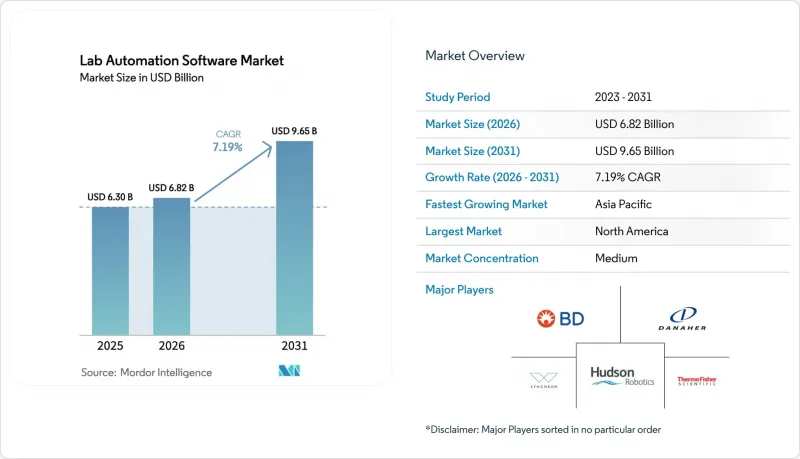
Mordor Intelligence에 따르면 실험실 자동화 소프트웨어 시장 규모는 2025년에 63억 달러, 2026년에 68억 2,000만 달러에 달하며, 2031년까지 96억 5,000만 달러에 달할 것으로 예측되고 있으며, 2026-2031년에 CAGR 7.19%로 성장할 것으로 전망되고 있습니다.
이 보고서는 소프트웨어(LIMS, LIS, CDS, ELN, SDMS, 통합 플랫폼), 배포 모델(온프레미스, 클라우드 기반, 하이브리드), 최종사용자(제약·바이오기술,CRO, 임상 진단, 학술기관 등), 용도 분야(신약 개발, 유전체학, 단백질체학, 임상 진단 등) 및 지역별로 분류되어 있습니다. 시장 예측은 금액(달러) 기준으로 제시되어 있습니다.
글로벌 실험실 자동화 소프트웨어 시장의 동향 및 인사이트
AI를 활용한 워크플로우 최적화의 가속화
현재 생성형 AI는 장비 가동 일정을 설정하고, 시약 고갈을 예측하며, 사람이 확인하기 전에 비정상적인 피크를 표시함으로써 반복적인 작업을 줄이고 첫 번째 시도 성공률을 높이고 있습니다. Thermo Fisher Scientific은 2026년 1월, Unity Lab Services 플랫폼 전체에 대규모 언어 모델을 통합하여 연구자가 자연 언어로 쿼리를 입력하면 몇 초 만에 프로토콜 권장 사항을 받을 수 있도록 했습니다. 초기 도입자에 따르면 2025년 베타 프로그램 기간 중 프로토콜 개발 주기가 60% 단축되었다고 합니다. Ginkgo Bioworks는 수동 개입 없이 균주 설계를 반복하는 자율형 파운드리(foundry)를 확대하여, 제약 분야 이외에서도 이 모델의 유효성을 입증했습니다. ISO 17025 및 CLIA에 따라 연구소가 AI 생성 기법을 검증하면 중기적인 이점은 정점에 달하겠지만, 결정적인 규제 지침은 아직 발표되지 않았습니다.
클라우드 네이티브 LIMS 플랫폼의 보급 확대
연산 처리와 스토리지를 분리함으로써, 연구소는 시퀀싱 처리가 집중되는 시간대에는 리소스를 확장하고, 비수기에는 리소스를 중단할 수 있습니다. 2025년 12월 TetraScience의 조사에 따르면 바이오의약품 품질관리 연구소의 68%가 2026년 말까지 최소 한 번의 클라우드 이전을 계획하고 있으며, 그 주요 요인으로 재해 복구와 원격 액세스를 꼽았습니다. LabVantage LIMS v8.7에 도입된 Kubernetes 기반의 오케스트레이션된 마이크로서비스를 통해 수 테라바이트 규모의 데이터세트에 대해 1초 미만의 쿼리 처리를 수반하는 자동 장애 조치(failover)가 가능해집니다. 전 세계에서 사업을 운영하는 CRO에서는 즉각적인 ROI를 실현하고 있습니다. 예를 들어 ICON plc는 클라우드 기반 샘플 추적 시스템을 도입한 후, 지사 간 데이터 대조 작업을 40% 줄였습니다. 중국과 러시아의 데이터 주권 관련 법률로 인해 여전히 하이브리드 토폴로지가 요구되고 있으며, 아키텍처 결정에는 세심한 고려가 필요합니다.
도메인 지식을 갖춘 자동화 엔지니어 부족
BioSpace의 보고서에 따르면 2025년에는 미국 바이오의약품 기업의 73%가 120일 이내에 자동화 엔지니어 자리를 채우지 못해 프로젝트 일정이 연장될 전망입니다. 필요한 기술은 분석 프로토콜, API 설계, GAMP 5 등의 규제 법령을 아우를 수 있어야 하므로, 희소한 하이브리드형 인재가 요구되고 있습니다. Tecan Group은 기술자들이 Python 스크립트와 로봇 암 프로그래밍을 습득할 수 있도록 사내 아카데미를 개설했습니다. 대학에서 제공하는 실험실 정보학 커리큘럼은 제한적이기 때문에 기업은 6개월에서 12개월에 걸친 기술 향상 교육에 자금을 투자할 수밖에 없으며, 그 결과 단기적인 소프트웨어 도입이 지연되고 있습니다.
부문 분석
실험실 정보 관리 시스템(LIMS)은 2025년 매출의 43.00%를 차지하며, 규제 대상인 제약 품질관리 환경에서 검증된 배치 릴리스 워크플로우를 통해 실험실 자동화 소프트웨어 시장의 기반을 지원하고 있습니다. 클라우드 네이티브형은 CRO의 유연한 용량 수요와 ‘샘플 단위 과금’이라는 경제성 덕분에 연평균 성장률(CAGR) 13.40%로 확대될 것으로 예측됩니다. 전자 실험 노트(ELN)와 과학 데이터 관리 시스템(SDMS)은 통합된 구독 번들로 수렴되고 있습니다. 예를 들어 Thermo Fisher의 AI가 강화된 ‘Unity’ 플랫폼에서는 LIMS, ELN 및 미들웨어가 단일 요금으로 제공됩니다. 크로마토그래피 데이터 시스템(CDS)은 여전히 자리 잡고 있지만, Waters는 독립형 버전의 라이선스 비용을 절감하기 위해 Arc HPLC 펌웨어에 CDS의 핵심 기능을 직접 통합했습니다. ABB와 메트러-톨레도의 통합 플랫폼은 벤치탑 로봇과 기업 분석을 연계하여 포괄적인 오케스트레이션으로의 전환을 시사하고 있습니다. 이러한 동향으로 인해 기존 벤더들은 규제 대응 실적을 무기로 삼는 반면, API 우선 전략을 내세우는 신생 기업은 비용에 민감한 연구소를 타깃으로 삼는 등 경쟁 격차가 발생하고 있습니다. 통합 플랫폼용 실험실 자동화 소프트웨어 시장 규모는 두 자릿수 연평균 성장률(CAGR)과 멀티오믹스 프로그램에 대한 선호도 증가를 배경으로 꾸준히 확대될 것으로 예상됩니다.
분자 병리학으로 인해 연구 영역과 임상 영역의 경계가 모호해지는 가운데, 진단 분야의 레거시 LIS 환경은 점차 LIMS와 통합되고 있습니다. Roche의 ‘cobas pro’는 검체 접수부터 보고서 작성까지의 샘플 흐름을 자동화하고 있으며, 이 영역의 중첩을 상징합니다. Benchling의 ELN이 갖춘 첨단 버전 관리 기능은, 특히 세밀한 감사 추적이 필수적인 분야에서 부서 간 협업 연구팀의 관심을 끌고 있습니다. Dotmatics의 기계학습 분류기는 비정형 데이터세트에 자동 태그를 부여하여, 대형 제약 기업의 지식 수집 및 축적을 향상시키고 있습니다. ISO 17025 및 CLIA 검증 분야에서는 여전히 오랜 감사 실적을 보유한 기존 기업이 우위를 점하고 있지만, 스타트업이 제공하는 사전 검증된 커넥터 덕분에 기존 시스템에서 전환하는 데 드는 비용은 점차 낮아지고 있습니다.
2025년에는 클라우드 배포에 따른 매출 비중이 51.20%를 차지하고 연평균 성장률(CAGR) 15.20%로 상승할 것으로 예측되며, 이는 실험실 자동화 소프트웨어 시장에서 가장 급속한 변화를 보여줍니다. 구독 모델을 통해 하드웨어에 대한 초기 투자가 운영 비용으로 전환됨에 따라 실험실 팀은 온프레미스 서버실에 의존하는 대신 내장된 중복성에 의존하게 되었습니다. LabVantage v8.7과 같은 쿠버네티스(Kubernetes) 지원 릴리스는 AWS, Azure 또는 사설 데이터센터 간 컨테이너의 이식성을 보여줍니다. 원시 데이터를 로컬에 보관하면서 메타데이터를 클라우드로 복제하는 하이브리드 토폴로지는 엄격한 데이터 상주 요건을 부과하는 관할 구역에서 지지를 얻고 있습니다. 다만, 데이터 전송 비용이 숨겨진 비용으로 대두되고 있습니다. Oxford Nanopore는 엣지에서 염기 식별을 수행함으로써 이 문제를 완화하고 있습니다. 수출 규제 의무에 묶여 있는 국방 및 농약 분야 연구소에서는 온프레미스 도입의 시장 점유율이 여전히 견고한 추세를 보이고 있지만, 전반적인 추세로는 클라우드로의 단계적 전환이 우세해지고 있습니다.
클라우드의 신속한 검증도 또 다른 촉진요인으로 작용하고 있습니다. 서비스 제공업체는 현재 21 CFR Part 11 규정을 준수하는 사전 인증된 인스턴스를 제공하고 있으며, 이를 통해 검증 기간을 수개월에서 수주로 단축하고 있습니다. 하지만 2025년 유럽에서 발생한 랜섬웨어로 인한 정보 유출 사건을 계기로, 많은 연구소가 계약 체결 전에 SOC 2 Type II 보고서나 제3자에 의한 침투 테스트 감사를 요구하게 되면서 판매 주기가 장기화되고 있습니다. 예측 기간 중 워크로드의 이식성과 단위 기반 가격 책정 덕분에 신중한 기업조차도 클라우드를 주축으로 한 하이브리드 환경으로 전환해 나갈 것입니다.
지역별 분석
북미는 2025년에 시장 수익의 34.00%를 차지하며, 보스턴, 샌프란시스코, 롤리에 밀집된 바이오의약품 클러스터가 이를 지원하고 있습니다. 2025년 FDA의 21 CFR Part 11 업데이트로 클라우드 관련 요구 사항이 명확해짐에 따라 많은 레거시 LIMS가 AWS 및 Azure로 이전하는 계기가 되었습니다. 캐나다 국립연구평의회는 소규모 연구소가 청정 기술 및 농업 유전체학 워크플로우를 자동화할 수 있도록 지원하기 위해 5,000만 캐나다 달러(3,700만 달러)의 보조금을 지급하여 대상 수요를 확대했습니다. 멕시코의 수탁제조 거점에서는 FDA의 수출 감사 요건을 충족하기 위해 클라우드 기반 LIMS가 도입되고 있지만, 지방의 통신 환경 격차로 인해 여전히 하이브리드형 시스템의 도입이 필요로 하고 있습니다.
아시아태평양은 2026-2031년까지 연평균 성장률(CAGR) 12.60%를 기록할 것으로 예상되며, 이는 세계에서 가장 빠른 성장률입니다. 중국 국가의약품감독관리국은 중국어 인터페이스를 갖춘 국내 LIMS 공급업체를 인증하여 현지 연구소의 검증 절차를 용이하게 했습니다. 2025년 인도의 바이오의약품 자동화 분야에 유입된 18억 달러 규모의 외국인 직접 투자(FDI)는 정책적 인센티브와 풍부한 STEM 인재 풀을 반영하고 있습니다. 한국은 공중보건 검사실의 디지털화에 1,200억 원(9,000만 달러)을 배정한 반면, 일본은 고령화 사회에 대응하기 위해 임상 업무의 자동화를 추진하고 있습니다. 호주가 2025년에 수립한 ‘의료기기로서의 소프트웨어’에 관한 지침안은 진단 분야에서 클라우드 기반 LIMS에 대한 규제적 길을 열었습니다.
유럽의 전망은 전자 원데이터 수집을 의무화하는 EU 임상시험 규정과 밀접하게 관련되어 있습니다. 2024년 독일 부속서 11의 개정을 통해 클라우드 검증 기준이 더욱 명확해졌으며, 바이에른주 제조업체들 간의 전환이 가능해졌습니다. 영국에서는 현재 브렉시트 이후 독자적인 규제 체제가 운영되고 있으며, 유럽 전역에 걸쳐 있는 검사실에서는 이중 규제 요건을 충족하는 시스템의 도입이 요구되고 있습니다. 프랑스는 학술기관을 위한 자동화 보조금으로 4,000만 유로(4,500만 달러)를 배정했으며, 스페인 카탈루냐주는 AI를 활용한 바이오 프로세싱에 대해 세액 공제 조치를 시행했습니다. 중동에서는 ‘사우디 비전 2030’의 일환으로, 아랍어로된 LIMS 보고서 작성을 지원해야 하는 유전체학 연구소를 위해 20억 사우디 리얄(5억 3,300만 달러)이 배정되었습니다. 아프리카는 여전히 초기 단계에 있지만, 남아프리카공화국의 국립보건검사국은 각 주에 걸친 HIV 검사를 통합하기 위해 클라우드 기반 크로마토그래피 데이터 시스템의 시범 운영을 시행했습니다.
기타 혜택:
- 엑셀 형식의 시장 예측(ME) 시트
- 3개월간의 애널리스트 지원
자주 묻는 질문
목차
제1장 서론
제2장 조사 방법
제3장 개요
제4장 시장 구도
제5장 시장 규모와 성장 예측
제6장 경쟁 구도
제7장 시장 기회와 향후 전망
KSA 26.09.04According to Mordor Intelligence, the lab automation software market size is projected to be USD 6.30 billion in 2025, USD 6.82 billion in 2026, and reach USD 9.65 billion by 2031, growing at a CAGR of 7.19% from 2026 to 2031.
This report is Segmented by Software (LIMS, LIS, CDS, ELN, SDMS, and Integrated Platforms), Deployment Model (On-Premise, Cloud-Based, and Hybrid), End User (Pharma and Biotech, Cros, Clinical Diagnostics, Academic Institutes, and More), Field of Application (Drug Discovery, Genomics, Proteomics, Clinical Diagnostics, and More), and Geography. The Market Forecasts are Provided in Terms of Value (USD).
Global Lab Automation Software Market Trends and Insights
Accelerated AI-Driven Workflow Optimization
Generative AI now schedules instrument runs, predicts reagent depletion, and flags anomalous peaks before human review, cutting repetitive tasks and improving first-pass yield. Thermo Fisher Scientific integrated large language models across its Unity Lab Services platform in January 2026, allowing researchers to issue natural-language queries and receive protocol recommendations in seconds. Early adopters report protocol-development cycles shrinking by 60% during 2025 beta programs. Ginkgo Bioworks scaled autonomous foundries that iterate strain designs without manual intervention, showing the model's viability beyond pharmaceuticals. Mid-term benefit peaks once labs validate AI-generated methods under ISO 17025 and CLIA, though definitive regulatory guidance remains forthcoming.
Rising Adoption of Cloud-Native LIMS Platforms
Separating compute from storage lets labs scale resources during heavy sequencing runs and idle them during lulls. A December 2025 TetraScience survey found 68% of biopharma quality-control labs planning at least one cloud migration by end-2026, citing disaster recovery and remote access as top drivers. Kubernetes-orchestrated microservices, introduced in LabVantage LIMS v8.7, enable automated failovers with sub-second queries across multi-terabyte datasets. CROs with global footprints see immediate ROI, as ICON plc reduced cross-site data reconciliation by 40% after deploying cloud-based sample tracking. Sovereign data laws in China and Russia still compel hybrid topologies, creating nuanced architecture decisions.
Shortage of Domain-Savvy Automation Engineers
BioSpace reported 73% of U.S. biopharma firms unable to fill automation-engineer roles within 120 days during 2025, extending project timelines. Skills must span assay protocols, API design, and regulatory statutes such as GAMP 5, creating rare hybrid profiles. Tecan Group launched an internal academy to cross-train technicians in Python scripting and robotic-arm programming. Universities offer limited laboratory-informatics coursework, forcing companies to fund six-to-twelve-month upskilling, slowing near-term software rollouts.
Other drivers and restraints analyzed in the detailed report include:
- Pharma Outsourcing Surge in Emerging Markets
- Convergence of Multi-omics and Automation
- Data-Security Concerns in Public Cloud Deployments
For complete list of drivers and restraints, kindly check the Table Of Contents.
Segment Analysis
Laboratory Information Management Systems accounted for 43.00% of 2025 revenue, anchoring the lab automation software market with validated batch-release workflows in regulated pharma quality-control environments. Cloud-native variants are forecast to expand at a 13.40% CAGR, propelled by CRO demand for elastic capacity and pay-per-sample economics. Electronic lab notebooks and scientific data management systems are converging into unified subscription bundles, as Thermo Fisher's AI-enriched Unity platform bundles LIMS, ELN, and middleware for one fee. Chromatography data systems remain entrenched, but Waters embedded core CDS functions directly into Arc HPLC firmware to lower standalone license costs. Integrated platforms from ABB and Mettler Toledo link benchtop robotics to enterprise analytics, signaling a shift toward holistic orchestration. These developments create a competitive gradient where established vendors rely on regulatory pedigrees while API-first entrants court cost-sensitive labs. The lab automation software market size for integrated platforms is expected to expand steadily, given their double-digit CAGR and growing preference among multi-omics programs.
Legacy LIS environments in diagnostics are gradually merging with LIMS as molecular pathology blurs research and clinical domains; Roche's cobas pro automates sample flow from accessioning to report, exemplifying this overlap. Benchling's ELN advanced version-control features attracted cross-functional discovery teams, especially where fine-grained audit trails are vital. Dotmatics' machine-learning classifiers auto-tag unstructured datasets, improving knowledge capture in large pharmas. ISO 17025 and CLIA validation continues to favor incumbents with long audit histories, yet pre-validated connectors from startups are eroding traditional switching costs.
Cloud deployments held 51.20% revenue in 2025 and are projected to climb at a 15.20% CAGR, marking the fastest shift inside the lab automation software market. Subscription models convert hardware outlays to operational expense, and lab teams rely on built-in redundancy instead of on-premise server rooms. Kubernetes-ready releases such as LabVantage v8.7 illustrate container portability across AWS, Azure, or private data centers. Hybrid topologies, which replicate metadata to the cloud while retaining raw instrument files locally, appeal to jurisdictions enforcing strict data-residency rules. However, data-egress fees emerge as hidden costs; Oxford Nanopore mitigates these by performing edge base calling. The lab automation software market share for on-premise deployments remains sticky in defense and agrochemical labs bound by export-control mandates, yet overall momentum favors cloud incremental migrations.
Rapid cloud validation is another catalyst. Providers now supply pre-qualified instances with 21 CFR Part 11 controls, cutting validation from months to weeks. Nevertheless, the 2025 ransomware breach in Europe forced many labs to require SOC 2 Type II reports and third-party penetration audits before contract signature, elongating sales cycles. Over the forecast period, workload portability and unit-based pricing will tilt even cautious enterprises toward cloud-heavy hybrids.
Complete Report Scope:
- By Software
- Laboratory Information Management System (LIMS)
- Laboratory Information System (LIS)
- Chromatography Data System (CDS)
- Electronic Lab Notebook (ELN)
- Scientific Data Management System (SDMS)
- Integrated Automation Platforms
- By Deployment Model
- On-Premise
- Cloud-Based
- Hybrid
- By End User
- Pharmaceutical and Biotechnology Companies
- Contract Research Organizations
- Clinical Diagnostics Laboratories
- Academic and Research Institutes
- Other End Users
- By Field of Application
- Drug Discovery
- Genomics
- Proteomics
- Clinical Diagnostics
- Other Field of Applications
- By Geography
- North America
- United States
- Canada
- Mexico
- South America
- Brazil
- Argentina
- Rest of South America
- Europe
- Germany
- United Kingdom
- France
- Italy
- Spain
- Rest of Europe
- Asia-Pacific
- China
- Japan
- India
- South Korea
- Rest of Asia-Pacific
- Middle East
- Saudi Arabia
- United Arab Emirates
- Rest of Middle East
- Africa
- South Africa
- Rest of Africa
- North America
Geography Analysis
North America held 34.00% of market revenue in 2025, supported by dense biopharma clusters in Boston, San Francisco, and Raleigh. The FDA's 2025 21 CFR Part 11 update clarified cloud-signature expectations, prompting many legacy LIMS migrations to AWS and Azure. Canada's National Research Council awarded CAD 50 million (USD 37 million) in grants to help small laboratories automate cleantech and ag-genomics workflows, expanding addressable demand. Mexico's contract-manufacturing hubs have adopted cloud-based LIMS to meet FDA export audit requirements, though rural connectivity gaps still necessitate hybrid installations.
Asia-Pacific is forecast to post a 12.60% CAGR during 2026-2031, the fastest worldwide. China's National Medical Products Administration certified domestic LIMS vendors with Mandarin interfaces, easing validation for local labs. India's USD 1.8 billion in FDI inflows into biopharma automation in 2025 reflects policy incentives and a large STEM talent pool. South Korea earmarked KRW 120 billion (USD 90 million) to digitize public health labs, while Japan is pushing clinical automation to manage an aging population. Australia's draft software-as-medical-device guidance in 2025 opens regulatory pathways for cloud LIMS in diagnostics.
Europe's outlook is tied to the EU Clinical Trials Regulation, which mandates electronic source-data capture; Germany's Annex 11 update in 2024 further clarified cloud validation standards, unlocking migrations among Bavarian manufacturers. The United Kingdom now runs a divergent post-Brexit regime, forcing dual-compliant systems among pan-European labs. France allocated EUR 40 million (USD 45 million) to academic automation grants, and Spain's Catalonia region issued tax credits for AI-enabled bioprocessing. In the Middle East, Saudi Vision 2030 earmarked SAR 2 billion (USD 533 million) for genomics labs that must support Arabic-language LIMS reporting. Africa remains early stage; South Africa's National Health Laboratory Service piloted cloud chromatography data systems to centralize HIV testing across provinces.
- Thermo Fisher Scientific Inc.
- Danaher Corporation
- Becton, Dickinson and Company
- Agilent Technologies Inc.
- Siemens Healthineers AG
- Tecan Group Ltd.
- PerkinElmer Inc.
- Bio-Rad Laboratories Inc.
- Roche Holding AG
- Eppendorf AG
- Shimadzu Corporation
- Waters Corporation
- LabVantage Solutions Inc.
- Autoscribe Informatics
- Hudson Robotics Inc.
- Synchron Lab Automation
- LabWare Inc.
- Abbott Laboratories
- Illumina Inc.
- Qiagen N.V.
- Hamilton Company
Additional Benefits:
- The market estimate (ME) sheet in Excel format
- 3 months of analyst support
TABLE OF CONTENTS
1 INTRODUCTION
- 1.1 Study Assumptions and Market Definition
- 1.2 Scope of the Study
2 RESEARCH METHODOLOGY
3 EXECUTIVE SUMMARY
4 MARKET LANDSCAPE
- 4.1 Market Overview
- 4.2 Market Drivers
- 4.2.1 Accelerated AI-Driven Workflow Optimisation
- 4.2.2 Rising Adoption of Cloud-Native LIMS Platforms
- 4.2.3 Pharma Outsourcing Surge in Emerging Markets
- 4.2.4 Regulatory Push for Data Integrity (21 CFR Part 11)
- 4.2.5 Convergence of Multi-omics and Automation
- 4.2.6 ESG-Linked Funding for Green Laboratories
- 4.3 Market Restraints
- 4.3.1 Shortage of Domain-Savvy Automation Engineers
- 4.3.2 Data-Security Concerns in Public Cloud Deployments
- 4.3.3 High Validation Costs for Regulated Labs
- 4.3.4 Legacy System Incompatibility with Modern APIs
- 4.4 Industry Value Chain Analysis
- 4.5 Regulatory Landscape
- 4.6 Technological Outlook
- 4.7 Impact of Macroeconomic Factors on the Market
- 4.8 Porter's Five Forces Analysis
- 4.8.1 Bargaining Power of Suppliers
- 4.8.2 Bargaining Power of Buyers
- 4.8.3 Threat of New Entrants
- 4.8.4 Threat of Substitute Products
- 4.8.5 Intensity of Competitive Rivalry
5 MARKET SIZE AND GROWTH FORECASTS (VALUE)
- 5.1 By Software
- 5.1.1 Laboratory Information Management System (LIMS)
- 5.1.2 Laboratory Information System (LIS)
- 5.1.3 Chromatography Data System (CDS)
- 5.1.4 Electronic Lab Notebook (ELN)
- 5.1.5 Scientific Data Management System (SDMS)
- 5.1.6 Integrated Automation Platforms
- 5.2 By Deployment Model
- 5.2.1 On-Premise
- 5.2.2 Cloud-Based
- 5.2.3 Hybrid
- 5.3 By End User
- 5.3.1 Pharmaceutical and Biotechnology Companies
- 5.3.2 Contract Research Organizations
- 5.3.3 Clinical Diagnostics Laboratories
- 5.3.4 Academic and Research Institutes
- 5.3.5 Other End Users
- 5.4 By Field of Application
- 5.4.1 Drug Discovery
- 5.4.2 Genomics
- 5.4.3 Proteomics
- 5.4.4 Clinical Diagnostics
- 5.4.5 Other Field of Applications
- 5.5 By Geography
- 5.5.1 North America
- 5.5.1.1 United States
- 5.5.1.2 Canada
- 5.5.1.3 Mexico
- 5.5.2 South America
- 5.5.2.1 Brazil
- 5.5.2.2 Argentina
- 5.5.2.3 Rest of South America
- 5.5.3 Europe
- 5.5.3.1 Germany
- 5.5.3.2 United Kingdom
- 5.5.3.3 France
- 5.5.3.4 Italy
- 5.5.3.5 Spain
- 5.5.3.6 Rest of Europe
- 5.5.4 Asia-Pacific
- 5.5.4.1 China
- 5.5.4.2 Japan
- 5.5.4.3 India
- 5.5.4.4 South Korea
- 5.5.4.5 Rest of Asia-Pacific
- 5.5.5 Middle East
- 5.5.5.1 Saudi Arabia
- 5.5.5.2 United Arab Emirates
- 5.5.5.3 Rest of Middle East
- 5.5.6 Africa
- 5.5.6.1 South Africa
- 5.5.6.2 Rest of Africa
- 5.5.1 North America
6 COMPETITIVE LANDSCAPE
- 6.1 Market Concentration
- 6.2 Strategic Moves
- 6.3 Market Share Analysis
- 6.4 Company Profiles (includes Global level Overview, Market level overview, Core Segments, Financials as available, Strategic Information, Market Rank/Share for key companies, Products and Services, and Recent Developments)
- 6.4.1 Thermo Fisher Scientific Inc.
- 6.4.2 Danaher Corporation
- 6.4.3 Becton, Dickinson and Company
- 6.4.4 Agilent Technologies Inc.
- 6.4.5 Siemens Healthineers AG
- 6.4.6 Tecan Group Ltd.
- 6.4.7 PerkinElmer Inc.
- 6.4.8 Bio-Rad Laboratories Inc.
- 6.4.9 Roche Holding AG
- 6.4.10 Eppendorf AG
- 6.4.11 Shimadzu Corporation
- 6.4.12 Waters Corporation
- 6.4.13 LabVantage Solutions Inc.
- 6.4.14 Autoscribe Informatics
- 6.4.15 Hudson Robotics Inc.
- 6.4.16 Synchron Lab Automation
- 6.4.17 LabWare Inc.
- 6.4.18 Abbott Laboratories
- 6.4.19 Illumina Inc.
- 6.4.20 Qiagen N.V.
- 6.4.21 Hamilton Company
7 MARKET OPPORTUNITIES AND FUTURE OUTLOOK
- 7.1 White-Space and Unmet-Need Assessment


