|
시장보고서
상품코드
2121809
염화나트륨 : 시장 점유율 분석, 업계 동향과 통계, 성장 예측(2026-2031년)Sodium Chloride - Market Share Analysis, Industry Trends & Statistics, Growth Forecasts (2026 - 2031) |
||||||
 Mordor Intelligence
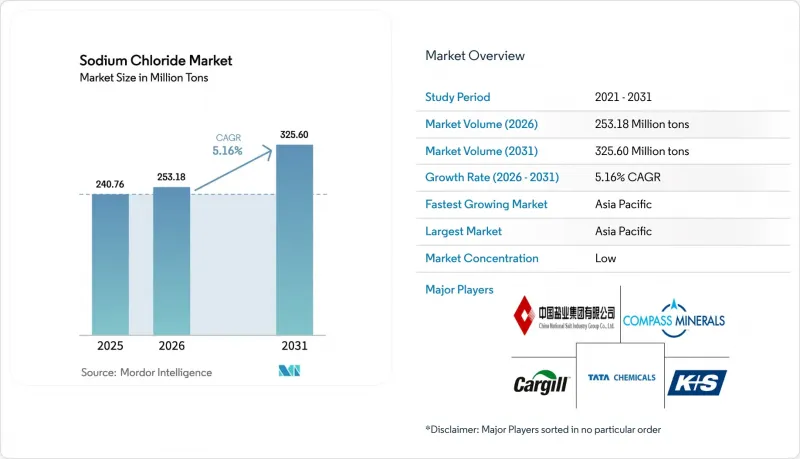
Mordor Intelligence에 의하면, 염화나트륨 시장 규모는 2025년에 2억 4,076만 톤으로 평가되어 2026년 2억 5,318만 톤에서 2031년까지 3억 2,560만 톤에 이를 것으로 예측되며, 예측 기간(2026-2031년) CAGR은 5.16%를 기록할 전망입니다.
본 보고서는 등급(암염, 천일염, 진공염), 용도(화학제품 제조, 제설제, 수처리, 식품 가공, 농업, 의약품, 기타 용도) 및 지역(아시아태평양, 북미, 유럽, 남미, 중동 및 아프리카)별로 분류되어 있습니다. 시장 예측은 수량(톤) 기준으로 제시되어 있습니다.
전 세계 염화나트륨 시장 동향 및 인사이트
가공 식품 및 음료 제조업체 수요 급증
자발적인 나트륨 섭취 감소 목표와 포장 식품 시장의 급속한 성장 사이의 긴장 관계가 소금의 대량 소비를 뒷받침하고 있습니다. 인도 및 동남아시아의 도시화가 진행되고 콜드체인에 대한 접근성이 확대되는 가운데, FDA가 정한 1단계 일일 3,000밀리그램 상한선과 2단계 목표인 2,300밀리그램 기준은 제조업체의 소금 절대 구매량을 아직 억제하지 못하고 있습니다. 인도의 가공식품 산업은 2025년에 11% 성장했으며, 미생물 증식을 방지하기 위해 염화나트륨을 사용하는 상온 보관 가능한 즉석식품이 시장을 주도했습니다. 유럽의 포장 전면 표시 제도는 투명성을 높이고 있지만, 2025년 유럽연합 집행위원회의 감사 결과 준수율은 58%에 그쳤으며, 제품 성분 재검토는 예정보다 지연되고 있습니다. 전해질을 함유한 스포츠 음료 등의 음료 부문은 2025년에 전년 대비 14%의 성장을 보였으며, 새로운 선택적 구매 채널이 추가되었습니다.
투석액 및 정맥주사용액에 대한 의약품 등급 NaCl 수요 증가
2024년 미국 및 호주 규제 당국이 기록한 공급 부족은 전 세계 12곳 미만의 진공 제염 공장에 의존하고 있는 생산 체제의 집중화를 여실히 드러냈습니다. 주 3회 투여를 받는 환자 1인당 연간 약 312Kg의 초고순도 소금을 소비하고 있으며, 미국 약전 및 유럽 약전의 규격에서는 99.9% 이상의 순도뿐만 아니라 중금속 및 내독소에 대한 엄격한 제한이 요구됩니다. 톤당 15-25kW시의 에너지 투입량을 절감하는 기계식 증기 재압축 증발 장치를 도입함으로써, 제조업체는 이익률을 유지하면서 이러한 기준을 충족할 수 있게 됩니다.
친환경 유기계 제설제(아세테이트, 포름산염)의 보급
공항과 북유럽 지자체에서는 암염에서 부식이 없는 대체품으로의 전환이 진행되고 있습니다. 2024년에는 미국 비행장의 제빙제 사용량 중 80%를 아세트산 칼륨 및 포름산 나트륨이 차지했습니다. ‘노르딕 스완 에코라벨’은 염소 함량을 1kg당 100mg으로 제한하고 있어, 연간 18만 톤이 아세트산염 혼합제로 전환되고 있습니다. 아세트산염은 암염보다 3-5배의 비용이 들지만, 교량의 부식 감소로 인한 수명 주기 비용 절감 덕분에 총 소유 비용의 차이는 점차 줄어들고 있습니다.
부문별 분석
진공염은 연평균 성장률(CAGR) 6.98%로 증가하고 있습니다. 이러한 수요는 구형 다단 증발 장치의 3분의 1에 해당하는 에너지로 99.9% 이상의 순도를 실현하는 MVR(증발 회수) 증발기에 기인합니다. 암염은 2025년 기준 염화나트륨 시장 점유율의 42.30%를 차지하며 여전히 지배적인 위치를 유지하고 있습니다. 이는 대량의 제설 계약에서는 극히 높은 순도보다 저비용이 우선시되기 때문입니다. 해안 증발지에서 생산되는 태양염은 미량의 황산칼슘 잔류물이 허용되는 섬유 염색이나 수질 연화 처리 등 중간 정도의 순도가 요구되는 용도 수요를 충족시키고 있습니다.
암염은 비용 면에서 우위를 점하고 있음(광산 FOB 가격 기준 40-60달러인 반면, 진공염은 120-180달러)에도 불구하고, 제약 회사와 배터리 양극재 제조업체들은 불순물 함량을 10ppm 미만으로 억제하기 위해 상대적으로 높은 가격을 지불하고 있습니다. 구자라트주에 위치한 타타 케미칼즈의 150만 톤 규모 공장은 지역 투석액 제조업체에 공급하고 있는 반면, 카길의 그레이트 솔트레이크 사업은 미국 서부의 식품 가공업체에 공급하고 있습니다. 산둥성과 장쑤성의 천일염 생산 업체들은 현재 더욱 엄격한 배출 규제 하에서 고염분 모액의 관리를 강요받고 있으며, 제품별로 마그네슘 브로마이드를 회수하는 천일 증발 결정화 장치로의 전환이 진행되고 있습니다. 에너지 가격 격차로 인해 유럽에서의 진공염 도입은 제한적이지만, 독일 베라 광산의 MVR(증기 재순환) 방식 개조를 통해 황산염 함유량이 0.2%까지 감소되어, 기존에는 접근할 수 없었던 제약 계약 입찰이 가능해졌습니다.
지역별 분석
아시아태평양은 2025년에 세계 생산량의 46.20%를 차지할 것으로 보이며, 중국의 나트륨 이온 배터리용 양극재 생산 능력과 구자라트주를 중심으로 한 인도의 3,000만 톤 규모의 소금 생산에 힘입어 연평균 성장률(CAGR) 6.44%로 성장할 전망입니다. 일본에서는 고령화가 진행되면서 의약품 등급에 대한 수요가 증가하고 있습니다. 한편, 한국에서는 막 셀 방식의 염소-알칼리 생산 라인이 반도체 등급의 화학 물질을 공급하고 있습니다. 베트남과 인도네시아의 아세안(ASEAN) 석유화학 회랑에서는 산업용 수요가 확대되고 있으며, 2024년에 가동을 시작한 싱가포르의 투아스 해수 담수화 플랜트(일일 13만 7,000m³)로 인해 염수 관리량이 증가하고 있습니다.
북미에서는 성숙한 성장세가 나타나고 있습니다. 혹독한 겨울 동안 고속도로에서는 최대 2,000만 톤의 제설용 소금이 소비되었으나, 지자체 예산 제한과 재고 소진으로 인해 컴퍼스 미네랄스(Compass Minerals)사의 2024년 소금 매출은 6% 감소했습니다. 캘리포니아주의 수질 연화 조례로 인해 주택용 수요가 증가하고 있습니다. 한편, 멕시코 몬테레이 주변의 염소-알칼리 생산 능력은 니어쇼어링을 실시하는 전자기기 공장에 공급하기 위해 확대되어, 2025년에는 원료 수요를 80만 톤 이상 끌어올릴 전망입니다.
북유럽의 ‘스완(Swan)’ 조달 금지 조치로 인해 도로용 소금 사용이 제한되는 가운데, 유럽 시장은 성장하고 있습니다. K+S사가 2,500만 유로를 투자해 실시한 이온 교환 설비 업그레이드를 통해 황산염 농도가 낮아져, 의약품 분야의 틈새 시장에 진출할 수 있게 되었습니다. EU의 물 프레임워크 지침에 따라 폐수 무방류(ZLD) 도입이 의무화되어 생산 비용은 상승하겠지만, 규제 준수가 가능해졌습니다. 남미에서는 펄프·제지 업계와 리튬 염수 가공업체 수요가 증가하고 있습니다. 한편, 중동에서는 해수 담수화, 염소-알칼리, 그리고 CSP(집중형 태양광 발전)의 전력 저장 기술에 대한 의존도가 높아지고 있습니다. 카타르는 2025년, 걸프 지역 전체의 의약품 및 식품 수요를 충족시키기 위해 연간 100만 톤 규모의 진공 제염 공장을 가동했습니다.
기타 혜택:
- 엑셀 형식 시장 예측(ME) 시트
- 3개월간의 애널리스트 지원
자주 묻는 질문
목차
제1장 서론
제2장 조사 방법
제3장 주요 요약
제4장 시장 구도
제5장 시장 규모와 성장 예측
제6장 경쟁 구도
제7장 시장 기회와 향후 전망
LSH 26.09.09According to Mordor Intelligence, the sodium chloride market size was valued at 240.76 Million tons in 2025 and is estimated to grow from 253.18 Million tons in 2026 to reach 325.60 Million tons by 2031, at a CAGR of 5.16% during the forecast period (2026-2031).
This report is Segmented by Grade (Rock Salt, Solar Salt, and Vacuum Salt), Application (Chemical Production, De-Icing, Water Treatment, Food Processing, Agriculture, Pharmaceuticals, and Other Applications), and Geography (Asia-Pacific, North America, Europe, South America, and Middle East and Africa). The Market Forecasts are Provided in Terms of Volume (Tons).
Global Sodium Chloride Market Trends and Insights
Surging Demand from Packaged-Food and Beverage Processors
The tension between voluntary sodium-reduction targets and rapid packaged-food growth is sustaining bulk consumption. The FDA's Phase I limit of 3,000 milligrams and Phase II goal of 2,300 milligrams per day have not yet suppressed the absolute tonnage of salt bought by manufacturers as urbanization in India and Southeast Asia broadens cold-chain access. India's processed-food industry expanded 11% in 2025, with shelf-stable ready-to-eat meals using sodium chloride for microbial control. Europe's front-of-pack labeling improves transparency, but a 2025 European Commission audit showed only 58% compliance, keeping reformulation behind schedule. Beverage categories such as electrolyte sports drinks grew 14% year over year in 2025, adding another discretionary channel.
Rising Pharmaceutical-Grade NaCl Uptake for Dialysis and IV Fluids
Regulatory shortages logged by U.S. and Australian agencies in 2024 exposed concentrated production footprints that rely on fewer than a dozen vacuum-salt plants worldwide. Each patient on thrice-weekly regimens consumes roughly 312 kilograms of ultra-pure salt annually, and specifications under the U.S. Pharmacopeia and European Pharmacopoeia require more than 99.9% purity plus tight heavy-metal and endotoxin limits. Adoption of mechanical-vapor-recompression evaporators, which slash energy input to 15-25 kilowatt-hours per ton, helps producers meet these standards while defending margins.
Proliferation of Eco-Friendly Organic De-Icers (Acetates, Formates)
Airports and Nordic municipalities are shifting from rock salt to corrosion-free alternatives. Potassium acetate and sodium formate covered 80% of U.S. airfield de-icing tonnage in 2024. The Nordic Swan Ecolabel caps chlorine at 100 mg per kg, diverting 180,000 tons annually into acetate blends. Though acetates cost three to five times more than rock salt, lifecycle savings from reduced bridge corrosion are narrowing total ownership gaps.
Other drivers and restraints analyzed in the detailed report include:
- Increasing Usage of Sodium-Based Batteries
- Municipal Water-Softening Mandates in Hard-Water Regions
- Public-Health Push to Curb Dietary Sodium Intake
For complete list of drivers and restraints, kindly check the Table Of Contents.
Segment Analysis
Vacuum salt is rising at a 6.98% CAGR. Demand stems from MVR evaporators that deliver more than 99.9% purity using one-third the energy of older multi-effect units. Rock salt retained dominance with a 42.30% sodium chloride market share in 2025 because bulk de-icing contracts require low cost more than extreme purity. Solar salt from coastal evaporation ponds meets mid-purity needs in textile dyeing and water softening where minor calcium sulfate residues are tolerated.
Despite rock salt's cost edge-USD 40-60 free-on-board mine versus USD 120-180 for vacuum salt-pharmaceutical and battery cathode makers pay premiums for impurity thresholds below 10 ppm. Tata Chemicals' 1.5 million-ton plant in Gujarat supplies regional dialysate producers, while Cargill's Great Salt Lake operation feeds western U.S. food processors. Solar-salt producers in Shandong and Jiangsu must now manage hypersaline mother liquor under stricter discharge rules, nudging them toward solar-evaporation crystallizers that reclaim magnesium bromide byproducts. Energy-price disparities cap vacuum-salt rollouts in Europe, but MVR retrofits in Germany's Werra mine cut sulfate to 0.2%, enabling bids for pharma contracts previously unreachable.
Complete Report Scope:
- By Grade
- Rock Salt
- Solar Salt
- Vacuum Salt
- By Application
- Chemical Production
- De-icing
- Water Treatment
- Food Processing
- Agriculture
- Pharmaceuticals
- Other Applications (Oil and Gas, Dyeing and Textile, etc.)
- By Geography
- Asia-Pacifc
- China
- India
- Japan
- South Korea
- ASEAN Countries
- Rest of Asia-Pacific
- North America
- United States
- Canada
- Mexico
- Europe
- Germany
- United Kingdom
- France
- Italy
- Spain
- NORDIC Countries
- Rest of Europe
- South America
- Brazil
- Argentina
- Rest of South America
- Middle East and Africa
- Saudi Arabia
- South Africa
- Qatar
- Nigeria
- United Arab Emirates
- Rest of Middle East and Africa
- Asia-Pacifc
Geography Analysis
Asia-Pacific commanded 46.20% of global volume in 2025 and will advance at a 6.44% CAGR, underpinned by Chinese sodium-ion battery cathode capacity and India's 30 million-ton salt output centered in Gujarat. Japan's aging population intensifies pharmaceutical-grade demand, while South Korea's membrane-cell chlor-alkali lines supply semiconductor-grade chemicals. ASEAN petrochemical corridors in Vietnam and Indonesia expand industrial uptake, and Singapore's Tuas desalination plant, commissioned in 2024 at 137,000 m3 per day, raises brine-management volumes.
North America exhibits mature growth. Highways consumed up to 20 million tons of de-icing salt during harsh winters, but municipal budget limits and inventory drawdowns trimmed Compass Minerals' 2024 salt revenue by 6%. California water-softening ordinances add residential-level volume, while Mexico's chlor-alkali capacity around Monterrey expanded to serve near-shoring electronics plants, boosting feedstock demand by over 800,000 tons in 2025.
Europe grows as Nordic Swan procurement bans limit road-salt use. K+S's EUR 25 million ion-exchange upgrade lowered sulfate levels to penetrate pharmaceutical niches. The EU Water Framework Directive forces zero-liquid-discharge adoption, raising production costs but enabling compliance. In South America, pulp-and-paper and lithium brine processors lift needs, while the Middle East leans on desalination, chlor-alkali, and CSP storage. Qatar opened a 1 million-ton vacuum-salt plant in 2025 to backfill pharmaceutical and food demand across the Gulf.
- Cargill Inc.
- China National Salt Industry Corporation
- CK Life Sciences Int'l., (Holdings) Inc.
- Compass Minerals
- Donald Brown Group (PureSalt)
- EUsalt c/o KELLEN
- GHCL Limited
- ICL
- K+S Aktiengesellschaft
- Morton Salt, Inc.
- Nouryon
- Rio Tinto
- Salins Group
- Sudwestdeutsche Salzwerke AG
- Swiss Salt Works AG
- Tata Chemicals
- Wacker Chemie AG
Additional Benefits:
- The market estimate (ME) sheet in Excel format
- 3 months of analyst support
TABLE OF CONTENTS
1 Introduction
- 1.1 Study Assumptions and Market Definition
- 1.2 Scope of the Study
2 Research Methodology
3 Executive Summary
4 Market Landscape
- 4.1 Market Overview
- 4.2 Market Drivers
- 4.2.1 Surging Demand from Packaged-Food and Beverage Processors
- 4.2.2 Rising Pharmaceutical-Grade NaCl Uptake for Dialysis and IV Fluids
- 4.2.3 Increasing Usage of Sodium-Based Batteries
- 4.2.4 Municipal Water-Softening Mandates in Hard-Water Regions
- 4.2.5 Molten-Salt Thermal Storage in Concentrated-Solar-Power Plants
- 4.3 Market Restraints
- 4.3.1 Proliferation of Eco-Friendly Organic De-Icers (Acetates, Formates)
- 4.3.2 Public-Health Push to Curb Dietary Sodium Intake
- 4.3.3 Stringent Regulation on Hypersaline Effluent Disposal
- 4.4 Value Chain Analysis
- 4.5 Porter's Five Forces
- 4.5.1 Bargaining Power of Suppliers
- 4.5.2 Bargaining Power of Buyers
- 4.5.3 Threat of New Entrants
- 4.5.4 Threat of Substitutes
- 4.5.5 Degree of Competition
5 Market Size and Growth Forecasts (Volume)
- 5.1 By Grade
- 5.1.1 Rock Salt
- 5.1.2 Solar Salt
- 5.1.3 Vacuum Salt
- 5.2 By Application
- 5.2.1 Chemical Production
- 5.2.2 De-icing
- 5.2.3 Water Treatment
- 5.2.4 Food Processing
- 5.2.5 Agriculture
- 5.2.6 Pharmaceuticals
- 5.2.7 Other Applications (Oil and Gas, Dyeing and Textile, etc.)
- 5.3 By Geography
- 5.3.1 Asia-Pacifc
- 5.3.1.1 China
- 5.3.1.2 India
- 5.3.1.3 Japan
- 5.3.1.4 South Korea
- 5.3.1.5 ASEAN Countries
- 5.3.1.6 Rest of Asia-Pacific
- 5.3.2 North America
- 5.3.2.1 United States
- 5.3.2.2 Canada
- 5.3.2.3 Mexico
- 5.3.3 Europe
- 5.3.3.1 Germany
- 5.3.3.2 United Kingdom
- 5.3.3.3 France
- 5.3.3.4 Italy
- 5.3.3.5 Spain
- 5.3.3.6 NORDIC Countries
- 5.3.3.7 Rest of Europe
- 5.3.4 South America
- 5.3.4.1 Brazil
- 5.3.4.2 Argentina
- 5.3.4.3 Rest of South America
- 5.3.5 Middle East and Africa
- 5.3.5.1 Saudi Arabia
- 5.3.5.2 South Africa
- 5.3.5.3 Qatar
- 5.3.5.4 Nigeria
- 5.3.5.5 United Arab Emirates
- 5.3.5.6 Rest of Middle East and Africa
- 5.3.1 Asia-Pacifc
6 Competitive Landscape
- 6.1 Market Concentration
- 6.2 Strategic Moves
- 6.3 Market Share(%)/Ranking Analysis
- 6.4 Company Profiles (includes Global-level Overview, Market-level Overview, Core Segments, Financials as available, Strategic Information, Market Rank/Share, Products and Services, Recent Developments)
- 6.4.1 Cargill Inc.
- 6.4.2 China National Salt Industry Corporation
- 6.4.3 CK Life Sciences Int'l., (Holdings) Inc.
- 6.4.4 Compass Minerals
- 6.4.5 Donald Brown Group (PureSalt)
- 6.4.6 EUsalt c/o KELLEN
- 6.4.7 GHCL Limited
- 6.4.8 ICL
- 6.4.9 K+S Aktiengesellschaft
- 6.4.10 Morton Salt, Inc.
- 6.4.11 Nouryon
- 6.4.12 Rio Tinto
- 6.4.13 Salins Group
- 6.4.14 Sudwestdeutsche Salzwerke AG
- 6.4.15 Swiss Salt Works AG
- 6.4.16 Tata Chemicals
- 6.4.17 Wacker Chemie AG
7 Market Opportunities and Future Outlook
- 7.1 White-space and Unmet-Need Assessment
- 7.2 Use as Osmotic Stressor in Micro-algae Cultivation for Biofuels