|
시장보고서
상품코드
2121818
실외용 와이파이(Outdoor Wi-Fi) : 시장 점유율 분석, 업계 동향과 통계, 성장 예측(2026-2031년)Outdoor Wi-Fi - Market Share Analysis, Industry Trends & Statistics, Growth Forecasts (2026 - 2031) |
||||||
 Mordor Intelligence
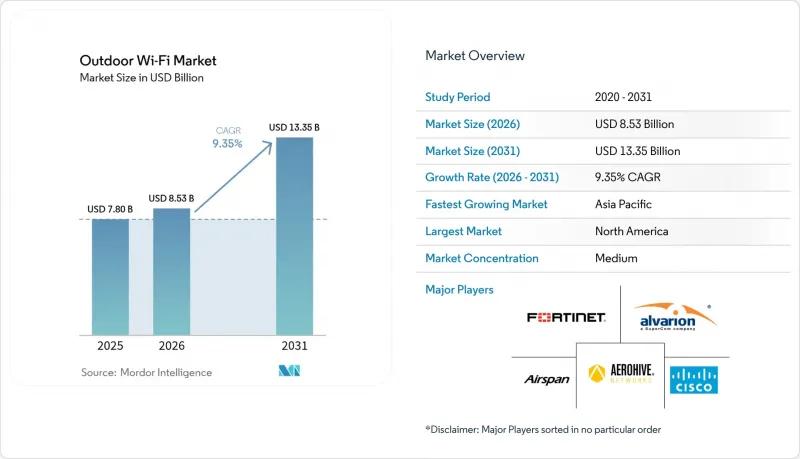
Mordor Intelligence에 의하면, 실외용 와이파이 시장 규모는 2025년 78억 달러에서 2026년에는 85억 3,000만 달러에 이르고, 2026-2031년 CAGR 9.35%로 성장을 지속하여 2031년에는 133억 5,000만 달러에 달할 것으로 예측됩니다.
본 보고서는 제품(WLAN 컨트롤러, 액세스 포인트 등), 서비스(네트워크 계획 및 설계 등), 도입 모델(실외 핫스팟, 사설 네트워크 등), 최종 사용자 산업(의료, 교육, 물류 및 운송 등) 및 지역별로 분류되어 있습니다. 시장 예측은 금액(달러) 기준으로 제시되어 있습니다.
전 세계 실외 Wi-Fi 시장 동향 및 인사이트
IoT 에지 디바이스의 폭발적인 성장
수십억 대에 달하는 저전력 센서에는 지속적이고 비용 효율적인 실외 커버리지가 필요하며, 아키텍처는 사용자 중심의 핫스팟에서 기계 중심의 그리드로 전환되고 있습니다. 퀄컴이 2024년에 ST마이크로일렉트로닉스와 맺은 제휴를 통해 MCU 모듈에 3개 대역 지원 SoC와 온보드 AI가 통합되어, 실외 액세스 포인트가 수천 건의 동시 연결을 처리할 수 있게 되었습니다. Milesight와 Morse Micro는 장거리 스마트 시티 센싱을 위해 1GHz 미만의 Wi-Fi HaLow의 유효성을 입증했습니다. 이는 실외 Wi-Fi 시장이 장거리·저전력 백홀로 중심을 옮기고 있음을 보여줍니다. 디바이스 밀도가 증가함에 따라, 수신 감도를 최적화하고, 고급 스케줄링 기능을 갖추며, 혼잡을 사전에 방지하는 클라우드 분석 기능을 탑재한 액세스 포인트(AP)에 대한 수요가 높아지고 있습니다.
스마트 시티 Wi-Fi 프로젝트의 급속한 전개
지자체 예산에서 실외 연결은 중요 인프라로서 점점 더 중점적으로 배정되고 있습니다. Calix사의 Passpoint를 기반으로 하는 SmartTown Alliance는 2024년 미국 지방 광대역 사업자를 대상으로 연결성을 75% 향상시키고 ARPU를 3% 끌어올렸습니다. 익스트림 네트웍스의 로마 도입 사례와 화웨이 및 텔코넷이 에콰도르에서 1,700대의 AP를 구축한 사례는 지자체의 노력 규모와 다양성을 여실히 보여줍니다. 이러한 프로그램은 장기적인 서비스 계약의 기반이 되어 민관 협력 자금 조달 모델을 촉진하는 동시에, 현장의 유지보수 주기를 대폭 단축하는 AI 네이티브 네트워크 운영 플랫폼의 도입을 뒷받침하고 있습니다.
증가하는 보안 및 개인정보 보호에 대한 우려
WPA3 의무화, GDPR(EU 개인정보보호규정) 준수, 그리고 제로 트러스트 의무화로 인해 도입의 복잡성이 증가하고 있습니다. 실외 네트워크 토폴로지에는 물리적 경계 제어가 부족하기 때문에 ID 중심의 정책과 AI 기반 이상 감지가 필수적입니다. 주니퍼의 ‘Mist’는 머신러닝 기반의 위협 점수 산정 기능을 내장하여 위협 격리를 자동화하고 있습니다. 한편, 의료시설의 도입 사례를 통해 실외 환자 구역에서 HIPAA 준수를 위한 암호화 요건이 필요하다는 사실이 밝혀졌습니다. 특히 유럽 규제 당국의 감시가 강화되면서 감사 비용은 증가하는 한편, 통합형 보안 스택에 대한 수요가 촉진되고 있어, 정책 엔진, SASE 온램프, 엣지 방화벽을 번들로 제공하는 벤더가 유리한 입지를 점하고 있습니다.
부문 분석
액세스 포인트는 2025년 매출의 48.44%를 차지하며, 실외 Wi-Fi 시장 규모에서 그 중심적인 역할을 부각시키고 있습니다. 엣지 컴퓨팅을 통합한 멀티 라디오·IP67 규격 지원 장치는 현재 동시 클라이언트 트래픽과 IoT 백홀을 지원하며, 사용자와 머신의 워크로드를 융합하고 있습니다. 견고한 설계로 온도 변화와 습기를 견딜 수 있으며, 클라우드 텔레메트리를 통해 예측 유지보수가 가능해졌습니다. 주니퍼, 익스트림 네트웍스, 시스코는 Wi-Fi 6E/7 지원 무선 기능, 트라이밴드 스캔, 위치 정보 서비스용 통합 GPS를 탑재하여 제품 라인업을 새롭게 단장하고 있습니다. 클라이언트 용량 확대는 스마트 시티용 센서의 급증과 맞물려, 액세스 포인트를 실외 디지털 인프라의 핵심으로 확고히 자리매김하고 있습니다.
연평균 성장률(CAGR) 10.08%로 성장하고 있는 실외 무선 브리지는 산업용 포인트-투-포인트 영상 전송, 5G 스몰 셀 백홀, 그리고 예산 제약이 있는 지역의 광섬유 대체 수요를 충족시키고 있습니다. Ceragon의 Siklu 인수 계획은 mm파 옵션을 확대하여 2km 링크에서 멀티 기가비트 처리량을 실현합니다. 브리지 벤더들이 Wi-Fi 무선 모듈을 통합하여 신속한 메시 형성을 가능하게 함에 따라, 실외 Wi-Fi 시장은 그 혜택을 누리고 있으며, 현장 출장 횟수와 서비스 개시까지의 시간을 단축하고 있습니다. 컨트롤러와 핫스팟 게이트웨이는 특히 호텔업 및 교통 허브와 같이 중앙 집중식 세션 관리 및 캡티브 포털이 여전히 주류를 이루는 분야에서 틈새 시장으로서의 중요성을 유지하고 있습니다.
2025년에는 설치 및 지원 서비스의 점유율이 52.52%를 차지할 것으로 예상되며, 이는 전신주에 대한 설치, 배선, RF 조정과 같은 작업이 노동 집약적이라는 점을 반영합니다. 한편, 매니지드 서비스는 연평균 10.12%의 성장률이 예상되며, 이는 기업의 IT 인력 감축 추세와 여러 거점 및 여러 벤더로 구성된 생태계의 복잡성을 반영한 것입니다. 매니지드 서비스 제공업체는 연중무휴 24시간 모니터링, 무선 펌웨어 업데이트, 규정 준수 보고를 패키지로 제공함으로써 평균 복구 시간(MTTR)과 자본 지출(CapEx)의 위험을 대폭 줄이고 있습니다. 실외 Wi-Fi 업계에서는 통신 사업자가 NOC(네트워크 운영 센터)의 기능을 구독형 Wi-Fi 운영으로 확대하고 있는 반면, Calix의 SmartTown Alliance와 같은 MSP(매니지드 서비스 제공업체)는 지방에서 규모의 경제를 실현하기 위해 네트워크 인프라를 공동으로 활용하고 있습니다.
네트워크 계획 및 설계는 3D RF 모델링, LiDAR 기반 장애물 감지, 6GHz AFC를 위한 주파수 공존 시뮬레이션 등을 도입한 컨설팅형 성장 분야로서 계속해서 존재감을 드러내고 있습니다. 교육 및 컨설팅은 AI를 활용한 문제 해결, 보안 태세 강화, Wi-Fi와 프라이빗 5G를 융합하는 크로스 도메인 오케스트레이션에 초점을 맞추어, 확대되는 기술 격차를 해소하고 있습니다.
지역별 분석
북미는 2025년 매출의 38.33%를 차지하며, 오랜 기간에 걸친 광대역 구상, 스마트 시티 보조금, 그리고 6GHz 대역 주파수 대역의 명확화를 지속적으로 활용하고 있습니다. 알딘 독립 교육구(Aldine ISD)의 8,000대 액세스 포인트(AP) 도입과 같은 프로젝트는 대규모 배포에서 교육 분야의 역할을 부각시키고 있습니다. 공항 컨소시엄, 유틸리티 협동조합 및 병원 시스템은 견조한 수주 전망을 유지하고 있습니다. 이 지역의 실외 Wi-Fi 시장은 FCC가 표준 출력의 6GHz 대역에 관한 AFC 규정을 최종 확정하는 가운데 여전히 주파수 조정의 병목 현상에 직면해 있지만, 공급업체의 준비 태세와 공공 자금 지원으로 인해 도입 장벽은 완화되고 있습니다.
아시아태평양은 실외 Wi-Fi 시장 성장의 원동력이며, 연평균 성장률(CAGR)은 9.70%로 성장을 지속하고, 있습니다. 중국, 인도, 동남아시아의 대규모 도시화가 지방 정부의 연결 환경 구축을 견인하는 한편, 일본은 Wi-Fi 7 시범 운영 및 OpenRoaming 도입을 선도하고 있습니다. 국가 차원의 주파수 대역 할당이 도입을 가속화하고 있으며, 정부의 디지털화 추진 지침이 다중 벤더 시장 진입을 뒷받침하고 있습니다. Claro Brasil 등 통신 사업자의 투자(2029년까지 77억 달러)는 대규모 실외 무선 네트워크 확장을 시사합니다. 잠비아의 화웨이 ‘스마트 빌리지 쇼케이스’를 포함한 정부 지원 농촌 지역 광대역은 인구 밀집 대도시권을 넘어선 활용 사례를 보여주며, 실외 Wi-Fi 시장의 범위를 농업 지역까지 확대되고 있습니다.
유럽에서는 꾸준하지만 규제에 중점을 둔 확장이 관찰됩니다. GDPR(EU 개인정보보호규정), AI법(AI Act)의 규정 및 ETSI의 출력 제한이 설계 선택지에 영향을 미치며, 프라이버시를 중시하는 제로 트러스트 아키텍처의 도입을 촉진하고 있습니다. 벨기에와 런던에서 진행된 초기 OpenRoaming 프로젝트는 원활한 인증 모델에 대한 지지가 높아지고 있음을 보여줍니다. 민관 파트너십을 통해 교통 회랑 및 역사 지구에서의 구축이 강화되어, 문화유산 보존과 현대적인 연결성을 양립시키고 있습니다. 남미, 중동 및 아프리카는 여전히 신흥 시장이지만, 정부의 연결 목표에 힘입어 전략적으로 중요한 지역으로 부상하고 있습니다. 모로코가 2025년까지 5G 커버리지율을 25%로 끌어올리겠다는 목표를 세운 만큼, 실외 Wi-Fi는 이를 보완하는 오프로드 수단으로서 자리매김하고 있습니다. 길랏(Gilat)의 라틴아메리카 대상 300만 달러 규모 계약을 대표적으로 볼 때, 위성 백홀을 활용한 Wi-Fi는 인구 밀도가 낮은 지역의 커버리지를 확대되고 있습니다.
기타 혜택:
- 엑셀 형식 시장 예측(ME) 시트
- 3개월간의 애널리스트 지원
자주 묻는 질문
목차
제1장 서론
제2장 조사 방법
제3장 주요 요약
제4장 시장 구도
제5장 시장 규모와 성장 예측
제6장 경쟁 구도
제7장 시장 기회와 향후 전망
LSH 26.09.09According to Mordor Intelligence, the outdoor wi-Fi market size is expected to grow from USD 7.80 billion in 2025 to USD 8.53 billion in 2026 and is forecast to reach USD 13.35 billion by 2031 at 9.35% CAGR over 2026-2031.
This report is Segmented by Product (WLAN Controllers, Access Points, and More), Service (Network Planning and Design, and More), Implementation Model (Outdoor Hotspots, Private Networks, and More), End-User Industry (Healthcare, Education, Logistics and Transportation, and More), and Geography. The Market Forecasts are Provided in Terms of Value (USD).
Global Outdoor Wi-Fi Market Trends and Insights
Explosive Growth of IoT Edge Devices
Billions of low-power sensors require continuous, cost-effective outdoor coverage, shifting architecture from user-centric hotspots to machine-centric grids. Qualcomm's 2024 alliance with STMicro embeds tri-radio SoCs and on-board AI in MCU modules, enabling outdoor access points to handle thousands of concurrent links. Milesight and Morse Micro validated sub-1 GHz Wi-Fi HaLow for long-range smart-city sensing, underscoring the Outdoor Wi-Fi market pivot toward extended-range, low-energy backhaul. Device density intensifies demand for APs with optimized receive sensitivity, advanced scheduling, and cloud analytics that pre-empt congestion.
Rapid Roll-out of Smart-City Wi-Fi Projects
Municipal budgets increasingly earmark outdoor connectivity as critical infrastructure. Calix's Passpoint-driven SmartTown Alliance delivered 75% connectivity gains and 3% ARPU uplift for U.S. rural broadband providers in 2024. Extreme Networks' Rome deployment and Huawei-Telconet's 1,700-AP Ecuador rollout illustrate the scale and diversity of municipal initiatives. Such programs anchor long-term service contracts, foster public-private funding models, and catalyze adoption of AI-native network operations platforms that slash field-maintenance cycles.
Escalating Security and Privacy Concerns
Mandatory WPA3, GDPR compliance, and zero-trust mandates heighten deployment complexity. Outdoor topologies lack physical perimeter controls, making identity-centric policies and AI-driven anomaly detection essential. Juniper's Mist embeds machine-learning threat scoring to automate containment, while healthcare campus rollouts illustrate HIPAA-grade encryption requirements for outdoor patient zones. Regulatory scrutiny, particularly in Europe, raises audit costs yet spurs demand for integrated security stacks, favoring vendors that bundle policy engines, SASE on-ramps, and edge firewalls.
Other drivers and restraints analyzed in the detailed report include:
- Transportation-Hub Demand for Seamless Connectivity
- Wi-Fi 6/6E as Cost-Effective 5G Offload
- Spectrum Congestion and RF Interference
For complete list of drivers and restraints, kindly check the Table Of Contents.
Segment Analysis
Access Points generated 48.44% of 2025 revenue, underlining their centrality to the Outdoor Wi-Fi market size. Multi-radio, IP67-rated units with integrated edge compute now support concurrent client traffic and IoT backhaul, blending user and machine workloads. Rugged designs withstand temperature swings and moisture, while cloud telemetry enables predictive maintenance. Juniper, Extreme Networks, and Cisco refresh portfolios with Wi-Fi 6E/7 radios, tri-band scanning, and integrated GPS for location services. Growing client capacity aligns with smart-city sensor surges, cementing Access Points as the nexus of outdoor digital infrastructure.
Outdoor Wireless Bridges, advancing at a 10.08% CAGR, respond to industrial point-to-point video, backhaul for 5G small cells, and fiber-replacement in budget-sensitive regions. Ceragon's planned integration of Siklu expands millimeter-wave options, pushing multi-gigabit throughput over 2-kilometer links. The Outdoor Wi-Fi market benefits as bridge vendors embed Wi-Fi radios for rapid mesh formation, reducing truck rolls and time-to-service. Controllers and hotspot gateways retain niche relevance where centralized session management or captive portals remain in force, particularly across hospitality and transport hubs.
Installation and Support services held 52.52% share in 2025, reflecting the labor-intensive nature of pole mounts, cabling, and RF tuning. Yet Managed Services are forecast to expand 10.12% annually, mirroring enterprises' lean IT staffing and the complexity of multi-site, multi-vendor ecosystems. Managed providers bundle 24X7 monitoring, over-the-air firmware, and compliance reporting, slashing mean-time-to-repair and CapEx risk. The Outdoor Wi-Fi industry sees telcos extending NOC capabilities into subscription-based Wi-Fi operations, while MSPs such as Calix's SmartTown Alliance pool footprints for rural economies of scale.
Network Planning and Design persists as a consultative growth niche, incorporating 3-D RF modeling, LiDAR-based obstructions, and spectrum coexistence simulations for 6 GHz AFC. Training and Consulting fill a widening skills gap, focusing on AI-driven troubleshooting, security posture hardening, and cross-domain orchestration that blends Wi-Fi with private 5G.
Complete Report Scope:
- By Product
- WLAN Controllers
- Access Points
- Outdoor Wireless Bridges
- Wireless Hotspot Gateways
- By Service
- Network Planning and Design
- Installation and Support
- Managed Services
- Training and Consulting
- By Implementation Model
- Outdoor Hotspots
- Private Networks
- Community Wi-Fi Mesh
- IoT Backhaul Networks
- By End-user Industry
- Healthcare
- Education
- Logistics and Transportation
- Travel and Hospitality
- Public Utilities
- Smart Cities and Municipalities
- Retail
- Oil and Gas / Mining
- Other End-user Industries
- By Geography
- North America
- South America
- Europe
- Asia-Pacific
- Middle East and Africa
Geography Analysis
North America, with 38.33% revenue in 2025, capitalizes on longstanding broadband initiatives, smart-city grants, and 6 GHz spectrum clarity. Projects such as Aldine ISD's 8,000-AP rollout underscore education's role in volume deployments. Airport consortia, utility cooperatives, and hospital systems sustain strong pipeline demand. The Outdoor Wi-Fi market here still faces spectrum-coordination bottlenecks as the FCC finalizes AFC rules for standard-power 6 GHz, but vendor readiness and public funding mitigate adoption headwinds.
Asia-Pacific is the Outdoor Wi-Fi market's growth engine, advancing 9.70% CAGR. Massive urbanization in China, India, and Southeast Asia drives municipal connectivity, while Japan pioneers Wi-Fi 7 pilots and OpenRoaming adoption. National spectrum allocations expedite deployments, and governmental digitization mandates encourage multivendor participation. Investments by carriers such as Claro Brasil (USD 7.7 billion through 2029) signal large-scale outdoor wireless expansion. Government-backed rural broadband, including Huawei's Smart Village Showcase in Zambia, illustrates use cases beyond dense metros, extending Outdoor Wi-Fi market reach into agrarian communities.
Europe registers steady yet regulation-focused expansion. GDPR, AI Act provisions, and ETSI power limits influence design choices, prompting privacy-centric zero-trust architectures. Early OpenRoaming projects in Belgium and London demonstrate traction for seamless authentication models. Public-private partnerships bolster deployments in transport corridors and historical districts, balancing heritage preservation with modern connectivity. South America and the Middle East and Africa remain emerging but strategic, fueled by government connectivity targets. Morocco's 25% 5G coverage goal by 2025 positions Outdoor Wi-Fi as complementary offload. Satellite-backhauled Wi-Fi, illustrated by Gilat's USD 3 million Latin American contract, extends reach in sparsely populated zones.
- Aerohive Networks LLC
- Airspan Networks Holdings Inc.
- Alvarion Technologies Ltd.
- Cisco Systems, Inc.
- Fortinet, Inc.
- Hewlett Packard Enterprise Company (Aruba)
- Huawei Technologies Co., Ltd.
- Juniper Networks, Inc.
- NETGEAR, Inc.
- Nokia Solutions and Networks Oy
- Ubiquiti Inc.
- Zebra Technologies Corporation
- CommScope Holding Company, Inc. (Ruckus Networks)
- Cambium Networks Corporation
- Extreme Networks, Inc.
- D-Link Corporation
- TP-Link Technologies Co., Ltd.
- EnGenius Technologies Inc.
- Siklu Communication Ltd.
- Proxim Wireless Corporation
- RADWIN Ltd.
Additional Benefits:
- The market estimate (ME) sheet in Excel format
- 3 months of analyst support
TABLE OF CONTENTS
1 INTRODUCTION
- 1.1 Study Assumptions and Market Definition
- 1.2 Scope of the Study
2 RESEARCH METHODOLOGY
3 EXECUTIVE SUMMARY
4 MARKET LANDSCAPE
- 4.1 Market Overview
- 4.2 Market Drivers
- 4.2.1 Explosive growth of IoT edge devices
- 4.2.2 Rapid roll-out of smart-city Wi-Fi projects
- 4.2.3 Transportation-hub demand for seamless connectivity
- 4.2.4 Wi-Fi 6/6E as cost-effective 5G offload
- 4.2.5 EV-charging stations bundling outdoor Wi-Fi
- 4.2.6 Wi-Fi HaLow-enabled long-range industrial sensing
- 4.3 Market Restraints
- 4.3.1 Escalating security and privacy concerns
- 4.3.2 Spectrum congestion and RF interference
- 4.3.3 Climate-hardening costs for rugged APs
- 4.3.4 Country-specific EIRP limits curbing range
- 4.4 Industry Value Chain Analysis
- 4.5 Regulatory Landscape
- 4.6 Technological Outlook
- 4.7 Porter's Five Forces Analysis
- 4.7.1 Bargaining Power of Suppliers
- 4.7.2 Bargaining Power of Consumers
- 4.7.3 Threat of New Entrants
- 4.7.4 Threat of Substitutes
- 4.7.5 Intensity of Competitive Rivalry
5 MARKET SIZE AND GROWTH FORECASTS (VALUE)
- 5.1 By Product
- 5.1.1 WLAN Controllers
- 5.1.2 Access Points
- 5.1.3 Outdoor Wireless Bridges
- 5.1.4 Wireless Hotspot Gateways
- 5.2 By Service
- 5.2.1 Network Planning and Design
- 5.2.2 Installation and Support
- 5.2.3 Managed Services
- 5.2.4 Training and Consulting
- 5.3 By Implementation Model
- 5.3.1 Outdoor Hotspots
- 5.3.2 Private Networks
- 5.3.3 Community Wi-Fi Mesh
- 5.3.4 IoT Backhaul Networks
- 5.4 By End-user Industry
- 5.4.1 Healthcare
- 5.4.2 Education
- 5.4.3 Logistics and Transportation
- 5.4.4 Travel and Hospitality
- 5.4.5 Public Utilities
- 5.4.6 Smart Cities and Municipalities
- 5.4.7 Retail
- 5.4.8 Oil and Gas / Mining
- 5.4.9 Other End-user Industries
- 5.5 By Geography
- 5.5.1 North America
- 5.5.2 South America
- 5.5.3 Europe
- 5.5.4 Asia-Pacific
- 5.5.5 Middle East and Africa
6 COMPETITIVE LANDSCAPE
- 6.1 Market Concentration
- 6.2 Strategic Moves
- 6.3 Market Share Analysis
- 6.4 Company Profiles (includes Global Level Overview, Market Level Overview, Core Segments, Financials as available, Strategic Information, Market Rank/Share for key companies, Products and Services, Recent Developments)
- 6.4.1 Aerohive Networks LLC
- 6.4.2 Airspan Networks Holdings Inc.
- 6.4.3 Alvarion Technologies Ltd.
- 6.4.4 Cisco Systems, Inc.
- 6.4.5 Fortinet, Inc.
- 6.4.6 Hewlett Packard Enterprise Company (Aruba)
- 6.4.7 Huawei Technologies Co., Ltd.
- 6.4.8 Juniper Networks, Inc.
- 6.4.9 NETGEAR, Inc.
- 6.4.10 Nokia Solutions and Networks Oy
- 6.4.11 Ubiquiti Inc.
- 6.4.12 Zebra Technologies Corporation
- 6.4.13 CommScope Holding Company, Inc. (Ruckus Networks)
- 6.4.14 Cambium Networks Corporation
- 6.4.15 Extreme Networks, Inc.
- 6.4.16 D-Link Corporation
- 6.4.17 TP-Link Technologies Co., Ltd.
- 6.4.18 EnGenius Technologies Inc.
- 6.4.19 Siklu Communication Ltd.
- 6.4.20 Proxim Wireless Corporation
- 6.4.21 RADWIN Ltd.
7 MARKET OPPORTUNITIES AND FUTURE OUTLOOK
- 7.1 White-space and Unmet-need Assessment