|
시장보고서
상품코드
2121823
이탈리아의 태양에너지 : 시장 점유율 분석, 업계 동향과 통계, 성장 예측(2026-2031년)Italy Solar Energy - Market Share Analysis, Industry Trends & Statistics, Growth Forecasts (2026 - 2031) |
||||||
 Mordor Intelligence
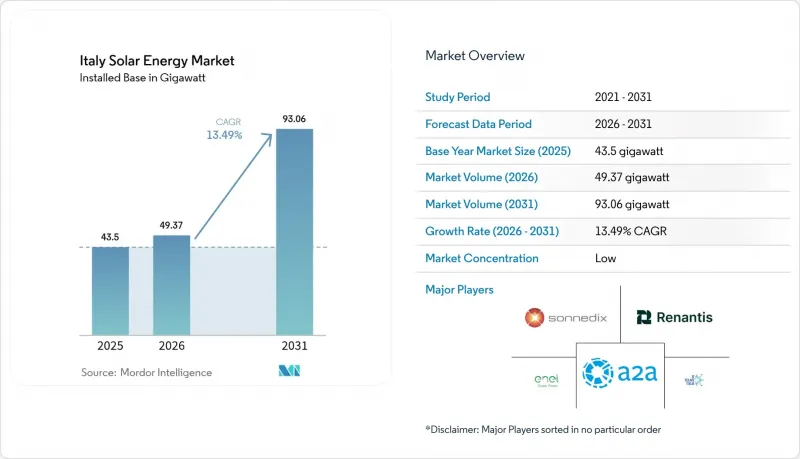
Mordor Intelligence에 따르면 이탈리아의 태양에너지 시장의 규모(설치용량 기반)는 2025년에 43.5기가와트라고 평가되며, 2026년 49.37기가와트로부터 2031년까지 93.06기가와트에 달할 것으로 예측되고 있으며, 예측 기간(2026-2031년)에 CAGR은 13.49%에 달할 전망입니다.
이 보고서는 기술별(태양광발전(PV)·집광형 태양열발전(CSP)), 그리드 유형별(온그리드·오프그리드), 최종사용자별(실용 규모, 상업·산업(C&I), 주택)로 분류되어 있습니다. 시장 규모와 전망은 설치 용량(GW)으로 표시됩니다.
이탈리아 태양 에너지 시장의 동향 및 인사이트
태양광발전의 LCOE 하락
이탈리아 태양광발전의 평균 LCOE는 2024년에 0.045유로/kWh까지 하락하여, 기존 발전 방식과 보조금 없이 비용 평형을 처음으로 달성했습니다. 주류인 결정질 패널의 모듈 효율은 22.5%에 달했으며, 표준화된 지지대를 통해 시스템 외부 비용이 더욱 절감되었습니다. 남부 지역의 전력 회사 프로젝트에서는 현재 LCOE가 0.040유로/kWh라는 낮은 수준을 달성하고 있으며, 이로 인해 가스 피크 발전소는 보조적인 역할로 밀려나고 있습니다. 국내 인버터 제조사인 Fimer는 변환 손실을 줄여 효율 99.2%를 달성한 스트링형 모델을 도입했으며, 2027년까지 비용이 더욱 절감될 전망입니다.
EU의 ‘REPowerEU’와 PNIEC의 2030년 목표
브뤼셀은 이탈리아의 2030년 태양광발전 의무량을 85GW로 상향 조정했습니다. 이는 이전 PNIEC 수치의 거의 2배에 해당하며, 정치적 관심을 유지하기 위한 분기별 이동 현황 검토가 포함되어 있습니다. 로마는 PNRR 기금에서 69억 유로를 배정하여, 그 중 60%를 남부 지역의 태양광발전 시설 확충에 사용하고 있습니다. 지역별 ‘그린 코리도’를 통해 50MW를 초과하는 발전소의 인허가 취득 기간이 24개월에서 약 8개월로 단축되었습니다. 또한 1,000m²를 초과하는 신축 상업용 건물에는 옥상 태양광발전 시스템 설치가 의무화되어 있으며, 확실한 수요 파이프라인이 형성되어 있습니다.
송전망 포화와 장기화되는 허가 절차
북부 송전망에서는 23기가와트 규모의 프로젝트가 대기 리스트에 올라 있으며, 이로 인해 계통 연계가 최대 2년 지연될 뿐만 아니라, 수요가 집중되는 지역에서는 계통 연계 요금이 1MW당 8만 유로로 상승하고 있습니다. 테르나(Terna)사의 180억 유로 규모 확장 계획은 여전히 본격화되고 있습니다. 개발사는 14단계의 승인 절차를 거쳐야 하며, 환경영향 평가만으로도 최대 12개월이 소요될 수 있습니다. 10MW 이하 발전소를 대상으로 한 신속 승인 규정은 부담을 줄여주지만, 신규 발전 용량의 대부분을 차지하는 대규모 발전소에는 거의 효과가 없습니다.
부문별 분석
2025년 신규 도입 총량의 99.97%를 태양광발전이 차지했습니다. 이는 성숙한 공급망과 옥상 설치의 용이성이 지원한 결과입니다. 집광형 태양열발전(CSP)은 현재 도입량이 0.02GW에 불과하지만, 연평균 성장률(CAGR) 104.7%로 확대되고 있으며, 6시간 용융염 축열 시스템을 활용함으로써 저녁 시간대의 피크 수요에 대응할 가능성이 있습니다. 시칠리아 섬에서는 연간 2,000kWh/m²를 초과하는 높은 직사 일사량 덕분에 CSP가 가스 발전소와 어깨를 나란히 하는 고정 요금으로 발전이 가능하며, EU의 택소노미도 그 계통 안정화 특성을 높이 평가하고 있습니다. 에넬 그린 파워(Enel Green Power)사의 CSP와 태양광발전을 결합한 하이브리드 구상은, 낮 시간대의 태양광발전량과 일몰 후의 축열을 통한 출력을 결합한 것으로, 이 모델은 베이스로드 재생에너지의 패러다임을 바꿀 가능성이 있습니다.
이탈리아의 CSP 시장 규모는 여전히 소규모이지만, 그린본드를 통한 유리한 차입 조건이 자본 비용을 낮추고 있습니다. 독립 발전 사업자(IPP)는 전력 판매와 ‘용량 상당’의 가동 보증료를 모두 포함하는 25년간의 고정가격매입계약(FIT)을 확보하고 있으며, 이를 통해 위험 조정 후 수익성이 향상되고 있습니다. 50MW 이상의 프로젝트에 대해 계통 지원 서비스 제공을 의무화하는 정책은 암묵적으로 열 저장을 장려하고 있으며, 개발업자들을 CSP의 조정형 출력 특성으로 유도하고 있습니다. 따라서 중기적인 성장은 기술적 위험보다는 부품 공급업체가 특수 수광기나 소금 생산을 얼마나 신속하게 확대할 수 있는지에 달려 있습니다.
기타 혜택
- 엑셀 형식의 시장 예측(ME) 시트
- 3개월간의 애널리스트 지원
목차
제1장 서론
제2장 조사 방법
제3장 개요
제4장 시장 구도
제5장 시장 규모와 성장 예측
제6장 경쟁 구도
제7장 시장 기회와 향후 전망
KSAAccording to Mordor Intelligence, the Italy solar energy market size in terms of installed base was valued at 43.5 gigawatt in 2025 and estimated to grow from 49.37 gigawatt in 2026 to reach 93.06 gigawatt by 2031, at a CAGR of 13.49% during the forecast period (2026-2031).
This report is Segmented by Technology (Solar Photovoltaic and Concentrated Solar Power), Grid Type (On-Grid and Off-Grid), and End-User (Utility-Scale, Commercial and Industrial, and Residential). The Market Sizes and Forecasts are Provided in Terms of Installed Capacity (GW).
Italy Solar Energy Market Trends and Insights
Declining LCOE of PV Electricity
Italy's average solar LCOE fell to EUR 0.045/kWh in 2024, marking the first instance of subsidy-free parity with conventional generation. Module efficiencies reached 22.5% for mainstream crystalline panels, and standardized racking further trimmed balance-of-system expenses. Southern utility projects now deliver LCOE as low as EUR 0.040/kWh, pushing gas peakers into residual duty. Domestic inverter maker Fimer introduced 99.2% efficiency string models that reduce conversion losses, locking in cost reductions that are likely to deepen through 2027.
EU REPowerEU & PNIEC 2030 Targets
Brussels raised Italy's 2030 solar obligation to 85 GW, nearly doubling the earlier PNIEC figure and incorporating quarterly compliance reviews that maintain political focus. Rome earmarked EUR 6.9 billion in PNRR funds, with 60% dedicated to southern solar build-out. Regional "green corridors" have reduced permit cycles for sites exceeding 50 MW from 24 months to approximately 8 months, while new commercial buildings over 1,000 m2 are required to install rooftop systems, creating an assured demand pipeline.
Grid Saturation & Lengthy Permitting
Northern grids face 23 GW of queued projects, which delays connections by up to two years and increases interconnection fees to EUR 80,000/MW in hotspots. Terna's EUR 18 billion expansion plan is still ramping. Developers must navigate 14 approvals; environmental impact assessments alone can take up to 12 months. Fast-track rules for sub-10 MW plants ease pressure but do little for the large farms that dominate new capacity.
Other drivers and restraints analyzed in the detailed report include:
- Corporate-PPA Boom Among Italian Industrials
- Residential "Superbonus" & Tax-Credit Schemes
- Phase-down of Superbonus Incentives
For complete list of drivers and restraints, kindly check the Table Of Contents.
Segment Analysis
PV installations accounted for 99.97% of total additions in 2025, driven by mature supply chains and the ease of rooftop siting. Concentrated solar power, though scarcely 0.02 GW today, is accelerating at a 104.7% CAGR and could supply evening peaks with six-hour molten-salt storage. Sicily's high direct normal irradiance, exceeding 2,000 kWh/m2/year, enables CSP to dispatch at fixed tariffs that rival those of gas units, and the EU taxonomy favors its grid-firming traits. Enel Green Power's hybrid CSP-PV blueprint pairs up-front PV yields with stored thermal output after dusk, a template that could reshape baseload renewables.
The Italy solar energy market size for CSP remains modest, yet favorable debt terms under green bonds lower capital cost. Independent power producers secure 25-year feed-in contracts that cover both electricity and "capacity-like" availability payments, improving risk-adjusted returns. A policy requiring >=50 MW projects to demonstrate grid-support services implicitly rewards thermal storage, nudging developers toward CSPs' dispatchable profile. Medium-term growth thus hinges less on technology risk than on how quickly component suppliers can scale specialized receivers and salts.
Complete Report Scope:
- By Technology
- Solar Photovoltaic (PV)
- Concentrated Solar Power (CSP)
- By Grid Type
- On-Grid
- Off-Grid
- By End-User
- Utility-Scale
- Commercial and Industrial (C&I)
- Residential
- By Component (Qualitative Analysis)
- Solar Modules/Panels
- Inverters (String, Central, Micro)
- Mounting and Tracking Systems
- Balance-of-System and Electricals
- Energy Storage and Hybrid Integration
List of Companies Covered in this Report:
- Enel Green Power S.p.A.
- EF Solare Italia S.p.A.
- Sonnedix Power Holdings Ltd
- Renantis S.p.A. (ex-Falck Renewables)
- A2A S.p.A.
- Acea S.p.A.
- Gruppo STG S.r.l.
- Peimar S.r.l.
- SunPower Corporation
- SunEdison Inc.
- Canadian Solar Inc.
- JinkoSolar Holding Co., Ltd.
- Trina Solar Co., Ltd.
- SMA Solar Technology AG
- Fimer S.p.A.
- TerniEnergia S.p.A.
- Sorgenia S.p.A.
- Saras S.p.A. (Sardeolica)
- NextEnergy Capital Group
- Engie Italia S.p.A.
Additional Benefits:
- The market estimate (ME) sheet in Excel format
- 3 months of analyst support
TABLE OF CONTENTS
1 Introduction
- 1.1 Study Assumptions & Market Definition
- 1.2 Scope of the Study
2 Research Methodology
3 Executive Summary
4 Market Landscape
- 4.1 Market Overview
- 4.2 Market Drivers
- 4.2.1 Declining LCOE of PV Electricity
- 4.2.2 EU REPowerEU & PNIEC 2030 Targets
- 4.2.3 Corporate-PPA Boom Among Italian Industrials
- 4.2.4 Residential "Superbonus" & Tax-credit Schemes
- 4.2.5 Agrivoltaics Enhancing Dual-Use Land Value
- 4.2.6 Behind-the-Meter Storage Cost Parity with PV
- 4.3 Market Restraints
- 4.3.1 Grid Saturation & Lengthy Permitting
- 4.3.2 Phase-down of Superbonus Incentives
- 4.3.3 Restrictions on Ground-mount PV on Farmland
- 4.3.4 Local Opposition & Landscape-Protection Rules
- 4.4 Supply-Chain Analysis
- 4.5 Regulatory Outlook
- 4.6 Technological Outlook
- 4.7 Porter's Five Forces
- 4.7.1 Threat of New Entrants
- 4.7.2 Bargaining Power of Suppliers
- 4.7.3 Bargaining Power of Buyers
- 4.7.4 Threat of Substitutes
- 4.7.5 Competitive Rivalry
- 4.8 PESTLE Analysis
5 Market Size & Growth Forecast
- 5.1 By Technology
- 5.1.1 Solar Photovoltaic (PV)
- 5.1.2 Concentrated Solar Power (CSP)
- 5.2 By Grid Type
- 5.2.1 On-Grid
- 5.2.2 Off-Grid
- 5.3 By End-User
- 5.3.1 Utility-Scale
- 5.3.2 Commercial and Industrial (C&I)
- 5.3.3 Residential
- 5.4 By Component (Qualitative Analysis)
- 5.4.1 Solar Modules/Panels
- 5.4.2 Inverters (String, Central, Micro)
- 5.4.3 Mounting and Tracking Systems
- 5.4.4 Balance-of-System and Electricals
- 5.4.5 Energy Storage and Hybrid Integration
6 Competitive Landscape
- 6.1 Market Concentration
- 6.2 Strategic Moves (M&A, Partnerships, PPAs)
- 6.3 Market Share Analysis (Market Rank/Share for key companies)
- 6.4 Company Profiles (includes Global level Overview, Market level overview, Core Segments, Financials as available, Strategic Information, Products & Services, and Recent Developments)
- 6.4.1 Enel Green Power S.p.A.
- 6.4.2 EF Solare Italia S.p.A.
- 6.4.3 Sonnedix Power Holdings Ltd
- 6.4.4 Renantis S.p.A. (ex-Falck Renewables)
- 6.4.5 A2A S.p.A.
- 6.4.6 Acea S.p.A.
- 6.4.7 Gruppo STG S.r.l.
- 6.4.8 Peimar S.r.l.
- 6.4.9 SunPower Corporation
- 6.4.10 SunEdison Inc.
- 6.4.11 Canadian Solar Inc.
- 6.4.12 JinkoSolar Holding Co., Ltd.
- 6.4.13 Trina Solar Co., Ltd.
- 6.4.14 SMA Solar Technology AG
- 6.4.15 Fimer S.p.A.
- 6.4.16 TerniEnergia S.p.A.
- 6.4.17 Sorgenia S.p.A.
- 6.4.18 Saras S.p.A. (Sardeolica)
- 6.4.19 NextEnergy Capital Group
- 6.4.20 Engie Italia S.p.A.
7 Market Opportunities & Future Outlook
- 7.1 White-space & Unmet-need Assessment