|
시장보고서
상품코드
2121831
전자제품용 접착제 : 시장 점유율 분석, 업계 동향과 통계, 성장 예측(2026-2031년)Electronics Adhesives - Market Share Analysis, Industry Trends & Statistics, Growth Forecasts (2026 - 2031) |
||||||
 Mordor Intelligence
Mordor Intelligence에 의하면, 전자기기용 접착제 시장 규모는 2025년 65억 1,000만 달러에서 2026년에는 70억 7,000만 달러에 이르고, 2026-2031년 CAGR 8.63%로 성장을 지속하여 2031년까지 106억 9,000만 달러에 달할 것으로 예측됩니다.
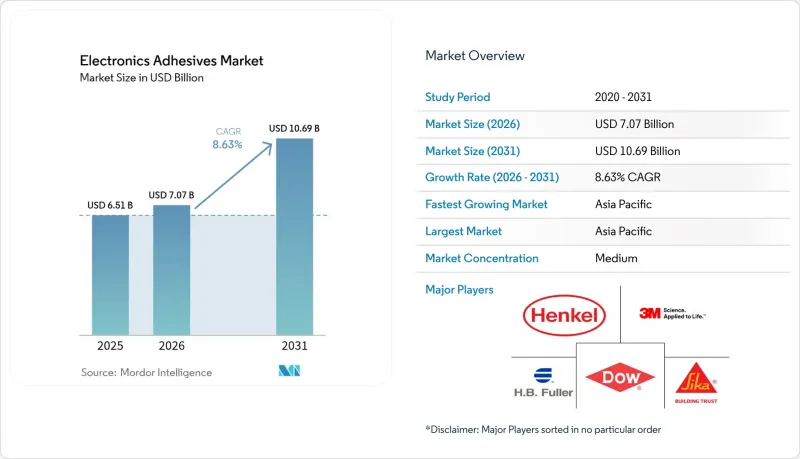
본 보고서는 수지 유형(에폭시, 아크릴 등), 제품 유형(전도성, 열전도성 등), 용도(컨포멀 코팅, 표면 실장 등), 최종 사용자 산업(소비자용 하드웨어, IT 하드웨어 등) 및 지역(아시아태평양, 북미, 유럽 등)별로 분류되어 있습니다. 시장 전망은 금액(미화) 기준으로 제시되어 있습니다.
전 세계 전자기기용 접착제 시장 동향 및 인사이트
고밀도 패키징의 급증
고밀도 패키징으로 인해 본딩 라인의 공차가 미크론 수준으로 좁아지고 있으며, 점도 범위가 좁고, 아웃가스를 제어할 수 있으며, 적층된 다이 간의 열팽창 차이를 흡수할 수 있는 탄성률을 가진 접착제가 요구되고 있습니다. 웨이퍼 레벨 패키징(WLP) 및 3D 집적화에서는 접합부가 260°C 부근에서 최고점에 도달하는 리플로우 온도 변동에 노출되지만, 이 임계값은 새롭게 배합된 에폭시-실록산 하이브리드 소재를 통해 충족되고 있습니다. DELO사의 최신 웨이퍼 레벨용 제품군은 이 온도를 견디면서도 고정밀 제트 헤드에 적합한 유동 특성을 유지하고 있습니다. 이러한 견고한 소재는 스마트폰에 그치지 않고, 첨단 운전자 보조 시스템(ADAS)의 제어 장치 및 소형 산업용 센서로 응용 범위를 넓히고 있으며, 이들 모두는 소비자용 기기와 마찬가지로 공간 제약에 직면해 있습니다.
접착제가 필요한 표면실장기술(SMT)에 대한 수요 증가
SMT는 과거 비용 절감의 역할을 했으나, 현재는 부품 간격이 솔더 페이스트의 허용 오차를 밑도는 초미세 피치 실장을 가능하게 하고 있습니다. 언더필 접착제는 플립 칩 패키지 내의 열역학적 응력을 재분배하고 주석 위스커의 확산을 차단함으로써 웨어러블 전자 기기의 현장 고장률을 낮춥니다. 자동차용 인포테인먼트 기판에서는 진동 감쇠 및 1,000시간의 열 사이클 내구성과 같은 추가적인 요구 사항이 요구되고 있어, 특수 에폭시·폴리이미드 블렌드에 대한 수요가 증가하고 있습니다. 기기 제조업체들은 인라인 타크트 타임을 최대 40% 단축하는 고처리량 제트 디스펜서나 2단계 열/UV 경화 스테이션으로 이에 대응하고 있으며, 이는 전자제품용 접착제 시장 전체에서 접착제 채택을 촉진하고 있습니다.
에폭시 및 아크릴레이트 원료 가격 변동
에피클로로히드린공급 차질과 운임 인상으로 인해 에폭시의 현물 가격은 수년 만에 최고치를 기록하며 소규모 배합 제조업체의 매출 총이익률을 압박했습니다. 미국 국제무역위원회(ITC)가 특정 아시아산 에폭시 수입품에 대해 내린 판정으로 추가 관세가 도입되었으며, 그 영향은 몇 주 만에 계약 재협상으로 파급되었습니다. 복합재용 수지 제조업체들은 톤당 150-200유로의 가격 인상으로 대응했으며, 이로 인해 접착제 원가가 직접 상승했습니다. 대형 공급업체들은 수년에 걸친 공급 계약을 통해 리스크를 헤지하고 있지만, 지역 전문 제조업체들은 운전 자금 부족에 직면해 있어 혁신의 속도가 둔화될 가능성이 있습니다.
부문 분석
에폭시 수지는 여전히 가장 중요하며, 2025년 전자기기용 접착제 시장 매출의 29.74%를 차지하고 있습니다. 높은 내접착 강도, 유전 안정성, 그리고 가혹한 유체에 대한 내성 덕분에 자동차 엔진룸 내의 모듈 및 산업용 구동 장치에서 확고한 입지를 구축하고 있습니다. 한편, 연평균 성장률(CAGR) 10.78%로 성장하고 있는 아크릴계 수지는 빛과 열을 병용하여 더 빠른 경화 속도와 기판에 대한 높은 유연성을 제공하며, 이러한 특성은 스마트폰 렌즈 스택 접착 분야에서 높이 평가받고 있습니다. 리그닌 및 식물성 오일 유도체를 활용한 바이오 에폭시 수지 개발 노력은 260°C의 최고 온도 대응 능력을 저해하지 않으면서 탄소 발자국을 줄이는 것을 목표로 하고 있습니다. 전문 조립 제조업체들 사이에서는 단일 배합으로 초고속 경화 특성이 필요한 상황에서 에폭시와 아크릴레이트의 하이브리드 블렌드가 주목받고 있습니다. 이러한 기존의 견고성과 새로운 기동성의 상호작용은 전자기기용 접착제 시장을 주도할 다양한 배합 로드맵을 부각시키고 있습니다.
2세대 폴리우레탄계 시스템은 노면으로부터의 충격에 노출되는 배터리 모듈 등 진동이 심한 환경에 대응하고 있습니다. 한편, 실리콘과 시아노아크릴레이트는 고온의 전력 장치나 신속한 고정 용도에서 여전히 틈새 시장을 유지하고 있습니다. 비스페놀 A 디글리시딜 에테르에 대한 규제 당국의 관심으로 인해 에폭시 수지 공급업체들은 대체 단량체로 전환해야 하는 상황에 처해 있지만, 장기적인 수요 기반은 여전히 견고합니다. 각 제조업체는 작동 온도 범위를 -55°C에서 175°C로 넓히는 독자적인 인성 향상제를 통해 차별화를 꾀하고 있으며, 아크릴계 접착제의 출하량이 증가하는 가운데서도 에폭시계 접착제의 주도적 지위를 확고히 하고 있습니다.
전도성 등급은 2025년 매출의 43.25%를 차지하며, 솔더 보이드가 회로의 연속성을 위협하는 모든 상황에서 필수적임이 입증되었습니다. 은 플레이크가 함유된 에폭시는 플립 칩 다이 부착에서 주류를 이루고 있는 반면, 니켈 배합 유형은 5G 안테나용으로 비용 효율적인 EMI 차폐 기능을 제공합니다. 연평균 성장률(CAGR) 11.42%로 성장하고 있는 UV 경화형 접착제는 라인 타크트 타임을 수 초 단위로 단축하고, 현장에서의 광학 검사를 가능하게 함으로써 카메라 모듈 공장의 첫 번째 합격률을 향상시키고 있습니다. 질화 알루미늄 및 질화 붕소 충전재를 배합한 열전도성 등급은 최대 5 W/mK의 열을 방출하여 LED의 루멘 유지율과 인버터의 가동 시간을 연장합니다.
비전도성 구조용 에폭시 수지는 고전압 트레이스로부터의 절연이 필수적인 분야, 특히 트랙션 인버터나 데이터센터의 전원 장치에서 안정적인 수요를 유지하고 있습니다. UV를 이용한 예비 겔화와 열을 이용한 후경화를 결합한 하이브리드형 듀얼 경화 제품은 복잡한 3차원 조립에서 최적의 선택지로 부상하고 있습니다. 현재 이용 가능한 광범위한 성능 프로파일은 전자기기용 접착제 시장을 강화하고 있으며, 설계자에게 전기적, 열적, 광학적 매개변수를 동시에 최적화할 수 있는 자유도를 제공합니다.
지역별 분석
아시아태평양은 2025년 매출의 58.21%를 차지하며, 전자기기용 접착제 시장에서 가장 규모가 큰 지역적 버팀목이 되고 있습니다. 중국 본토에서는 첨단 패키징 라인에 대한 국가 보조금과 현지 웨이퍼 레벨 언더필 생산 능력 확대로 인해 2024년 전자기기 생산량이 11.3% 증가했습니다. 미국이 2025년 4월부터 전자기기 수입에 대해 일부 관세 면제를 허용함에 따라, 태국과 베트남은 새로운 외국인 직접 투자를 유치했고, 조립 프로그램이 아세안 클러스터로 재배치되었습니다. 수지 반응조에서 완전 자동화된 SMT 라인에 이르기까지, 이 지역의 통합된 공급 기반은 리드 타임을 단축하고 비용 면에서의 우위를 강화하고 있습니다.
북미의 ‘리쇼어링’ 움직임은 ‘CHIPS and Science Act(칩스 앤 사이언스 법)’에 힘입어 탄력을 받고 있으며, 이 법에 따라 국내 웨이퍼 제조에 520억 달러가 배정되었습니다. 이러한 업스트림 공정에 대한 자본 투자는 클린룸 등급의 언더필 및 액체 열 인터페이스 재료와 같은 다운스트림 공정에서의 접착제 수요를 촉진하고 있습니다. 캐나다 퀘벡 코리도에서도 마찬가지로, 바이오 화학 물질을 우선시하는 새로운 인쇄 전자 시범 공장이 가동 중이며, 이는 유럽에서 볼 수 있는 지속가능성 노력을 반영하고 있습니다.
유럽에서는 EU 고유의 ‘EU 칩스법’이 지역 마이크로전자 밸류체인을 강화하고 있어, 전자제품용 접착제 시장 규모가 회복 조짐을 보이고 있습니다. 진보적인 PFAS 규제를 포함한 환경 규제가 불소 무함유 윤활성 필러에 대한 연구 개발을 활성화하고 있습니다. 독일의 자동차 1차 공급업체들은 대시보드 디스플레이용 박리 가능한 등급의 인증을 추진 중이며, 한편 스칸디나비아의 EMS 제공업체들은 에너지 발자국을 줄이기 위해 저온 경화에 중점을 두고 있습니다.
남미, 중동 및 아프리카는 새로운 성장의 전초기지가 되고 있습니다. 브라질 마나우스 자유무역지역에서는 소비자용 전자기기 조립이 확대되고 있어, 열대 지역의 습도에 적합한 중점도 아크릴계 접착제에 대한 수요가 발생하고 있습니다. 아랍에미리트(UAE)는 자유무역지대의 우대 조치와 AI 중심의 연구개발 단지를 결합하여 지역 물류 허브로서의 입지를 확립해 가고 있으며, 이는 현지에서 접착제 혼합 공장 설립으로 이어질 가능성이 있습니다. 현재 규모는 작지만, 이러한 지역들은 기존 생산 거점에 대한 집중으로 인한 위험을 완화하고자 하는 기업들에게 사업 다각화의 전망을 제시하고 있습니다.
기타 혜택:
- 엑셀 형식 시장 예측(ME) 시트
- 3개월간의 애널리스트 지원
자주 묻는 질문
목차
제1장 서론
제2장 조사 방법
제3장 주요 요약
제4장 시장 구도
제5장 시장 규모와 성장 예측
제6장 경쟁 구도
제7장 시장 기회와 향후 전망
LSH 26.09.09According to Mordor Intelligence, the electronics adhesives market size is expected to grow from USD 6.51 billion in 2025 to USD 7.07 billion in 2026 and is forecast to reach USD 10.69 billion by 2031 at 8.63% CAGR over 2026-2031.
This report is Segmented by Resin Type (Epoxy, Acrylic, and More), Product Type (Electrically Conductive, Thermally Conductive, and More), Application (Conformal Coating, Surface Mounting, and More), End-User Industry (Consumer Hardware, IT Hardware, and More), and Geography (Asia-Pacific, North America, Europe, and More). The Market Forecasts are Provided in Terms of Value (USD).
Global Electronics Adhesives Market Trends and Insights
Surge in High-Density Packaging
High-density packaging pushes bond lines toward micron-level tolerances, demanding adhesives with tight-viscosity windows, controlled outgassing, and elastic moduli that absorb differential expansion among stacked die. Wafer-level packaging (WLP) and 3D integration expose joints to reflow excursions that peak near 260 °C, a threshold met by newly formulated epoxy-siloxane hybrids. DELO's latest wafer-level range sustains that temperature while maintaining flow behavior suitable for precision jetting heads. Robust materials have broadened beyond smartphones into advanced driver-assistance systems (ADAS) control units and compact industrial sensors, both of which mirror consumer device space constraints.
Increase in Demand for Surface-Mount Technology Requiring Adhesives
SMT once filled cost-reduction roles but now enables ultra-fine-pitch assembly where component clearances fall below solder paste tolerances. Underfill adhesives redistribute thermo-mechanical stress in flip-chip packages and arrest tin-whisker propagation, cutting field-failure rates in wearable electronics. Automotive infotainment boards add further requirements for vibration damping and 1,000-hour thermal-cycling durability, elevating demand for specialty epoxy-polyimide blends. Equipment makers respond with high-throughput jet dispensers and dual-stage thermal/UV curing stations that shrink in-line takt times by up to 40%, reinforcing adhesive uptake throughout the electronics adhesives market.
Volatility in Epoxy and Acrylate Feedstock Prices
Epichlorohydrin supply disruptions and freight surcharges pushed spot epoxy prices to multi-year highs, crimping gross margins for small formulators. The U.S. International Trade Commission's ruling against certain Asian epoxy imports introduced additional tariffs that filtered into contract renegotiations within weeks. Composite-grade resin producers responded with EUR 150-200 per-ton price hikes, directly raising adhesive cost bases. While top-tier vendors hedge via multi-year supply deals, regional specialists face working-capital strain that may curb innovation pace.
Other drivers and restraints analyzed in the detailed report include:
- Increasing Mini-LED and Micro-LED Backlighting Adoption
- Growing Technological Advancements in Electronic Adhesives
- Stringent VOC and RoHS/REACH Compliance Costs
For complete list of drivers and restraints, kindly check the Table Of Contents.
Segment Analysis
Epoxy resins remained paramount, accounting for 29.74% of 2025 revenue within the electronics adhesives market. Their high cohesive strength, dielectric stability, and resistance to harsh fluids keep them entrenched in under-the-hood automotive modules and industrial drives. Meanwhile, acrylic chemistries, expanding at an 10.78% CAGR, offer faster light-plus-heat curing and greater substrate flexibility, features prized by smartphone lens-stack bonding. Bio-based epoxy initiatives, leveraging lignin and vegetable-oil derivatives, aim to cut carbon footprints without sacrificing 260 °C peak-temperature capability. Across specialty assembly houses, hybrid epoxy-acrylate blends are gaining traction where manufacturers need snap-cure attributes in a single formulation. This interplay of legacy robustness and emerging agility underscores the diverse formulation roadmap powering the electronics adhesives market.
Second-tier polyurethane systems address vibration-rich settings such as battery modules that face road-surface shocks, whereas silicone and cyanoacrylate niches persist for high-temperature power devices and rapid fixturing. Regulatory attention on bisphenol-A diglycidyl ether is nudging epoxy suppliers toward alternative monomers, yet long-term demand fundamentals remain intact. Manufacturers continue to differentiate through proprietary toughening agents that widen operating windows from -55 °C to 175 °C, thereby cementing epoxy's leadership even as acrylic volumes accelerate.
Electrically conductive grades delivered 43.25% of 2025 sales, proving indispensable wherever solder voids threaten circuit continuity. Silver-flake epoxies dominate flip-chip die-attach, while nickel-loaded versions offer cost-effective EMI shielding for 5G antennas. UV-curing adhesives, scaling at a 11.42% CAGR, compress line tact times to seconds and enable in-situ optical inspection, elevating first-pass yields in camera module factories. Thermally conductive variants, infused with aluminum nitride or boron nitride fillers, dissipate up to 5 W/mK, extending LED lumen maintenance and inverter uptime.
Non-conductive structural epoxies sustain demand where isolation from high-voltage traces is non-negotiable, notably in traction inverters and data-center power supplies. Hybrid dual-cure products that combine UV pre-gelling with thermal post-cure are emerging as the go-to option for complex three-dimensional assemblies. The breadth of performance profiles available today strengthens the electronics adhesives market, giving designers latitude to optimize electrical, thermal, and optical parameters simultaneously.
Complete Report Scope:
- By Resin Type
- Epoxy
- Acrylic
- Polyurethane
- Other Resin Types (Silicone, Cyanoacrylate, etc.)
- By Product Type
- Electrically Conductive
- Thermally Conductive
- UV Curing
- Other Product Types (Non-conductive, etc.)
- By Application
- Conformal Coating
- Surface Mounting
- Encapsulation
- Wire Tacking
- Other Applications (Underfill, Die-Attach)
- By End-user Industry
- Consumer Hardware
- IT Hardware
- Automotive
- Other End-user Industries (Industrial and Power Electronics, etc.)
- By Geography
- Asia-Pacific
- China
- Japan
- India
- South Korea
- ASEAN Countries
- Rest of Asia-Pacific
- North America
- United States
- Canada
- Mexico
- Europe
- Germany
- United Kingdom
- France
- Italy
- Spain
- Russia
- NORDIC Countries
- Rest of Europe
- South America
- Brazil
- Argentina
- Rest of South America
- Middle-East and Africa
- Saudi Arabia
- South Africa
- Rest of Middle-East and Africa
- Asia-Pacific
Geography Analysis
Asia-Pacific contributed 58.21% of 2025 revenue, making it the single largest regional pillar of the electronics adhesives market. Mainland China raised electronics output by 11.3% in 2024 through state grants for advanced packaging lines and local wafer-level underfill capacity expansions. Thailand and Vietnam absorbed fresh foreign direct investment after the United States granted selected tariff exemptions on electronics imports from April 2025, redirecting assembly programs into ASEAN clusters. The region's integrated supply base-from resin reactors to fully automated SMT lines-compresses lead times and reinforces its cost leadership.
North America's reshoring narrative gained momentum via the CHIPS and Science Act, which allocates USD 52 billion toward domestic wafer fabrication. This upstream capital outlay is stimulating downstream adhesive demand for clean-room-grade underfills and liquid thermal interface materials. Canada's Quebec corridor likewise hosts new printed-electronics pilot plants that prioritize bio-based chemistries, mirroring sustainability pushes seen in Europe.
Europe is charting an electronics adhesives market size rebound as its own EU Chips Act strengthens local microelectronic value chains. Environmental regulations, including progressive PFAS limitations, are galvanizing R&D into fluorine-free lubricious fillers. Germany's automotive Tier 1s are qualifying debondable grades for dashboard displays, while Scandinavian EMS providers emphasize low-temperature curing to shrink energy footprints.
South America and the Middle East and Africa represent emerging frontiers. Brazil's Manaus free-trade zone is broadening consumer-electronic assembly, opening opportunities for mid-viscosity acrylics tailored to tropical humidity. The United Arab Emirates is positioning itself as a regional logistics hub, pairing free-zone incentives with AI-centered R&D parks that could seed localized adhesive blending plants. Though smaller today, these geographies add diversification prospects for firms eager to de-risk concentration within traditional production centers.
- 3M
- Arkema
- Avery Dennison
- BASF
- DELO
- Dow
- Dymax Corporation
- H.B. Fuller Company
- Henkel AG and Co. KGaA
- Huntsman International LLC.
- ITW Engineered Polymers
- Master Bond Inc.
- NAMICS CORPORATION
- Panacol-Elosol GmbH
- Parker Hannifin Corp
- Permabond LLC
- Pidilite Industries Ltd.
- Shin-Etsu Chemical Co., Ltd.
Additional Benefits:
- The market estimate (ME) sheet in Excel format
- 3 months of analyst support
TABLE OF CONTENTS
1 Introduction
- 1.1 Study Assumptions and Market Definition
- 1.2 Scope of the Study
2 Research Methodology
3 Executive Summary
4 Market Landscape
- 4.1 Market Overview
- 4.2 Market Drivers
- 4.2.1 Surge in High-Density Packaging Demand
- 4.2.2 Increase in Demand for Surface Mount Technology requiring Adhesives
- 4.2.3 Increasing Mini-LED and Micro-LED Backlighting Adoption
- 4.2.4 Growing Technological Advancements in Electronic Adhesives
- 4.2.5 Expansion of Consumer Electronics Production
- 4.3 Market Restraints
- 4.3.1 Volatility in Epoxy and Acrylate Feedstock Prices
- 4.3.2 Stringent VOC and RoHS/REACH Compliance Costs
- 4.3.3 Thermal-Mismatch Failures in Ultra-Thin Flexible Substrates
- 4.4 Value Chain Analysis
- 4.5 Porter's Five Forces
- 4.5.1 Bargaining Power of Suppliers
- 4.5.2 Bargaining Power of Buyers
- 4.5.3 Threat of New Entrants
- 4.5.4 Threat of Substitutes
- 4.5.5 Degree of Competition
5 Market Size and Growth Forecasts (Value)
- 5.1 By Resin Type
- 5.1.1 Epoxy
- 5.1.2 Acrylic
- 5.1.3 Polyurethane
- 5.1.4 Other Resin Types (Silicone, Cyanoacrylate, etc.)
- 5.2 By Product Type
- 5.2.1 Electrically Conductive
- 5.2.2 Thermally Conductive
- 5.2.3 UV Curing
- 5.2.4 Other Product Types (Non-conductive, etc.)
- 5.3 By Application
- 5.3.1 Conformal Coating
- 5.3.2 Surface Mounting
- 5.3.3 Encapsulation
- 5.3.4 Wire Tacking
- 5.3.5 Other Applications (Underfill, Die-Attach)
- 5.4 By End-user Industry
- 5.4.1 Consumer Hardware
- 5.4.2 IT Hardware
- 5.4.3 Automotive
- 5.4.4 Other End-user Industries (Industrial and Power Electronics, etc.)
- 5.5 By Geography
- 5.5.1 Asia-Pacific
- 5.5.1.1 China
- 5.5.1.2 Japan
- 5.5.1.3 India
- 5.5.1.4 South Korea
- 5.5.1.5 ASEAN Countries
- 5.5.1.6 Rest of Asia-Pacific
- 5.5.2 North America
- 5.5.2.1 United States
- 5.5.2.2 Canada
- 5.5.2.3 Mexico
- 5.5.3 Europe
- 5.5.3.1 Germany
- 5.5.3.2 United Kingdom
- 5.5.3.3 France
- 5.5.3.4 Italy
- 5.5.3.5 Spain
- 5.5.3.6 Russia
- 5.5.3.7 NORDIC Countries
- 5.5.3.8 Rest of Europe
- 5.5.4 South America
- 5.5.4.1 Brazil
- 5.5.4.2 Argentina
- 5.5.4.3 Rest of South America
- 5.5.5 Middle-East and Africa
- 5.5.5.1 Saudi Arabia
- 5.5.5.2 South Africa
- 5.5.5.3 Rest of Middle-East and Africa
- 5.5.1 Asia-Pacific
6 Competitive Landscape
- 6.1 Market Concentration
- 6.2 Strategic Moves
- 6.3 Market Share(%)/Ranking Analysis
- 6.4 Company Profiles (includes Global level Overview, Market level overview, Core Segments, Financials as available, Strategic Information, Market Rank/Share for key companies, Products and Services, and Recent Developments)
- 6.4.1 3M
- 6.4.2 Arkema
- 6.4.3 Avery Dennison
- 6.4.4 BASF
- 6.4.5 DELO
- 6.4.6 Dow
- 6.4.7 Dymax Corporation
- 6.4.8 H.B. Fuller Company
- 6.4.9 Henkel AG and Co. KGaA
- 6.4.10 Huntsman International LLC.
- 6.4.11 ITW Engineered Polymers
- 6.4.12 Master Bond Inc.
- 6.4.13 NAMICS CORPORATION
- 6.4.14 Panacol-Elosol GmbH
- 6.4.15 Parker Hannifin Corp
- 6.4.16 Permabond LLC
- 6.4.17 Pidilite Industries Ltd.
- 6.4.18 Shin-Etsu Chemical Co., Ltd.
7 Market Opportunities and Future Outlook
- 7.1 White-space and Unmet-Need Assessment