
|
시장보고서
상품코드
2121877
규산나트륨 시장 : 시장 점유율 분석, 업계 동향 및 통계, 성장 예측(2026-2031년)Sodium Silicate - Market Share Analysis, Industry Trends & Statistics, Growth Forecasts (2026 - 2031) |
||||||
 Mordor Intelligence
Mordor Intelligence에 의하면, 규산나트륨 시장 규모는 2025년 839만 톤으로 평가되었고, 2026년에는 879만 톤으로 추정되고, 2026-2031년 CAGR 4.8%로 성장을 지속할 전망이며, 2031년에는 1,112만 톤에 이를 것으로 예측됩니다.
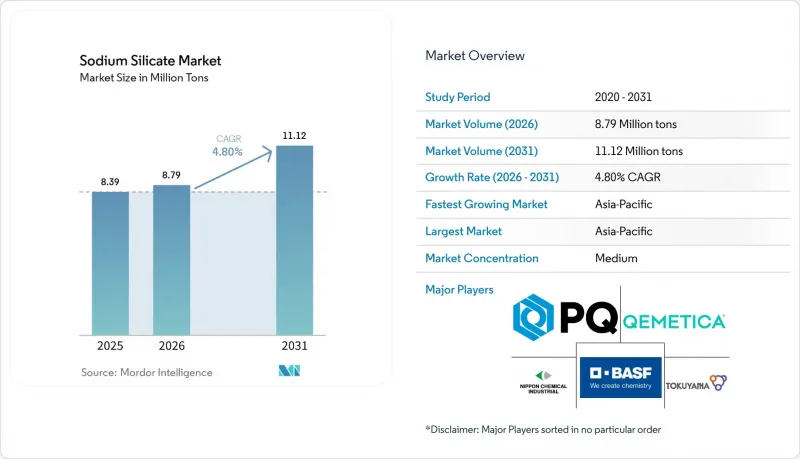
본 보고서는 유형별(고체 및 액체), 용도별(접착제·도료, 세제, 식품 보존, 침전 실리카, 제지 및 펄프, 수처리, 기타 용도), 지역별(아시아태평양, 북미, 유럽, 남미, 중동 및 아프리카)로 분류되어 있습니다. 시장 전망은 수량(톤) 기준으로 제시되어 있습니다.
세계의 나트륨 실리케이트 시장 동향 및 인사이트력
폐지 재활용에 대한 수요 증가
포장재의 재생재 함유율 제고를 의무화하는 정부 규제로 인해, 부유 탈색 공정에서 나트륨 실리케이트의 사용이 가속화되고 있습니다. 현대 제지 공장에서는 회수된 종이 1톤당 8-12kg의 나트륨 실리케이트를 소비하고 있으며, 이 화학 물질을 통한 알칼리도 조절로 잉크 입자의 재응집이 방지되므로 인쇄업자는 엄격한 백도 및 청정도 기준을 충족할 수 있습니다. 플라스틱 대체가 진행됨에 따라 추가적인 섬유 수요가 발생하고 있으며, 특히 유럽에서는 ‘일회용 플라스틱 지침’에 따라 가공업체들이 종이 기반 제품으로의 전환을 강요받고 있어 수요가 더욱 증가하고 있습니다. 안정적인 pH 완충 성능을 갖춘 등급을 공급할 수 있는 공급업체들은 통합 제지 그룹과 장기 계약을 체결하고 있습니다.
‘친환경’ 타이어에서의 침전 실리카 사용 증가
침전 실리카 1톤당 약 1.3톤의 규산나트륨 원료가 필요합니다. 타이어 제조업체들이 끊임없이 변화하는 연비 라벨 표시 규제에 대응하기 위해 구름 저항을 줄여감에 따라, 이것이 직접적인 수요 견인 효과를 낳고 있습니다. 실리카 대 소다 비율이 좁은 고순도 나트륨 실리케이트 등급은 차세대 전기차용 타이어에 있어 매우 중요한 매개변수인 비표면적과 다공성을 제어한 실리카를 생성하기 때문에 높은 가격에 거래되고 있습니다. 동남아시아 지역의 생산 능력 확충이 해당 지역 수요 성장세를 더욱 뒷받침하고 있습니다.
고알칼리성 규산염의 건강 및 안전 위험
규제 당국은 고농도 나트륨 실리케이트를 부식성 물질로 분류하고 있으며, 이에 따라 작업장 내 노출 한계치가 엄격해지고 개인보호구(PPE) 착용 의무도 강화되고 있습니다. 중소규모 사용자들은 규정 준수 비용 증가에 직면하고 있으며, 이로 인해 크래프트 주조소나 소규모 세제 제조업체 등 가격에 민감한 업계에서의 도입이 지연될 가능성이 있습니다. 반면, 첨단 폐쇄형 처리 시스템과 원격 모니터링을 도입한 대형 제조업체들은 운영 안전성을 확보하는 동시에 다운스트림 고객들의 신뢰도 유지하고 있습니다.
부문 분석
2025년에는 액체 제품이 나트륨 실리케이트 시장의 68.39%를 차지한 것으로 평가되었으며, 2031년까지 연평균 성장률(CAGR) 5.05%로 확대될 것으로 예측됩니다. 수처리 플랜트의 자동 공급 시스템은 용해 지연을 해소하고 보다 정밀한 투여량 제어가 가능하기 때문에 액상 제품을 선호하는 경향이 있습니다. 50° 보메 농축 제품의 기술 혁신을 통해 반응성을 유지하면서 운송 비용을 25% 절감할 수 있게 되었으며, 이러한 장점은 수출 지향적인 세제 제조업체들로부터 높은 평가를 받고 있습니다. 고체 비드나 분말 형태는 유통 기한, 원격지 보관, 혹은 초고알칼리도가 최우선으로 고려되는 상황에서 여전히 중요하지만, 물류 효율이 뛰어난 액상 제품이 시장 점유율을 서서히 확대함에 따라 그 가치 차이는 점차 좁혀지고 있습니다.
각 제조업체는 막 여과 기술을 활용하여 액상 등급 실리카 대 소다의 비율을 미세 조정하고 있으며, 그 결과 고순도 침전 실리카 및 특수 접착제 용도에 적합한 성능이 최적화된 중간체를 얻고 있습니다. 이러한 기계 집약적인 제조 능력은 특히 유틸리티이나 숙련된 노동자가 부족한 지역에서 시장 진입에 대한 기술적 장벽이 되고 있습니다. 액체 제품 포트폴리오의 폭이 넓기 때문에 통합형 공급업체들은 더 높은 EBITDA 마진을 유지하고 다국적 소비재(FMCG) 기업들과 장기 공급 계약을 확보하고 있습니다.
지역별 분석
아시아태평양은 2025년에 전 세계 소비량의 42.12%를 차지했으며, 가장 큰 점유율을 기록한 것으로 평가되었습니다. Taicang Sinoch의 30만 톤 규모 플랜트 등의 시설을 포함한 중국의 국내 생산자들은 소다회부터 고체 및 액체 규산염에 이르기까지 후방 통합을 통해 동남아시아 전역으로의 수출을 뒷받침하고 있습니다. 인도의 세제 업계에서는 액상 규산염의 투여 제어에 의존하는 분무 건조탑의 도입이 가속화되고 있는 반면, 호주에서는 정부 자금을 통한 교통 인프라 프로젝트에서 지오폴리머 시멘트의 조기 도입이 촉진되고 있습니다.
북미 수요는 규정에 따라 규산염계 부식 방지제 사용이 의무화된 수자원 인프라 개보수를 위한 연방 정부의 지출에 힘입어 증가하고 있습니다. 셰일 분지의 운영사들은 점토층을 안정화시키는 시추액 첨가제로 나트륨 실리케이트를 사용하고 있어, 전체 시추 장비 수가 변동하더라도 지역 내 수요는 안정적입니다. 고품질 전자기기용 등급에 대한 수요는 서부 해안의 반도체 산업 집적지에 집중되어 있으며, 이곳에서는 고순도 등급의 제품이 흠집 없는 유리 제조를 뒷받침하고 있습니다.
유럽에서는 양보다 질을 중시하는 태도가 유지되고 있습니다. ‘물 프레임워크 지침’에 따른 더욱 엄격한 방류 규제로 인해 규정 준수 비용은 증가하고 있지만, 폐쇄형 물 재활용 시스템을 갖춘 생산자에게는 유리하게 작용하고 있습니다. 2024년 11월 Qemetica사가 PPG사의 실리카 자산을 인수한 것과 같은 업계 재편 동향으로 인해, 주로 지역 타이어 산업에 공급되는 침전 실리카의 밸류체인 내 공급이逼迫하고 있습니다. 폐쇄형 유리 재활용용 화학 약품에 대한 수요 또한 공급량의 안정성을 더욱 뒷받침하고 있습니다.
기타 혜택 :
- 엑셀 형식 시장 전망(ME) 시트
- 3개월간의 애널리스트 지원
자주 묻는 질문
목차
제1장 서론
제2장 조사 방법
제3장 주요 요약
제4장 시장 구도
제5장 시장 규모 및 성장 예측
제6장 경쟁 구도
제7장 시장 기회 및 향후 전망
AJY 26.09.09According to Mordor Intelligence, the sodium silicate market size is expected to grow from 8.39 million tons in 2025 to 8.79 million tons in 2026 and is forecast to reach 11.12 million tons by 2031 at 4.8% CAGR over 2026-2031.
This report is Segmented by Type (Solid and Liquid), Application (Adhesives and Paints, Detergents, Food Preservation, Precipitated Silica, Paper and Pulp, Water Treatment, and Other Applications), and Geography (Asia-Pacific, North America, Europe, South America, and Middle East and Africa). The Market Forecasts are Provided in Terms of Volume (Tons).
Global Sodium Silicate Market Trends and Insights
Mounting Demand for Waste-Paper Recycling
Government mandates for higher recycled-content packaging accelerate the use of sodium silicate in flotation deinking processes. Modern mills consume 8-12 kg of sodium silicate per ton of recovered paper, and the chemical's alkalinity control prevents ink particle re-agglomeration, allowing printers to meet exacting brightness and cleanliness standards. Demand intensifies as plastic substitution drives an additional fiber requirement, especially in Europe, where the Single-Use Plastics Directive prompts converters to shift toward paper-based formats. Suppliers able to deliver consistent pH buffering grades secure long-term contracts with integrated paper groups.
Rising Usage of Precipitated Silica in "Green" Tires
Each ton of precipitated silica requires roughly 1.3 tons of sodium silicate feedstock, creating a direct pull-through effect as tire makers lower rolling resistance to meet evolving fuel-economy labeling rules. High-purity sodium silicate grades with narrow silica-to-soda ratios command premium prices because they yield silica with controlled surface area and porosity-critical parameters for next-generation electric vehicle tires. Capacity additions in Southeast Asia reinforce regional demand momentum.
Health and Safety Hazards of High-Alkali Silicates
Regulators classify concentrated sodium silicate as corrosive, prompting stricter workplace exposure limits and tighter personal protective equipment mandates. Small and mid-size users face higher compliance costs, which can delay adoption in price-sensitive industries such as craft foundries and micro-scale detergent blenders. Large producers that embed advanced closed-loop handling systems and remote monitoring safeguard operations and credibility with downstream customers.
Other drivers and restraints analyzed in the detailed report include:
- Growth of Powder Detergents in Low-Income Economies
- Rapid Industrial-Scale Uptake of Geopolymer Cement
- Volatility in Soda-Ash Prices
For complete list of drivers and restraints, kindly check the Table Of Contents.
Segment Analysis
Liquid products controlled 68.39% of the sodium silicate market in 2025 and are projected to expand at a 5.05% CAGR through 2031. Automated feed systems in water-treatment plants favor liquid chemistry because they eliminate dissolution lag and enable tighter dosage control. Concentrated 50° Baume innovations deliver 25% freight savings while preserving reactivity, a benefit that resonates with export-oriented detergent makers. Solid beads and powder forms retain relevance where shelf life, remote storage, or ultrahigh alkalinity are paramount, yet the value gap narrows as logistics-optimized liquids capture incremental territory.
Manufacturers utilize membrane filtration to fine-tune silica-to-soda ratios in liquid grades, resulting in performance-tailored intermediates for high-purity precipitated silica and specialty adhesive applications. This machinery-intensive capability creates technological barriers to entry, particularly in regions where utilities and skilled labor are scarce. Portfolio breadth in liquids explains why integrated suppliers sustain higher EBITDA margins and secure long-term supply agreements with multinational fast-moving consumer goods companies.
Complete Report Scope:
- By Type
- Solid
- Liquid
- By Application
- Adhesives and Paints
- Detergents
- Food Preservation
- Precipitated Silica
- Paper and Pulp
- Water Treatment
- Other Applications
- By Geography
- Asia-Pacific
- China
- India
- Japan
- South Korea
- Rest of Asia-Pacific
- North America
- United States
- Canada
- Mexico
- Europe
- Germany
- United Kingdom
- Italy
- France
- Rest of Europe
- South America
- Brazil
- Argentina
- Rest of South America
- Middle East and Africa
- Saudi Arabia
- South Africa
- Rest of Middle East and Africa
- Asia-Pacific
Geography Analysis
The Asia-Pacific region accounts for the largest share of global consumption at 42.12% in 2025. Domestic producers in China, including facilities such as Taicang Sinoch's 300,000-ton plant, back-integrate from soda ash to solid and liquid silicates, supporting exports across Southeast Asia. India's detergent industry accelerates the installation of spray-drying towers that rely on liquid silicate dosing control, while Australia fosters the early adoption of geopolymer cement in government-funded transport projects.
North American demand benefits from federal spending on water infrastructure upgrades that specify silicate-based corrosion inhibitors. Shale-basin operators use sodium silicate as a drilling fluid additive that stabilizes clay formations, keeping regional offtake stable even when overall rig counts fluctuate. Premium electronics-grade volumes cluster along the West Coast semiconductor corridor, where high-purity grades support the fabrication of scratch-free glass.
Europe maintains a quality-over-quantity orientation. Stricter effluent discharge rules under the Water Framework Directive increase compliance costs but also favor producers equipped with closed-loop water recycling systems. Consolidation trends, such as Qemetica's November 2024 acquisition of PPG's silica assets, tighten supply in precipitated-silica value chains that primarily feed the regional tire industry. Demand for closed-loop glass recycling chemicals further anchors volume stability.
- Alumina doo Zvornik
- BASF
- C Thai Group
- QEMETICA
- Evonik Industries
- Gujarat Multi Gas Base Chemicals Pvt Ltd
- Hindcon Chemicals Ltd.
- Kiran Global Chem Ltd.
- Nippon Chemical Industrial Co. Ltd.
- Nouryon
- Occidental Petroleum Corporation
- PQ Corporation
- Silmaco
- Tokuyama Corporation
- W. R. Grace & Co.-Conn.
Additional Benefits:
- The market estimate (ME) sheet in Excel format
- 3 months of analyst support
TABLE OF CONTENTS
1 Introduction
- 1.1 Study Assumptions and Market Definition
- 1.2 Scope of the Study
2 Research Methodology
3 Executive Summary
4 Market Landscape
- 4.1 Market Overview
- 4.2 Market Drivers
- 4.2.1 Mounting demand for waste-paper recycling
- 4.2.2 Rising usage of precipitated silica in "green" tyres
- 4.2.3 Growth of powder detergents in low-income economies
- 4.2.4 Rapid industrial-scale uptake of geopolymer cement
- 4.2.5 Circular-economy push for closed-loop glass recycling
- 4.3 Market Restraints
- 4.3.1 Health and safety hazards of high-alkali silicates
- 4.3.2 Volatility in soda-ash prices
- 4.3.3 Tightening EU effluent-discharge limits on silicate liquor
- 4.3.4 Competitive threat from bio-based binders in foundry cores
- 4.4 Value Chain Analysis
- 4.5 Porter's Five Forces Analysis
- 4.5.1 Bargaining Power of Suppliers
- 4.5.2 Bargaining Power of Buyers
- 4.5.3 Threat of New Entrants
- 4.5.4 Threat of Substitutes
- 4.5.5 Degree of Competition
5 Market Size and Growth Forecasts (Volume)
- 5.1 By Type
- 5.1.1 Solid
- 5.1.2 Liquid
- 5.2 By Application
- 5.2.1 Adhesives and Paints
- 5.2.2 Detergents
- 5.2.3 Food Preservation
- 5.2.4 Precipitated Silica
- 5.2.5 Paper and Pulp
- 5.2.6 Water Treatment
- 5.2.7 Other Applications
- 5.3 By Geography
- 5.3.1 Asia-Pacific
- 5.3.1.1 China
- 5.3.1.2 India
- 5.3.1.3 Japan
- 5.3.1.4 South Korea
- 5.3.1.5 Rest of Asia-Pacific
- 5.3.2 North America
- 5.3.2.1 United States
- 5.3.2.2 Canada
- 5.3.2.3 Mexico
- 5.3.3 Europe
- 5.3.3.1 Germany
- 5.3.3.2 United Kingdom
- 5.3.3.3 Italy
- 5.3.3.4 France
- 5.3.3.5 Rest of Europe
- 5.3.4 South America
- 5.3.4.1 Brazil
- 5.3.4.2 Argentina
- 5.3.4.3 Rest of South America
- 5.3.5 Middle East and Africa
- 5.3.5.1 Saudi Arabia
- 5.3.5.2 South Africa
- 5.3.5.3 Rest of Middle East and Africa
- 5.3.1 Asia-Pacific
6 Competitive Landscape
- 6.1 Market Concentration
- 6.2 Strategic Moves
- 6.3 Market Share (%)/Ranking Analysis
- 6.4 Company Profiles (includes Global Level Overview, Market Level Overview, Core Segments, Financials as available, Strategic Information, Market Rank/Share for key companies, Products and Services, and Recent Developments)
- 6.4.1 Alumina doo Zvornik
- 6.4.2 BASF
- 6.4.3 C Thai Group
- 6.4.4 QEMETICA
- 6.4.5 Evonik Industries
- 6.4.6 Gujarat Multi Gas Base Chemicals Pvt Ltd
- 6.4.7 Hindcon Chemicals Ltd.
- 6.4.8 Kiran Global Chem Ltd.
- 6.4.9 Nippon Chemical Industrial Co. Ltd.
- 6.4.10 Nouryon
- 6.4.11 Occidental Petroleum Corporation
- 6.4.12 PQ Corporation
- 6.4.13 Silmaco
- 6.4.14 Tokuyama Corporation
- 6.4.15 W. R. Grace & Co.-Conn.
7 Market Opportunities and Future Outlook
- 7.1 White-Space and Unmet-Need Assessment