|
시장보고서
상품코드
2121934
아시아태평양의 자동 자재관리 및 보관 시스템 : 시장 점유율 분석, 업계 동향과 통계, 성장 예측(2026-2031년)Asia Pacific Automated Material Handling And Storage Systems - Market Share Analysis, Industry Trends & Statistics, Growth Forecasts (2026 - 2031) |
||||||
 Mordor Intelligence
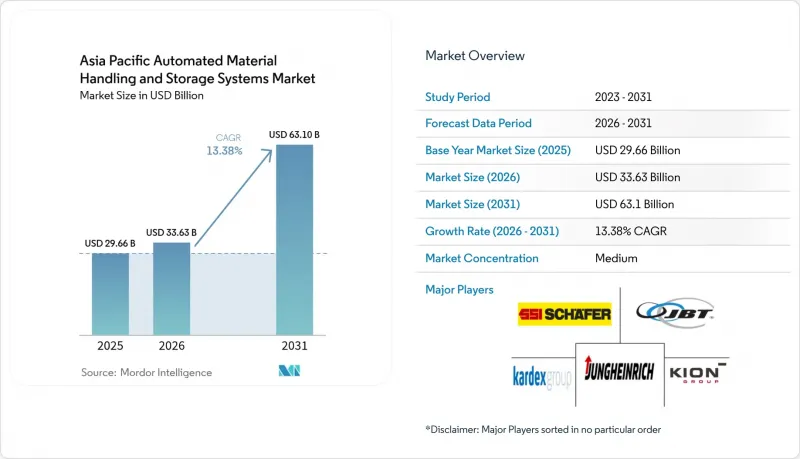
Mordor Intelligence에 따르면 2026년 아시아태평양의 자동 자재관리·보관 시스템 시장의 규모는 336억 3,000만 달러로 추정되고 있으며, 2025년 296억 6,000만 달러에서 확대하며, 2031년에는 631억 달러에 달할 것으로 예측됩니다.
2026-2031년까지의 연평균 성장률(CAGR)은 13.38%에 달할 전망입니다.
이 보고서는 제품 유형(하드웨어, 소프트웨어, 서비스), 장비 유형(이동 로봇, ASRS, 자동 컨베이어, 팔레타이저, 분류 시스템), 최종사용자 산업(공항, 자동차 등), 기능(보관, 운송 등) 및 지역별로 분류되어 있습니다. 시장 전망은 금액(달러) 단위로 표시되어 있습니다.
아시아태평양의 자동 자재 취급 및 보관 시스템 시장 동향 및 인사이트
아시아 2선 도시의 E-Commerce 주문 처리 센터 급성장
청두, 푸네, 수라바야 등의 도시에서 자동화 지원 창고 건설 붐이 일면서, 표준화되어 있으면서도 확장성이 뛰어난 시스템에 대한 수요가 급격히 증가하고 있습니다. 운영 사업자는 전 세계의 베스트 프랙티스와 현지 인프라의 제약을 조화시켜야 하며, 이로 인해 통합 업체는 단계적 도입과 현지화된 예비 부품 생태계를 지원하는 모듈식 플랫폼을 설계해야 하는 상황에 직면해 있습니다. 당일 배송을 목표로 하는 소매업체에게 자동화된 피킹, 분류, 보관은 필수적인 기능으로 간주되며, 이는 아시아태평양의 자동 자재 취급 및 보관 시스템 시장을 지원하는 수년에 걸친 조달 파이프라인을 촉진하고 있습니다.
5G 지원 산업용 IoT 네트워크 도입 가속화
프라이빗 5G 네트워크는 지연 시간을 10밀리초 미만으로 단축하여, 차량 그룹의 실시간 오케스트레이션, AMR 그룹의 동기화, 그리고 클라우드 기반 디지털 트윈을 실현합니다. 서울과 요코하마의 초기 도입 기업으로부터는 예측 유지보수 알고리즘의 성숙에 따라 생산성이 두 자릿수 증가를 보였고, 예기치 못한 가동 중단 시간이 30% 감소했다는 보고가 접수되고 있습니다. 또한 이 연결 계층은 원격 성능 모니터링 및 성과 기반 서비스 계약과 같은 새로운 서비스 모델을 지원하며, 아시아태평양의 자동 자재 취급 및 보관 시스템 시장의 지속적인 수익 구조를 강화하고 있습니다.
중소기업의 높은 초기 설비 투자와 긴 ROI 주기
자카르타와 마닐라의 중소기업 수출업체들은 프로젝트 초기 비용이 1-2년 치의 자유 현금 흐름에 상당하는 경우가 적지 않습니다. 벤더의 융자를 이용하는 경우에도 3-5년에 달하는 회수 기간은 위험 감수 능력을 압박하여 구매 결정을 지연시키고, 아시아태평양의 자동 자재 취급 및 보관 시스템 시장의 성장 궤도를 다소 둔화시키고 있습니다.
부문 분석
소프트웨어 하위 부문은 2031년까지 연평균 성장률(CAGR) 14.12%를 기록할 것으로 예상되며, 이는 기본적인 제어 로직에서 분석 기능을 갖춘 오케스트레이션으로의 전환을 반영합니다. 고급 창고 관리 및 디지털 트윈 제품군을 통해 예측 기반의 슬롯 할당 및 동적인 주문 배치 처리가 가능해졌으며, 상하이의 여러 가전 제품 제조 시설에서는 처리 능력이 최대 20% 향상되었습니다. 2024년 지출의 대부분은 하드웨어가 차지하고 있지만, 소프트웨어를 중심으로 한 가치 제안이 자본 배분 위원회에 점점 더 큰 영향을 미치고 있으며, 데이터 활용이 성숙한 사업자들 사이에서 아시아태평양의 자동 자재 취급 및 보관 시스템 시장 규모가 확대되고 있습니다.
클라우드 네이티브 애플리케이션에 대한 수요가 증가함에 따라 오픈 API 및 엣지에서 클라우드에 이르는 사이버 보안 계층을 중심으로 한 벤더 간의 경쟁이 가속화되고 있습니다. 소프트웨어 구독과 수명주기 서비스를 결합한 공급업체는 더 높은 이익률과 고객 유지율을 실현하며, 아시아태평양의 자동 자재 취급 및 보관 시스템 시장에서 장기적인 수입원을 공고히 하고 있습니다.
AMR(자율 이동 로봇)은 인프라에 내장된 유도 시스템 없이도 동적인 랙이나 좁은 통로를 주행할 수 있다는 점에서 기존의 AGV(자동 유도 차량)를 능가하며, 도입 시간을 절반으로 단축하고 빈번한 SKU 재구성에도 대응하고 있습니다. 그 결과, AMR 출하 대수는 연평균 성장률(CAGR) 14.78%로 증가하고 있으며, 자본 흐름은 고정식 컨베이어 확장에서 AI 기반 교통 관리 소프트웨어로 관리되는 로봇 함대로 재분배되고 있습니다.
자동 창고 시스템은 여전히 높은 처리량을 자랑하는 옴니채널 거점에서 필수적이지만, 구매자들은 이를 AMR 주도의 피킹 구역과 결합하는 경향이 강해지고 있습니다. 또한 인체공학적 위험 감소를 추구하는 음료 병입 업체들 사이에서 팔레타이징 로봇의 도입이 진행되고 있으며, 아시아태평양의 자동 자재 취급 및 보관 시스템 시장의 수요 다양성을 더욱 강화하고 있습니다.
기타 혜택:
- 엑셀 형식의 시장 예측(ME) 시트
- 3개월간의 애널리스트 지원
자주 묻는 질문
목차
제1장 서론
제2장 조사 방법
제3장 개요
제4장 시장 구도
제5장 시장 규모와 성장 예측
제6장 경쟁 구도
제7장 시장 기회와 향후 전망
KSA 26.09.04According to Mordor Intelligence, the Asia Pacific automated material handling and storage systems market size in 2026 is estimated at USD 33.63 billion, growing from 2025 value of USD 29.66 billion with 2031 projections showing USD 63.1 billion, growing at 13.38% CAGR over 2026-2031.
This report is Segmented by Product Type (Hardware, Software, and Services), Equipment Type (Mobile Robots, ASRS, Automated Conveyor, Palletizer, and Sortation System), End-User Industry (Airport, Automotive, and More), Function (Storage, Transportation, and More), and Geography. The Market Forecasts are Provided in Terms of Value (USD).
Asia Pacific Automated Material Handling And Storage Systems Market Trends and Insights
Booming E-commerce Fulfilment Centers Across Tier-2 Asian Cities
The construction boom of automation-ready warehouses in cities such as Chengdu, Pune, and Surabaya sharply elevates demand for standardized yet scalable systems. Operators must harmonize global best practices with local infrastructure constraints, prompting integrators to design modular platforms that support phased rollouts and localized spare-parts ecosystems. Retailers targeting one-day delivery windows view automated picking, sorting, and storage as non-negotiable capabilities, spurring multi-year procurement pipelines that underpin the Asia Pacific automated material handling and storage systems market.
Accelerated Adoption of 5G-Enabled Industrial IoT Networks
Private 5G networks shrink latency to sub-10 milliseconds, enabling real-time fleet orchestration, synchronized AMR swarms, and cloud-based digital twins. Early adopters in Seoul and Yokohama report double-digit productivity gains and 30% reductions in unplanned downtime as predictive maintenance algorithms mature. The connectivity layer also underwrites new service models such as remote performance monitoring and outcome-based service contracts, strengthening the recurring-revenue profile of the Asia Pacific automated material handling and storage systems market.
High Initial Capex and Long ROI Cycles for SMEs
Small and midsize exporters in Jakarta and Manila often confront upfront project costs equalling 1-2 years of free cash flow. Even with vendor financing, a three-to-five-year payback stretches risk tolerance, delaying purchase decisions and marginally tempering the Asia Pacific automated material handling and storage systems market growth trajectory.
Other drivers and restraints analyzed in the detailed report include:
- Government Incentives for Smart-Factory Automation
- Cost Pressure from Rising Intra-Asia Wages Pushing Warehouse Automation
- Cyber-security Vulnerabilities in Connected Automation Fleets
For complete list of drivers and restraints, kindly check the Table Of Contents.
Segment Analysis
The software sub-segment is on track to log a 14.12% CAGR to 2031, reflecting the shift from basic control logic to analytics-enabled orchestration. Advanced warehouse management and digital-twin suites allow predictive slotting and dynamic order batching, bolstering throughput by up to 20% in several Shanghai consumer-electronics facilities. While hardware sustains the bulk of 2024 spending, software-centric value propositions increasingly sway capital-allocation committees, expanding the Asia Pacific automated material handling and storage systems market size among data-mature operators.
Heightened demand for cloud-native applications fuels vendor competition centered on open APIs and edge-to-cloud cybersecurity layers. Providers that bundle software subscriptions with lifecycle services realize higher margins and stickier customer relationships, solidifying long-term revenue streams within the Asia Pacific automated material handling and storage systems market.
AMRs outperform legacy AGVs by navigating dynamic racks and tight aisles without infrastructure-embedded guidance, cutting deployment time by half and accommodating frequent SKU re-profiling. As a result, AMR shipments advance at a 14.78% CAGR, reallocating capital flows away from fixed conveyor expansions toward robot fleets managed by AI-based traffic software.
Automated storage and retrieval systems remain essential in high-throughput omnichannel nodes, though buyers increasingly couple them with AMR-led picking zones. Palletizing robots gain traction among beverage bottlers seeking ergonomic risk mitigation, reinforcing the diversity of demand across the Asia Pacific automated material handling and storage systems market.
Complete Report Scope:
- By Product Type
- Hardware
- Software
- Services
- By Equipment Type
- Mobile Robots
- Automated Guided Vehicle (AGV)
- Automated Forklift
- Automated Tow / Tractor / Tug
- Unit Load
- Assembly Line
- Special Purpose
- Autonomous Mobile Robots (AMR)
- Automated Guided Vehicle (AGV)
- Automated Storage and Retrieval System (ASRS)
- Fixed Aisle
- Carousel
- Vertical Lift Module
- Automated Conveyor
- Belt
- Roller
- Pallet
- Overhead
- Palletizer
- Conventional
- Robotic
- Sortation System
- Mobile Robots
- By End-user Industry
- Airport
- Automotive
- Food and Beverage
- Retail / Warehousing / Distribution Centres / Logistic Centres
- General Manufacturing
- Pharmaceuticals
- Post and Parcel
- Electronics and Semiconductor Manufacturing
- Other End-user Industries
- By Function
- Storage
- Transportation
- Sorting
- Packaging / Palletising
- Assembly / Kitting
- By Country
- China
- Japan
- India
- South Korea
- Australia
- Indonesia
- Thailand
- Singapore
- Malaysia
- Taiwan
- Rest of Asia Pacific
List of Companies Covered in this Report:
- Daifuku Co., Ltd.
- Kardex Holding AG
- KION Group AG
- Dematic Corp. (KION subsidiary)
- Jungheinrich AG
- SSI Schaefer AG
- Toyota Industries Corporation
- Murata Machinery, Ltd.
- Honeywell Intelligrated Inc.
- BEUMER Group GmbH and Co. KG
- Interroll Holding AG
- Witron Logistik and Informatik GmbH
- JBT Corporation
- VisionNav Robotics (Shenzhen) Co., Ltd.
- Geekplus Technology Co., Ltd.
- Grey Orange Pte. Ltd.
- AutoStore Holdings Ltd.
- System Logistics S.p.A.
- Swisslog Holding AG
- Quicktron Intelligent Technology Co., Ltd.
Additional Benefits:
- The market estimate (ME) sheet in Excel format
- 3 months of analyst support
TABLE OF CONTENTS
1 INTRODUCTION
- 1.1 Study Assumptions and Market Definition
- 1.2 Scope of the Study
2 RESEARCH METHODOLOGY
3 EXECUTIVE SUMMARY
4 MARKET LANDSCAPE
- 4.1 Market Overview
- 4.2 Industry Value-Chain Analysis
- 4.3 Impact of Macroeconomic Factors
- 4.4 Market Drivers
- 4.4.1 Booming e-commerce fulfilment centres across Tier-2 Asian cities
- 4.4.2 Accelerated adoption of 5G-enabled industrial IoT networks
- 4.4.3 Government incentives for smart-factory automation (e.g., China MIIT, India PLI)
- 4.4.4 Cost pressure from rising intra-Asia wages pushing warehouse automation
- 4.4.5 Surge in dark-store micro-fulfilment models
- 4.4.6 ESG-driven demand for energy-efficient material handling systems
- 4.5 Market Restraints
- 4.5.1 High initial capex and long ROI cycles for SMEs
- 4.5.2 Fragmented intra-Asian safety regulations complicating standardisation
- 4.5.3 Cyber-security vulnerabilities in connected automation fleets
- 4.5.4 Limited grid power quality in developing economies hampering uptime
- 4.6 Regulatory Landscape
- 4.7 Technological Outlook
- 4.8 Porter's Five Forces Analysis
- 4.8.1 Bargaining Power of Suppliers
- 4.8.2 Bargaining Power of Consumers
- 4.8.3 Threat of New Entrants
- 4.8.4 Intensity of Competitive Rivalry
- 4.8.5 Threat of Substitute Products
5 MARKET SIZE AND GROWTH FORECASTS (VALUE)
- 5.1 By Product Type
- 5.1.1 Hardware
- 5.1.2 Software
- 5.1.3 Services
- 5.2 By Equipment Type
- 5.2.1 Mobile Robots
- 5.2.1.1 Automated Guided Vehicle (AGV)
- 5.2.1.1.1 Automated Forklift
- 5.2.1.1.2 Automated Tow / Tractor / Tug
- 5.2.1.1.3 Unit Load
- 5.2.1.1.4 Assembly Line
- 5.2.1.1.5 Special Purpose
- 5.2.1.2 Autonomous Mobile Robots (AMR)
- 5.2.1.1 Automated Guided Vehicle (AGV)
- 5.2.2 Automated Storage and Retrieval System (ASRS)
- 5.2.2.1 Fixed Aisle
- 5.2.2.2 Carousel
- 5.2.2.3 Vertical Lift Module
- 5.2.3 Automated Conveyor
- 5.2.3.1 Belt
- 5.2.3.2 Roller
- 5.2.3.3 Pallet
- 5.2.3.4 Overhead
- 5.2.4 Palletizer
- 5.2.4.1 Conventional
- 5.2.4.2 Robotic
- 5.2.5 Sortation System
- 5.2.1 Mobile Robots
- 5.3 By End-user Industry
- 5.3.1 Airport
- 5.3.2 Automotive
- 5.3.3 Food and Beverage
- 5.3.4 Retail / Warehousing / Distribution Centres / Logistic Centres
- 5.3.5 General Manufacturing
- 5.3.6 Pharmaceuticals
- 5.3.7 Post and Parcel
- 5.3.8 Electronics and Semiconductor Manufacturing
- 5.3.9 Other End-user Industries
- 5.4 By Function
- 5.4.1 Storage
- 5.4.2 Transportation
- 5.4.3 Sorting
- 5.4.4 Packaging / Palletising
- 5.4.5 Assembly / Kitting
- 5.5 By Country
- 5.5.1 China
- 5.5.2 Japan
- 5.5.3 India
- 5.5.4 South Korea
- 5.5.5 Australia
- 5.5.6 Indonesia
- 5.5.7 Thailand
- 5.5.8 Singapore
- 5.5.9 Malaysia
- 5.5.10 Taiwan
- 5.5.11 Rest of Asia Pacific
6 COMPETITIVE LANDSCAPE
- 6.1 Market Concentration
- 6.2 Strategic Moves
- 6.3 Market Share Analysis
- 6.4 Company Profiles (includes Global level Overview, Market level overview, Core Segments, Financials as available, Strategic Information, Market Rank / Share for key companies, Products and Services, and Recent Developments)
- 6.4.1 Daifuku Co., Ltd.
- 6.4.2 Kardex Holding AG
- 6.4.3 KION Group AG
- 6.4.4 Dematic Corp. (KION subsidiary)
- 6.4.5 Jungheinrich AG
- 6.4.6 SSI Schaefer AG
- 6.4.7 Toyota Industries Corporation
- 6.4.8 Murata Machinery, Ltd.
- 6.4.9 Honeywell Intelligrated Inc.
- 6.4.10 BEUMER Group GmbH and Co. KG
- 6.4.11 Interroll Holding AG
- 6.4.12 Witron Logistik and Informatik GmbH
- 6.4.13 JBT Corporation
- 6.4.14 VisionNav Robotics (Shenzhen) Co., Ltd.
- 6.4.15 Geekplus Technology Co., Ltd.
- 6.4.16 Grey Orange Pte. Ltd.
- 6.4.17 AutoStore Holdings Ltd.
- 6.4.18 System Logistics S.p.A.
- 6.4.19 Swisslog Holding AG
- 6.4.20 Quicktron Intelligent Technology Co., Ltd.
7 MARKET OPPORTUNITIES AND FUTURE OUTLOOK
- 7.1 White-space and Unmet-need Assessment