|
시장보고서
상품코드
2122253
아시아태평양의 자동 자재관리 : 시장 점유율 분석, 업계 동향과 통계, 성장 예측(2026-2031년)Asia Pacific Automated Material Handling - Market Share Analysis, Industry Trends & Statistics, Growth Forecasts (2026 - 2031) |
||||||
 Mordor Intelligence
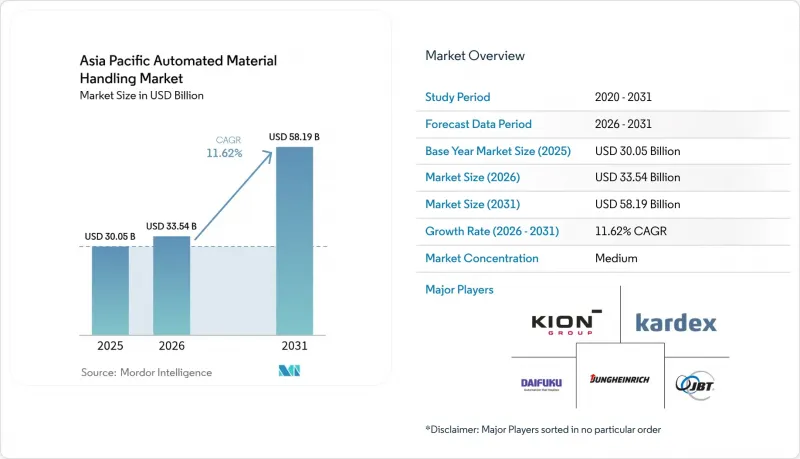
Mordor Intelligence에 따르면 2026년 아시아태평양의 자동 자재관리 시장의 규모는 335억 4,000만 달러로 추정되고 있으며, 2025년 300억 5,000만 달러에서 확대하며, 2031년에는 581억 9,000만 달러에 달할 것으로 예측됩니다.
2026-2031년까지의 연평균 성장률(CAGR)은 11.62%에 달할 것으로 전망됩니다.
이 보고서는 제품 유형(하드웨어, 소프트웨어, 서비스), 장비 유형(이동형 로봇, ASRS 등), 최종사용자 산업(공항, 자동차, 기타),적재 용량(500kg 이하, 500kg-1,500kg, 기타), 내비게이션 기술(레이저 유도, 비전 유도, 기타) 및 지역별로 분류되어 있습니다. 시장 예측은 금액(달러) 기준으로 제시되어 있습니다.
아시아태평양 자동 자재 취급 시장의 동향 및 인사이트
물류 시설에서의 인더스트리 4.0 투자 확대
이 지역의 제조업체들은 생산 라인, 창고 관리 시스템 및 기업 소프트웨어를 통합하는 사이버-물리 시스템의 업그레이드에 사상 최대 규모의 예산을 투자하고 있습니다. 중국의 스마트 팩토리에 대한 연간 지출은 이미 2,000억 달러를 넘어선 반면, 일본의 ‘사회 5.0’ 프로그램에서는 산업용 IoT에 1,300억 달러가 배정되어 있습니다. 이러한 노력은 실시간 계획 시스템과 자재 흐름을 동기화하는 자율주행형 태거, 셔틀, 지게차에 대한 주문으로 직접 이어지고 있습니다. 싱가포르의 ‘스마트 네이션’ 구상은 공공 공동 투자가 도입을 어떻게 촉진하는지 보여주고 있습니다. 2024년까지 이 도시 국가의 창고 중 40%에 자율주행 이동 로봇이 도입되었습니다. 사업자들은 이제 통합된 자재 취급 시스템을 ‘인더스트리 4.0’이 약속하는 효율화를 실현하기 위한 전제 조건으로 간주하고 있습니다.
E-Commerce 주문 처리 센터의 급증
2024년, 아시아태평양의 온라인 소매 시장 침투율은 총매출의 18.3%에 달해 다른 모든 지역을 앞질렀습니다. 주문 급증으로 인해 배송 리드타임이 단축되면서, 풀필먼트 허브에서는 피킹, 분류, 발송의 자동화가 시급해졌습니다. 2024년 중국의 ‘싱글스 데이’에는 24시간 이내에 14억 8,000만 개의 소포가 처리되었는데, 이는 높은 처리량을 자랑하는 자율형 로봇 군단만이 달성할 수 있는 위업입니다. JD.com과 같은 플랫폼은 현재 1,000곳 이상의 자동화 창고를 운영하고 있으며, 이로 인해 해당 지역의 경쟁사인 Shopee와 Lazada도 유사한 로봇 도입 전략을 따르고 있습니다. 새로운 물류 센터가 하나씩 늘어날 때마다 상·하류 물류 거점에 대한 병행 투자가 촉진되어, 자율형 솔루션에 대한 선순환적인 수요가 유지되고 있습니다.
통합형 자동화 프로젝트의 고액 초기 설비 투자
엔드투엔드 시스템을 도입하려면 중규모 거점의 경우, 건물 개보수비나 변경 관리 비용을 제외하더라도 대부분의 경우 200만-500만 달러가 필요합니다. 연간 매출이 1,000만 달러 미만인 인도네시아의 창고 운영업체에게 이러한 투자는 연간 매출의 25%-50%에 해당합니다. 자금 조달 수단은 여전히 제한적이며, RaaS(Robotics-as-a-Service) 플랜은 진입 비용을 낮추는 한편, 총 소유 비용(TCO)을 높일 가능성이 있습니다. 설비 가격이 하락하거나 대출 접근성이 확대될 때까지는 소규모 사업자들이 도입을 미룰 가능성이 있으며, 시장 전체의 성장을 둔화시킬 우려가 있습니다.
부문 분석
2025년, 아시아태평양의 자동 자재 취급 시장에서 하드웨어가 60.63%의 점유율을 차지하며, 물리적 자산이 여전히 업무의 기반임을 재확인했습니다. 그러나 기업이 데이터 중심의 성과 향상을 추구함에 따라 소프트웨어 매출은 2031년까지 연평균 성장률(CAGR) 13.32%로 증가할 전망입니다. 예측 유지보수, 에너지 최적화, AI 기반 경로 설정이 기존 차량 군에 통합됨에 따라 자동 자재 취급 시장의 소프트웨어 부문 규모는 매년 확대될 것으로 예측됩니다. 시스템이 점점 더 복잡해짐에 따라 컨설팅, 통합, 수명주기 지원에 대한 수요가 높아지고 있으며, 서비스 수익은 꾸준히 증가하고 있습니다. KION과 같은 벤더들은 Dematic을 인수하여 소프트웨어 분야에 진출하고 있으며, 기계 위주였던 기업이 포괄적인 솔루션으로 전환하고 있는 모습을 엿볼 수 있습니다.
하드웨어의 성장률은 1차 도입이 대체로 완료됨에 따라 2019-2024년에 둔화될 전망입니다. 현재 사업자들은 대규모 설비 갱신보다는 소프트웨어를 활용한 미세 조정을 통해 수익성을 높이고 있습니다. 규제의 초점도 ISO 3691-4에 규정된 펌웨어 안전성 점검으로 이동하고 있으며, 강재의 강도보다 코드의 품질이 더 중요시되고 있습니다. 지역 네트워크가 성숙해짐에 따라 하드웨어 교체 주기가 장기화되는 한편, 소프트웨어 중심의 서비스가 추가 예산을 확보하여 이미 도입된 설비의 정착률을 높여갈 것으로 예상됩니다.
2025년에는 모바일 로봇이 설비 수요의 33.22%를 차지하며, 2031년까지 연평균 성장률(CAGR) 12.21%로 성장할 전망입니다. 이러한 플랫폼은 고정 인프라를 최소화할 수 있으며, 진입 장벽이 낮으며, 기존 시설(브라운필드)에서도 고액의 개보수 공사를 진행하지 않고도 통로 자동화를 실현할 수 있습니다. 아시아태평양의 자재 취급 장비 시장에서 자동 창고 시스템(ASRS)은 여전히 고밀도 사용 사례를 독점하고 있지만, 컨베이어는 벌크 물류에서 여전히 필수적인 존재로 남아 있습니다. 그럼에도 불구하고 AMR은 SKU 변동이 심하고 SKU가 급속히 확대되는 환경에서 뛰어난 성능을 발휘함으로써 시장 점유율을 확대하고 있습니다.
무인운반차(AGV)에서 자연 내비게이션형 AMR로의 전환은 유연성에 대한 보다 광범위한 지향을 부각시키고 있습니다. 비전 센서와 AI 알고리즘을 탑재한 AMR은 적응형 경로를 수립하여 고정된 가이드 경로를 피합니다. 고정식 시스템은 특히 처리 능력이 변경 빈도를 상회하는 경우, 여전히 수익성이 높은 틈새 시장에서 활용되고 있습니다. 그러나 조사 데이터에 따르면 예산 배분은 창고 실행 시스템(WES)과 원활하게 통합되는 풍부한 소프트웨어를 탑재한 모바일 플랫폼으로 이동하고 있는 것으로 확인되었습니다. IEC 61508 기능 안전 표준 준수는 규제 산업 전반에 걸쳐 모바일 솔루션에 대한 신뢰도를 높이고 있습니다.
기타 혜택:
- 엑셀 형식의 시장 예측(ME) 시트
- 3개월간의 애널리스트 지원
자주 묻는 질문
목차
제1장 서론
제2장 조사 방법
제3장 개요
제4장 시장 구도
제5장 시장 규모와 성장 예측
제6장 경쟁 구도
제7장 시장 기회와 향후 전망
KSA 26.09.07According to Mordor Intelligence, Asia Pacific automated material handling market size in 2026 is estimated at USD 33.54 billion, growing from 2025 value of USD 30.05 billion with 2031 projections showing USD 58.19 billion, growing at 11.62% CAGR over 2026-2031.
This report is Segmented by Product Type (Hardware, Software, and Services), Equipment Type (Mobile Robots, ASRS, and More), End-User Vertical (Airport, Automotive, and More), Payload Capacity (Up To 500 Kg, 500 Kg - 1, 500 Kg, and More), Navigation Technology (Laser Guidance, Vision Guidance, and More), and Geography. The Market Forecasts are Provided in Terms of Value (USD).
Asia Pacific Automated Material Handling Market Trends and Insights
Increasing Industry 4.0 Investments in Logistics Facilities
Regional manufacturers channel record budgets into cyber-physical upgrades that unite production lines, warehouse control systems, and enterprise software. China's annual smart-factory spend already exceeds USD 200 billion, while Japan's Society 5.0 program earmarks USD 130 billion for industrial IoT. These commitments translate directly into orders for autonomous tuggers, shuttles, and forklifts that synchronize material flows with real-time planning systems. Singapore's Smart Nation agenda shows how public co-investment catalyzes adoption: 40% of the city-state's warehouses had deployed autonomous mobile robots by 2024. Operators now view integrated material handling as a prerequisite for extracting promised Industry 4.0 efficiency gains.
Proliferation of E-Commerce Fulfillment Centers
Asia Pacific online retail penetration rose to 18.3% of total sales in 2024, outpacing all other regions. Massive order surges compress delivery windows, forcing fulfillment hubs to automate picking, sorting, and dispatch. China's 2024 Singles Day moved 1.48 billion parcels within 24 hours, a feat achievable only through high-throughput autonomous fleets. Platforms such as JD.com now operate more than 1,000 automated warehouses, prompting regional peers Shopee and Lazada to replicate similar robotics playbooks. Each new fulfillment node spurs parallel investments in upstream and downstream logistics sites, sustaining a virtuous demand cycle for autonomous solutions.
High Upfront Capex of Integrated Automation Projects
Deploying end-to-end systems often requires USD 2-5 million for a mid-size site, excluding building modifications and change-management costs. Indonesian warehouses earning under USD 10 million annually view such commitments as 25%-50% of yearly turnover. Financing channels remain limited, and robotics-as-a-service plans, while reducing entry fees, can inflate the total cost of ownership. Until equipment prices fall or credit access widens, smaller operators may delay adoption, moderating overall market growth.
Other drivers and restraints analyzed in the detailed report include:
- Rapid Adoption of Autonomous Mobile Robots in Warehousing
- Rising Labor Cost and Scarcity in the Asia Pacific
- Limited Interoperability Standards Across Vendor Ecosystems
For complete list of drivers and restraints, kindly check the Table Of Contents.
Segment Analysis
Hardware held 60.63% of the Asia Pacific automated material handling market share in 2025, reaffirming that physical assets still anchor operations. Yet software revenue will climb at a 13.32% CAGR through 2031 as enterprises pursue data-centric performance boosts. The autonomous material handling market size for software is projected to widen each year as predictive maintenance, energy optimization, and AI-based routing stack on top of existing fleets. Services revenues grow steadily because rising system complexity pushes demand for consulting, integration, and lifecycle support. Vendors such as KION expanded into software by acquiring Dematic, illustrating how mechanical-first firms pivot toward holistic solutions.
Hardware growth decelerates from the 2019-2024 period because many first-wave installations are complete. Operators now refine returns through software-enabled tweaks rather than large capital swaps. Regulatory focus also shifts toward firmware safety checks in ISO 3691-4, amplifying the value of code quality over steel strength. As regional networks mature, software-centric offerings should capture incremental budgets while hardware refresh cycles lengthen, deepening the installed base's stickiness.
Mobile robots controlled 33.22% of equipment demand in 2025 and will grow at a 12.21% CAGR through 2031. These platforms lower entry barriers because they require minimal fixed infrastructure, enabling brownfield sites to automate aisles without costly retrofits. Within the Asia Pacific automated material handling market size for equipment, automated storage and retrieval systems (ASRS) still corner high-density use cases, while conveyors remain indispensable for bulk flow. Nonetheless, AMRs win share by excelling in variable SKUs and rapid SKU expansion environments.
The shift from automated guided vehicles to natural-navigation AMRs underscores a broader preference for flexibility. AMRs equipped with vision sensors and AI algorithms plot adaptive routes, sidestepping rigid guidepaths. Fixed systems still serve profitable niches, especially where high throughput outweighs change frequency. Yet survey data confirm budget allocations moving toward software-rich mobile platforms that integrate seamlessly with warehouse execution systems. Compliance with IEC 61508 functional safety elevates trust in mobile options across regulated industries.
Complete Report Scope:
- By Product Type
- Hardware
- Software
- Services
- By Equipment Type
- Mobile Robots
- Automated Guided Vehicles (AGV)
- Automated Forklift
- Automated Tow / Tractor / Tug
- Unit Load
- Assembly Line
- Special Purpose
- Autonomous Mobile Robots (AMR)
- Laser Guided Vehicle
- Automated Guided Vehicles (AGV)
- Automated Storage and Retrieval System (ASRS)
- Fixed Aisle (Stacker Crane + Shuttle System)
- Carousel (Horizontal Carousel + Vertical Carousel)
- Vertical Lift Module
- Automated Conveyor
- Belt
- Roller
- Pallet
- Overhead
- Palletizer
- Conventional (High Level + Low Level)
- Robotic
- Sortation System
- Mobile Robots
- By End-User Vertical
- Airport
- Automotive
- Food and Beverage
- Retail / Warehousing / Distribution / Logistics Centers
- General Manufacturing
- Pharmaceuticals
- Post and Parcel
- Other End-User Verticals
- By Payload Capacity
- Up to 500 kg
- 500 kg - 1,500 kg
- Above 1,500 kg
- By Navigation Technology
- Laser Guidance
- Vision Guidance
- Magnetic Tape / Wire Guidance
- Natural Feature Guidance (SLAM)
- By Region
- China
- Japan
- India
- South Korea
- Australia
- Indonesia
- Thailand
- Singapore
- Malaysia
- Taiwan
- Rest of Asia Pacific
List of Companies Covered in this Report:
- DAIFUKU Co., Ltd.
- Kardex Holding AG
- KION GROUP AG
- John Bean Technologies Corporation
- JUNGHEINRICH AG
- SSI SCHAEFER AG
- VisionNav Robotics Co., Ltd.
- System Logistics S.p.A.
- BEUMER Group GmbH and Co. KG
- Interroll Holding AG
- WITRON Logistik and Informatik GmbH
- KUKA Aktiengesellschaft
- Honeywell International Inc.
- Murata Machinery, Ltd.
- Toyota Industries Corporation
- GreyOrange Pte. Ltd.
- Geekplus Technology Co., Ltd.
- Hyster-Yale Materials Handling, Inc.
- Mitsubishi Logisnext Co., Ltd.
- Shenzhen Casun Intelligent Robot Co., Ltd.
Additional Benefits:
- The market estimate (ME) sheet in Excel format
- 3 months of analyst support
TABLE OF CONTENTS
1 INTRODUCTION
- 1.1 Study Assumptions and Market Definition
- 1.2 Scope of the Study
2 RESEARCH METHODOLOGY
3 EXECUTIVE SUMMARY
4 MARKET LANDSCAPE
- 4.1 Market Overview
- 4.2 Market Drivers
- 4.2.1 Increasing Industry 4.0 Investments in Logistics Facilities
- 4.2.2 Proliferation of E-Commerce Fulfillment Centers
- 4.2.3 Rapid Adoption of Autonomous Mobile Robots in Warehousing
- 4.2.4 Rising Labor Cost and Scarcity in Asia Pacific
- 4.2.5 Government Incentives for Smart Industrial Parks in ASEAN
- 4.2.6 Integration of 5G Private Networks Enabling Real-Time Fleet Coordination
- 4.3 Market Restraints
- 4.3.1 High Upfront Capex of Integrated Automation Projects
- 4.3.2 Limited Interoperability Standards Across Vendor Ecosystems
- 4.3.3 Delayed Port Infrastructure Digitalization in Emerging Economies
- 4.3.4 Data Security Concerns in Cloud-Managed Material Handling Fleets
- 4.4 Industry Value Chain Analysis
- 4.5 Regulatory Landscape
- 4.6 Technological Outlook
- 4.7 Impact of Macroeconomic Factors
- 4.8 Porter's Five Forces Analysis
- 4.8.1 Threat of New Entrants
- 4.8.2 Bargaining Power of Buyers
- 4.8.3 Bargaining Power of Suppliers
- 4.8.4 Threat of Substitute Products
- 4.8.5 Intensity of Competitive Rivalry
- 4.9 Investment Analysis
5 MARKET SIZE AND GROWTH FORECASTS (VALUE)
- 5.1 By Product Type
- 5.1.1 Hardware
- 5.1.2 Software
- 5.1.3 Services
- 5.2 By Equipment Type
- 5.2.1 Mobile Robots
- 5.2.1.1 Automated Guided Vehicles (AGV)
- 5.2.1.1.1 Automated Forklift
- 5.2.1.1.2 Automated Tow / Tractor / Tug
- 5.2.1.1.3 Unit Load
- 5.2.1.1.4 Assembly Line
- 5.2.1.1.5 Special Purpose
- 5.2.1.2 Autonomous Mobile Robots (AMR)
- 5.2.1.3 Laser Guided Vehicle
- 5.2.1.1 Automated Guided Vehicles (AGV)
- 5.2.2 Automated Storage and Retrieval System (ASRS)
- 5.2.2.1 Fixed Aisle (Stacker Crane + Shuttle System)
- 5.2.2.2 Carousel (Horizontal Carousel + Vertical Carousel)
- 5.2.2.3 Vertical Lift Module
- 5.2.3 Automated Conveyor
- 5.2.3.1 Belt
- 5.2.3.2 Roller
- 5.2.3.3 Pallet
- 5.2.3.4 Overhead
- 5.2.4 Palletizer
- 5.2.4.1 Conventional (High Level + Low Level)
- 5.2.4.2 Robotic
- 5.2.5 Sortation System
- 5.2.1 Mobile Robots
- 5.3 By End-User Vertical
- 5.3.1 Airport
- 5.3.2 Automotive
- 5.3.3 Food and Beverage
- 5.3.4 Retail / Warehousing / Distribution / Logistics Centers
- 5.3.5 General Manufacturing
- 5.3.6 Pharmaceuticals
- 5.3.7 Post and Parcel
- 5.3.8 Other End-User Verticals
- 5.4 By Payload Capacity
- 5.4.1 Up to 500 kg
- 5.4.2 500 kg - 1,500 kg
- 5.4.3 Above 1,500 kg
- 5.5 By Navigation Technology
- 5.5.1 Laser Guidance
- 5.5.2 Vision Guidance
- 5.5.3 Magnetic Tape / Wire Guidance
- 5.5.4 Natural Feature Guidance (SLAM)
- 5.6 By Region
- 5.6.1 China
- 5.6.2 Japan
- 5.6.3 India
- 5.6.4 South Korea
- 5.6.5 Australia
- 5.6.6 Indonesia
- 5.6.7 Thailand
- 5.6.8 Singapore
- 5.6.9 Malaysia
- 5.6.10 Taiwan
- 5.6.11 Rest of Asia Pacific
6 COMPETITIVE LANDSCAPE
- 6.1 Market Concentration
- 6.2 Strategic Moves
- 6.3 Market Share Analysis
- 6.4 Company Profiles (includes Global level Overview, Market level Overview, Core Segments, Financials as available, Strategic Information, Market Rank/Share for key companies, Products and Services, and Recent Developments)
- 6.4.1 DAIFUKU Co., Ltd.
- 6.4.2 Kardex Holding AG
- 6.4.3 KION GROUP AG
- 6.4.4 John Bean Technologies Corporation
- 6.4.5 JUNGHEINRICH AG
- 6.4.6 SSI SCHAEFER AG
- 6.4.7 VisionNav Robotics Co., Ltd.
- 6.4.8 System Logistics S.p.A.
- 6.4.9 BEUMER Group GmbH and Co. KG
- 6.4.10 Interroll Holding AG
- 6.4.11 WITRON Logistik and Informatik GmbH
- 6.4.12 KUKA Aktiengesellschaft
- 6.4.13 Honeywell International Inc.
- 6.4.14 Murata Machinery, Ltd.
- 6.4.15 Toyota Industries Corporation
- 6.4.16 GreyOrange Pte. Ltd.
- 6.4.17 Geekplus Technology Co., Ltd.
- 6.4.18 Hyster-Yale Materials Handling, Inc.
- 6.4.19 Mitsubishi Logisnext Co., Ltd.
- 6.4.20 Shenzhen Casun Intelligent Robot Co., Ltd.
7 MARKET OPPORTUNITIES AND FUTURE OUTLOOK
- 7.1 White-Space and Unmet-Need Assessment