

|
시장보고서
상품코드
2121943
조직진단 : 시장 점유율 분석, 업계 동향과 통계, 성장 예측(2026-2031년)Tissue Diagnostics - Market Share Analysis, Industry Trends & Statistics, Growth Forecasts (2026 - 2031) |
||||||
 Mordor Intelligence
Mordor Intelligence에 의하면, 조직진단시장 규모는 2025년 64억 5,000만 달러에서 2026년에는 68억 6,000만 달러에 이르고, 2026-2031년 CAGR 6.35%로 성장을 지속하여 2031년에는 93억 3,000만 달러에 달할 것으로 예측됩니다.
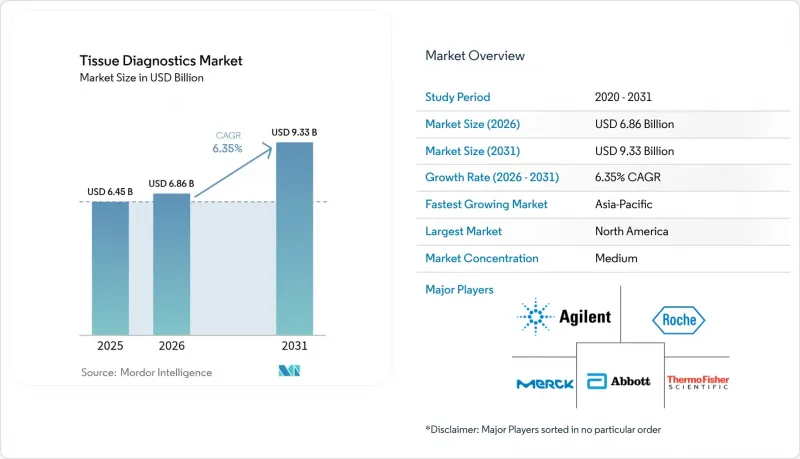
본 보고서는 제품별(기기, 시약, 소모품), 기술별(면역조직화학, 인 시투 하이브리다이제이션 등), 용도별(유방암, 전립선암, 비소세포폐암 등), 최종 사용자별(병원 및 진단실험실 등),지역별(북미, 유럽 등)로 분류되어 있습니다. 시장 예측은 금액(미화) 기준으로 제시되어 있습니다.
전 세계 조직 진단 시장 동향 및 인사이트
암 발병률 증가에 따른 부담 가중
세계 암 환자 수는 매년 2.1% 증가하고 있으며, 2050년까지 3,500만 명에 달할 것으로 예측되므로, 확정 진단을 위한 조직 분석은 여전히 필수적입니다. 유방암은 여전히 진단 건수의 대부분을 차지하고 있지만, 각국의 선별 검사 프로그램에서 상세한 종양 프로파일링이 요구됨에 따라 비소세포폐암이 가장 빠르게 확대되고 있는 이용 사례가 되고 있습니다. 65세를 넘기면 위험이 급격히 높아지기 때문에 이미 한계에 다다른 병리 검사실의 처리 능력에 대한 압박이 더욱 커지고 있습니다. 검체 유입이 지속되고 있다는 사실은 벤더에게 안정적인 수익원이 될 뿐만 아니라, 정확도를 유지하면서 검사 소요 시간을 단축하는 자동화, 다중 면역조직화학, AI 알고리즘에 대한 지속적인 연구 개발의 유효성을 뒷받침하고 있습니다.
조직병리 검사실에서의 자동화 및 AI 가속화
AI를 활용한 전체 슬라이드 스캐너는 슬라이드 검토 시간을 40% 단축하고 검사실 간 판정 일치율을 향상시켜, 인력 부족에 시달리는 병리 전문의가 복잡한 증례에 집중할 수 있게 해줍니다. 2024년 로슈(Roche)사의 컴퓨터 지원 동반 진단이 FDA로부터 ‘획기적 진단(Breakthrough Designation)’을 받은 것은 알고리즘 지원에 의한 판독이 규제 당국으로부터 인정받았음을 보여 주며, 이는 고객층 확대로 이어지고 있습니다. 현재 미국에서는 은퇴자 수가 신규 채용자의 2배에 달하고 있어, 서비스의 지속성을 위해 자동화가 필수적입니다. AI를 도입한 검사실에서는 보고의 신속화, 품질 지표의 엄격화, 그리고 확장성 향상이 실현되고 있으며, 조직 진단 시장은 소프트웨어를 통해 강화된 표준 치료 방식으로 나아가고 있습니다.
높은 설비 투자 및 소모품 비용, 불균일한 보험 환급
전체 슬라이드 스캐너의 가격은 20만-50만 달러이며, 소모품 비용은 검사실 운영 예산의 약 65%를 차지하고 있습니다. 민간 보험사별로 환급 기준이 통일되지 않은 상황에서 소규모 병원은 이러한 지출을 회수하는 데 어려움을 겪고 있으며, 자금력이 있는 의료기관이 역량 격차를 확대하는 ‘양극화된 생태계’가 형성되고 있습니다. 코로나19의 영향으로 지출이 급성기 의료로 이동함에 따라 하드웨어 교체 주기가 지연되고, 이로 인한 교체 지연이 더욱 확대되고 있습니다. 리스 모델이나 지역별 공유 서비스 허브가 임시 대책으로 부상하고 있지만, 비용 대비 효과 문제를 완전히 해결하는 것은 아닙니다.
부문 분석
장비 부문은 검사실이 수작업에 의존하는 워크플로우를 재검토함에 따라 2031년까지 연평균 성장률(CAGR) 7.02%를 나타낼 것으로 예측되며, 조직 진단 시장 전체의 성장률을 상회할 것으로 전망됩니다. 전체 슬라이드 스캐너는 미국 및 유럽연합(EU)에서의 보상 확실성에 힘입어 대수 기준으로 가장 급격한 성장을 보이고 있습니다. 로봇 기술을 탑재한 조직 처리 장치는 취급 오류를 줄이고, AI를 활용한 염색 시스템은 시약 사용량을 절감합니다. 바코드를 이용한 검체 추적 및 클라우드 네이티브 대시보드와 같은 기술 발전은 검사실의 효율성을 더욱 높이고 있습니다. 한편, 시약 및 소모품에서 발생하는 지속적인 수익은 공급업체의 이익률을 뒷받침하고 있습니다. 모든 검체에 항체, 프로브, 마운팅제가 필요하기 때문에 이 카테고리는 2025년에도 67.65%의 점유율을 유지했습니다. 멀티플렉스 분석 키트는 여러 바이오마커를 한 번의 측정으로 통합함으로써 결과당 비용을 절감하고 조직을 절약할 수 있어 지지를 얻고 있습니다. 조직은 소량의 생검 샘플에서 점점 더 귀중한 자원이 되고 있습니다. 일상적으로 사용되는 시약에 대한 안정적인 수요는 공급업체에 예측 가능한 현금 흐름을 가져다주며, 이는 높은 이익률을 내는 장비의 연구 개발 자금을 충당하고 있습니다.
2세대 마이크로톰과 크라이오스탯에는 디지털 방식의 온도 제어 및 블레이드 각도 제어 기능이 내장되어 있어, 절편 두께의 편차를 최소화하고 있습니다. 이러한 장비는 성숙한 제품이지만, 마모 및 CAP 인증 요건 준수로 인해 교체 주기는 안정적입니다. 일회용 플라스틱 카세트, 유리 슬라이드, 커버 글라스가 소모품 라인업을 구성하고 있어, 소규모 지역 병리 검사 부서라도 안정적인 수입원을 확보하고 있습니다. 장비와 소모품 간의 시너지 효과에 더해, 처리 능력에 대한 기대감의 고조가 조직 진단 시장의 장기적인 성장을 뒷받침하고 있습니다.
디지털 병리학은 연평균 성장률(CAGR) 7.10%로 발전하고 있으며, 이는 모든 진단 방식 중에서 가장 높은 수치입니다. 알고리즘에 기반한 패턴 인식을 통해 픽셀 데이터가 정량적 지표로 변환되어, 종양 침윤 림프구나 유사분열상의 객관적인 등급 판정이 가능해집니다. 지방 의료기관은 클라우드 연결을 활용하여 도시 지역의 전문의들의 전문 지식을 도입함으로써, 환자의 통원 거리 및 대기 시간을 단축하고 있습니다. FDA가 2025년에 AI 기반 유방암 전이 검출 장치를 승인하는 등 규제상의 전환점이 마련됨에 따라, 병원 조달 위원회의 활동이 활발해지고 있습니다. 한편, 면역조직화학법은 임상 현장에서 익숙한 기법일 뿐만 아니라, 표적 치료의 지침이 되는 바이오마커 목록이 지속적으로 확대되고 있어 43.10%의 시장 점유율을 유지하고 있습니다. 자동화를 통해 염색 주기 시간이 60분 미만으로 단축되어, 인력을 늘리지 않고도 일일 슬라이드 처리 능력이 향상되고 있습니다.
인 시투 하이브리다이제이션(ISH)은 특히 혈액 악성 종양에서 유전자 재구성 및 바이러스 유전체의 검출 수단으로서 여전히 중요한 위치를 차지하고 있습니다. 일부 검사실에서는 ISH와 다중 IHC를 결합하여 RNA와 단백질의 공동 발현을 다각적으로 분석함으로써, 제한된 조직에서 얻을 수 있는 진단 정보의 가치를 높이고 있습니다. 새로운 질량 분석 이미징 및 라만 분광법에 기반한 기법은 여전히 틈새 분야에 머물러 있지만, 약물 분포 연구 및 리피도믹스 분야에서 유망한 것으로 평가받고 있습니다. 전반적으로 이러한 기술 동향은 조직 진단 시장의 지속적인 다각화를 확실히 뒷받침하고 있습니다.
지역별 분석
북미는 2025년 전 세계 매출의 41.00%를 차지했습니다. 이는 CLIA 인증 실험실의 탄탄한 기반, 광범위한 보험 적용 범위, 그리고 다수의 장비 및 시약 제조업체의 본사와의 근접성이 뒷받침하고 있습니다. FDA의 지속적인 감독이 세계적 모범 사례 기준을 형성하고 있으며, 벤처 캐피털의 유입이 AI 스타트업 설립을 뒷받침하고 있습니다. 캐나다에서는 인구 밀도가 낮은 지역과 도시의 암 센터를 연결하는 전국적인 원격 병리 네트워크가 추진되어 시장의 도달 범위를 확대되고 있습니다.
유럽은 국경을 초월한 데이터 교환 및 조달을 효율화하는 EU의 ‘디지털 단일 시장’ 전략의 혜택을 받고 있습니다. 독일과 영국이 AI 검증 연구를 주도하는 한편, 북유럽 국가들은 알고리즘 훈련에 중앙 집중화된 병리 등록 제도를 활용하고 있습니다. 일관된 규제 체계와 안정적인 보험 환급 덕분에 유럽은 2세대 디지털 시스템이 확실하게 도입되는 지역이 되고 있지만, 일부 남유럽 및 동유럽 회원국의 예산 긴축이 성장을 저해하고 있습니다.
아시아태평양은 가장 빠르게 성장하는 지역으로, 중국과 인도가 진단 인프라 업그레이드에 총 2,000억 달러를 투자함에 따라 연평균 성장률(CAGR)은 7.48%를 나타낼 것으로 예측됩니다. 이미 기술적으로 선진화된 일본과 한국의 검사 기관들은 공간 생물학으로 신속하게 중심을 옮기고 있는 반면, 동남아시아 국가들은 기초 조직병리학 역량 강화에 투자하고 있습니다. 쑤저우, 선전,하이데라바드에서는 항체 및 슬라이드의 현지 제조 클러스터가 부상하고 있어, 공급의 회복탄력성이 향상되고 도입 비용이 낮아지고 있습니다. 이와 동시에 싱가포르나 태국 등 의료 관광 거점에서는 국제적으로 인증된 검사실이 요구되며, 품질 기준이 높아지고 있습니다.
라틴아메리카, 중동 및 아프리카는 새로운 성장 영역으로 부상하고 있습니다. 브라질, 사우디아라비아, 아랍에미리트는 민간 병원의 확대와 정부의 현대화 추진에 힘입어 각 지역에서 지출을 주도하고 있습니다. 그러나 불충분한 보험 환급과 숙련된 인력 부족으로 인해 총 성장률은 세계 평균을 밑돌고 있습니다. 대상층을 좁힌 지원 프로그램과 현장 진단(Point-of-Care)용 마이크로플루이딕스 기술은 저소득 국가에서의 진단 격차 해소를 목표로 하고 있으며, 조직 진단 시장의 잠재 고객 기반을 서서히 확대되고 있습니다.
기타 혜택:
- 엑셀 형식 시장 예측(ME) 시트
- 3개월간의 애널리스트 지원
자주 묻는 질문
목차
제1장 서론
제2장 조사 방법
제3장 주요 요약
제4장 시장 구도
제5장 시장 규모와 성장 예측
제6장 경쟁 구도
제7장 시장 기회와 향후 전망
LSH 26.09.10According to Mordor Intelligence, the tissue diagnostics market size is expected to grow from USD 6.45 billion in 2025 to USD 6.86 billion in 2026 and is forecast to reach USD 9.33 billion by 2031 at 6.35% CAGR over 2026-2031.
This report is Segmented by Product (Instruments, Reagents and Consumables), Technology (Immunohistochemistry, In-Situ Hybridization, and More), Application (Breast Cancer, Prostate Cancer, Non-Small Cell Lung Cancer, and More), End User (Hospitals and Diagnostic Laboratories, and More), and Geography (North America, Europe, and More). The Market Forecasts are Provided in Terms of Value (USD).
Global Tissue Diagnostics Market Trends and Insights
Rising Cancer Incidence Burden
Confirmatory tissue analysis remains indispensable as global cancer cases grow 2.1% each year and are projected to hit 35 million by 2050. Breast cancer continues to dominate diagnostic volumes, yet non-small cell lung cancer is the fastest-expanding use case because national screening programs demand detailed tumor profiling . Risk escalates sharply beyond age 65, intensifying throughput pressure on already stretched pathology labs. The sustained specimen inflow gives vendors a stable revenue runway and validates ongoing R&D in automation, multiplex immunohistochemistry and AI algorithms that compress turnaround time while preserving accuracy.
Acceleration of Automation & AI in Histopathology Labs
AI-powered whole-slide scanners reduce slide review time by 40% and raise inter-laboratory concordance, allowing scarce pathologists to focus on complex cases. FDA breakthrough designation for Roche's computational companion diagnostic in 2024 signaled regulatory acceptance of algorithm-assisted reads, widening the customer pool. Retirement rates now outstrip replacements two-to-one in the United States, making automation central to service continuity. Laboratories that deploy AI achieve faster reporting, tighter quality metrics and greater scalability, pushing the tissue diagnostics market toward a software-augmented standard of care.
High Capital & Consumable Costs; Patchy Reimbursement
Whole-slide scanners list between USD 200,000 and USD 500,000, and consumables absorb roughly 65% of lab operating budgets. Smaller hospitals struggle to recoup such outlays when reimbursement remains inconsistent across private payors, creating a two-tier ecosystem where cash-rich providers widen capability gaps. COVID-19 diverted spending to acute care, delaying hardware refresh cycles and enlarging the replacement backlog. Leasing models and regional shared-service hubs are emerging stopgaps but do not fully resolve affordability.
Other drivers and restraints analyzed in the detailed report include:
- Expanding Digital Pathology Reimbursement in US-EU
- Healthcare CAPEX Surge in High-Population Asia
- Global Shortage of Trained Pathologists
For complete list of drivers and restraints, kindly check the Table Of Contents.
Segment Analysis
The instruments segment is projected to clock a 7.02% CAGR through 2031, outpacing overall tissue diagnostics market growth as labs overhaul manual workflows. Whole-slide scanners post the steepest unit growth, buoyed by reimbursement certainty in the United States and European Union. Robotics-enabled tissue processors reduce handling errors, while AI-oriented staining systems economize reagent use. Advances such as barcode-driven sample tracking and cloud-native dashboards further elevate laboratory efficiency . Conversely, recurring revenue from reagents and consumables sustains vendor margins; this category retained 67.65% share in 2025 because every specimen necessitates antibodies, probes and mounting media. Multiplex assay kits gain traction because they condense several biomarkers into a single run, lowering per-result cost and conserving tissue-an increasingly valuable commodity in small biopsy samples. Stable demand for routine reagents provides vendors with predictable cash flows that finance R&D in high-margin instrumentation.
Second-generation microtomes and cryostats incorporate digital temperature and blade-angle controls, minimizing variance in section thickness. Although these tools are mature, replacement cycles remain steady due to wear and adherence to CAP accreditation requirements. Disposable plastic cassettes, glass slides and cover slips round out the consumables landscape, ensuring that even small community pathology units contribute steady income streams. The symbiotic relationship between instruments and disposables, coupled with rising throughput expectations, anchors long-term expansion of the tissue diagnostics market.
Digital pathology is advancing at a 7.10% CAGR, the highest among all modalities. Algorithm-based pattern recognition converts pixel data into quantitative metrics, allowing objective grading of tumor infiltrating lymphocytes and mitotic figures. Rural facilities exploit cloud connectivity to tap urban subspecialists, cutting patient travel and wait times. Regulatory milestones-such as the FDA's 2025 clearance of an AI-enabled breast cancer metastasis detector-galvanize hospital procurement committees. Meanwhile, immunohistochemistry retains 43.10% market leadership thanks to its clinical familiarity and an ever-expanding biomarker catalog that guides targeted therapies. Automation has reduced staining cycle times to under 60 minutes, boosting daily slide throughput without extra headcount.
In-situ hybridization maintains relevance for detecting gene rearrangements and viral genomes, particularly in hematologic malignancies. Some laboratories combine ISH with multiplex IHC to triangulate RNA-protein co-expression, enhancing diagnostic yield from scarce tissue. Novel mass-spectrometry imaging and Raman-based modalities remain niche but show promise for drug-distribution studies and lipidomics. Collectively, these technology arcs ensure continual diversification within the tissue diagnostics market.
Complete Report Scope:
- By Product
- Instruments
- Slide-staining systems
- Tissue-processing systems
- Whole-slide scanners
- Microtomes & cryostats
- Other Instruments
- Reagents and Consumables
- Antibodies
- Kits & assays
- Reagents & probes
- Other consumables
- Instruments
- By Technology
- Immunohistochemistry
- In-situ Hybridization
- Digital Pathology
- Other Technologies
- By Application
- Breast Cancer
- Prostate Cancer
- Non-Small Cell Lung Cancer
- Gastric Cancer
- Lymphoma
- Others
- By End User
- Hospitals and Diagnostic Laboratories
- Pharmaceutical and Biotechnology Companies
- Research & Academic Institutes
- Others
- By Geography
- North America
- United States
- Canada
- Mexico
- Europe
- Germany
- United Kingdom
- France
- Italy
- Spain
- Rest of Europe
- Asia-Pacific
- China
- Japan
- India
- Australia
- South Korea
- Rest of Asia-Pacific
- Middle East and Africa
- GCC
- South Africa
- Rest of Middle East and Africa
- South America
- Brazil
- Argentina
- Rest of South America
- North America
Geography Analysis
North America generated 41.00% of global revenue in 2025, anchored by a deep installed base of CLIA-certified labs, broad payer coverage and proximity to many instrument and reagent headquarters. Continuous FDA oversight shapes worldwide best-practice standards, and venture capital flows sustain AI startup formation. Canada advances national telepathology networks that connect sparsely populated regions to urban cancer centers, broadening market reach.
Europe benefits from the EU Digital Single Market strategy, which streamlines cross-border data exchange and procurement. Germany and the United Kingdom spearhead AI validation studies, while the Nordics leverage centralized pathology registries for algorithm training. Cohesive regulatory frameworks and stable reimbursement make Europe a reliable adopter of second-generation digital systems, although budget austerity in some Southern and Eastern member states tempers growth.
Asia-Pacific is the fastest-growing region, posting a projected 7.48% CAGR as China and India channel a combined USD 200 billion into diagnostics infrastructure upgrades. Japanese and South Korean labs, already technologically advanced, pivot quickly to spatial biology, whereas Southeast Asian nations invest in foundational histopathology capacity. Local manufacturing clusters in Suzhou, Shenzhen and Hyderabad emerge for antibodies and slides, improving supply resilience and lowering landed costs. In parallel, medical-tourism hubs such as Singapore and Thailand demand internationally accredited labs, elevating quality benchmarks.
Latin America and the Middle East & Africa represent emerging frontiers. Brazil, Saudi Arabia and the United Arab Emirates lead spending in their respective regions, buoyed by private hospital expansion and government modernization drives. Nonetheless, inadequate reimbursement and skilled-workforce shortages hold aggregate growth below global averages. Targeted aid programs and point-of-care microfluidics aim to bridge diagnostic gaps in lower-income countries, slowly enlarging the addressable base for the tissue diagnostics market.
- Roche
- Danaher (Leica Biosystems)
- Agilent Technologies (Dako)
- Thermo Fisher Scientific
- Abbott Laboratories
- Merck
- Illumina
- QIAGEN
- PerkinElmer (Revvity)
- Sakura Finetek
- Epredia (PHC)
- 3DHISTECH
- Philips Digital & Computational Pathology
- PathAI
- OptraSCAN
- Indica Labs
- Biocare Medical
- Lunaphore Technologies
- Qritive
- Bio-Genex Laboratories
- Ventana Medical Systems (Roche)
Additional Benefits:
- The market estimate (ME) sheet in Excel format
- 3 months of analyst support
TABLE OF CONTENTS
1 Introduction
- 1.1 Study Assumptions & Market Definition
- 1.2 Scope of the Study
2 Research Methodology
3 Executive Summary
4 Market Landscape
- 4.1 Market Overview
- 4.2 Market Drivers
- 4.2.1 Rising cancer incidence burden
- 4.2.2 Acceleration of automation & AI in histopathology labs
- 4.2.3 Expanding digital pathology reimbursement in US-EU
- 4.2.4 Healthcare CAPEX surge in high-population Asia
- 4.2.5 Spatial-biology enabled multiplex IHC adoption
- 4.2.6 Point-of-care microfluidic tissue prep for LMICs
- 4.3 Market Restraints
- 4.3.1 High capital & consumable costs; patchy reimbursement
- 4.3.2 Global shortage of trained pathologists
- 4.3.3 Inter-platform data-format interoperability gaps
- 4.3.4 Reagent/antibody supply-chain volatility
- 4.4 Value / Supply-Chain Analysis
- 4.5 Regulatory Landscape
- 4.6 Technological Outlook
- 4.7 Porters Five Forces Analysis
- 4.7.1 Threat of New Entrants
- 4.7.2 Bargaining Power of Buyers
- 4.7.3 Bargaining Power of Suppliers
- 4.7.4 Threat of Substitutes
- 4.7.5 Intensity of Competitive Rivalry
5 Market Size & Growth Forecasts (Value, USD)
- 5.1 By Product
- 5.1.1 Instruments
- 5.1.1.1 Slide-staining systems
- 5.1.1.2 Tissue-processing systems
- 5.1.1.3 Whole-slide scanners
- 5.1.1.4 Microtomes & cryostats
- 5.1.1.5 Other Instruments
- 5.1.2 Reagents and Consumables
- 5.1.2.1 Antibodies
- 5.1.2.2 Kits & assays
- 5.1.2.3 Reagents & probes
- 5.1.2.4 Other consumables
- 5.1.1 Instruments
- 5.2 By Technology
- 5.2.1 Immunohistochemistry
- 5.2.2 In-situ Hybridization
- 5.2.3 Digital Pathology
- 5.2.4 Other Technologies
- 5.3 By Application
- 5.3.1 Breast Cancer
- 5.3.2 Prostate Cancer
- 5.3.3 Non-Small Cell Lung Cancer
- 5.3.4 Gastric Cancer
- 5.3.5 Lymphoma
- 5.3.6 Others
- 5.4 By End User
- 5.4.1 Hospitals and Diagnostic Laboratories
- 5.4.2 Pharmaceutical and Biotechnology Companies
- 5.4.3 Research & Academic Institutes
- 5.4.4 Others
- 5.5 By Geography
- 5.5.1 North America
- 5.5.1.1 United States
- 5.5.1.2 Canada
- 5.5.1.3 Mexico
- 5.5.2 Europe
- 5.5.2.1 Germany
- 5.5.2.2 United Kingdom
- 5.5.2.3 France
- 5.5.2.4 Italy
- 5.5.2.5 Spain
- 5.5.2.6 Rest of Europe
- 5.5.3 Asia-Pacific
- 5.5.3.1 China
- 5.5.3.2 Japan
- 5.5.3.3 India
- 5.5.3.4 Australia
- 5.5.3.5 South Korea
- 5.5.3.6 Rest of Asia-Pacific
- 5.5.4 Middle East and Africa
- 5.5.4.1 GCC
- 5.5.4.2 South Africa
- 5.5.4.3 Rest of Middle East and Africa
- 5.5.5 South America
- 5.5.5.1 Brazil
- 5.5.5.2 Argentina
- 5.5.5.3 Rest of South America
- 5.5.1 North America
6 Competitive Landscape
- 6.1 Market Concentration
- 6.2 Market Share Analysis
- 6.3 Company Profiles (includes Global level Overview, Market level overview, Core Segments, Financials as available, Strategic Information, Market Rank/Share for key companies, Products & Services, and Recent Developments)
- 6.3.1 F. Hoffmann-La Roche
- 6.3.2 Danaher (Leica Biosystems)
- 6.3.3 Agilent Technologies (Dako)
- 6.3.4 Thermo Fisher Scientific
- 6.3.5 Abbott Laboratories
- 6.3.6 Merck KGaA
- 6.3.7 Illumina
- 6.3.8 QIAGEN
- 6.3.9 PerkinElmer (Revvity)
- 6.3.10 Sakura Finetek
- 6.3.11 Epredia (PHC)
- 6.3.12 3DHISTECH
- 6.3.13 Philips Digital & Computational Pathology
- 6.3.14 PathAI
- 6.3.15 OptraSCAN
- 6.3.16 Indica Labs
- 6.3.17 Biocare Medical
- 6.3.18 Lunaphore Technologies
- 6.3.19 Qritive
- 6.3.20 Bio-Genex Laboratories
- 6.3.21 Ventana Medical Systems (Roche)
7 Market Opportunities & Future Outlook
- 7.1 White-space & Unmet-need Assessment


