|
시장보고서
상품코드
2121960
유럽의 심장 모니터링 시장 : 시장 점유율 분석, 업계 동향 및 통계, 성장 예측(2026-2031년)Europe Cardiac Monitoring - Market Share Analysis, Industry Trends & Statistics, Growth Forecasts (2026 - 2031) |
||||||
 Mordor Intelligence
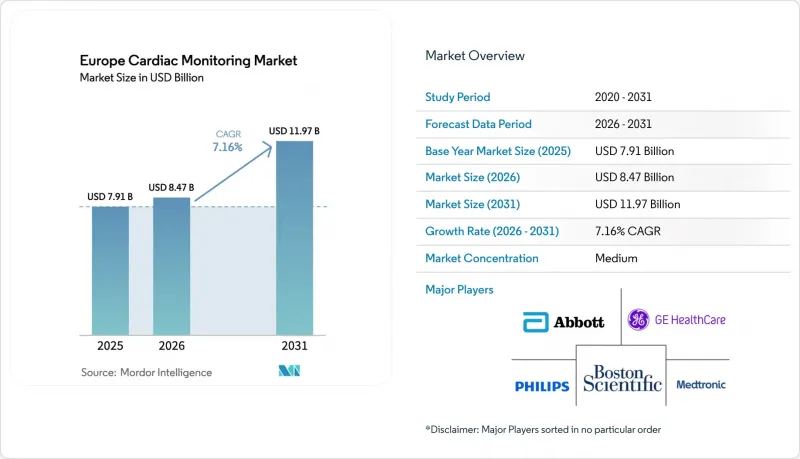
Mordor Intelligence에 의하면, 유럽의 심장 모니터링 시장 규모는 2025년 79억 1,000만 달러로 평가되었고, 2026년 84억 7,000만 달러에서 2031년까지 119억 7,000만 달러로 확대될 것으로 예측되며, 2026-2031년 연평균 복합 성장률(CAGR)은 7.16%를 나타낼 전망입니다.
본 보고서는 제품 유형별(심전도(ECG) 기기, 홀터 모니터, 이벤트 레코더, 모바일 심장 텔레메트리, 이식형 루프 레코더,스마트 웨어러블 모니터), 최종 사용자별(병원, 심장 센터·클리닉, 재택치료, 외래수술센터(ASC), 기타), 지역별(독일, 영국 등)로 분류되어 있습니다. 시장 예측은 금액(달러) 기준으로 제시되어 있습니다.
유럽의 심장 모니터링 시장 동향 및 인사이트
유럽 고령 인구에서 심혈관 질환(CVD) 유병률 증가
2024년, 심혈관 질환으로 인해 유럽에서 170만 명이 사망했으며, 이는 해당 지역의 전체 사망자의 42.5%에 해당합니다. 'Safe Hearts Plan'에 따르면, 2028년까지 40세 이상 성인을 대상으로 한 위험도 선별 검사가 의무화되어, 이를 통해 지속적인 심박 리듬 모니터링 대상자층이 확대될 것입니다. EU 전체의 고혈압 관리율은 고작 38%에 그치고 있어, 웨어러블 및 패치형 심전도가 대응할 수 있는 미충족 수요가 존재함이 밝혀졌습니다. 유로스타트의 예측에 따르면, 2030년까지 고령자(65세 이상)는 EU 인구의 24.8%를 나타낼 것으로 예측되며, 그 수요는 독일, 이탈리아,스페인에 집중될 것으로 전망됩니다. 기기를 일회성 진단 도구가 아닌 만성 질환 관리 도구로 포지셔닝하는 벤더들은 치료 성과에 따라 보상이 지급되는 정액제 모델로부터 혜택을 받을 준비가 되어 있습니다.
외래 및 원격 심장 모니터링으로의 전환
지급 인센티브는 입원에서 외래로 점차 전환되고 있습니다. 독일의 병원 개혁법에서는 특정 심장 치료가 정액제 번들에 포함되며, 조기 퇴원을 경제적으로 장려하는 제도가 도입되었습니다. 영국에서는 2025/26 회계연도 지급 제도에서 외래 혈압 모니터링과 프로-BNP 검사에 대해 별도의 요금이 설정되어, 병원 밖에서 이루어지는 진단이 공식적으로 인정되었습니다. 프랑스의 2025년 8월 DRG 개정으로 인해, 원격 텔레메트리가 임상적 조치를 유발한 경우 더 높은 보상률이 적용되게 되었습니다. 이러한 변화로 인해 구매력은 휴대용 심장 텔레메트리 및 이벤트 레코더로 이동하고 있으며, 제조업체들은 지불 기관과의 관계를 구축하고 진단당 비용 측면에서 우위를 입증해야 할 필요가 있습니다.
부문 분석
2025년, 유럽 심장 모니터링 시장에서 심전도(ECG) 기기는 40.1%의 점유율을 차지했습니다. 이는 12-리드 시스템에 대한 병원 수요에 힘입은 결과입니다. 그러나 스마트 웨어러블 모니터는 2031년까지 연평균 성장률(CAGR) 7.81%를 나타낼 것으로 예측되며, 다른 모든 카테고리를 능가하는 성장을 보일 것으로 전망됩니다. 이러한 급증은 Apple Watch Series 10이나 Samsung Galaxy Watch 7 등 FDA 승인을 받은 일반 소비자용 기기가 진단을 환자의 일상 속으로 가져오고 있음을 반영합니다. 홀터 모니터는 24시간에서 48시간에 걸친 검사에서 여전히 중요한 역할을 하고 있지만, 14일간의 기록이 가능한 장기 착용형 패치의 등장으로 그 수요는 점차 감소하고 있습니다. 30일 동안 실시간 데이터를 전송하는 모바일 심장 원격 측정 기술은 휴대용 패치와 이식형 루프 레코더 사이의 격차를 메워주며, 후자는 대당 3,000달러가 넘는 고가의 가격대를 형성하고 있습니다. Boston Scientific의 블루투스 지원 제품인 LUX-Dx II+는 배터리 수명을 4.5년으로 연장하여 교체 시술을 줄이는 동시에 가치 기반 할당 기준에도 부합합니다.
유럽의 심장 모니터링 시장에서 이식형 솔루션 시장 규모는 확대될 전망입니다. 이는 규제 지침에서 AI 알고리즘이 클래스 IIb 의료기기로 취급되게 되어, 소프트웨어 전문 벤더가 하드웨어 OEM 제조업체와 제휴할 수 있게 되었기 때문입니다. 예를 들어, Cardiologs는 2024년에 부정맥 감지 엔진을 3개 제조업체에 라이선스하고, 예측 분석 기능을 기본적으로 통합함으로써 후처리 시간을 단축했습니다. 따라서 경쟁사와의 차별화 요소는 하드웨어의 인체공학적 설계에서 클라우드 간 상호 운용성 및 분석 정확도로 점차 이동하고 있습니다.
기타 혜택 :
- 엑셀 형식 시장 예측(ME) 시트
- 3개월간의 애널리스트 지원
자주 묻는 질문
목차
제1장 서론
제2장 조사 방법
제3장 주요 요약
제4장 시장 구도
제5장 시장 규모 및 성장 예측
제6장 경쟁 구도
제7장 시장 기회 및 향후 전망
AJY 26.09.09According to Mordor Intelligence, the Europe cardiac monitoring market size is projected to expand from USD 7.91 billion in 2025 and USD 8.47 billion in 2026 to USD 11.97 billion by 2031, registering a CAGR of 7.16% between 2026 to 2031.
This report is Segmented by Product Type (ECG Devices, Holter Monitors, Event Recorders, Mobile Cardiac Telemetry, Implantable Loop Recorders, Smart Wearable Monitors), End User (Hospitals, Cardiac Centers & Clinics, Home-Care Settings, Ambulatory Surgical Centers, Others), and Geography (Germany, United Kingdom, and More). The Market Forecasts are Provided in Terms of Value (USD).
Europe Cardiac Monitoring Market Trends and Insights
Rising Prevalence of CVD Among Europe's Ageing Population
Cardiovascular disease claimed 1.7 million European lives in 2024, equal to 42.5% of all regional deaths. The Safe Hearts Plan mandates risk screening for adults over 40 by 2028, expanding the candidate pool for continuous rhythm surveillance. Hypertension control rates stand at only 38% across the EU, revealing an unmet need that wearable and patch-based ECG can address. Eurostat projects seniors (>= 65 years) will rise to 24.8% of the EU population by 2030 concentrating demand in Germany, Italy, and Spain . Vendors that position devices as chronic-disease-management tools rather than episodic diagnostics are poised to benefit from capitated payment models that reward outcomes.
Shift Toward Ambulatory and Remote Cardiac Monitoring
Payment incentives are migrating from inpatient to outpatient settings. Germany's Hospital Reform Act moved select cardiac procedures into flat-rate bundles that financially encourage early discharge . In the United Kingdom, the 2025/26 Payment Scheme set separate tariffs for ambulatory BP monitoring and Pro-BNP testing, formally recognizing diagnostics performed outside hospital walls. France's August 2025 intra-DRG update now pays higher rates when remote telemetry triggers clinical action. These changes redirect purchasing power toward mobile cardiac telemetry and event recorders, forcing manufacturers to cultivate payer relationships and validate cost-per-diagnosis advantages.
Other drivers and restraints analyzed in the detailed report include:
- Technological Advances in Wearable ECG Devices
- Favorable DRG and National Tariff Updates
- Stringent EU-MDR Compliance Costs
- Data-Privacy Hurdles Under GDPR
For complete list of drivers and restraints, kindly check the Table Of Contents.
Segment Analysis
ECG devices accounted for 40.1% of Europe's cardiac monitoring market share in 2025, underpinned by hospital demand for 12-lead systems. . Yet smart wearable monitors are projected to post a 7.81% CAGR to 2031, outpacing every other category. This surge reflects FDA-cleared consumer devices such as Apple Watch Series 10 and Samsung Galaxy Watch 7 that push diagnostics closer to the patient. Holter monitors remain relevant for 24- to 48-hour studies, but extended-wear patches offering 14-day recordings are eroding demand. Mobile cardiac telemetry, which delivers real-time data over 30 days, bridges the gap between ambulatory patches and implantable loop recorders, the latter commanding premium pricing above USD 3,000 per unit. Boston Scientific's Bluetooth-enabled LUX-Dx II+ extends battery life to 4.5 years, reducing replacement procedures and aligning with value-based quotas.
The Europe cardiac monitoring market size for implantable solutions is poised to expand as regulatory guidance now treats AI algorithms as Class IIb devices, permitting software-only vendors to partner with hardware OEMs. Cardiologs, for example, licensed its arrhythmia-detection engine to three manufacturers in 2024, embedding predictive analytics natively and shrinking post-processing times. Competitive differentiation is therefore shifting from hardware ergonomics to cloud interoperability and analytic accuracy.
Complete Report Scope:
- By Product Type
- ECG Devices
- Holter Monitors
- Event Recorders
- Mobile Cardiac Telemetry
- Implantable Loop Recorders
- Smart Wearable Monitors
- By End User
- Hospitals
- Cardiac Centres & Clinics
- Home-Care Settings
- Ambulatory Surgical Centres
- Others
- By Country
- Germany
- United Kingdom
- France
- Italy
- Spain
- Rest of Europe
List of Companies Covered in this Report:
- Abbott Laboratories
- AliveCor
- Baxter
- BIOTRONIK
- Bittium Corporation
- Boston Scientific
- Cardiologs Technologies SAS
- GE HealthCare Technologies Inc.
- iRhythm Technologies
- Koninklijke Philips
- Lepu Medical
- LivaNova
- Medtronic
- MicroPort
- Mindray
- Nihon Kohden
- Preventice Solutions
- Schiller
- Spacelabs Healthcare (OSI Systems)
- Vectorious Medical Technologies
Additional Benefits:
- The market estimate (ME) sheet in Excel format
- 3 months of analyst support
TABLE OF CONTENTS
1 Introduction
- 1.1 Study Assumptions & Market Definition
- 1.2 Scope of the Study
2 Research Methodology
3 Executive Summary
4 Market Landscape
- 4.1 Market Overview
- 4.2 Market Drivers
- 4.2.1 Rising Prevalence of CVD Among Europe's Ageing Population
- 4.2.2 Shift Toward Ambulatory & Remote Cardiac Monitoring
- 4.2.3 Technological Advances in Wearable ECG Devices
- 4.2.4 Favorable DRG & National Tariff Reimbursement Updates
- 4.2.5 AI-Driven Predictive Analytics in Holter Datasets
- 4.2.6 Emergence Of Tele-Cardiology Hubs in C & E Europe
- 4.3 Market Restraints
- 4.3.1 Stringent EU-MDR Compliance Costs
- 4.3.2 Data-Privacy Hurdles Under GDPR
- 4.3.3 Shortage Of Trained Electrophysiologists
- 4.3.4 Specialty Lithium Battery Supply Constraints
- 4.4 Supply-Chain Analysis
- 4.5 Regulatory Landscape
- 4.6 Technological Outlook
- 4.7 Porter's Five Forces
- 4.7.1 Buyer Power
- 4.7.2 Supplier Power
- 4.7.3 Threat of Substitutes
- 4.7.4 Threat of New Entrants
- 4.7.5 Competitive Rivalry
5 Market Size & Growth Forecasts (Value, USD)
- 5.1 By Product Type
- 5.1.1 ECG Devices
- 5.1.2 Holter Monitors
- 5.1.3 Event Recorders
- 5.1.4 Mobile Cardiac Telemetry
- 5.1.5 Implantable Loop Recorders
- 5.1.6 Smart Wearable Monitors
- 5.2 By End User
- 5.2.1 Hospitals
- 5.2.2 Cardiac Centres & Clinics
- 5.2.3 Home-Care Settings
- 5.2.4 Ambulatory Surgical Centres
- 5.2.5 Others
- 5.3 By Country
- 5.3.1 Germany
- 5.3.2 United Kingdom
- 5.3.3 France
- 5.3.4 Italy
- 5.3.5 Spain
- 5.3.6 Rest of Europe
6 Competitive Landscape
- 6.1 Market Concentration
- 6.2 Market Share Analysis
- 6.3 Company Profiles (includes Global level Overview, Market level overview, Core Segments, Financials as available, Strategic Information, Market Rank/Share for key companies, Products & Services, and Recent Developments)
- 6.3.1 Abbott Laboratories
- 6.3.2 AliveCor Inc.
- 6.3.3 Baxter International Inc
- 6.3.4 Biotronik SE & Co. KG
- 6.3.5 Bittium Corporation
- 6.3.6 Boston Scientific Corporation
- 6.3.7 Cardiologs Technologies SAS
- 6.3.8 GE HealthCare Technologies Inc.
- 6.3.9 iRhythm Technologies Inc.
- 6.3.10 Koninklijke Philips N.V.
- 6.3.11 Lepu Medical Technology
- 6.3.12 LivaNova PLC
- 6.3.13 Medtronic plc
- 6.3.14 MicroPort Scientific
- 6.3.15 Mindray Medical International Ltd.
- 6.3.16 Nihon Kohden Corporation
- 6.3.17 Preventice Solutions Inc.
- 6.3.18 Schiller AG
- 6.3.19 Spacelabs Healthcare (OSI Systems)
- 6.3.20 Vectorious Medical Technologies
7 Market Opportunities & Future Outlook
- 7.1 White-Space & Unmet-Need Assessment