|
시장보고서
상품코드
2121962
의료 임상 분석 시장 : 시장 점유율 분석, 업계 동향 및 통계, 성장 예측(2026-2031년)Healthcare Clinical Analytics - Market Share Analysis, Industry Trends & Statistics, Growth Forecasts (2026 - 2031) |
||||||
 Mordor Intelligence
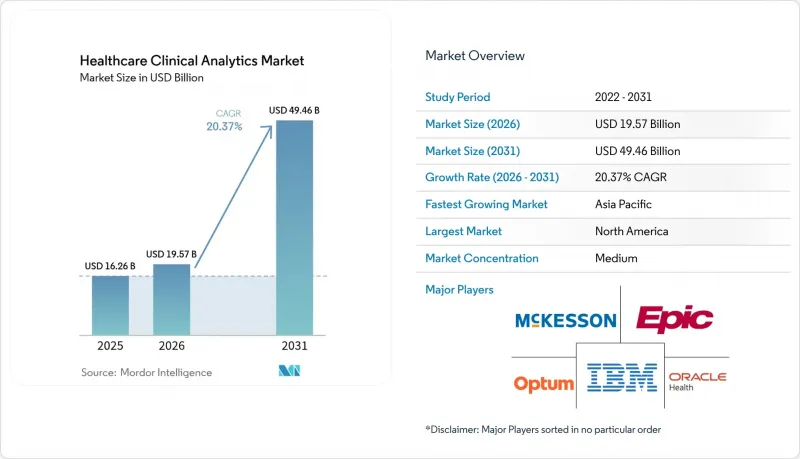
Mordor Intelligence에 의하면, 의료 임상 분석 시장 규모는 2025년에 162억 6,000만 달러로 평가되었고, 2026년 195억 7,000만 달러에서 2031년까지 494억 6,000만 달러에 이를 것으로 예측되며, 예측 기간(2026-2031년) CAGR은 20.37%를 나타낼 전망입니다.
본 보고서는 기술 유형별(예측 분석 등), 용도별(의료 품질 향상 등), 제공 형태별(온프레미스, 웹 및 클라우드 기반), 제품별(하드웨어, 서비스, 소프트웨어), 최종 사용자별(의료 제공업체, 의료비 지불자 등), 지역별(북미, 유럽 등)로 분류되어 있습니다. 시장 규모 및 전망은 금액(달러) 기준으로 제시되어 있습니다.
세계의 의료 임상 분석 시장 동향 및 인사이트
전자건강기록(EHR)의 높은 보급률
병원 및 외래 진료 시설에 인증된 전자의무기록(EHR) 시스템이 도입됨에 따라 기계 판독이 가능한 환자의 경과 데이터가 이용 가능해졌으며, 이는 의료 임상 분석 시장의 성장을 뒷받침하고 있습니다. Kaiser Permanente의 Advanced Alert Monitor는 EHR 워크플로우에 예측 알고리즘을 통합한 결과, 입원 환자의 사망률을 20% 감소시켰습니다. 벤더들의 로드맵은 현재 임상 현장에 통합된 AI 에이전트에 초점을 맞추었습니다. 예를 들어, 2025년에 본격적으로 출시될 예정인 Oracle Health의 차세대 플랫폼은 음성 인식 자동화 기능과 앰비언트 문서화 기능을 통합하여 차트 작성 시간을 최소화합니다. FHIR과 같은 표준화 노력으로 데이터 상호 운용성이 더욱 향상되어, 여러 의료 기관에 걸친 치료 성과 벤치마킹 및 치료 격차 분석이 촉진되고 있습니다. 규제 당국이 디지털 품질 보고를 지속적으로 평가함에 따라, EHR 주도형 분석 도구 도입에 대한 의사결정에서 그 효과가 눈덩이처럼 불어나고 있습니다.
AI/ML을 활용한 분석 플랫폼의 성숙
미국 식품의약국(FDA)은 1,000건 이상의 AI 탑재 의료기기를 승인했습니다. 이는 임상 용도에서 머신러닝에 대한 규제 당국의 신뢰를 보여주는 획기적인 사건입니다. 실제 운영에서도 이러한 낙관적인 전망이 반영되고 있으며, 예를 들어 ChristianaCare의 간소화된 예측 모델은 90일 이내 재입원 위험을 78%의 정확도로 식별하는 동시에, 특징량의 가중치를 투명하게 공개함으로써 임상의의 신뢰를 유지하고 있습니다. Stanford Health Care의 ChatEHR과 같은 생성형 AI 프론트엔드를 통해 의사는 자연어로 진료 기록을 검색할 수 있게 되어, 정보 검색 시간 단축과 번아웃 경감으로 이어지고 있습니다. 영상, 진료 기록, 유전체 정보 등의 다중 모달 데이터를 통합하는 능력은 정밀한 치료법 선택을 뒷받침하며, 의료 임상 분석 시장 전체에서 장기적인 수요를 견인하고 있습니다.
데이터 개인정보 보호 및 사이버 보안 침해
2024년에는 병원을 대상으로 한 랜섬웨어 공격이 다시 급증했으며, 공격자들은 시스템 중단과 규제 당국의 벌금 부과를 모두 위협하는 이중 협박 전술을 무기로 사용했습니다. 2024년에는 생명과학 기업의 90%가 사이버 보안 예산을 증액했으며, 이는 개인의 건강 정보를 보호하기 위해 현재 요구되는 경계 수준이 얼마나 높은지를 여실히 보여줍니다. EU의 GDPR(EU 개인정보보호규정)과 같은 규정 준수 프레임워크는 엄격한 정보 유출 통지 기한과 무거운 벌금을 부과하고 있으며, 이는 개방적인 데이터 교환을 저해하고 알고리즘의 학습 범위를 제한하고 있습니다. 선도적인 서비스 제공업체들은 연합 학습(federated learning)이나 동형 암호화(homomorphic encryption)와 같은 개인정보 보호 기술을 도입하여 분석의 깊이와 기밀 유지 요건 간의 균형을 맞추고 있습니다. 그러나 이러한 조치는 지연과 비용 증가를 초래합니다.
부문 분석
2025년에는 기술적 분석이 매출의 44.65%를 차지한 것으로 평가되었으며, 대부분의 조직은 더 고도화된 과제를 해결하기 전에 여전히 성과 기준선에 대한 사후 가시성을 필요로 하는 것으로 확인되었습니다. 한편, 인지 분석은 연평균 성장률(CAGR) 26.85%로 확대될 것으로 예측되며, 이는 기술 벤더들에게 있어 인지 분석이 의료 임상 분석 시장 전체의 규모를 확대하는 데 있어 매우 중요한 역할을 하고 있음을 뒷받침합니다. 자연어 처리 및 생성 추론을 기반으로 하는 인지 엔진은 검사 결과, 영상 진단, 임상 기록을 자율적으로 통합하여 감별 진단을 제안합니다. Stanford Health Care의 ChatEHR 시범 프로젝트는 대화형 인터페이스가 진료 기록 확인 시간을 단축하고 진단의 확신도를 높일 수 있음을 입증하고 있습니다. FDA의 진화하는 제품 수명 주기 전반에 대한 지침은 적응형 알고리즘의 시판 전 문서화 요건을 명확히 함으로써 이러한 방향성을 뒷받침하고 있습니다.
이러한 추세는 과도한 업무 부담에 직면한 임상의들의 시간 절약으로도 이어지고 있습니다. 알고리즘이 구조화된 필드에 미리 데이터를 입력하고 지침에 따른 지시를 제시함으로써, 의료진은 환자와 소통하는 시간을 확보할 수 있게 됩니다. Epic과 같은 기존 플랫폼 사업자들은 임상의들이 서로 다른 분석 포털 사이를 오가도록 강요하지 않고, 대규모 언어 모델의 보조 시스템을 워크플로우 화면에 직접 통합하고 있습니다. 인지 처리를 통한 출력이 대시보드 수준의 알림에서 주문 세트 내의 인라인 알림으로 전환됨에 따라, 하류 사용자 수가 증가하고 의료 임상 분석 시장의 도입 기반이 확대되고 있습니다. 모델 출력, 히트맵 및 기여 특징에 설명 가능성 계층을 추가하는 벤더는 의료 법적 위험을 억제하고 의료 기관의 승인을 가속화하는 데 기여하고 있습니다.
2025년에는 수익 주기 담당 팀이 변화하는 보험사 규정에 따라 환급을 확보해야 하기 때문에 재무 분석이 34.15%를 차지하며 계속해서 가장 큰 수익원이 되었습니다. 그러나 집단건강관리는 연평균 성장률(CAGR) 25.6%로 가속화되고 있으며, 의료 임상 분석 시장에 가장 두드러진 성장을 가져오고 있습니다. 예측 위험 점수화를 통해 고액의 악화 비용이 발생하기 훨씬 전에 COPD, 당뇨병, 심부전(CHF)의 이상 수치를 식별할 수 있습니다. Accenture와 CCS의 PropheSee 모델은 85%의 예측 정확도를 달성하고 있으며, 예방적 아웃리치를 통해 당뇨병 환자 1인당 연간 2,200달러의 비용 절감을 실현하고 있습니다.
메디케어 어드밴티지의 보급률은 대상 고령자의 70%를 초과하여, 정액제 사업자가 하류 비용 위험을 부담하도록 유도하고 있습니다. 의료 품질 개선에 관한 대시보드는 CMS(미국 의료보험서비스센터)의 별점 평가에 기반한 보너스 지급 제도와 밀접하게 연계되어 있으며, 재입원, HCAHPS 점수, 약물 복용 준수 상황을 추적하는 분석 모듈을 강력하게 뒷받침하고 있습니다. 데이터 세트에 사회적 결정 요인과 가정용 기기 데이터가 통합됨에 따라, 세분화는 단순히 ‘고비용’이라는 분류에서 벗어나 개인에 맞춘 차선책 조정을 위한 단계로 심화되고 있으며, 이는 의료 임상 분석 시장 규모를 확대함과 동시에 클라우드 네이티브 플랫폼의 선점자 우위를 강화하고 있습니다.
지역별 분석
북미는 선진적인 IT 인프라, 전자의무기록(EHR)의 광범위한 보급, 그리고 명확하게 정의된 환급 인센티브에 힘입어 여전히 가장 중요한 지역 시장으로서의 위상을 유지하고 있습니다. Epic이 미국 급성기 병상의 42.3%를 차지하고 있다는 사실은 기존 워크플로우 내에 분석 기능을 원활하게 통합할 수 있는 기술 선도 기업이 누리는 규모의 경제를 여실히 보여줍니다. 동시에, 연방 정부의 지불 제도 개혁과 사이버 보안 보조금은 의료 임상 분석 시장의 성장을 가속하는 AI 업그레이드에 대한 지속적인 자본 배분을 뒷받침하고 있습니다.
유럽에서는 유럽 헬스 데이터 스페이스(European Health Data Space) 및 EU AI 법과 같은 획기적인 디지털 헬스 규제를 배경으로 시장이 가속화되고 있습니다. 이 모든 규제는 상호 운용성과 알고리즘의 투명성을 의무화하고 있습니다. 독일의 건강 데이터 이용법이나 프랑스의 강화된 임상 검증 절차는 공급업체의 도입 모델을 형성하는 엄격한 GDPR(EU 개인정보보호규정) 보호 조치가 있음에도 불구하고 국경을 초월한 연구 네트워크를 촉진하고 있습니다. 이러한 노력은 인구 규모 분석을 가능하게 하는 표준화된 데이터 레이크를 촉진하여, 전 세계 성장에 대한 이 지역의 중기적 기여를 공고히 하고 있습니다.
아시아태평양은 중국, 인도, 일본 각국 정부가 클라우드 인프라, AI 인재 양성, 국가 건강 ID 제도에 자금을 투자하고 있어 가장 높은 연평균 성장률(CAGR)을 기록하고 있습니다. 사우디아라비아의 ‘비전 2030’ 의료 분야 이니셔티브 등 공공 부문의 현대화가 그 대표적인 예입니다. 이를 통해 데이터 유통 기반이 확립되어, 공립 및 민간 병원 모두에서 의료 임상 분석 시장이 확대되고 있습니다. 레거시 시스템의 비일관성이나 인재의 역량 강화와 같은 과제는 여전히 남아 있지만, 목표가 명확한 투자 분야와 현지 언어를 지원하는 AI 인터페이스를 통해 준비 태세의 격차는 빠르게 해소되고 있습니다.
기타 혜택 :
- 엑셀 형식 시장 예측(ME) 시트
- 3개월간의 애널리스트 지원
자주 묻는 질문
목차
제1장 서론
제2장 조사 방법
제3장 주요 요약
제4장 시장 구도
제5장 시장 규모 및 성장 예측
제6장 경쟁 구도
제7장 시장 기회 및 향후 전망
AJY 26.09.09According to Mordor Intelligence, the healthcare clinical analytics market size was valued at USD 16.26 billion in 2025 and estimated to grow from USD 19.57 billion in 2026 to reach USD 49.46 billion by 2031, at a CAGR of 20.37% during the forecast period (2026-2031).
This report is Segmented by Technology Type (Predictive, and More), Application (Quality of Care Improvement, and More), Mode of Delivery (On-Premise, Web, and Cloud-Based), Product (Hardware, Services, and Software), End User (Healthcare Providers, Healthcare Payers, and More), and Geography (North America, Europe, and More). The Market Sizes and Forecasts are Provided in Terms of Value (USD).
Global Healthcare Clinical Analytics Market Trends and Insights
High Adoption of Electronic Health Records
The installation of certified EHR systems across hospitals and ambulatory practices unlocks machine-readable, longitudinal patient data that fuels the healthcare clinical analytics market. Kaiser Permanente's Advanced Alert Monitor reduced inpatient mortality by 20% after embedding predictive algorithms inside its EHR workflow. Vendor roadmaps now center on clinically embedded AI agents, such as Oracle Health's next-generation platform, slated for broad release in 2025, which incorporates voice-enabled automation and ambient documentation to minimize charting time. Standardization efforts such as FHIR further ease data interoperability, encouraging multi-institution outcome benchmarking and care-gap analysis. With regulators continuing to reward digital-quality reporting, the result is a snowball effect in EHR-driven analytics purchasing decisions.
AI / ML-Powered Analytics Platforms Mature
The U.S. Food and Drug Administration has cleared more than 1,000 AI-enabled medical devices, a milestone signaling regulatory confidence in machine learning for clinical use.Real-world deployments mirror this optimism, for instance, ChristianaCare's simplified predictive model achieves 78% accuracy in flagging 90-day readmission risk while preserving clinician trust through transparent feature weighting. Generative AI front-ends such as Stanford Health Care's ChatEHR allow physicians to interrogate charts with natural language, cutting information-retrieval time and curbing burnout. The ability to fuse multimodal data, such as images, notes, and genomics, underpins precision therapy selection and drives longer-range demand across the healthcare clinical analytics market.
Data Privacy & Cyber-Security Breaches
Ransomware attacks on hospitals surged again in 2024, with adversaries weaponizing double-extortion tactics that threaten both downtime and regulatory fines. Ninety percent of life-sciences firms raised cybersecurity budgets in 2024, underscoring the scale of vigilance now required to protect personal health information. Compliance frameworks such as the EU's GDPR impose tough breach-notification timelines and stiff penalties that dissuade open data exchanges, limiting algorithm training breadth. Forward-leaning providers are adopting privacy-preserving technologies, such as federated learning and homomorphic encryption, to strike a balance between analytics depth and confidentiality mandates. Yet, these measures add latency and cost overhead.
Other drivers and restraints analyzed in the detailed report include:
- Value-Based-Care & Reimbursement Mandates
- Cost-Containment Pressure on Providers
- High Up-Front Integration & Change-Management Costs
For complete list of drivers and restraints, kindly check the Table Of Contents.
Segment Analysis
Descriptive analytics accounted for 44.65% of revenue in 2025, confirming that most organizations still need retrospective visibility into performance baselines before tackling higher-order tasks. Cognitive analytics, however, is forecast to expand at a 26.85% CAGR, validating its pivotal role in raising the overall healthcare clinical analytics market size for technology vendors. Fueled by natural-language processing and generative reasoning, cognitive engines autonomously synthesize lab values, imaging studies, and clinical notes to suggest differential diagnoses. Stanford Health Care's ChatEHR pilot showcases how conversational interfaces can compress chart review time and elevate diagnostic confidence. The FDA's evolving total product life-cycle guidance encourages this trajectory by clarifying pre-market documentation requirements for adaptive algorithms.
Momentum also reflects time savings for over-burdened clinicians. When algorithms pre-populate structured fields and surface guideline-concordant orders, providers regain face-to-face minutes with patients. Platform incumbents such as Epic embed large-language-model copilots directly inside their workflow canvas, rather than forcing clinicians to toggle between disparate analytics portals. As cognitive outputs move from dashboard-level alerts to inline nudges within order sets, downstream users multiply, expanding the installed base of the healthcare clinical analytics market. Vendors that layer explainability onto model outputs, heat maps, and contributing features help contain medical-legal risk and accelerate institutional sign-off.
Financial analytics continues to supply the largest revenue block at 34.15% in 2025 because revenue-cycle teams must defend reimbursement under shifting payer rules. Yet population health management is accelerating at a 25.6% CAGR, providing the sharpest uplift to the healthcare clinical analytics market. Predictive risk scoring pinpoints COPD, diabetes, and CHF outliers long before expensive exacerbations unfold. Accenture and CCS's PropheSee model hits 85% predictive accuracy and yields USD 2,200 annual savings per diabetic patient through proactive outreach.
Medicare Advantage penetration tops 70% of eligible seniors, incentivizing capitated entities to shoulder downstream cost risk. Quality-of-care improvement dashboards dovetail with CMS's star-rating bonus payments, turbo-charging analytics modules that track readmissions, HCAHPS scores and medication compliance. As datasets integrate social determinants and home-based device feeds, segmentation deepens from "high cost" to personalized next-best-action orchestration, widening the healthcare clinical analytics market size and reinforcing first-mover advantage for cloud-native platforms.
Complete Report Scope:
- By Technology Type
- Predictive Analytics
- Prescriptive Analytics
- Descriptive Analytics
- By Application
- Quality of Care Improvement
- Customer Relationship Management
- Workforce Performance Evaluation
- Hospital/Clinical Data Management & Curation
- By Mode of Delivery
- On-Premise
- Web & Cloud-Based
- By Product
- Hardware
- Software
- Services
- By End User
- Healthcare Providers
- Healthcare Payers
- Life-Science & CROs
- Government/ Public Health Agencies
- Geography
- North America
- United States
- Canada
- Mexico
- Europe
- Germany
- United Kingdom
- France
- Italy
- Spain
- Rest of Europe
- Asia Pacific
- China
- Japan
- India
- South Korea
- Australia
- Rest of Asia Pacific
- Middle East and Africa
- GCC
- South Africa
- Rest of Middle East and Africa
- South America
- Brazil
- Argentina
- Rest of South America
- North America
Geography Analysis
North America remains the most significant regional contributor, propelled by advanced IT infrastructure, widespread EHR penetration, and well-defined reimbursement incentives. Epic's capture of 42.3% of U.S. acute-care beds underscores the scale advantages that accrue to technology leaders able to bundle analytics seamlessly inside existing workflows. Simultaneously, federal payment reform and cybersecurity grant funding sustain ongoing capital allocation toward AI upgrades that grow the healthcare clinical analytics market.
Europe accelerates behind landmark digital-health regulations such as the European Health Data Space and the EU AI Act, each mandating interoperability and algorithm transparency. Germany's Health Data Use Act and France's reinforced clinical-validation pathways are fueling cross-border research networks, albeit with strict GDPR safeguards that shape vendor deployment models. These initiatives encourage standardized data lakes that power population-scale analytics, reinforcing the region's medium-term contribution to global growth.
Asia-Pacific posts the steepest CAGR as governments in China, India, and Japan bankroll cloud infrastructure, AI talent pipelines, and national health-ID schemes. Public-sector modernization, such as Saudi Arabia's Vision 2030 health component, is illustrative. It establishes baseline data liquidity, expanding the healthcare clinical analytics market across both public and private hospitals. Challenges remain around disparate legacy systems and workforce upskilling, but targeted investment corridors and local-language AI interfaces are closing readiness gaps at pace.
- Allscripts
- Cerner / Oracle Health
- IBM
- Mckesson
- MedeAnalytics
- Meditech
- Optum (UnitedHealth)
- Verisk Analytics
- Veeva Systems
- Parexel International
- Signant Health
- SAS Institute
- Health Catalyst
- Epic Systems
- Innovaccer
- Arcadia
- Philips HealthSuite
- Truven Health (IBM Watson Health)
- Cloudera
- Tableau (Salesforce)
Additional Benefits:
- The market estimate (ME) sheet in Excel format
- 3 months of analyst support
TABLE OF CONTENTS
1 Introduction
- 1.1 Study Assumptions & Market Definition
- 1.2 Scope of the Study
2 Research Methodology
3 Executive Summary
4 Market Landscape
- 4.1 Market Overview
- 4.2 Market Drivers
- 4.2.1 High Adoption Of Electronic Health Records (EHR)
- 4.2.2 AI / ML-Powered Analytics Platforms Mature
- 4.2.3 Value-Based-Care & Reimbursement Mandates
- 4.2.4 Cost-Containment Pressure On Providers
- 4.2.5 Real-World-Evidence Feeds From Decentralised & Virtual Trials
- 4.2.6 Synthetic Data & Privacy-Preserving Computation Unlock Multi-Institution Studies
- 4.3 Market Restraints
- 4.3.1 Data Privacy & Cyber-Security Breaches
- 4.3.2 High Up-Front Integration & Change-Management Costs
- 4.3.3 Algorithmic Bias & Lack Of Explainability In Clinical Settings
- 4.3.4 Regulatory Ambiguity Around AI/ML SaMD Classification
- 4.4 Regulatory Landscape
- 4.5 Technological Outlook
- 4.6 Porter's Five Forces Analysis
- 4.6.1 Threat of New Entrants
- 4.6.2 Bargaining Power of Buyers
- 4.6.3 Bargaining Power of Suppliers
- 4.6.4 Threat of Substitutes
- 4.6.5 Intensity of Competitive Rivalry
5 Market Size & Growth Forecasts (Value)
- 5.1 By Technology Type
- 5.1.1 Predictive Analytics
- 5.1.2 Prescriptive Analytics
- 5.1.3 Descriptive Analytics
- 5.2 By Application
- 5.2.1 Quality of Care Improvement
- 5.2.2 Customer Relationship Management
- 5.2.3 Workforce Performance Evaluation
- 5.2.4 Hospital/Clinical Data Management & Curation
- 5.3 By Mode of Delivery
- 5.3.1 On-Premise
- 5.3.2 Web & Cloud-Based
- 5.4 By Product
- 5.4.1 Hardware
- 5.4.2 Software
- 5.4.3 Services
- 5.5 By End User
- 5.5.1 Healthcare Providers
- 5.5.2 Healthcare Payers
- 5.5.3 Life-Science & CROs
- 5.5.4 Government/ Public Health Agencies
- 5.6 Geography
- 5.6.1 North America
- 5.6.1.1 United States
- 5.6.1.2 Canada
- 5.6.1.3 Mexico
- 5.6.2 Europe
- 5.6.2.1 Germany
- 5.6.2.2 United Kingdom
- 5.6.2.3 France
- 5.6.2.4 Italy
- 5.6.2.5 Spain
- 5.6.2.6 Rest of Europe
- 5.6.3 Asia Pacific
- 5.6.3.1 China
- 5.6.3.2 Japan
- 5.6.3.3 India
- 5.6.3.4 South Korea
- 5.6.3.5 Australia
- 5.6.3.6 Rest of Asia Pacific
- 5.6.4 Middle East and Africa
- 5.6.4.1 GCC
- 5.6.4.2 South Africa
- 5.6.4.3 Rest of Middle East and Africa
- 5.6.5 South America
- 5.6.5.1 Brazil
- 5.6.5.2 Argentina
- 5.6.5.3 Rest of South America
- 5.6.1 North America
6 Competitive Landscape
- 6.1 Market Concentration
- 6.2 Market Share Analysis
- 6.3 Company Profiles (includes Global level Overview, Market level overview, Core Segments, Financials as available, Strategic Information, Market Rank/Share, Products & Services, and Recent Developments)
- 6.3.1 Allscripts Healthcare Solutions
- 6.3.2 Cerner / Oracle Health
- 6.3.3 IBM
- 6.3.4 McKesson (Ontada)
- 6.3.5 MedeAnalytics
- 6.3.6 MEDITECH
- 6.3.7 Optum (UnitedHealth)
- 6.3.8 Verisk Analytics
- 6.3.9 Veeva Systems
- 6.3.10 Parexel
- 6.3.11 Signant Health
- 6.3.12 SAS Institute
- 6.3.13 Health Catalyst
- 6.3.14 Epic Systems
- 6.3.15 Innovaccer
- 6.3.16 Arcadia
- 6.3.17 Philips HealthSuite
- 6.3.18 Truven Health (IBM Watson Health)
- 6.3.19 Cloudera
- 6.3.20 Tableau (Salesforce)
7 Market Opportunities & Future Outlook
- 7.1 White-space & Unmet-Need Assessment