|
시장보고서
상품코드
2123252
임상화학 분석기 시장 : 시장 점유율 분석, 업계 동향 및 통계, 성장 예측(2026-2031년)Clinical Chemistry Analyzers - Market Share Analysis, Industry Trends & Statistics, Growth Forecasts (2026 - 2031) |
||||||
 Mordor Intelligence
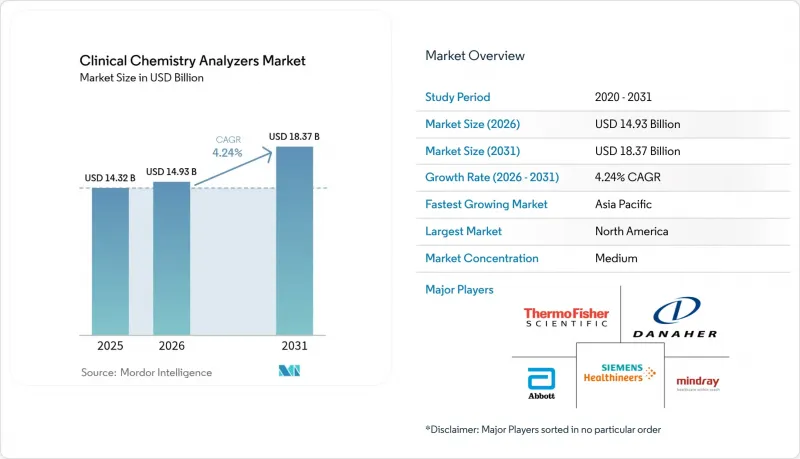
Mordor Intelligence에 의하면, 임상화학 분석기 시장 규모는 2025년에 143억 2,000만 달러로 평가되었고, 2026년 149억 3,000만 달러에서 2031년까지 183억 7,000만 달러에 이를 것으로 예측되며, 예측 기간(2026-2031년) CAGR은 4.24%를 나타낼 전망입니다.
본 보고서는 제품 유형별(분석 장비(고정형·고속 처리형 등), 시약, 기타), 검사 유형별(기본 대사 패널, 간 기능 패널, 전해질 패널 등), 최종 사용자별(병원, 독립 진단 검사 기관 등), 지역별(북미, 유럽, 아시아태평양 등)로 분류되어 있습니다. 시장 전망은 금액(달러) 기준으로 제시되어 있습니다.
세계의 임상화학 분석기 시장 동향 및 인사이트
고령화와 만성 질환의 부담
급속한 인구 고령화로 인해 만성 질환에 대한 검사 수요가 증가하고 있으며, 대사 패널, 심장 마커, 신장 기능 검사에 대한 일일 수요가 증가하고 있습니다. 당뇨병, 심혈관 질환, 만성 신장 질환의 선별 검사 및 모니터링 프로토콜이 더욱 엄격해짐에 따라, 검사 건수 증가율은 인구 증가율을 웃도는 속도로 상승하고 있습니다. 자동 반복 검사 및 리플렉스 검사 기능을 갖춘 고처리량 분석 장비는 이러한 검사 수요의 급증에 대응하는 데 필요한 확장성을 제공하여, 검사실이 인력을 비례적으로 늘리지 않고도 미래를 대비한 처리 능력을 확보할 수 있도록 합니다. 워크플로우 시뮬레이터 및 예측 분석 기능을 패키지로 제공하는 공급업체는 자본 조달 입찰에서 경쟁 우위를 누리고 있습니다. 성숙한 의료 시스템에서는 성과 연동형 보상 제도에 따라 임상화학 분석기 시장이 예방 의료 프로그램의 최전선에서 자원으로서의 입지를 더욱 공고히 하고 있습니다. 장기적으로는 인구 동향의 추세로 인해 일시적인 지출 둔화가 나타나더라도 검사 건수는 지속적으로 유지될 것이 확실합니다.
응급의료 현장에서의 포인트 오브 케어 도입
응급실이나 중환자실에서는 결과가 몇 시간이 아닌 몇 분 이내에 나오는 환자 측 생화학 검사 패널에 대한 의존도가 높아지고 있습니다. 고감도 심근 트로포닌, 젖산 및 대사 평가는 현재 신속한 트라이아지(triage)의 지침이 되고 있으며, 심근경색이나 패혈증 치료 경로에서 ‘이송부터 치료 시작까지의 시간’을 단축하고 있습니다. bioMerieux사가 SpinChip Diagnostics사를 1억 1,100만 유로에 인수한 사례는 심근 마커 검사 결과를 10분 내에 확보하는 것을 목표로 한 전략적 투자의 전형적인 예입니다. 장비의 소형화로 인해 중앙 검사실과의 분석 능력 격차가 줄어들면서, 분산형 워크플로는 검체 이송 지연과 입원 기간을 대폭 단축하여 보험사 및 의료 제공업체에게 더 큰 가치를 제공합니다. 그 결과 발생하는 수요 급증으로 인해, 벤치탑형 시스템과 일회용 마이크로플루이딕스 카트리지는 임상화학 분석기 시장에서 높은 성장이 예상되는 틈새 분야로 자리매김하고 있습니다.
숙련된 검사 기술자 부족
미국 임상화학 부문의 공석률은 17.3%, 검사실 전체 직종에서는 46%에 달하여 기술 격차의 확대를 여실히 드러내고 있습니다. 채용 지연은 베이비붐 세대의 은퇴, 연수 프로그램의 수용 능력 한계, 그리고 이 직업에 대한 대중의 낮은 인지도에 기인합니다. 미들웨어를 통한 자동화가 수작업의 부담을 줄여주고 있는 반면, 품질 관리 경고 사항의 모니터링이나 복잡한 검사 결과의 해석에는 여전히 자격을 갖춘 인력의 존재가 필수적입니다. 검사실 측에서는 교차 교육 실시, 자격 요건 완화, 급여 우대 등의 조치를 취하고 있지만, 수급 불균형은 여전히 지속되고 있습니다. 제조업체 입장에서는 인력 부족에 대처하기 위한 직관적인 사용자 인터페이스, 자동 검증 알고리즘, 원격 진단 기능이 제품의 필수 요건이 되어, 임상화학 분석기 업계에서의 가치 제안을 강화하고 있습니다.
부문 분석
2025년 시점에서 시약 부문은 임상화학 분석기 시장 규모의 58.02%를 차지했으며, 이는 검사실의 현금 흐름을 뒷받침하는 확고한 소모품 모델을 반영합니다. 정기적인 검사 건수가 교정액, 컨트롤, 효소 기질에 대한 수요를 지탱하고 있기 때문에 수익은 예측 가능한 상태를 유지하고 있습니다. 그러나 자본 투자는 처리 속도 향상, AI를 활용한 유지보수, 검사 메뉴 통합을 약속하는 완전 자동 분석기 플랫폼으로 이동하고 있으며, 그 결과 2031년까지 분석기 시장의 연평균 성장률(CAGR)은 8.12%로 예측됩니다. 장비 구매 시 토탈 솔루션 계약에 포함된 미들웨어 라이선스나 클라우드 대시보드가 포함되는 사례가 증가하고 있으며, 이는 부품 단위 가격 책정에서 성과 기반 조달로의 전환을 시사합니다.
벤치탑형 분석 장비는 포인트 오브 케어(POC)의 확대와 급성기 패널이 응급실로 복귀되고 있는 것을 배경으로, 출하 대수 증가 측면에서 플로어 스탠드형 장비를 앞지르고 있습니다. 각 벤더사는 카트리지의 인체공학적 설계, 검체의 추적성, 가동 시간을 극대화하는 신속한 품질 관리(QC) 승인 시간 등을 통해 차별화를 꾀하고 있습니다. 시약 혁신은 기기 내 안정성이 연장된 액상 안정 제제, 검사당 플라스틱 사용량 절감, 재고 분석에 활용되는 바코드가 부착된 패키지 추적 등에 초점을 맞추었습니다. 고감도 심근 트로포닌 및 새로운 패혈증 마커용 특수 화학 약품은 높은 이익률을 가져와, 기초 대사 검사용 시약의 가격 하락을 일부 상쇄하고 있습니다. 이러한 시너지 효과로 인해 소모품이 수익의 기반을 보장하고, 하드웨어 업그레이드가 획기적인 효율 향상을 가져오는 균형 잡힌 생태계가 형성되어, 임상화학 분석기 시장의 장기적인 수요를 공고히 하고 있습니다.
지역별 분석
북미는 견조한 보험 환급, AI의 급속한 도입, 그리고 차세대 분석 기기의 밀집된 도입 기반에 힘입어 2025년 매출의 33.78%를 차지했습니다. FDA의 LDT 최종 규정은 규정 준수 비용을 증가시키는 한편, 검증된 시스템과 문서를 대규모로 제공할 수 있는 기존 공급업체의 입지를 공고히 하는 높은 규제 기준을 확립하여, 해당 지역의 전반적인 판매 모멘텀을 뒷받침하고 있습니다. 유럽은 안정적인 갱신 수요에 힘입어 그 뒤를 따르고 있지만, IVDR(체외진단용 의료기기 규정)에 따른 재인증 부담으로 인해 제조업체의 자원이 부족해지는 상황에 대처해야 합니다.
아시아태평양은 7.56%라는 강력한 연평균 성장률(CAGR)을 보일 것으로 예상되며, 향후 전 세계 임상화학 분석기 시장 규모에 지대한 기여를 할 전망입니다. 중국은 지방 병원 통합 및 만성 질환 검진 의무화에 힘입어 판매량 증가를 주도하고 있지만, 수량 기준의 조달 방식이 공급업체의 가격 결정력을 위협하고 있습니다. 인도 및 동남아시아 국가에서는 민관 파트너십을 통해 지방에 대한 진단 서비스 제공이 가속화되고 있으며, 탁상형 및 반자동 분석기 도입이 촉진되고 있습니다. 라틴아메리카 및 중동 및 아프리카에서는 건강보험 확대와 검사실 인프라 현대화에 따라 한 자릿수 중반대의 성장 궤도가 예상되지만, 환율 변동의 영향을 받기 쉬운 측면도 있습니다. 시약 팩의 크기, 자금 조달 조건, 현장 서비스 체계를 현지 사정에 맞추어 조정하는 벤더는 타사를 압도하는 시장 점유율을 확보하고 있으며, 임상화학 분석기 시장에서 지역에 특화된 사업 전개가 결정적인 성공 요인임이 부각되고 있습니다.
기타 혜택 :
- 엑셀 형식 시장 예측(ME) 시트
- 3개월간의 애널리스트 지원
자주 묻는 질문
목차
제1장 서론
제2장 조사 방법
제3장 주요 요약
제4장 시장 구도
제5장 시장 규모 및 성장 예측
제6장 경쟁 구도
제7장 시장 기회 및 향후 전망
AJY 26.09.07According to Mordor Intelligence, the clinical chemistry analyzers market size was valued at USD 14.32 billion in 2025 and estimated to grow from USD 14.93 billion in 2026 to reach USD 18.37 billion by 2031, at a CAGR of 4.24% during the forecast period (2026-2031).
This report is Segmented by Product Type (Analyzers [Floor-Standing High-Throughput, and More], Reagents, and Others), Types of Test (Basic Metabolic Panel, Liver Panel, Electrolyte Panels, and More), End User (Hospitals, Independent Diagnostic Laboratories, and More) and Geography (North America, Europe, Asia-Pacific, and More). The Market Forecasts are Provided in Terms of Value (USD).
Global Clinical Chemistry Analyzers Market Trends and Insights
Aging Population & Chronic-Disease Burden
Rapid demographic aging is intensifying chronic-disease testing needs, lifting daily demand for metabolic panels, cardiac markers, and renal function assays. Screening and monitoring protocols for diabetes, cardiovascular disorders, and chronic kidney disease have grown more stringent, producing test-volume curves that rise faster than population growth. High-throughput analyzers with auto-repeat and reflex testing options deliver the scalability required to keep pace with this influx, enabling laboratories to future-proof capacity without proportionate staffing increases. Instrument vendors that package workflow simulators and predictive analytics enjoy a competitive edge in capital tenders. In mature healthcare systems, pay-for-outcome reimbursement further cements the clinical chemistry analyzers market as a frontline resource for preventive care programs. Long term, demographic momentum ensures durable test volumes even amid episodic spending slowdowns.
Point-of-Care Adoption in Critical Care Settings
Emergency departments and intensive care units increasingly depend on near-patient chemistry panels that return results within minutes rather than hours. High-sensitivity cardiac troponin, lactate, and metabolic assessments now guide rapid triage, reducing door-to-needle times in myocardial infarction and sepsis pathways. bioMerieux's EUR 111 million move for SpinChip Diagnostics typifies strategic investment aimed at 10-minute cardiac marker turnaround. As device miniaturization narrows the analytical gap with central labs, decentralised workflows slash specimen transport delays and hospital length-of-stay, amplifying value for payers and providers. The resulting demand updraft positions benchtop systems and disposable microfluidic cartridges as high-growth niches within the clinical chemistry analyzers market.
Shortage of Skilled Lab Technologists
Vacancy rates of 17.3% in U.S. chemistry departments and 46% across total laboratory positions underline a widening skills gap. Recruitment lags stem from retiring baby-boom cohorts, limited training program capacity, and muted public visibility of the profession. While middleware automation eases manual workloads, oversight of quality-control flags and complex result interpretation still demands licensed staff. Laboratories respond with cross-training, relaxed credential prerequisites, and salary premiums, yet the supply-demand mismatch endures. For manufacturers, intuitive user interfaces, auto-verification algorithms, and remote diagnostics become product imperatives to counter workforce scarcity, reinforcing value propositions inside the clinical chemistry analyzers industry.
Other drivers and restraints analyzed in the detailed report include:
- AI-Enabled High-Throughput Automation
- Broader Metabolic/Specialty Chemistry Test Menu
- High Capital & Maintenance Costs
For complete list of drivers and restraints, kindly check the Table Of Contents.
Segment Analysis
The reagents segment accounted for 58.02% of clinical chemistry analyzers market size in 2025, reflecting the entrenched consumable model that underwrites laboratory cash flow. Revenues remain predictable as recurrent test volumes anchor demand for calibrators, controls, and enzyme substrates. Yet capital investments are tilting toward fully automated analyzer platforms that promise faster throughput, AI-backed maintenance, and consolidated assay menus, resulting in an 8.12% CAGR forecast for analyzers through 2031. Instrument purchases increasingly include middleware licenses and cloud dashboards bundled into total-solution contracts, signaling a shift from component pricing to outcome-based procurement.
Benchtop analyzers are outpacing floor-standing units in shipment growth, powered by point-of-care expansion and the repatriation of acute panels into emergency wards. Vendors differentiate via cartridge ergonomics, sample traceability, and rapid QC unlock times that maximize uptime. Reagent innovation centers on liquid-stable formulations with extended onboard stability, trimmed plastic volume per test, and barcoded pack tracking that feeds inventory analytics. Specialty chemicals for high-sensitivity cardiac troponin and emerging sepsis markers deliver premium margins, partially offsetting price erosion in basic metabolic reagents. The combined effect is a balanced ecosystem where consumables guarantee baseline revenue while hardware upgrades unlock step-change efficiency, fortifying long-term demand for the clinical chemistry analyzers market.
Complete Report Scope:
- By Product Type
- Analyzers
- Floor-standing High-Throughput
- Modular/Integrated Systems
- Benchtop
- Semi-automated
- Reagents
- Calibrators & Controls
- Consumables
- Others (QC Materials, Software Licenses)
- Analyzers
- By Types of Test
- Basic Metabolic Panel
- Electrolyte Panel
- Liver Panel
- Lipid Profile
- Thyroid Function Panel
- Renal Function Panel
- Cardiac Markers
- Specialty Chemistries
- By End User
- Hospitals
- Independent Diagnostic Laboratories
- Academic & Research Institutes
- Point-of-Care Centers
- Geography
- North America
- United States
- Canada
- Mexico
- Europe
- Germany
- United Kingdom
- France
- Italy
- Spain
- Rest of Europe
- Asia-Pacific
- China
- Japan
- India
- South Korea
- Australia
- Rest of Asia-Pacific
- Middle East and Africa
- GCC
- South Africa
- Rest of Middle East and Africa
- South America
- Brazil
- Argentina
- Rest of South America
- North America
Geography Analysis
North America generated 33.78% of 2025 revenue, anchored by robust reimbursement, rapid AI adoption, and a dense installed base of next-generation analyzers. The FDA's LDT Final Rule, while elevating compliance costs, cements a high regulatory bar that entrenches incumbent suppliers who can furnish validated systems and documentation at scale, bolstering overall sales momentum within the region. Europe follows with steady replacement demand but must navigate IVDR-driven re-certification workloads that tax manufacturer resources.
Asia-Pacific is forecast to post a vigorous 7.56% CAGR, driving outsized contribution to future global clinical chemistry analyzers market size. China leads volume growth, propelled by provincial hospital consolidation and chronic-disease screening mandates, even as volume-based-procurement schemes challenge vendor pricing power. India and Southeast Asian nations accelerate rural diagnostic outreach via public-private partnerships, boosting benchtop and semi-automated analyzer adoption. Latin America and the Middle East & Africa present mid-single-digit trajectories tied to health-insurance expansion and laboratory infrastructure modernization, albeit vulnerable to currency volatility. Vendors that tailor reagent pack sizes, financing terms, and field-service footprints to local realities capture disproportionate share, underscoring geography-specific execution as a decisive success factor in the clinical chemistry analyzers market.
- Abbott Laboratories
- Danaher Corp. (Beckman Coulter)
- Roche
- Siemens Healthineers
- Thermo Fisher Scientific
- HORIBA
- Sysmex Corp.
- Mindray Medical
- Johnson & Johnson (Ortho Clinical)
- Elitech Group
- Hitachi High-Tech
- Randox Laboratories
- DIRUI Industrial
- Bio-Rad Laboratories
- Shenzhen Mindray Bio-Medical
- Agappe Diagnostics
- Xylem Analytics (YSI)
- Erba Mannheim
- Tecom Science
- Medica Corp.
- Diasys Diagnostics
Additional Benefits:
- The market estimate (ME) sheet in Excel format
- 3 months of analyst support
TABLE OF CONTENTS
1 Introduction
- 1.1 Study Assumptions & Market Definition
- 1.2 Scope of the Study
2 Research Methodology
3 Executive Summary
4 Market Landscape
- 4.1 Market Overview
- 4.2 Market Drivers
- 4.2.1 Aging Population & Chronic-Disease Burden
- 4.2.2 Point-Of-Care Adoption In Critical Care Settings
- 4.2.3 AI-Enabled High-Throughput Automation
- 4.2.4 Broader Metabolic/Specialty Chemistry Test Menu
- 4.2.5 Sustainability Push For Energy-Efficient Analyzers
- 4.2.6 Monetization Of Analyzer-Generated Data
- 4.3 Market Restraints
- 4.3.1 Shortage Of Skilled Lab Technologists
- 4.3.2 High Capital & Maintenance Costs
- 4.3.3 Rare-Earth-Dependent Reagent Supply Risk
- 4.3.4 Rising Cybersecurity & Compliance Overhead
- 4.4 Technological Outlook
- 4.5 Porter's Five Forces
- 4.5.1 Threat of New Entrants
- 4.5.2 Bargaining Power of Buyers
- 4.5.3 Bargaining Power of Suppliers
- 4.5.4 Threat of Substitutes
- 4.5.5 Competitive Rivalry
5 Market Size & Growth Forecasts (Value, USD)
- 5.1 By Product Type
- 5.1.1 Analyzers
- 5.1.1.1 Floor-standing High-Throughput
- 5.1.1.2 Modular/Integrated Systems
- 5.1.1.3 Benchtop
- 5.1.1.4 Semi-automated
- 5.1.2 Reagents
- 5.1.2.1 Calibrators & Controls
- 5.1.2.2 Consumables
- 5.1.3 Others (QC Materials, Software Licenses)
- 5.1.1 Analyzers
- 5.2 By Types of Test
- 5.2.1 Basic Metabolic Panel
- 5.2.2 Electrolyte Panel
- 5.2.3 Liver Panel
- 5.2.4 Lipid Profile
- 5.2.5 Thyroid Function Panel
- 5.2.6 Renal Function Panel
- 5.2.7 Cardiac Markers
- 5.2.8 Specialty Chemistries
- 5.3 By End User
- 5.3.1 Hospitals
- 5.3.2 Independent Diagnostic Laboratories
- 5.3.3 Academic & Research Institutes
- 5.3.4 Point-of-Care Centers
- 5.4 Geography
- 5.4.1 North America
- 5.4.1.1 United States
- 5.4.1.2 Canada
- 5.4.1.3 Mexico
- 5.4.2 Europe
- 5.4.2.1 Germany
- 5.4.2.2 United Kingdom
- 5.4.2.3 France
- 5.4.2.4 Italy
- 5.4.2.5 Spain
- 5.4.2.6 Rest of Europe
- 5.4.3 Asia-Pacific
- 5.4.3.1 China
- 5.4.3.2 Japan
- 5.4.3.3 India
- 5.4.3.4 South Korea
- 5.4.3.5 Australia
- 5.4.3.6 Rest of Asia-Pacific
- 5.4.4 Middle East and Africa
- 5.4.4.1 GCC
- 5.4.4.2 South Africa
- 5.4.4.3 Rest of Middle East and Africa
- 5.4.5 South America
- 5.4.5.1 Brazil
- 5.4.5.2 Argentina
- 5.4.5.3 Rest of South America
- 5.4.1 North America
6 Competitive Landscape
- 6.1 Market Concentration
- 6.2 Market Share Analysis
- 6.3 Company Profiles (includes Global level Overview, Market level overview, Core Segments, Financials as available, Strategic Information, Market Rank/Share for key companies, Products & Services, and Recent Developments)
- 6.3.1 Abbott Laboratories
- 6.3.2 Danaher Corp. (Beckman Coulter)
- 6.3.3 F. Hoffmann-La Roche Ltd
- 6.3.4 Siemens Healthineers
- 6.3.5 Thermo Fisher Scientific
- 6.3.6 Horiba Ltd
- 6.3.7 Sysmex Corp.
- 6.3.8 Mindray Medical
- 6.3.9 Johnson & Johnson (Ortho Clinical)
- 6.3.10 Elitech Group
- 6.3.11 Hitachi High-Tech
- 6.3.12 Randox Laboratories
- 6.3.13 DIRUI Industrial
- 6.3.14 Bio-Rad Laboratories
- 6.3.15 Shenzhen Mindray Bio-Medical
- 6.3.16 Agappe Diagnostics
- 6.3.17 Xylem Analytics (YSI)
- 6.3.18 Erba Mannheim
- 6.3.19 Tecom Science
- 6.3.20 Medica Corp.
- 6.3.21 Diasys Diagnostics
7 Market Opportunities & Future Outlook
- 7.1 White-space & Unmet-need Assessment