|
시장보고서
상품코드
2121980
단백질 발현 : 시장 점유율 분석, 업계 동향과 통계, 성장 예측(2026-2031년)Protein Expression - Market Share Analysis, Industry Trends & Statistics, Growth Forecasts (2026 - 2031) |
||||||
 Mordor Intelligence
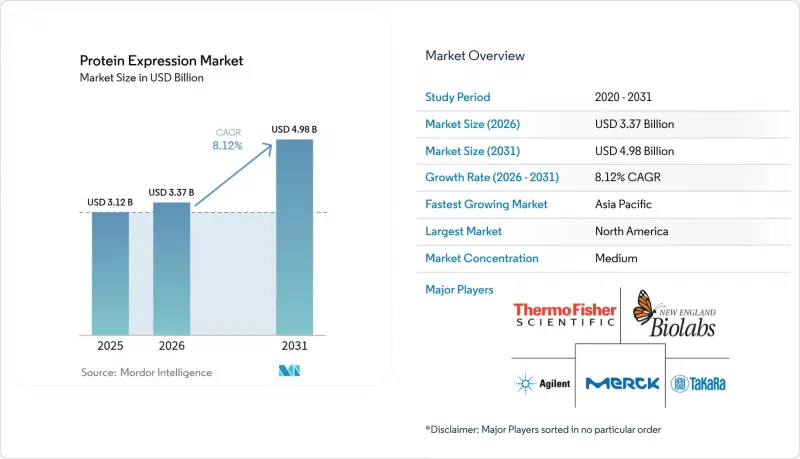
Mordor Intelligence에 의하면, 단백질 발현 시장 규모는 2025년 31억 2,000만 달러에서 2026년에는 33억 7,000만 달러에 이르고, 2026-2031년 CAGR 8.12%로 성장을 지속하여 2031년에는 49억 8,000만 달러에 달할 것으로 예측됩니다.
본 보고서는 제품 및 서비스(시약 및 키트(무세포 발현, 세균 발현 등), 서비스, 기타 제품), 용도(치료용, 산업용 효소 등), 최종 사용자(학술기관 및 연구기관, CRO/CDMO 등), 지역(북미, 유럽, 아시아태평양 등)별로 분류되어 있습니다. 시장 예측은 금액(달러) 기준으로 제시되어 있습니다.
세계 단백질 발현 시장 동향 및 인사이트
대형 제약사의 연구개발 투자 증가
업계 선두 기업들은 발현 인프라에 막대한 투자를 하고 있으며, 서모피셔 사이언티피크(Thermo Fisher Scientific)만 해도 생산 능력 확대와 차세대 공정 혁신을 목표로 미국 내 사업 확장에 20억 달러를 배정했습니다. 이러한 자금 흐름은 바이오의약품이 바이오의약품 매출의 70% 가까이를 차지하게 되었습니다는 사실과 일치하며, 신뢰성 높은 단백질 생산이 전략적으로 필수적임을 보여줍니다. 로슈가 포세이다 테라퓨틱스(Poseida Therapeutics)를 10억 달러에 인수하기로 합의한 사례에서 볼 수 있듯이, M&A 활동을 통해 귀중한 발현 노하우가 최상위 기업들에 집중되고 있습니다. 스타트업 기업들도 그 혜택을 누리고 있으며, 익스프레션 에디츠(Expression Edits)는 고신뢰도 단백질을 설계하기 위해 1,300만 달러를 조달하여 이 분야에 대한 폭넓은 신뢰를 보여주고 있습니다. 이러한 자금 조달의 급증은 새로운 시범 시설 및 상업시설의 건설로 이어지고 있으며, 단백질 발현 시장에서는 수주 잔고 증가와 기술 갱신 주기의 가속화가 나타나고 있습니다.
치료용 바이오의약품 파이프라인 확대
WuXi Biologics의 698개 진행 중인 프로그램(후기 임상시험 단계 프로젝트 51개 포함)은 첨단 발현 시스템에 의존하는 임상 개발이 전례 없는 규모로 진행되고 있음을 보여줍니다. 단일클론 항체의 FDA 승인 건수 증가와 Lonza공급 계약에 기반한 CASGEVY와 같은 유전자 편집 세포 치료제의 등장으로, 복잡한 번역 후 변형 요건을 충족할 수 있는 플랫폼에 대한 수요가 높아지고 있습니다. 항체-약물 복합체(ADC) 및 이중 특이성 포맷에는 고수율의 포유류 기반 시스템이 필요한 반면, 플라스미드 DNA를 상업적 규모로 공급할 수 있도록 미생물 플랫폼의 재설계가 진행되고 있습니다. 이러한 광범위한 치료 방식의 조합은 기존 생산 능력을 한계까지 끌어올리고, 수년에 걸친 아웃소싱 계약을 촉진함으로써 장비, 시약, 서비스에 걸쳐 안정적인 수익원을 창출하고 있습니다. 임상시험의 지리적 다각화는 아시아태평양 및 유럽 내 현지 생산 거점의 필요성을 강화하여 단백질 발현 시장을 더욱 확대되고 있습니다.
자본 집약적인 고처리량 시스템
주당 10종에서 288종에 이르는 재조합 단백질로의 규모 확대에는 액체 처리 로봇, 병렬 바이오리액터 및 통합형 정제 스키드가 필요하지만, 이러한 장비에는 막대한 초기 비용이 소요됩니다. ‘단백질 발현·정제 플랫폼’과 같은 플랫폼은 완전 자동화된 HEK 및 CHO 세포주에 의존하고 있어, 전용 시설, 지속적인 유지보수, 숙련된 운영자가 필요합니다. 다운스트림 공정에 드는 비용은 전체 개발 예산의 최대 60%를 차지하기도 하여, 중소기업의 자금 사정을 압박하고 저소득 지역에서의 도입을 지연시키고 있습니다. 저비용 DIY형 리액터는 일정한 해결책이 될 수 있지만, 처리량이나 규정 준수 대응 능력을 희생해야 합니다. 이러한 재정적 장벽으로 인해 공급업체의 다양성이 좁아지고, 자금이 제한된 지역의 단백질 발현 시장의 단기적인 성장이 억제되고 있습니다.
부문 분석
2025년, 시약 및 키트는 단백질 발현 시장에서 46.80%의 점유율을 차지하며, 벡터 구축부터 최종 정제에 이르는 모든 워크플로우에서 필수적인 투입물로서의 위상을 확고히 했습니다. 서비스 제공업체는 성장세를 보이고 있으며, 개발자들이 복잡하거나 대량 생산 프로그램을 독자적인 세포주와 GMP 시설을 보유한 파트너에게 아웃소싱함에 따라 이 부문은 2031년까지 연평균 성장률(CAGR) 12.07%를 나타낼 것으로 예측됩니다. KBI Biopharma는 2억 5,000만 달러 상당의 장기 포유류 세포 생산 계약을 수주했으며, 이는 외부 전문 지식에 대한 지속적인 수요를 보여줍니다.
시약 분야의 혁신도 여전히 활발합니다. Bioneer사의 ExiProgen 시스템과 최신 무세포 제제는 수율을 유지하면서 발현에 소요되는 시간을 단축하고 있습니다. 한편, 『BioProcess International』이 보도한 다중 모드 CDMO 계약을 통해 서비스 메뉴는 무세포 및 미생물을 활용한 옵션까지 확대되고 있으며, 바이오의약품의 복잡성이 높아짐에 따라 서비스 수익이 시약의 성장률을 상회할 것임을 시사하고 있습니다. 이러한 요인들이 복합적으로 작용하여 단백질 발현 시장은 더욱 심화되고 있으며, 소모품과 턴키형 아웃소싱에서 병행된 수익원이 창출되고 있습니다.
지역별 분석
북미는 탄탄한 제약 파이프라인, 벤처 캐피탈 네트워크, 그리고 지원적인 정책 환경을 배경으로 2025년 단백질 발현 시장에서 39.55%의 점유율을 차지했습니다. NSF(미국 국립과학재단)의 4,000만 달러 규모의 단백질 설계 프로그램과 ARPA-H(미국 국방고등연구계획국)의 백신 중심 이니셔티브는 장기적인 수요 전망을 명확하게 하고 있습니다. 써모피셔의 Olink 31억 달러 인수 등 기업 차원의 움직임은 분석 처리량을 강화하여 이 지역을 세계 단백질체학의 거점으로 자리매김하고 있습니다. 캐나다와 멕시코는 미국의 생산 능력을 보완하는 규모 확대 및 충전·마무리 서비스를 제공하고 있으며, 규제 절차의 간소화를 통해 국경을 초월한 임상시험이 촉진되고 있습니다.
아시아태평양은 규제 조화, 비용 경쟁력 있는 생산 능력, 그리고 생물학적 제제의 자급자족을 위한 정부의 인센티브에 힘입어 2031년까지 11.45%라는 지역별 최고 연평균 성장률(CAGR)을 달성할 것으로 예측됩니다. 중국은 투자를 주도하고 있으며, 그 증거로 WuXi Biologics의 비코로나 관련 매출이 37.7% 증가한 점과 재조합 단백질 및 플라스미드 DNA용으로 설계된 새로운 미생물 플랫폼을 들 수 있습니다. 일본과 한국은 최첨단 자동화 기술을 제공하는 반면, 인도와 호주는 비용 효율성이 뛰어나고 GMP 기준을 충족하는 인프라를 제공합니다. 각 지역의 정부는 식량 안보를 위해 정밀 발효 기업을 지원하고 있으며, 치료제 이외의 최종 시장도 확대되고 있습니다.
유럽에서는 확립된 제조 거점과 엄격하면서도 예측 가능한 규제 체계에 힘입어 한 자릿수 중반대의 꾸준한 성장이 나타나고 있습니다. 유전자 편집 세포 치료제 ‘CASGEVY’의 핵심 시설인 론자의 네덜란드 시설은 유럽이 새로운 치료법을 상업적 규모로 대응할 수 있는 역량을 갖추고 있음을 입증하고 있습니다. 독일, 영국, 프랑스는 계속해서 연구 개발의 중심지이며, 동유럽 국가들은 경쟁력 있는 인건비를 무기로 생산 능력을 확대되고 있습니다. 지속가능성에 대한 지속적인 중시가 식물 유래 및 정밀 발효 단백질 수요를 뒷받침하고 있으며, 정책 목표와 상업적 확산이 일치하고 있습니다.
기타 혜택:
- 엑셀 형식 시장 예측(ME) 시트
- 3개월간의 애널리스트 지원
자주 묻는 질문
목차
제1장 서론
제2장 조사 방법
제3장 주요 요약
제4장 시장 구도
제5장 시장 규모와 성장 예측
제6장 경쟁 구도
제7장 시장 기회와 향후 전망
LSH 26.09.10According to Mordor Intelligence, the protein expression market size is expected to grow from USD 3.12 billion in 2025 to USD 3.37 billion in 2026 and is forecast to reach USD 4.98 billion by 2031 at 8.12% CAGR over 2026-2031.
This report is Segmented by Product & Services (Reagents & Kits [Cell-Free Expression, Bacterial Expression, and More], Services, and Other Products), Application (Therapeutic, Industrial Enzymes, and More), End User (Academia & Research Institutes, Cros / CDMOs, and More), and Geography (North America, Europe, Asia-Pacific, and More). The Market Forecasts are Provided in Terms of Value (USD).
Global Protein Expression Market Trends and Insights
Rising R&D Investments by Large-Cap Pharma
Industry majors are investing heavily in expression infrastructure; Thermo Fisher Scientific alone allocated USD 2 billion for U.S. expansion that targets both capacity and next-generation process innovation. Such capital flows align with the fact that biologics now account for nearly 70% of biopharmaceutical sales, making dependable protein output a strategic imperative. M&A activity, illustrated by Roche's USD 1 billion agreement to acquire Poseida Therapeutics, concentrates valuable expression know-how within top tier firms. Start-ups also benefit; ExpressionEdits raised USD 13 million to engineer higher-fidelity proteins, signalling broad confidence in the space. As this funding surge translates into new pilot and commercial facilities, the protein expression market experiences stronger order books and faster technology refresh cycles.
Expansion of Therapeutic Biologics Pipeline
WuXi Biologics' 698 active programs, including 51 late-phase projects, highlight the unprecedented scale of clinical development that hinges on sophisticated expression systems. Growing FDA approvals of monoclonal antibodies and the advent of gene-edited cell therapies, such as CASGEVY under Lonza's supply agreement, intensify demand for platforms that can handle complex post-translational requirements. Antibody-drug conjugates and bispecific formats require high-yield mammalian systems, while microbial platforms are being re-engineered to deliver plasmid DNA at commercial scale. This broad modality mix stretches existing capacity and drives multiyear outsourcing contracts, fuelling consistent revenue streams across equipment, reagents, and services. Geographic diversification of clinical trials reinforces the need for local manufacturing footprints in Asia-Pacific and Europe, further widening the protein expression market.
Capital-Intensive High-Throughput Systems
Scaling from 10 to 288 recombinant proteins per week necessitates liquid-handling robots, parallel bioreactors, and integrated purification skids that carry heavy upfront costs. Platforms such as the Protein Expression and Purification Platform rely on fully automated HEK and CHO lines, requiring specialised facilities, ongoing maintenance, and skilled operators. Downstream processing outlays can consume up to 60% of total development budgets, stretching the finances of smaller firms and slowing adoption in lower-income regions. While low-cost DIY reactors offer limited relief, they sacrifice throughput and compliance readiness. This financial barrier narrows supplier diversity and tempers the near-term growth of the protein expression market in capital-constrained geographies.
Other drivers and restraints analyzed in the detailed report include:
- Government-Funded Multi-Omics Initiatives
- AI-Optimised Codon Usage Accelerating Yield
- Limited Post-Translational Modification Fidelity
For complete list of drivers and restraints, kindly check the Table Of Contents.
Segment Analysis
Reagents & Kits captured 46.80% protein expression market share in 2025, underlining their status as indispensable inputs across every workflow, from vector construction to final purification. Service providers are gaining momentum; the segment is forecast to post a 12.07% CAGR through 2031 as developers outsource complex or high-volume programs to partners with proprietary cell lines and GMP suites. KBI Biopharma secured USD 250 million worth of long-term mammalian production contracts that illustrate sustained demand for external expertise.
Innovation within reagents remains brisk: Bioneer's ExiProgen system and newer cell-free formulations cut expression timelines while preserving yields. Meanwhile, multi-modality CDMO deals, reported by BioProcess International, broaden service menus to include cell-free and microbial options, signalling that service revenues will outpace reagent growth as biologic complexity rises. Collectively, these forces deepen the protein expression market, creating parallel revenue streams from consumables and turnkey outsourcing.
Complete Report Scope:
- By Product & Services
- Reagents & Kits
- Cell-free Expression
- Bacterial Expression
- Yeast Expression
- Algal Expression
- Insect Expression
- Mammalian Expression
- Plant-based Expression
- Services
- Other Products
- Reagents & Kits
- By Application
- Therapeutic
- Industrial Enzymes
- Research & Discovery
- Agricultural Biotechnology
- By End-user
- Academia & Research Institutes
- Biotechnology & Pharmaceutical Companies
- CROs / CDMOs
- Geography
- North America
- United States
- Canada
- Mexico
- Europe
- Germany
- United Kingdom
- France
- Italy
- Spain
- Rest of Europe
- Asia-Pacific
- China
- Japan
- India
- South Korea
- Australia
- Rest of Asia-Pacific
- Middle East and Africa
- GCC
- South Africa
- Rest of Middle East and Africa
- South America
- Brazil
- Argentina
- Rest of South America
- North America
Geography Analysis
North America held 39.55% protein expression market share in 2025 on the strength of deep pharmaceutical pipelines, venture capital networks, and an enabling policy environment. The NSF's USD 40 million protein design program and ARPA-H's vaccine-centric initiatives provide long-term demand visibility. Company-level moves-including Thermo Fisher's USD 3.1 billion acquisition of Olink-bolster analytical throughput and are positioning the region as a global proteomics hub. Canada and Mexico contribute scale-up and fill-finish services that complement U.S. capacity, while streamlined regulatory pathways encourage cross-border trials.
Asia-Pacific is forecast to deliver the highest regional CAGR at 11.45% through 2031, propelled by harmonised regulations, cost-competitive capacity, and government incentives for biologics self-sufficiency. China leads investments, evidenced by WuXi Biologics' 37.7% non-COVID revenue growth and new microbial platforms designed for recombinant protein and plasmid DNA. Japan and South Korea supply cutting-edge automation, while India and Australia offer cost-effective, GMP-ready infrastructures. Regional governments back precision fermentation firms to address food security, expanding end-markets beyond therapeutics.
Europe shows steady mid-single-digit growth anchored by established manufacturing hubs and a rigorous yet predictable regulatory framework. Lonza's Netherlands facility, key to the CASGEVY gene-edited cell therapy, confirms Europe's ability to handle novel modalities at commercial scale. Germany, the United Kingdom, and France remain R&D powerhouses, and Eastern European nations add capacity with competitive labor costs. Ongoing emphasis on sustainability feeds demand for plant-based and precision-fermented proteins, aligning policy goals with commercial adoption.
- Thermo Fisher Scientific
- Merck
- Agilent Technologies
- Takara Bio
- QIAGEN
- Bio-Rad Laboratories
- New England Biolabs
- Promega
- GenScript Biotech
- Lonza Group
- Abcam
- Danaher
- Bio-Techne
- Sino Biological
- Bioneer Corp
- Oxford Expression Technologies
- Synthetic Genomics
- Charles River
- Evitria AG
Additional Benefits:
- The market estimate (ME) sheet in Excel format
- 3 months of analyst support
TABLE OF CONTENTS
1 Introduction
- 1.1 Study Assumptions & Market Definition
- 1.2 Scope of the Study
2 Research Methodology
3 Executive Summary
4 Market Landscape
- 4.1 Market Overview
- 4.2 Market Drivers
- 4.2.1 Rising R&D Investments By Large-Cap Pharma
- 4.2.2 Expansion Of Therapeutic Biologics Pipeline
- 4.2.3 Government-Funded Multi-Omics Initiatives
- 4.2.4 AI-Optimised Codon Usage Accelerating Yield
- 4.2.5 Continuous-Flow Micro-Bioreactors Adoption
- 4.3 Market Restraints
- 4.3.1 Capital-Intensive High-Throughput Systems
- 4.3.2 Limited Post-Translational Modification Fidelity
- 4.3.3 IP Clustering Around AI-Generated Protein Libraries
- 4.4 Porter's Five Forces
- 4.4.1 Threat of New Entrants
- 4.4.2 Bargaining Power of Buyers
- 4.4.3 Bargaining Power of Suppliers
- 4.4.4 Threat of Substitutes
- 4.4.5 Competitive Rivalry
5 Market Size & Growth Forecasts (Value, USD)
- 5.1 By Product & Services
- 5.1.1 Reagents & Kits
- 5.1.1.1 Cell-free Expression
- 5.1.1.2 Bacterial Expression
- 5.1.1.3 Yeast Expression
- 5.1.1.4 Algal Expression
- 5.1.1.5 Insect Expression
- 5.1.1.6 Mammalian Expression
- 5.1.1.7 Plant-based Expression
- 5.1.2 Services
- 5.1.3 Other Products
- 5.1.1 Reagents & Kits
- 5.2 By Application
- 5.2.1 Therapeutic
- 5.2.2 Industrial Enzymes
- 5.2.3 Research & Discovery
- 5.2.4 Agricultural Biotechnology
- 5.3 By End-user
- 5.3.1 Academia & Research Institutes
- 5.3.2 Biotechnology & Pharmaceutical Companies
- 5.3.3 CROs / CDMOs
- 5.4 Geography
- 5.4.1 North America
- 5.4.1.1 United States
- 5.4.1.2 Canada
- 5.4.1.3 Mexico
- 5.4.2 Europe
- 5.4.2.1 Germany
- 5.4.2.2 United Kingdom
- 5.4.2.3 France
- 5.4.2.4 Italy
- 5.4.2.5 Spain
- 5.4.2.6 Rest of Europe
- 5.4.3 Asia-Pacific
- 5.4.3.1 China
- 5.4.3.2 Japan
- 5.4.3.3 India
- 5.4.3.4 South Korea
- 5.4.3.5 Australia
- 5.4.3.6 Rest of Asia-Pacific
- 5.4.4 Middle East and Africa
- 5.4.4.1 GCC
- 5.4.4.2 South Africa
- 5.4.4.3 Rest of Middle East and Africa
- 5.4.5 South America
- 5.4.5.1 Brazil
- 5.4.5.2 Argentina
- 5.4.5.3 Rest of South America
- 5.4.1 North America
6 Competitive Landscape
- 6.1 Market Concentration
- 6.2 Market Share Analysis
- 6.3 Company Profiles (includes Global level Overview, Market level overview, Core Segments, Financials as available, Strategic Information, Market Rank/Share for key companies, Products & Services, and Recent Developments)
- 6.3.1 Thermo Fisher Scientific
- 6.3.2 Merck KGaA (Sigma-Aldrich)
- 6.3.3 Agilent Technologies
- 6.3.4 Takara Bio
- 6.3.5 Qiagen
- 6.3.6 Bio-Rad Laboratories
- 6.3.7 New England Biolabs
- 6.3.8 Promega
- 6.3.9 GenScript Biotech
- 6.3.10 Lonza Bioscience
- 6.3.11 Abcam Plc
- 6.3.12 Danaher (Cytiva)
- 6.3.13 Bio-Techne
- 6.3.14 Sino Biological
- 6.3.15 Bioneer Corp
- 6.3.16 Oxford Expression Technologies
- 6.3.17 Synthetic Genomics
- 6.3.18 Charles River Laboratories
- 6.3.19 Evitria AG
7 Market Opportunities & Future Outlook
- 7.1 White-space & Unmet-need Assessment