

|
시장보고서
상품코드
2122001
중동 및 아프리카의 판유리 : 시장 점유율 분석, 업계 동향과 통계, 성장 예측(2026-2031년)Middle-East And Africa Flat Glass - Market Share Analysis, Industry Trends & Statistics, Growth Forecasts (2026 - 2031) |
||||||
 Mordor Intelligence
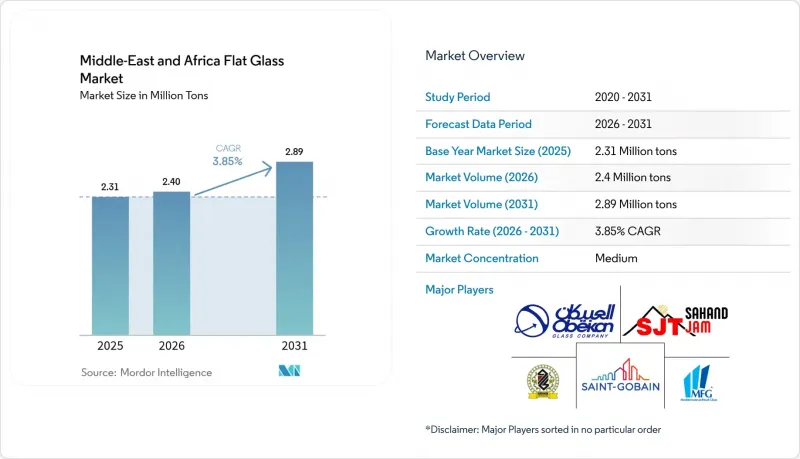
Mordor Intelligence에 따르면 중동 및 아프리카의 판유리 시장 규모는 2025년에 231만 톤으로 평가되어 예측 기간(2026-2031년)에 CAGR 3.85%로 확대하며, 2026년 240만 톤에서 2031년에는 289만 톤에 달할 것으로 추정되고 있습니다.
이 보고서는 제품 유형(어닐링 유리, 코팅 유리, 가공 유리, 거울 유리, 무늬 유리), 용도(건축·건설, 자동차, 태양광 유리, 기타 최종사용자 산업) 및 지역(사우디아라비아, 카타르,아랍에미리트, 나이지리아, 이집트, 남아프리카공화국 및 기타 중동 및 아프리카 국가)별로 분류되어 있습니다. 시장 전망은 톤 기준으로 제시되어 있습니다.
중동 및 아프리카 평판유리 시장의 동향 및 인사이트
건설 메가 프로젝트 파이프라인
걸프협력회의(GCC) 및 북아프리카 전역에 걸친 대규모 복합 용도 도시, 관광 지구, 산업 회랑은 유리 수요에 대해 수년에 걸친 전망을 확고히 하고 있습니다. 사우디아라비아의 ‘레드씨 프로젝트’만 해도 50개의 리조트 시설과 8,000개의 호텔 객실을 대상으로 한 61억 달러 규모의 계약을 수주했으며, 여기에는 3,700제곱미터의 곡면 파사드 유닛이 포함되어 있습니다. NEOM의 신달라 섬이나 이집트의 신행정수도 같은 동급의 플래그십 프로젝트에서는 미적 가치와 단열 성능을 모두 갖춘 접합 유리, Low-E 유리, 초대형 패널이 지정되어 있습니다. 특정 경제 특구 내의 높은 수주 밀도로 인해 생산자는 납품을 통합하고, 물류 비용을 절감하며, 특정 두께 목표에 맞춘 용해로 가동 계획을 최적화할 수 있게 됩니다. 이집트의 유리 생산 확대를 위한 국제금융공사(IFC)의 1억 달러 대출 패키지는 해당 지역의 건설 수주 잔고에 대한 금융 기관의 신뢰를 지원하고 있습니다. 이러한 일련의 메가 프로젝트는 수요 기반을 공고히 하고, 새로운 플로트 라인 및 코팅 챔버에 대한 지속적인 설비 투자를 정당화합니다.
확대되는 지역 자동차 생산 클러스터
사우디아라비아, 아랍에미리트(UAE), 이집트에서 자동차 제조에 대한 우대 조치가 자동차용 유리의 수요 구조를 변화시키고 있습니다. 리야드의 ‘자동차 투자 개발 프로그램’은 2030년까지 연간 30만-50만 대 생산을 목표로 하고 있으며, Ceer나 Lucid와 같은 신흥 전기자동차 제조사들은 파노라마 루프와 HUD 지원 전면 유리를 중시하고 있습니다. 이집트의 현지화 로드맵도 이 전략과 맥을 같이하며, 접합 유리 전면 유리, 강화유리 측면 창문, 그리고 일사 제어 필름이 부착된 선루프에 대한 수요를 촉진하고 있습니다. 각 OEM 업체들이 조립 공장 인근에서 부품을 조달하게 됨에 따라 지역 평판유리 가공 업체들은 기술 제휴를 강화하고, 온라인 품질 검사 시스템을 도입하며, 적시(JIT) 납품 모델을 전개할 기회를 얻고 있습니다. 배터리식 전기자동차 플랫폼에서 유리 면적이 확대됨에 따라 차량 1대당 유리 사용량이 더욱 증가할 것입니다. 이러한 자동차 관련 클러스터는 전반적으로 판매 채널의 다각화, 수입 의존도 감소, 그리고 전체 용해 능력의 가동률 향상을 가져오고 있습니다.
에너지 및 소다회 투입 가격의 변동
2024년, 남아프리카공화국에서는 소다회 시세가 톤당 20유로로 급등한 반면, 유럽의 벤치마크 가격은 175유로에서 195유로 사이에서 변동하여 배치 비용에 직접적인 영향을 미쳤습니다. 에너지 비용은 용해로 운영비의 15-20%를 차지하므로 천연가스 현물 가격의 급등은 플로트 유리 제조업체의 기여 이익률을 즉시 압박합니다. 터키와 중국산 소다회 수입에 대한 의존은 지역 공장을 운임 변동 및 환율 불일치라는 위험에 노출시키고 있습니다. 사우디아라비아는 이 지역 최초의 합성 소다회 복합 시설 건설을 발표했으나, 초기 생산량으로는 수입을 완전히 대체할 수 없어 단기적으로는 가격 리스크가 높은 수준을 유지할 전망입니다. 비용을 안정화하기 위해 각 제조사들은 유리 파편 재활용을 가속화하고, 고정 가격의 LNG 공급 계약을 체결하며, 태양광발전을 활용한 용융 기술의 시범 운영을 추진하고 있습니다.
부문별 분석
2025년, 중동 및 아프리카의 판유리 시장에서 어닐링 유리는 표준 파사드 및 보급형 자동차 창유리에서의 비용 우위 덕분에 79.75%의 시장 점유율을 유지했습니다. 그러나 강화유리, 접합유리, 코팅유리와 같은 가공유리는 기가 프로젝트의 설계 요건과 엄격한 에너지 규제의 지원을 받아 연평균 성장률(CAGR) 4.62%를 기록할 것으로 예측됩니다. NEOM의 신달라(Sindalah)와 같은 프로젝트에서는 높은 안전 하중 요건을 충족하는 다층 곡면 패널이 요구되고 있으며, 중동 및 아프리카의 가공 유리 시장 규모는 확대될 것으로 예상됩니다. 이에 따라 각 제조사들은 부가가치 창출을 도모하기 위해 오프라인형 하드코팅용 마그네트론 스퍼터링 장비와 디지털 인쇄 라인을 도입하고 있습니다. 생고뱅(Saint-Gobain)의 3억 유로 규모 이집트 공장 개보수나 오베이칸(Obeikan)의 5억 2,000만 사우디 리얄 규모의 제2 플로트 라인 건설과 같은 투자는 수익성이 높은 SKU로의 전략적 전환을 보여줍니다.
동시에, 거울 유리나 무늬가 들어간 유리 같은 틈새 시장이 고급 주거 타워나 유동 인구가 많은 소매 시설에서 주목을 받고 있습니다. 이러한 장소에서는 텍스처 가공이나 사생활 보호 기능이 프리미엄 가격의 요인이 되고 있습니다. 롤러 웨이브 제어 및 광학 왜곡 측정 기술의 지속적인 발전으로 현지 가공 업체들은 유럽의 품질 기준에 필적하는 제품을 생산할 수 있게 되었으며, 연마된 가장자리가 있는 특수 시트 수입에 대한 기존 의존도가 낮아지고 있습니다. 건축적 선호도가 초대형 패널로 기울어짐에 따라 최대 12미터 길이의 유리를 처리할 수 있도록 지역 어닐링로 구성이 확장되고 있으며, 프로젝트 일정을 지원하는 데 있으며, 국내 용융 능력의 중요성이 더욱 커지고 있습니다. 전반적으로 제품 구성의 변화는 범용 투명 플로트 유리에서 코팅, 중간막 또는 전도성 트레이스를 통합한 차별화된 제품으로의 점진적인 전환을 보여줍니다.
기타 혜택:
- 엑셀 형식의 시장 예측(ME) 시트
- 3개월간의 애널리스트 지원
자주 묻는 질문
목차
제1장 서론
제2장 조사 방법
제3장 개요
제4장 시장 구도
제5장 시장 규모와 성장 예측
제6장 경쟁 구도
제7장 시장 기회와 향후 전망
KSA 26.09.03According to Mordor Intelligence, the Middle East and Africa Flat Glass Market size was valued at 2.31 million tons in 2025 and estimated to grow from 2.4 million tons in 2026 to reach 2.89 million tons by 2031, at a CAGR of 3.85% during the forecast period (2026-2031).
This report is Segmented by Product Type (Annealed Glass, Coater Glass, Processed Glass, Mirror Glass, and Patterned Glass), Application (Building and Construction, Automotive, Solar Glass, and Other End-User Industries), and Geography (Saudi Arabia, Qatar, UAE, Nigeria, Egypt, South Africa, and Rest of Middle East and Africa). The Market Forecasts are Provided in Terms of Volume (Tons).
Middle-East And Africa Flat Glass Market Trends and Insights
Construction Mega-Projects Pipeline
Massive mixed-use cities, tourism enclaves, and industrial corridors across the Gulf Cooperation Council and North Africa are locking in multi-year visibility for glass offtake. Saudi Arabia's Red Sea Project alone secured USD 6.1 billion in contracts covering 50 resorts and 8,000 hotel rooms, including 3,700 square meters of curved facade units. Comparable flagship sites such as NEOM's Sindalah Island and Egypt's New Administrative Capital are specifying laminated, low-E, and oversized panels that deliver both aesthetic value and thermal performance. High order density within defined economic zones allows producers to consolidate deliveries, cut logistics costs, and optimize furnace campaigns for specific thickness targets. The International Finance Corporation's USD 100 million debt package for Egyptian glass expansion underscores financial institutions' confidence in the region's construction backlog. Taken together, these mega-projects anchor baseline demand and justify continued capital expenditure on new float lines and coating chambers.
Expanding Regional Automotive Production Clusters
Vehicle-manufacturing incentives in Saudi Arabia, the United Arab Emirates, and Egypt are reshaping the demand for automotive glass. Riyadh's Automotive Investment Development Program aims for 300,000-500,000 units per year by 2030, with electric-vehicle newcomers such as Ceer and Lucid emphasizing panoramic roofs and HUD-ready windshields. Egypt's localization roadmap echoes this strategy, catalyzing requirements for laminated windscreens, tempered sidelites, and sunroofs with solar-control films. As OEMs source closer to assembly plants, regional flat-glass converters gain the opportunity to deepen technical partnerships, introduce online quality inspection systems, and roll out just-in-time delivery models. Higher glazing surface area in battery-electric platforms further boosts tonnage per vehicle. Collectively, these automotive clusters diversify sales channels, reduce reliance on imports, and increase overall melting capacity utilization.
Volatile Energy and Soda-Ash Input Prices
Soda-ash quotations jumped EUR 20 per tonne in South Africa during 2024, while European benchmark offers fluctuated between EUR 175 and EUR 195, directly influencing batch costs. Because energy outlays represent 15-20% of furnace operating expense, spikes in spot natural gas immediately compress contribution margins for float producers. Dependence on imported Turkish or Chinese soda ash further exposes regional plants to fluctuations in freight rates and currency mismatches. Although Saudi Arabia has announced the region's first synthetic soda-ash complex, initial volumes will not fully displace imports, leaving price risk elevated in the near term. To stabilize costs, manufacturers are accelerating cullet recycling, signing fixed-price LNG supply contracts, and piloting solar-assisted melting technologies.
Other drivers and restraints analyzed in the detailed report include:
- Utility-Scale Solar and BIPV Build-Outs
- Green-Building Mandates for Low-E / Smart Glazing
- Low-Priced Asian Imports Squeezing Local Margins
For complete list of drivers and restraints, kindly check the Table Of Contents.
Segment Analysis
Annealed glass retained 79.75% of the Middle East and Africa flat glass market share in 2025 due to its cost advantage in standard facades and entry-level automotive windows. However, processed variants-tempered, laminated, and coated-are projected to log a 4.62% CAGR, fueled by design mandates in giga-projects and stringent energy codes. The Middle East and Africa flat glass market size for processed grades is expected to expand as projects, such as NEOM's Sindalah, require multi-layer curved panels that meet high safety loads. Producers are therefore installing offline hard-coat magnetron sputtering units and digital printing lines to capture incremental value. Investments like Saint-Gobain's EUR 300 million Egypt upgrade and Obeikan's SAR 520 million second float line mark a strategic pivot toward higher-margin SKUs.
Simultaneously, mirror and patterned glass niches are gaining traction in luxury residential towers and high-traffic retail centers, where textured finishes and privacy features command premium prices. Continuous advances in roller-wave control and optical distortion measurement allow local processors to match European quality benchmarks, reducing the historic reliance on imports of polished-edge specialty sheets. As architectural preferences favor oversized panels, regional annealing lehr configurations are being lengthened to handle up to 12-meter glass, reinforcing the relevance of domestic melt capacity in supporting project timelines. Overall, the product-mix shift signals a gradual migration away from commoditized clear float to differentiated offerings embedded with coatings, interlayers, or conductive traces.
Complete Report Scope:
- By Product Type
- Annealed Glass
- Coater Glass
- Processed Glass
- Mirror Glass
- Patterned Glass
- By Application
- Building and Construction
- Automotive
- Solar Glass
- Other End-user Industries
- By Geography
- Saudi Arabia
- Qatar
- United Arab Emirates
- Nigeria
- Egypt
- South Africa
- Rest of Middle East and Africa
List of Companies Covered in this Report:
- Ardakan Glass Corporation
- Emirates Float Glass LLC
- Guardian Industries
- Kaveh Glass Industrial Group
- Mediterranean Float Glass (MFG SPA)
- Obeikan Glass Company
- Sahand Jam Tabriz Company
- Saint-Gobain
- Sphinx Glass
- The National Company for Glass Industries (Zoujaj)
- United Float Glass
- Qazvin Glass Co.
- Azar Mina Jam Glass Industries
- SCHOTT AG
Additional Benefits:
- The market estimate (ME) sheet in Excel format
- 3 months of analyst support
TABLE OF CONTENTS
1 Introduction
- 1.1 Study Assumptions & Market Definition
- 1.2 Scope of the Study
2 Research Methodology
3 Executive Summary
4 Market Landscape
- 4.1 Market Overview
- 4.2 Market Drivers
- 4.2.1 Construction mega-projects pipeline (GCC and North Africa)
- 4.2.2 Expanding regional automotive production clusters
- 4.2.3 Utility-scale solar and BIPV build-outs
- 4.2.4 Green-building mandates for low-E / smart glazing
- 4.2.5 Signature tourism and giga-projects driving specialty curved glass
- 4.3 Market Restraints
- 4.3.1 Volatile energy and soda-ash input prices
- 4.3.2 Low-priced Asian imports squeezing local margins
- 4.3.3 Scarce cullet-recycling infrastructure raises costs
- 4.4 Value Chain Analysis
- 4.5 Regulatory Landscape
- 4.6 Technological Outlook
- 4.7 Porter's Five Forces
- 4.7.1 Bargaining Power of Suppliers
- 4.7.2 Bargaining Power of Buyers
- 4.7.3 Threat of New Entrants
- 4.7.4 Threat of Substitutes
- 4.7.5 Degree of Competition
5 Market Size & Growth Forecasts (Volume)
- 5.1 By Product Type
- 5.1.1 Annealed Glass
- 5.1.2 Coater Glass
- 5.1.3 Processed Glass
- 5.1.4 Mirror Glass
- 5.1.5 Patterned Glass
- 5.2 By Application
- 5.2.1 Building and Construction
- 5.2.2 Automotive
- 5.2.3 Solar Glass
- 5.2.4 Other End-user Industries
- 5.3 By Geography
- 5.3.1 Saudi Arabia
- 5.3.2 Qatar
- 5.3.3 United Arab Emirates
- 5.3.4 Nigeria
- 5.3.5 Egypt
- 5.3.6 South Africa
- 5.3.7 Rest of Middle East and Africa
6 Competitive Landscape
- 6.1 Market Concentration
- 6.2 Strategic Moves
- 6.3 Market Share/Ranking Analysis
- 6.4 Company Profiles {(includes Global level Overview, Market level overview, Core Segments, Financials as available, Strategic Information, Market Rank/Share for key companies, Products & Services, and Recent Developments)}
- 6.4.1 Ardakan Glass Corporation
- 6.4.2 Emirates Float Glass LLC
- 6.4.3 Guardian Industries
- 6.4.4 Kaveh Glass Industrial Group
- 6.4.5 Mediterranean Float Glass (MFG SPA)
- 6.4.6 Obeikan Glass Company
- 6.4.7 Sahand Jam Tabriz Company
- 6.4.8 Saint-Gobain
- 6.4.9 Sphinx Glass
- 6.4.10 The National Company for Glass Industries (Zoujaj)
- 6.4.11 United Float Glass
- 6.4.12 Qazvin Glass Co.
- 6.4.13 Azar Mina Jam Glass Industries
- 6.4.14 SCHOTT AG
7 Market Opportunities & Future Outlook
- 7.1 White-space and Unmet-Need Assessment


