|
시장보고서
상품코드
2122024
자동차 브레이크 시스템 : 시장 점유율 분석, 업계 동향과 통계, 성장 예측(2026-2031년)Automotive Brake Systems - Market Share Analysis, Industry Trends & Statistics, Growth Forecasts (2026 - 2031) |
||||||
 Mordor Intelligence
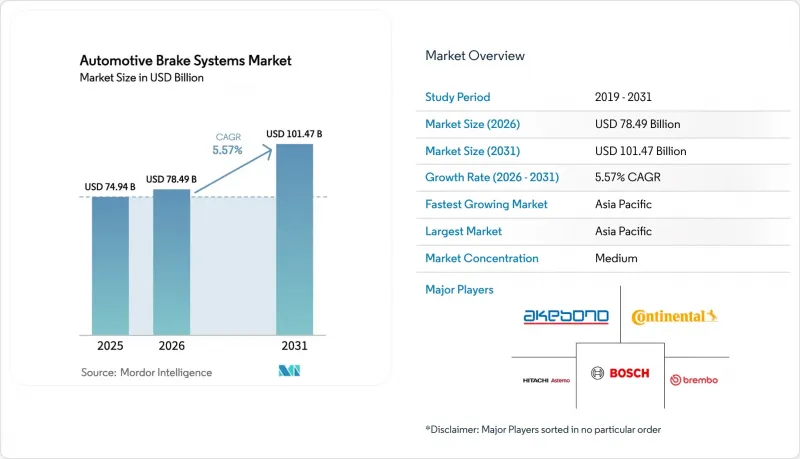
Mordor Intelligence에 의하면, 자동차용 브레이크 시스템 시장 규모는 2025년 749억 4,000만 달러에서 2026년에는 784억 9,000만 달러, 2031년까지 1,014억 7,000만 달러에 이를 것으로 예상되며, 2026-2031년 CAGR 5.57%를 기록할 전망입니다.
본 보고서는 차종(승용차 등), 제품 유형(디스크 브레이크 등), 기술(안티록 브레이크 시스템(ABS) 등),작동 방식(유압식 등), 부품(브레이크 패드 및 슈 등), 패드 재질(유기계 등), 판매 채널, 구동 방식 및 지역별로 분류되어 있습니다. 시장 예측은 금액(달러) 및 수량(단위)으로 제시되어 있습니다.
전 세계 자동차용 브레이크 시스템 시장 동향 및 인사이트
급속한 전동화가 회생 제동 대응 브레이크 하드웨어를 견인
BEV(배터리 전기자동차) 생산 확대에 따라, 자동차 브레이크 시스템 시장공급업체들은 에너지 회수를 극대화하는 블렌디드 브레이크를 구현하기 위해 캘리퍼, 로터 및 소프트웨어의 재설계를 요구받고 있습니다. 폴스타(Polestar)와 테슬라(Tesla)는 도시 주행 주기에서 패드 마모를 줄이고 정비 주기를 10만 킬로미터 이상으로 연장하는 ‘원 페달 모드’를 실증하고 있습니다. 이러한 요구 사항에 따라 1차 공급업체들은 배터리 상태 데이터를 실시간으로 전송할 수 있는 통합 제어 장치 개발을 추진하고 있습니다. 중국의 GB 21670-2025는 승용차 브레이크 시스템 요건을 개정하는 것으로, NEV(신에너지차)의 회생 제동/원페달 모드에 대한 캘리브레이션 전략에 영향을 미칠 것으로 예측됩니다. OEM과 공급업체 간의 공동 엔지니어링 프로그램이 기존의 ‘블랙박스’형 조달 모델을 대체하며, 소프트웨어 소유권 확보와 사이버 보안 기준 준수를 보장하고 있습니다.
전 세계 BEV 생산이 가속화됨에 따라, 저분진·무구리 마찰재가 필요해지고 있습니다.
캘리포니아주의 ‘더 안전한 소비자 제품 규정’ 및 이와 유사한 워싱턴주 법률에 따르면, 2025년 이후 브레이크 패드의 구리 함량을 중량비 0.5% 이하로 제한하게 되어, 세라믹 섬유나 아라미드 펄프로의 전환이 시급해지고 있습니다. 보쉬는 제안된 Euro 7의 미세먼지 배출 기준을 충족하는 ECE R90 인증을 받은 저금속계 브레이크 패드를 출시했습니다. 한편, 아케보노 브레이크 공업의 ‘ProACT’ 시리즈는 세미메탈릭 브레이크 패드와 비교해 분진을 60% 이상 줄일 수 있다고 홍보하고 있습니다. 유럽연합(EU)의 ‘유로 7’ 프레임워크 안에서는 브레이크 먼지의 상한치를 7mg/km로 설정하여 인증 시험이 더욱 엄격해졌습니다. 회생 제동으로 인해 접촉 빈도가 감소함에 따라 잔류하는 먼지가 더욱 두드러지게 나타나, 브랜드 이미지와 대기 질을 지키는 ‘클린 브레이크’의 화학 조성에 대한 각 OEM 업체들의 선호도가 더욱 높아지고 있습니다.
회생 제동으로 인한 마모 감소가 애프터마켓 브레이크 패드 매출을 압박
자동차 브레이크 시스템 시장에서 정비 데이터에 따르면, BEV(배터리식 전기차)는 동급 ICE(내연기관) 모델에 비해 브레이크 패드 교체 주기를 2배로 늘릴 수 있기 때문에 독립 정비 공장의 수익이 감소하는 동시에 유통업체 간의 통합이 진행되고 있습니다. 플릿 운영 사업자들은 총 소유 비용(TCO)의 감소를 환영하고 있지만, 패드의 대량 판매에 의존하고 있는 공급업체들은 판매 대수 감소에 직면해 있으며, 가치를 회복하기 위해 프리미엄 복합 소재 및 내장형 센서 서비스로의 전환을 강요받고 있습니다.
부문 분석
디스크 브레이크는 2025년 시장 규모의 75.21%를 차지하며, 입증된 열 관리 성능, 일관된 페달 감각, 신속한 제동력 조정을 통해 자동차 브레이크 시스템 시장의 기반을 지탱하고 있습니다. 광범위한 공급망과 ABS 및 ESC와의 하위 호환성 덕분에, 혼합 제동 전략이 보급되는 가운데서도 그 위상을 계속 유지하고 있습니다. 드럼 브레이크는 엔트리급 승용차나 소형 밴의 후륜 축에서 여전히 비용 효율성이 뛰어나지만, 안정성 제어 장치의 탑재가 의무화됨에 따라 그 중요성은 점차 낮아지고 있습니다. 회생 모듈은 절대적인 규모로는 작지만, 각 OEM 업체들이 BEV의 주행 거리를 연장하기 위해 1와트 단위의 에너지 회수를 추구하고 있기 때문에 연평균 성장률(CAGR) 7.77%로 확대될 것으로 예측됩니다. 브렘보(Brembo)사의 경량 카본 세라믹 디스크는 기존 마찰재와 전동화 요건의 융합을 구현하고 있습니다.
콘티넨탈의 모듈식 회생 컨트롤러는 소프트웨어 중심 아키텍처가 Tier 1 공급업체 전체의 제품 로드맵을 어떻게 재정의하고 있는지를 보여줍니다. 이 컨트롤러는 배터리의 충전 상태를 실시간으로 전달하도록 설계되어, 모터 토크와 유압의 원활한 전환을 가능하게 합니다. 이러한 통합을 통해 세계 플랫폼에서의 검증 주기가 단축되고, 캘리브레이션 비용이 절감됩니다. 이와 동시에, 전동식 주차 브레이크는 차량 내부 공간을 확보하고 자동 주차 기능을 용이하게 함으로써 보급이 확대되고 있습니다. 이러한 발전들이 결합되어, 순수 유압식 하드웨어에서 하이브리드 에너지 회생 토폴로지로의 장기적인 전환이 가속화되고 있습니다.
잠김 방지 브레이크 시스템(ABS)은 2025년 매출의 45.65%를 차지하며, 안정성 성능의 기반이 되고 있으며, 대부분의 주요 시장에서 기존의 규제 요건을 충족하고 있습니다. 그러나 그 예측 연평균 성장률(CAGR)은 자동 긴급 제동 및 차선 유지 보조와 긴밀한 규제 연계의 혜택을 받고 있는 전자식 안정성 제어(ESC)보다 낮습니다. ESC는 휠 속도 센서와 요율 센서를 공유함으로써, Tier 1 제조업체가 단일 도메인 컨트롤러 내에 여러 기능을 통합하고 배선 중량을 줄일 수 있게 해줍니다. 이미 양산 시작이 예정된 보쉬의 ‘Vehicle Motion Management’는 ESC, 토크 벡터링,어댑티브 크루즈 컨트롤을 통합하여 제동 거리를 8% 이상 단축합니다. 이러한 기능 통합 추세는 소프트웨어의 가치를 높이는 동시에 하드웨어의 비용 곡선을 평탄화시킵니다.
트랙션 컨트롤과 전자 제어 제동력 분배 시스템은 동일한 반도체 칩에 통합되어 있어, 이를 통해 부품 비용 증가분을 더욱 억제하고 있습니다. 유로 NCAP의 2025년판 5성급 평가 기준 및 미국의 AEB 규정에 따르면, 모두 고속 충돌 회피 인증의 필수 요건으로 ESC가 제시되어 있으며, 이에 따라 엔트리 레벨 등급으로의 보급이 가속화되고 있습니다. ZF의 cubiX 플랫폼은 ESC를 전동 파워 스티어링 및 액티브 서스펜션과 연동하여, 운전자가 반응하기 전에 차량을 안정화시키는 예측형 휠 토크 제어를 가능하게 합니다. 신흥 경제국에서는 인도의 AIS-145 규제로 인해 현지 모듈 생산이 촉진되고, 수입 관세가 인하되며, 공급이 확보되었습니다. 이러한 요인들이 맞물려 ESC는 소프트웨어 정의 섀시 제어의 새로운 기준으로 자리매김하고 있습니다.
유압식 액추에이터는 수십 년에 걸친 기술적 개선, 저렴한 단가, 그리고 지역 조립 공장에 널리 보급된 금형 설비의 지원에 힘입어 2025년 시장 규모의 84.02%를 차지하고 있습니다. 그러나 그 연평균 성장률(CAGR)은 BEV(배터리 전기자동차) 및 자율 주행 프로그램의 성숙에 따라 9.69%의 연평균 복합 성장률(CAGR)을 기록하고 있는 전자식 및 Brake-by-wire 방식의 솔루션에는 미치지 못하는 상황입니다. 공압 시스템은 대형 트럭에 여전히 필수적이지만, 유럽 내 디젤차 등록 대수 감소와 소음 규제 강화라는 역풍에 직면해 있습니다. Brake-by-wire는 진공 부스터를 불필요하게 만들고, 페달 스트로크를 단축하는 동시에, ADAS의 충돌 회피 조작에 있어 중요한 사양인 100밀리초 미만의 응답 시간을 실현합니다. 콘티넨탈의 유체를 사용하지 않는 ‘MK C2’ 시스템은 질량을 25% 줄이고, 전기 SUV의 열 관리를 단순화하는 드라이 캘리퍼로의 전환을 상징합니다.
ZF가 수주한 500만 대의 전기 기계식 브레이크 시스템은 고급차 브랜드에 그치지 않고 일반 차량 시장에서도 널리 수용되고 있음을 보여줍니다. 넥스테어의 스티어 바이 와이어 및 Brake-by-wire 프로토타입은 독립적인 휠 토크 제어가 자동 주차, 차선 중앙 유지, 저속 주행 시의 조작성을 얼마나 향상시키는지 보여줍니다. ISO 26262 기능 안전 규격에서는 중복된 작동 경로가 의무화되어 있어, 이로 인해 설계 요건이 엄격해졌으며, 충분한 검증 예산을 보유한 Tier 1 공급업체가 유리한 입장에 서 있습니다. 따라서 각 공급업체는 반도체 제조업체와 제휴하여 지연 시간을 줄이는 안전 인증을 받은 마이크로컨트롤러를 공동 설계하고 있습니다. 비용 격차가 좁혀짐에 따라 OEM 각사는 유압 라인으로는 결코 실현할 수 없는 ‘무선(OTA) 업그레이드 기능’에서 가치를 발견하고 있습니다.
지역별 분석
아시아태평양은 2025년 전 세계 매출의 42.41%를 차지할 것으로 예상되며, 2031년까지 연평균 성장률(CAGR) 6.88%로 성장할 것으로 전망되는데, 이는 모든 지역 중 가장 높은 성장률입니다. 중국의 ‘듀얼 크레딧’ 정책은 신에너지차 생산을 장려하고 있으며, BYD, 지리(Geely), NIO는 모든 신규 플랫폼에 회생 제동 기능을 지원하는 브레이크 모듈을 채택하고 있습니다. 인도의 생산 연계형 인센티브에 따라 보쉬와 ZF가 현지에서 ESC 및 전자식 주차 브레이크 공장을 설립하고 있으며, 이를 통해 수입 의존도가 낮아지고 리드 타임이 단축되고 있습니다. 일본의 아케보노(Akebono), 닛신(Nissin), 히타치 아스테모(Hitachi Astemo)는 정밀 제조 기술을 활용하여 국내 생산 대수가 정체된 상황에서도 프리미엄 시장 점유율을 유지하고 있습니다.
북미에서는 ABS 보급률이 성숙 단계에 도달했으나, 2029년까지 규격에 부합하는 하드웨어 탑재를 의무화하는 미국의 자동 긴급 제동 규제로 인해 시장이 활기를 띠고 있습니다. ZF가 디트로이트의 자동차 제조업체로부터 500만 개의 전기 기계식 캘리퍼를 수주한 것은 소프트웨어 정의 브레이크로의 급속한 전환을 뒷받침합니다. 캐나다의 제로 배출 판매 의무화로 인해 구리가 포함되지 않은 브레이크 패드와 회생 제어 소프트웨어에 대한 수요가 가속화되고 있는 반면, 멕시코의 비용 우위 덕분에 주철 로터의 기계 가공 분야에서 니어쇼어링이 진행되고 있습니다. 애프터마켓 매출은 전자상거래의 혜택을 받고 있지만, BEV에서 브레이크 패드의 수명이 연장되면서 판매 주기가 완만해지고 있어, 유통업체들은 프리미엄 키트나 부가가치가 높은 진단 서비스로 전환하고 있습니다.
유럽에서는 디젤 밴 생산 감소와 강철 로터 공급 부족이 ADAS 탑재율의 점진적인 증가를 상쇄하고 있어 성장률이 비교적 완만합니다. 그럼에도 불구하고, 유로 NCAP의 2025년 평가와 도입이 예정된 유로 7의 분진 배출 규제로 인해 Brake-by-wire, 세라믹 패드, 그리고 미세 입자 포집 캘리퍼에 대한 투자는 유지되고 있습니다. 독일에는 콘티넨탈, 보쉬, ZF가 거점을 두고 있으며, 이 3사는 공동으로 ISO 26262를 준수하면서 경량화를 실현하는 무유체 액추에이터의 연구 개발에 주력하고 있습니다. 아르셀로미탈(ArcelorMittal)이 생산량을 스페인으로 이전함에 따라 공급망의 긴장은 다소 완화되었으나, 고품질 강판공급은 여전히 부족하여 공급업체들은 알루미늄 및 복합재 로터로 전환해야 하는 상황에 놓여 있습니다. 남유럽의 항만에서는 물류 트럭에도 적용될 가능성이 있는 부두 전원 공급 요건을 검토하고 있으며, 이는 향후 회생 제동을 지원하는 상용차용 브레이크에 대한 수요가 발생할 것임을 시사합니다.
기타 혜택:
- 엑셀 형식 시장 예측(ME) 시트
- 3개월간의 애널리스트 지원
자주 묻는 질문
목차
제1장 서론
제2장 조사 방법
제3장 주요 요약
제4장 시장 구도
제5장 시장 규모와 성장 예측
제6장 경쟁 구도
제7장 시장 기회와 향후 전망
LSH 26.09.10According to Mordor Intelligence, the automotive brake system market size is expected to increase from USD 74.94 billion in 2025 to USD 78.49 billion in 2026 and reach USD 101.47 billion by 2031, growing at a CAGR of 5.57% over 2026-2031.
This report is Segmented by Vehicle Type (Passenger Cars and More), Product Type (Disc Brakes and More), Technology (Anti-Lock Braking System (ABS) and More), Actuation Mechanism (Hydraulic and More), Component (Brake Pads and Shoes and More), Pad Material (Organic and More), Sales Channel, Propulsion, and Geography. The Market Forecasts are Provided in Terms of Value (USD) and Volume (Units).
Global Automotive Brake Systems Market Trends and Insights
Rapid Electrification Driving Regenerative-Compatible Brake Hardware
Growing BEV production is compelling suppliers in the Automotive Brake System Market to redesign calipers, rotors, and software for blended braking that maximizes energy recovery. Polestar and Tesla have demonstrated one-pedal modes that cut pad contact in urban duty cycles, extending service intervals beyond 100,000 kilometers. These requirements push tier ones toward integrated control units that can communicate battery-state data in real-time. China's GB 21670-2025 updates passenger-car braking system requirements and is expected to influence regenerative-braking/one-pedal calibration strategies in NEVs. Joint engineering programs between OEMs and suppliers are replacing the traditional black-box sourcing model, ensuring software ownership and compliance with cybersecurity standards.
Accelerating Global BEV Production Necessitating Low-Dust, Copper-Free Friction Materials
California's Safer Consumer Products rule and equivalent Washington legislation cap pad copper content at 0.5% by weight beginning in 2025, forcing a shift toward ceramic fibers and aramid pulp. Bosch rolled out an ECE R90-certified low-metallic pad that meets proposed Euro 7 particulate limits, while Akebono's ProACT line claims over 60% dust reduction relative to semi-metallic analogs. The European Union's draft Euro 7 framework adds a 7 mg/km brake-dust ceiling, further tightening qualification tests. Because regenerative braking reduces contact frequency, any residual dust becomes more visible, intensifying OEMs' preference for clean-brake chemistries that protect brand image and air quality.
Reduced Wear in Regenerative Braking Curtailing Aftermarket Pad Revenues
In the Automotive Brake System Market, Service data indicates that BEVs can double the pad-replacement interval compared with comparable ICE models, trimming independent workshop revenue and encouraging consolidation among distributors. Fleet operators welcome the lower total cost of ownership, yet suppliers reliant on high-volume pad sales face declining unit sales and must pivot toward premium composites or embedded sensor services to restore value capture.
Other drivers and restraints analyzed in the detailed report include:
- Heightened ADAS Penetration Raising Demand for Brake-by-Wire Architectures
- Stricter U.S. FMVSS 126 and UNECE R140 Mandates Boosting ABS/ESC Installations
- Volatility in Rare-Earth Prices Inflating Electronic Brake Actuator Costs
For complete list of drivers and restraints, kindly check the Table Of Contents.
Segment Analysis
Disc brakes captured 75.21% of the 2025 market size, underpinning the automotive brake system market through proven heat management, consistent pedal feel, and rapid pressure modulation. Their extensive supply networks and backward compatibility with ABS and ESC help defend their position even as blended-braking strategies proliferate. Drum brakes remain cost-effective for rear axles in entry-level cars and light vans, yet mandatory stability control erodes their relevance. Regenerative modules, although smaller in absolute terms, are projected to advance at a 7.77% CAGR as OEMs seek every watt of energy recovery to extend the driving range of BEVs. Lightweight carbon-ceramic discs from Brembo illustrate convergence between traditional friction materials and electrification requirements.
Continental's modular regenerative controller showcases how software-centric architectures are redefining product roadmaps across tier-one suppliers. The controller is designed to communicate the battery's state of charge in real-time, enabling seamless transitions between motor torque and hydraulic pressure. Such integration shortens validation cycles and lowers calibration costs for global platforms. In parallel, electric parking brakes are gaining popularity by freeing cabin space and facilitating automated parking functions. Together, these developments reinforce the long-term pivot from purely hydraulic hardware toward hybrid energy-recovery topologies.
Anti-lock braking systems accounted for 45.65% of 2025 revenue, anchoring stability performance and satisfying legacy mandates across most major markets. Nonetheless, their forecasted CAGR trails electronic stability control, which benefits from a tight regulatory link with automatic emergency braking and lane-keeping assist. ESC leverages shared wheel-speed and yaw-rate sensors, allowing tier-one manufacturers to package multiple functions inside a single domain controller and reduce wiring weight. Bosch's Vehicle Motion Management, already scheduled for a volume launch, unifies ESC, torque vectoring, and adaptive cruise control to reduce stopping distance by over 8%. This bundling trend elevates software value while flattening hardware cost curves.
Traction control and electronic brake-force distribution are integrated into the same silicon, further reducing incremental component costs. Euro NCAP's 2025 five-star protocol and the U.S. AEB rule both list ESC as a prerequisite for high-speed collision-avoidance certification, thereby accelerating its penetration in entry-level trims. ZF's cubiX platform links the ESC to electric power steering and active suspension, enabling predictive wheel-torque commands that stabilize the vehicle before the driver reacts. In emerging economies, India's AIS-145 mandate has spurred local module production, trimmed import duties, and secured supply. Collectively, these triggers position ESC as the new baseline for software-defined chassis control.
Hydraulic actuation commands 84.02% of the 2025 market size, supported by decades of engineering refinement, low unit cost, and pervasive tooling across regional assembly plants. Even so, its CAGR lags behind electromagnetic and brake-by-wire solutions, which post a 9.69% CAGR as BEV and autonomous programs mature. Pneumatic systems remain essential for heavy trucks but face headwinds from Europe's declining diesel registrations and tightening noise regulations. Brake-by-wire eliminates the vacuum booster, shortens pedal travel, and enables sub-100-millisecond response, a key specification for ADAS collision-avoidance maneuvers. Continental's fluid-free MK C2 system highlights the shift toward dry calipers that reduce mass by 25% and simplify thermal management in electric SUVs.
ZF's record order for 5 million electro-mechanical units demonstrates mainstream acceptance beyond luxury nameplates. Nexteer's steer-by-wire and brake-by-wire prototype shows how independent wheel-torque control can enhance automated parking, lane centering, and low-speed maneuvering. ISO 26262 functional-safety rules enforce redundant actuation paths, raising the engineering bar and favoring tier-ones with deep validation budgets. Suppliers are therefore partnering with semiconductor houses to co-design safety-certified microcontrollers that lower latency. As the cost differential narrows, OEMs see value in over-the-air upgradability that hydraulic lines can never match.
Complete Report Scope:
- By Product Type
- Disc Brakes
- Drum Brakes
- Electric Parking Brakes
- Regenerative Braking Modules
- By Technology
- Anti-lock Braking System (ABS)
- Electronic Stability Control (ESC)
- Traction Control System (TCS)
- Electronic Brake-force Distribution (EBD)
- By Actuation Mechanism
- Hydraulic
- Pneumatic
- Electromagnetic / Brake-by-Wire
- Mechanical (Cable)
- By Component
- Brake Pads and Shoes
- Calipers
- Rotors and Drums
- Brake Boosters and Master Cylinders
- Electronic Control Units and Actuators
- By Pad Material
- Organic (Non-Asbestos)
- Semi-Metallic
- Metallic
- Ceramic
- By Sales Channel
- Original Equipment Manufacturers (OEM)
- Aftermarket
- By Vehicle Type
- Passenger Cars
- Light Commercial Vehicles
- Heavy Commercial Vehicles and Buses
- By Propulsion
- Internal Combustion Engine (ICE) Vehicles
- Hybrid Electric Vehicles (HEV/PHEV)
- Battery Electric Vehicles (BEV)
- Fuel-Cell Electric Vehicles (FCEV)
- By Geography
- North America
- United States
- Canada
- Rest of North America
- South America
- Brazil
- Argentina
- Rest of South America
- Europe
- Germany
- United Kingdom
- France
- Italy
- Spain
- Rest of Europe
- Asia-Pacific
- China
- India
- Japan
- South Korea
- Rest of Asia-Pacific
- Middle East and Africa
- Saudi Arabia
- United Arab Emirates
- South Africa
- Egypt
- Rest of Middle East and Africa
- North America
Geography Analysis
Asia-Pacific produced 42.41% of global 2025 revenue and is projected to grow at a 6.88% CAGR through 2031, the fastest among all regions. China's dual-credit policy rewards new-energy vehicle output, pushing BYD, Geely, and NIO to specify regenerative-ready brake modules on every fresh platform. India's production-linked incentives lure Bosch and ZF into local ESC and electronic parking brake plants, reducing reliance on imports and shortening lead times. Japan's Akebono, Nissin, and Hitachi Astemo leverage precision manufacturing to hold a premium share even as domestic volumes plateau.
North America advances with mature ABS penetration, yet is invigorated by the U.S. automatic emergency braking rule that mandates compliant hardware by 2029. ZF's order for 5 million electromechanical calipers from a Detroit automaker underscores the rapid migration toward software-defined braking. Canada's zero-emission sales mandate accelerates demand for copper-free pads and regenerative control software, while Mexico's cost advantage encourages near-shoring of cast-iron rotor machining. Aftermarket revenue benefits from e-commerce, although longer pad life in BEVs moderates sales cycles, nudging distributors toward premium kits and value-added diagnostics.
Europe grows at a comparatively modest rate as declining diesel van production and steel-rotor shortages offset incremental ADAS content. Euro NCAP's 2025 assessment and pending Euro 7 dust limits nonetheless sustain investment in brake-by-wire, ceramic pads, and particulate-capture calipers. Germany hosts Continental, Bosch, and ZF, which together channel R&D into fluid-free actuators that meet ISO 26262 while lowering mass. Supply-chain tension eased somewhat after ArcelorMittal shifted volumes to Spain, but high-grade sheet remains tight, nudging suppliers toward aluminum and composite rotors. Southern European ports explore shore-power requirements that may extend to logistics trucks, implying future demand for regenerative-compatible commercial-vehicle brakes.
- Continental AG
- Robert Bosch GmbH
- ZF Friedrichshafen AG
- Brembo S.p.A
- Akebono Brake Industry Co. Ltd
- Aisin Corporation
- ADVICS Co. Ltd
- Knorr-Bremse AG
- Hyundai Mobis Co. Ltd
- Mando Corporation
- Federal-Mogul Motorparts (Tenneco)
- Hitachi Astemo, Ltd.
- WABCO (ZF CVS)
- Meritor Inc.
- Nissin Kogyo Co. Ltd
- Bendix Commercial Vehicle Systems
- Aptiv PLC
- Haldex AB
- HELLA GmbH & Co. KGaA
- Carlisle Brake & Friction
Additional Benefits:
- The market estimate (ME) sheet in Excel format
- 3 months of analyst support
TABLE OF CONTENTS
1 Introduction
- 1.1 Study Assumptions and Market Definition
- 1.2 Scope of the Study
2 Research Methodology
3 Executive Summary
4 Market Landscape
- 4.1 Market Overview
- 4.2 Market Drivers
- 4.2.1 Rapid Electrification Driving Shift to Regenerative-Compatible Brake Hardware
- 4.2.2 Accelerating Global BEV Production Necessitating Low-Dust, Copper-Free Friction Materials
- 4.2.3 Heightened ADAS Penetration Raising Demand for Brake-by-Wire Architectures
- 4.2.4 Stricter U.S. FMVSS 126 and UNECE R140 Mandates Boosting ABS/ESC Installations
- 4.2.5 Post-COVID E-commerce Surge Increasing LCV Brake Aftermarket
- 4.2.6 OEM Warranty Extensions Driving Adoption of Long-Life Ceramic Pad Formulations
- 4.3 Market Restraints
- 4.3.1 Reduced Wear in Regenerative Braking Curtailing Aftermarket Pad Revenues
- 4.3.2 Volatility in Rare-earth Prices Inflating Electronic Brake Actuator Costs
- 4.3.3 Supply-chain Bottlenecks for High-grade Steel Rotors in EU
- 4.3.4 Declining Diesel CV Production Dampening Pneumatic Brake Demand
- 4.4 Value-Chain Analysis
- 4.5 Regulatory Outlook
- 4.6 Technological Outlook
- 4.7 Porter's Five Forces
- 4.7.1 Bargaining Power of Suppliers
- 4.7.2 Bargaining Power of Buyers
- 4.7.3 Threat of New Entrants
- 4.7.4 Threat of Substitutes
- 4.7.5 Intensity of Rivalry
5 Market Size and Growth Forecasts (Value (USD) and Volume (Units))
- 5.1 By Product Type
- 5.1.1 Disc Brakes
- 5.1.2 Drum Brakes
- 5.1.3 Electric Parking Brakes
- 5.1.4 Regenerative Braking Modules
- 5.2 By Technology
- 5.2.1 Anti-lock Braking System (ABS)
- 5.2.2 Electronic Stability Control (ESC)
- 5.2.3 Traction Control System (TCS)
- 5.2.4 Electronic Brake-force Distribution (EBD)
- 5.3 By Actuation Mechanism
- 5.3.1 Hydraulic
- 5.3.2 Pneumatic
- 5.3.3 Electromagnetic / Brake-by-Wire
- 5.3.4 Mechanical (Cable)
- 5.4 By Component
- 5.4.1 Brake Pads and Shoes
- 5.4.2 Calipers
- 5.4.3 Rotors and Drums
- 5.4.4 Brake Boosters and Master Cylinders
- 5.4.5 Electronic Control Units and Actuators
- 5.5 By Pad Material
- 5.5.1 Organic (Non-Asbestos)
- 5.5.2 Semi-Metallic
- 5.5.3 Metallic
- 5.5.4 Ceramic
- 5.6 By Sales Channel
- 5.6.1 Original Equipment Manufacturers (OEM)
- 5.6.2 Aftermarket
- 5.7 By Vehicle Type
- 5.7.1 Passenger Cars
- 5.7.2 Light Commercial Vehicles
- 5.7.3 Heavy Commercial Vehicles and Buses
- 5.8 By Propulsion
- 5.8.1 Internal Combustion Engine (ICE) Vehicles
- 5.8.2 Hybrid Electric Vehicles (HEV/PHEV)
- 5.8.3 Battery Electric Vehicles (BEV)
- 5.8.4 Fuel-Cell Electric Vehicles (FCEV)
- 5.9 By Geography
- 5.9.1 North America
- 5.9.1.1 United States
- 5.9.1.2 Canada
- 5.9.1.3 Rest of North America
- 5.9.2 South America
- 5.9.2.1 Brazil
- 5.9.2.2 Argentina
- 5.9.2.3 Rest of South America
- 5.9.3 Europe
- 5.9.3.1 Germany
- 5.9.3.2 United Kingdom
- 5.9.3.3 France
- 5.9.3.4 Italy
- 5.9.3.5 Spain
- 5.9.3.6 Rest of Europe
- 5.9.4 Asia-Pacific
- 5.9.4.1 China
- 5.9.4.2 India
- 5.9.4.3 Japan
- 5.9.4.4 South Korea
- 5.9.4.5 Rest of Asia-Pacific
- 5.9.5 Middle East and Africa
- 5.9.5.1 Saudi Arabia
- 5.9.5.2 United Arab Emirates
- 5.9.5.3 South Africa
- 5.9.5.4 Egypt
- 5.9.5.5 Rest of Middle East and Africa
- 5.9.1 North America
6 Competitive Landscape
- 6.1 Market Concentration
- 6.2 Strategic Moves (M&A, JV, Product Launches)
- 6.3 Market Share Analysis
- 6.4 Company Profiles (Includes Global level Overview, Market level overview, Core Segments, Financials as available, Strategic Information, Products and Services, and Recent Developments)
- 6.4.1 Continental AG
- 6.4.2 Robert Bosch GmbH
- 6.4.3 ZF Friedrichshafen AG
- 6.4.4 Brembo S.p.A
- 6.4.5 Akebono Brake Industry Co. Ltd
- 6.4.6 Aisin Corporation
- 6.4.7 ADVICS Co. Ltd
- 6.4.8 Knorr-Bremse AG
- 6.4.9 Hyundai Mobis Co. Ltd
- 6.4.10 Mando Corporation
- 6.4.11 Federal-Mogul Motorparts (Tenneco)
- 6.4.12 Hitachi Astemo, Ltd.
- 6.4.13 WABCO (ZF CVS)
- 6.4.14 Meritor Inc.
- 6.4.15 Nissin Kogyo Co. Ltd
- 6.4.16 Bendix Commercial Vehicle Systems
- 6.4.17 Aptiv PLC
- 6.4.18 Haldex AB
- 6.4.19 HELLA GmbH & Co. KGaA
- 6.4.20 Carlisle Brake & Friction
7 Market Opportunities and Future Outlook
- 7.1 White-Space and Unmet-Need Assessment