

|
시장보고서
상품코드
2122035
헬스케어용 인쇄 전자 : 시장 점유율 분석, 업계 동향과 통계, 성장 예측(2026-2031년)Printed Electronics In Healthcare - Market Share Analysis, Industry Trends & Statistics, Growth Forecasts (2026 - 2031) |
||||||
 Mordor Intelligence
Mordor Intelligence에 따르면 헬스케어용 인쇄 전자 시장 규모는 2025년에 24억 1,000만 달러로 평가되며, 2026년 27억 4,000만 달러에서 2031년까지 52억 달러에 달할 것으로 예측되고 있으며, 예측 기간(2026-2031년)에 CAGR은 13.67%에 달할 전망입니다.
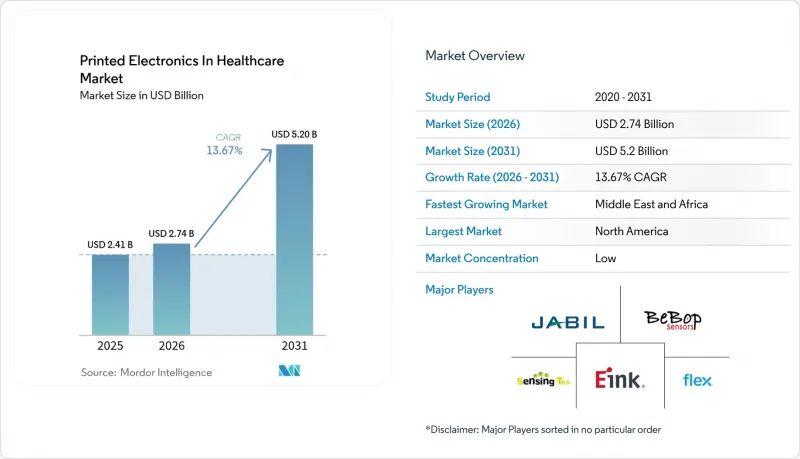
이 보고서는 유형(프린팅형 바이오센서, 프린팅형 생리 센서, 프린팅형 RFID/NFC 라벨 등), 인쇄 기술(스크린 인쇄, 잉크젯 인쇄 등), 용도(환자 모니터링, 진단 검사, 약물전달 등), 최종사용자(병원, 재택 의료 등) 및 지역별로 분류되어 있습니다. 시장 예측은 금액(달러) 기준으로 제시되어 있습니다.
전 세계 헬스케어용 인쇄 전자 시장의 동향 및 인사이트
미국 재택 의료 분야에서 원격 환자 모니터링용 웨어러블 패치의 급속한 보급
메디케어의 원격의료에 대한 보험 적용 범위 확대와 더불어, 피부에 자극이 적은 혈당 및 심전도 패치의 FDA 승인이 맞물려 재택 의료 분야에서 프린트 센서의 광범위한 도입이 촉진되고 있습니다. 미세유체 제어 기술이 결합된 하이브리드형 패치는 현재 여러 가지 생체 신호를 측정할 수 있으며, 진료소를 방문하지 않고도 의료진에게 상세한 경과 데이터를 제공하고 있습니다. 미국 의료 시스템에서는 재입원율 감소와 환자 만족도 향상이 보고되어, 구체적인 비용 절감 효과가 입증되고 있습니다. 이러한 환경에서 사업을 확장하고 있는 의료기기 제조사들은, 보험 급여 체계 평가를 진행 중인 EU 및 아시아태평양의 의료 시스템에 설득력 있는 선례를 제시하고 있습니다.
EU의 위조 의약품 지침이 인쇄형 RFID를 탑재한 스마트 의약품 포장을 촉진
EU의 위조 의약품 지침에 따른 완전한 일련번호 부여를 통해 제약사는 모든 소매용 포장에 인증 기능을 포함해야 할 의무가 있습니다. 고속 플렉소 인쇄 라인에서 제조되는 인쇄형 RFID 및 NFC 태그는 제네릭 의약품 제조사와 브랜드 의약품 제조사 모두에게 수용 가능한 단가 수준에서 추적성과 위조 방지 기능을 모두 충족하게 되었습니다. EU 규정을 준수하는 포장을 채택한 글로벌 제약 기업은 아시아태평양의 물류 허브로도 유사한 솔루션을 확대하고 있으며, 이는 종이 및 호일 기판에 최적화된 전도성 잉크에 대한 수요에 시너지 효과를 가져오고 있습니다.
FDA 및 EMA의 심사 주기가 상용화를 지연시키고 있습니다.
심사관이 새로운 기판에 대한 추가 실험 데이터나 임상 데이터를 요구하므로 실제 510(k) 심사는 명목상의 일정을 크게 초과하여 6-7개월에 달하는 경우가 많습니다. 데 노보(De Novo) 분류는 승인 절차를 더욱 장기화시키고 있으며, 새로운 유럽 MDR(의료기기 규정)은 추가적인 임상 성능 시험을 의무화하고 있으며, 이중 신청 절차를 거칠 수밖에 없습니다. 사이버 보안 및 AI와 관련된 문서화 요건이 강화됨에 따라 시험 비용이 더욱 증가하고 있으며, 일부 중견 기업은 미국내 출시를 연기하고 중동 및 아프리카(MEA) 및 남미에서의 시범 도입을 우선시하고 있습니다.
부문 분석
2025년, 프린트 바이오센서는 인쇄 전자 시장의 41.35%를 차지했습니다. 혈당 측정 스트립과 연속 혈당 모니터가 도입 기반의 대부분을 차지하고 있으며, 일상적인 모니터링에 대한 편견을 해소하는 미국의 일반의약품(OTC) 승인이 이를 지원하고 있습니다. 감염병 검사는 아시아태평양(APAC)의 공중 보건 관련 입찰에서 계속해서 성장 동력이 되고 있는 반면, 새롭게 등장한 pH 측정용 패치와 상처 모니터링용 패치는 임상 분야에서의 적용 범위를 넓히고 있습니다.
신축성과 유연성을 갖춘 하이브리드 전자 기기는 연평균 성장률(CAGR) 16.02%를 기록할 것으로 예상되며, 이는 각 유형 중 가장 높은 성장률입니다. 자가 복구형 전도성 메쉬는 박리되지 않고 반복적인 변형 주기를 견딜 수 있게 되어, 1주일에 걸친 심장 및 신경 모니터링이 가능해졌습니다. 의약품 패키징용 인쇄형 RFID 라벨은 특히 전 세계에서 일련번호 부여 규제가 정착됨에 따라 수요의 두 번째 축이 되고 있습니다.
스크린 인쇄는 입증된 처리 능력과 일회용 전극의 저렴한 단가 덕분에 2025년에는 인쇄 전자 시장의 52.25%를 차지했습니다. 성숙한 공정 제어 덕분에 FDA 승인이 용이해져, 대량 생산되는 바이오센서의 표준 기술이 되었습니다.
에어로졸 제트 방식 및 3D 성형 방식은 연평균 성장률(CAGR) 14.46%로 성장하고 있습니다. 3D 미세유체 채널 내부에 전도성 트랙을 형성할 수 있는 이 기술 덕분에 프로토타입 제작 시간이 며칠에서 몇 분으로 단축되었습니다. 스위스와 싱가포르의 초기 도입 기업은 파일럿 규모에서 100µm 미만의 채널 정밀도를 실현하여, 랩온칩(Lab-on-a-Chip) 진단 기기의 신속한 설계 반복을 가능하게 하고 있습니다.
지역별 분석
북미는 2025년 전 세계 매출의 40.15%를 차지했습니다. 이는 FDA의 초기 디지털 헬스 프레임워크와 소재 연구개발의 위험을 완화하는 NIH의 자금 지원의 혜택을 받은 결과입니다. 메이요 클리닉과 클리블랜드 클리닉에서 진행된 다기관 공동 임상시험을 통해 원격 모니터링의 평가 지표가 검증되었으며, 지역 병원 네트워크내 조달 승인이 원활해지고 있습니다. 온타리오주의 캐나다 연구 클러스터는 기판 관련 전문 지식을 제공함으로써 북미 대륙에서의 리더십을 더욱 공고히 하고 있습니다.
유럽은 여전히 전략적 요충지입니다. 이 지역의 대형 제약사들은 ‘위조 의약품 지침’ 준수가 의무화되어 있으며, 일련번호가 부여된 스마트 태그에 대한 지속적인 수요가 확고히 자리 잡고 있습니다. 독일의 정밀 기계 제조 전통은 대량 생산형 인쇄기의 보급을 지원하고 있는 반면, 영국에서는 벤처 자금이 플렉서블 IC 스타트업 기업에 투자되고 있습니다. 프랑스와 북유럽 국가의 공중보건 당국은 원격 센서에 대한 예방 의료 보험 적용을 통해 그 보급을 촉진하고 있습니다.
중동 및 아프리카는 세계 최고 수준인 연평균 성장률(CAGR) 15.16%를 기록할 것으로 예측됩니다. 사우디아라비아와 아랍에미리트(UAE)에서는 국민 의료제도의 확충에 따라 커넥티드 진단 기기에 예산이 배정되고 있으며, 인쇄 전자는 대규모 인프라 구축 없이도 지방에 의료 서비스를 신속하게 제공하는 수단으로서 주목받고 있습니다. 남아프리카공화국의 규제 당국은 의료기기 분류 기준을 FDA의 분류 체계와 일치시켜 수입 승인을 신속하게 처리하고 있습니다. 이러한 추세는 해당 지역의 의료 기술 분야에서 자급자족으로의 도약적인 변화를 보여주고 있습니다.
기타 혜택:
- 엑셀 형식의 시장 예측(ME) 시트
- 3개월간의 애널리스트 지원
자주 묻는 질문
목차
제1장 서론
제2장 조사 방법
제3장 개요
제4장 시장 구도
제5장 시장 규모와 성장 예측
제6장 경쟁 구도
제7장 시장 기회와 향후 전망
KSA 26.09.03According to Mordor Intelligence, the printed electronics market size in healthcare was valued at USD 2.41 billion in 2025 and estimated to grow from USD 2.74 billion in 2026 to reach USD 5.2 billion by 2031, at a CAGR of 13.67% during the forecast period (2026-2031).
This report is Segmented by Type (Printed Biosensors, Printed Physiological Sensors, Printed RFID/NFC Labels, and More), Printing Technology (Screen Printing, Inkjet Printing, and More), Application (Patient Monitoring, Diagnostic Testing, Drug Delivery, and More), End-User (Hospitals, Home Healthcare, and More), and Geography. The Market Forecasts are Provided in Terms of Value (USD).
Global Printed Electronics In Healthcare Market Trends and Insights
Rapid Uptake of Remote Patient-Monitoring Wearable Patches in United States Homecare
Medicare's broader reimbursement for telehealth, coupled with FDA clearance of skin-friendly glucose and cardiac patches, fuels wide deployment of printed sensors in the home-care channel. Hybrid microfluidic-regulated patches now capture multi-parameter vitals, handing care teams granular longitudinal data without clinic visits. U.S. systems report fewer readmissions and higher patient satisfaction, confirming tangible cost savings. Device makers scaling in this environment set a compelling precedent for EU and APAC health systems as they evaluate reimbursement frameworks.
EU Falsified Medicines Directive Catalyzing Smart Pharma-Packaging with Printed RFID
Full serialization under the EU Falsified Medicines Directive forces pharmaceutical producers to embed authentication features on every retail pack. Printed RFID and NFC tags, fabricated on high-speed flexographic lines, now satisfy both traceability and tamper evidence at unit cost levels acceptable to generic and branded manufacturers. Global drug firms adopting EU-compliant packaging extend the same solutions to APAC logistics hubs, creating a multiplier effect on demand for conductive inks optimized for paper and foil substrates.
FDA and EMA Validation Cycles Delaying Commercial Roll-outs
Actual 510(k) reviews often stretch to 6-7 months, well beyond nominal timelines, as examiners request extra bench and clinical data on novel substrates. De novo classifications lengthen approvals further, and the new European MDR imposes additional clinical performance studies, forcing dual submission tracks. Rising cybersecurity and AI documentation requirements add layers of testing cost, prompting some mid-cap firms to defer U.S. launches in favor of pilot deployments in MEA or South America.
Other drivers and restraints analyzed in the detailed report include:
- Surge in Point-of-Care Disposable Biosensors for Infectious Disease Detection in Asia
- Cold-Chain Integrity Needs Boosting Printed Temperature Sensors for Vaccines
- Sterilization and Biocompatibility Challenges of Polymer Substrates
For complete list of drivers and restraints, kindly check the Table Of Contents.
Segment Analysis
Printed biosensors held 41.35% of the printed electronics market in 2025. Glucose strips and continuous glucose monitors dominate the installed base, buoyed by over-the-counter U.S. approvals that destigmatize routine monitoring. Infectious disease assays remain a growth engine in APAC public-health tenders, while emerging pH and wound-monitor patches broaden clinical reach.
Stretchable and flexible hybrid electronics is projected to post a 16.02% CAGR, the fastest among types. Self-healing conductive meshes now survive repeated strain cycles without delamination, allowing week-long cardiac or neuro monitoring. Printed RFID labels for pharma packs add a second demand pillar, especially as global serialization mandates mature
Screen printing captured 52.25% of the printed electronics market in 2025 thanks to proven throughput and low per-unit costs for disposable electrodes. Mature process controls ease FDA filing, making it the default for high-volume biosensors.
Aerosol jet and 3D methods are growing at a 14.46% CAGR. Their ability to deposit conductive tracks inside 3D microfluidic channels has cut prototyping times from days to minutes. Early adopters in Switzerland and Singapore have demonstrated sub-100 µm channel fidelity at pilot scale, enabling rapid design iteration for lab-on-chip diagnostics.
Complete Report Scope:
- By Type
- Printed Biosensors
- Glucose Sensors
- Infectious-Disease Test Strips
- Other Biosensors
- Printed Physiological Sensors
- ECG/EEG Electrodes
- Temperature/pH Patches
- Printed RFID/NFC Labels
- Stretchable and Flexible Hybrid Electronics
- Printed Microfluidics
- Other Printed Components (Antennas, Heaters)
- Printed Biosensors
- By Printing Technology
- Screen Printing
- Inkjet Printing
- Gravure/Flexography
- Aerosol Jet and 3D Printing
- By Application
- Patient Monitoring and Wearables
- Diagnostic Testing and Point-of-Care
- Drug Delivery and Smart Patches
- Pharmaceutical Packaging and Anti-Counterfeit
- Medical Imaging and Therapeutic Devices
- Others
- By End-user
- Hospitals and Clinics
- Home Healthcare Providers
- Pharmaceutical and Biotech Companies
- Diagnostic Laboratories
- Academic and Research Institutes
- By Geography
- North America
- United States
- Canada
- Mexico
- Europe
- Germany
- United Kingdom
- France
- Nordics
- Rest of Europe
- South America
- Brazil
- Rest of South America
- Asia-Pacific
- China
- Japan
- India
- South-East Asia
- Rest of Asia-Pacific
- Middle East and Africa
- Middle East
- Gulf Cooperation Council Countries
- Turkey
- Rest of Middle East
- Africa
- South Africa
- Rest of Africa
- Middle East
- North America
Geography Analysis
North America posted 40.15% of global revenue in 2025, benefiting from FDA's early digital-health frameworks and NIH funding streams that de-risk material R&D. Multicenter trials at Mayo Clinic and Cleveland Clinic validate remote monitoring endpoints, smoothing procurement approvals for regional hospital networks. Canadian research clusters in Ontario add specialized substrate expertise, further bolstering continental leadership.
Europe remains a strategic stronghold. The region's pharmaceutical giants must comply with the Falsified Medicines Directive, locking in sustained demand for serialized smart tags. Germany's precision-machinery heritage supports high-volume printing presses, while the United Kingdom channels venture funding into flexible IC startups. Public health authorities in France and Nordic nations augment uptake through preventive-care reimbursement for remote sensors.
The Middle East and Africa is forecast to deliver a 15.16% CAGR, the fastest worldwide. National health expansions in Saudi Arabia and the United Arab Emirates allocate budget lines for connected diagnostics, seeing printed electronics as a quick path to rural coverage without heavy infrastructure. South Africa's regulatory agency aligns its device code to FDA classification, accelerating import approvals. This momentum signals a step-change in the region's medical technology self-sufficiency.
- DuPont de Nemours, Inc.
- Henkel AG and Co. KGaA
- Nissha Co., Ltd. (Nissha Medical)
- Flex Ltd. (Health Solutions)
- Molex LLC (Sensable)
- GE Healthcare
- Abbott Laboratories (FreeStyle Libre Sensors)
- Medtronic plc (Printed Electrodes)
- Jabil Inc. (Blue Sky Center)
- Zimmer Biomet (Smart Implants)
- NovaCentrix Corp.
- PragmatIC Semiconductor Ltd.
- Thinfilm Electronics ASA
- Toppan Printing Co., Ltd. (Healthcare Labels)
- PolyIC GmbH and Co. KG
- GSI Technologies LLC
- PV Nano Cell Ltd.
- Coatema Coating Machinery GmbH
- Bebop Sensors Inc.
- Sensing Tex S.L.
Additional Benefits:
- The market estimate (ME) sheet in Excel format
- 3 months of analyst support
TABLE OF CONTENTS
1 INTRODUCTION
- 1.1 Study Assumptions and Market Definition
- 1.2 Scope of the Study
2 RESEARCH METHODOLOGY
3 EXECUTIVE SUMMARY
4 MARKET LANDSCAPE
- 4.1 Market Overview
- 4.2 Market Drivers
- 4.2.1 Rapid Uptake of Remote Patient-Monitoring Wearable Patches in United States Homecare
- 4.2.2 EU Falsified Medicines Directive Catalyzing Smart Pharma-Packaging with Printed RFID
- 4.2.3 Surge in Point-of-Care Disposable Biosensors for Infectious Disease Detection in Asia
- 4.2.4 Chronic-Disease Burden Driving Demand for Flexible Printed Electrodes in Cardiology
- 4.2.5 Cold-Chain Integrity Needs Boosting Printed Temperature Sensors for Vaccines
- 4.2.6 NIH and EU Horizon Grants Funding Bio-Compatible Conductive-Ink R&D
- 4.3 Market Restraints
- 4.3.1 FDA and EMA Validation Cycles Delaying Commercial Roll-outs
- 4.3.2 Sterilization and Biocompatibility Challenges of Polymer Substrates
- 4.3.3 Humidity-Driven Degradation Limiting Shelf-Life of Printed Biosensors
- 4.3.4 Reimbursement Ambiguity for Wearable Diagnostics in Emerging Markets
- 4.4 Industry Ecosystem Analysis
- 4.5 Regulatory and Technological Outlook
- 4.5.1 Printing Technology Snapshot
- 4.5.1.1 Screen Printing
- 4.5.1.2 Inkjet Printing
- 4.5.1.3 Gravure and Flexography
- 4.5.1.4 Aerosol Jet and Other Emerging Techniques
- 4.5.1 Printing Technology Snapshot
- 4.6 Porter's Five Forces Analysis
- 4.6.1 Threat of New Entrants
- 4.6.2 Bargaining Power of Buyers
- 4.6.3 Bargaining Power of Suppliers
- 4.6.4 Threat of Substitute Products
- 4.6.5 Intensity of Competitive Rivalry
5 MARKET SIZE AND GROWTH FORECASTS (VALUES)
- 5.1 By Type
- 5.1.1 Printed Biosensors
- 5.1.1.1 Glucose Sensors
- 5.1.1.2 Infectious-Disease Test Strips
- 5.1.1.3 Other Biosensors
- 5.1.2 Printed Physiological Sensors
- 5.1.2.1 ECG/EEG Electrodes
- 5.1.2.2 Temperature/pH Patches
- 5.1.3 Printed RFID/NFC Labels
- 5.1.4 Stretchable and Flexible Hybrid Electronics
- 5.1.5 Printed Microfluidics
- 5.1.6 Other Printed Components (Antennas, Heaters)
- 5.1.1 Printed Biosensors
- 5.2 By Printing Technology
- 5.2.1 Screen Printing
- 5.2.2 Inkjet Printing
- 5.2.3 Gravure/Flexography
- 5.2.4 Aerosol Jet and 3D Printing
- 5.3 By Application
- 5.3.1 Patient Monitoring and Wearables
- 5.3.2 Diagnostic Testing and Point-of-Care
- 5.3.3 Drug Delivery and Smart Patches
- 5.3.4 Pharmaceutical Packaging and Anti-Counterfeit
- 5.3.5 Medical Imaging and Therapeutic Devices
- 5.3.6 Others
- 5.4 By End-user
- 5.4.1 Hospitals and Clinics
- 5.4.2 Home Healthcare Providers
- 5.4.3 Pharmaceutical and Biotech Companies
- 5.4.4 Diagnostic Laboratories
- 5.4.5 Academic and Research Institutes
- 5.5 By Geography
- 5.5.1 North America
- 5.5.1.1 United States
- 5.5.1.2 Canada
- 5.5.1.3 Mexico
- 5.5.2 Europe
- 5.5.2.1 Germany
- 5.5.2.2 United Kingdom
- 5.5.2.3 France
- 5.5.2.4 Nordics
- 5.5.2.5 Rest of Europe
- 5.5.3 South America
- 5.5.3.1 Brazil
- 5.5.3.2 Rest of South America
- 5.5.4 Asia-Pacific
- 5.5.4.1 China
- 5.5.4.2 Japan
- 5.5.4.3 India
- 5.5.4.4 South-East Asia
- 5.5.4.5 Rest of Asia-Pacific
- 5.5.5 Middle East and Africa
- 5.5.5.1 Middle East
- 5.5.5.1.1 Gulf Cooperation Council Countries
- 5.5.5.1.2 Turkey
- 5.5.5.1.3 Rest of Middle East
- 5.5.5.2 Africa
- 5.5.5.2.1 South Africa
- 5.5.5.2.2 Rest of Africa
- 5.5.5.1 Middle East
- 5.5.1 North America
6 COMPETITIVE LANDSCAPE
- 6.1 Market Concentration
- 6.2 Strategic Moves
- 6.3 Market Share Analysis
- 6.4 Company Profiles (includes Global level Overview, Market level overview, Core Segments, Financials as available, Strategic Information, Market Rank/Share for key companies, Products and Services, and Recent Developments)
- 6.4.1 DuPont de Nemours, Inc.
- 6.4.2 Henkel AG and Co. KGaA
- 6.4.3 Nissha Co., Ltd. (Nissha Medical)
- 6.4.4 Flex Ltd. (Health Solutions)
- 6.4.5 Molex LLC (Sensable)
- 6.4.6 GE Healthcare
- 6.4.7 Abbott Laboratories (FreeStyle Libre Sensors)
- 6.4.8 Medtronic plc (Printed Electrodes)
- 6.4.9 Jabil Inc. (Blue Sky Center)
- 6.4.10 Zimmer Biomet (Smart Implants)
- 6.4.11 NovaCentrix Corp.
- 6.4.12 PragmatIC Semiconductor Ltd.
- 6.4.13 Thinfilm Electronics ASA
- 6.4.14 Toppan Printing Co., Ltd. (Healthcare Labels)
- 6.4.15 PolyIC GmbH and Co. KG
- 6.4.16 GSI Technologies LLC
- 6.4.17 PV Nano Cell Ltd.
- 6.4.18 Coatema Coating Machinery GmbH
- 6.4.19 Bebop Sensors Inc.
- 6.4.20 Sensing Tex S.L.
7 MARKET OPPORTUNITIES AND FUTURE OUTLOOK
- 7.1 White-space and Unmet-Need Assessment


