|
시장보고서
상품코드
2122040
미국의 안과용 기기 : 시장 점유율 분석, 업계 동향과 통계, 성장 예측(2026-2031년)United States Ophthalmic Devices - Market Share Analysis, Industry Trends & Statistics, Growth Forecasts (2026 - 2031) |
||||||
 Mordor Intelligence
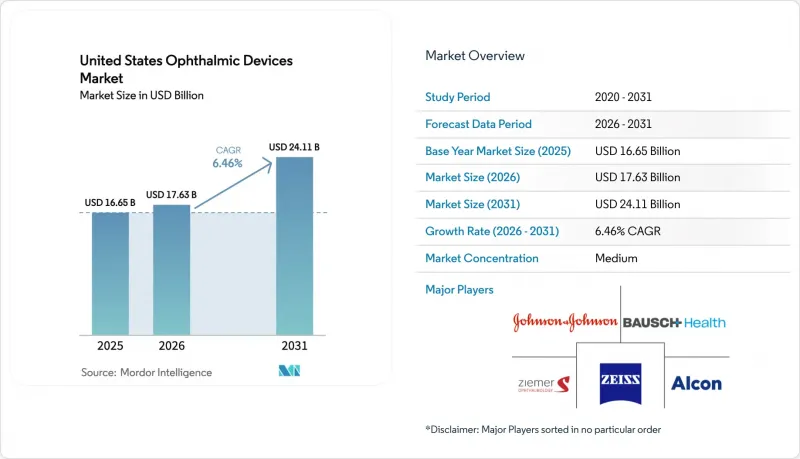
Mordor Intelligence에 따르면 미국의 안과용 기기 시장 규모는 2025년에 166억 5,000만 달러, 2026년에 176억 3,000만 달러에 달하며, 2031년까지 241억 1,000만 달러에 달할 것으로 예측되고 있으며, 2026-2031년에 CAGR 6.46%로 성장할 것으로 전망되고 있습니다.
이 보고서는 기기 유형(진단·모니터링 기기, 수술용 기기, 시력 관리 기기), 질환 적응증(백내장, 녹내장, 당뇨병성 망막병증, 기타 질환), 최종사용자(병원, 안과 전문 클리닉 등)별로 분류되어 있습니다. 시장 예측은 금액(달러) 기준으로 제시되어 있습니다.
미국 안과용 기기 시장의 동향 및 인사이트
고령화와 백내장 유병률의 급증
미국 인구조사국의 예측에 따르면 65세 이상 인구는 2022년 5,800만 명에서 2030년까지 7,300만 명에 달할 것으로 예상됩니다. 백내장 발병은 60세 이후부터 가속화되며, 국립안과연구소(NEI)는 2050년까지 5,000만 명의 미국인이 백내장을 앓을 가능성이 있다고 예측하고 있습니다. 'JAMA Ophthalmology'지에 따르면 메디케어는 표준 단초점 백내장 수술을 보장하여 폭넓은 접근성을 확보하고 있는 반면, 2024년에는 프리미엄 인공수정체(IOL)의 보급률이 수술 건수의 35%에 달했습니다. 선벨트 지역의 각 주에서는 은퇴한 환자를 유치하며 사상 최대 수술 건수를 기록하고 있으며, 이에 따라 각 공급업체들은 회복 기간을 최소화하기 위해 지역 서비스 거점을 개설하고 있습니다.
당뇨병과 녹내장의 동반 질환으로 인한 부담 증가
CDC의 집계에 따르면 2024년 기준 3,840만 명의 미국인이 당뇨병을 앓고 있으며, 이 중 약 4분의 1이 진단 후 15년 이내에 당뇨병성 망막증을 발병하는 것으로 알려져 있습니다. 녹내장 연구 재단(Glaucoma Research Foundation)의 데이터에 따르면 40세 이상의 미국인 중 330만 명이 녹내장을 앓고 있으며, 2030년까지 430만 명에 달할 것으로 예측됩니다. 당뇨병 환자는 개방각 녹내장 발병 위험이 40% 높기 때문에 한 번의 진료로 두 질환을 모두 확인할 수 있는 통합 플랫폼에 대한 수요가 증가하고 있습니다. IDx-DR과 같은 자율형 AI 시스템을 통해 선별 검사가 1차 진료소까지 확대되면서, 지방 지역의 의료 인프라 부족 문제가 완화되고 있습니다.
펨토초 레이저 및 OCT 플랫폼의 높은 도입 비용
펨토초 레이저 도입에는 50만-75만 달러가 필요하며, 연간 유지보수 비용은 5만-10만 달러가 듭니다. 개인 개업의가 이러한 비용을 상쇄하기 위해 필요한 연간 300건의 진료 건수 기준을 달성하는 경우는 거의 없습니다. 고성능 멀티모달 OCT 장비는 15만 달러 이상이나 하므로 지방 진료소에서는 장비 교체를 미룰 수밖에 없는 상황입니다. 리스나 클릭피 제도는 리스크를 공급업체 측으로 전가하므로 공급업체의 이익률을 압박하고 있습니다.
부문 분석
2025년에는 안경 및 콘택트렌즈의 방대한 사용자 기반에 힘입어 시력 관리 기기가 매출의 63.27%를 차지했습니다. AI 플랫폼이 1차 진료 현장에 도입됨에 따라 진단·모니터링 기기는 2031년까지 연평균 성장률(CAGR) 7.32%로 성장할 전망입니다. 안경 렌즈, 특히 에시롤 룩소티카(Essilor Luxottica)사의 근시 진행 억제용 ‘스텔레스트(Stellest)’는 계속해서 높은 판매량을 이끌고 있습니다. 1일용 일회용 콘택트렌즈는 편의성과 위생 면에서의 안심감 덕분에 월간용 렌즈를 능가하는 성장을 이어가고 있습니다. 수술용 기기는 백내장, 유리체망막, 굴절 교정 및 녹내장 치료에 여전히 필수적입니다. 첨단 파코에멀시피케이션 콘솔과 세트로 판매되는 프리미엄 인공수정체(IOL)는 공급업체와 ASC(외래 수술 센터) 간의 관계를 강화하고 있으며, 한편 MIGS(최소 침습 녹내장 수술) 및 서방형 녹내장 임플란트는 새로운 치료 분야를 개발하고 있습니다.
파코에멀시피케이션 콘솔의 도입 대수가 광범위하므로 교체 주기가 안정적인 수익을 창출하고 있지만, 소모품의 상품화로 인해 이익률은 압박을 받고 있습니다. 각 진단 기기 제조사는 클라우드 연결 및 AI를 활용한 분석 기능을 통해 차별화를 꾀하고 있습니다. CIRRUS 6000 OCT는 이러한 변화를 상징하는 제품으로, 망막층을 자동으로 세분화하여 초기 변화를 감지하고, 검사 기술자에 따른 편차를 줄여줍니다. EyeArt AI와 연동된 안저 카메라는 소매점이나 연방 인증 클리닉에서도 신뢰성 높은 선별 검사를 가능하게 합니다. 이러한 동향들이 맞물려 시력 관리 분야의 우위가 지속되는 가운데, 미국 안과용 기기 시장의 성장을 지원하고 있습니다.
기타 혜택:
- 엑셀 형식의 시장 예측(ME) 시트
- 3개월간의 애널리스트 지원
목차
제1장 서론
제2장 조사 방법
제3장 개요
제4장 시장 구도
제5장 시장 규모와 성장 예측
제6장 경쟁 구도
제7장 시장 기회와 향후 전망
KSAAccording to Mordor Intelligence, the United States ophthalmic devices market size is projected to be USD 16.65 billion in 2025, USD 17.63 billion in 2026, and reach USD 24.11 billion by 2031, growing at a CAGR of 6.46% from 2026 to 2031.
This report is Segmented by Device Type (Diagnostic & Monitoring Devices, Surgical Devices, and Vision Care Devices), Disease Indication (Cataract, Glaucoma, Diabetic Retinopathy, Other Disease Indications), End-User (Hospitals, Specialty Ophthalmic Clinics, and More). The Market Forecasts are Provided in Terms of Value (USD).
United States Ophthalmic Devices Market Trends and Insights
Aging Population & Cataract Prevalence Surge
The U.S. Census Bureau expects the 65-plus cohort to reach 73 million by 2030, up from 58 million in 2022. Cataract formation accelerates after age 60, and the National Eye Institute projects 50 million Americans could have cataracts by 2050. Medicare covers standard monofocal cataract extraction, ensuring broad access, while premium IOL penetration rose to 35% of procedures in 2024, according to JAMA Ophthalmology. Sun Belt states attract retiring patients and record-high volumes, prompting vendors to open regional service hubs to minimize downtime.
Rising Diabetes & Glaucoma Comorbidity Burden
The CDC counted 38.4 million Americans with diabetes in 2024, and roughly a quarter will develop diabetic retinopathy within 15 years of diagnosis. Glaucoma Research Foundation data indicate 3.3 million Americans aged 40 and older have glaucoma, expected to reach 4.3 million by 2030. Diabetic patients face a 40% higher risk of open-angle glaucoma, prompting demand for integrated platforms that identify both conditions in one visit. Autonomous AI systems such as IDx-DR extend screening into primary-care offices, easing rural capacity gaps.
High Capital Cost of Femtosecond & OCT Platforms
Acquiring a femtosecond laser requires USD 500,000-750,000, with annual service fees of USD 50,000-100,000. Independent practices rarely reach the 300-case threshold needed to justify these expenses. Advanced multimodal OCT units cost more than USD 150,000, prompting rural clinics to defer upgrades. Leasing and click-fee programs shift risk to vendors, tightening their profit margins.
Other drivers and restraints analyzed in the detailed report include:
- Shift of Cataract & MIGS Procedures to ASCs
- Surge in Premium IOL & Daily-Disposable Contact Lens Uptake
- Reimbursement Uncertainty for Emerging MIGS & AI Diagnostics
For complete list of drivers and restraints, kindly check the Table Of Contents.
Segment Analysis
Vision care devices accounted for 63.27% of revenue in 2025, underpinned by the vast base of spectacle and contact lens users. Diagnostic and monitoring equipment is on track for a 7.32% CAGR through 2031 as AI platforms migrate into primary care settings. Spectacle lenses, especially EssilorLuxottica's Stellest for myopia control, continue to drive high unit demand. Daily-disposable contact lenses continue to outpace monthly formats, driven by convenience and perceived hygiene. Surgical devices remain vital for cataract, vitreoretinal, refractive, and glaucoma care. Premium IOLs bundled with advanced phacoemulsification consoles deepen vendor-ASC relationships, while MIGS and sustained-release glaucoma implants open new therapy classes.
A broad installed base of phaco consoles means replacement cycles create stable revenue, but the commoditization of consumables tightens margins. Diagnostic players are differentiating through cloud connectivity and AI-based analytics. The CIRRUS 6000 OCT illustrates this shift, automatically segmenting retinal layers to flag early change and reducing technician variability. Fundus cameras coupled with EyeArt AI extend reliable screening to retail and federally qualified clinics. Collectively, these trends reinforce growth in the United States ophthalmic devices market even as vision-care dominance persists.
Complete Report Scope:
- By Device Type
- Diagnostic & Monitoring Devices
- OCT Scanners
- Fundus & Retinal Cameras
- Autorefractors & Keratometers
- Corneal Topography Systems
- Ultrasound Imaging Systems
- Perimeters & Tonometers
- Other Diagnostic & Monitoring Devices
- Surgical Devices
- Cataract Surgical Devices
- Vitreoretinal Surgical Devices
- Refreactive Surgical Devices
- Glaucoma Surgical Devices
- Other Surgical Devices
- Vision Care Devices
- Spectacles Frames & Lenses
- Contact Lenses
- Diagnostic & Monitoring Devices
- By Disease Indication
- Cataract
- Glaucoma
- Diabetic Retinopathy
- Other Disease Indications
- By End-user
- Hospitals
- Specialty Ophthalmic Clinics
- Ambulatory Surgery Centers (ASCs)
- Other End-users
List of Companies Covered in this Report:
- Alcon
- Bausch + Lomb Corp.
- Carl Zeiss
- CooperVision Inc.
- EssilorLuxottica
- Glaukos Corp.
- Heidelberg Engineering
- Hoya Corp.
- Johnson & Johnson
- Lensar Inc.
- Lumenis
- Nidek
- Topcon Corp.
- Ziemer Group
Additional Benefits:
- The market estimate (ME) sheet in Excel format
- 3 months of analyst support
TABLE OF CONTENTS
1 Introduction
- 1.1 Study Assumptions & Market Definition
- 1.2 Scope of the Study
2 Research Methodology
3 Executive Summary
4 Market Landscape
- 4.1 Market Overview
- 4.2 Market Drivers
- 4.2.1 Aging Population & Cataract Prevalence Surge
- 4.2.2 Rising Diabetes & Glaucoma Comorbidity Burden
- 4.2.3 Shift of Cataract & MIGS Procedures to ASCS
- 4.2.4 Surge in Premium IOL & Daily-Disposable Contact Lens Uptake
- 4.2.5 AI-Integrated OCT & Fundus Imaging Adoption
- 4.2.6 Sustainability Push for Single-Use Surgical Packs
- 4.3 Market Restraints
- 4.3.1 High Capital Cost of Femtosecond & OCT Platforms
- 4.3.2 Reimbursement Uncertainty for Emerging MIGS & AI Diagnostics
- 4.3.3 Growing ASC Price Pressure on Instrument Vendors
- 4.3.4 Tariff-Driven Raw-Material Inflation for Steel/Titanium Tools
- 4.4 Regulatory Landscape
- 4.5 Technological Outlook
- 4.6 Porter's Five Forces Analysis
- 4.6.1 Threat of New Entrants
- 4.6.2 Bargaining Power of Buyers
- 4.6.3 Bargaining Power of Suppliers
- 4.6.4 Threat of Substitute Products
- 4.6.5 Intensity of Competitive Rivalry
5 Market Size & Growth Forecasts (Value & Volume)
- 5.1 By Device Type
- 5.1.1 Diagnostic & Monitoring Devices
- 5.1.1.1 OCT Scanners
- 5.1.1.2 Fundus & Retinal Cameras
- 5.1.1.3 Autorefractors & Keratometers
- 5.1.1.4 Corneal Topography Systems
- 5.1.1.5 Ultrasound Imaging Systems
- 5.1.1.6 Perimeters & Tonometers
- 5.1.1.7 Other Diagnostic & Monitoring Devices
- 5.1.2 Surgical Devices
- 5.1.2.1 Cataract Surgical Devices
- 5.1.2.2 Vitreoretinal Surgical Devices
- 5.1.2.3 Refreactive Surgical Devices
- 5.1.2.4 Glaucoma Surgical Devices
- 5.1.2.5 Other Surgical Devices
- 5.1.3 Vision Care Devices
- 5.1.3.1 Spectacles Frames & Lenses
- 5.1.3.2 Contact Lenses
- 5.1.1 Diagnostic & Monitoring Devices
- 5.2 By Disease Indication
- 5.2.1 Cataract
- 5.2.2 Glaucoma
- 5.2.3 Diabetic Retinopathy
- 5.2.4 Other Disease Indications
- 5.3 By End-user
- 5.3.1 Hospitals
- 5.3.2 Specialty Ophthalmic Clinics
- 5.3.3 Ambulatory Surgery Centers (ASCs)
- 5.3.4 Other End-users
6 Competitive Landscape
- 6.1 Market Concentration
- 6.2 Market Share Analysis
- 6.3 Company Profiles (includes Global Level Overview, Market Level Overview, Core Segments, Financials as Available, Strategic Information, Market Rank/Share for Key Companies, Products & Services, and Recent Developments)
- 6.3.1 Alcon Inc.
- 6.3.2 Bausch + Lomb Corp.
- 6.3.3 Carl Zeiss Meditec AG
- 6.3.4 CooperVision Inc.
- 6.3.5 EssilorLuxottica SA
- 6.3.6 Glaukos Corp.
- 6.3.7 Heidelberg Engineering GmbH
- 6.3.8 Hoya Corp.
- 6.3.9 Johnson & Johnson Vision Care Inc.
- 6.3.10 Lensar Inc.
- 6.3.11 Lumenis Be Ltd
- 6.3.12 Nidek Co. Ltd
- 6.3.13 Topcon Corp.
- 6.3.14 Ziemer Ophthalmic Systems AG
7 Market Opportunities & Future Outlook
- 7.1 White-space & Unmet-Need Assessment