|
시장보고서
상품코드
2122166
무수말레인산 : 시장 점유율 분석, 업계 동향과 통계, 성장 예측(2026-2031년)Maleic Anhydride - Market Share Analysis, Industry Trends & Statistics, Growth Forecasts (2026 - 2031) |
||||||
 Mordor Intelligence
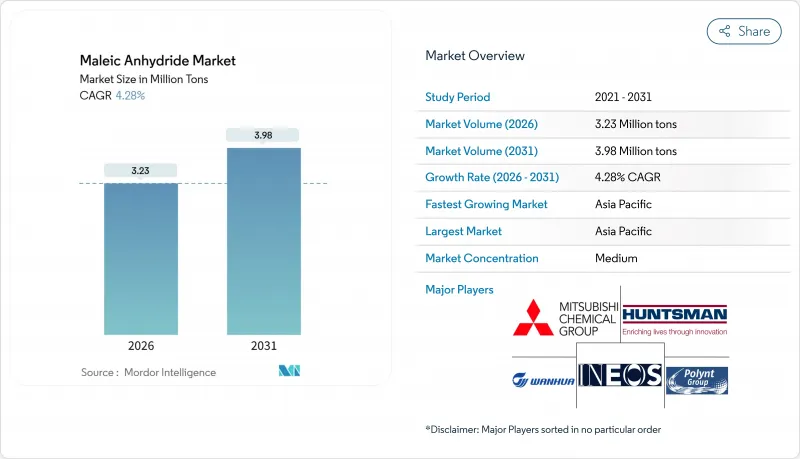
Mordor Intelligence에 따르면 무수말레인산 시장 규모는 2026년에 323만 톤으로 추정되고 있으며, 예측 기간(2026-2031년)에 CAGR 4.28%로 추이하며, 2031년까지 398만 톤에 달할 것으로 전망되고 있습니다.
이 보고서는 제품 유형(불포화 폴리에스테르 수지, 1,4-부탄디올,윤활유 첨가제 등), 원료(n-부탄 및 벤젠), 형태(고체 및 용융체), 최종사용자 산업(건설, 자동차 등) 및 지역(아시아태평양, 북미, 유럽, 남미, 중동 및 아프리카)별로 분류되어 있습니다. 시장 예측은 톤 기준으로 제시되어 있습니다.
전 세계 무수 말레산 시장의 동향 및 인사이트
유럽 건설 업계에서 재생 PET UPR의 채택이 급증
플라스틱에 재생재 함유 의무화를 규정한 EU 규정 2022/1616 및 순환형 특성을 입증하기 위한 디지털 제품 여권을 요구하는 2024년 에코디자인 규정에 대응하여, 유럽의 복합재료 제조업체들은 적극적인 조치를 취하고 있습니다. 이들은 사용 후 PET를 무수 말레인산으로 개질한 불포화 폴리에스테르 수지와 혼합하고 있습니다. 이 전략은 그린 빌딩 크레딧을 확보하는 데 도움이 될 뿐만 아니라, 내재된 탄소 배출량도 줄일 수 있게 해줍니다. 독일, 프랑스, 네덜란드 등의 국가들이 이러한 움직임을 주도하고 있으며, 이들 국가에서는 UPR(불포화 폴리에스테르 수지) 수요가 이러한 친환경 혼합 제품으로 전환되고 있습니다. 2026년 7월부터 여권 의무화가 시행될 예정인 만큼, 이러한 노력의 도입은 더욱 가속화될 전망이며, 저탄소 건축용 복합재료 분야에서 무수 말레인이 용해제로서 수행하는 지극히 중요한 역할이 확고해질 것입니다.
n-부탄 플랜트의 생산 능력 증대가 원료 비용을 낮추고
2024년에는 n-부탄 산화법이 세계 생산 능력에서 압도적인 점유율을 차지했습니다. 특히 중국과 오만의 신규 플랜트에서는 최첨단 바나듐 인산염 및 트라이리프 촉매를 활용하여 높은 수율을 달성하고 있습니다. 이러한 진전은 생산성을 향상시킬 뿐만 아니라, 벤젠 배출량을 저감시켜 해당 시설들이 EPA의 NESHAP(국가대기청정법에 따른 배출 기준) 준수 비용을 회피할 수 있게 해주고 있습니다. 또한 원료 시장 동향은 부탄에 유리하게 흘러가고 있으며, 아시아태평양의 생산자들은 벤젠보다 부탄을 더 저렴하게 조달할 수 있었습니다. 이러한 현저한 비용 격차는 3개 대륙에 걸친 전환 프로젝트와 그린필드 프로젝트의 급증에 박차를 가하고 있으며, n-부탄 공정의 경쟁 우위를 공고히 하고 있습니다.
중국의 신규 생산 능력 확대로 인한 세계적 공급 과잉
2024년, 중국은 헝리(Hengli)의 복합 단지를 필두로 신규 생산 능력을 가동함에 따라 중국의 세계 생산 점유율은 70% 대를 돌파했습니다. 공장 출하 가격은 급락하여 북미의 현물 가격과 현저한 대조를 이루는 상황이 되었고, 이는 수출의 급증을 초래했습니다. 한편, 가동률은 하락했습니다. 고정비 급등으로 어려움을 겪는 유럽과 미국의 기업은 공장 폐쇄에 나섰습니다. 헌츠맨(Huntsman)은 2025년 중반에 모어스(Moers) 공장의 가동을 중단했고, 난야(Nan Ya)는 2024년 하반기에 대만 거점을 일시 중단했습니다. 이러한 과제를 극복하기 위해 업계의 기존 기업은 현재, 중국과의 경쟁이 여전히 제한적인 고순도 용융 제품 및 특수 코폴리머에 주력하고 있습니다.
부문 분석
불포화 폴리에스테르 수지는 2025년에 무수 말레산 시장 점유율의 50.15%를 차지하며, 2031년까지 연평균 성장률(CAGR) 4.98%를 기록하며 시장 전체를 상회하는 성장이 전망됩니다. 유럽의 규제로 인해 재생 PET 블렌드의 사용이 촉진되고 있습니다. 북미에서는 전기자동차(EV) 배터리 케이스에 차량 1대당 무수 말레산이 사용되고 있습니다. 이러한 용도는 완충재 역할을 하여, 범용 수지에서 흔히 볼 수 있는 경기 순환에 따른 수요 감소로부터 공급량을 보호하고 있습니다. 1,4-BDO 수요는 아시아 전역의 스판덱스 및 PBT 투자에 힘입어 해마다 증가하는 추세를 보이고 있습니다. 내연기관의 쇠퇴에 따라 윤활유 첨가제의 사용량은 감소하는 추세이지만, 무수 말레인산 공중합체는 호조를 보이고 있습니다. 수처리 및 바이오 기반 포장재에 활용되는 이러한 공중합체는 윤활유 분야의 부진을 완화하는 데 일조하고 있습니다. 또한 푸마르산 및 말산 유도체는 주로 음료용 산미료로서의 용도에 힘입어 꾸준한 연간 성장을 달성하고 있습니다.
특수 제품은 생산량은 적지만 높은 이익률을 자랑합니다. 예를 들어 바이오 유래 숙신산 공중합체는 고급 포장 분야에서 눈부신 프리미엄 가격을 실현하고 있습니다. 각 생산 기업은 공급 과잉이라는 과제를 극복하기 위해 이러한 틈새 시장에 전략적으로 진출하고 있습니다. 특히 주목할 점은, 푸르푸랄 경로를 통한 무수 말레산 및 그 하류 공정에서 환경 친화적인 공중합체에 초점을 맞춘 일본의 연구개발이 현저한 진전을 보이고 있다는 것입니다. 이 두 가지 동향은 무수 말레산 시장 매출에서 불포화 폴리에스테르가 중심적인 역할을 하고 있음을 확고히 할 뿐만 아니라, 그 유도체를 통한 수입원의 다각화도 부각시키고 있습니다.
n-부탄 공정은 2025년에 생산량의 70.45%를 차지하며, 무수 말레인산 시장 전체보다 빠른 성장이 전망됩니다. 부탄의 산화 반응을 통해 벤젠 배출이 제거되고, 제품인 수소가 회수되므로 현금 비용 절감과 인허가 절차 간소화가 실현됩니다. BASF사의 트리리프(Trileaf) 촉매는 수율을 향상시키고 반응기의 압력 손실을 저감함으로써, 특히 에너지가 두 번째로 큰 변동비인 상황에서 상당한 비용 절감으로 이어집니다.
벤젠 기반 생산의 시장 점유율은 하락하고 있지만, 2031년까지 연평균 성장률(CAGR) 4.72%로 성장할 것으로 예측되며, 시장 전체를 상회하는 속도를 보일 것입니다. 이는 기존 벤젠 루트 플랜트가 벤젠이 나프타 크래킹의 저비용 부산물인 경우, 생산자가 이미 규정 준수 투자에 대한 상각을 완료한 통합 석유화학 단지에 집중되어 있기 때문입니다. 기존 벤젠 생산 설비가 경쟁력을 유지할 수 있는 것은 벤젠이 자사 크래커의 부산물인 경우에 한합니다. 예를 들어 UPR 반응기와 동일한 부지 내에 위치한 헌츠맨(Huntsman)사의 미국 멕시코만 연안 거점 등이 있습니다. 그러나 그러한 장소라 하더라도, 가동 지속은 이미 감가상각이 완료된 스크러버에 의존하고 있습니다.
지역별 분석
아시아태평양은 2025년에 세계 생산량의 69.45%를 차지하며, 2031년까지 연평균 성장률(CAGR) 4.66%로 확대되고 있습니다. 헨리사 한 곳만으로도 중국의 생산량은 증가하고 있지만, 가동률이 70% 전후에 머물고 있으며, 수출 압력은 여전히 뚜렷합니다. 파니파트에 위치한 인디언 오일사의 프로젝트는 인도가 수입 의존도 70%에서 자급자족을 향한 큰 한 걸음을 내디뎠음을 보여줍니다. 한편, 일본과 한국은 고순도 및 바이오 기반 연구개발에 주력하고 있으며, 2028년 이후 풀프랄 제조 경로의 상업적 도약을 위한 기반을 다지고 있습니다.
북미는 전기자동차 생산과 USMCA의 국내 조달률 요건에 힘입어 성장 궤도에 올라 있습니다. 일리노이주와 웨스트버지니아주의 신규 부탄 시설은 자사 수지 생산 전용이며, 걸프 코스트의 벤젠 제조 플랜트는 스크러버의 감가상각이 완료된 시설에서만 가동되고 있습니다. 이 지역의 판매 가격은 중국의 수출 가격을 상회하는 경우가 많으며, 이는 물류 비용과 순도에 따른 프리미엄이 반영되었음을 보여줍니다.
수요 점유율이 높은 유럽은 에너지 가격 급등과 엄격한 벤젠 배출 규제에 직면하여 다소 완만한 속도로 성장하고 있습니다. 그러나 유럽내 재생 PET 복합재의 급증과 디지털 여권 도입이 임박한 점은 아시아산 수입품의 유입에 대해 무수 말레산 시장에 대한 완충 역할을 하고 있습니다. 남미 및 중동 및 아프리카(MEA) 지역에서는 ABP사의 오만 공장과 같은 전략적 투자가 이루어지고 있습니다. 이 공장은 저렴한 부탄을 활용하여 오랫동안 공급이 부족했던 아프리카 및 중동의 수지 시장에 대응하고 있습니다.
기타 혜택:
- 엑셀 형식의 시장 예측(ME) 시트
- 3개월간의 애널리스트 지원
자주 묻는 질문
목차
제1장 서론
제2장 조사 방법
제3장 개요
제4장 시장 구도
제5장 시장 규모와 성장 예측
제6장 경쟁 구도
제7장 시장 기회와 향후 전망
KSA 26.09.04According to Mordor Intelligence, the maleic anhydride market size is estimated at 3.23 million tons in 2026, and is expected to reach 3.98 million tons by 2031, at a CAGR of 4.28% during the forecast period (2026-2031).
This report is Segmented by Product Type (Unsaturated Polyester Resin, 1, 4-Butanediol, Lubricant Additives, and More), Raw Material (N-Butane and Benzene), Physical Form (Solid and Molten), End-User Industry (Construction, Automobile, and More), and Geography (Asia-Pacific, North America, Europe, South America, and Middle-East and Africa). The Market Forecasts are Provided in Terms of Volume (Tons).
Global Maleic Anhydride Market Trends and Insights
Surging Adoption of Recycled-PET UPR in European Construction
In response to EU Regulation 2022/1616, which mandates recycled content in plastics, and the 2024 Ecodesign Regulation, requiring digital product passports to certify circular attributes, European composite producers are taking proactive steps. They are blending post-consumer PET with maleic-anhydride-modified unsaturated polyester resin. This strategy not only helps them secure green-building credits but also enables a reduction in embodied carbon. Countries like Germany, France, and the Netherlands are leading the charge, channeling their UPR demand into these eco-friendly blends. With passport obligations set to take effect in July 2026, the adoption of these practices is poised to accelerate, solidifying maleic anhydride's pivotal role as a compatibilizer in the realm of low-carbon construction composites.
Capacity Additions of N-Butane Plants Lowering Feedstock Cost
In 2024, n-butane oxidation dominated with a commanding share of global capacity. Notably, new facilities in China and Oman, leveraging cutting-edge vanadium-phosphate and tri-leaf catalysts, are achieving high yields. These advancements not only enhance productivity but also mitigate benzene emissions, allowing these facilities to dodge EPA NESHAP compliance costs. Furthermore, feedstock dynamics tilt in favor of butane, while producers in the Asia-Pacific region paid less for butane than for benzene. This pronounced cost disparity is fueling a surge in conversions and greenfield projects across three continents, solidifying the n-butane route's competitive advantage.
Global Oversupply Driven by New Chinese Capacities
In 2024, China unveiled new capacity, spearheaded by Hengli's complex, pushing China's global output share past the 70% mark. Ex-works prices plummeted, a stark contrast to North America's spot prices, igniting a surge in exports. Meanwhile, utilization rates dipped. Western players, grappling with elevated fixed costs, began shuttering plants: Huntsman ceased operations at its Moers facility in mid-2025, and Nan Ya put its Taiwan site on hold in late 2024. In a bid to navigate these challenges, industry incumbents are now focusing on high-purity molten supplies and specialty copolymers, areas where competition from China remains limited.
Other drivers and restraints analyzed in the detailed report include:
- Lightweight SMC Panels for EVs Boosting UPR Demand in North America
- Rising 1,4-BDO Demand for Spandex and PBT in Asia
- Stricter OECD Benzene-Emission Caps Raising Compliance Cost
For complete list of drivers and restraints, kindly check the Table Of Contents.
Segment Analysis
Unsaturated polyester resin secured 50.15% of the maleic anhydride market share in 2025 and is tracking a 4.98% CAGR to 2031, ahead of the overall market. European regulations are pushing for the use of recycled-PET blends. In North America, electric vehicle (EV) battery enclosures are utilizing maleic anhydride for each vehicle. These applications act as a buffer, shielding volumes from the cyclical downturns often seen in commodity resins. Demand for 1,4-BDO is on an annual growth trajectory, driven by investments in spandex and PBT across Asia. While the usage of lubricant additives has seen a decline as combustion engines wane, maleic anhydride copolymers are thriving. These copolymers, utilized in water treatment and bio-based packaging, are helping to mitigate the downturn in lubricants. Additionally, fumaric and malic acid derivatives are witnessing steady annual growth, primarily fueled by their use as beverage acidulants.
Specialty products, despite their lower volumes, command significant margins. For instance, bio-based succinic-acid copolymers are achieving impressive premiums in the premium packaging sector. Producers are strategically tapping into these niche markets to navigate the challenges of oversupply. Notably, Japanese research and development is making strides, focusing on the furfural-route maleic anhydride and its downstream green copolymers. This dual landscape not only solidifies unsaturated polyester's central role in the maleic anhydride market's revenue but also highlights the diversification of profit pools through its derivatives.
The n-butane route dominated 70.45% of production in 2025 and is projected to grow faster than the overall maleic anhydride market. Butane oxidation eliminates benzene emissions and captures co-product hydrogen, delivering lower cash costs and simpler permitting. BASF's tri-leaf catalyst boosts yield and reduces reactor pressure drop, translating to significant savings, especially with energy being the second-largest variable cost.
Benzene-based production, though declining in share, is forecast to grow at a 4.72% CAGR through 2031, faster than the overall market, because surviving benzene-route plants are concentrated in integrated petrochemical complexes where benzene is a low-cost byproduct of naphtha cracking and where producers have already amortized compliance investments. Surviving benzene units remain competitive only where benzene is an internal cracker by-product, for example, Huntsman's U.S. Gulf Coast sites co-located with UPR reactors. Even there, continued operation hinges on already-amortized scrubbers.
Complete Report Scope:
- By Product Type
- Unsaturated Polyester Resin
- 1,4-Butanediol
- Lubricant Additives
- Maleic Anhydride Copolymers
- Malic Acid
- Fumaric Acid
- Alkyl Succinic Anhydrides
- Surfactants and Plasticizers
- Other Product Types
- By Raw Material
- N-Butane
- Benzene
- By Physical Form
- Solid (Flake / Prill)
- Molten
- By End-user Industry
- Construction
- Automobile
- Electronics
- Food and Beverage
- Oil Products
- Personal Care
- Pharmaceuticals
- Agriculture
- By Geography
- Asia-Pacific
- China
- India
- Japan
- South Korea
- Rest of Asia-Pacific
- North America
- United States
- Canada
- Mexico
- Europe
- Germany
- United Kingdom
- France
- Italy
- Rest of Europe
- South America
- Brazil
- Argentina
- Rest of South America
- Middle-East and Africa
- Saudi Arabia
- South Africa
- Rest of Middle-East and Africa
- Asia-Pacific
Geography Analysis
Asia-Pacific held 69.45% of global volume in 2025 and advances at a 4.66% CAGR to 2031. Hengli alone boosts China's output, but with utilization rates lingering around 70%, export pressures remain pronounced. Indian Oil's project in Panipat signals India's pivot from a 70% reliance on imports to a stride towards self-sufficiency. Meanwhile, Japan and South Korea are channeling efforts into high-purity and bio-based research and development, setting the stage for a commercial leap into furfural routes after 2028.
North America is on a growth trajectory, buoyed by EV production and USMCA content stipulations. New butane facilities in Illinois and West Virginia are dedicated to in-house resin production, and Gulf Coast benzene units operate solely where scrubbers have seen their depreciation. Selling prices in the region often surpass Chinese exports, underscoring the logistics and purity premiums commanded.
Europe, holding a share of demand, is expanding at a more tempered pace, grappling with energy-price challenges and stringent benzene-emission regulations. However, Europe's surge in recycled-PET composites and the impending rollout of digital passports provide a cushion for the maleic anhydride market against the influx of Asian imports. South America and the MEA region see strategic investments like ABP's plant in Oman, which capitalizes on affordable butane to cater to the resin markets in Africa and the Middle East that have long been underserved.
- AOC
- Arkema
- Ashland
- Bartek Ingredients Inc.
- BASF
- Borealis AG
- Clariant
- Evonik Industries AG
- Huntsman International LLC
- I G Petrochemicals Ltd. (IGPL)
- INEOS AG
- LANXESS
- Mitsubishi Chemical Group Corporation
- NAN YA PLASTICS CORPORATION
- NIPPON SHOKUBAI CO., LTD.
- PETRONAS Chemicals Group Berhad
- Polynt S.p.A.
- Sinopec Qilu Petrochemical
- SK Functional Polymer
- Thirumalai Chemicals
- Wanhua
Additional Benefits:
- The market estimate (ME) sheet in Excel format
- 3 months of analyst support
TABLE OF CONTENTS
1 Introduction
- 1.1 Study Assumptions and Market Definition
- 1.2 Scope of the Study
2 Research Methodology
3 Executive Summary
4 Market Landscape
- 4.1 Market Overview
- 4.2 Market Drivers
- 4.2.1 Surging adoption of recycled-PET UPR in European construction
- 4.2.2 Capacity additions of n-butane plants lowering feedstock cost
- 4.2.3 Lightweight SMC panels for EVs boosting UPR demand in North America
- 4.2.4 Rising 1,4-BDO demand for spandex and PBT in Asia
- 4.2.5 Bio-based succinic-acid copolymers unlocking premium margins
- 4.3 Market Restraints
- 4.3.1 Global oversupply driven by new Chinese capacities
- 4.3.2 Stricter OECD benzene-emission caps raising compliance cost
- 4.3.3 ICE phase-out curbing lube-oil-additive derivatives
- 4.4 Value Chain Analysis
- 4.5 Porter's Five Forces
- 4.5.1 Bargaining Power of Suppliers
- 4.5.2 Bargaining Power of Buyers
- 4.5.3 Threat of New Entrants
- 4.5.4 Threat of Substitutes
- 4.5.5 Competitive Rivalry
- 4.6 Price Trend
5 Market Size and Growth Forecasts (Volume)
- 5.1 By Product Type
- 5.1.1 Unsaturated Polyester Resin
- 5.1.2 1,4-Butanediol
- 5.1.3 Lubricant Additives
- 5.1.4 Maleic Anhydride Copolymers
- 5.1.5 Malic Acid
- 5.1.6 Fumaric Acid
- 5.1.7 Alkyl Succinic Anhydrides
- 5.1.8 Surfactants and Plasticizers
- 5.1.9 Other Product Types
- 5.2 By Raw Material
- 5.2.1 N-Butane
- 5.2.2 Benzene
- 5.3 By Physical Form
- 5.3.1 Solid (Flake / Prill)
- 5.3.2 Molten
- 5.4 By End-user Industry
- 5.4.1 Construction
- 5.4.2 Automobile
- 5.4.3 Electronics
- 5.4.4 Food and Beverage
- 5.4.5 Oil Products
- 5.4.6 Personal Care
- 5.4.7 Pharmaceuticals
- 5.4.8 Agriculture
- 5.5 By Geography
- 5.5.1 Asia-Pacific
- 5.5.1.1 China
- 5.5.1.2 India
- 5.5.1.3 Japan
- 5.5.1.4 South Korea
- 5.5.1.5 Rest of Asia-Pacific
- 5.5.2 North America
- 5.5.2.1 United States
- 5.5.2.2 Canada
- 5.5.2.3 Mexico
- 5.5.3 Europe
- 5.5.3.1 Germany
- 5.5.3.2 United Kingdom
- 5.5.3.3 France
- 5.5.3.4 Italy
- 5.5.3.5 Rest of Europe
- 5.5.4 South America
- 5.5.4.1 Brazil
- 5.5.4.2 Argentina
- 5.5.4.3 Rest of South America
- 5.5.5 Middle-East and Africa
- 5.5.5.1 Saudi Arabia
- 5.5.5.2 South Africa
- 5.5.5.3 Rest of Middle-East and Africa
- 5.5.1 Asia-Pacific
6 Competitive Landscape
- 6.1 Market Concentration
- 6.2 Strategic Moves
- 6.3 Market Share Analysis
- 6.4 Company Profiles (includes Global-level Overview, Market-level Overview, Core Segments, Financials as available, Strategic Information, Products and Services, and Recent Developments)
- 6.4.1 AOC
- 6.4.2 Arkema
- 6.4.3 Ashland
- 6.4.4 Bartek Ingredients Inc.
- 6.4.5 BASF
- 6.4.6 Borealis AG
- 6.4.7 Clariant
- 6.4.8 Evonik Industries AG
- 6.4.9 Huntsman International LLC
- 6.4.10 I G Petrochemicals Ltd. (IGPL)
- 6.4.11 INEOS AG
- 6.4.12 LANXESS
- 6.4.13 Mitsubishi Chemical Group Corporation
- 6.4.14 NAN YA PLASTICS CORPORATION
- 6.4.15 NIPPON SHOKUBAI CO., LTD.
- 6.4.16 PETRONAS Chemicals Group Berhad
- 6.4.17 Polynt S.p.A.
- 6.4.18 Sinopec Qilu Petrochemical
- 6.4.19 SK Functional Polymer
- 6.4.20 Thirumalai Chemicals
- 6.4.21 Wanhua
7 Market Opportunities and Future Outlook
- 7.1 White-space and Unmet-Need Assessment
- 7.2 Commercialization of Bio-based Maleic Anhydride